

Updated: September 2026 · By the KKeyQik Team
“Percentage of ad spend.” “Flat monthly fee.” “Setup plus training.” Indian agencies structure Google Ads management in a handful of recurring ways — and the model you pick shapes your incentives, your reporting, and what happens when results stall. This guide maps the five engagement models Indian agencies actually use, what’s typically inside each one, and how to compare them without a finance degree. For the full picture of the service itself, see our guide to PPC management services — this post is specifically about how Indian agencies structure the engagement.
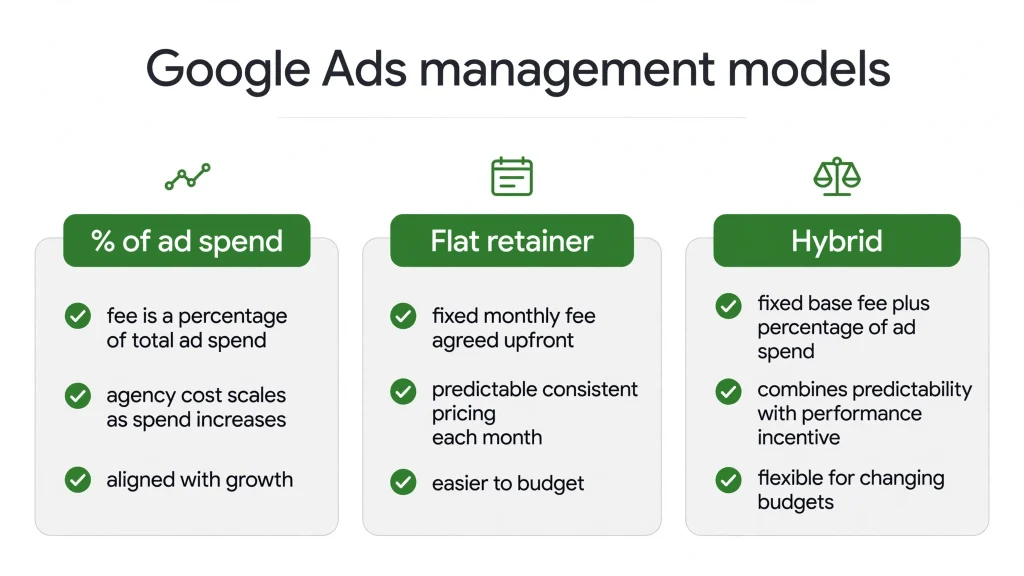
Google Ads management in India is typically sold as a monthly service covering campaign setup, keyword and audience targeting, ad copy, bid management, and reporting — structured under one of five models: percentage of ad spend, flat retainer, hybrid, setup-plus-handover, or performance-linked. The model determines how the agency gets paid and, more importantly, what it’s incentivized to do with your budget. For official documentation, see Google Ads Help.
Key takeaways
- There are five common models: percentage of ad spend, flat monthly retainer, hybrid, setup-plus-handover, and performance-linked. Each creates different incentives — understand them before you sign.
- The model matters more than the fee. A cheap fee on a misaligned model costs more than a fair fee on an aligned one.
- Ad spend always goes to Google separately — it’s never “included” in a management fee, whatever the listing implies.
- Every model should include the same core work: proper conversion tracking, search term review, negative keywords, ad testing, and plain-language reporting.
- You keep full access to your Google Ads account in every model. No exceptions, no “proprietary dashboards” as substitutes.
Google Ads Management in India: The 5 Engagement Models, Explained
1. Percentage of ad spend
The agency charges a share of what you spend on Google Ads each month. Common in India for mid-size budgets. The logic: bigger budgets mean more work, so the fee scales. The incentive problem: the agency earns more when you spend more — which is fine when growth is the goal, but ask how they think about efficiency, not just scale. Best fit: established advertisers with meaningful monthly budgets who want the agency invested in growth. Understanding these models helps you evaluate Google Ads management in India like an informed buyer.
2. Flat monthly retainer
One fixed fee per month regardless of spend. Common for smaller budgets and local businesses. The logic: predictable cost, and the agency’s incentive is to keep you happy enough to renew — which usually means efficiency. The watch-out: at very small budgets, make sure the fee doesn’t dwarf the ad spend itself; ask what minimum budget makes the engagement worthwhile. Best fit: local businesses and early-stage advertisers who need cost predictability. For smaller budgets, this predictability makes Google Ads management in India more accessible.
3. Hybrid: flat fee plus percentage
A base retainer covering the core work, plus a percentage kicker above a spend threshold. Tries to combine predictability with growth alignment. The watch-out: complexity — make sure the threshold, the percentage, and what triggers it are all in writing, or “hybrid” becomes “whatever we feel like.” Best fit: growing advertisers whose budgets fluctuate seasonally. This balanced approach to Google Ads management in India suits businesses with fluctuating spend.
4. Setup plus handover (or coaching)
The agency builds the account properly — structure, tracking, initial campaigns — then hands it to your team, sometimes with a period of coaching. The logic: you pay once for expertise, then run it in-house. The watch-out: Google Ads decays without ongoing management — search terms drift, competitors shift, ad fatigue sets in. Only pick this if someone on your team will genuinely own the account afterward. Best fit: businesses with an in-house marketer ready to take over. If you have in-house capacity, this model of Google Ads management in India can be cost-effective.
5. Performance-linked
Part of the fee ties to agreed metrics — leads, cost per lead, revenue. Sounds ideal; in practice it’s the trickiest model. The problems: attribution arguments (was that lead from the ads or your SEO?), metric gaming (cheap low-quality leads to hit a volume target), and agencies cherry-picking only easy accounts. If you go this route, the definitions — what counts as a lead, how it’s tracked, who verifies — need to be airtight and in writing before a rupee is spent. Best fit: sophisticated advertisers with clean tracking and legal-grade contracts. Be cautious with performance-linked Google Ads management in India — the incentives need careful alignment.
| Model | Best fit | Main watch-out |
|---|---|---|
| Percentage of ad spend | Established budgets, growth focus | Incentive favors spending more |
| Flat retainer | Smaller budgets, cost predictability | Fee can dwarf tiny ad spends |
| Hybrid | Fluctuating/seasonal budgets | Terms must be precisely written |
| Setup + handover | In-house marketer ready to own it | Accounts decay without ongoing care |
| Performance-linked | Sophisticated advertisers, clean tracking | Attribution disputes and metric gaming |
What’s Included in Google Ads Management in India — Regardless of Model
The model changes how the agency is paid. The work itself should always include: Every legitimate provider of Google Ads management in India should deliver these fundamentals.
- Conversion tracking setup and verification — without this, everything else is guesswork. The agency proves it’s working before spending a rupee.
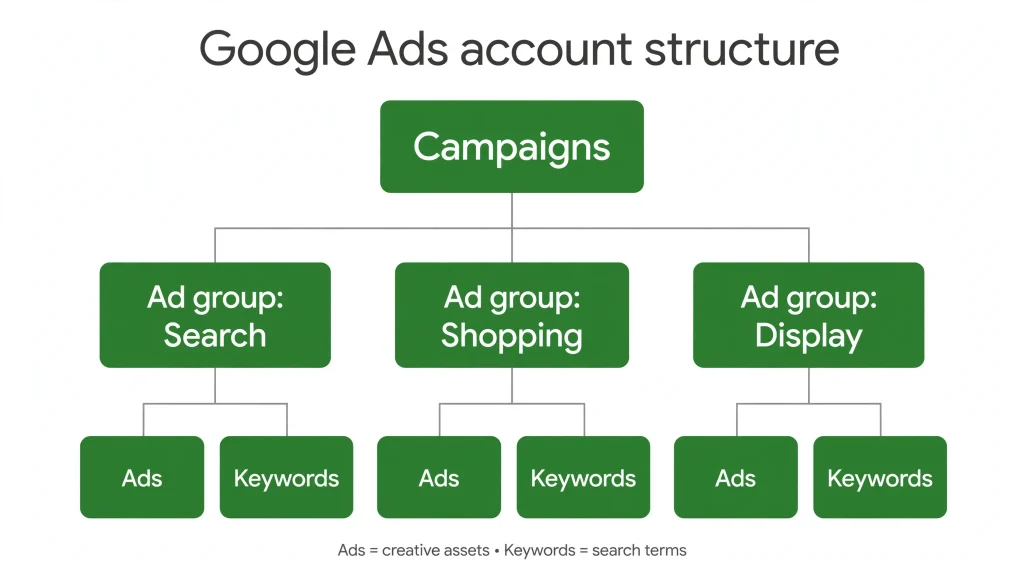
- Account structure and campaign builds — campaigns, ad groups, and keywords organized so budgets flow to what works.
- Ad copywriting and testing — multiple ads per group, tested and rotated on evidence, not opinion.
- Ongoing search term review and negative keywords — the unglamorous weekly work that stops budget leaking to irrelevant searches.
- Bid and budget management — adjustments based on performance data, not set-and-forget.
- Landing page recommendations — the agency flags where your pages are losing conversions, even if rebuilding them is separate scope.
- Plain-language monthly reporting — spend, leads, cost per lead, and what changed, plus next month’s plan.
What’s Usually NOT Included in Google Ads Management in India
- Ad spend itself — paid directly to Google, always separate from the management fee. Any listing that blurs this line is waving a red flag.
- Landing page design and development — recommendations yes; building pages is usually separate scope.
- Creative production beyond ad copy — display banners, video ads, and photoshoots are typically separate.
- SEO, social media, or email — different disciplines; occasionally bundled, usually not.
- Guaranteed cost-per-lead or ROI figures — no legitimate agency promises these, because no agency controls your market, your competitors, or your website’s ability to convert.
5 Red Flags in Google Ads Management in India Listings
- Guaranteed leads, rankings, or ROI. The paid-search version of the oldest lie in marketing. Walk away.
- No mention of conversion tracking. An agency that talks about clicks and impressions but not tracking is planning to spend your money blind — or planning to report vanity metrics.
- You don’t get full access to the ad account. If the account lives in the agency’s manager account with no admin access for you, leaving means starting over. Non-negotiable.
- “We guarantee first-page placement.” Google Ads placement is an auction. Anyone guaranteeing position is either lying or planning to overbid with your money.
- One-size-fits-all packages with no discovery. Search, Performance Max, YouTube, and remarketing are different tools for different jobs. A single fixed bundle “for everyone” is a sign nobody’s diagnosing.
How to Compare Two Google Ads Management in India Proposals Apples-to-Apples
| Question to ask | Good answer looks like | Bad answer looks like |
|---|---|---|
| Which model, and why for my business? | A recommendation tied to your budget and goals | Whatever model they sell everyone |
| How is conversion tracking handled? | Set up and verified before significant spend | “We’ll look into it” / not mentioned |
| Who owns the ad account? | You do, with full admin access from day one | Agency-owned; you get “reports” |
| What does a typical month of work look like? | Named tasks: search term reviews, ad tests, bid adjustments | “Ongoing optimization” |
| What happens if I pause or leave? | Clear notice terms; account and data stay yours | Long lock-in; account held hostage |
| How do you report? | Spend, leads, cost per lead, changes made, next steps | Impressions and clicks screenshots |
Which Google Ads Management in India Model Fits Your Business?
Local services and small budgets
Flat retainer, usually. Predictable cost, efficiency-aligned incentives. Just make sure the retainer is proportionate to what you’ll actually spend on ads — ask the agency directly what minimum budget makes the engagement work. For local services, this model of Google Ads management in India keeps costs predictable.
Growing eCommerce and lead-gen
Percentage of spend or hybrid. Your budget will grow if the ads work, and the model should grow with it — with the efficiency conversation held explicitly, in the monthly review, every month. As you scale, your Google Ads management in India should evolve with your budget.
Teams with in-house marketing
Setup plus handover, with honest self-assessment about whether someone will actually own the account afterward. A handover to nobody is just an expensive way to pause your ads in three months. Honest assessment matters here — good Google Ads management in India starts with realistic expectations.
Everyone else
Default to the model whose incentives match your goal: efficiency → flat retainer; growth → percentage or hybrid. And whatever you choose, the non-negotiables don’t change: your account, your tracking, your data, plain-language reporting. Match the model to your goal and your Google Ads management in India will be set up for success.
Ready to talk about your Google Ads?
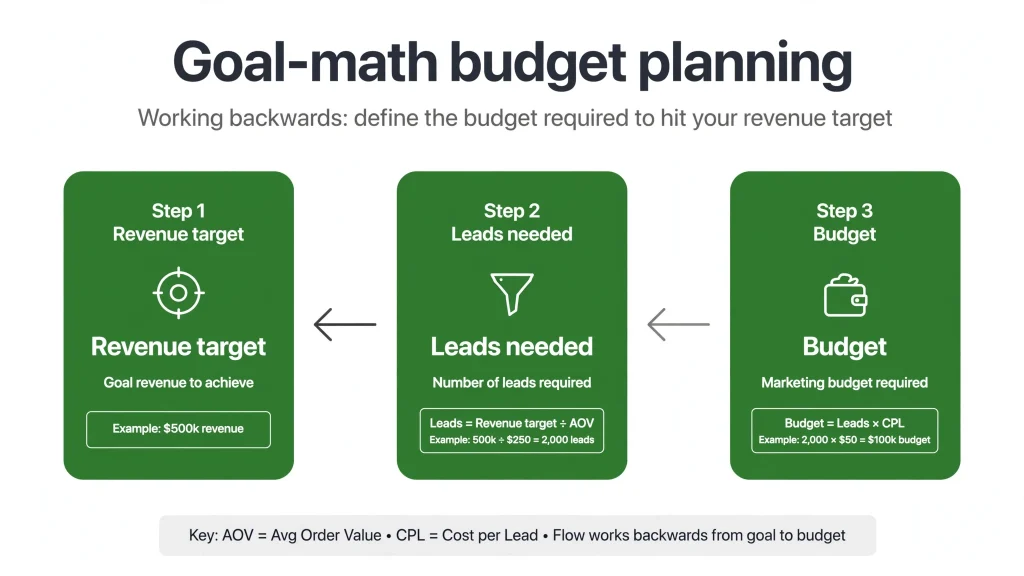
If this guide helped you read engagement models like a buyer instead of a bystander, the next step is telling us about your advertising specifically — your goals, your current spend, and which model actually fits. Contact the KKeyQik team and tell us where you want to be in twelve months. We’ll reply honestly with what it takes — and whether we’re the right team to run it with.
Further reading: our complete guide to PPC management services — what’s included, how engagements are structured, and how to choose an agency.
About the KKeyQik Team
KKeyQik is a digital marketing agency helping small businesses grow with SEO, social media marketing, PPC (Google Ads and Meta Ads), web development, video editing, and graphic design. The KKeyQik Team publishes practical, no-fluff guides for business owners who want marketing that pays for itself.
Frequently Asked Questions
Five models: a percentage of ad spend, a flat monthly retainer, a hybrid of the two, a one-time setup plus handover, and performance-linked fees tied to agreed metrics. Each creates different incentives — understand how the agency is paid before you sign, because the model shapes what it does with your budget.
Ask the agency directly what minimum spend makes the engagement worthwhile — and be wary if they dodge the question. If the management fee would eat most of your total marketing spend, you're usually better off running a lean campaign yourself until the budget grows.
No — ad spend always goes to Google separately and is never included in a management fee, whatever a listing implies. Any proposal should show the fee and the ad spend as two separate lines.
Proper conversion tracking setup and verification, account structure and campaign builds, ad copywriting and testing, ongoing search-term review with negative keywords, bid and budget management based on data, landing page recommendations, and plain-language reporting. The model changes how the agency is paid — the core work shouldn't change.
Never. You keep full access and ownership of your Google Ads account in every model — no exceptions, and a proprietary dashboard is not a substitute for account access. Any agency that resists this is a red flag worth walking away from.
Agree on cost-per-result targets in writing and review them monthly — the conversation should be about what each lead costs, not just how much is being spent. If the agency resists efficiency targets, the incentive structure is working against you.
Renegotiate the scope or the model before resentment builds — a fee that made sense at a higher spend can become punishing when budgets shrink. Options include a leaner scope, a hybrid structure, or pausing the engagement until spend justifies it.
A base retainer covers the core work, plus a percentage kicker above a spend threshold — designed to combine predictability with growth alignment. The watch-out is complexity: the threshold, the percentage, and what triggers it must all be in writing, or hybrid becomes whatever the agency feels like that month.
Only if someone on your team will genuinely own the account afterward, with real hours assigned to it. Google Ads decays without active management — search terms drift, competitors shift, creative fatigues — and the build is the easy part; the ongoing ownership is what determines results.
They sound ideal but they're the trickiest in practice: attribution arguments (was that lead from the ads or your SEO?), metric gaming (cheap low-quality leads to hit volume targets), and agencies cherry-picking only easy accounts. If you go this route, the definitions — what counts as a lead, how it's tracked, who verifies — need to be airtight and in writing before any budget is spent.