
Updated: September 2026 · By the KKeyQik Team
Pay-per-click advertising is the fastest way to buy customers — and the fastest way to burn money if it’s unmanaged. Most small businesses don’t fail at PPC because the platforms are too complex; they fail because nobody’s actively managing the account. PPC management services are professional services that plan, launch, and optimize paid advertising campaigns on platforms like Google Ads and Meta Ads. A full engagement typically covers account audits, tracking setup, keyword and audience research, ad creative, landing page guidance, bid management, and monthly reporting tied to revenue. This guide covers what’s included, how engagements are structured, and how to choose an agency that treats your budget like its own money.
The single most useful thing to understand before you read further:
Key takeaways
- PPC management covers seven areas: audits, research, creative, landing pages, tracking, bid management, and reporting. Weak tracking is the #1 reason small business PPC fails.
- The management fee and the ad spend are two separate things — understand both before signing anything.
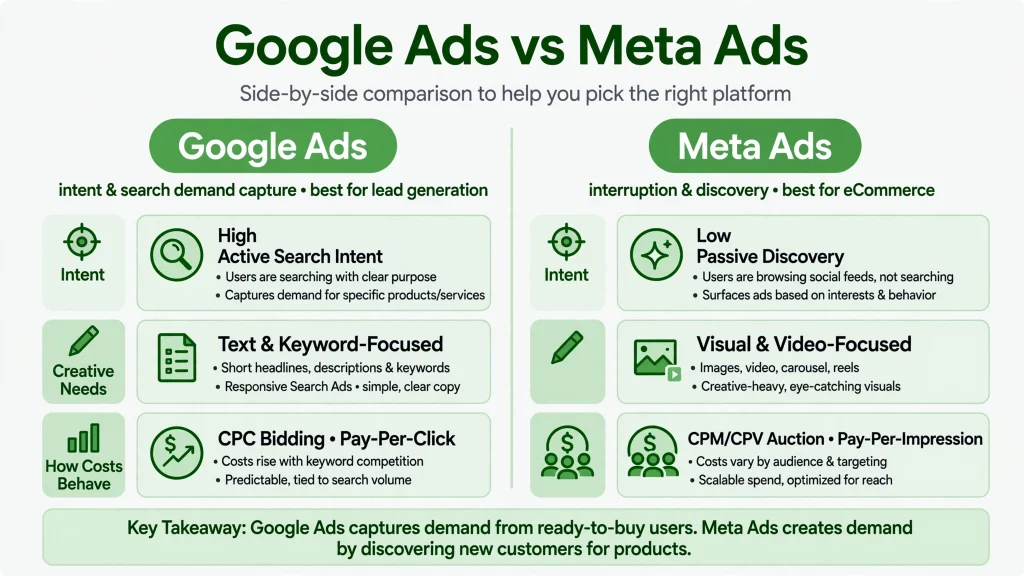
- Google Ads captures existing demand (people searching); Meta Ads creates demand (people scrolling). Most businesses eventually need both, but the starting point depends on your market.
- Engagements come as percentage-of-spend, flat retainer, hybrid, or setup-plus-management — the model matters less than the deliverables in writing.
- The first 90 days should follow a disciplined sequence: tracking first, then restructure, then test, then scale. Agencies that scale before tracking is verified are gambling with your money.
What Are PPC Management Services?
When you run Google Ads or Meta Ads yourself, you’re the strategist, the copywriter, the analyst, and the budget manager — usually in whatever spare hour you have. PPC management services hand all of that to specialists: people who live inside these platforms daily, who’ve seen what works across dozens of accounts, and whose job is to make your ad spend produce more than it costs. The difference shows up in the details you’d never have time to notice.
What the management fee covers vs ad spend
This is the confusion that causes the most disputes, so let’s settle it permanently. Ad spend is the money you pay Google or Meta for clicks and impressions — it goes to the platforms, never to the agency (if an agency asks you to pay ad spend to them, that’s a red flag; you should pay platforms directly from your own accounts). The management fee is what you pay the agency for their work: strategy, setup, creative, optimization, reporting. Two separate payments, two separate purposes. Any proposal that blends them into one number is hiding something — insist on seeing both, clearly separated.
Beyond the money, clarify three ownership points before signing. First, account ownership: ad accounts are created under your business entity, with you as the owner and the agency as a manager — never the reverse. Second, data ownership: all historical data, audiences, and creative remain yours if you leave. Third, exit terms: how much notice, what gets handed over, and in what format. The agencies worth hiring answer all three without hesitation, usually before you ask. The ones worth avoiding get vague exactly here — because vagueness here is where hostage situations are born.
Google Ads vs Meta Ads: Which Should You Run First?
| Google Ads | Meta Ads | |
|---|---|---|
| How it works | Shows your ads to people actively searching for what you sell | Shows your ads to people matching your audience, while they scroll |
| Mindset | Capturing existing demand | Creating new demand |
| Best for | Lead gen and local services — plumbers, lawyers, clinics | eCommerce, D2C, and anything visual or impulse-friendly |
| How costs behave | Driven by keyword competition; high-intent clicks cost more | Driven by audience competition and creative quality |
| Creative needs | Text-first: headlines, descriptions, extensions | Visual-first: video and image creative makes or breaks it |
| Learning curve | Steeper — match types, bidding, Quality Score | Gentler to start, deep to master |
Our honest guidance: if customers search for what you sell (“emergency plumber near me”), start with Google Ads — the intent is already there. If what you sell needs to be seen to be wanted (fashion, food, novel products), start with Meta Ads. B2B with long sales cycles often needs both: Meta for awareness and retargeting, Google for capturing the eventual search. And whichever you start with, start with one — splitting a small budget across two platforms means neither gets enough data to optimize. For the official documentation on campaign types, bidding strategies, and policies, see Google Ads Help.
When you do expand to both, don’t split the budget evenly out of fairness — split it by intent coverage. A common working pattern: the majority goes to the platform capturing existing demand (usually Google for service businesses), with a smaller allocation to the demand-creation platform feeding the top of the funnel, plus a retargeting layer that follows warm visitors across both. The exact split shifts as data comes in; the principle doesn’t. Budget follows proven intent, not platform loyalty.
Related: Meta Ads vs Google Ads for Lead Generation: Which Wins in 2026? — the head-to-head breakdown and the verdict by business type, so you pick the platform your buyer uses.
What’s Included in PPC Management Services?
Account & tracking audit
Before spending another dollar, a proper audit examines the account structure, campaign settings, and — most critically — whether conversion tracking actually works. Broken or missing tracking is the single most common problem we see in unmanaged accounts: businesses optimizing blind, making decisions on incomplete data.
- The audit should be a written document you keep, not a sales call with slides.
- Tracking verification comes before any structural recommendation — data first, opinions second.
- Expect findings on wasted spend patterns: irrelevant search terms, overlapping campaigns, broken conversion actions.
Keyword & audience research
For Google Ads: finding the searches worth bidding on and — equally important — the ones to exclude. For Meta Ads: defining audiences by interest, behavior, and lookalikes of your best customers. Google Ads Help has the official guide to keyword match types and negative keyword lists for PPC management services.
- Research should map keywords to intent: informational, commercial, transactional — bid accordingly.
- Negative keyword lists are built from day one, not discovered after the budget’s gone.
- Audience research includes who not to target — exclusion is half the skill.
Ad copy + creative
Writing the ads and making the visuals. On Google: headlines and descriptions engineered around intent. On Meta: thumb-stopping creative — and this is where our video editing and graphic design capabilities plug directly in, because creative quality is the dominant variable on paid social.
- Multiple variants per ad group from the start — testing is built in, not bolted on.
- Copy speaks to the searcher’s problem, not your company’s history.
- Creative is refreshed on a schedule — ad fatigue is real and measurable.
Related: Meta Ads Creative Testing: Our 3-2-2 Testing Framework (2026) — 3 hooks × 2 angles × 2 formats: the structured way to find winning creative.
Landing page recommendations
Your ads are only as good as where they land. Management includes reviewing landing pages and recommending fixes — message match, load speed, form friction, mobile experience.
- Sending paid traffic to a generic homepage is the most common landing page sin.
- Recommendations should be specific and prioritized, not a vague “improve the page.”
- Note the boundary: most PPC managers recommend; implementing major rebuilds is usually separate scope. Clarify this upfront.
Related: PPC Landing Pages: Why Your Ads Deserve Better Than Your Homepage (2026) — why paid traffic deserves a dedicated page, the anatomy of a high-converting one, and the five sins we see in audits.
Conversion tracking setup
Making sure every meaningful action — calls, form fills, purchases, booked appointments — is tracked accurately back to the click that caused it. Without this, optimization is guesswork.
- Tracking is verified with test conversions before any scaling decision.
- Call tracking is set up for businesses where the phone is the conversion.
- You own all tracking assets and have full admin access. Always.
Bid & budget management
The ongoing work: adjusting bids, reallocating budget to winners, pausing losers, testing new structures. This is the “management” in PPC management — and it’s weekly work, not set-and-forget.
- Budget shifts follow data, on a schedule — not gut feel, not panic.
- Search term reviews happen regularly; new negatives are added continuously.
- Seasonality and market changes are planned for, not reacted to.
Monthly reporting
Plain-English reporting: what was spent, what it produced, what changed, and what’s next.
- Spend and results are shown side by side — never spend without outcomes attached.
- Reports distinguish platform-reported conversions from verified business outcomes.
- Every report includes next month’s testing plan.
The Tracking Conversation: Why We Start Every Engagement Here
If you remember one thing from this guide, make it this: tracking quality determines everything downstream. Bidding algorithms optimize toward the conversions you tell them about — feed them incomplete data and they’ll confidently optimize toward the wrong outcomes. We’ve seen accounts where half the phone calls weren’t tracked, so the algorithm learned that the campaigns generating calls were “underperforming” and shifted budget away from them. The business was paying the platform to unlearn what worked.
Proper tracking setup means: every conversion action defined (not just purchases — calls, form fills, chat starts, booked appointments, whatever a “customer” looks like for you), values assigned where possible so the algorithm can optimize toward revenue rather than raw conversion count, and offline conversion imports for businesses where the sale closes on the phone or in person. Then — and this is the step everyone skips — verification: test conversions fired, numbers cross-checked against your CRM or order system, discrepancies investigated before a single scaling decision.
When vetting an agency, ask this exact question: “Walk me through how you verify conversion tracking before you scale spend.” The good ones light up — it’s their favorite topic. The bad ones change the subject to creative or strategy. Creative and strategy matter enormously, but they’re multipliers on measurement. Zero measurement times great creative is still zero.
PPC + SEO: Why Paid and Organic Belong in the Same Plan
PPC and SEO are usually sold by different people as competing line items. That’s a sales convenience, not a strategy. They do different jobs: PPC buys immediate visibility and data; SEO builds durable, compounding visibility. Run together, each makes the other better.
The practical synergy works in both directions. PPC search-term data reveals exactly which queries convert — that’s your SEO content roadmap, written by your customers’ wallets. Meanwhile, pages that rank organically give you proven landing content for paid campaigns, and dominating both the ad slot and the organic result for your money keywords captures dramatically more total clicks than either alone. Competitors can outbid you or outrank you; it’s much harder to do both at once.
For small businesses with limited budgets, the sequencing matters: use PPC to buy data and immediate leads while SEO compounds in the background. Over time, as organic rankings capture more of the demand, you can shift paid budget toward keywords you don’t rank for yet — expanding coverage instead of paying twice for the same click. An agency that handles both (like ours) plans this handoff deliberately. An agency that only sells one will tell you the other can wait. It can’t — it just compounds quietly while you decide.
How PPC Engagements Are Structured
| Model | How it works | Watch for |
|---|---|---|
| Percentage of ad spend | Fee scales with your ad budget | Misaligned incentives at high spend — the agency earns more when you spend more, regardless of results |
| Flat retainer | Fixed monthly fee regardless of spend | Make sure the scope is defined in writing — what’s included, what’s extra |
| Hybrid | Base retainer plus a performance component | Define “performance” precisely — which metric, measured how, over what period |
| Setup fee + management | One-time build fee, then ongoing management | The setup fee should buy you documented assets you keep — account structure, tracking, creative — not just labor |
No model is inherently bad; the question is whether the deliverables are in writing. A flat retainer with a vague scope is worse than percentage-of-spend with a detailed one. Whatever the model, your contract should name: exactly which platforms and campaigns are covered, how often optimization happens, what reporting looks like, who owns the accounts and data, and how either side exits. If an agency resists putting scope in writing, you have your answer about working with them.
Related: Google Ads Management Models in India: How Agencies Structure Engagements (2026) — the engagement models Indian agencies use, and how to compare them.
How to Think About Your Ad Budget
Forget rules of thumb. Budget from the goal backwards:
- Start from the customer. What’s one new customer worth to you over their lifetime? That’s the ceiling your cost-per-acquisition has to sit under.
- Work backwards to clicks. If you know (or can estimate) your website’s conversion rate, you can calculate roughly how many clicks you need for one customer — and therefore what you can afford per click.
- Separate testing from scaling. The first phase of any account is buying data: learning which keywords, audiences, and creative actually work. Budget for a testing phase where the goal is information, not profit — then scale what the data validates.
- Give each platform enough to learn. Platforms optimize on data volume. A budget too small to generate meaningful conversion data leaves the algorithms guessing — which is just expensive randomness.
The uncomfortable truth: PPC punishes underfunding more than overspending. A budget too small to exit the learning phase produces nothing but invoices. If the math says your budget can’t buy enough data to optimize, say so honestly — better to wait until you can fund it properly than to spend six months proving the budget was too small.
If the math doesn’t work yet, that doesn’t mean marketing stops — it means the channel mix changes. A budget too small for PPC is often perfectly sized for SEO groundwork and organic social, which cost time rather than media spend and compound while you save. The worst move is forcing PPC to work on a starvation budget; the second-worst is doing nothing. Build the organic foundation now, and you’ll enter paid later with better landing pages, clearer messaging, and an audience to retarget — which makes every future ad dollar work harder.
Related: How Should a Small Business Plan Its Google Ads Budget? (2026) — the goal-math framework: working backwards from revenue to budget, with testing vs scaling rules.
Our First-90-Days PPC Onboarding Process
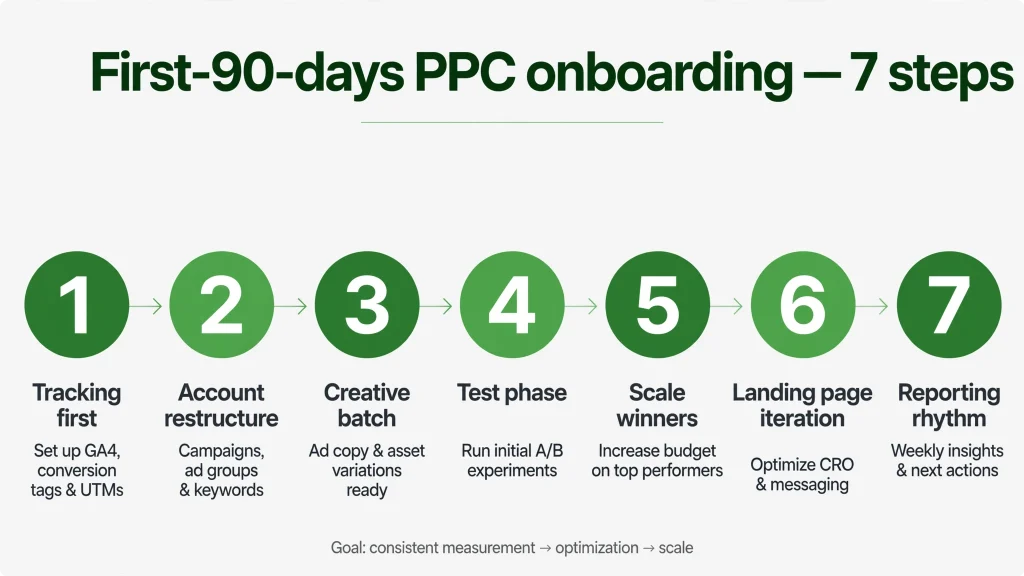
This is the sequence we’d run for your account — the same discipline we’d apply on day one. Notice what comes first and what comes last: measurement before creative, creative before scaling. Most failed engagements we audit got this order backwards — they launched fast, spent fast, and tried to reconstruct what happened from incomplete data. Speed is the enemy in the first month and the ally in the third:
- Weeks 1–2: Tracking and audit. Verify every conversion action fires correctly. Audit account structure, settings, and historical waste. Nothing is rebuilt until measurement is trustworthy — optimizing on broken data is worse than not optimizing at all.
- Weeks 2–3: Research and architecture. Keyword and audience research mapped to intent. Campaign structure designed around how your customers actually buy, not around platform defaults.
- Weeks 3–4: Creative and landing pages. Ad copy written, creative produced, landing page recommendations delivered. Everything reviewed against one question: does this match what the searcher or scroller was thinking?
- Weeks 4–6: Launch and observe. Campaigns go live with testing structures in place. The goal here is data, not heroics — resist the urge to judge performance in week one.
- Weeks 6–8: First optimization cycle. Search terms reviewed, negatives added, budgets shifted toward early winners, losers paused. Creative variants tested against each other.
- Weeks 8–10: Landing page iteration. With real traffic data, the biggest conversion leaks become visible. Fix the page, not just the ads — a 20% lift in conversion rate is worth more than a 20% lift in clicks.
- Weeks 10–12: Scale decision. With verified tracking, tested creative, and a working funnel, we make the call: scale budgets on what’s proven, or fix what’s still broken. No scaling on hope.
7 Ways Agencies Waste Your Ad Spend
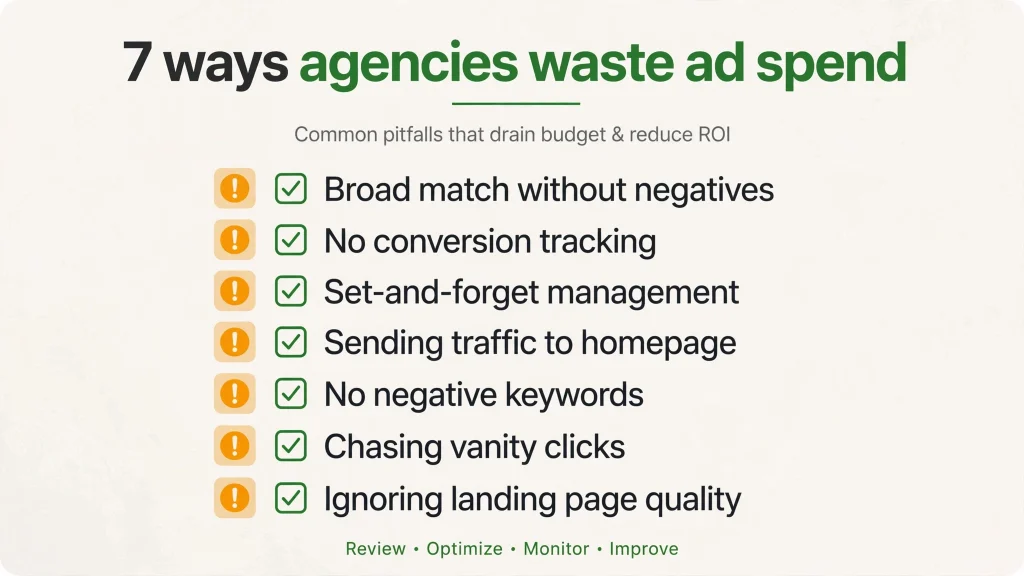
None of these are exotic failures. They’re the ordinary, everyday ways budgets quietly bleed — which is exactly why they’re worth listing. If you recognize your current situation in more than two of these, your account needs an audit before it needs more budget:
- Broken or missing conversion tracking. The #1 sin. If the agency can’t tell you exactly which clicks became customers, every optimization decision is a guess billed as expertise.
- No negative keywords. On Google Ads, failing to exclude irrelevant searches is like leaving the tap running — your budget drains into clicks that could never convert.
- Sending traffic to the homepage. Generic landing pages convert generic results. Every campaign deserves a destination matched to its promise.
- Set-and-forget management. Accounts launched and checked monthly. Platforms, competitors, and costs change weekly — your management should too.
- Testing nothing. One ad per ad group, one audience, one landing page — forever. Without testing, you’re paying full price for your first guess.
- Chasing cheap clicks. Low cost-per-click feels good and means nothing if the clicks don’t convert. Optimize for customers, not for the cheapest traffic.
- Reporting spend without outcomes. “We spent your budget efficiently” is not a result. Every report should tie dollars to customers — or explain exactly why it can’t yet, and what’s being fixed.
Related: 7 Google Ads Mistakes That Burn Budget (2026) — the 7 account errors we see most, each with its symptom, the fix, and a 30-minute weekly review ritual.
5 Red Flags in PPC Proposals
- Guaranteed results. No honest agency guarantees rankings, click costs, or returns — platforms are auctions affected by competitors, seasonality, and algorithm changes. Guarantees are either meaningless or a sign someone plans to hit the number with junk traffic.
- They want to own your ad accounts. Covered above, worth repeating as a proposal-stage filter: if the account lives under their business entity and you’d lose everything by leaving, keep walking.
- No mention of tracking. A proposal that jumps straight to campaigns and creative without a tracking plan is planning to fly blind. The tracking section should be the longest part of any serious proposal.
- One-size-fits-all packages. “Silver, Gold, Platinum” tiers with identical deliverables regardless of your business model. A plumber and a SaaS startup do not need the same PPC structure.
- They lead with platform badges, not with questions. Certifications are table stakes, not differentiators. The best first meeting is mostly them asking about your customers, margins, and sales process — because that’s what determines the strategy.
In-House vs Freelancer vs Agency
| In-house hire | Freelancer | Agency | |
|---|---|---|---|
| Platform coverage | As deep as one person’s expertise | Usually one platform done well | Multi-platform under one roof |
| Creative capability | Depends on the hire | Rarely included — you’ll source creative separately | Should be built in (copy, design, video) |
| Continuity risk | High — one departure stalls everything | Medium — availability varies | Low — team coverage |
| Best when | Ad spend is large enough to justify a full-time specialist | One platform, straightforward needs | You want strategy, creative, and management handled together |
The decision usually comes down to spend level and complexity. Below a certain spend threshold, a full-time hire is hard to justify and a good freelancer on a single platform is the rational choice. As spend grows and spans Google plus Meta, the coordination cost rises — creative, tracking, landing pages, and reporting all have to move together — and that’s where an agency’s bundled team earns its fee. The expensive mistake isn’t picking the wrong model; it’s picking a model and then expecting it to do a different model’s job, like hiring a freelancer and being frustrated they don’t bring a design team.
Ready to make your ad spend accountable?
Most small businesses don’t have a traffic problem — they have an accountability problem. Money goes in, reports come out, and nobody can quite connect the two. Contact the KKeyQik team and tell us what you’re spending and what it’s producing. We’ll show you what properly managed PPC looks like — tracking first, testing always, and every dollar accounted for.
What happens next: an honest look at your current accounts (or your goals if you’re starting fresh), a clear picture of the first 90 days, and a proposal with the scope in writing. If the math doesn’t work for your budget, we’ll tell you that too — we’d rather lose a bad-fit client than run a doomed account. Either way, you’ll know exactly where your ad spend stands and what it would take to fix it.
About the KKeyQik Team
KKeyQik is a digital marketing agency helping small businesses grow with SEO, social media marketing, PPC (Google Ads and Meta Ads), web development, video editing, and graphic design. The KKeyQik Team publishes practical, no-fluff guides for business owners who want marketing that pays for itself.
Frequently Asked Questions
A full engagement typically covers account audits, conversion tracking setup, keyword and audience research, ad creative, landing page guidance, bid and budget management, and monthly reporting tied to revenue. The core job is making your ad spend produce more than it costs.
Decline and pay the platforms from your own accounts. Ad spend should never flow through the agency — that separation is what keeps your data yours and makes the agency's reporting verifiable instead of a black box.
Add it when the first platform is reliably producing results and you have budget left to test with. The second platform works best as an amplifier — using winning creative and proven offers from platform one as the starting point instead of building from scratch.
Run a test conversion yourself — submit a form or place a test call — and confirm it shows up correctly in the ad platform. If actions go missing or get double-counted, the data feeding every bidding decision is wrong, and optimization built on it will misfire.
Everything needed to run the account without them: account access transferred to your ownership, historical data and audiences intact, creative files, and a written summary of what's working. Agree on this handover format before you sign — it's hardest to negotiate at the exit.
Expect a disciplined sequence over the first 90 days: tracking first, then account restructure, then testing, then scale. The early phase buys data and fixes fundamentals — anyone promising meaningful results before tracking is verified is skipping the step everything else depends on.
Common structures include percentage of ad spend, flat monthly retainer, hybrid models, and setup-plus-management. The model matters less than the deliverables in writing — get the exact scope, reporting cadence, and ownership terms documented before signing.
Watch for reports that lead with spend and impressions but bury cost per lead and revenue. A trustworthy report shows spend next to outcomes in plain language and explains what changed and what's next — if you can't tell what your money bought, the report is decoration.
Because each platform's algorithm needs enough conversion data to optimize, and a thin split means neither side learns fast enough. Start with the one platform that matches how your customers buy, prove the offer converts, then expand using what the first platform taught you.
Mostly questions from their side — about your customers, margins, and sales process — because that's what determines the strategy. Be cautious of agencies that lead with credentials and package pitches before understanding your business.