
Updated: September 2026 · By the KKeyQik Team
If you’re spending money on ads for the first time — or moving budget from one platform to another — the Meta Ads vs Google Ads question comes up fast. Both can generate leads. Both can waste money. The difference isn’t which platform is “better,” it’s which one matches how your customers buy. This Meta Ads vs Google Ads guide gives you the head-to-head breakdown and a verdict by business type, so you pick the platform your buyer is actually on. (For the full paid-media system both platforms plug into, see our guide to PPC management services.)
Meta Ads vs Google Ads is the choice between demand creation and demand capture. Google Ads puts you in front of people already searching for what you sell — high intent, high competition, pay per click. Meta Ads (Facebook and Instagram) puts your offer in front of people who match your customer profile but weren’t searching — lower intent per impression, but precise targeting and creative do the selling. Lead generation works on both; the buying journey decides which side of the Meta Ads vs Google Ads tradeoff wins for you.
Key takeaways
- Google Ads captures existing demand (people searching); Meta Ads creates demand (people scrolling). Your customer’s buying behavior picks the winner.
- Urgent, search-driven needs → Google Ads. Emergency plumber, “near me” services, and anything people Google with intent to buy now.
- Visual, impulse, or discovery-driven offers → Meta Ads. Home services with great before/afters, D2C products, local events, and anything people didn’t know they wanted.
- For high-ticket B2B, the Meta Ads vs Google Ads answer is usually both: Meta for awareness and retargeting, Google for capturing the search that follows.
- Start with one platform, prove the offer converts, then expand. Splitting a small budget across both platforms starves both.
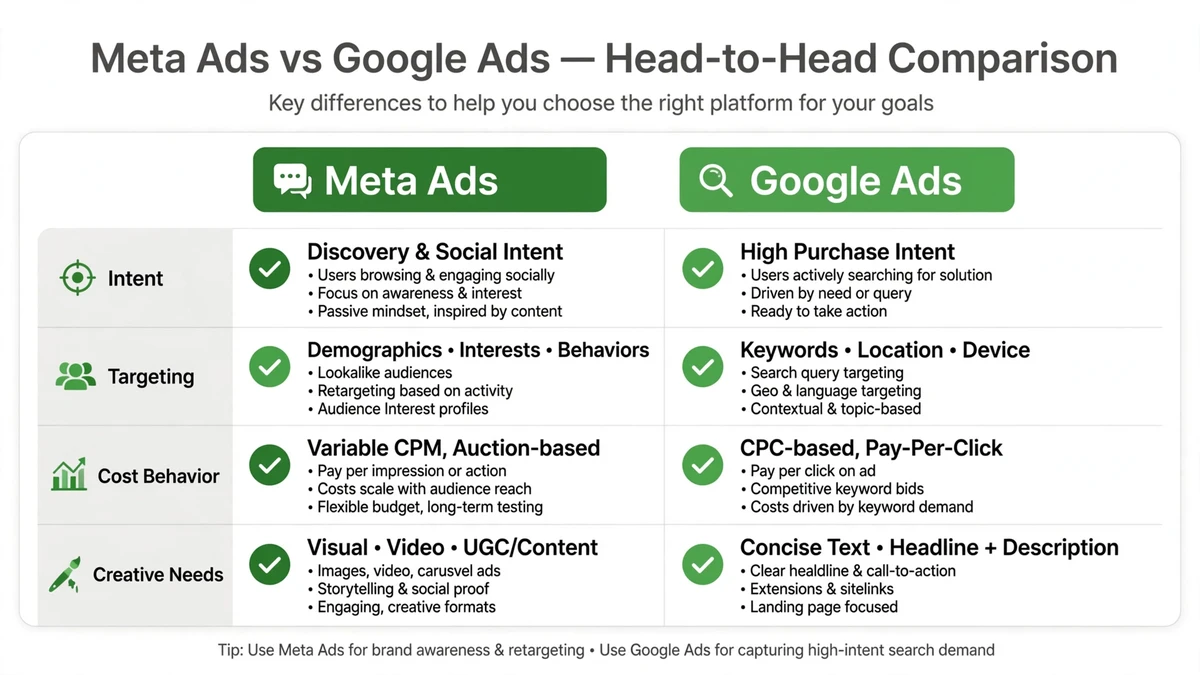
Meta Ads vs Google Ads: Head to Head
| Google Ads | Meta Ads | |
|---|---|---|
| How it finds customers | Keywords — people searching right now | Targeting — interests, behaviors, lookalikes |
| Intent level | High — they asked for it | Lower — you interrupted the scroll |
| Creative burden | Lower — text ads and landing pages do the work | Higher — thumb-stopping creative is everything |
| Learning curve | Keyword research, match types, negative keywords | Audience testing, creative iteration, pixel setup |
| Speed to signal | Fast — search volume is immediate | Slower — algorithm needs conversion data to optimize |
| Best lead type | Bottom-of-funnel: quote requests, bookings, calls | Mid-funnel: quiz leads, webinar signups, offer claims |
Meta Ads vs Google Ads: The Verdict by Business Type
| Business type | Start with | Why |
|---|---|---|
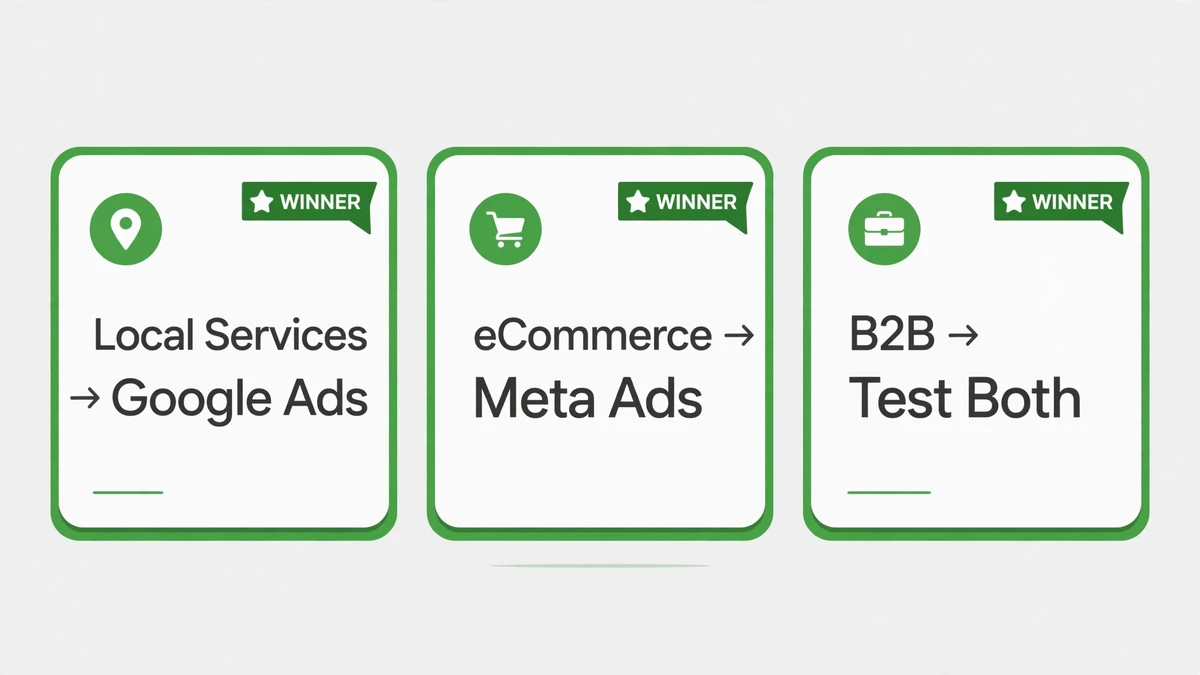
| Home services (plumbing, HVAC, electrical) | Google Ads | Customers search “near me” with urgency — capture beats creation |
| Law firms, dentists, clinics | Google Ads | High-trust, high-intent searches; people comparison-shop by query |
| D2C / e-commerce brands | Meta Ads | Visual products sell on creative; discovery drives the purchase |
| Local restaurants, salons, gyms | Meta Ads | Offers and visuals travel on social; geo-targeting is precise |
| B2B services, SaaS, agencies | Both, sequenced | Meta builds the audience and retargets; Google captures the eventual search |
| Real estate, mortgage, insurance | Both, sequenced | Long consideration cycle — Meta nurtures, Google closes |
If you’re in local services
If you run a plumbing, HVAC, electrical, or other home-service business, start with Google Ads — and it’s not close. Your customer has an urgent problem and reaches for their phone. They search “plumber near me” or “AC repair [your city]” and call the first credible business that picks up. That is demand capture at its purest, and Google owns it.
In the Meta Ads vs Google Ads debate for local services, Meta plays a supporting role at best. Before-and-after photos of a remodel or a seasonal maintenance offer can stop the scroll — but Meta should never be your first dollar. Build the Google foundation first: a dedicated page for each service, call tracking on every number, and a tight service-area geo-target. Once that’s producing booked jobs predictably, use Meta retargeting to stay in front of past site visitors who didn’t convert the first time.
If you’re in eCommerce
If you sell products online, start with Meta Ads. Nobody searches for a product they don’t know exists — discovery drives your purchase, and discovery happens in the feed. Meta’s creative-led formats (short video, carousel, creator-style ads) let the product sell itself to people matched by interest and behavior.
The Meta Ads vs Google Ads answer for eCommerce flips the sequence: Meta creates the demand, Google harvests the spillover. Your Google Ads role comes second — capture branded search from people who saw your ad and Googled your name, and run Shopping for high-intent product queries. Sequence it right and the two platforms compound instead of competing.
If you’re in B2B
If you sell to businesses — services, SaaS, or agency work — plan to run both, but sequence them. B2B cycles run weeks to months and involve several stakeholders, so no single platform covers the whole journey. Meta builds your audience before they have a defined need: useful content, case studies, and webinar invitations put you in front of decision-makers early.
The Meta Ads vs Google Ads question for B2B is really about order. Google captures the search that follows, when that same buyer Googles your category or your brand name. Lead with whichever matches your shortest path to a conversation — a strong content engine points to Meta first, clear category search intent points to Google first — then add the second platform once the first is converting.
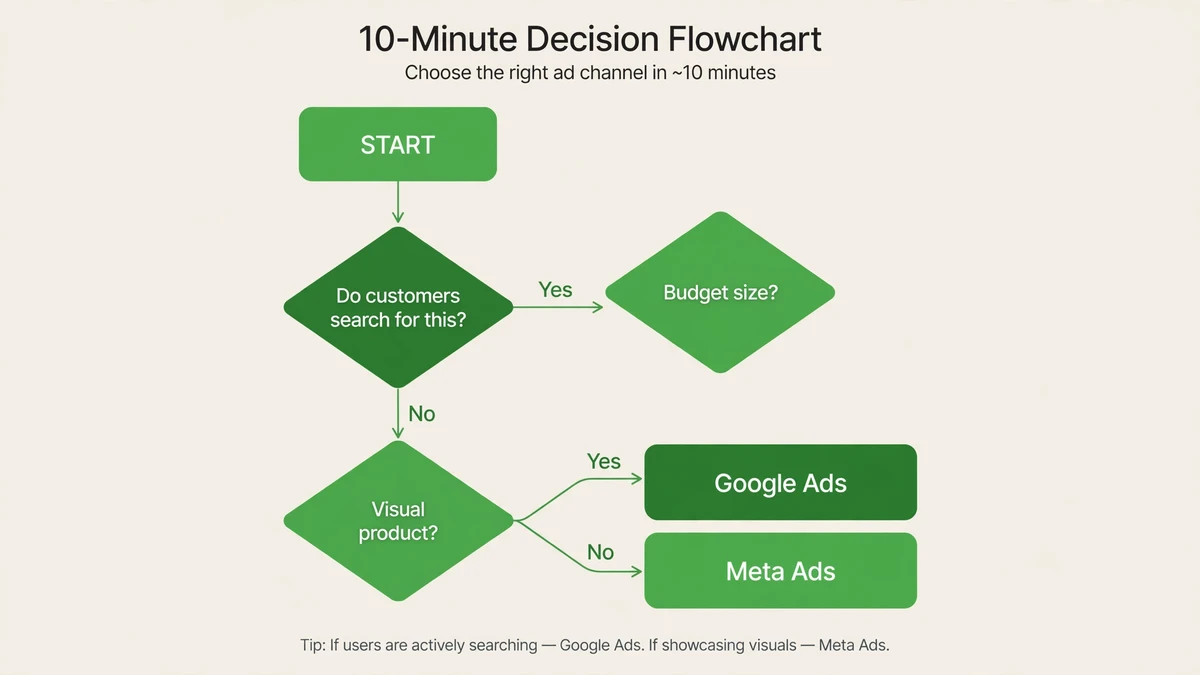
Meta Ads vs Google Ads: How to Decide in 10 Minutes
Run through this Meta Ads vs Google Ads checklist before you commit budget:
- Ask: do my customers Google this when they need it? If yes — plumber, lawyer, dentist — start with Google Ads.
- Ask: would my offer stop someone mid-scroll? If your product or result is visual and desirable — start with Meta Ads.
- Ask: how long is my sales cycle? Days → lean Google. Weeks to months → you’ll need Meta’s nurturing layer too.
- Check your creative assets. Strong photos and video → Meta is viable now. No creative and no budget to make it → Google’s text-led format is the safer start.
- Commit to one for 90 days. Switching platforms monthly teaches you nothing — each needs a full learning cycle before you judge it.
The Tracking Setup Both Platforms Need Before You Spend
Here’s the unglamorous truth behind every Meta Ads vs Google Ads debate: the platform matters less than the tracking feeding it. Both Google and Meta optimize toward the conversion events you define. Tell them the wrong goal — or give them no goal at all — and their algorithms will happily optimize for the wrong thing while spending your budget. We don’t launch a single campaign, on either platform, until this foundation is in place.
Start by choosing one primary conversion action — the business outcome that actually matters. A qualified lead form submission. A booked sales call. A completed purchase. Not a page view, not a button click, not “engagement.” If your platform is optimizing for page views, it will find you the cheapest page views on the internet, and none of them will buy anything.
Then wire up both platforms to see that action — this Meta Ads vs Google Ads tracking baseline is non-negotiable:
- Google Ads conversion tracking on your thank-you or confirmation page, installed via Google Tag Manager. This is what Smart Bidding learns from — no conversion data, no smart bidding.
- The Meta Pixel on every page, plus the Conversions API (CAPI) sending server-side events. The pixel alone misses conversions blocked by ad blockers and privacy settings; CAPI fills the gap by sending the event from your server. Running the pixel without CAPI means optimizing on partial data.
- UTM parameters on every ad URL, so your analytics can attribute each lead to the right platform, campaign, and ad — independent of what the platforms report about themselves.
- A lead log or CRM that records source for every inquiry. If you can’t tie a closed deal back to the platform that produced it, you can’t calculate ROI, and you’re flying blind.
| Setup step | What it gives you |
|---|---|
| One primary conversion action | Both algorithms optimize for revenue, not vanity metrics |
| Google Ads conversion tag | Smart Bidding has clean data to learn from |
| Meta Pixel + Conversions API | Reliable event data despite blockers and privacy changes |
| UTM parameters | Independent attribution in your own analytics |
| Source-tagged CRM | Closed-loop ROI by platform |
This setup typically takes an afternoon to wire up. Every optimization decision — which platform wins, which campaign scales, which ad dies — gets easier when both platforms are graded against the same real conversion. Skip it, and you’re not really comparing Meta Ads vs Google Ads; you’re comparing two black boxes.
When to Run Both: The 70/20/10 Split Framework
Our “start with one platform” advice for the Meta Ads vs Google Ads journey has a sequel: once that platform is converting predictably, when and how do you add the second? Add it wrong — splitting attention, starving the winner, or testing without a decision rule — and you turn one working channel into two mediocre ones. The framework we use for this stage is 70/20/10.
70% of effort stays with the proven winner. The platform already generating qualified leads at an acceptable cost keeps the majority. This is the non-negotiable part: never weaken what’s working to fund an experiment. Your winner earned its share, and consistency is what compounds.
20% goes to the second platform as a contained test. This isn’t “also running” the second platform — it’s a structured experiment with its own tracking, its own creative built for that platform’s format, and a pre-defined decision point. You’re buying information: can this channel produce qualified leads at a comparable cost? Give it a full learning cycle before you judge it.
10% goes to experiments on either platform. New audiences, new creative angles, new formats. This is where your next winner comes from, and the small allocation means failed tests cost you almost nothing while successful ones get promoted into the 70 or the 20.
Why ratios instead of fixed amounts? Because the principle scales and the numbers don’t. The discipline is the same at any size: protect the winner, fund the test, reserve room to experiment. Revisit the split monthly. If the 20% test beats the 70% winner on cost per qualified lead over a full cycle, shift the ratio. If it doesn’t, kill it without sentiment and rotate a new test into the 20%.
| Share | Role | Rule |
|---|---|---|
| 70% | Proven winner | Never reduce while it’s hitting your cost-per-lead target |
| 20% | Second-platform test | One full learning cycle, then a kill-or-scale decision |
| 10% | Experiments | New angles and audiences; promote winners, kill losers fast |
The 70/20/10 split protects you from the two classic expansion errors: never expanding (leaving growth on the table because one channel “works fine”) and expanding recklessly (breaking the winner to chase the new). This is where the Meta Ads vs Google Ads question gets practical — run both, but run them with a structure.
The Mistake to Avoid
The most expensive error in the Meta Ads vs Google Ads decision isn’t picking the “wrong” platform — it’s splitting a small budget across both and concluding neither works. A small budget on one platform buys enough data to learn. The same budget split in two buys noise on both. Pick the platform your buyer uses, fund it properly for a quarter, and expand only when the first one is converting predictably. Get the Meta Ads vs Google Ads sequencing right, and the budget works harder.
Ready to talk about your ads?
Still torn between the two? That’s a targeting and offer question more than a platform question. Contact the KKeyQik team and tell us about your business, your customers, and what you’ve tried — we’ll help you think through which platform fits your situation.
Further reading: our complete guide to PPC management services — how engagements are structured, how budgets are planned, and how to choose an agency. For the official documentation behind this Meta Ads vs Google Ads comparison, see Google Ads Help and the Meta Business Help Center.
About the KKeyQik Team
KKeyQik is a digital marketing agency helping small businesses grow with SEO, social media marketing, PPC (Google Ads and Meta Ads), web development, video editing, and graphic design. The KKeyQik Team publishes practical, no-fluff guides for business owners who want marketing that pays for itself.
Frequently Asked Questions
Google Ads — and it's not close. Your customer has an urgent problem and searches with intent to buy now, and that demand capture is what Google owns. Meta plays a supporting role at best, useful for retargeting past site visitors once the Google foundation is producing booked jobs.
Meta Ads. Most people don’t search for a product they don’t know exists — discovery drives your purchase, and discovery happens in the feed. Meta’s creative-led formats let the product sell itself to interest-matched audiences; Google’s role comes second, harvesting branded search and high-intent product queries from the spillover.
Typically yes, sequenced. For high-ticket B2B, Meta builds the audience early with useful content and case studies before buyers have a defined need; Google captures the search that follows when they look up your category or brand. Lead with whichever matches your shortest path to a conversation, then add the second once the first is converting.
Better not — splitting a small budget across two platforms starves both of the data each algorithm needs to optimize. Start with one platform, prove the offer converts, then expand with the learnings from the first.
Google Ads skews bottom-of-funnel — quote requests, bookings, and calls from people who asked for what you sell. Meta Ads skews mid-funnel — quiz leads, webinar signups, and offer claims from people who matched your customer profile but weren't searching. Match the platform to how your customer actually buys.
Google Ads is steeper to start — keyword research, match types, negative keywords, and Quality Score are a real discipline. Meta Ads is gentler to begin with but deep to master, since creative iteration, audience testing, and pixel setup take ongoing craft. Factor your team's actual skills into the choice.
Google Ads, usually — search volume is immediate, so you'll see real buying-intent traffic within days of launch. Meta needs more time because the algorithm requires conversion data to optimize, and your creative has to do the selling before the algorithm can do its job.
Because your buyers are high-trust, high-intent searchers who comparison-shop by query — they search the service with intent to book. Capturing that existing demand beats creating it; Meta comes later as a nurturing and retargeting layer, not the first dollar.
Because offers and visuals travel on social — a limited-time offer or transformation photo stops the scroll in a way a search ad can't. Meta's geo-targeting is precise enough to keep the audience local, and the creative formats match how these businesses actually win customers.
Start with one, prove the offer converts, then add the second — never split a small budget to be fair to both. The common working pattern: the majority of budget goes to the platform capturing existing demand, a smaller allocation feeds the top of the funnel, and retargeting follows warm visitors across both.