
Updated: September 2026 · By the KKeyQik Team
On Meta Ads, creative is the targeting. The algorithm finds your buyers, but only your creative decides whether they stop, watch, and click — and creative fatigues fast, which means Meta Ads creative testing isn’t a launch activity, it’s the ongoing job. Our 3-2-2 framework is the testing system we run: 3 hooks × 2 angles × 2 formats, a structured way to find winning creative without burning budget on random experiments. (For the full paid-media system this framework plugs into, see our guide to PPC management services.)
Meta ads creative testing is the systematic process of running structured creative experiments — varying hooks, angles, and formats against each other — to find the combinations that earn attention and conversions at scale. Random testing (“let’s try this video”) wastes budget; structured testing turns every dollar of test spend into a reusable answer about what your market responds to.
Key takeaways
- Creative is the targeting on Meta — the algorithm distributes, but creative decides who stops. Test creative like it’s your most important lever, because it is.
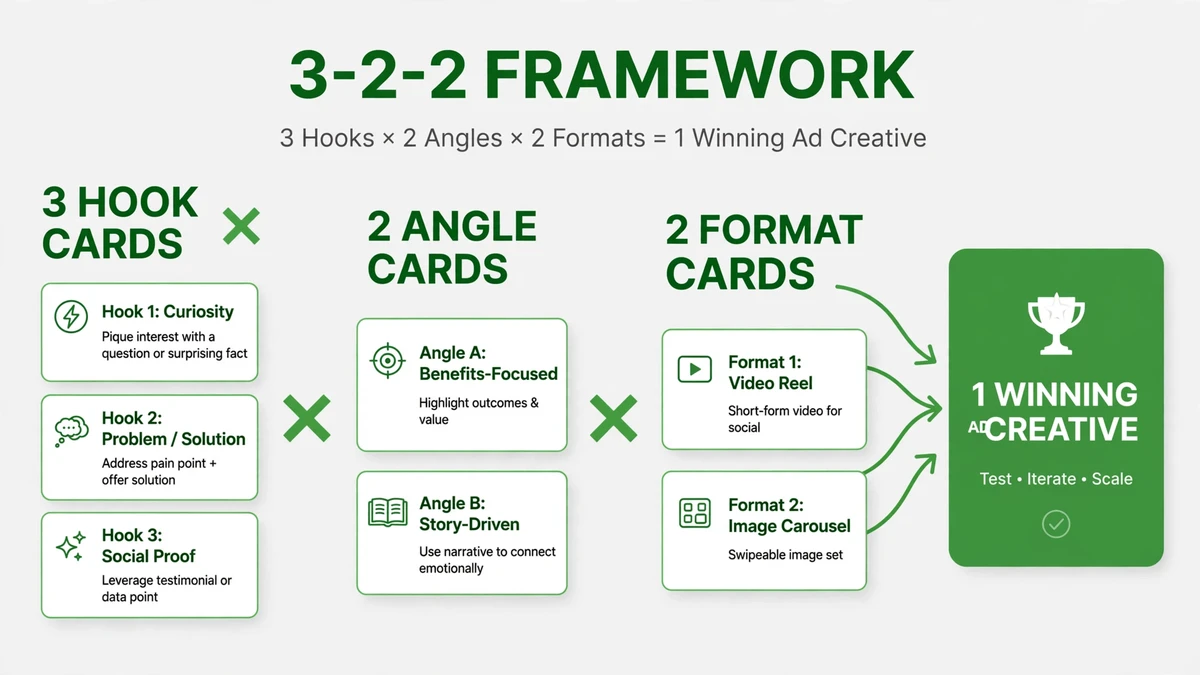
- The 3-2-2 Meta Ads creative testing framework: 3 hooks × 2 angles × 2 formats = 12 test variants from one core idea. Structured, not random.
- Test one variable at a time. Change the hook, keep everything else identical — otherwise you learn nothing from the winner.
- Kill fast, scale deliberately: in Meta Ads creative testing, losers get paused in days; winners get budget increases in controlled steps, not leaps.
- Every test ends with a written learning, not just a winner. “Hook B won” is data; “problem-agitation hooks beat benefit hooks for this audience” is an asset.
The 3-2-2 Meta Ads Creative Testing Framework
| Layer | What it is | Example (a dental clinic) |
|---|---|---|
| 3 hooks | The first 2 seconds — three different openers for the same message | “Stop hiding your smile” / “The whitening mistake most people make” / “POV: your wedding photos” |
| 2 angles | The persuasion strategy — two different reasons to care | Angle 1: pain avoidance (fix the problem). Angle 2: aspiration (get the outcome). |
| 2 formats | The delivery vehicle — two different creative formats | Format 1: talking-head video. Format 2: before/after carousel. |
Three hooks times two angles times two formats gives you twelve variants — all testing one core idea from every direction that matters. That’s a complete test cell, not a random pile of ads. In Meta Ads creative testing, the cell is the unit of learning: each cell answers a specific question about your market, and the answers compound across cells.
Why 3-2-2 specifically? Because it balances coverage with clarity. Three hooks give you enough variation to find a winner without spreading budget so thin that nothing reaches significance. Two angles force you to test fundamentally different persuasion strategies, not just word variations. Two formats reveal whether the message or the medium is doing the work. Fewer variants and you’re guessing; more variants and you’re diluting. The 3-2-2 is the sweet spot we’ve landed on after running this Meta Ads creative testing framework across dozens of accounts.
Meta Ads Creative Testing: How to Run a 3-2-2 Test in 6 Steps
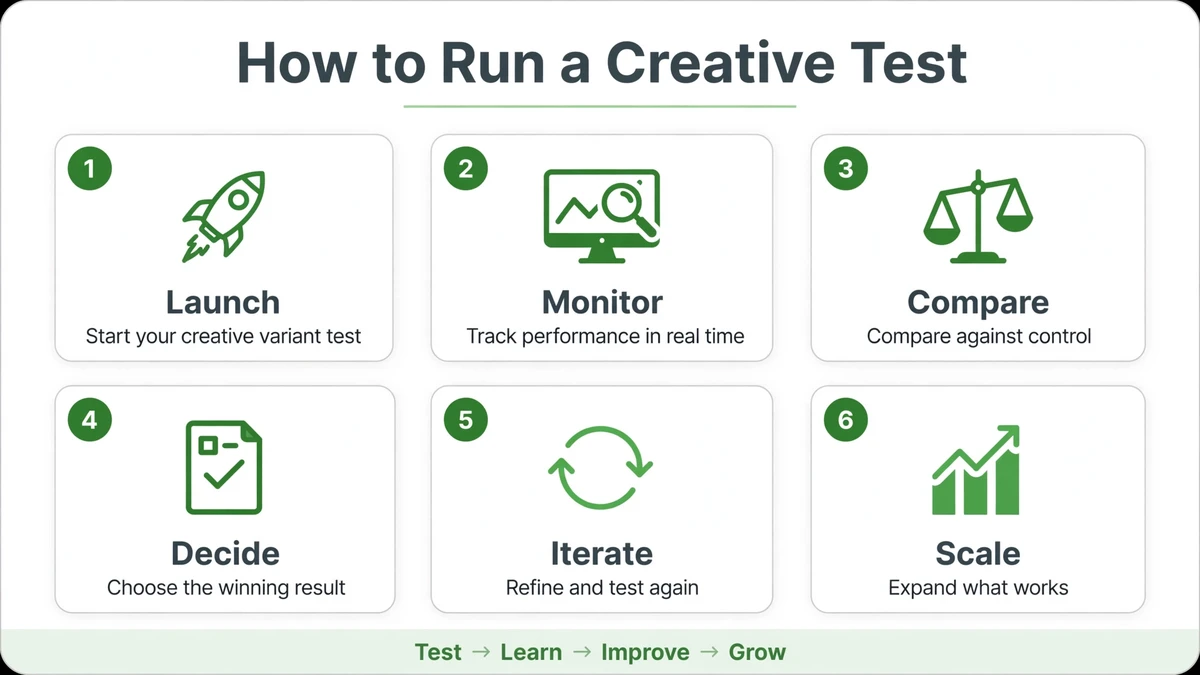
- Pick one core idea to test — one offer, one audience, one desired action. Everything else stays fixed. If you’re testing a teeth-whitening offer to women 25-44, don’t also test a cleaning offer to men 35-54 in the same cell. One variable at a time.
- Write the 3 hooks first. Hooks are the highest-leverage variable: the first two seconds decide whether anything else gets seen. Make them genuinely different — a question, a bold claim, a pattern interrupt — not three wordings of the same line. “Stop hiding your smile” (command), “The whitening mistake most people make” (curiosity), “POV: your wedding photos” (scenario) — three different psychological triggers.
- Build the 2 angles. Same offer, two persuasion strategies: problem-focused (the cost of inaction, the pain of stained teeth, the embarrassment) versus outcome-focused (the confidence of a bright smile, the transformation). Your market will strongly prefer one; the test tells you which. Don’t guess — test.
- Produce the 2 formats. One video, one static or carousel — using the same hooks and angles across both. This tells you whether the format or the message is doing the work. If the video wins across all hooks and angles, you’ve learned that video is the format for this audience. If the winner is hook-specific regardless of format, you’ve learned that the message matters more than the medium.
- Launch all 12 in one campaign with equal budgets and identical targeting. Let them run until each variant has enough impressions to judge — a few days at minimum, never judge on day one. Resist the urge to peek at hour six and declare a winner. The algorithm needs time to find the right people for each variant.
- Read the results in order: hooks first (which opener won across angles and formats?), then angles (which persuasion strategy won across hooks?), then formats. Promote the winning combination, write down the learning in one sentence, and build the next test cell from what you learned. The learning is the asset — the winning ad is just the current champion.
The Creative Brief Template That Feeds the 3-2-2 Machine
The 3-2-2 framework only works if the 12 variants actually get produced — and produced correctly. The bottleneck is never the strategy; it’s the brief. A vague brief (“make some ads”) produces 12 random creatives. A structured brief produces 12 testable variants. Here’s the template we use for Meta Ads creative testing.
For each variant, the brief needs five things:
- The hook, verbatim. The exact first-two-seconds opener, word for word. Hooks are the highest-leverage variable in Meta Ads creative testing — the designer or video editor must not paraphrase them. “Stop hiding your smile” and “Don’t hide your smile” are different hooks; test them as written. Paraphrasing contaminates the test.
- The angle, in one sentence. Which persuasion strategy this variant serves — problem-focused or outcome-focused — and the specific claim. This keeps the designer from mixing angles inside one creative and contaminating the test. One variant, one angle, no exceptions.
- The format specs. Video (9:16, under 30 seconds, captions burned in) or static/carousel (1:1 or 4:5, headline under 40 characters). Format constraints are part of the test, not an afterthought — the editor needs them upfront, not after the first draft.
- The mandatory elements. Logo placement, CTA button text, any offer terms or disclaimers. These are non-negotiable and identical across all 12 variants, so the test measures the hook and angle — not the CTA button color or logo size.
- What NOT to change. The offer, the landing page, the audience. The brief explicitly lists the fixed variables so a well-meaning designer doesn’t “improve” them and invalidate the cell. Creativity goes into the hook execution, not into changing the offer.
| Brief field | Why it matters | Example |
|---|---|---|
| Hook (verbatim) | Hooks are the test variable — paraphrasing ruins the test | “Stop hiding your smile” |
| Angle (one sentence) | Keeps persuasion strategy consistent per variant | Problem-focused: the cost of stained teeth |
| Format specs | Format is a test layer, not an afterthought | 9:16 video, captions burned in |
| Mandatory elements | Fixed variables don’t contaminate results | CTA: “Book whitening”, logo top-right |
| Do-not-change list | Protects the test’s integrity | Same offer, same landing page, same audience |
One brief per variant, twelve briefs per test cell. It sounds like overhead, but it’s the opposite — the template lets a designer or video editor produce all 12 in a single batch with minimal back-and-forth. In our Meta Ads creative testing workflow, the brief template is what turns the 3-2-2 from a strategy into actual ads. Clear briefs reduce revisions because there’s nothing ambiguous to revise.
Kill Rules and Scale Rules
| Rule | What to do | Why |
|---|---|---|
| Kill rule: no engagement after meaningful impressions | Pause the variant | Weak hooks reveal themselves fast — don’t fund the funeral |
| Kill rule: clicks but no conversions | Check the landing page before blaming creative | Creative did its job; the destination failed |
| Scale rule: winner under your cost-per-lead ceiling | Increase budget in controlled steps | Big jumps reset the learning phase and destabilize delivery |
| Scale rule: winner fatiguing (frequency rising, CTR falling) | Rotate in fresh hooks on the winning angle | Creative has a shelf life — plan the replacement before you need it |
| Learning rule: every test ends with one written sentence | Log what the market taught you | Twelve tests with no notes is twelve lessons lost |
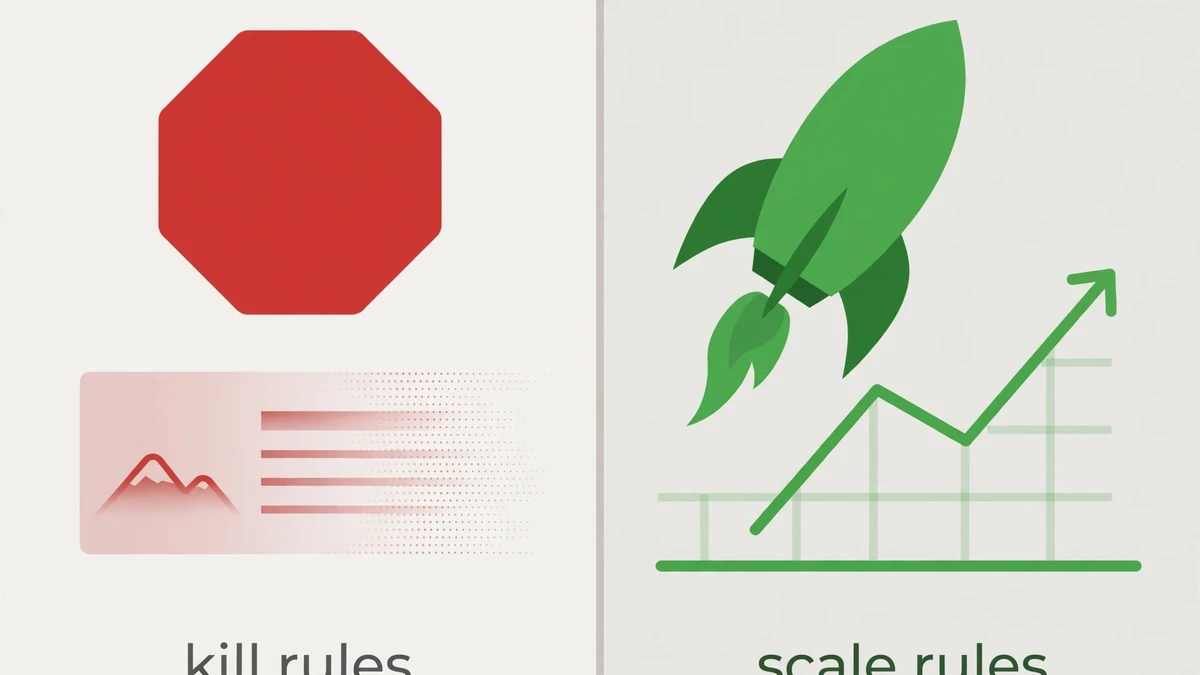
The kill rules exist because hope is not a strategy. In Meta Ads creative testing, every dollar spent on a dead variant is a dollar not spent finding the winner. The most common failure mode we see isn’t killing too fast — it’s killing too slow, letting losers drain budget for weeks because “it might turn around.” It won’t. The data tells you within days whether a hook resonates. Trust the data, kill the loser, reallocate to the test.
Creative Fatigue: How to Spot It and What to Do Next
Every winning creative has a shelf life. The same ad that crushed it in month one will fade — the audience has seen it, the algorithm has shown it to everyone receptive, and performance decays. This is creative fatigue, and in Meta Ads creative testing, managing it is as important as finding winners in the first place.
How to spot it: watch two signals together — frequency and CTR. When frequency climbs (the same people seeing the ad repeatedly) and CTR decays (fewer of them clicking), the creative is fatiguing. Either signal alone can mislead. Rising frequency with stable CTR means the audience is still responding — keep spending. Falling CTR at low frequency means the hook was never strong — kill it, don’t wait for fatigue that isn’t coming.
What to do next: don’t just make “more ads.” Go back to the 3-2-2 machine. The winning angle is still valid — it’s the specific hook execution that’s tired. Brief five fresh hooks on the winning angle using the template above. That’s a new test cell, not a random refresh. This is why the framework matters for Meta Ads creative testing: fatigue doesn’t send you back to a blank page, it sends you back to a system.
Refresh cadence: we plan creative refreshes on a rolling basis, not when performance crashes. The moment a winner is identified, its replacement cell goes into production. By the time fatigue shows in the data, fresh variants are already tested and ready to rotate in. In Meta Ads creative testing, the best time to brief the next cell is the day the current winner is declared.
What to Test After the First Win
Your first Meta Ads creative testing cell answers: which hook, which angle, which format. The second cell goes deeper on the winner — five new hooks on the winning angle, or the winning hook applied to two new audiences. In Meta Ads creative testing, testing compounds: each cell’s learning makes the next cell’s variants stronger, which is why structured testing beats random inspiration over any horizon longer than a month.
The third cell typically tests the offer itself. Once you know which hook and angle resonate, you can test variations of the offer — different price points, different bonuses, different guarantees — using the winning creative framework. This is where Meta Ads creative testing becomes business testing: you’re not just optimizing ads, you’re discovering what your market actually wants to buy.
Common 3-2-2 Mistakes to Avoid
Even with the framework, teams make predictable errors in Meta Ads creative testing. Here are the ones we see most often:
- Testing too many variables at once. Changing the hook, the angle, AND the offer in one cell teaches you nothing. When a variant wins, you won’t know why. Discipline: one core idea per cell, only the 3-2-2 layers vary.
- Judging too early. Pausing a variant after 200 impressions because “it’s not working” is like pulling cookies out after two minutes because “they’re not done.” Give each variant enough impressions to judge — a few days minimum, depending on budget.
- Skipping the written learning. Teams run the test, find the winner, and move on without writing down WHY it won. Three months later, they’re testing the same losing hooks again because nobody recorded the learning. One sentence per test. Non-negotiable.
- Letting winners run forever. The winning creative from Q1 is still running in Q3, frequency is through the roof, CTR has halved, but “it’s still getting some conversions.” That’s not a winner anymore — it’s a fatigued creative coasting on brand awareness. Rotate.
Ready to talk about your ads?
If your Meta Ads account is running three creatives from last quarter and performance is sliding, you don’t have a targeting problem — you have a Meta Ads creative testing problem. Contact the KKeyQik team and tell us about your business and what’s running now — we’ll help you think through whether the 3-2-2 framework fits what you’re selling and what to prioritize first.
Further reading: our complete guide to PPC management services — how engagements are structured, how budgets are planned, and how to choose an agency. For Meta’s official documentation on this Meta Ads creative testing framework, see About A/B testing and the Meta Business Help Center.
About the KKeyQik Team
KKeyQik is a digital marketing agency helping small businesses grow with SEO, social media marketing, PPC (Google Ads and Meta Ads), web development, video editing, and graphic design. The KKeyQik Team publishes practical, no-fluff guides for business owners who want marketing that pays for itself.
Frequently Asked Questions
A structured system for testing one core idea: 3 hooks times 2 angles times 2 formats equals 12 test variants. Three different openers for the first two seconds, two persuasion strategies (problem-focused versus outcome-focused), and two delivery formats — all launched together with identical targeting so the results reveal what your market actually responds to.
Because otherwise you learn nothing from the winner. Change the hook while keeping everything else identical, and you know the hook made the difference; change three things at once and a win teaches you nothing reusable. Structured testing turns every unit of test spend into a learning asset.
At minimum a few days — never judge on day one, and resist the urge to declare a winner after a few hours. The algorithm needs time to find the right people for each variant, and each variant needs enough impressions to be judged fairly.
Kill losers fast — pause them in days — and scale winners deliberately in controlled steps, not leaps. Every test should end with a written learning, not just a winner: knowing one hook won is data, but knowing problem-agitation hooks beat benefit hooks for your audience is an asset that compounds across campaigns.
Because a vague brief (make some ads) produces random creatives, while a structured brief produces testable variants — every variant needs the hook verbatim, the angle in one sentence, and the format specified. The designer must not paraphrase hooks, since paraphrasing contaminates the test.
Good hooks use genuinely different psychological triggers — a command, a curiosity gap, a scenario. Weak hooks are three wordings of the same line; if your three hooks aren't truly different from each other, you're not testing, you're repeating.
The hook is the first-two-seconds opener — what stops the scroll. The angle is the persuasion strategy — why the viewer should care, typically problem-focused (the cost of inaction) versus outcome-focused (the transformation). You test both layers because your market may respond to one message in many openings, or one opening across messages.
That's exactly what the two-formats layer answers: run the same hooks and angles across two formats, like video and carousel. If video wins across all hooks and angles, you've learned the format matters for this audience; if one hook wins regardless of format, the message matters more than the medium.
The test cell is the complete 12-variant unit — one core idea tested from every direction that matters. Thinking in cells instead of one-off ads matters because each cell answers a specific question about your market, and the answers compound across cells into a reusable creative playbook.
One core idea per cell, and keep cells focused — one offer, one audience, one desired action per cell. Running multiple cells multiplies both learning and budget burn, so master the discipline of one complete, well-read cell before stacking more.