

Updated: September 2026 · By the KKeyQik Team
SEO services for small business are professional services that improve a website’s visibility in organic (unpaid) search results. A full engagement typically covers a technical audit and fixes, on-page optimization, content creation, authority building through links and digital PR, local search optimization, and transparent monthly reporting. For most US small businesses, SEO is a 6–12 month compounding investment, not a quick fix — and the agencies worth hiring will tell you that upfront. Done well, SEO services for small business compound: every optimized page and earned link keeps working long after the invoice is paid.
If you run a small business in the US, you’ve probably been pitched SEO services a dozen times — by email, by cold call, by the agency that “found issues” on yourlock-in
website. Most of those pitches were noise. This guide is the signal. We wrote it to answer every question a smart buyer should ask before spending a dollar on search engine optimization: what’s actually included, how engagements are structured, how long results take, and how to tell a real agency from a smooth talker.
Key takeaways
- A full engagement covers six core areas: technical fixes, on-page optimization, content, link building, local SEO, and reporting. If a proposal is missing any of these, ask why.
- Most small businesses see early movement in months 3–4 and compounding returns from month 6 onward. Anyone promising page one in 30 days is selling something else.
- Engagements come in four models — monthly retainer, one-time project, hourly, and performance-based — and the right one depends on your goals, not the agency’s preference.
- The fastest wins for a US small business are almost always the same: Google Business Profile, technical basics, a handful of strong service pages, and a review engine.
- Measure revenue, not rankings. The only SEO metric that pays your bills is organic-sourced revenue.
What Are SEO Services for Small Business?
At its simplest, an SEO service is any professional work done to earn your business more visibility — and more customers — from search engines like Google and Bing, without paying for ads. That work falls into two buckets: making your website deserve to rank (relevance and quality), and proving to search engines that others vouch for you (authority and trust). Keep this two-bucket model in mind as you read: every honest proposal for SEO services for small business should address both relevance and authority.
What SEO is not
Let’s clear the fog first, because this industry has an honesty problem. SEO is not a guaranteed #1 ranking — nobody can promise that, since nobody controls Google’s algorithm. It’s not a one-time task you “finish.” And it’s not the same as running Google Ads; SEO earns organic listings, ads buy placement, and a good strategy often uses both. Any agency that blurs these lines in a sales call will blur them in your reporting too. Internalize that before you talk to anyone selling SEO services for small business — it instantly filters out the guarantee-makers.
The three things every SEO service is really doing
Strip away the jargon and all SEO work serves three masters. Relevance: making sure each page clearly answers a specific search — the right topic, the right depth, the right intent. Authority: earning signals that your site is trustworthy — links, mentions, reviews, brand searches. Experience: making the site fast, mobile-friendly, and easy to use, because Google measures how visitors behave and so should you. Every deliverable in a proposal should trace back to one of these three. If it doesn’t, ask what it’s for. When an agency can’t explain which of these three masters a task serves, their SEO services for small business probably aren’t worth the retainer.
What’s Included in SEO Services for Small Business Engagements?
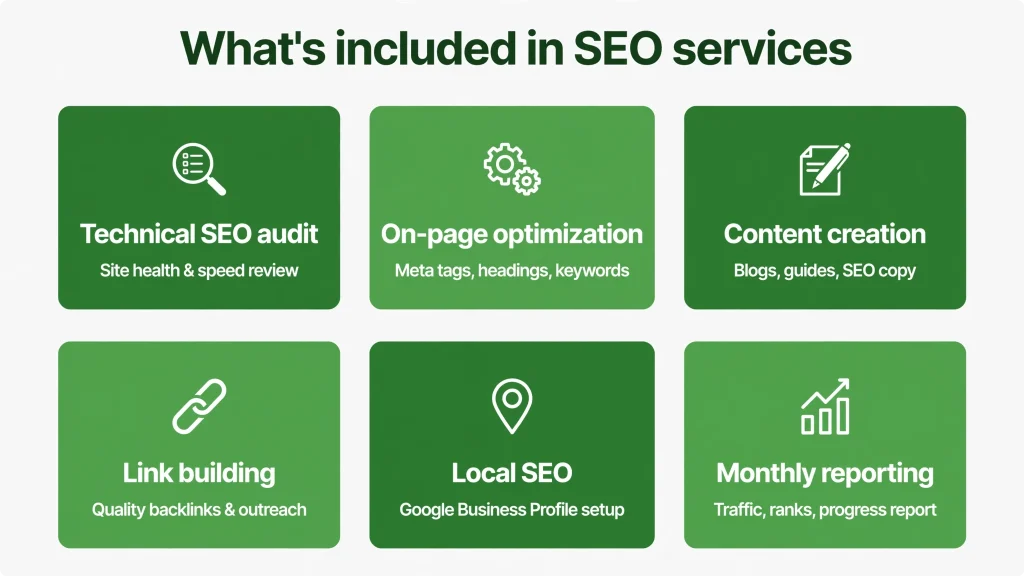
Every legitimate SEO engagement we’ve seen — ours and our competitors’ — is built from the same six components. The mix changes with your goals, but if a proposal skips one entirely without explanation, that’s a question worth asking. If a proposal is missing any of these six, ask why — complete SEO services for small business cover all of them, even when the emphasis shifts.
Technical SEO audit & fixes
This is the foundation work: crawling your site the way Google does and fixing what blocks it. Broken links, slow pages, mobile issues, missing sitemaps, indexation errors, duplicate content. Skipping this step is the most common reason SEO services for small business fail to show results in the first six months.
- you get the actual audit document, not just a summary — every issue listed, prioritized by impact, with before/after verification.
- fixes are implemented, not just recommended. A PDF of problems with no one to fix them is a report, not a service.
- Core Web Vitals and mobile usability are treated as ranking factors, because they are.
Related: Technical SEO Audit Checklist: 27 Points We Run on Every Site (2026) — the full 27-point checklist we run on every site, in the order we run them.
On-page optimization
Making each important page the best possible answer for its target search. Title tags, headings, content depth, internal links, image optimization, schema markup. This is also the easiest work to verify yourself, which makes it a good trust test for any SEO services for small business provider.
- every money page targets one clear search intent — not five keywords stuffed into one page.
- title tags and meta descriptions are written for humans first, algorithms second.
- internal linking is deliberate: your strongest pages pass authority to the pages that need it.
Content creation & optimization
Publishing pages and posts that deserve to rank — service pages, location pages, guides, comparisons — and improving what you already have. Thin, generic content is the telltale sign of cheap SEO services for small business — real expertise shows in the writing.
- content is written for the searcher’s intent, not around a keyword density target.
- old content gets updated and pruned, not just new content piled on top.
- every piece has a job: rank, convert, or earn links. “Blog filler” isn’t a strategy.
Link building / digital PR
Earning links and mentions from other reputable websites — the closest thing search has to votes of confidence. Ask any provider how they earn links before you sign; the answer reveals more about their SEO services for small business than any case study.
- links come from real, relevant sites (local press, industry publications, resource pages) — never bought in bulk.
- the agency can show you every link built and where it lives. No “proprietary network” secrecy.
- digital PR — original data, expert quotes, genuinely useful resources — does the heavy lifting, not directory spam.
Local SEO
For businesses serving a geographic area: Google Business Profile optimization, local citations, review strategy, and location pages. If you serve local customers, weight this section heavily when comparing SEO services for small business — it’s where most of your ROI will come from.
- your Google Business Profile is fully built out — categories, services, photos, posts, Q&A — not just claimed.
- NAP (name, address, phone) is identical everywhere it appears online.
- there’s a real system for earning reviews, not a one-time request blast.
Related: Local SEO for Small Business: Google Business Profile Setup, Step by Step (2026) — the six-step playbook: profile setup, NAP consistency, the review engine, and local content.
Monthly reporting
Plain-English reporting on what was done, what changed, and what happens next. Vague reports are how bad SEO services for small business hide; insist on seeing exactly what was done each month.
- you see traffic, rankings, and conversions — tied to revenue where possible, not just “impressions are up.”
- the report explains the why behind the numbers, in language a non-marketer understands.
- there’s a next-month plan attached, not just a backward-looking scorecard.
The Four Types of SEO Services for Small Business (and Which One You Need)
Not all SEO is the same engagement. The right type depends entirely on how your customers find you. Most small businesses need exactly one of these as their primary focus — the agency that tries to sell you all four at once is selling hours, not outcomes. Figure out where your next ten customers are searching, and start there. Matching the engagement type to your business model is step one — the wrong type of SEO services for small business wastes even a good budget.
Local SEO
Best for: plumbers, dentists, law firms, restaurants — any business where customers search “near me.” Dominates the map pack and local organic results. For these businesses, local SEO services for small business routinely deliver the highest ROI of any marketing channel.
eCommerce SEO
Best for: online stores and D2C brands. Focuses on product and category pages, faceted navigation, product schema, and content that captures commercial-intent searches. Ecommerce brands should look specifically for SEO services for small business with catalog and faceted-navigation experience.
B2B / lead-generation SEO
Best for: agencies, SaaS companies, consultants. Targets high-intent, lower-volume keywords and builds content for long sales cycles — comparisons, guides, case studies. In B2B, the best SEO services for small business focus on a handful of high-intent pages rather than high traffic volume.
International SEO
Best for: businesses selling across borders. Covers hreflang implementation, country targeting, and content adapted — not just translated — for each market. International work is specialized — only consider SEO services for small business with proven hreflang and multi-region experience.
How SEO Services for Small Business Get Scoped
One reason SEO proposals are hard to compare: no two businesses need the same scope. Before you judge any proposal, understand the variables that determine its size. A 10-page brochure site for a local dentist and a 2,000-product eCommerce store are not the same engagement, and any honest agency will scope them differently. Use the drivers below to normalize quotes before comparing SEO services for small business side by side.
The main scope drivers are: Keep these five in mind — they explain why two quotes for SEO services for small business can differ by an order of magnitude.
- Site size and health. A 15-page site with clean code needs a light technical pass. A 5,000-page site with years of accumulated issues needs serious remediation before anything else can work.
- Competition level. Ranking for “plumber Boise” and ranking for “project management software” are different sports. Your agency should show you the competitive landscape, not just promise to beat it.
- Content gap. If you have five thin service pages and your competitors have fifty deep ones, closing that gap is the bulk of the work.
- Goals and timeline. “We need leads this quarter” scopes differently from “we want to own this category in two years.” Both are valid; they just require different plans.
- Who does the implementation. Some agencies advise and your team implements. Others do everything end-to-end. Full-service scopes are bigger — and for most small businesses without an in-house team, they’re the only kind that actually gets done.
Use these variables as your lens: when two proposals look wildly different, it’s usually because they’re scoping different amounts of this work — not because one agency is magically cheaper. A proposal that doesn’t reference your specific situation isn’t really SEO services for small business — it’s a template.
Related: SEO Service Packages in India: What’s Typically Included (2026) — how Indian agencies bundle these scope variables into tiered packages.
A concrete example: a local dental practice with a 12-page site, weak competition, and no content might need a tight 3-month scope — technical cleanup, five core pages rewritten, Google Business Profile built out, review system installed. A D2C skincare brand with 400 products, national competitors, and no blog needs something entirely different — months of content production, digital PR for links, and ongoing category-page optimization. Same service category, completely different engagements. The proposal that acknowledges this difference is the one from the agency that’s actually thought about your business. Benchmark your own site against this example when scoping SEO services for small business for the first time.
Doing SEO Yourself vs Hiring It Out
Can you do SEO yourself instead of hiring? Honestly: the basics, yes. The full job, rarely — and the math usually favors hiring sooner than owners expect. Be honest about your available hours before choosing between DIY and SEO services for small business — consistency matters more than skill.
What a motivated owner can genuinely handle: claiming and optimizing the Google Business Profile, asking for reviews, writing decent service pages, and fixing the obvious technical issues Search Console flags. That’s real progress, and for a brand-new local business it’s the right first 90 days. Master these basics and you’ll get far more value from any SEO services for small business you hire later.
Where DIY breaks down: link building and digital PR (relationships and outreach at scale), technical SEO on larger or older sites, content production at competitive depth, and — the underrated one — knowing what not to do. Most of the expensive SEO disasters we’ve seen came from confident DIY: the site migration with no redirects, the “SEO plugin” that noindexed half the site, the blog strategy targeting keywords with zero buying intent for eighteen months.
The practical middle path: do the basics yourself, hire for the rest — or hire an agency for a one-time foundation project (audit + fixes + strategy) and execute the ongoing work in-house. A good agency will tell you which parts you can own. A bad one will tell you everything requires them. This hybrid approach to SEO services for small business gives you expert leverage without a full monthly commitment.
SEO Engagement Models Compared
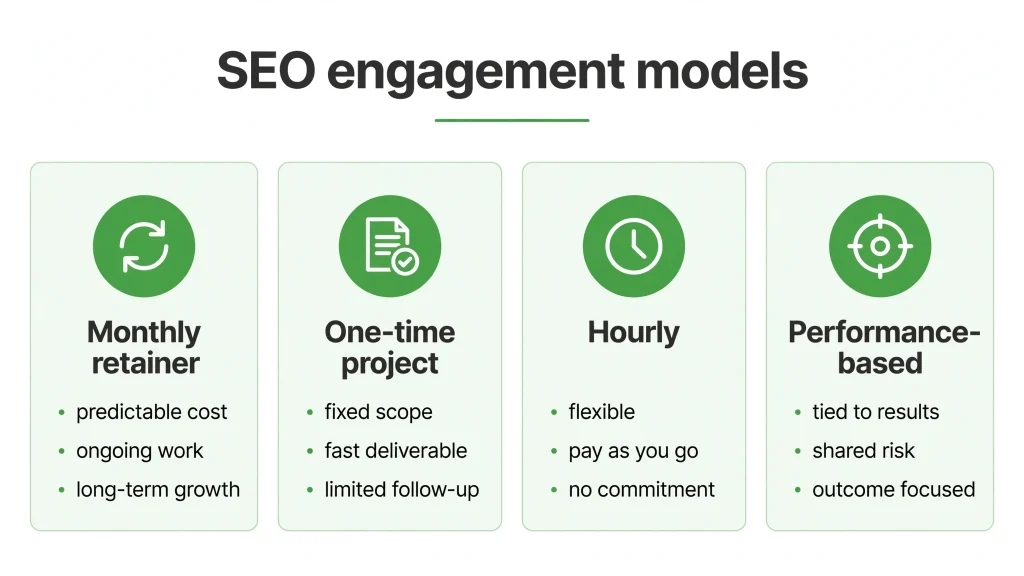
Agencies generally sell SEO in four ways. None is inherently better; the right one depends on your situation. There’s no universally best model — the right SEO services for small business fit your stage, team, and timeline.
| Model | How it works | Best for | Watch out for |
|---|---|---|---|
| Monthly retainer | Ongoing work each month: technical maintenance, content, links, reporting | Businesses committed to long-term growth; the most common model for real results | Vague deliverables — insist on a monthly scope list |
| One-time project | Fixed-scope work: a full audit, a site migration, a content sprint | Specific problems with a clear endpoint | Expecting lasting rankings from a one-off effort |
| Hourly consulting | Pay for expert time: strategy, audits, team training | Businesses with in-house teams who need direction | Hours that produce advice nobody implements |
| Performance-based | Fees tied to agreed outcomes like rankings or traffic | Sounds ideal in theory | Incentivizes gaming vanity metrics; the rare honest version is a hybrid with a base fee |
Our take: for most small businesses, the monthly retainer is the model that actually compounds — SEO is ongoing work, and one-time projects rarely survive contact with Google’s algorithm updates. Whatever model you choose, get the deliverables in writing. That compounding is why we recommend retainers to most buyers of SEO services for small business who are playing the long game.
How Long Until SEO Services for Small Business Show Results?
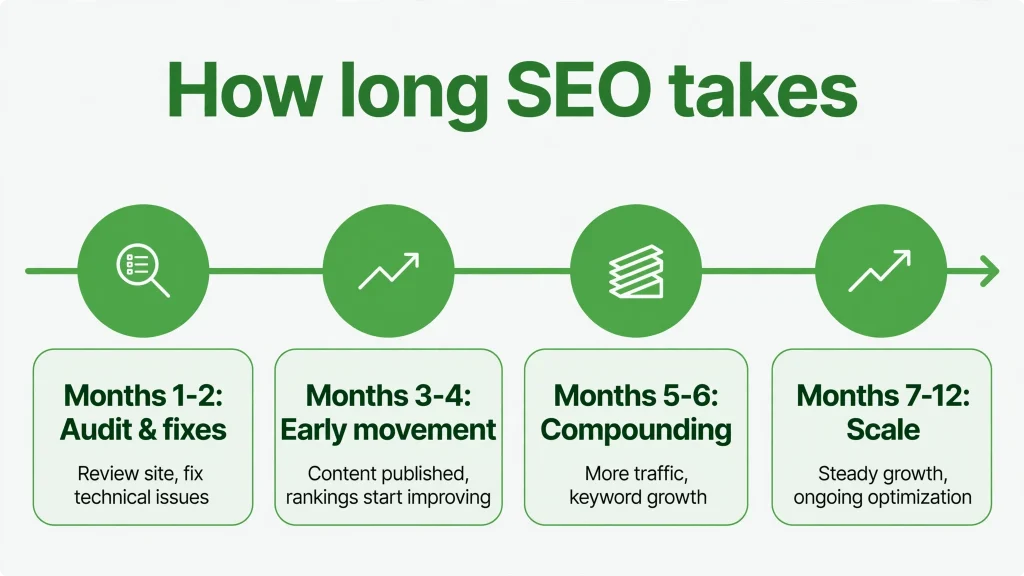
The honest timeline nobody puts in their ads: Set expectations with stakeholders using this timeline before buying SEO services for small business — it prevents painful month-three conversations.
- Months 1–2: audit and foundation. Technical fixes, analytics cleanup, keyword research, content planning. You’ll see almost nothing in the rankings yet — this is the work that makes everything else possible.
- Months 3–4: early movement. Long-tail keywords start climbing. Impressions rise. If local SEO is in play, map-pack visibility improves. This is where most businesses first feel something happening.
- Months 5–6: compounding begins. Content published in month two starts ranking. Early links kick in. Lead volume from organic search becomes noticeable.
- Months 7–12: scale. Authority compounds — new content ranks faster because the domain is stronger. This is where SEO starts outperforming paid channels on return per dollar.
Two things move this timeline: competition (a crowded market takes longer) and starting point (a penalized or brand-new site takes longer than a healthy one). An agency that gives you a timeline without asking about either is guessing. Factor both into your planning so your SEO services for small business investment is sized for reality, not hope.
One more reality to budget for: Google updates its algorithm constantly, with several significant updates a year. A good agency doesn’t panic at these — the foundation work (technical health, genuine content, real links) is exactly what survives updates. If your traffic drops after an update, that’s a diagnostic moment, not a disaster: it tells you which part of the foundation was weakest. Agencies that chase algorithm loopholes, on the other hand, rebuild from zero every time Google sneezes. Ask any agency you’re vetting how they handled the last major update for their clients. The good ones have a story. The bad ones change the subject. A good provider will proactively explain algorithm impacts — it’s a hallmark of trustworthy SEO services for small business.
Related: How Long Does SEO Take? Realistic Timelines by Competition (2026) — timelines by competition level, what happens in each phase, and what speeds things up or slows them down.
In-House vs Freelancer vs SEO Agency
| In-house hire | Freelancer | SEO agency | |
|---|---|---|---|
| Scope of expertise | One person, one skill set — strong in their lane | Deep in their specialty, narrow outside it | Team coverage: technical, content, links, local |
| Speed | Fast on priorities, bottlenecked on bandwidth | Fast to start, limited hours per week | Parallel workstreams, but onboarding takes weeks |
| Accountability | Full — they’re yours | Varies wildly; you’re one of many clients | Structured reporting, but you’re one account among many |
| Best when | SEO is core to the business and you can hire senior | You need a specific skill plugged in fast | You want full-funnel execution without building a team |
The small-agency sweet spot, honestly stated: you get broader expertise than any single hire, at a scope a 5–50 person business can actually use. The trade-off is attention — a good small agency takes fewer clients per strategist. Ask how many accounts your strategist handles. If they dodge the question, that’s your answer. For most owners, this balance makes boutique SEO services for small business the pragmatic choice over both freelancers and large firms.
There’s also a hybrid worth knowing about: agency strategy plus in-house or freelancer execution. You pay for the plan and the oversight, and a cheaper pair of hands does the implementation. It works when someone internal can own the day-to-day and the agency genuinely reviews the work — not when “strategy” means a PDF nobody opens again. For businesses with a marketing coordinator but no SEO expertise, this is often the smartest first engagement. This model works well when you have in-house capacity but need the strategy behind effective SEO services for small business.
7 Red Flags in an SEO Pitch
- Guaranteed #1 rankings. Nobody controls Google. Guarantees are either lies or target keywords nobody searches.
- Secret methods or proprietary systems they can’t explain. Real SEO is explainable. “Secret sauce” means either snake oil or tactics they don’t want you googling.
- Suspiciously cheap monthly packages. Real SEO is labor-intensive. If the price barely covers an hour of expert time, you’re buying automation and hoping.
- No reporting access. If you can’t see your own Google Search Console and Analytics, you’re not a client — you’re a hostage.
- They only talk about rankings, never revenue. Rankings are a means. An agency allergic to the word “leads” is optimizing for their report, not your business.
- One-size-fits-all packages. Your business isn’t a template. Neither is a real SEO plan.
- No questions about your business. If the first call is a pitch instead of an interrogation about your customers, margins, and goals — walk away.
How to Choose SEO Services for Small Business: 7-Step Checklist
- Check their own rankings. An SEO agency invisible in search is like a broke financial advisor. They don’t need to rank #1 nationally, but they should rank for something real.
- Ask for a sample audit. Even a lite version shows you how they think. Look for prioritization and plain English, not a 90-page automated export.
- Verify reporting. Ask exactly what you’ll see each month and how often you’ll talk to a human. “Quarterly check-ins” for a monthly retainer is a no.
- Talk to a current client. Not a testimonial quote — an actual conversation. Ask what surprised them, good and bad.
- Ask who does the work. The person pitching you is rarely the person optimizing your site. Meet the actual team or strategist.
- Demand the deliverables in writing. Monthly scope, in the contract. “Ongoing optimization” without specifics is a blank check.
- Start with a defined trial. A 3-month initial term with clear milestones beats a 12-month lock-in with vague promises. Confidence looks like short commitments.
Related: SEO Agency in Ghaziabad: 9 Questions to Ask Before Hiring (2026) — the local version of this checklist, with Ghaziabad-specific red flags and verification tactics.
SEO Services for Small Business: What Actually Moves the Needle First
If you’re a US small business starting from zero, don’t try to do everything. Do these four in order — they deliver the large majority of early results: Follow this order and your SEO services for small business will build on a solid foundation instead of shaky tactics.
1. Google Business Profile
For any business serving local customers, this is the highest-ROI hour in all of SEO. Claim it, complete every field, add real photos, list your services, and start posting updates. Then build the review engine: ask every happy customer, make it frictionless with a direct link, respond to every review. The map pack drives calls, and calls drive revenue. An hour here beats ten hours elsewhere — it’s the highest-leverage work in SEO services for small business.
2. Technical basics
Make sure Google can crawl and index your site, that it loads fast on mobile, and that you have a sitemap submitted in Search Console. Unsexy, non-negotiable. A beautiful site Google can’t read is a billboard in the desert. For the official playbook, see Google’s SEO Starter Guide — the official, plain-language primer on the fundamentals behind good SEO services for small business.
3. Five money pages
Most small businesses need exactly five excellent pages before anything else: homepage, 2–3 core service pages, about, and contact. Each one targeting a single clear intent, each one genuinely better than what’s currently ranking. Depth beats breadth until you have traction.
4. Reviews engine
Reviews influence local rankings and — more importantly — whether searchers choose you after finding you. A steady stream of recent, responded-to reviews on Google (and Yelp, where relevant for your industry) is a compounding asset no competitor can copy overnight.
How to Measure ROI From SEO
The formula is simple; the discipline is rare:
SEO ROI = (Revenue attributed to organic search − SEO investment) ÷ SEO investment
The hard part is attribution. Set up conversion tracking before the engagement starts — form fills, calls, booked appointments — so month six has a baseline to compare against month one. Without it, you’re debating feelings.
For most small businesses, simple attribution beats perfect attribution. Track three things: how many contact form submissions came from organic search (your form tool or CRM can tag the source), how many calls came from the website (a call-tracking number on the site works fine), and what those leads turned into (ask every new customer “how did you find us?” and log it). You don’t need enterprise software — you need consistency. The businesses that measure this way always know whether SEO is working. The ones that don’t are the ones arguing about rankings in month nine.
Track money metrics. Glance at vanity metrics only to diagnose:
| Vanity metric | Money metric |
|---|---|
| Total traffic | Organic-sourced leads and sales |
| Keyword rankings (all) | Rankings for keywords with buying intent |
| Impressions | Conversion rate from organic visitors |
| Domain authority score | Revenue per organic session |
| Number of backlinks | Cost per acquired customer vs paid channels |
One more thing: compare SEO against your other channels honestly. SEO usually loses to paid ads in months 1–3 and wins from month 6 onward. Judge it on the right timeline or you’ll kill a winner too early.
Related: SEO Reports Explained: What Your Agency Should Send You Every Month (2026) — the seven elements every monthly report should contain, and how to read yours in fifteen minutes.
Ready to make SEO your growth engine?
If this guide helped you understand what SEO services actually involve, the next step is telling us about your business specifically — your market, your competition, and what scope makes sense for your goals. Contact the KKeyQik team and tell us where you want to be in twelve months. We’ll reply honestly with what it takes to get there — and whether we’re the right team to do it with.
About the KKeyQik Team
KKeyQik is a digital marketing agency helping small businesses grow with SEO, social media marketing, PPC (Google Ads and Meta Ads), web development, video editing, and graphic design. The KKeyQik Team publishes practical, no-fluff guides for business owners who want marketing that pays for itself. Our SEO services for small business are built for owners who want straight answers, honest timelines, and measurable growth.
Frequently Asked Questions
A good agency prioritizes by impact and effort: technical blockers first, then the pages closest to revenue, then broader content and link building. Ask for a prioritized 90-day roadmap with the reasoning behind the order. If every proposal you receive lists the same generic task sequence, it was likely copied from a template rather than built around your site.
SEO earns listings in organic results through relevance, authority, and site quality, and it compounds over months. Google Ads buys placement at the top of the page for as long as you pay for clicks. Many small businesses use both: ads for immediate visibility and data, SEO for durable long-term visibility.
The contract should list specific monthly deliverables, who actually does the work, how reporting is delivered, and the terms for ending the arrangement. Avoid long lock-ins without milestones: a three-month initial term with clear targets is a fairer test than a twelve-month commitment. Make sure vague phrases like ongoing optimization are replaced with concrete line items.
Most owners can safely handle claiming their Google Business Profile, asking customers for reviews, and writing clear service pages. Leave technical fixes on large or older sites, link building at scale, and content aimed at competitive keywords to professionals. A practical middle path is hiring an agency for a one-time audit and strategy, then executing the ongoing work internally.
Ask what a typical month of deliverables looks like in writing, and who will actually do the work. A credible agency gives specifics: pages optimized, content pieces, outreach activity, a monthly report. Treat guaranteed page-one rankings as a disqualifier, since no agency controls the search algorithm.
Ultimately, revenue and leads attributed to organic search are what pay the bills. Rankings and traffic are useful diagnostics that explain where leads come from, but an agency that reports only rankings without connecting them to business results is managing your feelings rather than your growth.
SEO serves three masters: relevance (each page clearly answers a specific search), authority (links, mentions, and reviews that signal trust), and experience (a fast, mobile-friendly site visitors enjoy using). Every deliverable in a proposal should trace back to one of these three. If a task serves none of them, ask what it is for.
Because search is a moving target. Competitors keep optimizing, Google keeps updating its systems, and content freshness matters. Rankings are rented, not owned, so ongoing work maintains what you have won and expands to harder keywords. A one-time effort that is never maintained typically decays over time.
High competition, a brand-new or previously penalized site, and slow implementation all stretch the timeline. Businesses in crowded markets often need more months of content and link building before movement shows. An agency that quotes a timeline without asking about your competition and starting point is guessing, not estimating.
Your Google Business Profile is one of your most valuable local assets, since nearby customers often call or get directions straight from the map results. An unclaimed or half-empty profile, inconsistent name and address across the web, and too few reviews all suppress local visibility. Fixing these basics early sets up everything else in a local SEO program.