
Updated: September 2026 · By the KKeyQik Team
The honest answer to “how long does SEO take” is the one nobody wants to print: it depends — but it depends on specific, measurable things, not vibes. Competition level, your site’s starting point, and how much gets implemented each month. This guide gives you realistic timelines by competition level, what actually happens in each phase, and the factors that speed things up or slow them down. (For the full context on the work these timelines describe, see our guide to SEO services.)
How long does SEO take? It depends on competition: most small businesses see early movement in 3–4 months and meaningful results in 6–12 months. Low-competition niches can move faster; competitive national markets take longer. Anyone promising page-one rankings in 30 days is selling something SEO can’t deliver — and the “guarantee” is the reddest flag in the industry.
Key takeaways
- Plan for 3–4 months to early signals, 6–12 months to meaningful results. That’s the honest answer to “how long does SEO take” for most small businesses.
- Competition is the dominant variable — a local plumber and a national SaaS company are playing different sports with different timelines.
- Month 1–2 is foundation (audit, technical fixes, strategy). Nothing visible happens here, and that’s normal — skipping it is what makes SEO “not work.”
- Implementation speed matters as much as strategy: an audit nobody acts on has a timeline of never.
- SEO compounds. Month 12’s results come from month 3’s work — which is why stopping at month 4 is the most expensive mistake in SEO.
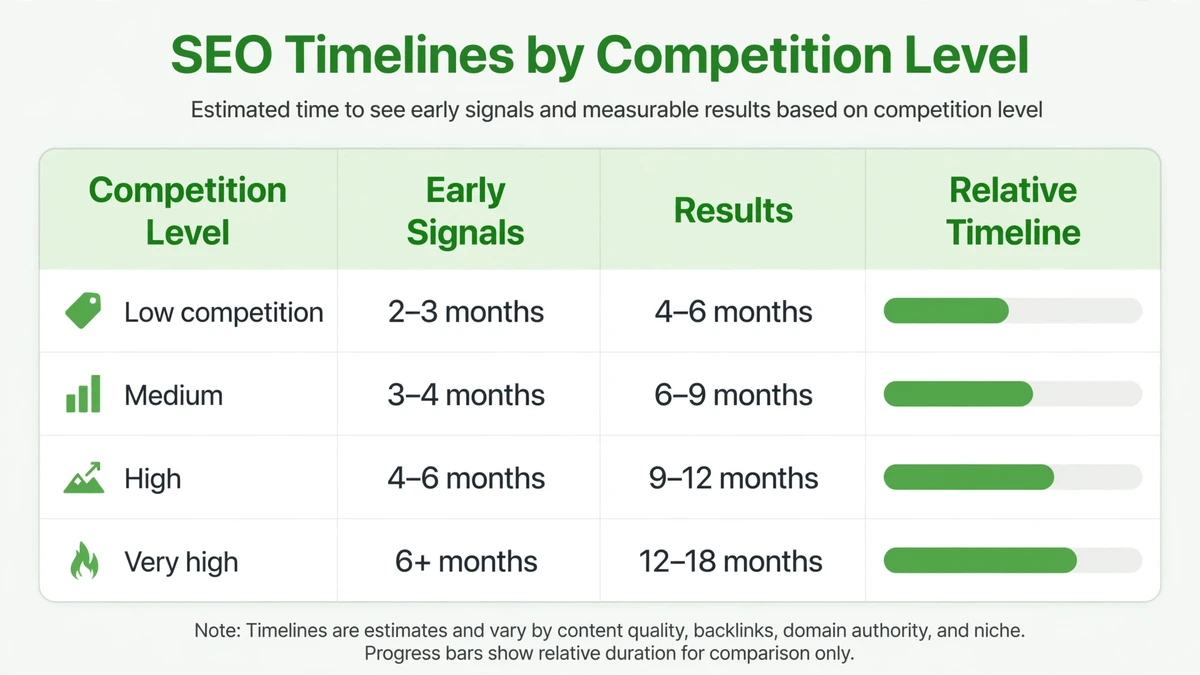
How Long Does SEO Take? Realistic Timelines by Competition Level
| Competition level | Example | Early signals | Meaningful results |
|---|---|---|---|
| Low — local niche, weak competitors | Plumber in a mid-size town | 2–3 months | 4–6 months |
| Medium — local competitive or niche national | Dental clinic in a metro area | 3–4 months | 6–9 months |
| High — competitive national market | E-commerce in a crowded category | 4–6 months | 9–12 months |
| Very high — finance, legal, SaaS nationally | Personal injury law, CRM software | 6+ months | 12–18 months |
These are ranges for consistent, properly executed work — not best cases. If you’re wondering “how long does SEO take” for your specific situation, find your row: that’s your honest starting estimate. Your position in this table is set by who’s already ranking for your money keywords and how entrenched they are, which is exactly what a competitive analysis tells you before work starts.
How Long Does SEO Take? What Happens in Each Phase
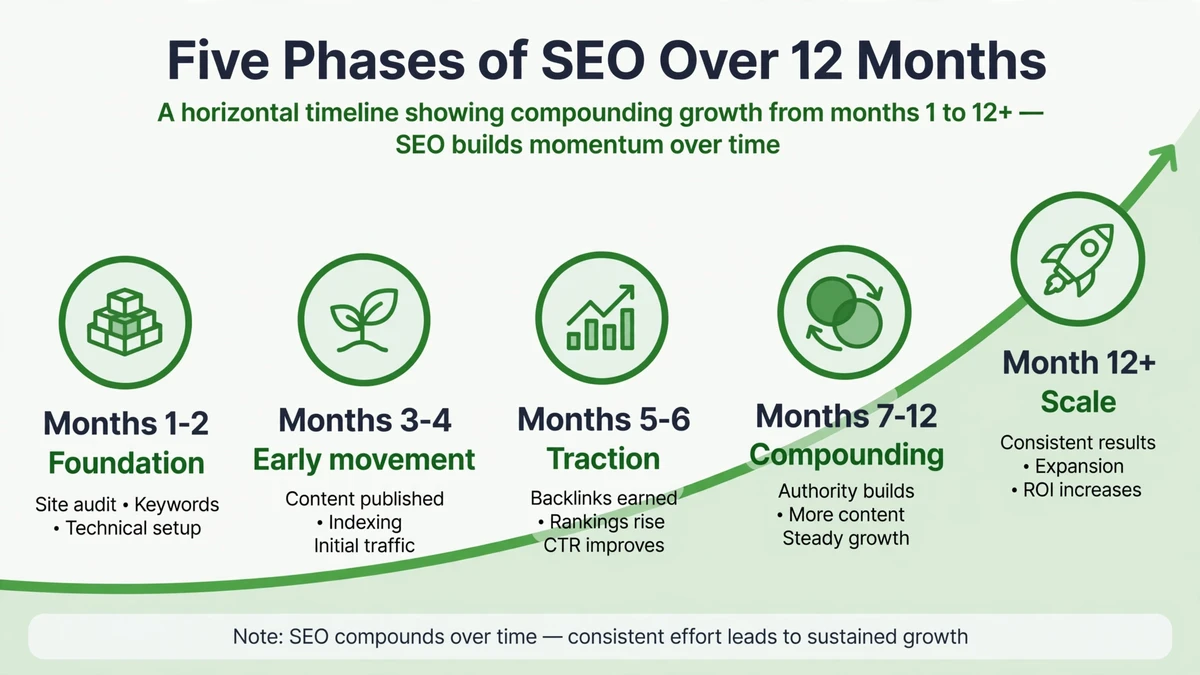
How long does SEO take to show results? Here’s what happens in each phase, and what’s happening behind the scenes while you wait.
- Months 1–2: Foundation. Technical audit, critical fixes, keyword research, content strategy, analytics and tracking setup. Visible traffic change: none. This is the phase impatient clients want to skip — and the phase that determines whether everything after it works.
- Months 3–4: Early movement. Technical fixes take effect, first content publishes, Google recrawls and reassesses. You’ll typically see long-tail keyword impressions climbing and a few pages entering the top 50. Traffic barely moves; the leading indicators do.
- Months 5–6: Traction. Money pages start ranking on page 2–3 for target terms, content compounds, early links land. Organic traffic begins a visible climb — modest in absolute numbers, clear in direction.
- Months 7–12: Compounding. Rankings consolidate on page 1 for attainable terms, content library reaches critical mass, brand searches grow. This is where SEO starts paying for itself — and where most of the ROI of the whole engagement is generated.
- Month 12+: Scale and defend. Expand to harder keywords, new content formats, digital PR. Maintenance becomes the job: competitors want your positions, and rankings are rented, not owned. By this point, “how long does SEO take” is the wrong question — it’s how aggressively you want to scale.
What Speeds SEO Up vs What Slows It Down
These are the factors that most affect the answer to “how long does SEO take” — some you control directly, others you inherit.
| Speeds it up | Slows it down |
|---|---|
| Fast implementation — fixes go live in days, not quarters | Approvals bottleneck — every change waits three weeks |
| Existing domain authority and clean technical base | New domain, penalty history, or years of technical debt |
| Consistent content publishing on a real schedule | Content in bursts, then silence for months |
| Narrow focus — winning a few money pages first | Trying to rank for everything at once |
| Earning links from real, relevant sites | No link acquisition at all — or toxic link schemes that backfire |
| Strong brand signals — reviews, mentions, direct traffic | Invisible brand — Google has no trust signals to lean on |
How to Tell If It’s Working Before the Traffic Comes
The dangerous months are 2–4: you’re spending, nothing visible is happening, and quitting feels rational. For anyone wondering “how long does SEO take to work,” these leading indicators tell you whether the foundation is forming:
- Impressions in Search Console are climbing for target keyword themes — even if clicks lag behind.
- Average ranking position is improving for tracked keywords, especially from position 50+ into the top 30.
- More pages are getting indexed and appearing in search results — coverage expanding.
- Technical health scores are improving — Core Web Vitals passing, crawl errors dropping.
- Early content is earning its first rankings and occasional featured snippets or “People also ask” placements.
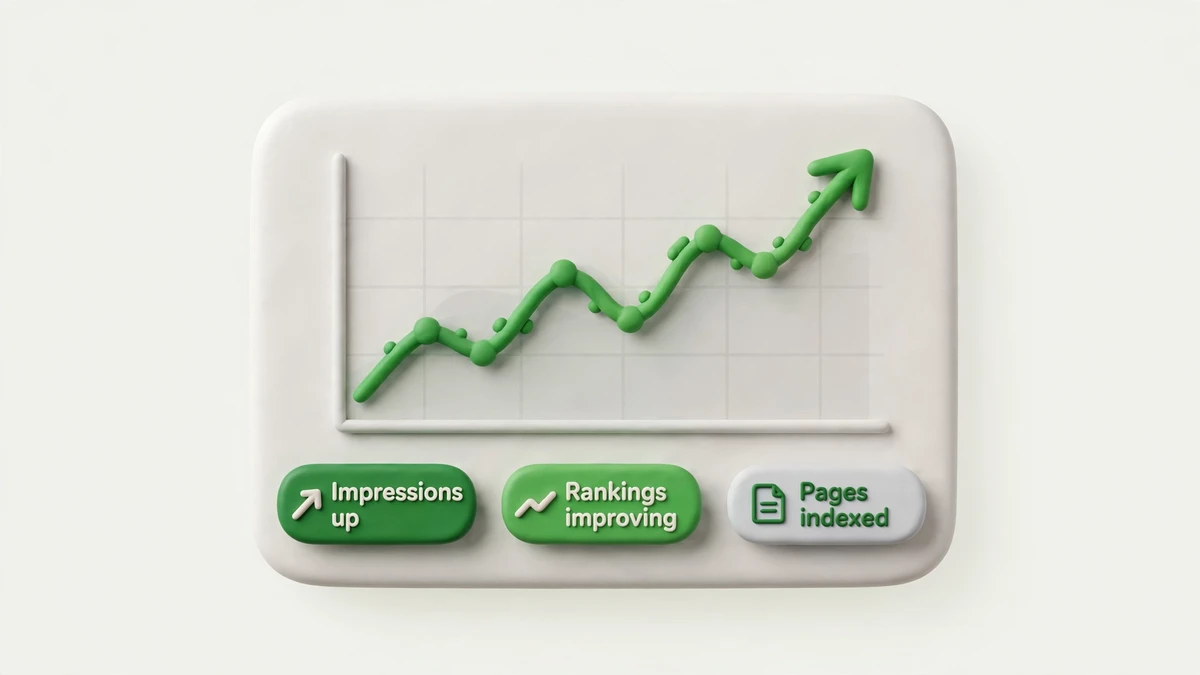
If none of these are moving by month 4, something is wrong with the strategy or the implementation — not with SEO as a channel. That’s a conversation to have with your agency, not a reason to abandon the channel.
Ready to talk about your SEO?
If you’ve been burned by answers to “how long does SEO take” that turned out to be fiction — or you’re trying to set honest expectations before starting — start with a straight answer about your market. Contact the KKeyQik team and tell us what you sell and where. We’ll reply honestly with what the timeline looks like for your competition level — including whether SEO is even the right first move.
Further reading: our complete guide to SEO services — what’s included, how engagements are structured, and how to choose an agency.
About the KKeyQik Team
KKeyQik is a digital marketing agency helping small businesses grow with SEO, social media marketing, PPC (Google Ads and Meta Ads), web development, video editing, and graphic design. The KKeyQik Team publishes practical, no-fluff guides for business owners who want marketing that pays for itself.
Frequently Asked Questions
Frame SEO as ranges tied to competition, not fixed dates — for example, early signals in three to four months if implementation stays on schedule. Report leading indicators like Search Console impressions during the quiet months so stakeholders see movement. The goal is a shared understanding that SEO is a compounding investment, which protects the program from being cut in month four.
Often yes, but not head-on for the same keywords. Small businesses win by targeting local and long-tail searches where big brands are weak, and by publishing deeper, more specific content. Competing on a national head term against entrenched sites is a long game — your agency should map where you can win first and expand from there.
A completed technical audit with prioritized fixes, keyword research tied to your money pages, analytics and conversion tracking setup, and a 90-day content and link plan. You should receive the actual audit document, not just a summary. If the first month produces only promises and no tangible artifacts, ask what you are paying for.
Monthly reports are the standard: what was done, what changed in traffic, rankings, and conversions, and what happens next month. Good reports tie numbers to revenue where possible and explain the why in plain language. Be wary of reports that only show impression growth without connecting it to leads or sales.
Consistency matters more than volume. A steady schedule of genuinely useful pages helps more than bursts of thin content followed by silence. Focus new content on your money pages first — depth on a few high-intent topics usually beats shallow coverage of everything at once.
Slow implementation. An audit nobody acts on has a timeline of never — approvals that take weeks, fixes queued behind other priorities, and content drafts that never get published. Before signing, agree on who approves what and how fast, because execution speed matters as much as strategy.
Because SEO compounds. Month twelve's results grow out of month three's content and links, so stopping early abandons the investment just as it starts to pay. If leading indicators are moving, patience is the strategy; if they are not moving, the strategy or execution needs a hard conversation.
No. Nobody controls the search algorithm, so guaranteed rankings are a fiction and the promise itself is the reddest flag in the industry. Honest agencies give you ranges based on your competition and starting point, not fixed outcomes on a fixed date.
An established domain with clean technical health and existing authority gives you a head start, so timelines run shorter. A new domain starts from zero trust signals and typically needs more time, as does a site with a penalty history or years of accumulated technical debt. This is one reason the audit and competitive analysis come before any timeline estimate.
Yes. Real SEO has flat months and even dips from algorithm updates, seasonality, or competitors outspending you. A healthy reporting routine distinguishes noise from signal by comparing against the same period last year and by watching leading indicators. A report that is never honest about a bad month cannot be trusted about the good ones.