


Updated: September 2026 · By the KKeyQik Team
Every month, SEO agencies send thousands of reports that nobody reads — 40-page PDFs full of graphs trending vaguely upward, filed away and forgotten. If that’s what lands in your inbox, you’re not getting reporting. You’re getting camouflage. This guide explains what SEO reporting should actually contain, how to read it in fifteen minutes, and the red flags that tell you the numbers are hiding something. (For the full context on what the work behind the report involves, see our guide to SEO services.)
SEO reporting is the monthly record of what your SEO engagement did, what changed, and what happens next. A real report covers completed work, traffic and ranking movement, leads and revenue attributed to organic search, and a plan for the coming month — all in language a non-marketer can understand. Anything less is a receipt, not a report. Good SEO reporting turns data into decisions.
Key takeaways
- A real SEO report has four parts: work completed, results (traffic, rankings, conversions), interpretation of what the numbers mean, and next month’s plan.
- If you can’t tell whether the month was good or bad in five minutes, the report is failing — no matter how pretty the charts are.
- Rankings and traffic are diagnostic metrics. Leads, customers, and revenue are the verdict. Demand both, in that order.
- You should have direct access to Google Search Console and Google Analytics — the report summarizes; the raw data is yours to check.
- The report should change the plan. A report that never alters next month’s priorities is decoration.
What Your Monthly SEO Reporting Should Include
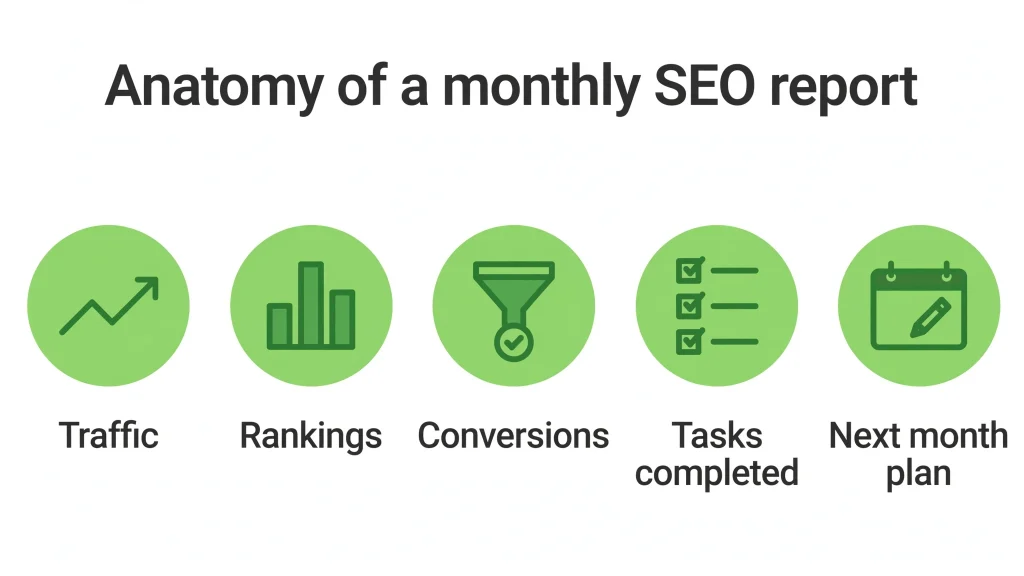
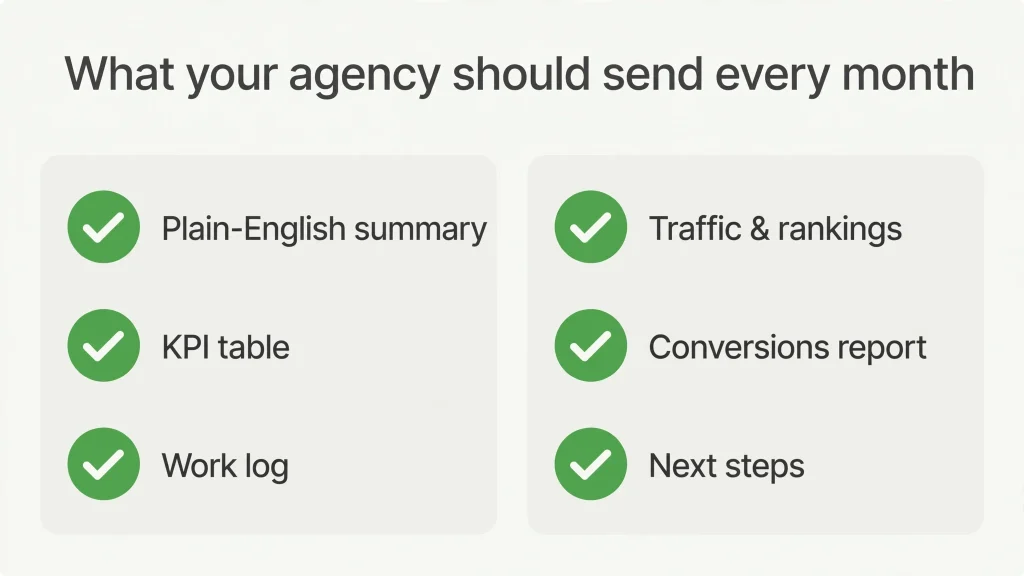
Strip away the formatting and every legitimate monthly SEO report contains the same seven elements. Use this as your checklist — if items are missing, ask why: For official Search Console guidance, see Google Search Console Help.
- Work completed. What was actually done this month — pages optimized, content published, technical fixes implemented, links earned. Specifics, not “ongoing optimization.”
- Organic traffic trend. Sessions from organic search versus previous month and versus the same month last year. Seasonality matters; month-over-month alone lies.
- Keyword movement. Rankings for your tracked keywords — with emphasis on the ones with buying intent, not the full list of 200.
- Conversions from organic. Form fills, calls, booked appointments attributed to organic search. This is the section that determines whether the engagement is working.
- Technical health snapshot. Crawling, indexation, Core Web Vitals — a brief status, not a 30-page audit every month. “All green” is a fine monthly answer.
- What the numbers mean. Interpretation in plain English: why traffic moved, what caused it, what it implies. Data without interpretation is homework assigned to you.
- Next month’s plan. What happens next and why — tied to what this month’s data revealed. The plan is the proof the agency actually read its own report.
SEO Reporting Metrics That Matter vs Metrics That Decorate
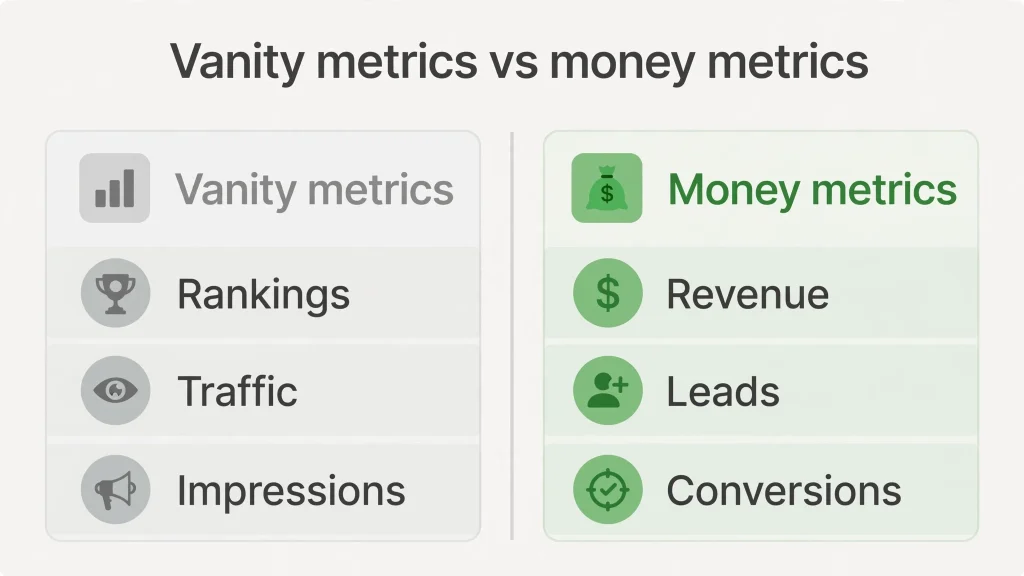
| Decorative metric (glance and move on) | Decision metric (this is the verdict) |
|---|---|
| Total organic sessions | Organic-sourced leads and customers |
| Rankings across all tracked keywords | Rankings for buying-intent keywords |
| Impressions | Click-through rate on money pages |
| Domain authority / domain rating | Revenue attributed to organic search |
| Total backlinks built | Referral traffic quality from earned links |
| Bounce rate in isolation | Conversion rate from organic visitors |
The left column isn’t useless — it’s diagnostic. When the right column drops, the left column tells you where to look. But an agency that reports the left column as the headline is managing your feelings, not your growth. That’s why honest SEO reporting leads with the numbers that matter.
How to Read Your SEO Reporting in 15 Minutes
You shouldn’t need a marketing degree or an hour of free time. Here’s the fifteen-minute routine: This simple approach to SEO reporting saves time without losing insight.
- Minutes 0–2: read the executive summary. One paragraph should tell you: was this month good, bad, or flat — and why. If there’s no summary, that’s finding number one.
- Minutes 2–5: check conversions from organic. Leads and customers first. Compare to last month and to three months ago — direction matters more than any single number.
- Minutes 5–8: scan traffic and buying-intent rankings. Do they support the conversion story? Traffic up with conversions flat means you’re attracting the wrong visitors.
- Minutes 8–11: review work completed. Does the listed work plausibly connect to the results? Big claims with thin work logs deserve questions.
- Minutes 11–15: read next month’s plan. Is it specific? Does it respond to this month’s data? “Continue ongoing optimization” is not a plan — it’s a shrug.
5 SEO Reporting Red Flags
- Rankings only, no traffic or conversions. The oldest agency magic trick: rank for keywords nobody searches, report victory. Demand the full funnel.
- Month-over-month comparisons with no year-over-year context. Many businesses are seasonal — an agency hiding the YoY column is usually hiding something.
- No access to your own data. If you can’t open Search Console and Analytics yourself, the report is the only reality you’re allowed to see. That’s not reporting; that’s storytelling.
- Every month is “great.” Real SEO has flat months and bad months — algorithm updates, seasonality, competitors outspending you. A report that’s never honest about a bad month can’t be trusted about the good ones.
- The plan never changes. Twelve months of identical “next steps” means nobody’s learning anything from the data. The report is a ritual, not a tool.
What Good SEO Reporting Cadence Looks Like
| Cadence | What you should get | Why |
|---|---|---|
| Monthly | The full report: work, results, interpretation, plan | SEO moves too slowly for weekly verdicts, too fast for quarterly ones |
| Quarterly | A deeper review: strategy check, competitive shifts, roadmap for next quarter | Monthly data in a quarterly frame reveals real trends |
| On demand | Direct access to Search Console, Analytics, and rank tracking — anytime | You should never have to ask permission to see your own numbers |
Questions to Ask About Your Next SEO Reporting
Bring these to your next monthly review — the quality of the answers tells you everything about the agency: These questions cut through vague SEO reporting fast.
- Which three numbers best describe this month, and why those three?
- What did we learn this month that changes next month’s plan?
- How many of our organic leads came from buying-intent keywords versus informational ones?
- Is there anything in Search Console or Analytics that contradicts this report?
- If you had to cut one activity next month, what would it be — and what would you double down on?
Ready for reports you can actually read?
If your current reporting looks more like camouflage than clarity, that’s fixable — and it’s one of the first things we fix for new clients. Contact the KKeyQik team and tell us what your reports show today. We’ll tell you honestly what they’re hiding — and what good looks like for your business.
Further reading: our complete guide to SEO services — what’s included, how engagements are structured, and how to choose an agency.
About the KKeyQik Team
KKeyQik is a digital marketing agency helping small businesses grow with SEO, social media marketing, PPC (Google Ads and Meta Ads), web development, video editing, and graphic design. The KKeyQik Team publishes practical, no-fluff guides for business owners who want marketing that pays for itself.
Frequently Asked Questions
Read the executive summary first — one paragraph should tell you whether the month was good, bad, or flat, and why. If there is no summary, that is finding number one. A report that takes more than five minutes to deliver a verdict is failing at its main job.
Impressions almost always trend upward, which makes them a comfortable headline. They are useful as a diagnostic — rising impressions with flat clicks can signal a title-tag or intent problem. But treat them as background data; the verdict comes from leads, customers, and revenue attributed to organic search.
Ask for one. A single paragraph stating whether the month was good, bad, or flat — and why — is the minimum a monthly report owes you. Without it, you are doing the agency's interpretation work for them. If summaries still don't appear after you ask, treat that as information about the agency.
You should. The accounts must be created under your business's ownership with the agency granted access — never the other way around. This way the raw data stays yours if you ever change providers. Any agency that insists on owning your data accounts is a red flag.
Look up the keyword's search intent and volume, and check whether it drove traffic and conversions. A #1 ranking for a term nobody searches, or one with no buying intent, is a vanity win. The keywords worth celebrating are the ones tied to leads — ask the report to show the full funnel for each celebrated ranking.
Compare against the same month last year alongside the month-over-month view. Many businesses are seasonal, and month-over-month alone can make a normal seasonal dip look like a failure — or a seasonal peak look like genius. Year-over-year context is what turns a traffic number into an actual trend.
It names specific actions tied to what this month's data revealed — pages to optimize, content to publish, technical issues to fix — not 'continue ongoing optimization.' The plan is the proof the agency actually read its own report. If the plan never changes month to month, nobody is learning from the data.
Usually not. SEO moves too slowly for weekly verdicts — week-to-week movement is mostly noise. Monthly reporting plus on-demand access to your own Search Console and Analytics is the right cadence. Save the deeper strategic reviews for quarterly.
Worry when flat results come with no explanation, or when leading indicators like impressions and ranking positions are also stalled by month four. A flat month that the report explains honestly — an algorithm update, seasonality, a competitor push — is normal. A flat month nobody can explain is a strategy problem.
Ask which three numbers best describe the month and why, what was learned that changes next month's plan, and whether anything in Search Console contradicts the report. Also ask what they would cut and what they would double down on. The quality of the answers tells you everything about the agency.