
# Crisis Communication: 9 Proven Lessons from Jason Kelce’s Viral ESPN Apology
—
Introduction
On Monday night, September 28, 2026, during halftime of the Bears–Eagles game in Chicago, ESPN analyst Jason Kelce did something broadcasters are never supposed to do — and then did the one thing that made millions of people love him for it.
Kelce, the former Philadelphia Eagles center who spent his entire 13-season NFL career in Philly before retiring in March 2024, has become one of ESPN’s most popular voices on Monday Night Countdown. But in the first half in Chicago, he kept doing the one thing an analyst covering a neutral broadcast must not do: calling the Eagles “we.”
His broadcast partner Pat McAfee finally called him out on it live: “A lot of ‘we’ talk out of Jason for Philly,” McAfee said. And Kelce — no defensiveness, no deflection, no ten-minute explanation — just laughed and said it: “Sorry, sorry, sorry, Bears fans.” Then, almost to himself, he asked: “Did I say we?”
That was it. Five seconds. A mistake owned, a laugh shared, and the moment was over. But by Tuesday morning, US searches for the moment had surged past 20,000 (up 800%), and the clips were everywhere.
Here’s the part that matters for your business: Kelce’s five seconds are a perfect, real-time demonstration of crisis communication done right. He had every incentive to freeze, deflect, or over-explain. Instead he did the exact thing the best brands do when they stumble — and the exact thing most small businesses get wrong. This post breaks down the nine crisis communication lessons inside his apology, plus a 60-minute response playbook you can keep on file for the day your business has its own viral moment.
What Actually Happened on Monday Night
The “we” problem started before kickoff. Speaking with Eagles head coach Nick Sirianni, Kelce said quarterback Jalen Hurts was “playing awesome for us” — then caught himself mid-sentence: “For the Eagles. Should say that. Unbiased media member.” It was charming, self-aware, and it set up everything that followed.
At halftime, with Chicago leading 10-7, Kelce slipped again while analyzing Philadelphia’s first half: “We played really well offensively. We had opportunities. We shot ourselves in the foot, but we’ve moved the ball. We’ve run the ball well.” McAfee’s callout — “A lot of ‘we’ talk out of Jason for Philly” — landed with perfect comedic timing. And Kelce’s response was the masterclass: “Sorry, sorry, sorry, Bears fans,” followed by the genuine, almost sheepish “Did I say we?”
For the record, the Bears went on to win 27-7, with backup quarterback Case Keenum throwing for 247 yards and two touchdowns. The coverage of Kelce’s moment has been uniformly warm — the sports press played it as endearing, not scandalous. Nobody is calling for Kelce’s head. The audience’s verdict was essentially unanimous: that was honest, that was human, we’re fine with it.
So why does a five-second broadcast blooper matter for crisis communication? Because the anatomy of what Kelce did right is identical to what the best companies do when they face real crises — and it exposes, by contrast, every way small businesses typically botch their response.
Why a Five-Second Apology Is a Crisis Communication Case Study
Most crisis communication advice is written for disasters: data breaches, product recalls, executive scandals. But for small businesses, the real threat is smaller and more frequent — a botched order that goes viral on TikTok, a one-star review that gains traction, a tone-deaf post that lands wrong. The stakes are lower than a corporate scandal, but the mechanics are the same: something went wrong, people noticed, and what you do in the next hour determines whether the moment becomes a story about your mistake or a story about your character.
Kelce’s moment had all three ingredients of a classic small-business crisis: it was public (millions watching live), it was his own fault (nobody made him say “we”), and it had a clear affected audience (Bears fans in the stadium and at home). He had no crisis team, no prepared statement, no time. What he had was instinct — and his instinct maps perfectly onto the professional crisis communication playbook. Here are the nine lessons.
Crisis Communication Lesson 1: Speed Beats Perfection — Respond in the Moment
Kelce apologized within seconds of the callout. He didn’t wait for the commercial break to consult with a producer, didn’t issue a statement the next morning, didn’t let the clip circulate for 12 hours while his team drafted language. He responded in the moment, on the air, in real time.
This is the single highest-leverage lesson in crisis communication for small businesses. The first hour after a public mistake is when the narrative forms. Every hour of silence is an hour in which other people — angry customers, competitors, random commentators — get to define what happened and what it means. Kelce understood instinctively what crisis professionals know from research: a fast, imperfect response almost always outperforms a slow, polished one.
For your business, “respond in the moment” doesn’t mean having all the answers instantly. It means acknowledging publicly that you’ve seen the issue, that you take it seriously, and that a fuller response is coming. “We see this, we’re looking into it right now, and we’ll update you within the hour” is infinitely better than 24 hours of silence followed by a perfect press release. Speed signals respect; delay signals indifference.
Crisis Communication Lesson 2: Name the Mistake Plainly — “Sorry, Bears Fans”
Kelce’s apology was three words, directed at exactly the right people. “Sorry, Bears fans.” He named what he did (the “we” slip), he named who it affected (the Bears fans he was implicitly slighting), and he didn’t wrap it in jargon or legal language.
Compare that to the standard corporate non-apology: “We regret that some viewers may have felt that our commentary did not meet the standards of impartiality our audience deserves.” Kelce said the thing in plain words. Small businesses should do the same. “We got your order wrong, and that’s on us” beats “We apologize for any inconvenience that may have been experienced during the fulfillment process” every single time.
Plain language does two jobs at once. First, it proves you actually understand what went wrong — vague apologies read as evasion. Second, it gives people something concrete to accept. An apology for a specific, named mistake can be forgiven. An apology for “any inconvenience” can’t, because nobody knows what you’re actually sorry for.
Crisis Communication Lesson 3: Don’t Over-Explain — Excuses Dilute Apologies
Notice what Kelce didn’t do: he didn’t explain that he’d spent 13 years with the Eagles, that old habits die hard, that he’d been talking to the Eagles’ coach all week, that anyone would have slipped. All true. All irrelevant to the apology. The moment he starts explaining, the apology stops being about the Bears fans and starts being about him.
This is where most small business apologies die. The instinct to add context — “our supplier let us down,” “we were short-staffed,” “the system glitched” — feels like honesty, but it lands as deflection. Research on apologies consistently finds that explanations reduce perceived sincerity: every sentence of context is a sentence that isn’t taking responsibility.
The rule: explain the fix, not the cause. Your customers don’t need the origin story of the mistake; they need to know you own it and what happens next. If there’s genuinely useful context (a product recall with safety implications, say), share it separately, after the apology — not inside it.
Crisis Communication Lesson 4: Let Humanity Do the Heavy Lifting
“Did I say we?” That little aside — genuine, unscripted, a little sheepish — is what turned a blooper into a beloved moment. Kelce didn’t perform contrition; he was just visibly, recognizably human. The laugh in his voice did more work than any scripted statement could.
Small businesses have a structural advantage here that big brands don’t: you are already human-scale. A local shop owner posting a 30-second phone video saying “I messed this up, here’s what I’m doing about it” will outperform any corporation’s crisis statement, because the audience can see a real person. The polish that big companies pay agencies for is actually a liability in a crisis — it reads as managed.
The practical takeaway: when something goes wrong, let the owner or the person responsible speak, in their own voice, on the channel where the complaint is happening. Don’t launder the apology through a social media manager’s template. Authenticity isn’t a tactic — it’s the absence of tactics, and audiences can tell the difference instantly.
Crisis Communication Lesson 5: Allies Amplify the Recovery — Cast Your McAfee
One underrated part of the Kelce moment: McAfee’s callout was affectionate, not hostile. “A lot of ‘we’ talk out of Jason for Philly” was said with a grin, and it gave Kelce the perfect opening — the callout and the apology were a duet, not a duel. If McAfee had been adversarial, the moment could have curdled into genuine controversy.
In business crisis communication, you rarely control the tone of the callout — but you can control your relationships before the crisis. Businesses with strong community ties, loyal customers, and genuine goodwill get the benefit of the doubt; their missteps get framed charitably. Businesses with thin relationships get framed harshly for the same mistakes.
This is the long game of reputation management: the trust you build in calm times is the credit line you draw on in a crisis. Every review you respond to thoughtfully, every community event you show up for, every customer you treat well when nobody’s watching — that’s all crisis insurance. Kelce had 13 seasons of goodwill banked. Your business banks it one interaction at a time, and strong digital marketing keeps that goodwill visible to the people who matter.
Crisis Communication Lesson 6: Match the Response to the Scale — Don’t Nuke a Gnat
Kelce calibrated perfectly: a small mistake got a small, warm apology. He didn’t issue a written statement, didn’t do a sit-down interview about bias in broadcasting, didn’t take a week off to reflect. Proportionality is a crisis communication skill, and he nailed it.
Small businesses routinely fail this test in both directions. Some ignore a brewing problem until it explodes — the one-star review that becomes a thread that becomes a local news story. Others detonate a full crisis response over a trivial complaint, which signals to everyone watching that the business is rattled and the complaint must be worse than it is.
The calibration rule: match the channel, the seniority, and the depth of the response to the scale of the harm. A single unhappy customer gets a direct, personal reply — not a public statement. A problem affecting hundreds of customers gets a public post and a named contact. A genuine safety or legal issue gets the full treatment. When in doubt, ask: “What would the reasonable customer expect here?” — and do that, not more.
Crisis Communication Lesson 7: Bank Reputational Capital Before You Need It
Why did the audience forgive Kelce instantly? Because he’d spent years being exactly the kind of person whose mistakes get forgiven: self-deprecating, hardworking, visibly decent. The apology worked because the audience’s existing model of Kelce was “good guy who slipped,” not “arrogant guy finally caught.”
For businesses, this is the argument for consistent, visible, values-driven marketing in the good times. The brands that survive crises aren’t the ones with the best crisis plans — they’re the ones whose customers already believe the best about them. A business with 500 genuine five-star reviews and an active, human social presence can absorb a viral complaint. A business with no reviews, no content, and no community presence has nothing to absorb it with.
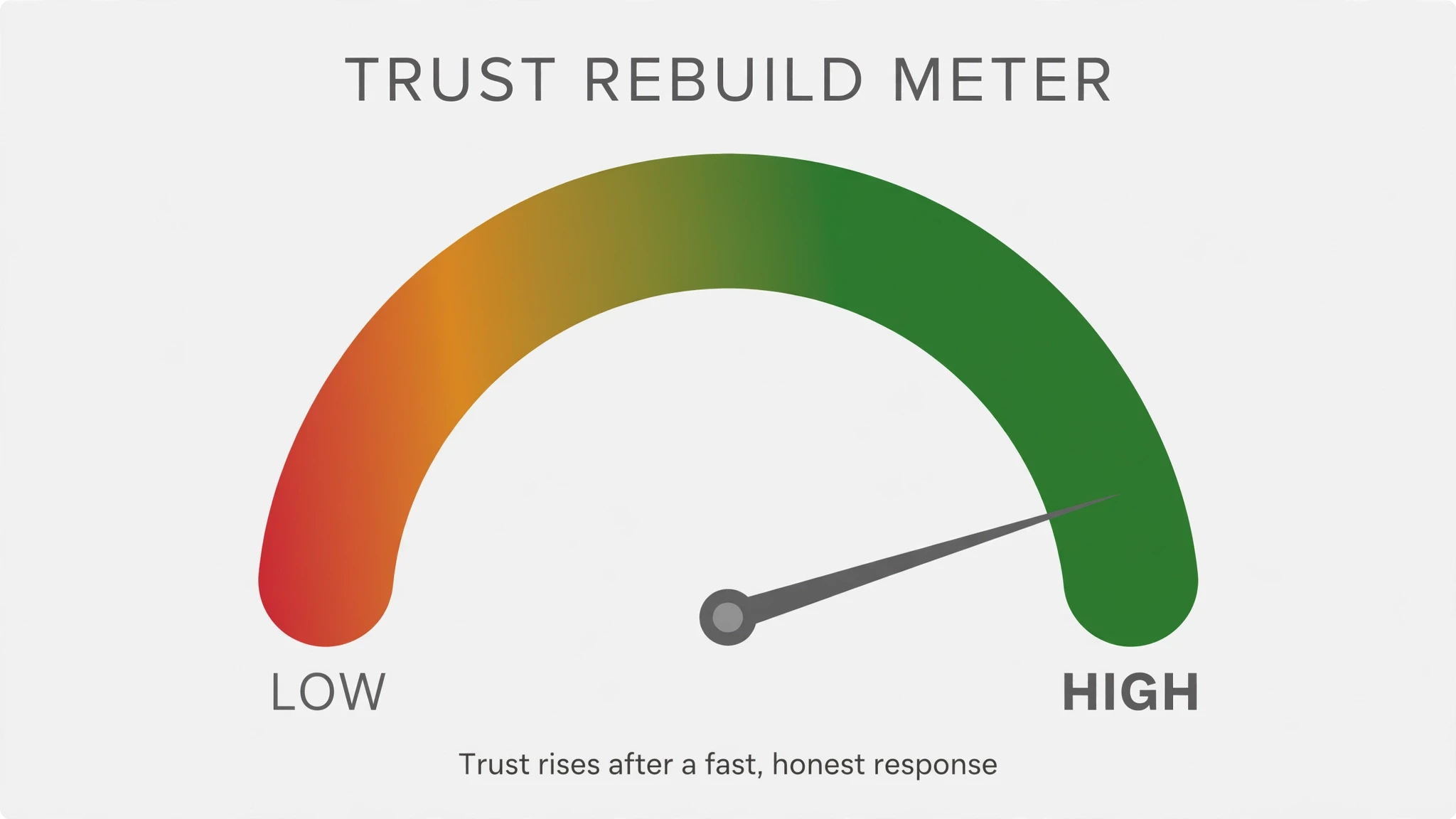
Practically: publish regularly, respond to every review (good and bad), show the humans behind the business, and be visibly useful to your community. That’s not “content marketing” — that’s a trust account, and every deposit compounds. Professional SEO and content work builds the same account in search results: when someone Googles your business mid-crisis, what they find is the reputation you’ve built, not just the complaint.
Crisis Communication Lesson 8: Fix the System, Not Just the Symptom
Here’s the part of the story nobody talks about: Kelce self-corrected before the big moment. Remember the pre-kickoff slip — “playing awesome for us” — followed by his own correction: “For the Eagles. Should say that. Unbiased media member.” He was already building the habit of catching himself. The halftime apology wasn’t a one-off performance; it was part of a pattern of self-awareness.
That’s the difference between crisis communication and crisis management. Communication handles the moment; management fixes the system so the moment doesn’t repeat. After any public stumble, the businesses that recover fastest are the ones that can point to a concrete change: the new double-check step, the revised policy, the retrained team, the fixed process.
Your post-crisis checklist should always end with: “What changed so this doesn’t happen again?” Then say it publicly. “Here’s what we’re doing differently” is the sentence that converts skeptics — because an apology addresses the past, but a fix addresses the future, and customers care far more about the future. (This is also the playbook we used when covering how AI agents are changing marketing operations — the winners are the businesses that build systems, not just responses.)
Crisis Communication Lesson 9: Own the Narrative — Turn the Moment into Content
The final lesson is the most counterintuitive: the best crisis communicators don’t just survive the moment — they convert it. Kelce’s blooper is now part of his legend; it’s a clip that humanizes him further and deepens the audience’s affection. The mistake became content.
Small businesses can do a version of this. The restaurant that handles a viral complaint gracefully and then posts about what it learned. The retailer that turns a shipping fiasco into a behind-the-scenes look at its new fulfillment process. The service business that writes the honest “here’s what went wrong and what we changed” post. This isn’t spin — it’s transparency as marketing, and it works because audiences reward honesty with loyalty.
Handled well, a crisis becomes proof of character — evidence, in public, that your business does the right thing under pressure. Nothing sells trust like a business that has visibly earned it. That’s why a crisis communication plan isn’t just defensive; it’s one of the highest-ROI marketing assets a small business can own.
The Small Business Crisis Communication Playbook: Your First 60 Minutes
Theory is nice; a checklist is better. Tape this to the wall (metaphorically or literally). When something goes wrong publicly, here’s your first hour:

Minutes 0–5: See it, don’t hide from it. Acknowledge the issue where it’s happening. A short public reply — “We see this, we take it seriously, we’re on it right now” — buys you the most valuable crisis asset there is: time without speculation. Silence is also a statement; make sure yours isn’t “we don’t care.”
Minutes 5–20: Get the facts, name a human. Find out what actually happened. Designate one spokesperson — ideally the owner or the person closest to the issue — and route everything through them. Mixed messages from multiple staff accounts are how small crises become big ones. Draft the real response: what happened (one sentence), who’s affected, what you’re doing now.
Minutes 20–60: Respond, fix visibly, commit. Post the response in the owner’s voice, on the channel where the issue lives. Name the mistake plainly (Lesson 2), skip the excuses (Lesson 3), say what changes (Lesson 8). Then do the visible fix — the refund, the callback, the corrected order — and say so publicly. End with a commitment: what you’ll do differently, and when you’ll follow up.
After the hour: follow through on every commitment, document what changed, and — once the dust settles — consider Lesson 9. The post-mortem post, done honestly, is how a bad week becomes a brand asset. For ongoing reputation work, our data breach recovery guide covers the same principles applied to the highest-stakes scenario of all.
When Not to Apologize Like Kelce
One honest caveat: Kelce’s approach works for mistakes, not for misconduct. If your business is accused of something serious — discrimination, fraud, safety failures — the playbook changes. Don’t improvise; get professional counsel before you speak publicly, because anything you say can have legal consequences. Apologizing for a shipping error builds trust; apologizing for something you did deliberately and correctly — a policy enforced fairly, a price that reflects your costs, a value your business genuinely holds — erodes it. Never apologize for your values to appease a mob. The Kelce method is for genuine mistakes, owned by decent people. Know which situation you’re in before you open your mouth.
Conclusion: The Five Seconds That Matter
Jason Kelce will call the Eagles “we” again — old habits from 13 seasons don’t die in one broadcast. But it won’t matter, because he showed the audience who he is in the five seconds after the mistake. Fast, plain, human, proportional, and already fixing the habit. That’s the whole of crisis communication in one halftime moment.
Your business will have its own “we” moment. A bad review will go semi-viral. A post will land wrong. An order will go sideways in public. The businesses that get destroyed by a single viral complaint are rarely destroyed by the complaint — they’re destroyed by the 48 hours of silence, deflection, and over-lawyering that follow it. The businesses that thrive are the ones that respond like Kelce: see it in five seconds, own it in plain words, fix it visibly, and turn the recovery into proof of character.
Crisis communication isn’t a PR department. For a small business, it’s a reflex — and reflexes are built by preparation, not by panic. Build the 60-minute playbook now, bank the reputational capital daily, and when your moment comes, you’ll already know the words: sorry, [your customers’ name here]. Then get to work.
If your business wants that reflex built in — reputation monitoring, review response systems, and a crisis communication plan that’s ready before you need it — KKeyQik helps small businesses manage their reputation and marketing with the same discipline — from social media management to full digital strategy. And if this breakdown was useful, our social media management resources go deeper on keeping your public channels healthy day to day.
—
Frequently Asked Questions
During halftime of the September 28, 2026 Bears–Eagles game in Chicago, ESPN analyst Jason Kelce repeatedly called the Eagles "we." Co-host Pat McAfee teased him — "A lot of 'we' talk out of Jason for Philly" — and Kelce immediately laughed and said "Sorry, sorry, sorry, Bears fans," then asked "Did I say we?" The five-second moment went viral, with US searches for it topping 20,000 overnight.
Crisis communication is the plan and practice of responding clearly, quickly, and honestly when something goes wrong in public — a bad review going viral, a service failure, a tone-deaf post. For small businesses it usually means the owner responding directly, in their own voice, on the channel where the problem is happening.
Within the first hour. You don't need all the answers instantly — a short public acknowledgment ("we see this, we're on it, update within the hour") stops speculation and shows respect. Every hour of silence lets others define the narrative for you.
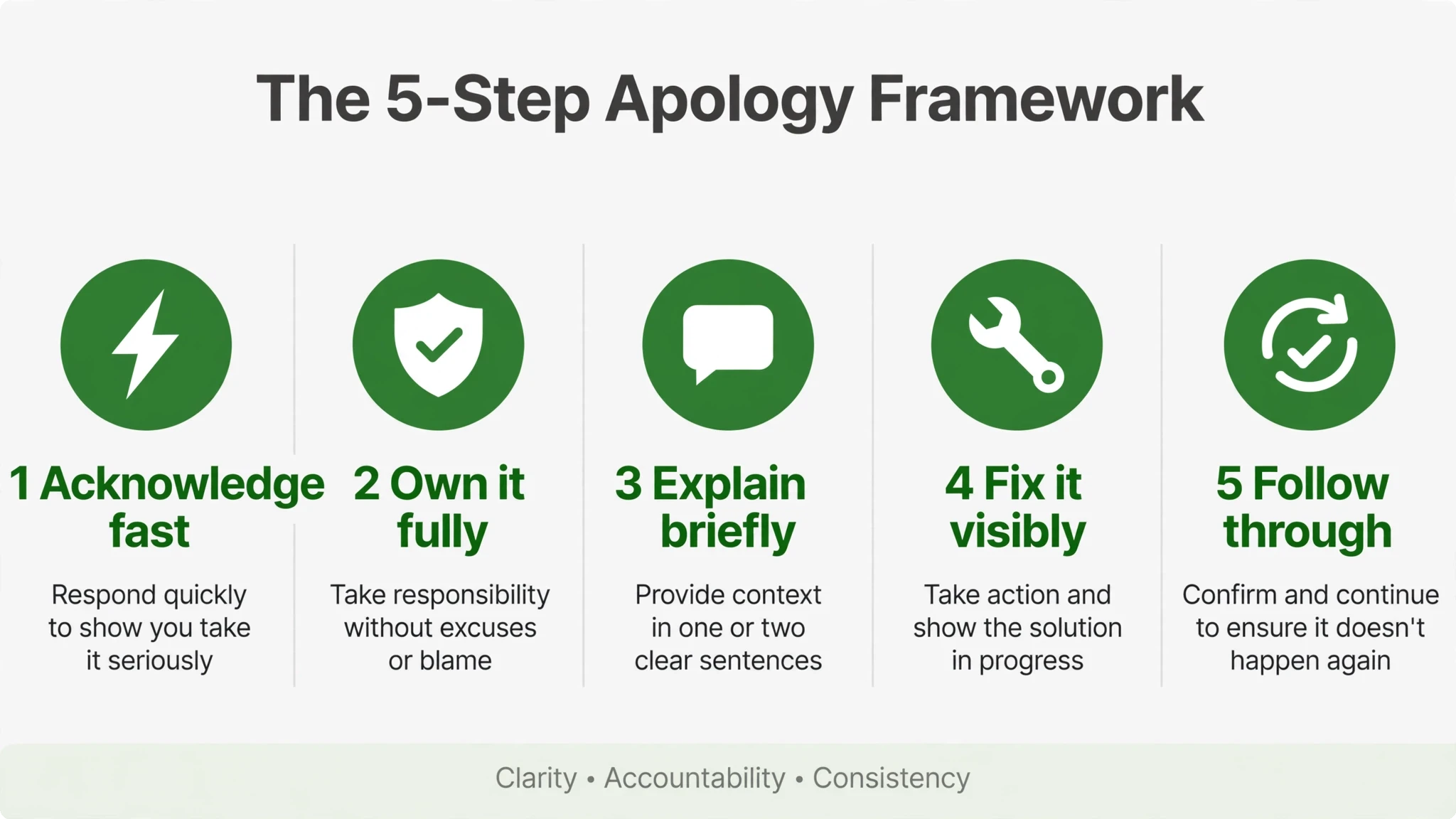
Five: acknowledge fast, name the mistake in plain words, skip the excuses, describe the visible fix, and follow through on every commitment. Kelce's "Sorry, sorry, sorry, Bears fans" hit the first two in under five seconds.
Reach out privately to the people directly affected first, but post publicly when the audience is public. If the complaint is on social media or review sites, your public response is being read by future customers too — treat it as both an apology and a demonstration.
Acknowledge it publicly without arguing, move the conversation to a private channel to resolve it, then post the outcome. Never delete negative comments or attack the reviewer — both escalate the situation and damage trust with everyone watching.
Waiting too long, using vague corporate language ("we regret any inconvenience"), adding excuses that sound like deflection, responding through a template instead of a human voice, and overreacting to small issues with a full crisis response — which makes the problem look bigger than it is.
Yes, when handled well. A fast, honest, well-documented recovery becomes public proof of character — customers trust businesses that have visibly done the right thing under pressure. Many brands earn more loyalty from a graceful recovery than from never stumbling at all.
Don't apologize for misconduct-level accusations without professional counsel first, and never apologize for your values — a fairly enforced policy or a sincerely held position — just to appease critics. The Kelce-style fast apology is for genuine mistakes, not for deliberate decisions you stand behind.
A designated spokesperson (usually the owner), a clear decision chain, pre-drafted acknowledgment templates, social and review monitoring, and a 60-minute response playbook: acknowledge in 5 minutes, gather facts by 20, respond and commit to a fix by 60. Review and rehearse it before you need it.