
Introduction
On Tuesday, September 29, 2026, OpenAI's annual DevDay in San Francisco opened with CEO Sam Altman on stage announcing something that sent US search interest in "openai dots" up 700% within hours: always-on AI agents called OpenAI Dots, powered by the company's new flagship model GPT-6 Astra, that keep working on your behalf around the clock — even when you've closed the chat window.
This isn't another chatbot. OpenAI Dots are persistent digital coworkers: they get their own cloud computer and browser, connect to more than 4,000 business apps, take instructions through ChatGPT, Slack, or Microsoft Teams, and pursue user-defined goals in the background with minimal supervision. You give your primary dot a name, set its objectives, and it keeps executing — monitoring, drafting, updating, and reporting back.
For small business marketing, the implications are enormous. Marketing has always been a race between ambition and bandwidth: you know you should be publishing consistently, watching competitors, responding to reviews, and optimizing campaigns weekly — but there are only so many hours in the day. OpenAI Dots doesn't just make those tasks faster; it removes the "you have to be there" requirement entirely.
This post explains what OpenAI Dots actually is, how it compares to Meta's Muse agent (the other giant move of September 2026), and — most importantly — seven practical ways always-on AI agents will change how small businesses market themselves. If you'd rather have a team that already thinks this way, KKeyQik helps small businesses turn new marketing technology into measurable growth.
What OpenAI Dots Actually Is
Before the tactics, the facts — because the OpenAI Dots launch was part of a much bigger package, and the details matter for marketers.
Always-on, goal-driven agents. Unlike a conventional ChatGPT conversation that sits idle until you send the next prompt, OpenAI Dots are designed to continue working independently. OpenAI describes them as "remarkably capable, always-on agents built to handle everything." A dot can run 24/7, learn from your feedback over time, and operate its own computer and browser. Think of it less like a search box and more like an assistant you brief in the morning and check in with in the afternoon.
Powered by GPT-6 Astra. OpenAI Dots run on OpenAI's flagship model GPT-6 Astra, which the company describes as its most capable model to date — optimized for complex multi-step work, computer use, browsing, coding, and professional workflows. It was introduced earlier this month, specifically tuned for the kind of sustained, tool-heavy execution that agentic work demands.
Works inside the tools you already use. OpenAI Dots live inside ChatGPT (mobile app and website) and can be launched from Codex or ChatGPT. But OpenAI is taking them to where business communication already happens: users can message their OpenAI Dots through Slack and Microsoft Teams, with text-message support on the way and voice interaction planned. Sam Altman also said Dots will eventually be reachable over the phone as an audio model.
Connected to 4,000+ applications. Through OpenAI's plugin ecosystem, OpenAI Dots can connect to more than 4,000 services. That is the key detail for marketers: the agent isn't limited to information inside ChatGPT. It can pull data from your CRM, check your ad accounts, draft in your docs, and post-ready content into your content tools — handling work that spans multiple services.
Teams of specialists, not one generalist. You start with a primary dot, give it a name, and make it your own. Over time, OpenAI envisions "teams of Dots working together on your behalf" — individual dots provisioned with specific identities, credentials, and tools. "By giving Dots their own identities, they become an extension of our team," said Holly Li, a member of OpenAI's product team, at the keynote. OpenAI is already working with Microsoft to integrate OpenAI Dots into the company's Agent 365 security controls — a signal that enterprise governance is part of the plan from day one.
ChatGPT Space: the shared workspace. Alongside OpenAI Dots, OpenAI announced ChatGPT Space — a collaborative layer where employees, ChatGPT, Codex, and OpenAI Dots work from the same shared context. Space replaces ChatGPT's existing Library for Pro, Business, and Enterprise users, and hosts Pages (living documents that people and dots co-author together), files, presentations, and spreadsheets. Slides for joint slide-deck editing arrive in the coming weeks.
The fine print. OpenAI Dots are initially available to ChatGPT Pro and Business Premium subscribers in eligible markets, with Enterprise, Education, and Healthcare betas rolling out when workspace administrators enable them. DevDay also brought an Ultrafast mode (up to eight times faster token generation in Codex, six times via the API), an enterprise Marketplace with 32 launch partners including Adobe, Salesforce, and Figma, and "Sign in with ChatGPT" for partner services. In total, OpenAI said DevDay 2026 delivered more than 20 major announcements.
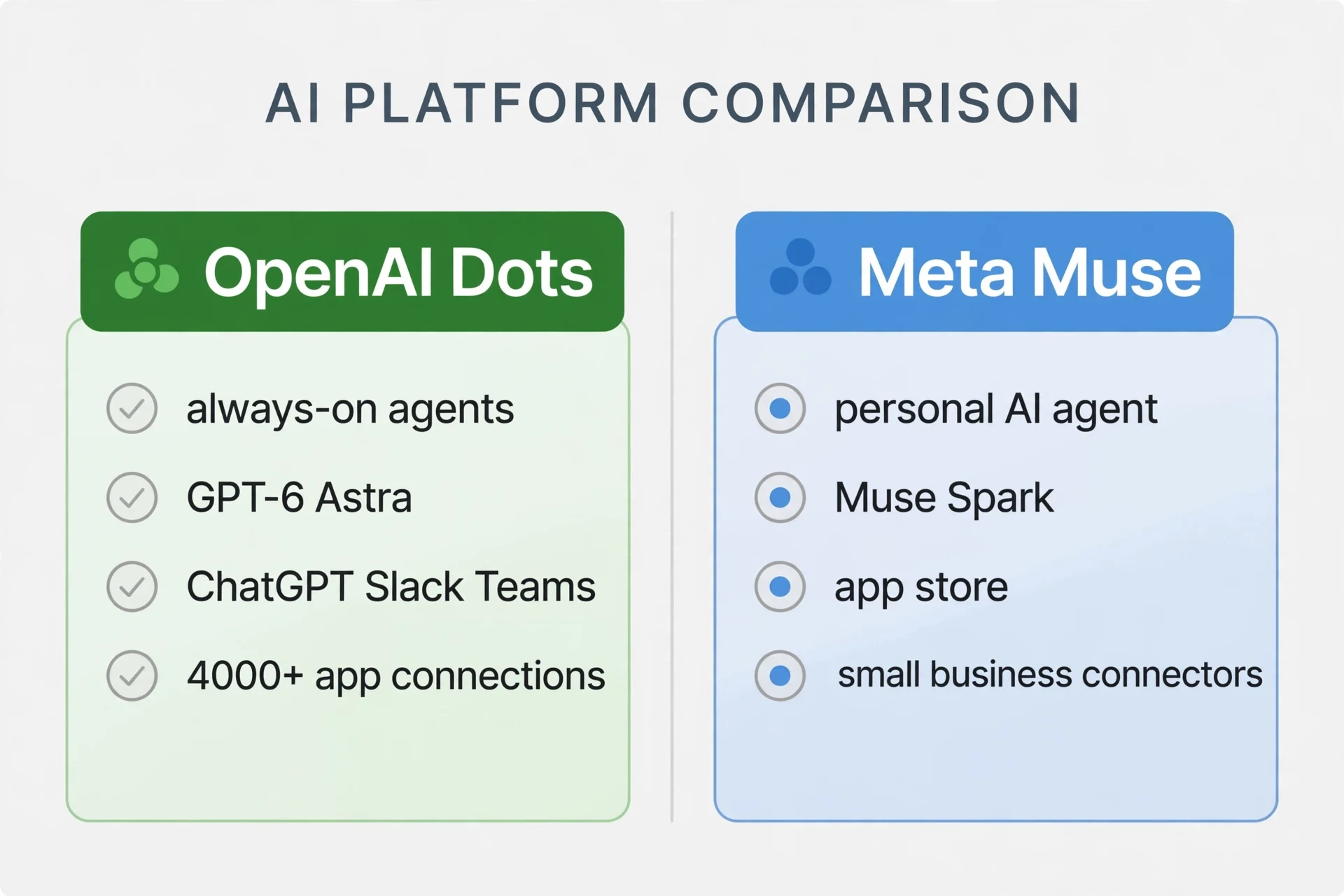
OpenAI Dots vs Meta Muse: The Other Giant Move
OpenAI isn't alone in the agent race — and for marketers, the competition is the most useful part of the story, because it's already reshaping how customers discover and buy.
Meta launched Muse, its personal AI agent, on September 8, 2026 (muse.ai, iOS, Android, web, US rollout). Muse runs on Muse Secure VM — its own dedicated cloud computer with its own browser — powered by Meta's Muse Spark model, and it's designed to complete long-running tasks rather than answer queries in a single exchange. Users name their agent, set its avatar and communication style, and a permissions system called Sentinel governs which services it can reach.
Muse exploded. It hit the top of the US App Store within days, passing ChatGPT. The market reaction to the Muse launch was strongly positive. On September 23, Meta's Connect event added a Realtime Avatar model for video conversations, macOS app control, the agent's own email address, Muse Charm (a palm-sized device for using the agent away from a phone), and smart-glasses support — plus commerce partners including Stripe, Shopify, Best Buy, Walmart, Wayfair, Expedia, and Instacart.
Then, on September 29 — the same day as DevDay — Meta announced Muse for Small Business: new business skills and app connectors including Asana, Canva, Dropbox, Figma, HighLevel, Intuit QuickBooks, Klaviyo, Notion, Shopify, Slack, Stripe, and Zoom, plus direct connections to Instagram business analytics, Facebook Pages, and Meta ad accounts. Meta says Muse can be given a goal — "run my business" or "find me new customers" — and will keep working toward it, returning when something changes or needs approval. Notably, Meta also says Muse will not publish content, send messages, or make purchases without a user's approval.
Put the two announcements together and the pattern is unmistakable: September 2026 is the month AI agents went mainstream. For marketers, that's not a tech story — it's a go-to-market story. OpenAI Dots and Muse are two agent ecosystems, each with their own browser and cloud computer, are now reading the open web on behalf of users and buyers. How your business shows up to an agent is about to matter as much as how it shows up to a human.
From Prompt → Response to Goal → Execution: How AI Agents for Marketing Work
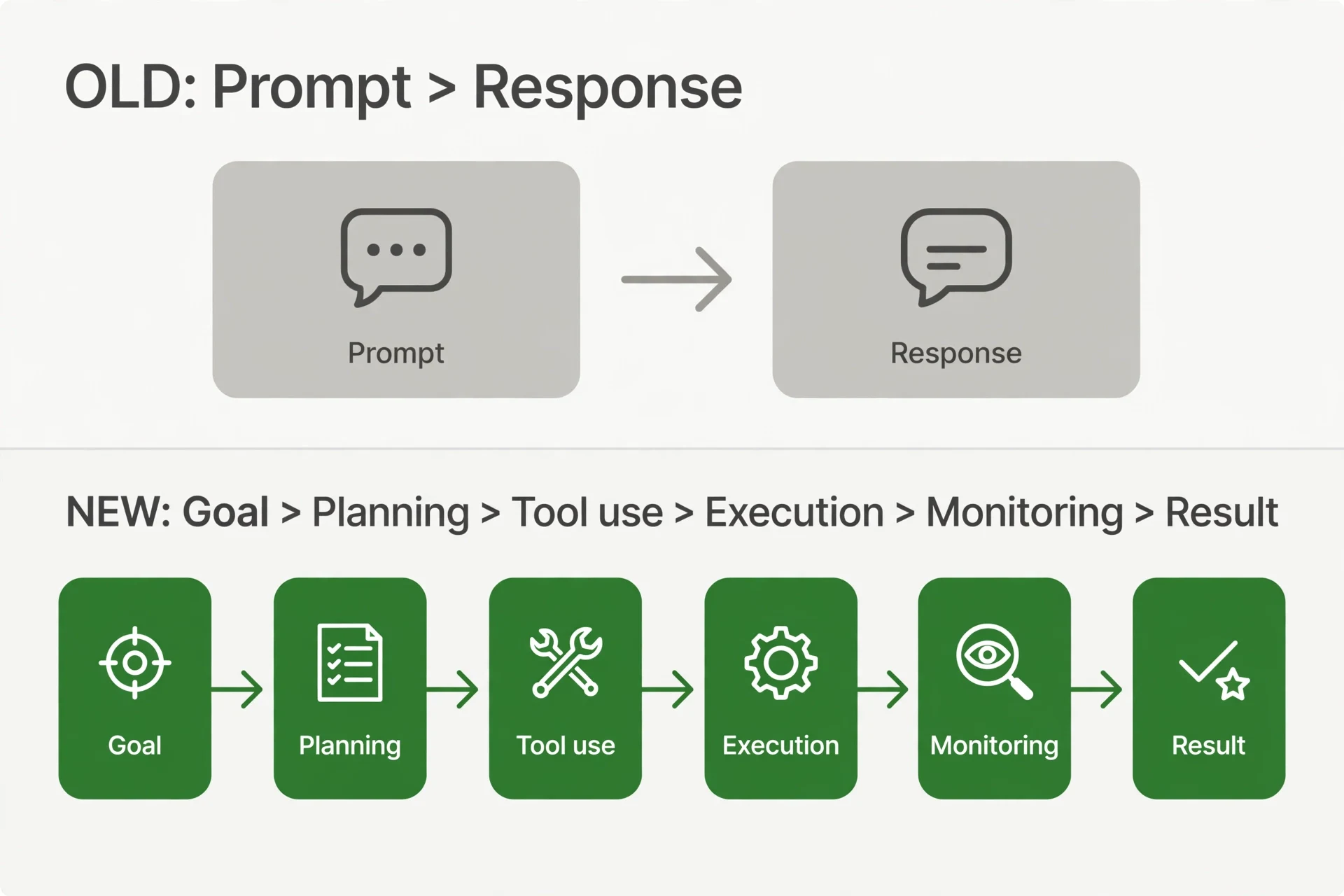
The deeper shift — and the reason this deserves a full marketing post rather than a news recap — is architectural. The traditional AI workflow is Prompt → Response: you ask, it answers, you act. The agentic workflow is closer to Goal → Planning → Tool use → Execution → Monitoring → Result. That distinction is what makes OpenAI Dots a marketing event, not just a tech launch.
Marketing is full of goal-shaped work: "keep our review ratings above 4.5," "never let a hot lead wait more than an hour," "publish three useful posts a week," "tell me when a competitor changes pricing." These are standing objectives with continuous monitoring and periodic execution — exactly the shape of work agents are built for. A chatbot can draft your email; only an always-on agent can watch your inbox for the trigger, draft the email when it fires, queue it for your approval, and send the weekly summary of what went out.
That is the lens for the seven use cases below. Each one pairs an OpenAI Dots capability with a marketing job small businesses actually need done — and each one is the kind of workflow agencies like ours are already designing around. See how KKeyQik approaches marketing for small businesses.
1. Always-On Social Listening and Brand Monitoring
Social listening used to be a line item in an agency retainer or a dashboard nobody opened. With OpenAI Dots, it becomes a standing assignment: "watch the web for every mention of our brand, our competitors, and our top five category keywords — summarize what's new every morning at 8."
Because OpenAI Dots operate their own browser and learn from feedback, they can roam review sites, forums, social platforms, and news coverage continuously, then surface only what matters. The demo scenarios OpenAI showed — a developer's dot monitoring customer feedback and implementing fixes as needed — map directly onto marketing: an OpenAI Dots agent that watches sentiment around your brand, flags a negative review within minutes, and drafts a response in your brand voice for your approval.
The economics matter here. Previously, 24/7 monitoring required either a big budget or a tool stack with six integrations. An always-on OpenAI Dots agent collapses that into a single briefing: set the objective once, refine its judgment with feedback, and let it run. For a small business, that's enterprise-grade listening without the enterprise retainer. It's also a natural complement to the kind of social media management work that compounds over time — the agent watches, the humans decide the narrative.
2. 24/7 Content Drafting Across Channels
Every small business knows content is the compounding engine of marketing. Every small business also knows it can't keep up. This is where always-on agents like OpenAI Dots change the math most visibly.
Brief a specialist OpenAI Dots agent on your audience, your offers, and your voice — then give it a standing objective like "keep a queue of ten ready-to-review posts at all times." It can draft blog outlines from trending topics, turn one blog post into platform-native versions for LinkedIn, Instagram, and X, and maintain the calendar in ChatGPT Space's Pages while you sleep. When OpenAI showed Dots creating websites and slide decks during the keynote, it was demonstrating exactly this muscle: sustained, multi-step creative production without hand-holding.
The honest version of this, though, is that drafting is the easy part — the hard part has always been consistency and quality control. Agents solve consistency; quality control stays human. The businesses that win here will be the ones that treat their dot like a junior copywriter: clear briefs, firm editorial standards, and an approval gate before anything publishes. That mirrors how strong AI-assisted marketing content is already being produced — machine speed, human judgment.
3. Ad Campaign Monitoring and Budget Guardrails
Paid media is the cruelest test of attention: budgets burn whether you're watching or not. Meta's Muse-for-Small-Business announcement explicitly includes connections to Meta ad accounts — and OpenAI's Dots, with 4,000+ app connections, will follow the same path. The use case writes itself: with OpenAI Dots connected to your stack, your brief becomes "watch my ad accounts; alert me the moment cost-per-lead rises 20% above the weekly average, pause anything spending without converting, and send me a Monday summary of what changed."
This doesn't replace media-buying strategy — deciding where to advertise and what to say is still judgment work. But the monitoring layer, which currently eats hours of dashboard-checking or goes undone entirely, becomes continuous and automatic. For small advertisers, the value is asymmetric: a single caught budget leak can pay for the effort many times over. If you're running Google Ads or Meta Ads with a lean team, an always-on watcher is the closest thing to hiring a night-shift media buyer.
One caveat worth stating plainly: give the agent alert-and-recommend permissions before you give it pause-and-spend permissions. Meta's own line — Muse won't publish, message, or purchase without approval — is the right default posture for any agent touching ad spend.

4. SEO Monitoring and Content Gap Tracking
Search has always rewarded the patient: track rankings, watch competitors, fill content gaps, repeat. It's also exactly the kind of continuous, multi-tool work OpenAI Dots is built for.
A marketing agent powered by OpenAI Dots — with browser access and app connections — can monitor your target keywords, check where competitors are publishing new content, flag technical issues on your site, and maintain a running list of topics your competitors cover that you don't. Give it the objective "keep our content gap analysis current" and it becomes a research analyst that never sleeps — surfacing, for example, that two competitors just published buyer's guides for a keyword you rank on page two for.
This pairs naturally with professional SEO for small business: the agent does the watching and the first-draft research; the strategist decides which gaps are worth filling and writes the content that actually deserves to rank. It's the same division of labor that makes AI content tools useful rather than dangerous — automation for detection, expertise for action.
And there's a second, stranger SEO implication hiding in this story: agents are now a search audience. Dots and Muse browse the open web on behalf of users — reading sites, comparing products, and completing purchases (Meta's commerce stack already includes Stripe, Shopify, and PayPal). The completeness and clarity of your product information across your own site and third-party listings is literally what these agents have to work with when comparing options for a buyer. Clean structured data, unambiguous pricing pages, up-to-date FAQs, and consistent business listings stop being nice-to-haves and become the raw material of agent-mediated discovery.
5. Lead Follow-Up That Never Sleeps
Speed-to-lead is one of the most researched numbers in sales: respond fast and conversion jumps; respond late and the lead is gone. Small businesses lose to this constantly — not because they don't care, but because the owner is on a job site, in a meeting, or asleep.
Always-on agents like OpenAI Dots attack this directly. An OpenAI Dots agent connected to your CRM and inbox can watch for new inquiries, draft personalized first responses in your voice, qualify with a few smart questions, and book the prospect into your calendar — all before you've had your coffee. OpenAI's own examples (an OpenAI Dots agent that keeps working after the employee closes the chat window, "bringing completed work back for approval") describe exactly this loop: act, then surface for human sign-off.
The critical design choice is the approval boundary. Auto-drafting is safe; auto-sending first-touch sales messages is where brand risk lives. The sensible setup: the agent prepares and queues, you approve from your phone in seconds. You still get the speed; you keep the judgment. For businesses where every lead matters, that's a genuine competitive edge — and it's precisely the kind of workflow a results-focused agency should be helping you design.
6. Review Management and Reputation Response
Reviews are the front door of local business, and they're brutal in their asymmetry: one unanswered one-star review does more damage than ten answered five-stars do good. Yet most small businesses respond to reviews in bursts — when someone remembers, usually weeks late.
A standing objective — "watch our Google, Yelp, and Facebook reviews; draft a response to every new review within two hours, in our voice, for my approval" — turns reputation management from a chore into a system. The agent drafts; you approve with one tap. Because OpenAI Dots learn from feedback, the drafts get better: it learns which complaints get the refund offer, which get the empathetic public response, and which get escalated to you directly.
There's a trust angle here that marketers shouldn't miss. In a market where AI-generated everything is making consumers more skeptical, a business that responds to every review — fast, personally, and consistently — signals something no agent can fake: that there's a human who cares on the other side. The agent is the delivery mechanism; the care is still yours. That's also why pairing this with solid local SEO foundations matters — reviews feed the rankings that feed the reviews.
7. Competitive Intelligence and Trend Spotting
The final use case is the one most small businesses never get to: a real competitive-intelligence function. Big companies pay for this; small ones rely on gut feel and the occasional glance at a competitor's Instagram.
Give an OpenAI Dots agent the objective "track our five biggest competitors; tell me weekly what they launched, what they're promoting, and what their customers are saying" and you have something close to a junior analyst on permanent duty. It can watch pricing pages for changes, monitor their content cadence, summarize their reviews for recurring complaints (which are your positioning opportunities), and flag category trends before they hit your feed.
This is also where the OpenAI-vs-Meta dynamic becomes practical intelligence rather than tech gossip. September 2026 taught us that platform shifts can arrive in weeks, not years: Muse went from launch to the top of the App Store in days; Dots went from announcement to 700% search growth in hours. A standing trend-watch objective means you hear about the next platform shift from your agent on day one, not from a competitor's case study in month six. Staying current with marketing technology is no longer optional homework — it's a standing assignment you can delegate.
AI Agents for Small Business Marketing: 5 Moves to Get Your Business Agent-Ready
Agents reward prepared businesses and punish messy ones. An OpenAI Dots agent can only work with what it can read, reach, and understand. Five moves put you ahead of the curve:
1. Clean up your public information. Agents browse the open web and compare options. If your hours, services, and contact details are inconsistent across Google, Yelp, and your own site, the agent's summary of you will be wrong. Consistency is the new SEO.
2. Structure your content for machine reading. Clear headings, real FAQs, schema markup, and product pages that state plainly what you sell and who it's for. The businesses that are easiest for agents to understand will be the ones agents recommend.
3. Set approval gates before you automate. Follow Meta's default: no publishing, messaging, or spending without human approval. Give the agent read-and-draft access first; widen permissions only after it earns trust.
4. Pick one workflow to pilot. Don't try to automate everything with OpenAI Dots at once. Social listening, review responses, or lead follow-up — one standing objective, one month, measured results. Then expand.
5. Keep strategy human. Agents execute objectives; they don't set them. Positioning, brand voice, which customers to chase — that's still the work of people who understand the business. The winners won't be the businesses with the most agents; they'll be the businesses with the clearest objectives.
The Honest Caveats About the OpenAI Dots Launch
A 700% search spike doesn't make a technology risk-free, and a marketing blog would be doing you a disservice to skip the cautions:
Security and permissions come first. OpenAI Dots get their own identities, credentials, and tools — which is powerful and, if misconfigured, dangerous. OpenAI's work with Microsoft on Agent 365 security controls and Meta's Sentinel permission system both exist because always-on agents with broad access need adult supervision. Start narrow.
Accuracy still needs a human in the loop. Agents browse, summarize, and draft — and they can be confidently wrong. Every public-facing output needs an approval gate until the agent has proven itself on your data, in your domain.
Don't build your house on one platform. OpenAI and Meta are racing, which means capabilities, pricing structures, and access rules will shift. Build your workflows around objectives and data you own, not around one agent's current feature set.
The human edge compounds. As agents make execution cheap, the scarce resource becomes judgment: which objectives matter, what your brand stands for, when to break the pattern. That's not going away — it's becoming more valuable.
Conclusion
OpenAI Dots is the clearest signal yet that marketing is shifting from software you drive to agents you hand objectives to. The businesses that benefit won't be the ones with the biggest AI budgets — they'll be the ones with the clearest objectives, the cleanest public presence, and the discipline to keep humans in the approval loop.
September 2026 will be remembered as the month AI agents went mainstream: Muse topping the App Store, OpenAI Dots launching at DevDay, and search interest spiking 700% overnight. The question for your business isn't whether agents will reshape marketing — it's whether you'll have your standing objectives set before your competitors do.
If you want help turning this shift into a working system — agent-ready content, review and lead workflows, and campaigns that actually convert — talk to the team at KKeyQik. We spend our days making new marketing technology practical for small businesses, and we'd rather you be ahead of the curve than catching up to it.
Frequently Asked Questions
The best fit is a business with repetitive standing work — review responses, listing updates, lead follow-up — and an owner who can approve drafts in batches. If your processes are already written down, an agent can run them; if everything is ad hoc, the agent will just automate the confusion. Document the workflow first, then delegate it.
ChatGPT is reactive: it waits for a prompt and answers. OpenAI Dots are proactive: they keep working in the background on standing objectives, plan multi-step sequences, use tools on your behalf, connect to thousands of business applications, and learn from your feedback over time.
Practical uses include social listening and alerts, drafting and polishing marketing content, monitoring ad performance, tracking SEO metrics, following up with leads, drafting review responses, keeping content briefs current, and reporting on competitors — all running as standing objectives.
Start with where your team already works: if daily operations run through Slack or Teams, Dots fits the flow; if marketing runs heavily through Meta’s ad and social stack, Muse’s connectors matter more. Many businesses may end up using both for different jobs. Either way, run the same approval-gate discipline on both.
OpenAI Dots launched with connections to more than 4,000 applications through an open plugin ecosystem, and they operate natively inside ChatGPT, Slack, and Microsoft Teams. Additional access via SMS and voice is expected in the coming months.
Access is rolling out first to ChatGPT Pro and Business Premium subscribers in eligible markets, with Enterprise, Education, and Healthcare availability in beta through workspace administrators. Broader availability is expected to follow.
It is manageable if you follow the same discipline as any new team member. OpenAI Dots are built with distinct identities, credentials, and permissions; Microsoft is integrating them with its Agent 365 security platform. The safest approach is to start agents on read-and-draft permissions, set clear approval gates for anything public or customer-facing, and review their work while you learn their limits.
Agents perform best when they see the same context as the people they are working with — documents, decisions, and past activity in one shared workspace. Without it, you spend half your time re-briefing the agent on things the team already knows. Shared workspaces turn one-off prompts into standing objectives the agent can actually maintain.
Agents change what marketing teams spend their time on, but they don't remove the need for them. Dots execute standing objectives — monitor, draft, analyze, optimize — while strategy, positioning, brand voice, and final approvals stay with people. The businesses that benefit most will be those with the clearest briefs, tightest standards, and best judgment about when to step in.
Giving the agent broad permissions before it has earned trust — publishing, spending, or messaging without a human gate. Start with read-and-draft access for a single workflow and widen permissions only after a month of clean results. The businesses that struggle with agents usually skip this boring middle step.