

Introduction
The Getty Images delisted saga began on September 29, 2026, when the New York Stock Exchange started delisting proceedings against the company that spent three decades selling the world its pictures. Trading in GETY shares was suspended immediately, and the stock now changes hands on the over-the-counter market for roughly eight cents a share, down more than 99% from its listing. The company that once defined commercial photography is in confidential talks with lenders about rescue financing that could end in a lender takeover through bankruptcy.
For marketers, this is not a finance story. It is the most important business case study of the AI era so far: the first great content empire to be eaten by the technology it tried to fight in court. Getty Images did almost everything a legacy brand is told to do when disruption arrives — it protected its intellectual property aggressively, sued the AI company that trained on its images, and even licensed its library to AI firms. It still got delisted.
Below are eight marketing lessons from the Getty Images delisted saga — what AI disruption marketing really looks like when it stops being a conference topic and starts being a delisting notice, and what your business should do about it this quarter. If you’d rather have a team that lives this stuff build your content strategy, KKeyQik helps businesses turn disruption into a growth advantage.
What Actually Happened: The Getty Images Collapse, in Facts
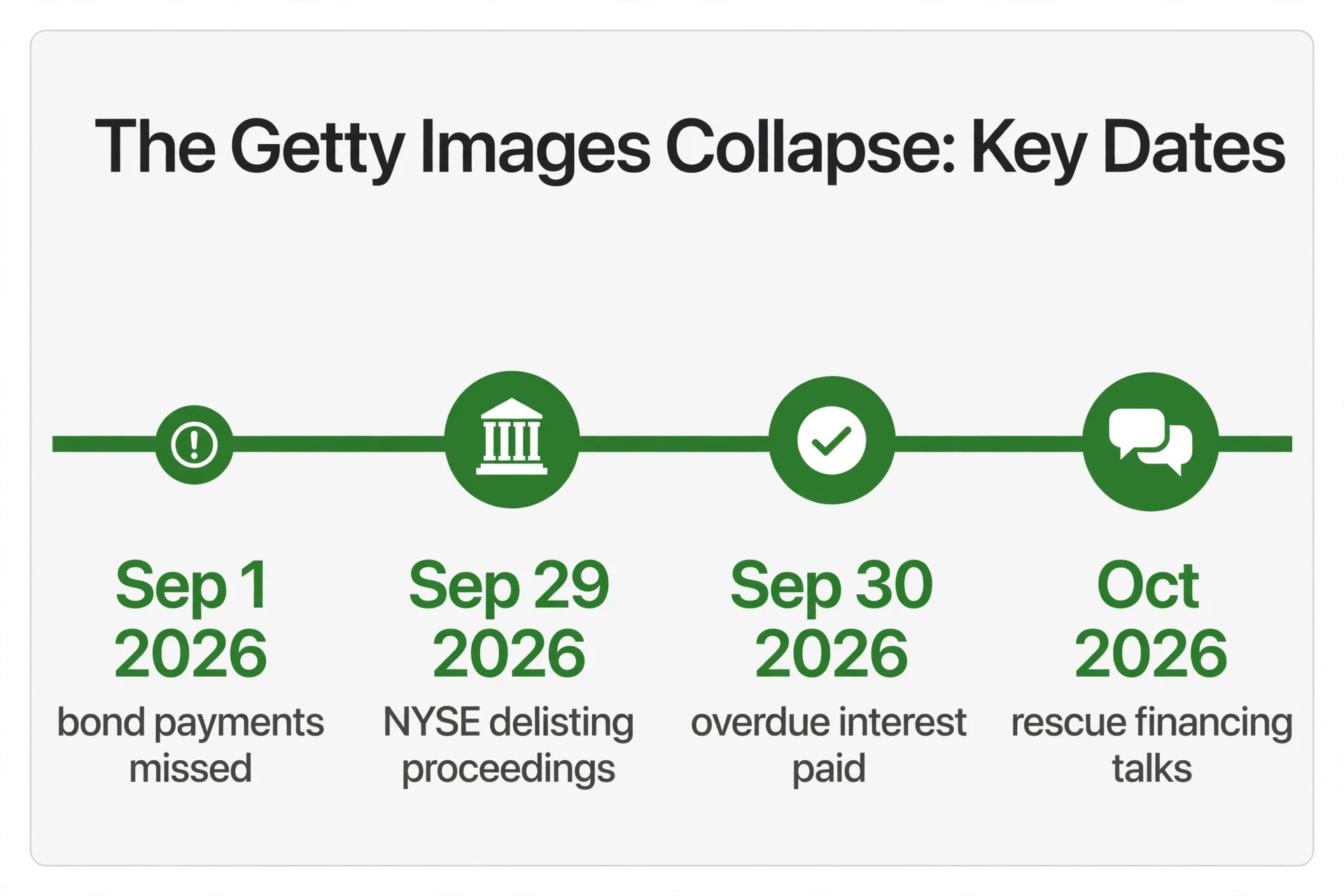
Before the lessons, the timeline — because the Getty Images delisted story only teaches if you see how fast a moat can drain:
The delisting. On September 29, 2026, NYSE Regulation announced it would commence proceedings to delist Getty Images Holdings Inc.’s Class A common stock, ticker GETY, citing “abnormally low selling price” levels. Trading was suspended immediately. The company can appeal to an NYSE board committee, but the shares now trade on the OTC Pink market at around eight to nine cents — a fall of more than 99% since the company went public.
The debt spiral. Getty skipped interest payments due September 1 on two bond series — its 9.75% notes due 2027 and its 14% notes due 2028 — and used the 30-day grace periods instead. It did make the overdue payments on September 30, but the market read that as a stay of execution, not a recovery: Moody’s had already cut the company’s corporate rating to Caa3, deep in distressed territory.
The rescue talks. Getty is holding confidential talks with lenders about new financing, possibly a bankruptcy loan, alongside a potential restructuring in which creditors take control through Chapter 11. Reports say the founding Getty family is weighing putting in its own money. The board postponed the annual shareholder meeting — previously scheduled for October 8 — while the financing review continues.
The operating picture. Second-quarter 2026 revenue came in at $229.1 million, down slightly year over year, with a net loss of $85.8 million. Cash stood at just $51.6 million at the end of June, the $150 million revolving credit facility was fully drawn, and management has formally warned of “substantial doubt about the company’s ability to continue as a going concern.” The company hired Guggenheim Securities to evaluate strategic alternatives.
The failed merger. In early July 2026, Getty terminated its previously announced merger with Shutterstock. The breakup cost the company roughly $60 million in merger-related expenses to date — money spent on a deal that never closed, at the exact moment the balance sheet could least afford it.
The customer erosion. Filings show declines in twelve-month purchasing customers and active annual subscribers — even as Getty’s image and video libraries kept growing. Read that twice: the product got bigger while the customer base got smaller. That is the signature of a business being substituted, not outcompeted.
The AI lawsuit. Getty spent years fighting generative AI in court, most visibly against Stability AI, maker of Stable Diffusion. In September 2026 a London judge ruled Getty had largely lost its UK case — succeeding only in part on trademark claims around AI outputs reproducing distorted Getty watermarks, while the secondary copyright claim was dismissed. Getty had dropped its AI-training allegation mid-trial for lack of evidence. A parallel US case continues, with a California court allowing Getty’s trademark claims to proceed in April 2026. Getty also signed a licensing deal with Perplexity — cooperating with one AI firm while litigating another.
That is the full picture behind the Getty Images delisted headlines: a debt-loaded legacy leader, shrinking customers, a collapsed merger, a courtroom war with AI — and a delisting notice. Now the lessons.
Why Every Marketer Should Study the Getty Images Delisted Case
Stock photography is the plumbing of digital marketing. Nearly every ad, landing page, social post, and blog header a small business publishes runs on licensed imagery — and for decades, Getty was the biggest pipe. When Benzinga asked whether “this once-mighty stock image giant [could] become AI’s first business victim,” the answer marketers should hear is: the substitution already happened in your own workflow. If your team now reaches for an AI image generator before a stock library, you are the demand shift that delisted Getty.
The Getty Images delisted story is therefore not really about one company’s debt. It is about what happens when the tool that disrupts your industry is also the tool your customers use every day. Every lesson below is written for the marketer or business owner reading this — not as an epitaph for Getty, but as a playbook.
Lesson 1: AI Disruption Is Not a Future Event — It Is Your Current P&L
The most dangerous sentence in business is “AI will change our industry.” The Getty Images delisted saga proves the correction: AI already changed it; the financial statements are just catching up. Getty’s purchasing-customer counts were declining while its library grew — the classic shape of substitution. Customers didn’t leave because the photos got worse. They left because a faster, cheaper alternative appeared in their browser tab.
Your move: Stop asking when AI will affect your marketing and start measuring where it already has. Audit which parts of your content production — image sourcing, copy drafting, video editing, ad creative — your team now does with AI tools, and rebuild the workflow around that reality instead of bolting AI onto a 2019 process. Agencies that treat AI as a side experiment are this decade’s stock-photo librarians: correct about quality, wrong about economics.
Lesson 2: Winning in Court Doesn’t Mean Winning in the Market
Getty fought the defining IP battle of the AI era — and even its partial victories changed nothing commercially. The London court confirmed AI outputs bearing distorted Getty watermarks infringed its trademarks, and Getty called it “a powerful precedent.” The US case continues. Meanwhile the stock went to eight cents. Legal wins protect rights; they don’t create demand.
Your move: If your strategy for AI disruption is “our lawyers will handle it,” you have a legal strategy, not a business strategy. Pursue IP protection — it matters — but fund the adaptation work in parallel: new products, new pricing, new distribution. Getty’s courtroom effort was real and serious; its business-model response was not fast enough. Do both.
Lesson 3: Audit Your Visual Content Supply Chain Now — Stock vs. AI Images
Here is the question the Getty Images delisted saga forces on every marketing team: where do your visuals come from, and what legal exposure do they carry? Getty’s remaining moat was always “licensed, lawsuit-safe imagery.” But AI vendors now offer their own indemnification, and Getty itself licensed content to Perplexity — the line between the two supply chains blurred from both sides.
Your move: This quarter, document every image source your brand uses — stock libraries, AI generators, freelancers, in-house shoots — and attach the license terms to each. Know which AI tools indemnify commercial use and which don’t. Set a written policy: where AI-generated imagery is allowed, where licensed photography is required (regulated industries, editorial credibility, brand campaigns), and who signs off. The marketers who get burned in the next two years won’t be the ones who used AI images — they’ll be the ones who used them without knowing the license terms.

Lesson 4: A Growing Library Means Nothing If Buyers Are Leaving
Getty’s image and video libraries kept expanding while purchasing customers and subscribers declined. More product, fewer buyers. In marketing terms, this is the vanity-metric trap at corporate scale: content output going up while pipeline goes down.
Your move: Apply this to your own marketing dashboard this week. If your blog publishes more posts than last year but organic leads are flat, if your social following grows but demo requests don’t, you are Getty — a growing library with shrinking customers. Pick one metric that represents a buying customer and make it the only number that matters in your next marketing review. Output metrics are how teams feel productive while the business quietly delists.
Lesson 5: Debt Removes Your Right to Be Wrong
Strip out the AI narrative and the Getty Images delisted story is also a plain balance-sheet story: $57 million-plus in quarterly interest expense, a fully drawn credit line, $51.6 million in cash, and a going-concern warning. Disruption is survivable; disruption plus leverage is usually not, because debt converts every strategic mistake from “expensive lesson” into “existential threat.”
Your move: You probably don’t carry Getty-level debt, but the principle scales down perfectly: keep your marketing operation’s fixed costs flexible enough to survive two bad quarters. Prefer variable, performance-linked spend over long retainers you can’t exit; keep a cash buffer before you fund the big rebrand; and never let one channel, one client, or one platform become the leverage that can break you. Resilience is a marketing strategy — it’s what lets you adapt when the market moves.
Lesson 6: Failed Big Bets Burn the Cash You Needed to Adapt
Getty spent roughly $60 million on a Shutterstock merger that was terminated in July 2026. Sixty million dollars, at the precise moment the company needed every dollar to reinvent itself against AI. The merger might have been strategically sound; it doesn’t matter. Failed transformations have a cost beyond the write-off: they consume the management attention and capital that adaptation required.
Your move: Before your business commits to a big-bet transformation — the platform migration, the rebrand, the acquisition — price the failure case, not just the success case. Ask: if this fails, do we still have the resources to pivot? Getty’s answer was no. For smaller businesses, the equivalent is the all-in website rebuild that eats the year’s entire marketing budget, or the single-vendor platform bet with no exit plan. Make big moves in stages, with kill criteria written down before you start.
Lesson 7: A Moat Is Only a Moat Until the Water Moves
Getty’s moat was the world’s largest library of licensed commercial imagery — decades of accumulation, impossible to replicate quickly. AI didn’t replicate it. It made it irrelevant for a large and growing share of use cases. The moat was real; the water just moved around it.
Your move: Name your business’s moat honestly — then ask what technology would route around it rather than cross it. If your moat is “we produce more content than competitors,” AI already crossed it. If it’s “we rank for 500 keywords,” AI search summaries are the water moving. Durable moats in the AI era look different: proprietary data, real customer relationships, genuine expertise, community, brand trust. Our earlier breakdown of Nvidia’s AI marketing playbook shows the other side of this coin — a company whose moat (compute + ecosystem) got deeper because AI expanded the water instead of draining it. Build moats that get stronger when the technology arrives, not weaker.
Lesson 8: Protect Your Creative IP Before the Model Trains on It
Getty’s one durable win was narrow but instructive: courts recognized that AI outputs reproducing its watermarks infringed its trademarks. The protection that worked was the protection baked into the asset itself — the visible watermark — not the after-the-fact lawsuit about training data, which collapsed for lack of evidence. Protection you build into the work beats protection you argue about later.
Your move: If your business produces original creative work — photography, video, design, courses, writing — take three steps this month: (1) make sure your terms of use explicitly address AI training; (2) use technical measures where practical (watermarks on portfolio work, robots.txt and crawler directives on your site); (3) consider licensing your best assets to AI platforms on your terms, the way Getty did with Perplexity — getting paid for training data beats watching it get scraped. Your content library is an asset; treat it like one before someone else’s model does.
What Getty Got Right (Give Credit Where It’s Due)
A fair reading of the Getty Images delisted saga credits the defense too — and Getty made several genuinely smart moves that marketers should copy, even if they weren’t enough to save the company:
It licensed instead of only litigating. While suing Stability AI, Getty signed a licensing deal with Perplexity, getting paid for AI training data on its own terms. That dual-track approach — defend your rights in court, monetize them in the market — is exactly right. If your content has value to AI systems, a licensing posture beats a purely adversarial one.
It built its own AI tools early. Getty launched commercially-safe generative AI image products with partners like NVIDIA years before the crisis peaked, trying to turn the disruptor into a product line. The idea was sound; the execution just couldn’t outrun the debt load and customer erosion. For your business: don’t just defend the old product — ship the new one, even if it cannibalizes you a little. Self-cannibalization is always cheaper than competitor-cannibalization.
It kept the library growing. Even in distress, Getty’s image and video collections expanded — the asset base stayed valuable, which is precisely why lenders are still negotiating rather than walking away. Whatever happens in the restructuring, the library has salvage value. Lesson: keep investing in the underlying asset (your content, your data, your audience) even during hard quarters. Assets are what give you options when strategy runs out of road.
The honest summary: Getty’s strategy was arguably 70% right and its balance sheet was 100% wrong. Strategy gets the headlines; the balance sheet gets the last word.
Your Q4 2026 Visual-Content Action Plan
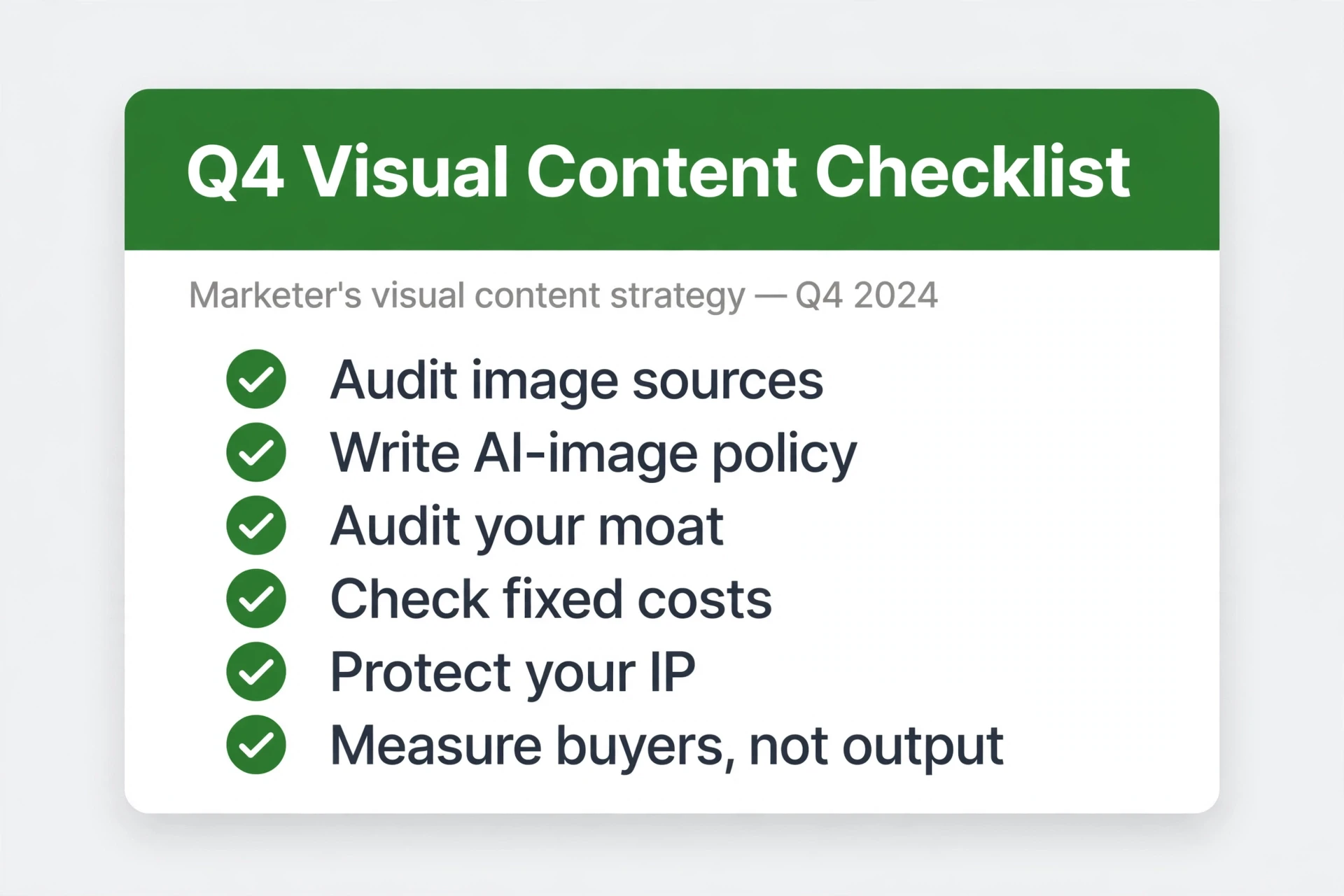
Turn the Getty Images delisted case into a checklist. Before the year ends:
1. Inventory your imagery. List every source — stock, AI, freelance, in-house — with license terms attached.
2. Write the AI-image policy. Where AI visuals are allowed, where licensed photos are mandatory, who approves.
3. Audit your moat. Name the one advantage AI is most likely to route around, and start building the one it can’t.
4. Check your fixed costs. Could your marketing survive two bad quarters? If not, flexibilize now.
5. Protect your IP. Terms of use, watermarks, crawler directives, and a licensing posture for AI training.
6. Measure buyers, not output. One customer metric rules your dashboard; everything else is commentary.
Businesses that do this work now are buying the adaptation Getty couldn’t afford. The delisting notice is the receipt for skipping it.
The Bottom Line on the Getty Images Delisted Saga
The Getty Images delisted story will be taught as the moment AI disruption stopped being a prediction and became a ticker symbol. A thirty-year content empire, the defining lawsuit of the generative-AI era, a licensing deal with an AI search company — and an eight-cent stock. The lesson isn’t that legacy brands are doomed; it’s that adaptation is a budget line, not a talking point. Fund it before the market funds your replacement.
If you want a marketing partner that treats AI as the operating reality it is — not a trend to watch but a workflow to master — talk to KKeyQik. We build content and SEO strategies for the market Getty didn’t survive.
Want to put this to work for your business? KKeyQik plans and delivers brand and graphic design for small businesses, with an in-house team available 24/7. See our graphic design service or get a quote within 24 hours.
Frequently Asked Questions
On September 29, 2026, NYSE Regulation commenced proceedings to delist Getty Images Holdings Inc.'s Class A common stock, citing "abnormally low selling price" levels. Trading was suspended immediately, and the shares now trade on the over-the-counter market at just a few cents — down more than 99% from the company's public listing. The company has the right to appeal the determination to an NYSE board committee.
Getty has not filed for bankruptcy as of this writing, but it is in confidential talks with lenders about rescue financing that could include a bankruptcy loan, and a lender takeover through Chapter 11 is one reported scenario. The company's own filings warn of "substantial doubt about the company's ability to continue as a going concern," and its annual shareholder meeting was postponed while the financing review continues.
AI didn't cause every problem — debt and a failed merger played major roles — but generative AI image tools substituted stock photography for a large and growing share of everyday marketing use cases. Getty's own filings show purchasing customers and subscribers declining even as its image library kept growing: more product, fewer buyers. Analysts have called the company potentially "AI's first business victim," meaning the first major content business substituted rather than merely outcompeted.
In September 2026, Getty largely lost its UK case against Stability AI: a London judge dismissed the secondary copyright claim and ruled Getty had succeeded only in part on trademark claims around AI outputs reproducing distorted Getty watermarks. Getty had dropped its AI-training allegation mid-trial for lack of evidence about where the model was trained. A parallel US lawsuit continues, with a California court allowing Getty's trademark claims to proceed in April 2026.
Most teams will use both — the smart move is to be deliberate about which and where. Use licensed stock photography where credibility, editorial standards, or regulated-industry rules demand real, attributable imagery, and AI-generated visuals where speed and customization matter most. Whatever you choose, document the license terms for every source and make sure someone on your team actually knows what each license permits.
It depends on the tool and its terms. Some AI image platforms offer indemnification for commercial use; others don't, and their terms change often. The Getty case is a reminder to treat licensing as a live operational question, not a one-time checkbox. Keep a written policy covering which tools are approved, where AI imagery may appear, and who signs off — and re-check the terms whenever you switch providers.
A visual content strategy is your plan for sourcing, licensing, producing, and governing every image and video your brand publishes — across your website, ads, and social channels. It covers where visuals come from (stock libraries, AI generators, freelancers, in-house shoots), what the license terms allow, who approves what, and how the imagery stays consistent with your brand. Getty's collapse made one thing clear: the supply chain behind your visuals deserves the same strategic attention as the visuals themselves.
Start with three practical steps: update your website's terms of use to address AI training explicitly, use visible watermarks on portfolio and social imagery, and set crawler directives (like robots.txt rules) to signal your preferences to AI crawlers. If your content library is genuinely valuable, you can also explore licensing it to AI platforms on your own terms — getting paid for training data beats discovering it was scraped.
It's a formal accounting disclosure in which a company's management states there is substantial doubt about the company's ability to keep operating for the next twelve months. Getty included this warning in its filings, citing debt pressure, merger costs, and liquidity constraints. For marketers studying the case, it's a reminder that financial health underpins every marketing plan — no content strategy survives a balance sheet in distress.
Price the failure case, not just the success case. Getty spent roughly $60 million on merger-related costs for a deal that was terminated in July 2026 — capital and management attention consumed at the exact moment the company needed both to adapt to AI disruption. Before committing to any big-bet transformation, ask whether you'd still have the resources to pivot if it fails, and set written kill criteria before you start.