

Introduction
"nvda stock" is one of the heaviest searches in the United States right now — thousands of searches and still climbing, riding a fresh wave of AI-rally coverage. The triggers are visible everywhere in today's business press: Big Tech shrugging off spiking Treasury yields as the AI rally rolls on, Akamai jumping on a new Anthropic deal, Meta and United Airlines making big premarket moves. Beneath all of that noise sits one company that has become the financial symbol of the entire AI era: Nvidia.
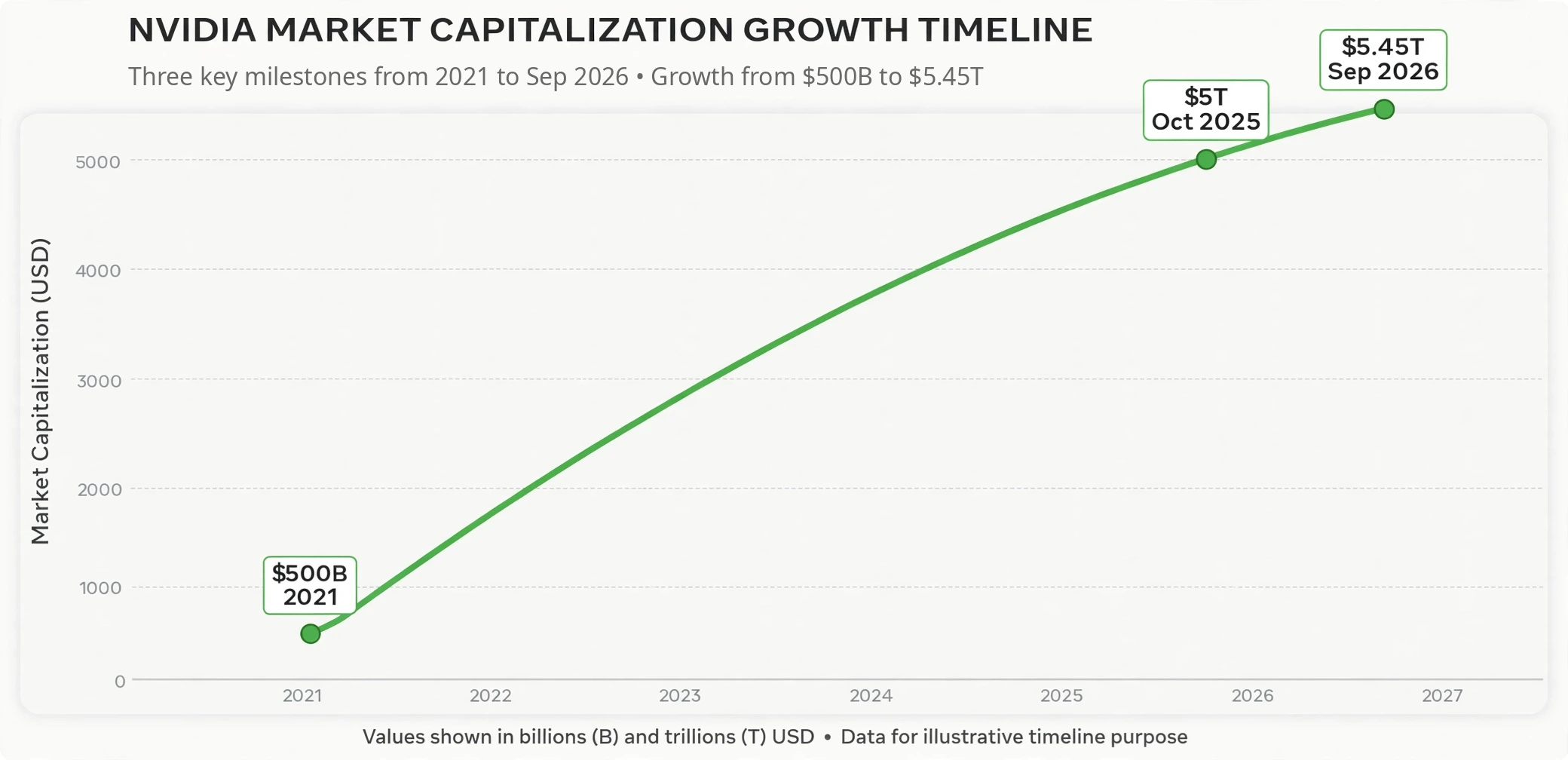
The numbers are almost hard to process. Nvidia's market capitalization sits around $5.45 trillion, making it the most valuable public company in the world. It became the first company in history to cross the $5 trillion mark back in October 2025 and has spent most of 2026 comfortably above it. For perspective, the company's value has expanded more than tenfold from just over $500 billion five years ago — growth concentrated almost entirely in the years since modern AI went mainstream. In its most recent quarter, Nvidia posted $96.2 billion in revenue, up 106% year over year, with net income of $59.7 billion, up 126%.
As CEO Jensen Huang put it in the earnings release: "Now, compute is revenue." Behind that financial machine sits an Nvidia marketing strategy most businesses never study — and this post dissects it.
Most analyses of this runaway success focus on the chips — the GPUs, the data-center dominance, the Vera Rubin platform now shipping. But chips alone do not build a $5.45 trillion company. What built it is the Nvidia marketing strategy: a decades-long, deliberate campaign that turned a component supplier into a cultural force, a developer movement, and a brand that millions of people who will never buy a GPU can still recognize on sight.
That is the real story for marketers. Nvidia sells some of the most technical products on earth to some of the most sophisticated buyers on earth — and it markets them like a consumer lifestyle brand. It runs conferences that feel like festivals. It turned its CEO into a rock star. It built a developer ecosystem so loyal that its customers effectively do its advertising for free. Every one of those moves contains a lesson that works far beyond semiconductors.
This guide breaks down 10 lessons from the Nvidia marketing strategy — how the company built the brand behind the AI boom — with a concrete application for your own business after each one. And if you would rather have specialists apply this kind of ecosystem thinking to your brand, our team builds growth systems on exactly these principles.
Lesson 1: Market the Platform, Not the Product
The deepest lesson in the Nvidia marketing strategy is structural: Nvidia does not really sell chips. It sells a platform that everything else is built on.
The mechanism is CUDA, Nvidia's parallel-computing platform, launched back in 2006 — the oldest layer of the Nvidia marketing strategy. Instead of keeping its technology closed, Nvidia gave developers everything they needed to build on it — software development kits, sample code, detailed documentation, active forums. Millions of developers learned to build AI on CUDA first. Universities taught it. Startups standardized on it. Once a company's entire AI stack runs on CUDA and companion libraries like TensorRT, switching to a competitor becomes expensive, slow, and risky. The product became infrastructure; the infrastructure became a moat.
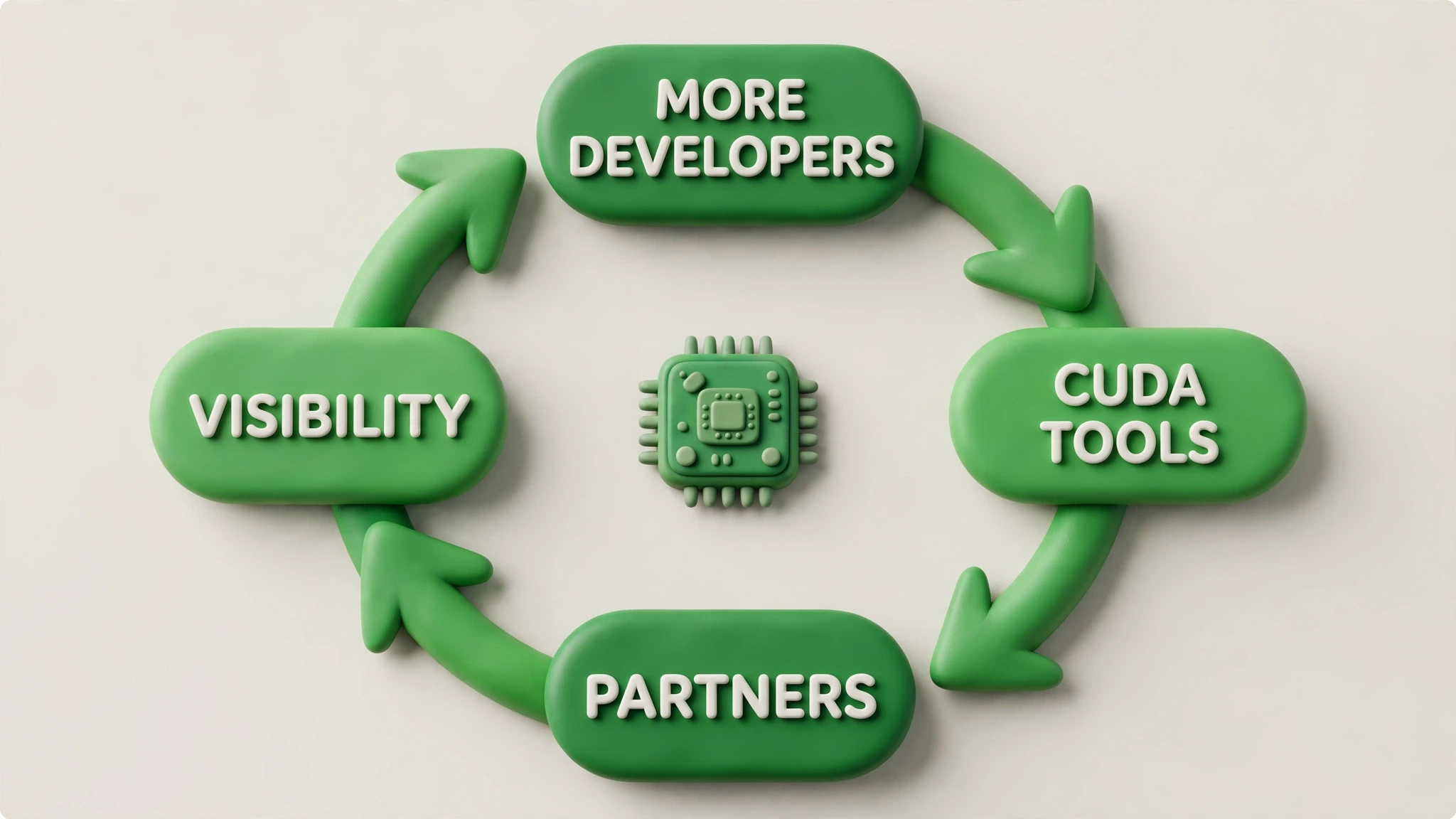
Here is the marketing genius inside that engineering decision: every developer who builds on CUDA becomes a quiet Nvidia marketer. AI researchers publish papers that run on Nvidia hardware. Enterprises announce "Nvidia-powered" deployments. Cloud providers, gaming studios, and robotics firms co-brand their products with Nvidia's name. None of them were asked to advertise — the platform relationship makes the endorsement automatic. It is a self-sustaining cycle: more partners create more visibility, which attracts more users, which attracts even more partners.
For most businesses applying the Nvidia marketing strategy, the application is simpler than it sounds. You do not need a computing platform; you need something others build on top of. A free tool, a template library, a certification program, an integration marketplace — anything that makes your product the foundation of someone else's work. When customers invest their own effort into your ecosystem, they stop being buyers and start being stakeholders. Stakeholders do not churn, and they market you without being asked.
Your move: Identify one asset you could give away that others would build on — a calculator, a checklist, an API, a starter template. Package it properly, document it well, and brand it lightly. Then watch who adopts it: those adopters are your future evangelists. This is platform thinking — the first pillar of the Nvidia marketing strategy.
Lesson 2: Turn Your Conference Into a Cultural Event
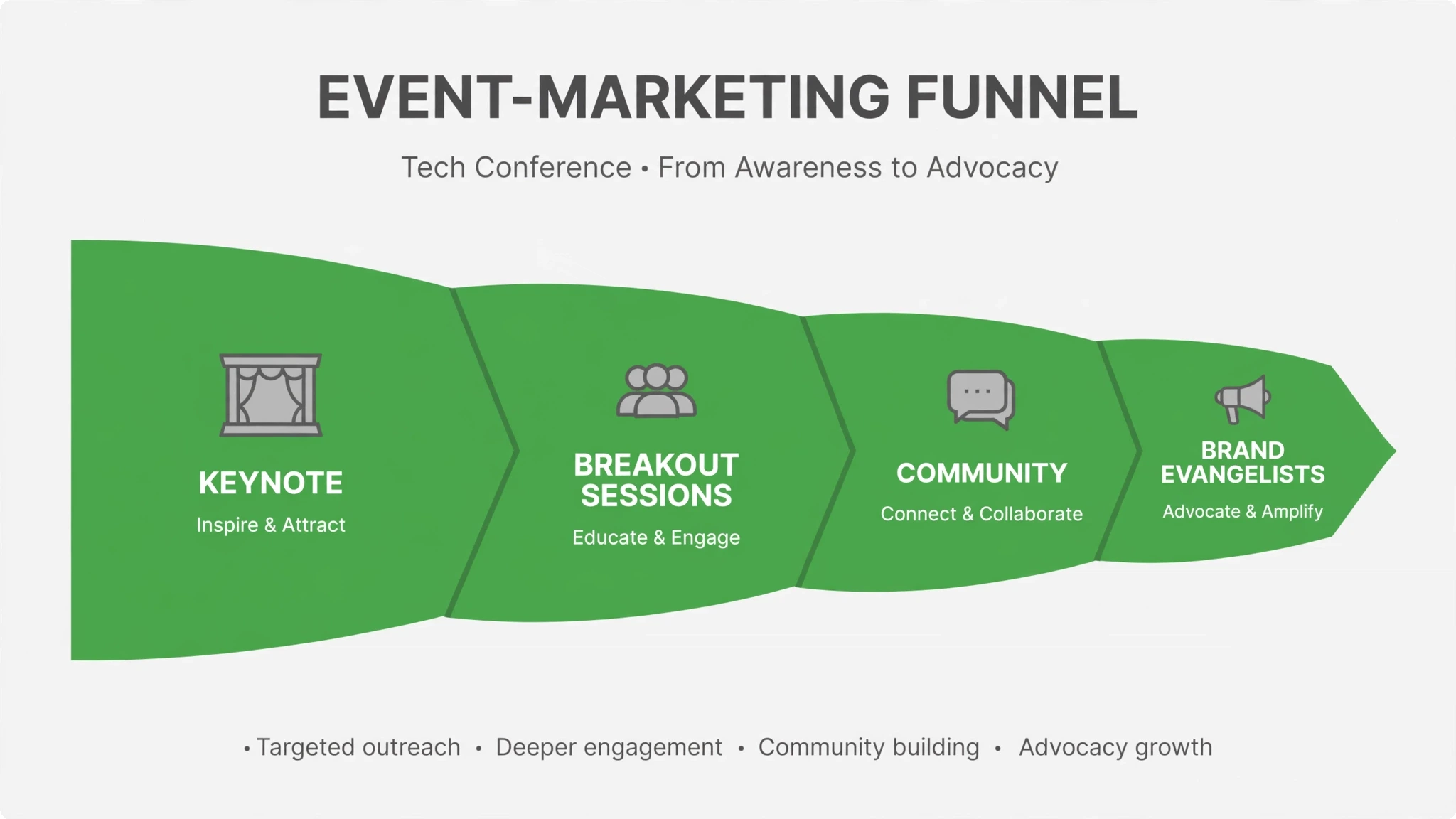
Nvidia's GPU Technology Conference — GTC — is the most underrated weapon in the Nvidia marketing strategy. What started as a technical gathering has become one of the most closely watched events in the global AI calendar, and Nvidia treats it less like a conference and more like a cultural moment.
The scale of ambition is visible in how GTC has expanded. Nvidia now takes the event to international cities to reach regional ecosystems directly — including GTC Taipei, staged alongside Computex in Taiwan's capital, placing the developer community inside the very geography where its silicon is manufactured. The company's own framing says it plainly: "It's not just a conference. It's where the AI era gets built together." That language positions GTC as a community-building platform rather than a product launch — which is precisely why developers feel like insiders rather than attendees. That is the Nvidia marketing strategy turning geography into community.
Every element of GTC functions as a word-of-mouth engine. Keynotes become global media events. Workshops and technical sessions give thousands of practitioners a reason to talk about Nvidia for weeks. Social promotion blends technical gravitas with cultural warmth — Nvidia's GTC Taipei posts urged attendees to treat the city's night markets as "a non-negotiable," tagged #NVIDIAGTC. The event manufactures belonging, and belonging manufactures loyalty.
The lesson for smaller businesses: your event does not need 10,000 attendees to work this way. A 50-person workshop, a virtual summit, a well-run webinar series — any gathering where your audience feels like insiders — creates the same dynamic at your scale. The mistake most companies make is treating events as sales pitches. Nvidia treats GTC as a belonging machine, and the sales follow.
Your move: Plan one event this quarter — virtual or in-person — designed around making attendees feel like insiders, not prospects. Give it a name, a hashtag, and one memorable ritual. Then document it relentlessly on your social channels so the belonging is visible to everyone who missed it. That visibility is what turns an event into a marketing asset — the event-as-belonging play at the heart of the Nvidia marketing strategy.
Lesson 3: Make the CEO the Brand
Few companies have weaponized a founder's persona the way the Nvidia marketing strategy has with Jensen Huang. The leather jacket, the keynote showmanship, the plain-spoken technical storytelling — Huang has become a rock star in an industry that historically hid its executives behind PR teams.
This is not accidental charisma; it is deliberate Nvidia marketing strategy. At GTC, Nvidia sold Jensen Huang-themed sweaters — a cultural artifact directly linking fandom to financial success. Analysts who study the company describe it as building a "cultural moat": as rival AI chips from competing chipmakers improve, technical superiority alone stops being a sufficient defense, so Nvidia reinforces loyalty by turning the CEO into a loyalty token. For developers, owning the sweater signals belonging to an exclusive, winning team — subtly influencing which platform they choose.
The mechanism is worth understanding. A beloved founder converts a transactional relationship into an emotional one. Rivals can match specifications, undercut prices, and outspend on ads — but they are forced to compete on the unfamiliar terrain of cultural relevance instead of the comfortable ground of benchmarks. Personality becomes infrastructure.
Most businesses underuse this completely. Founders hide behind logos; agencies hide behind portfolios. But audiences connect with people, and a visible leader is a compounding asset: every keynote, interview, and strong opinion adds to a brand no ad budget can replicate.
Your move: Put the founder visibly into your marketing for the next 90 days — one opinionated post per week, one short video explaining a real decision, one behind-the-scenes look at how you work. You do not need Huang's stage; you need his consistency. Founder-led content is one of the highest-ROI moves in the Nvidia marketing strategy playbook.
Lesson 4: Let Partners Do Your Marketing
One of the quietest triumphs of the Nvidia marketing strategy is how little of its visibility Nvidia has to buy. Its partners generate enormous awareness on its behalf, voluntarily and continuously.
Think about the mechanics. When a cloud provider launches an AI service, it announces it runs on Nvidia. When a carmaker shows off autonomous-driving features, Nvidia's name is in the press release. When a research lab publishes a breakthrough model, the training hardware gets credited. Each of these groups — developers using CUDA, AI researchers building models, enterprises deploying Nvidia-powered servers, cloud providers and gaming studios co-branding their products — markets Nvidia without Nvidia having to ask. The products are deeply technical and depend on others to unlock their full value, so the ecosystem's success stories are automatically Nvidia's success stories.
This is co-marketing at industrial scale — and a core Nvidia marketing strategy insight is that the branding followed the value, not the other way around. Companies do not put "powered by" badges on their products as a favor; they do it because the association makes them look more credible. Nvidia understood that credibility flows both ways and designed for it.
The small-business version — the most accessible Nvidia marketing strategy tactic in this list — is the strategic partnership announcement. Co-host a webinar with a complementary business. Publish a joint case study. Create a "powered by" or "preferred partner" badge program for your best clients. Every partner announcement reaches an audience you could never afford to buy — and it arrives with borrowed trust.
Your move: List five non-competing businesses that serve your ideal customer. Pitch one joint marketing asset to each — a webinar, a guide, a case study. Even one "yes" puts your brand in front of a warm audience with a trusted introduction. Partnerships are the cheapest distribution in marketing, and they sit at the heart of how Nvidia markets AI products to the world.
Lesson 5: Sell the Future, Not the Present
Nvidia rarely markets what its products do today. It markets what the world will look like because its products exist — and that future-selling is a defining trait of the Nvidia marketing strategy.
The clearest recent example: at GTC 2026, Nvidia and Adobe announced a strategic partnership to bring AI-powered digital production into the marketing machine itself. The centerpiece is a cloud-native 3D digital-twin solution that lets brands carry a product's digital identity from the design phase straight into campaign production. As Nvidia's Rev Lebaredian explained, when you represent a product in marketing, what you show must be exactly what customers get in the physical world — "you can't really promise that with a pure AI-generated image." The partnership merges Adobe's creative workflows with Nvidia's open models and accelerated computing, so brands can scale content without sacrificing product identity.
Notice what is being sold here — a hallmark of the Nvidia marketing strategy. Not chips, not software licenses, but a vision of how marketing itself will work: digital twins flowing from design into campaigns, generative AI held to pixel-perfect brand fidelity. Nvidia positions itself as the company building that future, which makes buying its products feel like buying into inevitability.
This is a learnable move. Customers do not buy features; they buy the future those features unlock. The roofing company sells the storm-proof decade, not the shingle. The agency sells the growth trajectory, not the deliverables. Frame your marketing around the destination and your product becomes the obvious vehicle.
Your move: Rewrite your homepage hero section to describe the customer's future state in one sentence — specific, vivid, desirable. Then position your service as the bridge. If your current headline describes what you do, flip it to describe what life looks like after you have done it. Future-selling is how the Nvidia marketing strategy turns infrastructure into inevitability.
Lesson 6: Treat Developers Like a Fanbase
Inside the Nvidia marketing strategy, developers are not a target segment. They are a fanbase — cultivated with the same care a consumer brand gives its most devoted customers.
The cultivation starts with genuine generosity: SDKs, sample code, documentation, forums, university programs. Every layer of generosity doubles as Nvidia marketing strategy, because each one deepens the relationship it monetizes later.
But it extends into culture. The GTC 2026 merch store — built, tellingly, on the same cloud infrastructure as the conference itself — sold RTX 5090 graphics cards alongside graphene-core golf balls developed with Titleist's ProV1 line, silk ties with hidden QR codes linking to AI-curated playlists, and the famous Huang sweaters. Surveys of attendees found that 42% listed tech-integrated leisure as a top interest; nearly one in five merch buyers bundled the golf balls with an RTX 5090. Nvidia is not just selling to developers — it is selling developers a lifestyle and an identity.
The business logic is ruthless. A developer who wears your merch, attends your conference, and learned your platform in college is not evaluating competitors on price-performance. They are defending a tribe. Technical communities behave like fandoms once you give them rituals, symbols, and belonging — and fandoms are the most durable moat in business.
You do not need a developer audience to use this. Every industry has its practitioners — the designers, the ops managers, the clinic administrators — who would love to belong to something. Give them the tools, the community, and the symbols, and they will give you loyalty that discounts cannot buy — the community flywheel every Nvidia marketing strategy depends on.
Your move: Create one artifact of belonging for your best customers — a private community, a certification, a members-only resource library, even well-designed merch. Then give your audience a name and a place to gather. Communities market themselves; that is the quiet engine of the Nvidia marketing strategy.
Lesson 7: Educate Relentlessly Until Education Becomes the Brand
Nvidia's keynotes are masterclasses disguised as product launches, and that educational posture is central to how Nvidia markets AI products. Huang's presentations teach — about accelerated computing, about where AI is going, about how industries transform — and the teaching is the marketing.
This works — and it is central to the Nvidia marketing strategy — because of a simple asymmetry: the company that teaches you the category earns the authority to define it. When Nvidia explains what AI factories are and why every industry needs one, it is simultaneously educating the market and positioning its hardware as the answer to the exam it just wrote. Education-first content builds trust that advertising cannot, because the audience experiences genuine value before any pitch arrives.
The format matters too. Long-form keynotes, deep technical blogs, developer documentation that people actually enjoy reading — Nvidia invests in content with real substance, not snackable fluff. That depth signals confidence and attracts exactly the sophisticated buyers it wants.
For service businesses, this is the most directly copyable lesson in the entire Nvidia marketing strategy. Publish the guide your competitors are afraid to write. Explain the thing everyone else keeps mysterious. A 2,500-word breakdown that genuinely teaches will outperform a month of promotional posts. It earns the two currencies that matter — attention and authority — and it is why education sits at the center of the Nvidia marketing strategy.
Your move: Publish one genuinely educational long-form piece this month — the definitive guide to something your customers struggle with. Make it so useful that competitors would hesitate to share it. Then promote it like a product launch. Education is the highest-converting content format in B2B, and our SEO services for small business are built to make that kind of content rank and compound.
Lesson 8: Make Every Milestone a Media Event
Watch how Nvidia handles its own news cycle and you will see the Nvidia marketing strategy operating as a full media operation: every milestone becomes an event. Earnings releases become global spectacles. Product announcements are staged like cultural moments. Even the stock's daily moves — the "nvda stock" searches trending in the thousands today — generate a drumbeat of coverage that keeps the brand in the headlines without a dollar of paid media.
This is not luck; it is cadence design. Nvidia gives the market a steady rhythm of newsworthy moments: GTC in the spring, earnings every quarter, platform launches, partnership announcements like the Adobe digital-twin deal. Each event hands journalists, analysts, and creators a fresh reason to talk about the company. The coverage compounds: today's AI-rally stories cite Nvidia as the bellwether, which drives more searches, which drives more coverage.
Smaller companies can build their own cadence. A quarterly industry report. An annual awards program. A monthly data drop. A predictable rhythm of announcements trains your audience — and the press — to pay attention on schedule. Most businesses announce things randomly and wonder why nobody notices. Nvidia announces things rhythmically and the world sets its watch by them — cadence as a deliberate Nvidia marketing strategy.
Your move: Design a 12-month announcement calendar with one newsworthy moment per quarter — original research, a customer milestone, a product update, an industry prediction. Then pitch each one like it matters, because rhythm is what turns announcements into anticipation. Consistent visibility is a core discipline of the Nvidia marketing strategy.
Lesson 9: Turn Merch Into Brand Currency
It sounds trivial for a $5.45 trillion company to sell sweaters and golf balls. It is not trivial at all — it is brand currency, and it is a deliberate chapter of the Nvidia marketing strategy.
Consider the economics of the GTC store through the Nvidia marketing strategy lens. The Huang sweater turns a purchase into a statement of belief. The graphene-core golf balls, engineered with the same materials science as the company's GPUs, turn a leisure product into a conversation about technical superiority. The silk ties with hidden QR codes turn clothing into a digital experience. Each item is engineered — literally — to carry the brand's story into rooms where no salesperson will ever go: the golf course, the office, the conference hallway.
Merch works as marketing because it converts customers into walking billboards who paid for the privilege. But it only works when the merch means something. Generic logo mugs are landfill. Merch that encodes your story — your inside jokes, your technical pride, your community identity — becomes a badge people wear voluntarily.
The lesson scales down cleanly. A beautifully designed playbook, a sticker pack with genuine wit, a shirt your customers would wear even if the logo were smaller — these are not vanity projects. They are loyalty instruments — merch-as-currency is an underrated Nvidia marketing strategy. Every item in someone's daily life is an impression your competitors cannot buy.
Your move: Design one merch item your best customers would genuinely want — not a logo slapped on a commodity, but something that encodes what makes your community yours. Launch it to your inner circle first and let scarcity do the marketing. Brand currency compounds exactly like financial currency.
Lesson 10: Play the Decade Game While Everyone Else Plays the Quarter
The final lesson of the Nvidia marketing strategy is the one that makes all the others work: time horizon. Nvidia's tenfold growth — from just over $500 billion to $5.45 trillion in five years — looks sudden only if you ignore the two decades before it.
CUDA launched in 2006, when almost nobody understood why a graphics company was building a parallel-computing platform. The developer programs, the university partnerships, the GTC conferences, the ecosystem investments — all of it compounded quietly for years before the AI boom made it look like overnight genius. Nvidia positioned for a future it was helping create, then waited with unusual patience while the world caught up. When ChatGPT launched in late 2022 and the AI era ignited, Nvidia was not scrambling to be relevant. It had been relevant for a decade; the world had finally arrived at its roadmap.
This is the hardest Nvidia marketing strategy lesson to copy, because it requires resisting the pressure for instant returns. Most marketing is optimized for this quarter's pipeline: the campaign, the hack, the viral attempt. Nvidia optimized for the decade: the platform, the community, the category definition. Quarterly tactics rent attention. Decade strategies own it.
The practical version is unglamorous: pick a positioning you can hold for ten years, invest in assets that compound (content libraries, communities, ecosystems, brand), and measure in years, not weeks. The companies that win the AI era — in marketing as in chips — will be the ones that started building before it was obvious.
Your move: Write down the one market position you want to own in 2036. Then audit your current marketing: what percentage of your budget builds toward that position versus chasing this quarter's numbers? Shift 20% toward the decade game this year. Compounding is slow until it is sudden — and sudden is where the Nvidia marketing strategy lives now.
The Nvidia Marketing Playbook: Your 90-Day Sprint
Reading lessons is easy; installing them is the work. Here is how to compress the full Nvidia marketing strategy into a 90-day sprint for a growing business:
Days 1–30: Foundation. Publish your definitive educational guide (Lesson 7). Rewrite your homepage around the customer's future state (Lesson 5). Put the founder visibly into your content cadence (Lesson 3). These three moves establish authority, vision, and humanity — the tripod every strong brand stands on.
Days 31–60: Ecosystem. Launch one giveaway asset others can build on (Lesson 1). Pitch five partnership co-marketing plays (Lesson 4). Start your announcement cadence with one newsworthy moment (Lesson 8). You are now building the flywheel instead of just running campaigns.
Days 61–90: Community. Create your artifact of belonging — community, certification, or merch (Lessons 6 and 9). Plan your insider event, virtual or in-person (Lesson 2). Write down your 2036 position and align next year's budget to it (Lesson 10).
None of this requires Nvidia's budget. It requires the Nvidia marketing strategy posture: teach generously, build platforms instead of campaigns, make people feel like insiders, and play for the decade. A growth partner that thinks in ecosystems rather than ad sets can accelerate every phase — but the posture has to be yours.
The AI boom made Nvidia the most valuable company in history. The Nvidia marketing strategy is what made sure the world noticed — and what will keep it there long after the current rally cools. The question is not whether these lessons apply to your business. It is how fast you start applying them.
Frequently Asked Questions
Nvidia positioned itself as the essential infrastructure of the AI era long before the boom, so when demand exploded the brand was already synonymous with AI computing. Its marketing lesson is category ownership: define the platform shift early and become its default name.
Nvidia markets to developers and enterprises through technical credibility — keynote demos, developer conferences, and ecosystem partnerships — rather than mass advertising. For B2B brands, the takeaway is that depth of expertise often converts better than breadth of reach.
Nvidia's GTC keynotes function like product launches for the entire AI industry, generating weeks of press, analyst coverage, and social conversation. Any company can borrow the format: a well-produced annual moment that the industry plans around creates compounding brand authority.
Nvidia invested in CUDA and developer tools years before they paid off, building loyalty among the people who recommend purchasing decisions. Marketing to the practitioners — not just the buyers — creates bottom-up demand that shortens enterprise sales cycles.
Nvidia translates chips into outcomes: medical breakthroughs, autonomous vehicles, creative tools. The lesson for technical brands is to lead with the customer's transformed future and let the specifications serve as evidence rather than the headline.
Nvidia grows through an ecosystem of cloud providers, OEMs, and software partners who all amplify the brand. SaaS companies can replicate this with integrations, co-marketing, and partner directories that turn every alliance into a distribution channel.
Nvidia's market performance became a cultural narrative that drew mainstream attention to an otherwise technical brand. While businesses cannot control their valuation, they can publicize genuine growth milestones — customer counts, revenue markers — to create similar momentum.
Nvidia publishes technical blogs, research showcases, and industry reports that serve the AI community while positioning the company as the field's center of gravity. Original research and genuinely useful technical content earn backlinks and authority that ads cannot buy.
Nvidia has leaned into allocation narratives and enterprise prioritization, which reinforced the perception of overwhelming demand. When demand exceeds supply, honest communication about timelines builds more trust than silence or overpromising.
Pick the platform shift in your industry and plant your flag early with educational content. You do not need Nvidia's scale — owning the conversation around one emerging trend in your niche can make a small brand the default choice when demand arrives.