
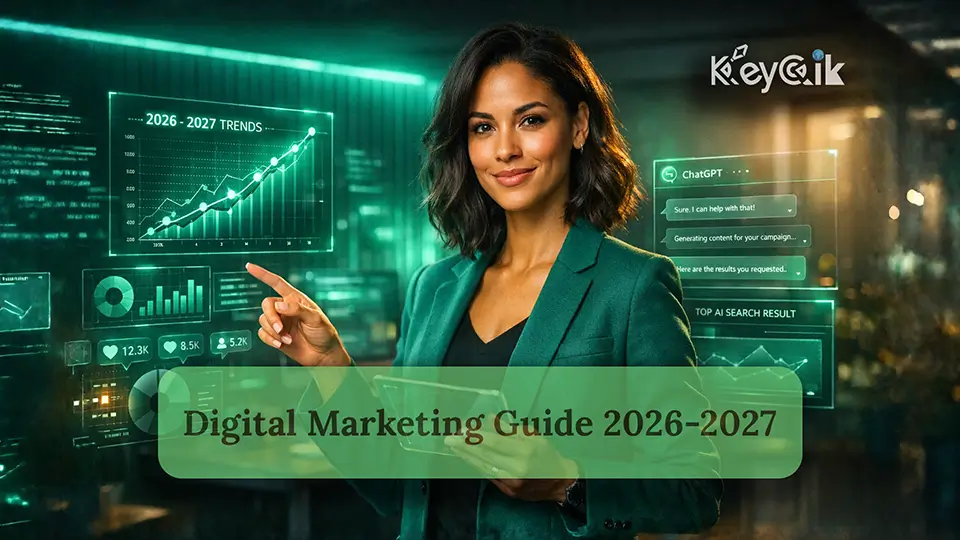
Digital Marketing Guide 2026-2027: Strategies for the AI-First Era
Quick Summary: This comprehensive guide covers the evolved digital marketing landscape of 2026-2027, including AI-driven search optimization (AIO), zero-click content strategies, privacy-first marketing, and platform-specific tactics for TikTok-as-search-engine, LinkedIn SEO, and LLM-optimized content.
The Post-AI Search Revolution: Marketing in 2026
The digital marketing landscape has fundamentally shifted between 2024 and 2026. With Search Generative Experience (SGE) now fully deployed across global markets and AI Overviews dominating 65% of informational queries, traditional SEO tactics have evolved into Answer Engine Optimization (AEO).
Businesses no longer compete merely for clicks—they compete for generative AI citations, zero-click visibility, and conversational search presence. As we navigate 2026-2027, digital marketing success requires optimizing for large language models (LLMs) while maintaining human-centric authenticity.
Key Takeaways: Marketing in 2026
- AI citations > rankings: Being referenced by ChatGPT, Claude, and Perplexity drives qualified traffic
- Zero-click content is king: 58% of Google searches now end without a click (optimize for visibility, not just visits)
- First-party data is currency: Third-party cookies are fully deprecated—owned audiences are critical
- Video SEO dominates: TikTok and YouTube Shorts function as primary search engines for Gen Z and Millennials
Understanding Modern Digital Marketing (2026 Definition)
Digital marketing in 2026 encompasses AI-assisted, privacy-compliant strategies across multimodal platforms. Unlike the channel-siloed approach of 2024, modern digital marketing operates on orchestrated ecosystems:
Core Components (Updated for 2026)
1. Generative AI Optimization (GAO) Previously “SEO,” now includes optimizing content for AI training data, structured data for rich snippets, and natural language processing (NLP) compatibility.
2. Conversational Commerce Chatbots evolved into AI agents handling complex sales cycles. Marketing now focuses on prompt engineering and AI persona alignment.
3. Video-First Content Architecture Short-form video (15-90 seconds) isn’t just for social—it’s primary website content, email embeds, and search results.
4. Privacy-First Attribution With third-party cookies eliminated, marketers use data clean rooms, server-side tracking, and consent-based analytics.
5. Community-Led Growth Sustainable marketing relies on owned communities (Discord, Slack, Circle) rather than rented social media audiences.
Critical Trends Shaping 2026-2027
Expert Insight: These trends reflect post-2025 algorithm updates, including Google’s March 2026 Core Update prioritizing “Information Gain” over regurgitated content.
Trend 1: LLM Optimization (LLMO)
By 2026, 40% of product research begins in ChatGPT, Claude, or Gemini. LLM Optimization involves:
- Creating definitive, well-cited “source of truth” content
- Structured data markup for entity recognition
- Brand mention monitoring in AI training datasets
Trend 2: Zero-Click Strategy Evolution
With AI Overviews providing instant answers, successful marketers optimize for visibility credits:
- Featured snippet optimization (position zero)
- “Best of” list inclusions
- Knowledge panel authority building
Trend 3: The TikTok Search Economy
TikTok is now the primary search engine for users under 35. 2026 strategies include:
- TikTok SEO (hashtag optimization, keyword-rich captions)
- “Search intent” video scripting
- Comment optimization (pinned educational comments rank in search)
Trend 4: Hyper-Personalization at Scale
AI enables 1:1 marketing without manual effort:
- Dynamic website experiences based on behavior
- AI-generated email subject lines and content blocks
- Predictive lead scoring using first-party data
Trend 5: Sustainability Marketing (Green SEO)
Gen Z purchasing power peaks in 2026-2027. Eco-transparency is now a ranking factor:
- Carbon-neutral website hosting badges
- Supply chain transparency content
- “Green” schema markup for sustainable products
Trend 6: Voice & Visual Search Maturity
- Voice: 55% of households use voice search daily (optimize for conversational long-tail)
- Visual: Google Lens processes 12 billion searches monthly (image SEO is non-negotiable)
AI-First Goal Setting & KPIs (2026 Framework)
Replace outdated SMART goals with AI-SMART objectives:
The AI-SMART Framework
- Augmented: Goals account for AI-assisted workflows
- Intent-matched: Objectives align with search intent, not just keywords
- Sustainable: Metrics prioritize retention over acquisition (CAC inflation post-2024)
2026 Digital Marketing KPIs
| Outdated Metric | 2026 Success Metric |
|---|---|
| Keyword ranking | AI Overview inclusion rate |
| Bounce rate | Engagement depth (scroll + interaction) |
| Social followers | Community engagement rate |
| Email open rate | Reply rate & conversation depth |
| Backlinks | Brand mention sentiment in LLMs |
Example Goal: “Achieve AI Overview citations for 25 commercial-intent keywords by Q3 2026, resulting in 15% qualified traffic lift through ChatGPT referrals.”
Platform Selection in the Privacy-First Era (2026 Update)
Search & Discovery Platforms
Google Search (The Hybrid Engine)
- 2026 Status: AI Overviews display for 70% of queries
- Strategy: Target “long-tail, high-intent” questions AI can’t fully answer
- New Feature: Search Console Insights now tracks AI-generated click-less impressions
Perplexity AI & ChatGPT
- Marketing Role: These are now traffic drivers, not just tools
- Optimization: Create definitive comparison content (AI prefers structured data)
YouTube (The Educational Index)
- SEO Shift: Chapters and timestamps are ranking factors
- Shorts: 60-second vertical videos appear in Google Discover
TikTok (The Gen Z Google)
- Search Feature: TikTok Search Ads launched 2025
- Strategy: Create “how-to” content answering specific questions (e.g., “Best CRM for small business 2026”)
Professional & B2B Platforms
LinkedIn (The B2B Search Engine)
- 2026 Update: LinkedIn articles now index in Google News
- Algorithm: Prioritizes “collaborative articles” and newsletter engagement
- Strategy: Long-form posts (1,300-1,500 words) outperform short updates
Emerging Platforms
Instagram Threads / Fediverse
- Decentralized social gains traction post-2025
- Strategy: Cross-post with ActivityPub protocols for wider reach
AI Agents & Marketplaces
- 2026 Reality: Consumers use AI shopping agents (Perplexity Shopping, ChatGPT Browse)
- Optimization: Ensure product feeds are compatible with AI parsing
Zero-Click SEO & Content Optimization (2026 Playbook)
The Information Gain Imperative
Google’s 2025-2026 updates penalize “SEO content” that adds no new value. Information Gain Score is now a ranking factor.
How to Optimize:
- First-Party Research: Include original surveys, data studies, or case studies
- Semantic Richness: Use entity-based SEO (People, Places, Things mentioned in your niche)
- Multimodal Content: Combine text, video, and interactive elements
Schema Markup for 2026
Implement these structured data types for AI visibility:
- Article Schema (with
authorandreviewedByfor E-E-A-T) - LearningVideo (for educational content)
- Product Schema with carbon footprint data
- FAQ Schema (still critical for voice search)
Content Refresh Strategy
- Quarterly audits: Update “2025” references to “2026” before competitors
- AI-content hybrid: Use AI for research, humans for strategic insights
- Evergreen dating: Avoid year-stamping unless necessary (improves content lifespan)
First-Party Data Strategy (Post-Cookie Marketing)
With third-party cookies fully deprecated by late 2025, this section is essential for 2026 survival:
The Zero-Party Data Framework
Definition: Data customers intentionally share (preferences, purchase intentions).
Collection Methods:
- Interactive content: ROI calculators, preference centers
- Community access: Gated Discord/Slack communities requiring email
- Progressive profiling: Ask one new question per interaction (don’t overwhelm forms)
Consent-Based Advertising
- Google’s Privacy Sandbox is now mandatory—master Topics API and Protected Audience API
- Contextual targeting resurgence (keyword-based, not behavioral)
- First-party data activation in clean rooms (Google Ads Data Manager, Meta’s Advanced Analytics)
Implementation Roadmap: Your First 90 Days (2026)
Month 1: Foundation & AI Readiness
- Audit existing content for AI Overview opportunities
- Implement consent mode v2 for analytics
- Set up LLM brand monitoring (Perplexity, ChatGPT citations)
Month 2: Platform Optimization
- Launch TikTok SEO strategy (if B2C) or LinkedIn newsletter (if B2B)
- Create video content library (repurpose top-performing blogs)
- Build first-party data capture mechanisms
Month 3: Measurement & Scale
- Analyze zero-click impression value
- Optimize for “Information Gain” in top 10 pages
- Scale AI-assisted personalization
Frequently Asked Questions (FAQ Schema)
Q: Is traditional SEO dead in 2026? A: No, but it has evolved. Traditional keyword optimization now includes Answer Engine Optimization (AEO) and LLM Optimization (LLMO). Focus on comprehensive topic coverage and semantic SEO rather than keyword stuffing.
Q: How do I optimize for AI Overviews in Google? A: Structure content with clear headings, use concise definitions in the first 100 words, implement FAQ schema, and earn citations from authoritative sources. Include unique data AI cannot generate.
Q: Which platform should I prioritize in 2026? A: B2B: LinkedIn + YouTube. B2C: TikTok + Instagram. All businesses must optimize for Google SGE and Perplexity AI visibility regardless of primary platform.
Q: What’s the biggest marketing mistake to avoid in 2026? A: Relying solely on third-party platforms. Build email lists and owned communities—the algorithm changes of 2025-2026 proved that rented audiences are volatile.
Q: How important is AI-generated content in 2026? A: AI is a tool, not a strategy. Use it for outlines and research, but human expertise, first-party data, and original insights are ranking differentiators. Google’s “Information Gain” update specifically targets thin AI content.
Conclusion: Thriving in the Algorithmic Age
The transition from 2024 to 2026-2027 represents the shift from traffic acquisition to answer provision. Success requires optimizing for AI citations, building sustainable first-party data ecosystems, and creating genuinely useful content that algorithms cite as authoritative sources.
Leave a Reply