
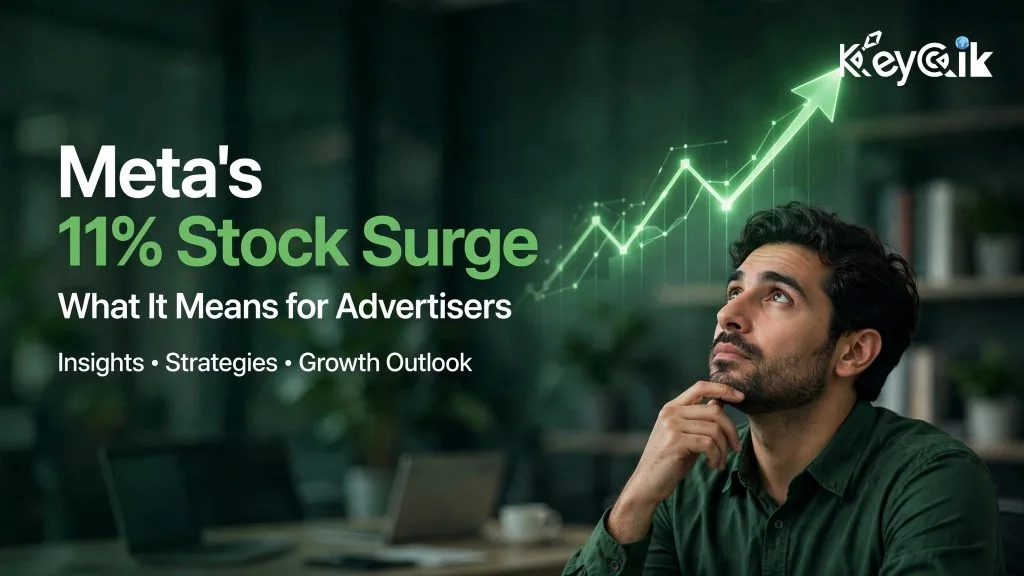
On September 22, 2026, shares of Meta Platforms jumped 11.3% in a single trading session to close at $741.25 — the company’s biggest daily gain since April 2025 and its best monthly run in more than two years. Search interest in “meta stock” spiked 200% on Google Trends US as investors and analysts scrambled to explain the move.
Here’s the part that matters to you as an advertiser: the rally is being driven by Meta ads itself. Family of Apps ad revenue grew 27% year over year in the second quarter of 2026. Meta ads’ AI-powered Advantage+ suite crossed a $75 billion annual revenue run rate. And analysts at Bernstein now believe Meta could overtake Google Search in ad revenue before the year is out.
In other words, the stock surge is a mirror. It reflects a platform that is more powerful, more automated, and more expensive for advertisers than ever before — heading into the highest-stakes quarter of the year. This guide breaks down the seven most important takeaways for anyone running Meta ads in Q4 2026, with the numbers behind the rally and a practical playbook for turning platform momentum into customer revenue.
1. The rally is an advertising story, not just an AI story
Headlines credit Meta’s new Muse AI assistant for the stock’s momentum — and Muse deserves part of the credit. But read the fine print and the numbers tell an ad-first story. Meta’s second-quarter revenue hit $60.8 billion, up 28% year over year, with Meta ads sales of roughly $59.4 billion driving nearly all of it. The company captured about half of every additional dollar of new digital advertising spend in the industry during the quarter.
That is the single most important context for your Meta ads planning. When Meta ads absorbs half of all new digital ad spend, competition inside its auctions intensifies. More bidders chasing the same attention pushes clearing prices up — which is exactly what the data shows: average ad prices across Meta’s properties rose 12% year over year even as impressions grew 14%.
For advertisers, the lesson is blunt. A stronger Meta is not a cheaper Meta. The stock is rising because the business is extracting more value from Meta ads advertisers, not because advertising on it suddenly got easier. Every budget you set for Q4 needs to assume a pricier auction than last year — and a smarter strategy for winning it.
Wall Street’s enthusiasm has specifics worth noting. Wells Fargo raised its Meta price target to $796 ahead of the Connect conference, citing early traction for the Muse assistant. The company is expected to report third-quarter revenue of $63.18 billion, up 23.3% year over year. And the stock has now gained 21.1% over the past four weeks. For Meta ads planners, these figures confirm a simple truth: you are buying media on a platform whose business has rarely been stronger — and whose auctions have rarely been more competitive.
2. AI is doing the targeting now — and the results are measurable
The most striking figures in Meta’s earnings weren’t about revenue at all; they were about machine performance. Internal model upgrades delivered an 8.3% lift in ad clicks and a 15.7% improvement in conversions on Facebook last quarter. Those are not vanity metrics — they are the output of Meta’s recommendation and targeting systems getting materially better at matching the right ad to the right person at the right moment.
This is the new reality of Meta ads: the algorithm is increasingly the media buyer. Manual audience building still has its place, but the performance edge has shifted decisively toward AI-driven delivery. Campaigns that give the system broad room to learn — larger budgets consolidated into fewer ad sets, creative variety instead of hyper-segmented audiences — are the ones capturing the gains.
If you are still running the 2023 playbook of dozens of narrow interest-based ad sets, you are fighting the platform’s own architecture. The stock market is rewarding Meta precisely because its AI works; your job is to structure campaigns so that AI works for you, not just for Meta’s revenue line. For a deeper look at how AI targeting reshapes campaign structure, see our analysis of AI targeting and the ethics of algorithmic advertising.
3. Advantage+ has crossed $75 billion — automation is the default
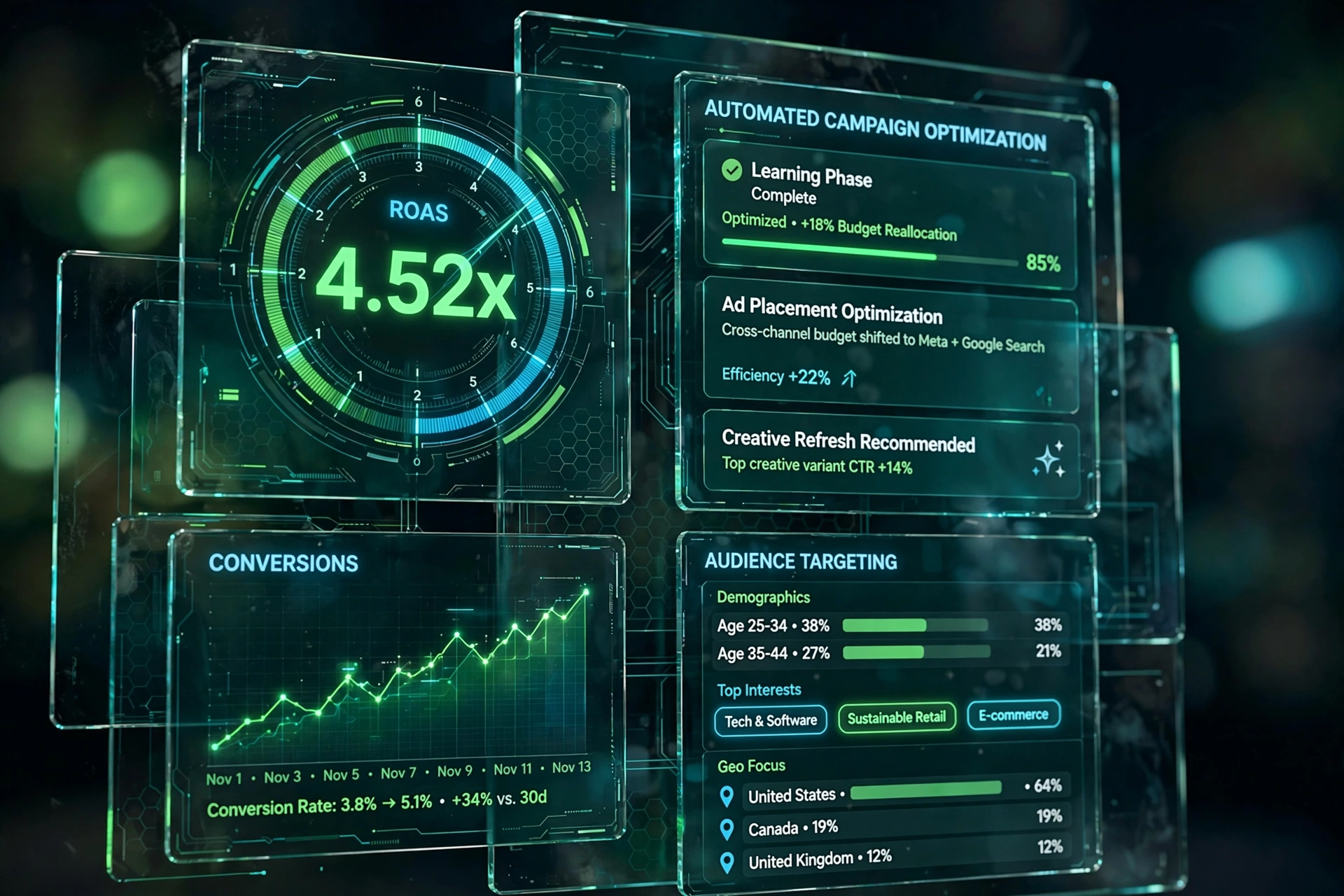
The headline number inside Meta’s ad business is the Advantage+ run rate: more than $75 billion in annualized revenue. Advantage+ is the end-to-end automated suite inside Meta ads — it handles audience targeting, placement, creative optimization, and budget allocation with minimal human input. Crossing $75 billion means automated campaigns are no longer an experiment; they are the dominant way Meta ads spend flows through the platform.
The performance case is equally loud. Meta reports that Meta ads Advantage+ campaigns deliver an average of $4.52 for every dollar spent — 22% more than manually structured campaigns. Meta has also signaled its endgame: fully automated ad creation and targeting, where an advertiser supplies little more than a product image and a budget while the AI handles creative generation and audience matching.
What should you do with this? First, audit how much of your Meta ads spend is already on automated products (Advantage+ sales campaigns, Advantage+ audience, automated placements) versus legacy manual setups. Second, invest where the AI needs you most: creative. When targeting is automated, the differentiator is the asset — video, hooks, offers, and creative diversity. Meta’s own data shows Meta ads advertisers using its AI video generators are growing quarter over quarter for exactly this reason. Automation rewards the advertisers who feed it the best raw material.
4. The Meta-versus-Google ad race is real — and it changes your media mix
One of the boldest analyst calls of September came from Bernstein: Meta may overtake Google Search in advertising revenue by the end of 2026. Even on a strict apples-to-apples comparison, Meta’s ad revenue is now within striking distance of Google’s search ads — roughly $59.4 billion against Google’s search revenue, with the gap closing fast.
Why does this matter for your budget allocation? Because the two platforms monetize fundamentally different behaviors. Google captures declared intent — someone searching for a product. Meta manufactures demand through algorithmic discovery — showing people things they didn’t know they wanted. As Meta’s AI improves at predicting engagement, discovery-based advertising becomes competitive with intent-based advertising for a growing share of categories, especially e-commerce, DTC brands, and mobile apps.
The practical move is to stop treating the platforms as interchangeable line items and start testing incrementality. Run controlled experiments: what happens to total revenue when you shift 15-20% of budget from search to Meta ads during a promotional period? Many brands discover that the Meta ads discovery engine drives demand that search then harvests — and that underfunding discovery starves the whole funnel. Our Digital Marketing Guide for the AI-first era covers how to structure these cross-channel tests.
5. Agentic commerce is arriving — Muse, Shopify, and the conversational checkout
The catalyst behind the stock’s September run was Muse, Meta’s personal AI assistant launched on September 8, 2026. Muse executes multi-step tasks — shopping, booking, form-filling — rather than just answering questions, and it topped Apple’s US App Store within days of launch. But the detail advertisers should focus on is the commerce layer: Shopify’s CEO confirmed a partnership enabling agentic checkout with Shop Pay across Shopify stores, letting shoppers complete purchases through Muse’s assistant.
Think about what that means for the funnel. If consumers start buying through AI assistants inside WhatsApp, Instagram, and Messenger, the distance between ad impression and transaction collapses. The Meta ad doesn’t just create awareness — it hands the customer to an agent that closes the sale. More than one million businesses already use Meta’s AI-powered business agents weekly, and nine million-plus small businesses have used Meta’s AI creative tools.
For Q4, this means two things. First, make sure your product catalogs, feeds, and checkout flows are clean and complete — agents can only sell what they can read. Second, start experimenting with conversational commerce formats now, while competition is low. Early adopters of new Meta surfaces historically get cheaper reach before the crowd arrives.

6. Watch Meta Connect (September 23–24) — the roadmap preview that sets Q4
Meta’s annual Connect conference begins September 23, 2026 — literally the day after this article publishes — and it lands at a pivotal moment. Analysts expect the event to showcase how Meta plans to turn its AI investments into revenue beyond core advertising: new agents, glasses, APIs, and enterprise services.
For Meta ads advertisers, Connect is worth watching as a product roadmap preview. Historically, features announced at Connect — new ad formats, creative tools, measurement upgrades — roll into Ads Manager within one to two quarters, which means this year’s announcements shape what you will be running in Q1 and Q2 of 2027. Pay particular attention to three things: any expansion of agentic advertising capabilities, new creative generation tools inside Advantage+, and measurement or attribution announcements (Meta’s measurement story is the weakest link in its pitch to performance marketers).
If Connect reveals a major new ad surface — for example, advertising inside Muse or expanded WhatsApp commerce placements — plan a test budget for it immediately. New placements in Meta ads consistently deliver the cheapest CPMs of their lifecycle in the first 90 days. That new surface has now arrived: Meta’s $1,299 VR Glasses launch at Connect marked the opening bell for immersive advertising — see our 9 Meta VR glasses marketing lessons for what it means for your ad strategy.
7. Your Q4 2026 Meta ads playbook: seven moves for a pricier, smarter auction
Here is how to convert everything above into action before the holiday peak:
1. Raise your Q4 bids and budgets deliberately. With ad prices up 12% year over year and auction competition at record levels, last year’s budgets will buy less reach. Increase budgets now rather than chasing the auction in December, when prices spike hardest. A good rule of thumb: plan for 15-20% higher CPMs than Q4 2025.
2. Consolidate into fewer, larger campaigns. Feed Meta’s learning systems the data volume they need. One campaign with a $500 daily budget will outperform five $100 campaigns in almost every test we run — the algorithm needs signal density to find your buyers.
3. Go all-in on Advantage+ for prospecting. The $4.52-per-dollar return figure and 22% edge over manual campaigns make this the default for new-customer acquisition. Reserve manual campaigns for retargeting and tightly controlled brand-safety scenarios.
4. Multiply your creative. When targeting is automated, creative is the targeting. Build 10-15 creative variations per campaign: different hooks in the first three seconds, UGC-style versus polished, multiple offers. Use Meta ads’ built-in AI video generators to scale production, then let the system sort winners from losers.
5. Fix your measurement before Black Friday. With iOS privacy constraints still in play, advertisers running Meta ads who rely solely on platform-reported numbers misallocate budget. Implement the Conversions API, validate event match quality, and agree on a single source of truth with your team before the holiday rush — not during it.
6. Prepare for conversational commerce. Clean up your product catalog, enable Shop integrations, and test click-to-WhatsApp and click-to-Messenger Meta ads campaigns. As agentic checkout expands through partnerships like Shopify and Shop Pay, the advertisers with the tidiest feeds will capture the earliest wins.
7. Test incrementality across channels. Don’t assume your Meta ads and Google ads are independent. Run geo-holdout or matched-market tests in October to measure how Meta spend lifts branded search and direct traffic. The brands that understand cross-channel lift allocate Q4 budgets with confidence instead of guesswork.

The risk side: why a stronger Meta demands a smarter advertiser
No honest analysis stops at the upside. Meta’s rally has a cost structure behind it that should make advertisers think. The company is guiding $130-145 billion in 2026 capital expenditures — nearly double last year’s $72 billion — to build the AI infrastructure powering these ad gains. Free cash flow collapsed to $784 million in Q2 even as revenue soared. Heavy spending plus rising legal costs (analysts flag a potential $10 billion legal charge) means Meta must keep extracting more revenue from Meta ads to justify the investment.
Translation: the pressure on advertisers will not ease. Expect continued price inflation in auctions, more aggressive pushes toward automated products, and less flexibility in legacy manual controls. The winning response is not to retreat from Meta ads — the platform’s scale and AI performance make that impractical for most businesses — but to get more efficient faster than prices rise. That means better creative, tighter measurement, and professional campaign management.
This is also where diversification discipline matters. Meta captured half of all new digital ad dollars in Q2, which is a concentration risk for any brand. Keep testing Google, TikTok, and emerging channels so that no single platform’s pricing power can dictate your customer acquisition cost.
Turn the rally into your revenue
Meta’s stock surge is really a story about the world’s most sophisticated Meta ads machine getting stronger. Meta ads revenue up 27%. Impressions up 14%. Prices up 12%. Advantage+ past $75 billion. Agentic commerce on the horizon. For advertisers, the message is clear: the platform rewards those who adapt to automation, invest in creative, and measure rigorously — and punishes those who don’t.
Q4 2026 will be the most competitive holiday season Meta ads have ever seen. The brands that win will be the ones that treat the auction as a system to master, not a tax to pay. If you want help building a Meta ads strategy that turns this platform momentum into profitable growth, KKeyQik’s digital marketing team manages paid campaigns for 80+ clients across the US, UK, Middle East, and India — and we’d love to make your Q4 your best quarter yet. Get in touch through our contact page to talk through your Q4 plan.
Frequently Asked Questions
Meta shares jumped sharply in September 2026, driven largely by advertising business strength — strong ad revenue growth and rapid AI-driven automation adoption. For advertisers, the rally is a signal that the platform is more powerful, more automated, and more competitive than ever.
A stronger Meta generally means pricier auctions, not cheaper advertising. More bidders chasing the same attention push clearing prices up, so Q4 budgets should assume higher costs than last year and pair them with smarter campaign structure.
Meta's automated Advantage+ suite now drives a dominant share of ad spend, handling targeting, placement, and budget allocation. Audit how much of your spend is automated versus manual, then invest where the AI needs you most: creative quality and diversity.
Consolidate into fewer, larger campaigns so the learning systems get enough signal, and feed them creative variety instead of hyper-segmented audiences. When targeting is automated, creative becomes the targeting.
Meta's AI shopping assistant enables conversational commerce, including agentic checkout partnerships with commerce platforms. Keep product catalogs and feeds clean and complete so agents — and shoppers — can find and buy your products.
Meta's ad revenue is closing in on Google's search ads, reflecting a shift toward discovery-based advertising. Test incrementality across channels — what happens to total revenue when budget shifts — rather than treating the platforms as interchangeable line items.
Implement the Conversions API, validate event match quality, and agree on a single source of truth before the holiday rush. Advertisers who rely only on platform-reported numbers risk misallocating budget under privacy constraints.
Expect continued auction price pressure, more aggressive automation pushes, and less flexibility in legacy manual controls. The winning response is efficiency: better creative, tighter measurement, and diversified channels so no single platform dictates acquisition cost.
Raise budgets deliberately for a pricier auction, consolidate into fewer larger campaigns, and make automated prospecting the default. Multiply creative variations, fix measurement before the holiday rush, prepare for conversational commerce, and test cross-channel incrementality.
Scale, automation, and AI performance make it impractical for most businesses to retreat — but they must adapt. Master the auction system with better creative and measurement rather than treating rising costs as a tax.