

Introduction
On October 1, 2026, one of the fastest-rising searches in America was “amazon ftc settlement payouts” — up more than 1,000% on Google Trends in a matter of hours. Millions of Prime members woke up to the same question: is money from the Amazon FTC settlement payouts actually landing in my account today? The answer, for a large group of consumers, is yes — automatic payments through Venmo, PayPal, or mailed check, no claim form required.
This is not just a consumer-finance story. The Amazon FTC settlement payouts are one of the most expensive trust lessons in modern business: a $2.5 billion settlement built on allegations that Amazon enrolled millions of people in Prime without clear consent and made cancellation deliberately hard. For small and mid-sized businesses watching from the sidelines, the Amazon FTC settlement payouts are a free masterclass in what trust is worth — and what losing it costs.
Trust is the quiet engine behind every metric a marketer cares about: conversion rates, repeat purchases, reviews, referrals, lifetime value. And the Amazon FTC settlement payouts prove that when trust breaks at scale, the repair bill arrives with interest. This post breaks down exactly what happened with the Amazon FTC settlement payouts, then distills seven brand-trust lessons any business can apply — to subscription marketing, checkout design, crisis communication, and everyday customer experience. If you’d rather have a team build that trust infrastructure for you, KKeyQik helps businesses turn marketing systems into measurable growth.
What Actually Happened With the Amazon FTC Settlement Payouts
Before the lessons, the facts — because the Amazon FTC settlement payouts only make sense with the full timeline:
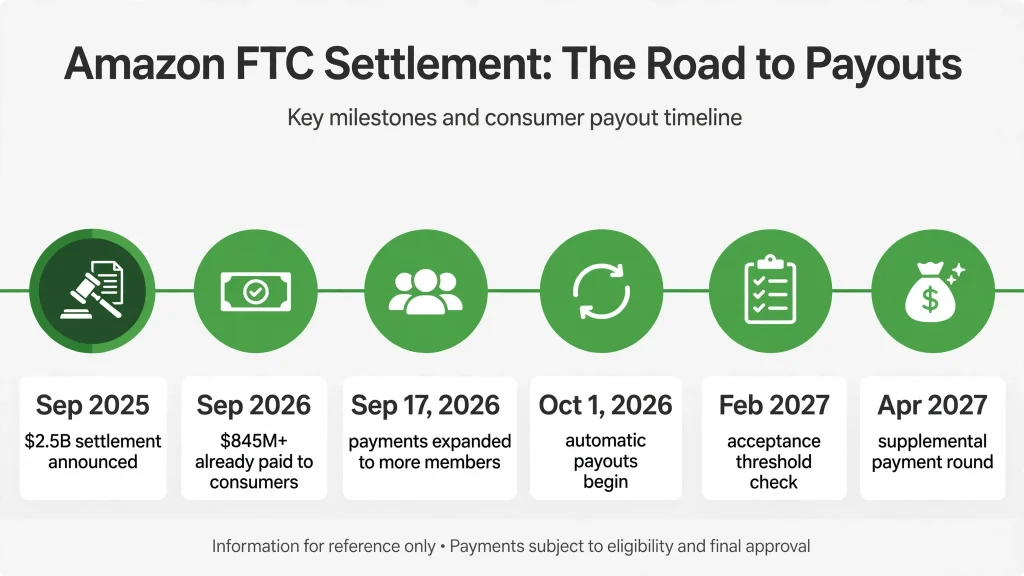
The original case. In September 2025, Amazon agreed to a $2.5 billion settlement with the Federal Trade Commission over allegations that the company signed up millions of consumers for Prime without their permission and deliberately made the cancellation process difficult. The settlement included up to $1.5 billion in consumer redress plus a $1 billion civil penalty. The FTC alleged that Amazon used deceptive enrollment designs — often called “dark patterns” — and violated the FTC Act and the Restore Online Shoppers’ Confidence Act. Amazon did not admit liability, saying the agreement “allows us to move forward and focus on innovating for customers.”
The money started moving. Amazon began sending settlement payments in November 2025. By September 2026, the FTC said more than $845 million in redress had already reached consumers — the largest consumer-refund program the agency has ever administered at this scale.
The expansion that sparked today’s trend. On September 17, 2026, the FTC announced a revised court order that would “accelerate and expand payments” under the Amazon FTC settlement payouts program. Two big changes: first, millions of additional consumers became eligible — people who used between 11 and 20 Prime benefits in a one-year period, a group left out of the earlier payment phases. Second, the maximum total payment jumped from $51 to $200 per consumer. All new payments go out automatically starting October 1, 2026 — Venmo, PayPal, or mailed check — with no claim to file and no forms to complete.
There’s a second wave coming. If the total of accepted payments doesn’t reach the required threshold by February 2027, Amazon must send another round of automatic payments to consumers who already accepted money under the settlement — up to $149 more per person, for a $200 total. That supplemental round is expected to begin by April 2027, and it’s automatic too.
Who qualifies. U.S. consumers who enrolled in Prime through the enrollment flows the FTC challenged — the universal Prime decision page, the shipping selection page, single-page checkout, or the Prime Video enrollment flow — between June 23, 2019 and June 23, 2025, and who used no more than 20 Prime benefits in a 12-month period, or who started the online cancellation process but never finished it. The old claim-filing window closed on July 27, 2026; everything from here is automatic.
The scam warning. The FTC has been blunt: the agency is not contacting anyone about the Amazon FTC settlement payouts, and no one from Amazon will ever ask for money to deliver a refund. Anyone reaching out and asking for payment, banking details, or personal information to “claim” a refund is running a scam. Legitimate payments arrive on their own — and they come with acceptance windows, so recipients should accept them promptly rather than letting them expire.
“The revised order will ensure more consumers who were harmed by Amazon’s deceptive enrollment and cancellation practices benefit from the FTC’s historic settlement,” said Christopher Mufarrige, Director of the FTC’s Bureau of Consumer Protection, when the expansion was announced.
That is the story in brief: enrollment tactics that regulators called deceptive, a record settlement, and now automatic Amazon FTC settlement payouts landing in millions of accounts. Here is what marketers should take from it.
Why the Amazon FTC Settlement Payouts Belong on a Marketing Blog
It’s tempting to file the Amazon FTC settlement payouts under “legal news” and move on. That would be a mistake, because every element of this story is a marketing story wearing a legal costume:
Enrollment is marketing. The FTC’s case was fundamentally about the top of the funnel — how people were brought into Prime. Sign-up flows, trial conversions, pre-checked boxes, and one-click enrollments are marketing decisions. The Amazon FTC settlement payouts are what happens when acquisition tactics optimize for sign-ups instead of consent.
Cancellation is retention marketing. Making it hard to leave doesn’t retain customers; it manufactures resentment. The consumers receiving Amazon FTC settlement payouts today are people the company is now paying to make whole — a retention strategy with a $1.5 billion price tag.
Trust is a conversion asset. Every friction-filled cancellation flow, every ambiguous charge, every dark pattern is a withdrawal from the trust account. The Amazon FTC settlement payouts show the overdraft fees.
Crises are content events. “Amazon ftc settlement payouts” is a 1,000%-spike search trend. The brands that explain confusing consumer moments clearly — and the ones that stay silent — are both doing marketing, whether they intend to or not.
Small businesses sometimes assume trust scandals are a big-company problem. They aren’t. A local gym with a maze-like cancellation policy, a SaaS tool with a surprise renewal, a retailer with a restocking-fee surprise — these are the same dynamics at neighborhood scale. The Amazon FTC settlement payouts just put a very large number on what those dynamics cost. The seven lessons below translate that number into actions.
Lesson 1: Make Leaving as Easy as Joining
The single most damaging allegation behind the Amazon FTC settlement payouts was asymmetry: signing up for Prime took seconds, while canceling took a gauntlet. Regulators have a word for that — a dark pattern — and they now treat it as an enforcement priority, not a design quirk.
The marketing lesson is counterintuitive: a visible, painless exit increases sign-ups. When customers know they can leave freely, the perceived risk of trying drops, and trial-to-paid conversion rises. When they suspect they’re being trapped, they don’t just cancel — they warn others, leave one-star reviews, and file complaints that attract regulators.
What easy exits look like in practice:
- One-click cancellation in the same place as sign-up. If a customer can subscribe from your pricing page, they should be able to cancel from their account page — not after a phone call, a chat with a retention specialist, and a guilt-trip survey.
- Say the renewal terms in plain language before the buy button. Price, billing frequency, renewal date, and how to cancel — all above the fold, in normal-sized type. The FTC’s Restore Online Shoppers’ Confidence Act exists precisely because too many businesses buried this.
- Send a reminder before renewals. A short “your plan renews in 7 days” email feels like great service. It also defuses the chargeback-and-complaint cycle that turns individual annoyance into regulatory attention.
This is the same retention logic we explored in subscription marketing’s monthly rituals — customers stay because the experience is worth it, not because the exit is hidden. The Amazon FTC settlement payouts are the receipt for getting that backwards.
Lesson 2: Audit Your Own Dark Patterns Before Someone Else Does
The FTC didn’t invent the term “dark pattern” for the Amazon case — it applied a label the design world has used for years to checkout tricks, pre-checked add-ons, confusing toggles, and “confirm-shaming” buttons (“No, I don’t like saving money”). What the Amazon FTC settlement payouts changed is the stakes: deceptive design is now a multi-billion-dollar liability category.
Every business should run a dark-pattern audit, and it doesn’t require a law firm. It requires fresh eyes and a simple question at each step of the customer journey: would a reasonable customer describe what just happened as fair?
A practical audit checklist:
- Enrollment flows: Is the customer affirmatively choosing, or just failing to uncheck? Are trial terms stated before the card is captured?
- Checkout pages: Are fees, shipping, and taxes shown before the final click, or do they appear as surprises?
- Cancellation and downgrade paths: Count the clicks from “I want to cancel” to “canceled.” If it’s more than three or four, you have a problem — and so does your review rating.
- Email and notification consent: Did the customer actually opt in, or did buying something silently subscribe them to a newsletter?
- Interface copy: Read your buttons out loud. If “Continue” actually means “enroll me in a paid program,” the copy is the dark pattern.
Document what you find, fix the worst offenders first, and keep the audit notes. If a regulator ever asks, a documented self-correction program is worth more than any apology. And if no regulator ever asks, you’ve still built the kind of experience that earns the reviews and referrals paid ads can’t buy. Marketing teams that want this discipline systematized can build it into their
digital marketing services engagement — trust work compounds.

Lesson 3: Automatic Restitution Beats a Scripted Apology
Notice what the revised Amazon FTC settlement payouts order actually did: it removed friction from the fix. No claim forms, no deadlines to track, no paperwork — money simply arrives via Venmo, PayPal, or check. The FTC explicitly framed the automation as a feature: payments go out “without requiring consumers to submit claims, respond to notices or complete any forms.”
That’s a marketing insight hiding in a legal document. When something goes wrong for your customers, the speed and ease of the fix matters more than the eloquence of the apology. Customers remember how hard you made it to be made whole.
Apply this at any scale:
- Proactive credits beat complaint-driven refunds. If you discover a billing error affecting 200 customers, credit all 200 before the first complaint arrives. The customers who never had to complain become your most loyal advocates.
- Make the fix one step, not five. A refund that requires a form, a phone call, and a 7-day wait teaches customers that complaining is expensive. A refund that just appears teaches them that you’re trustworthy.
- Tell people before they ask. A short email — “we found an error, we’ve fixed it, here’s your credit” — turns a mistake into a trust-building moment. Silence turns it into a discovery, and discoveries become reviews.
The Amazon FTC settlement payouts are arriving automatically because a court ordered it. Imagine the brand equity of a company that does the automatic thing voluntarily. That’s the gap between compliance and character — and customers can feel the difference.
Lesson 4: Say It Plainly, Say It Fast
Amazon’s public line on the settlement — that it “allows us to move forward and focus on innovating for customers” — is the kind of sentence that says nothing while sounding like something. Compare it with the FTC’s communications: specific numbers, specific dates, specific instructions, and a direct scam warning. One side communicated like a legal department; the other communicated like it wanted to be understood.
The marketing lesson from the Amazon FTC settlement payouts: in a trust crisis, clarity is the strategy. Customers in a confusing moment don’t need brand voice — they need answers: what happened, who is affected, what happens next, and what they should do.
The plain-language crisis playbook:
- Lead with the facts, not the framing. “Here’s what happened, here’s who’s affected, here’s what we’re doing” — in that order. Framing first reads as spin.
- Give dates and numbers. “Starting October 1” and “up to $200” are infinitely more reassuring than “soon” and “appropriate compensation.” Specificity signals honesty.
- Say what people should do — including nothing. The FTC’s most useful line was telling people they didn’t need to do anything. “No action required on your part” is the most calming sentence in crisis communication.
- Publish where the questions are. The Amazon FTC settlement payouts trend proves people search first and trust second. A clear FAQ page on your own domain, updated as the situation evolves, captures the worried-search traffic that would otherwise land on rumor sites.
This is the same discipline as crisis communication done right — speed plus one consistent, human message beats a perfect message delivered late. The Amazon FTC settlement payouts news cycle rewarded the side that explained itself clearly.
Lesson 5: Turn Compliance Into Content
Here’s an underused play: the businesses that treat compliance as a content opportunity end up owning the conversation. The Amazon FTC settlement payouts generated thousands of articles — and the most-linked, most-cited source in nearly all of them is the FTC’s own plain-English press release and refund page. The regulator became the publisher of record because it published the clearest explanation.
Your business can do the same at its own scale:
- Publish your policies in human language. Terms of service, refund policies, cancellation instructions, data practices — rewrite them so a real customer can understand them in two minutes. Then link them prominently instead of burying them in the footer.
- Write the “here’s how our billing works” post. A transparent explainer about your pricing, renewals, and cancellation process is both SEO content and trust content. It ranks for “[your brand] cancel” searches and it preempts complaints.
- Document your fixes. “Here’s what we found in our checkout audit and what we changed” is the kind of post that earns links, press mentions, and customer goodwill simultaneously.
- Keep a living trust page. Security practices, refund stats, response-time commitments — a single page that answers “can I trust these people?” before it’s asked.
Content marketing is usually aimed at acquisition. The Amazon FTC settlement payouts suggest a second job for content: reputation infrastructure. The brands that rank for their own controversies — with their own clear explanations — are the brands that prepared. For a deeper playbook on building content that compounds, our digital marketing guide for the AI-first era covers the full system.
Lesson 6: Guard Your Brand Against Impostors
One of the most striking details in the Amazon FTC settlement payouts story isn’t about Amazon at all — it’s about the scammers. The FTC had to explicitly warn consumers that fraudsters are impersonating the agency and the company, asking for money or banking details to “claim” refunds. Every high-attention consumer moment attracts parasites, and the Amazon FTC settlement payouts are no exception.
For marketers, this is a brand-protection lesson with two sides:
Protect your customers from people pretending to be you. If your brand ever issues refunds, recalls, or account notices, assume scammers will piggyback within days. Publish the official communication channels, state clearly what you will never ask for (passwords, payment to receive a refund, gift cards — ever), and make the real message easy to verify. The FTC’s warning worked because it was specific: “No one from Amazon will ever ask you for money to get a refund.” Write your version before you need it.
Monitor what ranks for your brand + “scam.” During any public moment — a launch, a refund, a policy change — search your brand name alongside words like “scam,” “refund,” and “cancel.” What you find is what your customers find. If impostor sites or phishing pages appear, report them and publish a verification page.
Treat trust signals as ad creative. Verified contact info, real human support, clear refund pages — these aren’t just operational details. In an era of AI-generated phishing and deepfake customer service, visible authenticity is a differentiator worth featuring in your marketing itself.
The Amazon FTC settlement payouts will be over one day; the impersonation playbook they attracted will be reused on smaller brands tomorrow. Build the defenses now.
Lesson 7: Measure Trust Like Revenue
The final lesson from the Amazon FTC settlement payouts is the simplest and the hardest: what gets measured gets managed, and trust was never measured until the bill arrived. Amazon optimized enrollment flows for sign-up volume — a metric that looked great right up until it cost $2.5 billion.
Small businesses can do better with a lightweight trust dashboard:
- Cancellation experience score. Mystery-shop your own cancel flow quarterly. Time it, count the clicks, and read the copy with fresh eyes. Trend it like you’d trend conversion rate.
- Complaint-to-customer ratio. Track support tickets and chargebacks about billing confusion as a percentage of active customers. A rising ratio is an early-warning system the Amazon case never had — or never heeded.
- Review sentiment on billing topics. Filter reviews for words like “charged,” “cancel,” “refund,” and “subscription.” These are your trust reviews; they influence prospects more than your five-star product reviews do.
- Refund and credit speed. Measure the time from “customer reports a billing issue” to “money back in their account.” Faster is a marketing stat worth publishing.
- Repeat purchase and referral rates. The ultimate trust metrics. If they drift down while acquisition holds steady, you’re filling a leaky bucket — the exact pattern that made the Amazon FTC settlement payouts necessary.
Pair this with the same reporting discipline you’d apply to any campaign — our SEO reporting framework shows how measurement turns activity into accountability. Trust deserves the same rigor as traffic, because as the Amazon FTC settlement payouts prove, trust eventually shows up on the balance sheet either way.
Your Brand-Trust Checklist for This Week
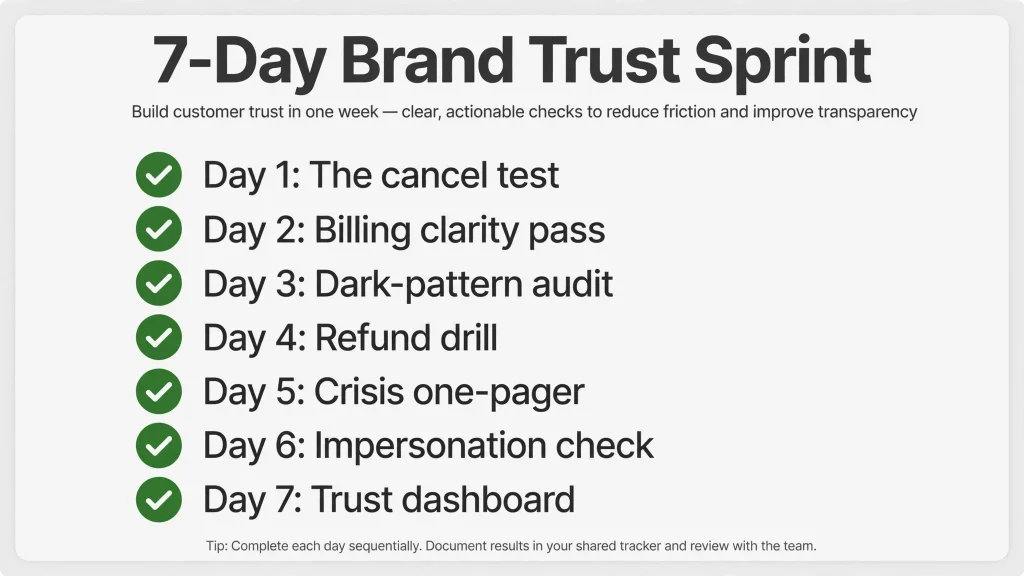
Lessons are only useful if they become actions. Here’s a one-week sprint any small business can run, inspired directly by the Amazon FTC settlement payouts:
Day 1 — The cancel test. Sign up for your own product or service with a fresh account, then cancel it. Note every step, every confusing sentence, every moment of friction. Fix the top three issues.
Day 2 — The billing clarity pass. Read your pricing page, checkout, and renewal emails as a first-time customer. Is the price, billing frequency, and cancellation method obvious before payment? Rewrite anything that isn’t.
Day 3 — The dark-pattern audit. Walk the checklist from Lesson 2: pre-checked boxes, surprise fees, confirm-shaming copy, silent opt-ins. Document and fix.
Day 4 — The refund drill. Pick your last five billing complaints. How long did resolution take? Could any of them have been fixed proactively? Write the “automatic fix” rule for next time.
Day 5 — The crisis one-pager. Draft the plain-language template from Lesson 4: what happened, who’s affected, what happens next, what customers should do. File it where you’ll find it at 9 PM on a bad day.
Day 6 — The impersonation check. Search your brand name plus “scam,” “refund,” and “cancel.” Publish or update your verification page with official channels and what you’ll never ask for.
Day 7 — The trust dashboard. Pick three metrics from Lesson 7, record the baselines, and put a monthly review on the calendar.
Seven days, no budget required — just the discipline to look at your own business the way a regulator, a reviewer, or a worried customer would. The companies that do this never become a case study like the Amazon FTC settlement payouts. The ones that don’t, eventually do.
The Bottom Line
The Amazon FTC settlement payouts are a $2.5 billion reminder that trust is not a soft value — it’s a line item. Deceptive enrollment tactics bought sign-ups and sold a liability. Friction-filled cancellation bought retention and sold resentment. And now the fix — automatic payments to millions of consumers, no forms required — is doing the trust work the original design didn’t. That’s brand turnaround marketing in action.
For small businesses, the math is kinder but the principle is identical: every subscription flow, every checkout page, every refund policy is either building trust or billing it later. Make leaving as easy as joining. Audit your own dark patterns. Fix mistakes automatically and explain them plainly. Turn compliance into content. Guard against impostors. Measure trust like revenue. Do those seven things and the Amazon FTC settlement payouts become someone else’s cautionary tale — not yours.
If you want a team to build that trust infrastructure into your marketing — transparent funnels, honest UX, content that earns confidence, and reporting that keeps you honest — talk to KKeyQik. We help businesses turn trust into their most reliable growth channel.
Frequently Asked Questions
They are automatic consumer refunds Amazon is issuing under a revised federal court order stemming from the FTC's 2025 settlement over Prime enrollment practices. The expanded payment round began on October 1, 2026, and covers millions of additional Prime members who were not included in earlier phases. Eligible consumers receive their payment without filing any claim.
The FTC alleged that Amazon enrolled millions of consumers in Prime without clear consent and made the cancellation process deliberately difficult, using what regulators call dark patterns. Amazon did not admit liability but agreed to the settlement, which includes consumer redress and a separate civil penalty. The payouts are meant to return money to consumers the FTC says were harmed by those enrollment and cancellation practices.
No. Under the revised order, all remaining payments are distributed automatically — the FTC states explicitly that consumers do not need to submit claims, respond to notices, or complete any forms. Amazon uses its own records to identify eligible consumers. The earlier claim-filing window closed in mid-2026, so anything arriving now comes without paperwork.
Payments are sent electronically through Venmo or PayPal, or as a mailed paper check, depending on the information Amazon has for each eligible consumer. Electronic payments and checks both come with acceptance windows, so recipients should accept or cash them promptly rather than letting them expire. Consumers who previously accepted a payment will generally receive any follow-up through the same method.
Possibly. The revised order includes a supplemental round: if the total of accepted payments does not reach the required threshold by early 2027, Amazon must send additional automatic payments to consumers who already accepted money under the settlement. That second round is expected to begin by spring 2027 and would also be distributed automatically, with no action required.
Almost certainly not. The FTC warns that it does not contact consumers about these refunds, and no one from Amazon will ever ask for money to deliver one. Anyone asking for payment, banking details, or personal information to "claim" a settlement refund is very likely running a scam. Treat any such message as a red flag and do not engage with it.
Dark patterns are interface designs that push users toward choices they might not make with full information — such as pre-checked enrollment boxes, confusing cancellation flows, or buttons whose wording obscures what they do. In the Amazon case, the FTC pointed to Prime enrollment flows and a cancellation process it described as deliberately difficult. The concept matters for any business: design that confuses customers into paying is now a recognized regulatory risk.
Make leaving as easy as joining. The core allegation was asymmetry — seconds to enroll, a gauntlet to cancel — and it turned an acquisition tactic into a record settlement. Businesses that offer visible, painless cancellation actually reduce the perceived risk of signing up, which supports trial-to-paid conversion. Trapping customers manufactures resentment, bad reviews, and regulatory attention.
Start with a fresh-eyes walkthrough: sign up and cancel your own product, count the clicks, and read every button out loud. Check for pre-checked add-ons, fees revealed only at the final step, renewal terms buried in fine print, and consent that was assumed rather than given. Document what you find, fix the worst friction first, and repeat the audit quarterly — it is inexpensive insurance against the trust erosion that made this settlement necessary.
The FTC's press release and its Amazon refund information page are the authoritative sources, with the full timeline, eligibility details, and the agency's scam warnings. Because high-attention refund moments attract impostor sites and phishing messages, always verify through official government channels rather than links in unsolicited emails or texts. If a message about the settlement asks you to act urgently or share sensitive details, assume it is fraudulent.