

Introduction
On September 30, 2026, Sony Interactive Entertainment did something it has done more than a hundred times before: it announced the next month’s lineup of games for PlayStation Plus subscribers. Starting Tuesday, October 6, every PlayStation Plus member can claim F1 25, Hunt: Showdown 1896, and Earth Defense Force: World Brothers 2, with the claim window open through November 2. Within hours, US search interest in the PlayStation Plus October 2026 games was surging on Google Trends — the kind of predictable, monthly spike Sony has engineered into a science.
Here is what most marketers miss about that spike: it is not really about the games. It is about a retention machine. Sony has turned a simple membership benefit into a monthly marketing ritual that reduces churn, re-engages dormant players, and generates a fresh wave of press coverage every thirty days — all without running a single ad campaign. That is subscription marketing operating at its highest level, and the playbook behind it translates directly to small businesses: the gym, the SaaS tool, the meal-kit service, the membership site, and yes, even the marketing agency retainer.
This post breaks down exactly how the PlayStation Plus October 2026 announcement works as a marketing system, and distills eight subscription marketing lessons any small business can apply. If you would rather have a team apply them for you, KKeyQik helps small businesses turn proven marketing systems into measurable growth.
What Sony Actually Announced (the Facts)
Before the lessons, the facts — because the details of the PlayStation Plus October 2026 lineup are what make the marketing mechanics visible:
Three games, one claim window. The PlayStation Plus October 2026 Essential-tier lineup is F1 25 (PS5), the official game of the 2025 FIA Formula One World Championship from EA’s Codemasters studio, featuring a career mode, My Team 2.0 management mode, and the F1 World multiplayer mode; Hunt: Showdown 1896 (PS5), Crytek’s unforgiving extraction shooter set in monster-infested backwaters; and Earth Defense Force: World Brothers 2 (PS5 and PS4), the voxel-styled co-op shooter with four-player online co-op and two-player split-screen. All three can be claimed from October 6 through November 2, 2026, and once claimed, they stay in the subscriber’s library for as long as the membership remains active.
The handoff from September. The PlayStation Plus October 2026 announcement also put a countdown on September’s games — Sniper Elite: Resistance, MLB The Show 26, Wobbly Life, and Chained Echoes — creating a clean, urgent handoff: claim the old ones before next Tuesday or lose them, then claim the new ones the moment they drop.
The ecosystem layer. Alongside the games, Sony announced that Spider-Man: Brand New Day arrives on Sony Pictures Core on October 6 with limited-edition film avatars, plus horror-themed in-game bundles rolling out through the month — including packs for Call of Duty: Warzone, a Hunt: Showdown 1896 starter pack, and an Overwatch 2 bundle timed for Halloween.
Three tiers, one ritual. PlayStation Plus runs on three membership tiers — Essential, Extra, and Premium — with Essential as the base tier that carries the monthly game drops, and the higher tiers layering on catalogs, demos, and extras. Every tier participates in the monthly ritual.
Now, here is how a marketer should read that announcement.
Lesson 1: Turn Your Marketing Into a Monthly Ritual
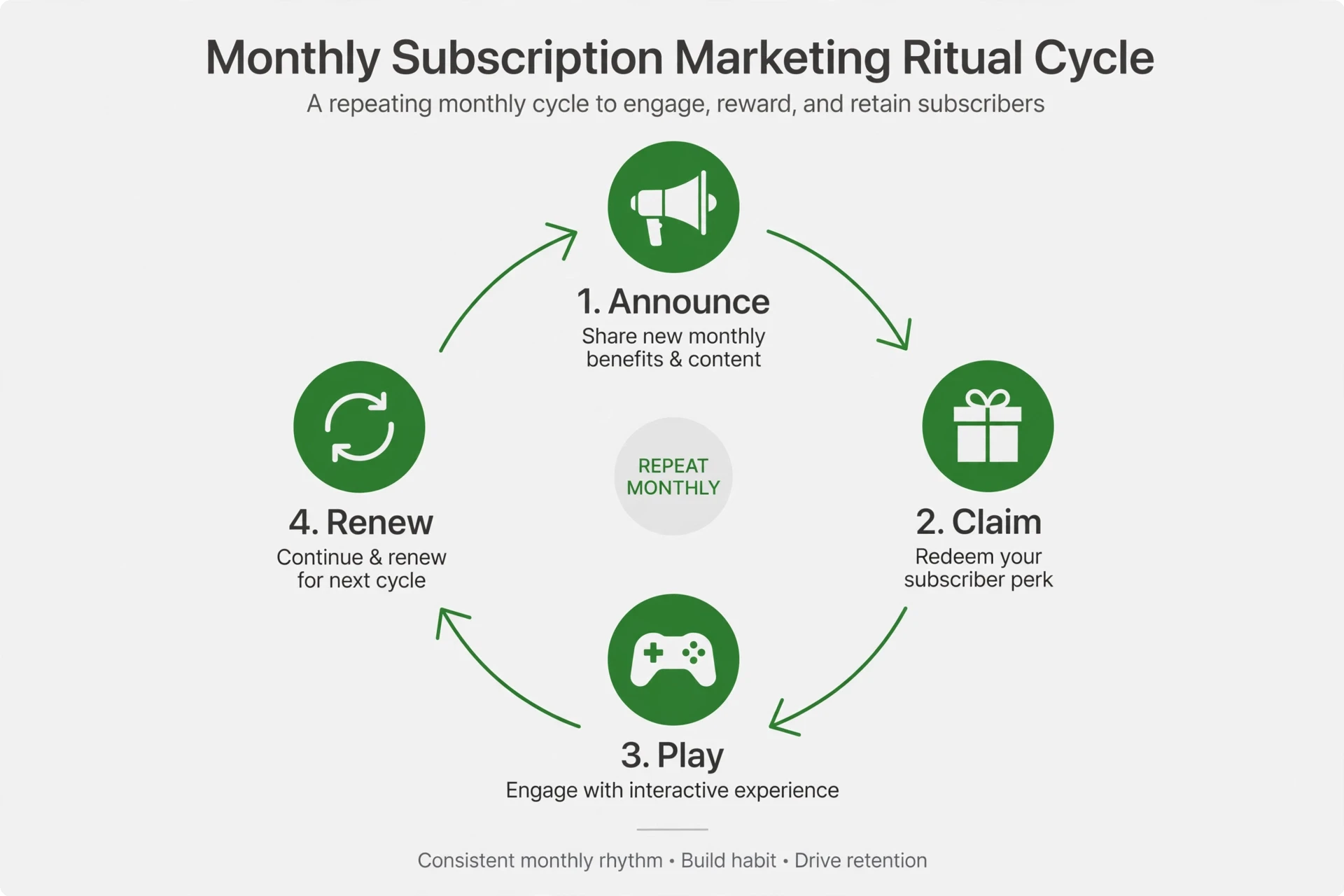
The most powerful thing about the PlayStation Plus October 2026 announcement is not the three games. It is that the announcement happened at all — on schedule, the way it always does. Sony reveals the monthly games at the end of each month, every month, like clockwork — the PlayStation Plus October 2026 reveal landed on September 30, exactly when subscribers expected it. Subscribers know the rhythm. Gaming press knows the rhythm. Google Trends literally lights up with it. The announcement has become a ritual, and rituals are marketing’s most underused retention tool.
Think about what a ritual does to customer psychology. A one-off promotion is noise; a recurring event is a habit. When customers know something good arrives on a predictable schedule, they stop evaluating whether to stay subscribed and start anticipating what comes next. The question shifts from “is this membership worth it?” to “what are they dropping this month?” That shift is the entire game of subscription marketing, and it is won with cadence.
Small businesses can build their own rituals without a billion-dollar content pipeline. A coffee subscription that announces a new origin roast on the first of every month. A marketing agency that publishes a monthly benchmark report for clients. A fitness studio that reveals next month’s class schedule with a themed challenge. A SaaS product that ships a “what’s new this month” video. The content does not need to be as expensive as a racing game — it needs to be as reliable. Pick a schedule, name the moment, and never miss it. Predictability is a feature.
This is the same event-driven rhythm we broke down in Mojang’s launch machine — the companies that turn launches into institutions stop renting attention and start owning it.
The deeper point: Sony does not market PlayStation Plus continuously. It markets it in monthly bursts that the calendar triggers automatically. That is the retention engine behind the PlayStation Plus October 2026 spike — and behind every monthly spike before it. If your marketing only happens when you “get around to it,” you are losing to everyone who turned their value delivery into an event.
Lesson 2: Tier Your Offer Like Essential, Extra, and Premium
PlayStation Plus comes in three tiers — Essential, Extra, and Premium — and that three-tier structure is doing quiet, sophisticated work. The base tier delivers the monthly games and core online access. The higher tiers add catalogs, demos, and extras. This is the classic good-better-best architecture, and it solves one of the hardest problems in subscription marketing: how to serve both the price-sensitive newcomer and the power user without building two businesses.
Three tiers work for a reason psychologists call the compromise effect: most buyers avoid the extremes and land in the middle, while the top tier makes the middle look reasonable and the bottom tier makes the whole offer feel accessible. Sony does not need to convince anyone that Premium is the right choice — it just needs Premium to exist so that Extra feels like the smart pick and Essential feels like a safe entry point.
Small businesses should steal this structure outright. A web design studio can offer a launch package, a growth package, and a premium package with ongoing optimization. A social media service can tier by platform count and posting frequency. A subscription box can tier by item count. The key insight from the PlayStation Plus October 2026 playbook: the base tier must still feel generous — three full games a month keeps Essential from feeling like a consolation prize — because the base tier is the on-ramp that feeds the upgrades. Note too that the PlayStation Plus October 2026 drop is available to every tier: the ritual is universal, only the extras are tiered, so nobody feels excluded from the monthly moment.
One more subtle move worth copying: Sony never positions the tiers against each other as rivals. They are presented as one family of membership with escalating benefits. Your tiers should feel the same way — a ladder the customer climbs, not a choice they might regret. If you are rethinking how your offers are structured, how we approach marketing services for small businesses starts from the same principle: one clear ladder, no dead ends.

Lesson 3: Put an Expiry Date on Every Offer
Look closely at the mechanics of the PlayStation Plus October 2026 drop: the games can be claimed from October 6 through November 2. After that, they are gone from the offer — not from your library if you claimed them, but from the chance to claim them. That four-week claim window is a masterclass in deadline-driven marketing.
Urgency works because loss aversion is real: people act more decisively to avoid losing something than to gain something equivalent. Sony never discounts the membership and never begs anyone to renew. It simply sets a clock. Miss the window and the games are gone. That quiet deadline does more retention work than a dozen “please stay” emails, because the motivation is internal — the subscriber claims the games to avoid regret, and every claim in the PlayStation Plus October 2026 window is another deposit in the “this membership pays for itself” account.
The application for small businesses is straightforward: put a genuine expiry date on every meaningful offer. A quarterly strategy review that is only available to clients who book this month. A seasonal service package that closes on a fixed date. A bonus for new retainer clients that expires at quarter-end. The deadline must be real — fake urgency trains customers to ignore you. Sony’s window is real: the games genuinely rotate out. Your deadlines must be equally honest.
Lesson 4: Make Claiming the Benefit Effortless
Notice how little friction sits between a PlayStation Plus subscriber and the October 2026 games: open the store, click claim, done. No forms, no upsell gauntlet, no “call to redeem.” The value is one click away. That frictionlessness is a deliberate retention choice. Every ounce of friction in claiming a benefit is an excuse to disengage — and disengaged subscribers cancel.
Small businesses routinely bury their own benefits in friction. The client loyalty discount that requires a phone call. The referral bonus that needs a three-step form. The membership perk hidden three menus deep. Audit your own business from the subscriber’s perspective: how many steps stand between your customer and the value you promised them? The PlayStation Plus October 2026 lesson is to count those steps and remove every one you can. When customers actually consume the value they pay for, renewals stop being decisions and start being defaults. This connects directly to retention strategies that keep small-business customers coming back — the ones that win are the ones that make value effortless to use.
Lesson 5: Write for the Leaver, Not Just the Joiner
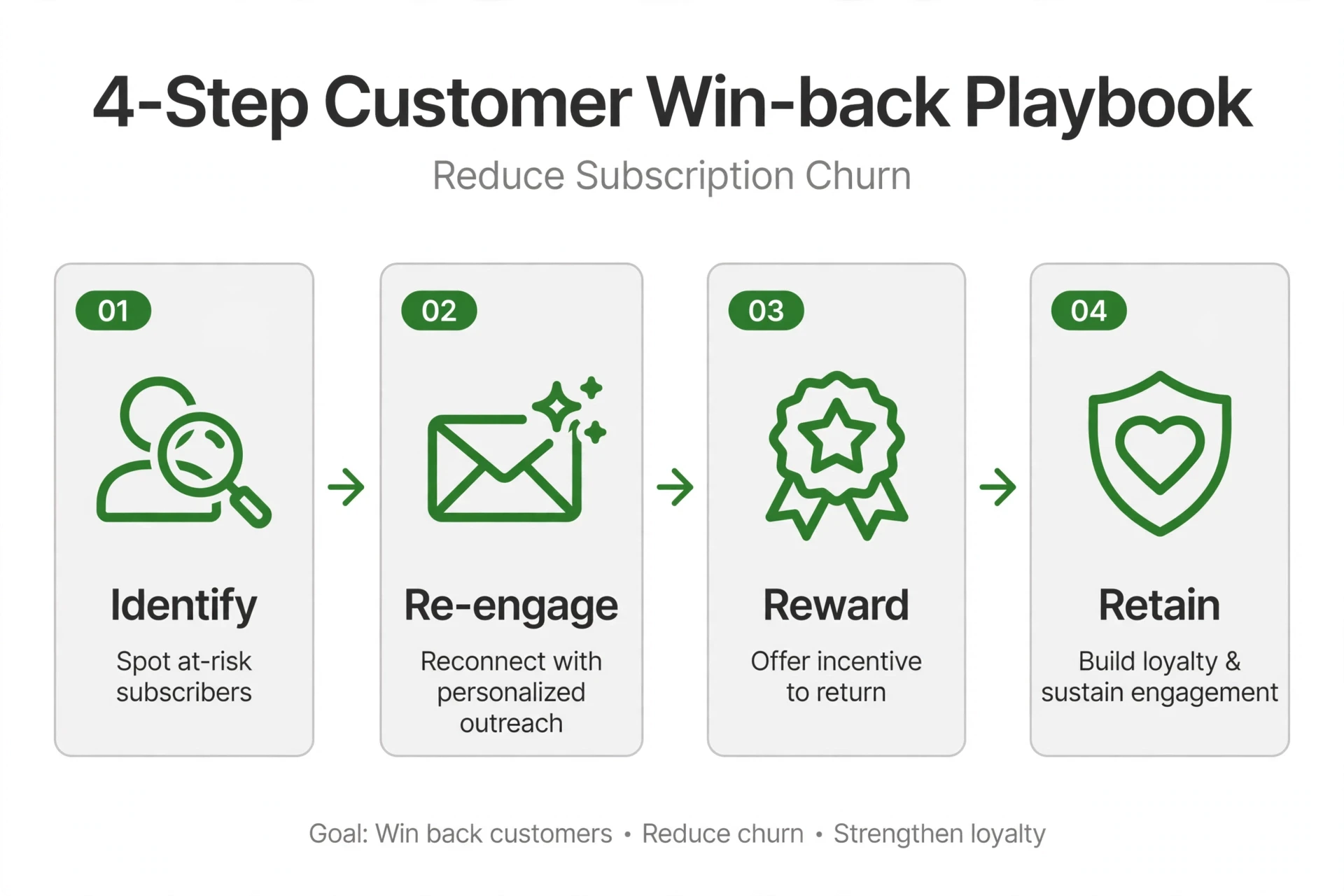
Here is the PlayStation Plus October 2026 mechanic most marketers overlook: the announcement is written as much for the person about to cancel as for the person about to join. Every reveal is a fresh argument for staying — new games, new reasons, new deposits in the value account. Sony runs twelve win-back campaigns a year and never calls them that.
Your business has the same opportunity. Most marketing copy is written to acquire: landing pages, ads, and pitches all aimed at the stranger. But the cheaper revenue is in the customer already holding the door. Build your own “monthly reveal” for existing customers: a re-engagement email that lands with genuinely new value, a “here is what you got this month” recap, a win-back sequence for dormant accounts that leads with something new rather than a discount. The PlayStation Plus October 2026 announcement works because it gives a wavering subscriber a reason to stay that has nothing to do with the price of the membership. Your retention emails should do the same: lead with new value, not with apologies or incentives.
Lesson 6: Bundle One Headline With Two Surprises
The October 2026 lineup leads with F1 25 — the headline act, the racing blockbuster — and then adds two surprises: an extraction shooter and a voxel co-op shooter. That 1+2 structure is deliberate. The headline gets the click; the surprises get the “wait, this too?” reaction that makes the whole bundle feel like a steal.
This is the bundling lesson for small businesses: never sell a single item when you can sell a headline plus bonuses. The agency retainer whose headline is “SEO” but that also includes a monthly content piece and a quarterly strategy session. The subscription box whose hero product ships with two small extras. The course whose core modules come with templates and a community. The headline does the positioning; the surprises do the delighting. And delight is what subscribers mention when friends ask whether something is “worth it.” The same psychology powers packaged service offers that convert — a clear headline with visible extras beats a bare line item every time.
Lesson 7: Let Members Co-Create the Moment
Watch what happens after every PlayStation Plus monthly reveal: the community takes over. Wishlist threads, prediction posts, reaction videos, tier lists of the best months ever. Sony does not manufacture this — it enables it by giving the community a predictable moment to gather around. The subscribers become the marketing channel, arguing about which month was best and convincing each other to stay.
Small businesses can engineer the same dynamic at their own scale. Give your customers something to react to on a schedule: a monthly poll on next month’s product flavor, a customer vote on the next workshop topic, a “show us how you use it” challenge with a recurring hashtag. The PlayStation Plus October 2026 conversation did not stay on Sony’s channels — it spread across forums, social feeds, and group chats. When your customers start creating the content around your ritual, your retention marketing runs itself.
Lesson 8: Design for Search, Not Just for Subscribers
There is a final, easy-to-miss layer to the PlayStation Plus October 2026 announcement: it is built for search. “PlayStation Plus October 2026” is a query with a predictable monthly spike, and Sony’s reveal — amplified by every gaming outlet publishing the same lineup — owns that query across the entire results page. The announcement is both a retention event and an SEO event, capturing everyone searching for the games, the claim dates, and the lineup details.
That dual purpose is the lesson. Every recurring moment in your business should be designed to be found, not just experienced. Name your monthly report, event, or release with the exact words your customers would search for. Publish it on a consistent URL pattern. Let each edition accumulate into an archive that ranks. Sony turns a retention mechanic into search traffic every single month; your business can do the same with a monthly guide, a recurring webinar series, or a seasonal collection. This is precisely the approach behind SEO for small businesses — build assets that compound instead of campaigns that expire.
Your Playbook: 8 Subscription Marketing Moves to Steal This Month
Here is the PlayStation Plus October 2026 playbook, condensed into eight moves you can apply to your own subscription, membership, or retainer business this month:
1. Name a monthly moment — Pick one recurring event (a report, a reveal, a drop) and announce it on a fixed schedule. Predictability builds the ritual.
2. Tier as good-better-best — Structure your offer so the base tier feels generous, the middle tier feels like the smart pick, and the top tier makes the middle look reasonable.
3. Set a real deadline — Put a genuine expiry date on every meaningful offer. Real urgency beats manufactured urgency every time.
4. Remove claiming friction — Audit the steps between your customer and the value they pay for. Delete every step you can.
5. Market to the leaver — Write your monthly updates as win-back campaigns: lead with new value, not with discounts or apologies.
6. Bundle headline + surprises — Lead every offer with one clear headline and add two unexpected bonuses. Delight is what gets mentioned.
7. Enable co-creation — Give customers something to react to, vote on, or share on a schedule. Let the community become the channel.
8. Design it to be found — Name every recurring asset with the exact words customers search for, on a consistent URL pattern, so it compounds in search.
Sony’s PlayStation Plus October 2026 reveal is a reminder that the best subscription marketing is not a tactic — it is a system. Build the system once, run it every month, and watch retention compound. If you want a team to build that system with you, talk to KKeyQik.
Frequently Asked Questions
Sony announced F1 25 (PS5), Hunt: Showdown 1896 (PS5), and Earth Defense Force: World Brothers 2 (PS5 and PS4) as the October 2026 PlayStation Plus Essential lineup. The games are claimable from October 6 through November 2, 2026, and stay in the subscriber's library for as long as the membership remains active. The reveal was reported across gaming press on September 30, 2026.
The claim window runs from Tuesday, October 6 through November 2, 2026. Members claim the games from the PlayStation Store during that window; once claimed, they remain playable for as long as the subscription stays active. September's games — Sniper Elite: Resistance, MLB The Show 26, Wobbly Life, and Chained Echoes — must be claimed before October 6.
Essential is the base tier that includes the monthly claimable games, online multiplayer, and core benefits. Extra and Premium layer on game catalogs, demos, and additional extras on top of that. The October 2026 monthly games are available to members on every tier, which keeps the monthly ritual universal rather than tier-gated.
The end-of-month reveal has become a monthly ritual that subscribers and the gaming press have come to expect. That predictability converts the membership from a continuous cost question into an anticipated event, which is exactly the shift that reduces churn. Marketers can copy this by turning their own value delivery into a named, recurring moment that customers look forward to.
The October 6 to November 2 window creates a quiet deadline: members claim the games to avoid losing access to them. Each claim is a small deposit in the subscriber's mental account of membership value, which makes the next renewal feel automatic rather than debated. This is the same deadline mechanic small businesses can apply to limited-time offers and re-engagement campaigns.
Build a monthly ritual, tier the offer as good-better-best, put an expiry date on every offer, make claiming the benefit effortless, write win-back messages for the leaver, bundle one headline with two surprises, let members co-create the experience, and design for search behavior by using official-language naming. The article walks through each lesson with a concrete small-business application.
A multi-item drop widens the net — racing, extraction shooter, and co-op shooter fans each get a reason to claim. It also creates a bundling effect where subscribers feel the membership delivers more than expected. For small businesses, the parallel is pairing one headline offer with smaller surprise bonuses to lift perceived value.
No — claimed monthly games remain in the library and playable only while the membership stays active. That ongoing-access design is itself a retention mechanic: the growing library raises the cost of letting the subscription lapse. It is a textbook example of endowment-style lock-in in subscription marketing.
Sony announced that Spider-Man: Brand New Day comes to Sony Pictures Core on October 6 with limited-edition film avatars, plus Halloween horror-themed in-game bundles rolling out through the month. Those include packs for Call of Duty: Warzone, a Hunt: Showdown 1896 starter pack, and an Overwatch 2 bundle. These ecosystem touches deepen engagement around the core monthly drop.
Pick a fixed schedule and a name for the moment — a monthly benchmark report, a new-product reveal, a members-only challenge. Announce it the same way each month, deliver on time, and never skip a month. Predictability is the feature: when customers can set their calendar by it, the ritual starts doing retention work for you.