
Introduction
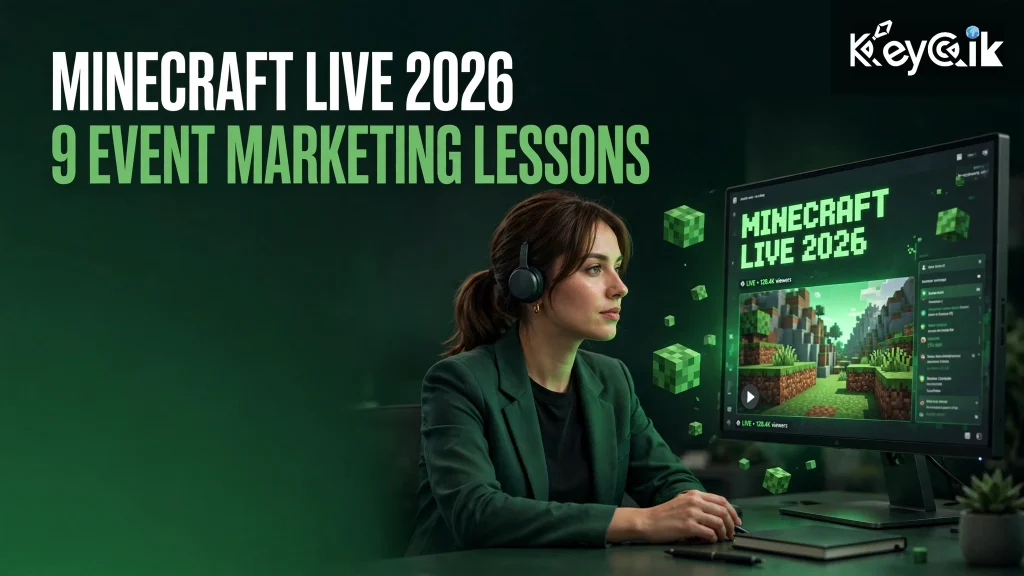
“Minecraft live” is one of the fastest-rising searches in the United States right now — up more than 800% in the last day. On September 26, 2026, Mojang Studios ran its September edition of Minecraft Live, the twice-yearly broadcast where the world’s best-selling video game unveils what’s next. Players around the world tuned in. The announcements — a brand-new dimension, a sequel launching this Tuesday, a theme-park hotel — ricocheted across YouTube, Twitch, and social feeds within minutes.
Here is what most coverage of Minecraft Live misses: the broadcast itself is event marketing at its most refined. Mojang doesn’t buy Super Bowl spots to announce a new Minecraft dimension. It doesn’t need to. Over the years, the studio has built something far more valuable than an ad budget — an event marketing machine that turns product announcements into community events, and community events into free global distribution. The September 2026 show was a masterclass in event marketing, and nearly every move in it maps directly onto something your business can do.
This guide breaks down nine proven event marketing lessons from Minecraft Live 2026 — from creator-led reveals to scarcity mechanics to physical-world brand extensions — and shows you how to apply each one to your own launches, no blockbuster game required. If your product announcements currently land with a press release and a prayer, keep reading.
What Minecraft Live September 2026 Actually Announced
Before the lessons, the facts — because the scale of what Mojang packed into one broadcast is itself the first event marketing signal. The September 26 show, which streamed at 10 a.m. PT, delivered:
- The Sift, a new dimension coming to Minecraft Java and Bedrock editions next year — the first new dimension in over a decade, joining the Overworld, the Nether, and the End. It debuts first inside Minecraft Dungeons II.
- Minecraft Dungeons II, releasing September 29, 2026 — just three days after the broadcast — on PC, PlayStation 5, Xbox Series X|S, Nintendo Switch, Nintendo Switch 2, and Xbox Game Pass, co-developed with Double Eleven. The sequel swaps the original’s mission map for one interconnected world, adds jumping, four-piece armor, twelve gear slots, and talismans.
- A Holiday Drop introducing underground ice caves, complete with a new frozen zombie variant that can slow attackers with a chilling effect and hurl ice projectiles.
- Sound Effects Packs for the Minecraft Marketplace, giving players new ways to customize their experience.
- Minecraft World, opening in 2027 at Chessington World of Adventures Resort in London — including the first official Minecraft hotel and Escape the Nether, billed as the world’s first Minecraft rollercoaster.
- A new Creator Platform for making, managing, and sharing community content.
- Minecraft launching on Nintendo Switch 2 on October 27.
The show also streamed with American Sign Language, British Sign Language, and audio-description feeds — a detail worth remembering when we get to Lesson 4. Now, the lessons.
Lesson 1: Own Your Tentpole — Build the Event Instead of Renting Attention
Most brands announce things the expensive way: they rent attention. They buy ads, pitch journalists, and hope an algorithm smiles on launch day. Mojang does the opposite. Minecraft Live is an owned tentpole — a recurring event the company controls completely, running twice a year (the March 2026 edition revealed the game’s Tiny Takeover and Chaos Cubed updates). The audience doesn’t discover the announcements by accident; they mark the date, clear their schedules, and show up.
That distinction is the single biggest event marketing advantage available to any business. Rented attention spikes and vanishes. Owned attention compounds. Every edition of Minecraft Live trains the audience to return for the next one — event marketing compounding in action — which means each launch starts with a warmer room than the last. The show has been running in various forms since the Minecon era — nearly a decade of compounding.
Your version doesn’t need a stadium or a streaming platform. A quarterly product webinar, a yearly customer summit, a monthly live “what’s shipping” session — any recurring format your audience can anticipate — does the same job at your scale. The event marketing principle is identical: stop launching into the void and start launching onto a stage you own. If you want help designing a launch calendar that compounds instead of resets, our team builds exactly that kind of always-on content engine.
Lesson 2: Let Creators Break Your News
Mojang didn’t unveil the September 2026 date through a corporate press release. The date leaked into the world at the end of a stream by Tubbo, one of Minecraft’s biggest creators — right after the Blue Creeper Battle community event, a short cinematic thanked players and teased a portal to the Sift. The company handed its most exciting news to a creator’s audience first.
This is event marketing working through the community marketing layer, and it’s devastatingly effective. A press release reaches journalists. A creator’s stream reaches believers — people who have opted into that creator’s taste, who trust their excitement, and who will clip, react, and repost the moment within minutes. When the news then hits the official broadcast, it arrives pre-amplified — a textbook event marketing outcome: the community has already spent days speculating about the Sift portal tease.
The mechanics are replicable for any brand. Identify the three to five creators your buyers already watch — not the biggest names, the most trusted ones in your niche. Give them the story first, in a form they can play with rather than just read. A hands-on preview beats an embargoed PDF every time. Minecraft’s audience doesn’t just consume announcements; it produces content about them, which is why a single cinematic shown on one stream became a week of speculation content across YouTube and TikTok. Your event marketing should be designed to be reacted to, not just watched — a principle that also powers the social video strategies in our social media management packages.
Lesson 3: Reward Attention with Scarcity Mechanics
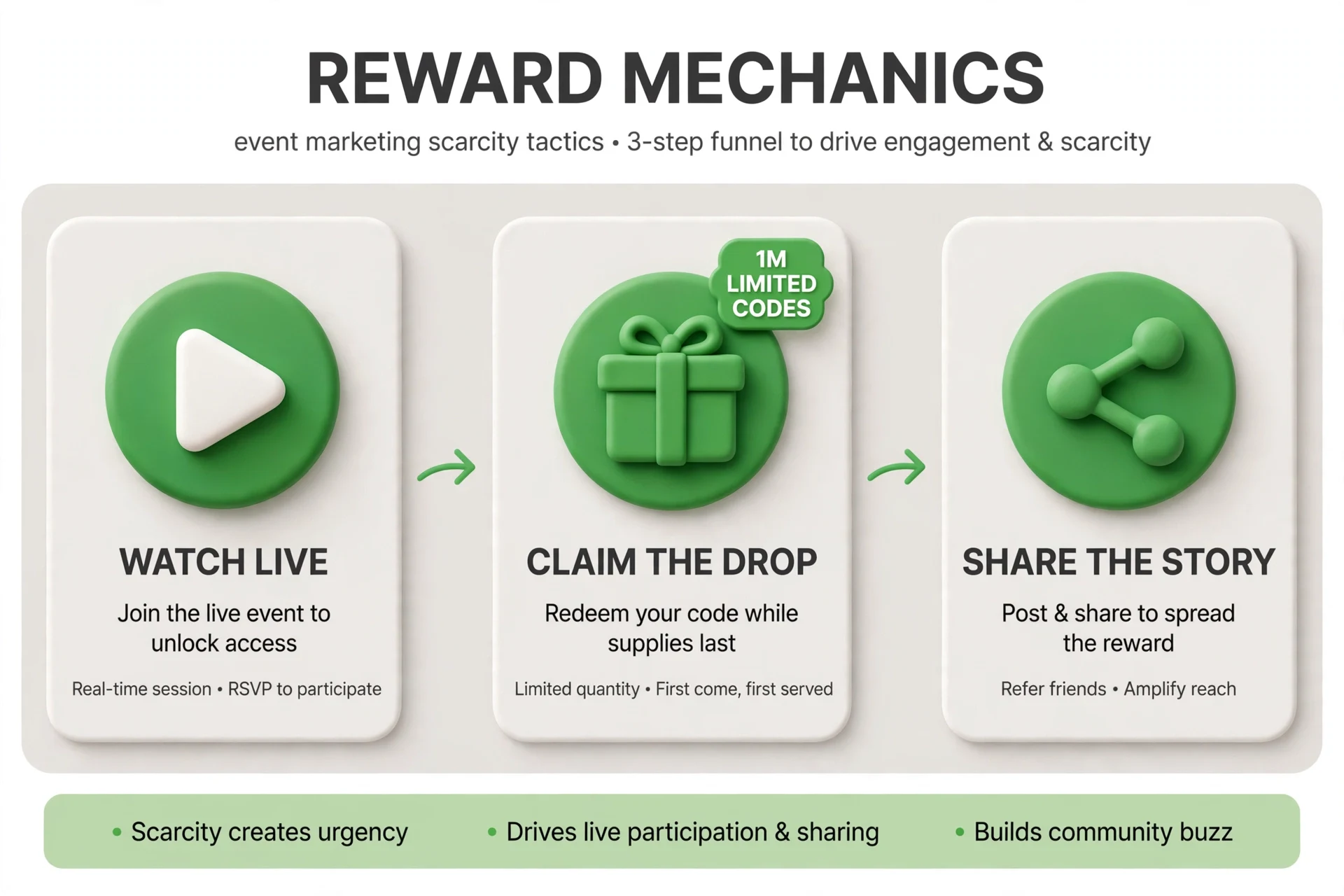
In the lead-up to the September broadcast, Mojang ran an event marketing campaign that started September 17 across Tokyo Game Show, YouTube, and in-game Bedrock Edition worlds. The campaign included Twitch Drops and — the detail that set the community alight — one million Corrupted Creeper Cape codes.
Pause on that number. One million sounds like a lot until you remember Minecraft has sold over 300 million copies. One million capes for hundreds of millions of players is deliberate scarcity — and scarcity is an event marketing superpower. It converts passive awareness (“there’s a show next week”) into active behavior (“I need to watch live or the cape is gone”). The cape isn’t valuable because of what it does in the game. It’s valuable because not everyone can have one, and everyone knows it.
This is the same event marketing psychology behind limited-seat webinars, early-bird pricing, and launch-day bonuses — but most brands apply it timidly. Mojang applies it at the center of the campaign, not the edges. For your next launch, build one genuinely scarce reward into the event itself: the first 200 attendees get the template pack, live viewers unlock the bonus module, launch-week buyers get the founding-member rate that never returns. Scarcity doesn’t just boost attendance; it gives attendees a story to tell afterward (“I got the cape”), which extends the event’s marketing half-life by weeks. And when the reward is digital, the marginal cost of each additional claimant is near zero — pure event marketing margin.
Lesson 4: Make Accessibility a Headline, Not a Footnote
Buried in the September 2026 announcements was a detail most brands would have left in the fine print: the broadcast shipped with dedicated American Sign Language, British Sign Language, and audio-description streams. Mojang didn’t treat accessibility as a compliance checkbox. It listed those feeds alongside the main show links, as first-class ways to experience the event.
In event marketing terms, this is audience expansion disguised as decency. Every accessibility feature is a door into a segment of the audience that most launches simply lock out. Deaf and hard-of-hearing viewers, blind and low-vision viewers — these are real people with real purchasing power who notice, vividly, which brands bother to include them and which don’t. And the reputational spillover goes further: when the broader community sees a brand investing in inclusion without being forced to, it reads as confidence and care, two of the scarcest commodities in marketing.
The lesson for your business is blunt: audit your next launch for the doors you’ve left locked. Captions on every video. Transcripts for every webinar. Alt text on every announcement graphic. Color contrast that doesn’t require perfect vision. None of this is expensive; almost all of it is skipped. In a crowded market, the brand that bothers to include everyone doesn’t just do the right thing — it runs event marketing that converts an audience its competitors never even see.
Lesson 5: Stretch Your Brand Into the Physical World
The most audacious announcement of Minecraft Live September 2026 wasn’t digital at all. Minecraft World — opening in 2027 at Chessington World of Adventures Resort in London — brings the first official Minecraft hotel, themed dining, and Escape the Nether, described as the world’s first Minecraft rollercoaster. A video game is building a hotel.
This is brand extension as event marketing, and the logic is worth studying. Digital attention is abundant and forgettable; physical experiences are scarce and memorable. A player who sleeps in a Minecraft-themed hotel room doesn’t just remember the brand — they inhabit it, photograph it, and post about it, generating exactly the user-created content no ad budget can buy. The theme park becomes a permanent, year-round marketing asset that pays for itself while advertising the game.
You don’t need a rollercoaster. The principle scales down cleanly: a software company that runs a genuinely great in-person user meetup, a skincare brand with a pop-up experience, a B2B firm with a customer advisory dinner that people actually enjoy — these are all physical-world extensions of a digital brand, and they all produce the same two event marketing outputs: deeper loyalty and better content. The question to ask isn’t “can we afford a theme park” but “what is the smallest physical experience that would make our customers feel our brand instead of just seeing it?” Start there.
Lesson 6: Run a Drumbeat, Not a One-Off
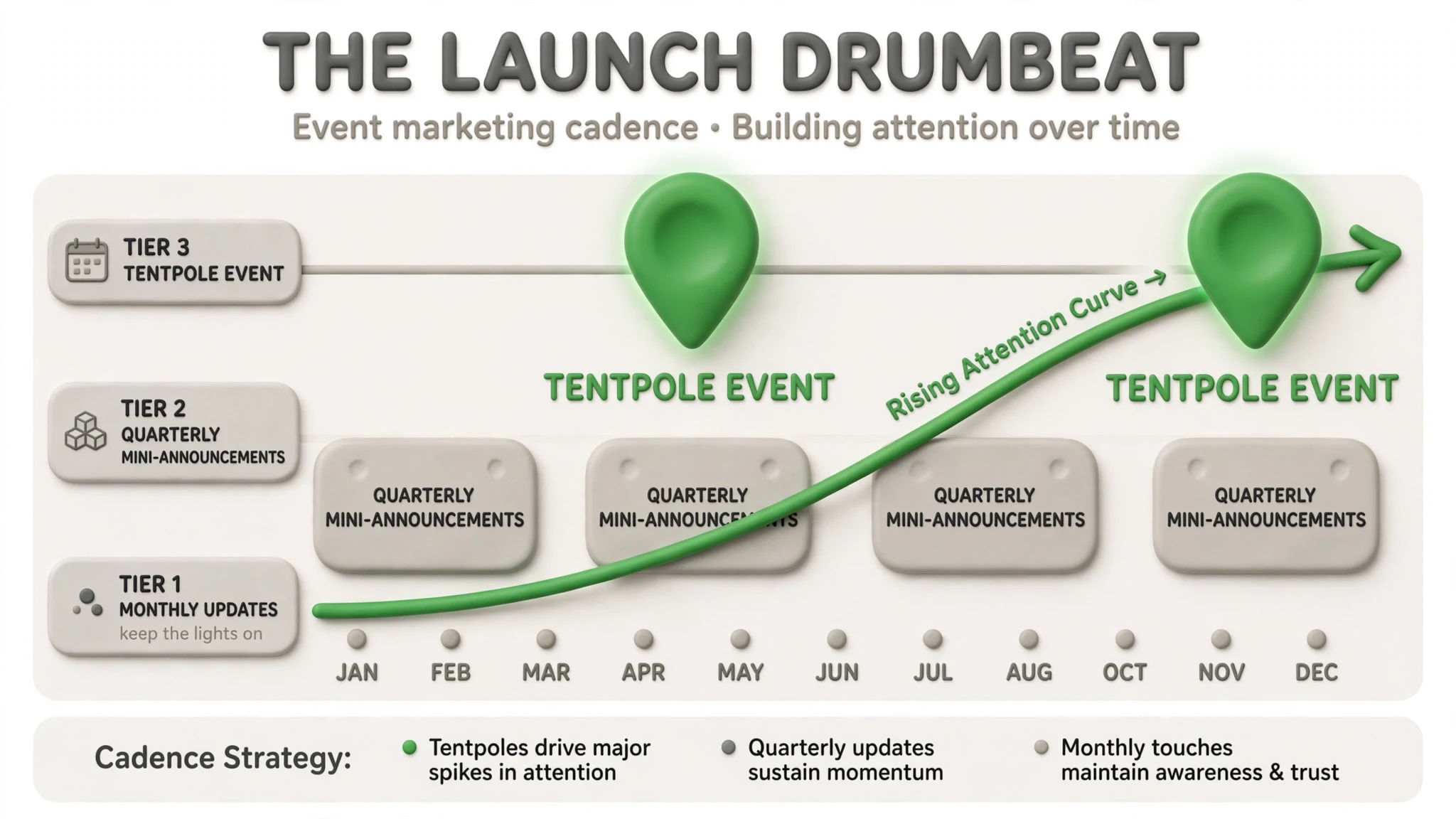
Notice the cadence. Minecraft Live now runs twice a year. Between the tentpoles, Mojang ships smaller “game drops” — the Tiny Takeover update, the Chaos Cubed update with its sulphur caves, the autumn Dappled Forest biome teased at the May 2026 TwitchCon edition. The September 2026 broadcast itself announced the Holiday Drop. Big beats, small beats, medium beats — a rhythm, not a spike. That’s event marketing as calendar discipline.
This is the event marketing lesson most brands get exactly backwards. They go quiet for eleven months, then detonate one giant launch and wonder why nobody shows up. Mojang’s drumbeat does three things a one-off can’t: it keeps the community warm between tentpoles, it gives creators a steady supply of content hooks, and it makes each big announcement feel like a chapter in an ongoing story rather than a desperate bid for attention.
Translate this to your business with a simple content calendar: one flagship launch event per year (or per half), quarterly feature announcements with their own mini-moments, and a monthly “what shipped” update that keeps the lights on. The monthly updates are the unglamorous hero — they train your audience to pay attention on a schedule, so that when the flagship arrives, the room is already full. Pair that rhythm with consistent search visibility work — SEO services that compound like the drumbeat itself — and every beat lands on an audience that’s already listening.
Lesson 7: Give Your Community Tools, Not Just Trailers
Among the September announcements, one was easy to overlook: a new Creator Platform for creating, managing, and sharing community content, alongside Sound Effects Packs for the Minecraft Marketplace. Mojang wasn’t just showing players new things to watch. It was shipping them new things to make.
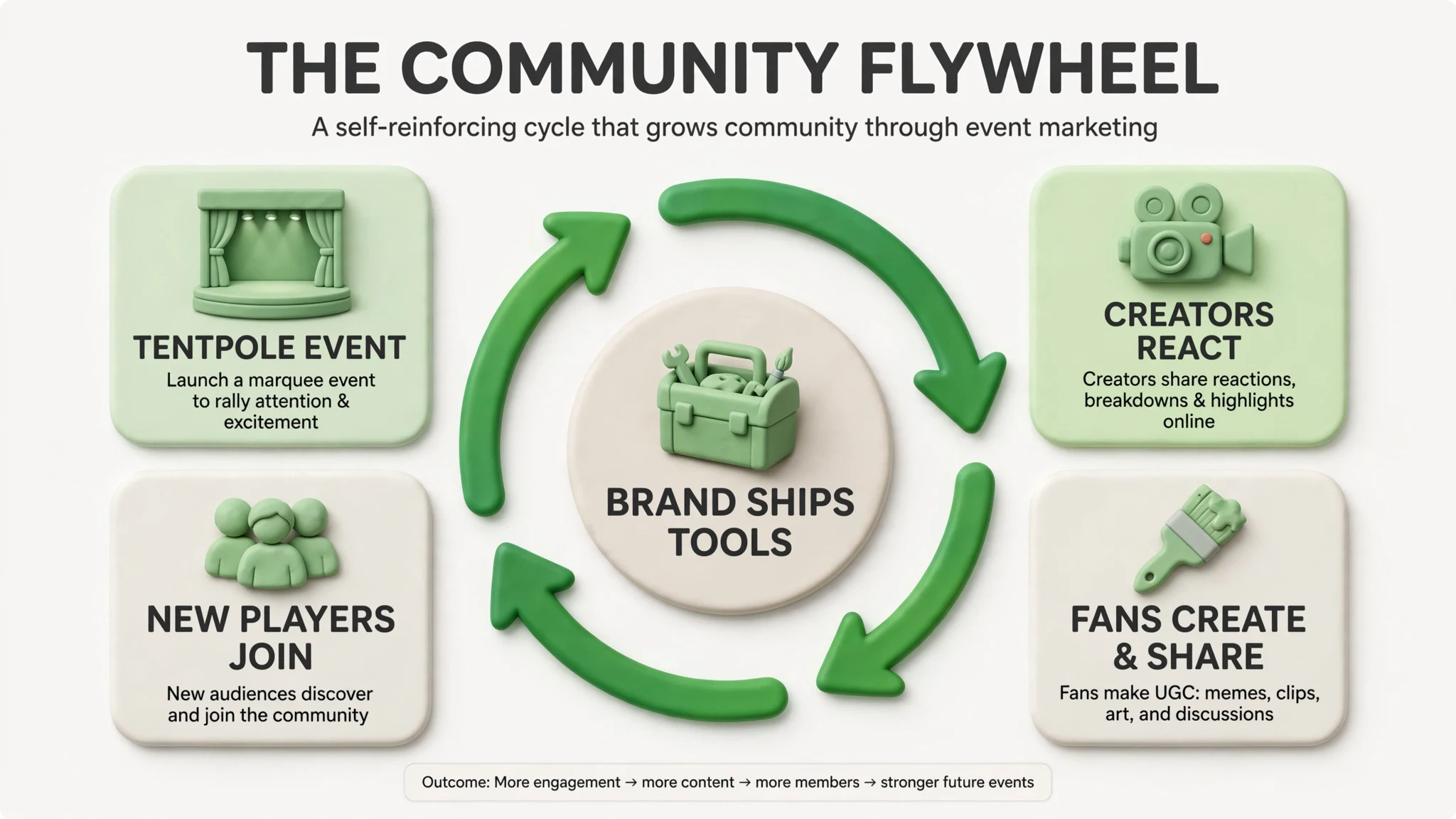
This is the deepest event marketing lesson on the list, because it inverts the normal launch logic. Most launches are broadcasts: the brand talks, the audience listens. Mojang’s launches are tool drops: the brand ships raw material, and the audience manufactures the marketing. Every custom map, every sound pack, every creator-built world is content Mojang didn’t have to produce, distributed through channels Mojang doesn’t have to pay for, carrying a brand message Mojang doesn’t have to write. The Marketplace turns players into vendors; the Creator Platform turns vendors into an ecosystem.
For your brand, the equivalent is any asset that lets customers create with you instead of just buying from you: templates, calculators, swipe files, API access, co-branded kits, a community gallery that showcases customer work. The GTA 6 launch playbook we covered earlier this week runs on the same fuel — a community that markets the product to itself. The brands winning the next decade of event marketing won’t be the ones with the best ads. They’ll be the ones with the best tools in their customers’ hands.
Lesson 8: Time Platform Expansion with Your Tentpole
Minecraft doesn’t just launch content at Minecraft Live — it launches distribution. The September 2026 broadcast confirmed Minecraft is coming to Nintendo Switch 2 on October 27. Announcing a new platform at your own tentpole event does double duty: the platform news gives the event extra gravity, and the event gives the platform news a guaranteed audience.
The event marketing principle here is bundling momentum. Every launch has a fixed cost in attention — the effort of getting people to care, show up, and share. Bundling two announcements into one moment doesn’t double the cost; it multiplies the payoff. The Switch 2 news pulled Nintendo’s audience into Minecraft’s event, and Minecraft’s event pulled its community toward Nintendo’s hardware. Both sides of the bundle got bigger than either would have alone.
Small businesses can run the same play: time your new service tier, your partnership announcement, or your market expansion to coincide with your flagship event instead of dribbling them out separately. One room, one moment, multiple headlines. Your audience’s attention is the most expensive thing you’ll ever buy — that’s the event marketing math. Spend it once and make it count twice.
Lesson 9: Sell the Mystery, Not the Specs
Finally, the Sift. Mojang could have announced “a new dimension with X biomes and Y mobs.” Instead, the reveal began weeks earlier as a tease — a short cinematic at the end of Tubbo’s stream, a portal, a name, and almost no details. The community spent the gap between the tease and the broadcast doing Mojang’s marketing for it: theory videos, speculation threads, frame-by-frame breakdowns of a thirty-second clip.
This is the curiosity gap, and it is event marketing’s oldest trick — executed here with unusual discipline. A spec sheet informs; a mystery compels. The human brain dislikes open loops, so it fills them with attention, discussion, and content. By the time the September broadcast finally showed the Sift in full, the audience had spent weeks emotionally invested in the reveal. No feature list could have bought that level of engagement.
Apply it by restructuring your next launch announcement: lead with the question, not the answer. Tease the outcome before you reveal the mechanism. Apple has run this playbook for decades; Mojang just proved it works for a fifteen-year-old game announcing its fourth dimension. The rule is simple — if your audience can predict your announcement from the headline, you’ve revealed too much, too soon. Make them need to show up to find out.
Your Event Marketing Playbook: Putting It All Together
Nine event marketing lessons are only useful if they become a plan. Here’s the condensed playbook, in the order you’d execute it:
- Pick your tentpole. One recurring owned event per year (minimum). Put it on the calendar before anything else.
- Set the drumbeat. Quarterly mini-announcements and monthly updates between tentpoles. Never go dark.
- Seed the mystery. Tease the headline announcement two to three weeks out through creators, not press releases.
- Arm the creators. Give trusted niche creators the story first, in a form they can play with.
- Build in scarcity. One genuinely limited reward tied to live attendance. Make it worth talking about.
- Bundle your news. Stack platform, partnership, and product announcements into the same moment.
- Ship tools, not just news. Every launch should hand your community something to create with.
- Open every door. Captions, transcripts, alt text, multiple formats — accessibility is audience expansion.
- Extend physically. Find the smallest real-world experience that lets customers feel the brand.
Run that playbook twice a year and your launches stop being gambles. They become a machine — the same kind of machine that turned a September livestream into an 800% search spike.
The Bottom Line
Minecraft Live 2026 worked because Mojang understands something most brands don’t: the event is the product launch, the community is the distribution channel, and the audience is the marketing team. The Sift, Dungeons II, the ice caves, the hotel — those are the headlines. The real story is the event marketing machine underneath them: owned tentpoles, creator-led reveals, scarcity mechanics, relentless rhythm, and tools that turn players into promoters.
Your business doesn’t need 300 million players to run this playbook. It needs a calendar, a community, and the discipline to launch like every announcement matters — because to your audience, it does. If you want a team that builds launch machines instead of one-off campaigns, talk to KKeyQik — event marketing, community marketing, and the content engine to power both are what we do every day.
Frequently Asked Questions
Minecraft Live is the annual event where Mojang announces game updates, features, and community news to millions of viewers. It is a masterclass in event marketing because it turns product updates into a communal celebration.
It treats announcements as entertainment — countdowns, reveals, developer storytelling, and community participation. Product and service businesses can borrow the format: make launches feel like events with build-up and payoff, not press releases.
Minecraft's community creates the marketing — fan art, theories, reaction videos, and mods generate year-round buzz. Brands that give customers tools and reasons to create (contests, templates, hashtags) earn distribution that paid ads cannot buy.
The event is produced for streaming platforms where the audience already lives, with chat and real-time interaction built in. Meet your audience on their preferred platforms instead of expecting them to come to yours.
Minecraft has thrived for over a decade by evolving with its players — new features respond to community requests. The marketing lesson: listen publicly, ship visibly, and let customers feel ownership of the product's direction.
Short cinematics, countdowns, mystery names, and partial reveals — like Mojang’s portal tease — spark speculation without giving away the announcement. Start teasing two to three weeks out through trusted creators, and leave enough unanswered that the audience has to show up for the reveal.
Behind-the-scenes developer content humanizes the company and builds trust. Small businesses can do the same with workshop tours, process videos, and team stories — authenticity tends to scale down well.
Interactive elements — polls, contests, live Q&A — can turn passive viewers into participants. Events with real participation often see stronger engagement and recall than passive announcements.
It pairs a beloved product with participatory rituals that make players feel like co-creators. Any brand with an engaged customer base can create rituals — annual awards, community showcases, user spotlights — that deepen loyalty.
Start with your existing customers, give them something to participate in, and stream it where they already spend time. A modest but genuine community event beats an expensive broadcast nobody asked for.