

On Thursday night, October 15, 2026, in front of a sold-out crowd and a live ESPN2 audience, the Savannah Bananas unveiled the 2027 Banana Ball World Tour — and it looked less like a schedule announcement than a coronation. Roughly 74 cities. 79 stadiums. 23 Major League Baseball parks and 10 football stadiums. And for the first time in the organization’s history, Banana Ball is going international, with dates in Monterrey and Tijuana, Mexico, plus Toronto and Winnipeg, Canada.
The response was instant and overwhelming. A centralized ticket lottery opened the moment the City Selection Show ended, and it will run through Halloween night — a random drawing, because Banana Ball long ago stopped pretending that first-come-first-served could handle this kind of demand. Banana Ball owner Jesse Cole told ESPN that the ticket waitlist had reached five million names. Five million. For a team that started a decade ago trying to fill a small historic ballpark in Savannah, Georgia.
That is not a sports story. That is a marketing story — one of the most instructive of the decade, and the Banana Ball playbook deserves a close read from every marketer. The Banana Ball phenomenon was not built on advertising spend. It was built on a company literally named Fans First Entertainment, a TikTok following bigger than any MLB club’s, ticket prices that start at $35 with no hidden fees, and a product — the two-hour, dance-break-filled, fan-catches-a-foul-ball-and-it’s-an-out spectacle of Banana Ball — that was designed from the first sketch to be shared.
For marketers, the 2027 World Tour announcement is the perfect moment to study what the Bananas actually did. Here are seven lessons any brand can steal.
Lesson 1: Build the Waitlist Before You Build the Sales Funnel
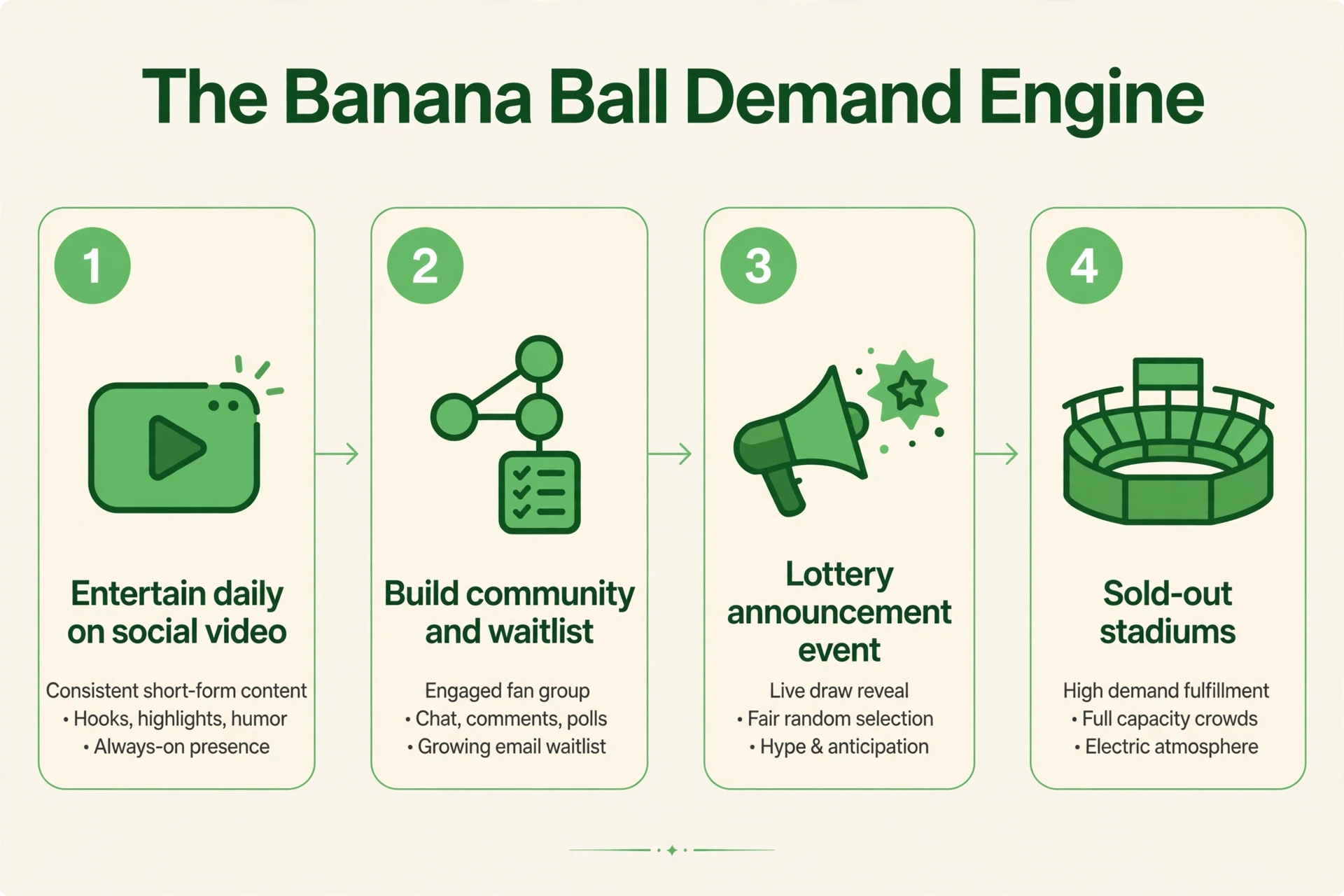
Most companies launch a product and then scramble to find buyers. The Savannah Bananas inverted the sequence: they built the audience first, converted it into a Banana Ball waitlist, and let the waitlist become the product’s launch engine. When the 2027 schedule dropped, the Banana Ball team did not open a shopping cart — they opened a lottery. Fans enter a random drawing through October 31, and entering earlier does not improve anyone’s odds. That single design choice tells you everything about how this brand thinks.
A lottery does three things a normal on-sale cannot. First, it manufactures fairness, which is catnip for trust: nobody can accuse the Bananas of favoring scalpers or insiders. Second, it manufactures conversation — every entrant tells friends to enter, because the scarcity is real and the stakes feel shared. Third, it turns each announcement into a news event rather than a transaction. “Tickets on sale now” is commerce. “Five million people are waiting for tickets” is a headline, and headlines are free distribution.
The deeper point is that the waitlist did not appear overnight. It is the harvest of years of content, community-building, and sold-out shows — demand cultivated so patiently that by the time the 2027 tour was announced, the marketing job of “finding customers” was already done.
The lesson for your brand: invest in the audience asset before you need the revenue event. Build the list, the following, the community — whatever form your waitlist takes — while you have the luxury of time, so that launch day feels like a celebration instead of a cold start. Search engine optimization works the same way: the brands that rank on launch day are the ones that published for a year before they needed the traffic.
Lesson 2: Make Content the Product, Not the Ad
Here is the most counterintuitive fact about the Banana Ball marketing machine: its social feeds are conspicuously free of selling. The Banana Ball content team has said its goals are to “pique curiosity” and “chase smiles” — not to push ticket links. There are no “buy now” calls to action interrupting the entertainment. The organization gives away pure, joyful content with no strings attached, and only when a conversion moment arrives — the lottery, the tour announcement — does it ask for anything. By then, the audience is so emotionally invested that the response is explosive.
That is the entire philosophy in one sentence: never ask the audience for anything until you have given them a reason to care. The execution is famously platform-native. The TikTok operation was famously kick-started by an intern, Savanah Alaniz, who understood the platform’s culture from the inside.
She now runs point on the brand’s social strategy, and the team’s signature move is what it calls “Banana-fying” trends — daily meetings where the crew identifies trending sounds, memes, and formats, then adapts them to the Banana Ball world. A viral dance challenge happens on the pitcher’s mound. A trending audio becomes a dugout skit. The content feels native to TikTok rather than like a repurposed commercial, because it is made by people who live on TikTok.
The numbers validate the approach: more than eight million TikTok followers — a larger audience than any Major League Baseball team — plus a YouTube and Instagram presence that regularly generates millions of views per clip. For marketers, the transferable lesson is uncomfortable but clear. Most brand content fails because it is an ad wearing a costume. Banana Ball treats content as the product and let the product sell the tickets.
Audit your own feed with that lens: if you removed every call to action, would anyone still watch? If the answer is no, you do not have a content strategy — you have a distribution problem for ads. The fix is to hire or empower people who natively understand the platform, give them the daily rhythm to react to trends in hours, and measure smiles and shares before you measure clicks. Your social media calendar should be an entertainment schedule first and a promotional schedule second.
Lesson 3: Turn Personalities Into Characters, Not Spokespeople
Traditional sports marketing sells the team. Banana Ball sells the cast. Every Banana Ball player is developed as a character with a backstory, a nickname, and a narrative arc — and the organization tells those stories with the patience of a television studio.
The signature example is Dakota “Stilts” Albritton, a pitcher who throws from ten feet in the air — on stilts. The Bananas did not just put him on the mound; they documented his journey from a small Georgia town, where he received stilts as a Christmas gift at age ten, through blue-collar jobs after high school, to a tryout he walked into on stilts and a sold-out Yankee Stadium appearance.
Social videos tracing that arc have drawn hundreds of thousands of views across TikTok, Instagram, and YouTube. Albritton is not a spokesperson reciting talking points. He is a character the audience roots for, and that emotional investment is precisely what converts casual viewers into traveling fans.
Notice the discipline here. The Bananas could have marketed “come see trick baseball.” Instead they market “come see Stilts” — a person with a past, a quirk, and a dream, and the Banana Ball character system turns every player into appointment viewing. People do not form parasocial bonds with organizations; they form them with people. The brand becomes the stage, and the cast becomes the reason to buy a ticket.
Every company has potential characters: the founder with an unlikely origin, the engineer obsessed with a detail, the customer whose life changed. Most marketing teams flatten these humans into testimonials. The Banana Ball lesson is to do the opposite — serialize them. Give your audience someone to follow, not just something to buy, and your content gains the one asset no ad budget can purchase: a storyline people check back for.
Lesson 4: Productize the Experience — Sell a Show, Not a Game
Banana Ball did not succeed by marketing baseball better. It succeeded by redesigning the product until it was unrecognizable — and then marketing the redesign. When Jesse and Emily Cole started experimenting with the format, the diagnosis was brutal and honest: fans at their Savannah games were staring at their phones and leaving early. The traditional product was failing, and no amount of promotion could fix a product people did not want to sit through.
So they rebuilt it from first principles. Banana Ball games have a hard two-hour time limit. Every inning won is worth a point, and every run counts in the final frame. If a fan catches a foul ball, the batter is out — the crowd is literally part of the defense. There are no walks: on ball four, the batter sprints the bases while every fielder except the pitcher and catcher has to touch the ball.
Add choreographed dances, a lip-syncing umpire, a “dad bod cheerleading squad” called the Man-nanas, and a pitcher on stilts, and you have something closer to a circus that happens to involve baseball than to baseball itself.
Marketers should study the product decision as closely as the promotion. The Bananas understood that attention is the scarcest resource, and they engineered a format that respects it: two hours, constant motion, a surprise around every corner. The 2027 tour’s innovations continue the pattern — at Notre Dame Stadium on June 26, two baseball fields will sit on opposite corners of the football stadium with teams switching fields every inning, purely so every fan gets a close view. That is product thinking in service of the audience, and it doubles as marketing: every new twist is a story the press wants to tell.
The application for your business: stop asking “how do we promote this?” and start asking “what would make this unmissable?” Packaging, onboarding, delivery, the event itself — every touchpoint is a marketing surface. A product engineered for delight markets itself through word of mouth, and word of mouth is the only channel with a negative cost per acquisition. Banana Ball’s two-hour guarantee is really a promise: your evening will not be wasted. What is your version of that promise, and is it printed on everything you sell?
Lesson 5: Price for Fandom, Not Extraction
Here is where the Bananas’ business model quietly diverges from the entire live-events industry — and where the marketing lesson hides. Standard tickets for the 2027 Disney World dates start at $35, with no hidden fees and no taxes added at checkout. Meet-and-greet experiences start at $100. The organization eliminated parking fees, folded food and drinks into the ticket price, and even stopped charging shipping on online merchandise orders.
Read that again, because it runs against every instinct of modern ticketing: no fees, food included, shipping free. The Bananas’ company is called Fans First Entertainment, and the pricing proves it is not a slogan. They will, as one business-school case study put it, turn down profit to make sure people become lifelong fans.
Why is this marketing and not just generosity? Because every fee you remove is a complaint you never receive, a negative review that never gets written, and a story a fan tells instead. “They didn’t charge me a service fee” is a remarkable sentence in 2026 — remarkable enough to become content. The Bananas understood that pricing is a communications channel. Extractive pricing communicates “we see you as revenue.” Fan-first pricing communicates “we see you as family,” and family comes back, brings friends, and buys the merchandise — which, analysts have noted, is a far larger share of the Bananas’ revenue than it is for traditional clubs, driven heavily by social media.
The lesson is not that you must be the cheapest. It is that your pricing should tell the same story your marketing tells. If your brand promises to put customers first but your checkout adds three surprise fees, the checkout is telling the truth and the ads are lying — and customers believe the checkout. Audit your pricing the way the Bananas did: kill the fee that generates the most complaints, bundle the thing customers resent paying for separately, and watch what happens to loyalty. The margin you “lose” is a marketing budget that spends itself.
Lesson 6: Borrow Scale From Partners Who Already Have It
For all its grassroots energy, the Banana Ball empire did not grow on organic reach alone. It grew by systematically borrowing other people’s audiences — and the 2027 announcement shows that machine running at full power.
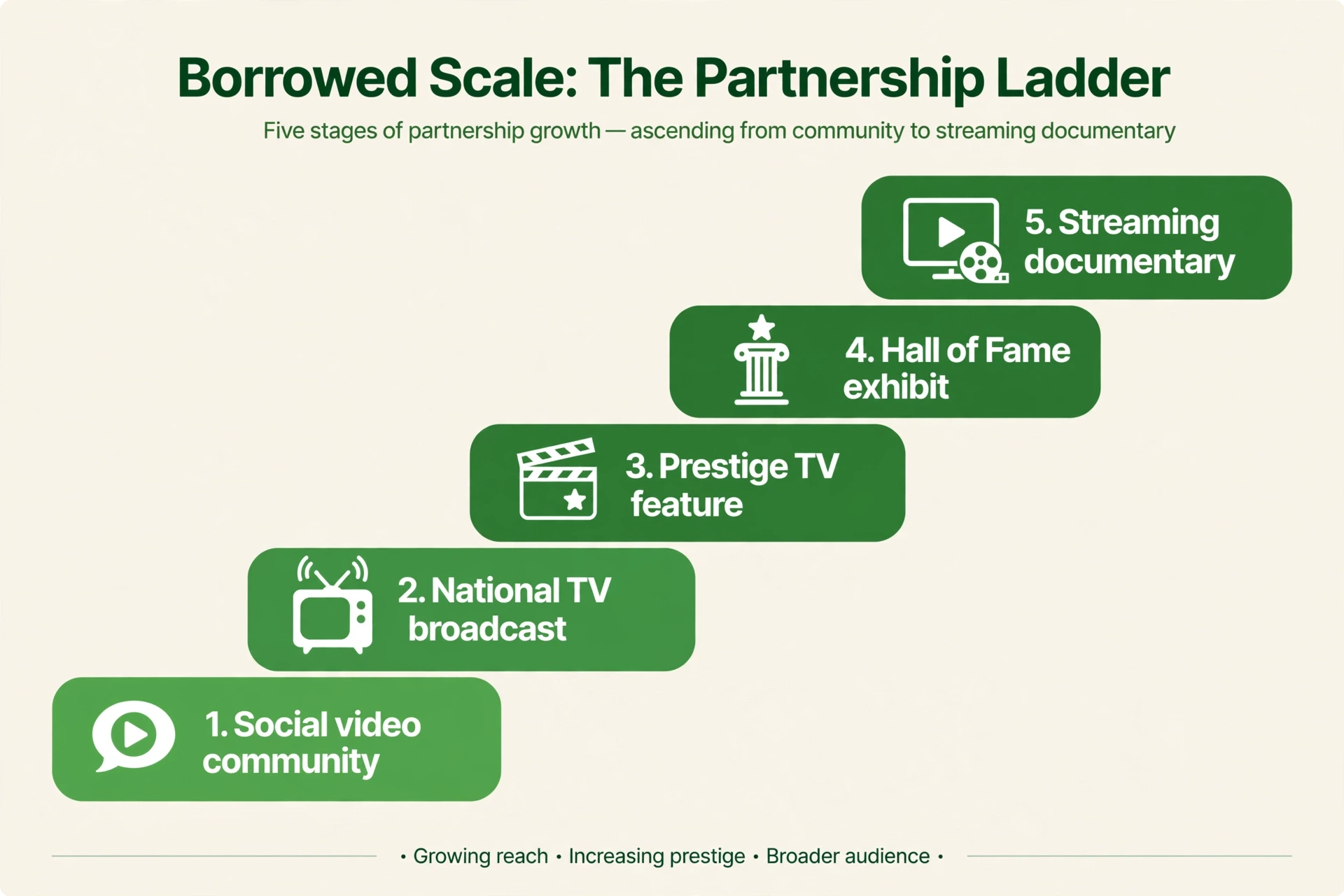
Start with media. The City Selection Show aired on ESPN2. Games stream on Disney+ and the ESPN app. A Disney-produced documentary on Banana Ball’s rise will debut at Atlanta’s Truist Park on June 12, 2027, with a Disney+ release to follow. A 60 Minutes feature gave the phenomenon its prestige-television moment. In 2023, the Baseball Hall of Fame in Cooperstown opened an exhibit honoring the Bananas — institutional validation that the “circus” had become canon. Even the commissioner’s office has borrowed from the playbook: MLB’s chief floated a “golden at-bat” rule straight out of Banana Ball’s experimental spirit.
Each partnership is a credibility transfer in both directions. ESPN and Disney get a proven youth magnet — the Bananas are famous for pulling young fans back to a sport that worried it was losing them. The Bananas get distribution and legitimacy they could never buy. The documentary is the masterstroke: it converts a decade of highlights into a permanent, streamable brand asset that will recruit fans for years.
Small brands can run the same playbook at their own scale. You do not need Disney; you need one partner whose audience trusts them and overlaps with yours. A guest slot on an established podcast, a co-branded event with a complementary local business, a feature in an industry publication, a creator collaboration — each is a loan of trust you could not manufacture yourself.
The Bananas’ rule for partnerships is visible in every deal: the partner must amplify the fan experience, not dilute it. Borrow scale, but never borrow it at the cost of the thing people love about you. And when the partnership lands, treat it as content: the announcement of the documentary generated its own news cycle, which is the partnership marketing twice.
Lesson 7: Turn Every Announcement Into an Event
The final lesson is the one the 2027 schedule reveal demonstrates most vividly: Banana Ball announcements are not made — they are staged. A schedule release is, in any other organization, a PDF and a press release. The Bananas turned theirs into the City Selection Show: a sold-out live event, broadcast on ESPN2 and YouTube, with all six league teams — the Savannah Bananas, Party Animals, Loco Beach Coconuts, Firefighters, Indianapolis Clowns, and Texas Tailgaters — revealed alongside marquee dates like the Banana Ball Open at ESPN Wide World of Sports (April 15–18), Banana Ball 360 at Notre Dame Stadium (June 26), and the Banana Bowl at Nashville’s Nissan Stadium (September 25).
Why does this matter? Because an event creates three assets a press release cannot: anticipation before, spectacle during, and clips after. The show format let the Bananas drip-feed the biggest news — international dates, the Disney documentary, the stadium spectacles — as moments, each engineered to be clipped, quoted, and shared. Every reveal became its own headline. The announcement of the announcement drove the lottery signups; the lottery deadline of October 31 gives the whole thing a ticking clock.
Most companies bury their news in the dullest possible container and then wonder why nobody noticed. A product launch, a funding round, a new hire, a milestone — each is a chance to manufacture a moment. You do not need ESPN2. A live stream with genuine reveals, a countdown, a behind-the-scenes build-up series, a community vote on the news itself — the mechanics are the same at any scale. The principle: if it matters to your business, make it feel like it matters. Ceremony signals importance, and importance is what earns attention in a feed that forgets everything by noon.
The Bottom Line: Fans First Is a Growth Strategy
Strip away the dancing umpires and the stilts, and the Banana Ball empire runs on a simple operating system: entertain before you sell, design the product for the audience’s attention span, price like you want customers for life, borrow scale from bigger stages, and stage your news like it deserves an audience. The 2027 World Tour — 74 cities, 79 stadiums, two countries beyond the United States — is what that operating system compounds into over a decade.
Your brand does not need a banana-yellow tuxedo (though it wouldn’t hurt). It needs the discipline underneath: a content engine that gives before it asks, a product worth talking about, and the patience to build the waitlist before you need the revenue. Do that, and your next announcement might just need a lottery of its own.
Ready to build a marketing engine your audience actually loves? KKeyQik helps US brands turn attention into revenue with content, social, and SEO strategies built for how people really behave online. Let’s talk about what your brand’s Banana Ball moment could look like — get in touch.
—
Related reading: College Football Rankings 2026: 9 Marketing Lessons
Want to put this to work for your business? KKeyQik plans and delivers social media campaigns for small businesses, with an in-house team available 24/7. See our social media marketing service or get a quote within 24 hours.
Frequently Asked Questions
Banana Ball is a fast-paced, entertainment-first version of baseball created by the Savannah Bananas. Games have a hard two-hour time limit, every inning won is worth a point, a fan catching a foul ball counts as an out, and there are no walks — on ball four, the batter sprints the bases while nearly every fielder has to touch the ball. Add choreographed dances, a lip-syncing umpire, and trick plays, and the result is closer to a live show than a traditional game.
On October 15, 2026, during a sold-out City Selection Show broadcast on ESPN2, the Bananas unveiled a 2027 tour covering roughly 74 cities and 79 stadiums, including 23 Major League Baseball parks and 10 football stadiums. For the first time, Banana Ball goes international, with dates in Monterrey and Tijuana, Mexico, and Toronto and Winnipeg, Canada. Marquee events include the Banana Ball Open at ESPN Wide World of Sports in April, Banana Ball 360 at Notre Dame Stadium in June, and the Banana Bowl at Nashville's Nissan Stadium in September.
Instead of a standard on-sale, the Bananas run a centralized ticket lottery. Fans enter a random drawing — for the 2027 tour, the entry window opened right after the October 15 announcement and closes on October 31, 2026. Entering earlier does not improve anyone's odds, and being selected enters you into the chance to buy tickets rather than guaranteeing them. The lottery format keeps the process fair and turns every tour announcement into a news event.
The Bananas built an audience of more than eight million TikTok followers — larger than any Major League Baseball team's — by treating content as the product rather than as advertising. Their feeds carry no "buy now" calls to action; the stated goal is to "pique curiosity" and "chase smiles." A signature tactic is "Banana-fying" trends: daily meetings where the team adapts trending sounds, memes, and formats to its own world, so the content feels native to the platform instead of like a repurposed commercial.
Dakota "Stilts" Albritton is a Banana Ball pitcher who throws from ten feet in the air — on stilts. The Bananas turned his unusual story into serialized content: he received stilts as a Christmas gift at age ten, worked blue-collar jobs after high school, walked into a tryout on stilts, and eventually pitched before a sold-out Yankee Stadium crowd. His journey shows the Bananas' core branding move — developing players as characters with narrative arcs the audience can root for, rather than marketing the team as an abstraction.
Fans First Entertainment is the name of the Bananas' parent company, and it shows up in concrete policies: no parking fees, food and drinks folded into the ticket price, no hidden fees or surprise taxes at checkout, and free shipping on online merchandise orders. The philosophy is that every fee removed is a complaint never received and a story a fan tells instead — pricing treated as a communications channel, not just a revenue lever.
Owner Jesse Cole launched the Savannah Bananas in 2016 to generate fan interest for baseball at the historic Grayson Stadium in Savannah, Georgia. After noticing fans staring at their phones and leaving games early, Cole and his wife Emily began experimenting with rule changes and showmanship that eventually became Banana Ball. What started as an effort to fill a small ballpark grew into a barnstorming tour selling out professional stadiums across the country.
The 2027 tour features six teams: the Savannah Bananas, the Party Animals, the Loco Beach Coconuts, the Firefighters, the Indianapolis Clowns, and the Texas Tailgaters. All six appeared at the City Selection Show, and all six will be part of the Banana Ball Open at ESPN Wide World of Sports in April 2027.
The Bananas have a growing multi-platform relationship with Disney and ESPN: games stream on Disney+ and the ESPN app, the City Selection Show aired on ESPN2, and a Disney-produced documentary about the rise of the Savannah Bananas and Banana Ball is set to debut at Atlanta's Truist Park on June 12, 2027, with a Disney+ release planned for summer 2027. The partnership gives the Bananas mainstream distribution and legitimacy while giving Disney a proven magnet for younger audiences.
Entertain before you sell. The Bananas built the audience first — through daily platform-native content, a product redesigned for attention spans, fan-first pricing, and characters worth following — and only then converted that attention into demand through events like the ticket lottery. The 2027 World Tour, with its reported five-million-name waitlist, is what that operating system compounds into over a decade: a brand whose announcements are news, whose pricing is marketing, and whose fans do the distribution.