

At half past one in the morning on September 22, 2026, a helicopter was hauling giant steel letters onto the roof of Miami’s Kaseya Center. By sunrise, the home arena of the Miami Heat carried a new message for every aircraft descending over downtown: “Welcome to Vice City.” The invoice for the stunt: $975,000, paid by Rockstar Games to Miami-Dade County under a marketing agreement the county’s own commissioners only learned about when the story broke. The mayor had signed it solo — no vote required, because the number landed just under her $1 million signing authority.
That is GTA 6 marketing in a single image: audacious, physical, expensive-looking, and impossible to scroll past. Grand Theft Auto VI launches on November 19, 2026 for PlayStation 5 and Xbox Series X|S, and the campaign for the most anticipated entertainment product of the decade is now unmistakably underway. There has been no Super Bowl spot. No carpet-bombing of banner ads. No celebrity-fronted TV blitz. That restraint is the first principle of GTA 6 marketing: never interrupt the culture when you can compel it. Instead, Rockstar is turning an entire American city into its billboard — and charging the culture itself with doing the rest of the distribution.
This is why GTA 6 marketing deserves a serious breakdown in a marketing publication. Strip away the franchise mythology, and what remains is one of the most disciplined demand-generation systems ever assembled: a machine that converts silence into speculation, speculation into coverage, and coverage into a launch so large that analysts estimate the development budget alone may have crossed a billion dollars. Every tactic in the GTA 6 marketing playbook — the real-world city takeover, the trailer-as-event, the merch-first collector’s box, the weaponized secrecy — has a direct, stealable equivalent for brands, agencies, and founders launching anything in 2026.
This guide breaks down nine GTA 6 marketing strategies, grounded in what actually happened this month, that you can adapt to your own launches — whether you sell software, sneakers, or services. Each one is a working part of the GTA 6 marketing machine.
The GTA 6 marketing scoreboard
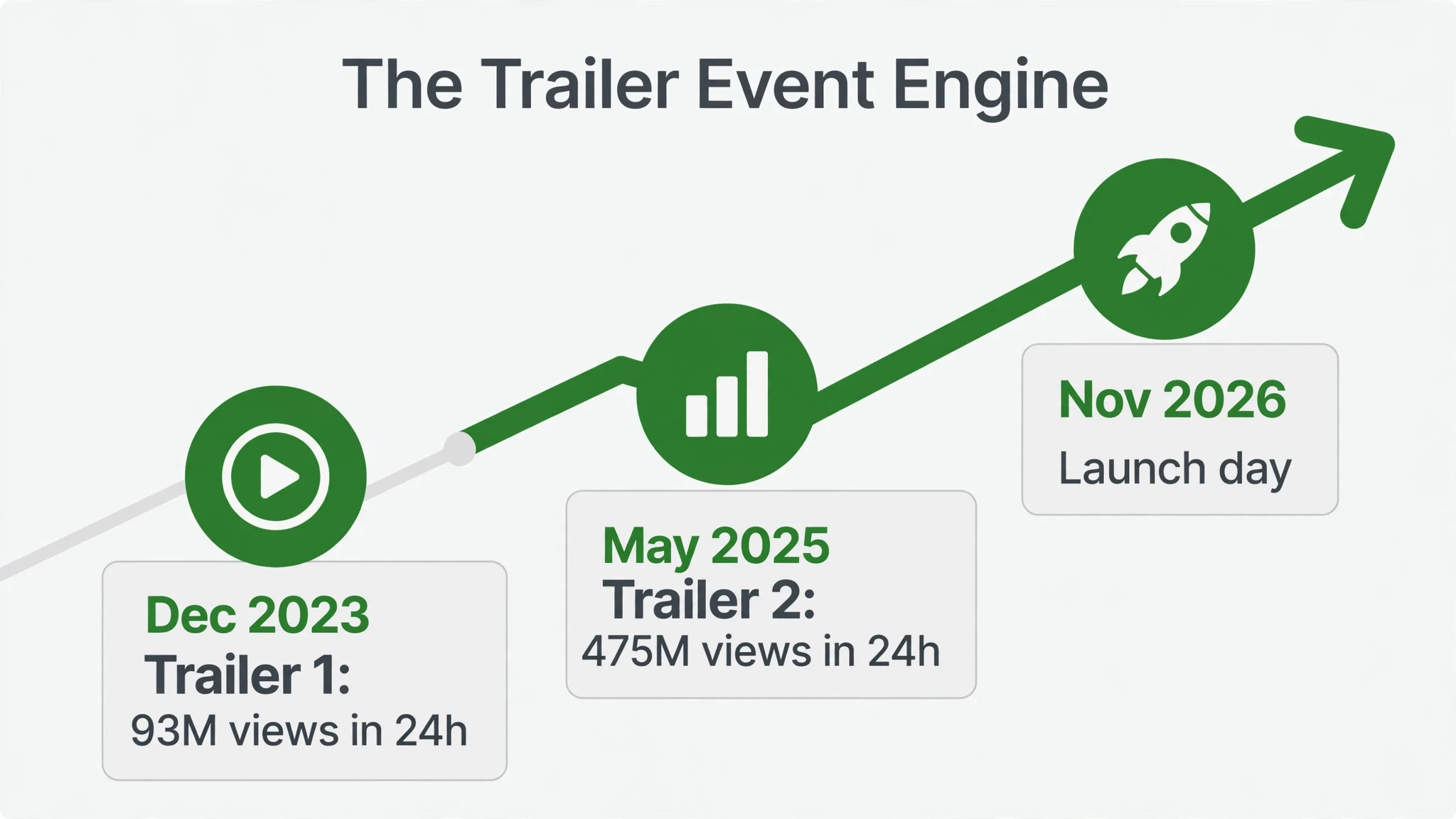
Before the strategies, the numbers that make this case study worth your time. Rockstar revealed the first GTA VI trailer in December 2023: it pulled roughly 93 million YouTube views in 24 hours, a non-music record that earned a Guinness World Records entry. The second trailer arrived May 6, 2025 — and Rockstar told The Hollywood Reporter it drew more than 475 million views across all platforms in its first day, which the company called the biggest video launch of all time. The trailer’s featured song, The Pointer Sisters’ “Hot Together,” surged 182,000% on Spotify in the aftermath. All trailer footage, Rockstar confirmed, was captured entirely in-game on a PlayStation 5.
The road to launch has been anything but straight, and the GTA 6 marketing machine absorbed every bump. The game was first expected in 2025, then dated May 26, 2026, then pushed again to November 19, 2026 — a second delay announced in November 2025 that briefly knocked 18% off Take-Two’s stock. Standard Edition pricing is $79.99, Ultimate Edition $99.99, the first Rockstar title to launch above the old $70 standard. Take-Two has guided fiscal-2027 net bookings of $8.0–8.2 billion, essentially a bet-the-company number built on this single release.
The franchise math explains the confidence. Grand Theft Auto V has sold more than 225 million copies, per Take-Two’s own earnings calls — the second best-selling game in history, still moving millions of units a quarter thirteen years after launch. Red Dead Redemption 2 sits above 85 million. And the GTA series as a whole has sold in more than 465 million units. When GTA 6 marketing operates at this scale, the tactics deserve forensic attention.
Strategy 1: Turn the setting into the stage
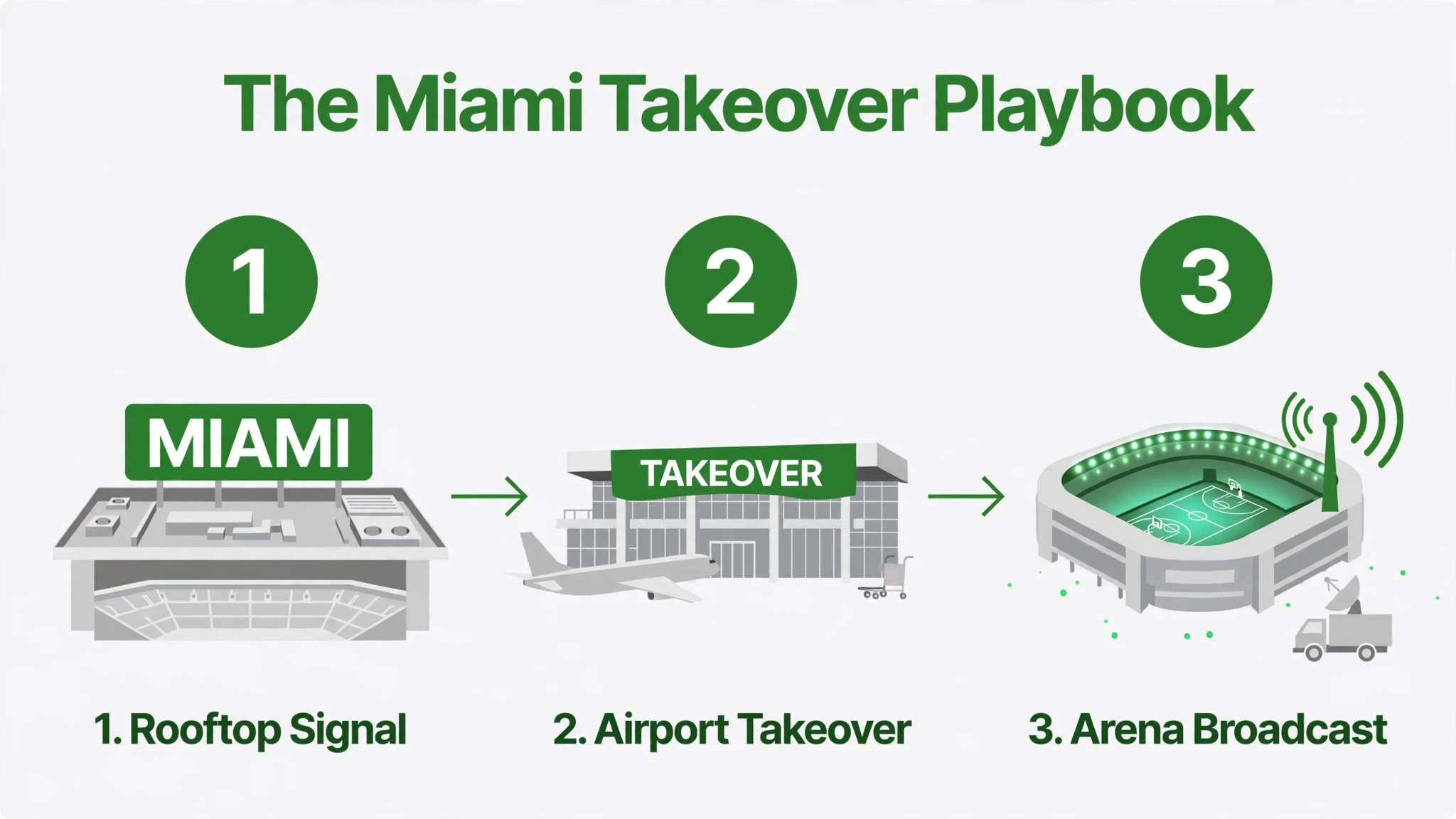
The Kaseya Center rooftop sign is not a billboard. It is a thesis statement — and the clearest physical expression of GTA 6 marketing to date. GTA VI is set in Leonida, Rockstar’s fictional Florida, with Vice City as its neon heart — a love letter to Miami rebuilt polygon by polygon. So instead of buying media about Miami, Rockstar is physically becoming Miami: paying the actual city nearly a million dollars to wear the game’s fiction on its most recognizable rooftop, with the letters staying in place through the Miami Heat’s 2026–27 season (the agreement runs to April 2027).
The sign is reportedly only the opening move. August reporting described talks covering airport takeovers and event tie-ins across the city; Miami Beach has separately weighed its own marketing arrangements with Rockstar. The timing is engineered: the Heat’s first regular-season home game lands October 21, roughly four weeks before launch, putting the rooftop installation in the background of nationally televised NBA broadcasts all season. Fans tracked the construction for days via social posts and live city cams before the helicopter lift — the buildup itself became content, which is exactly how GTA 6 marketing multiplies a single spend into weeks of coverage.
The GTA 6 marketing lesson for your brand: stop renting attention in places your customer merely visits, and start occupying the places they already live. A SaaS company can sponsor a conference; a great one turns the host city’s transit, coffee shops, and hotel lobbies into its own stage for a week. We broke down the same launch-theater instinct in our Meta VR glasses marketing analysis — the principle is identical: place-based marketing converts geography into emotion, and emotion into memory. If your product has a setting, a hometown, or a community, make the campaign physical there first, and let the internet film it for you.
Strategy 2: Weaponize silence
Between December 2023 and May 2025, Rockstar released exactly two trailers for the biggest game in history — and said almost nothing in between. No developer diaries. No E3 stage demos. No drip-feed of screenshots to keep the algorithm fed. The company’s communications posture for GTA VI has been near-total silence punctuated by seismic events, and the silence is the strategy: every quiet month compounds the hunger, so that when Rockstar finally speaks, the entire internet stops to listen. Scarcity this disciplined is the rarest move in GTA 6 marketing.
This discipline held through genuine crises. The September 2022 leak — 90 gameplay videos, described at the time as the biggest leak in gaming history — could have forced Rockstar into reactive overdrive. Instead the company confirmed the breach briefly and returned to silence. Two release delays, including the November 2025 push that cost Take-Two nearly a fifth of its market value in a day, were communicated as quality commitments and absorbed by a fanbase trained to believe the wait is the point. That is the compounding logic of GTA 6 marketing: every quiet month is an investment that pays out the next time the studio speaks.
Most brands do the opposite: they mistake noise for momentum, publishing on a calendar instead of a conviction. The GTA 6 marketing lesson is that scarcity of communication is a form of communication. You do not need Rockstar’s leverage to use it — a startup can announce less often and mean more each time, embargo its own news until the story is undeniable, and let anticipation do the work that a dozen forgettable posts never will. Speak rarely, and make every utterance an event.
Strategy 3: Make every asset a cultural event
When most companies “release a video,” they upload it. When Rockstar releases a trailer, it detonates one. Trailer 1’s 93-million-view first day did not happen by accident — it was preceded by a decade of pent-up demand that Rockstar deliberately refused to defuse, then released into a single timestamp the whole world shared. Trailer 2 repeated the trick at an even larger scale: 475 million cross-platform views in 24 hours, per Rockstar’s count, dwarfing the debuts of Deadpool & Wolverine (365 million) and The Fantastic Four: First Steps (200 million). No studio on earth runs the event-release playbook like GTA 6 marketing does.
Notice what Rockstar did around the assets, too — the same event-izing instinct we dissected in the Taylor Swift Encore album marketing playbook, where a 48-hour announcement window turned a re-release into a global moment. The trailers were captured entirely in-game on PS5 — a technical flex that doubled as a trust signal after years of “bullshot” skepticism across the industry. The music choices were engineered for the streaming era: “Hot Together” spiking 182,000% on Spotify turned a trailer into a record-label event, pulling the music press into coverage the gaming press alone could never buy. Even the speculation about a quiet Sony co-marketing arrangement became its own news cycle.
The GTA 6 marketing lesson: treat your major content drops like product launches, with their own countdowns, embargoes, and distribution choreography. A founder-led video, a flagship report, a product demo — any of these can be an event if you refuse to dribble it out. Build the asset, pick the moment, concentrate the blast. One detonation beats twelve firecrackers, and the internet’s memory rewards peaks, not averages. That is how GTA 6 marketing turns a two-minute video into a global news cycle.
Strategy 4: Sell the world, not just the game
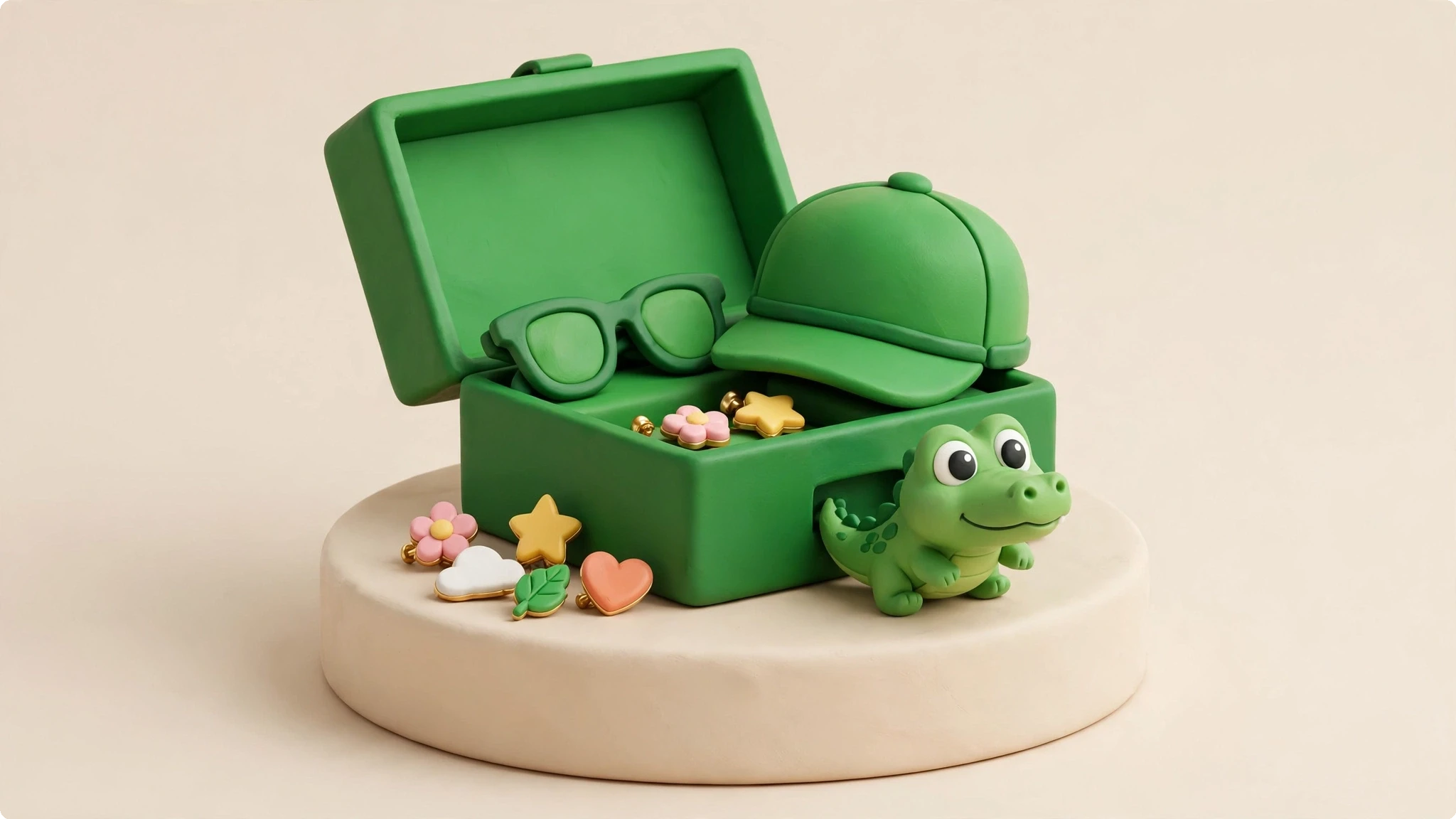
On September 24, Rockstar opened pre-orders for the “GTA VI: The Goodtime State – Vice City Collection”: a $399.99 collector’s box containing eleven items — Oakley Frogskins sunglasses, a New Era snapback, a Leonida Keys crossbody bag, a six-inch Macca the Gator figure with a stash compartment, enamel pins, a double-sided Leonida map poster — and, conspicuously, no copy of the game. The store page says so directly: Grand Theft Auto VI is sold separately. One box per person. Ships November 19, the same day as launch. Shipping not included.
This is merchandising as marketing, and it is ruthlessly smart. Every item is themed around Macca the Gator, an in-universe TV show character Rockstar has been seeding since June — meaning the box is not merchandise, it is world-building you can wear. The Oakley and New Era partnerships borrow credibility from brands with their own cults, and the $399.99 price (criticized loudly online, which only amplified the story) positions the franchise as luxury goods, not software. Fans are not buying a hat; they are buying citizenship in Leonida.
The GTA 6 marketing lesson for non-gaming brands: your best marketing asset may not be your product at all, but the world around it. Branded merchandise, limited drops, and partner collaborations turn customers into walking media inventory — and the scarcity mechanics (one per person, while supplies last) manufacture urgency no discount code can match. If your brand has lore, characters, or culture, package it. The GTA 6 marketing playbook proves people will pay $400 for the universe and consider the product the afterthought.
Strategy 5: Let controversy do the media buying
Here is the part most brands would have killed in a meeting. Some Miami-Dade commissioners openly questioned whether county-owned property should advertise a franchise built on crime and violence. The mayor signed the $975,000 deal without a commission vote. Commissioners learned about it at 1:30 in the morning. Every one of those details became a headline — in the Miami Herald, on Local 10, across the gaming press — and every headline repeated the same three words: Welcome to Vice City.
Rockstar did not manufacture the controversy, but it absolutely designed for it. A rooftop sign on a beloved public arena, priced just under a political tripwire, was always going to generate debate — and debate is distribution. The coverage of the deal reached audiences (local news viewers, civic Twitter, political newsletters) that gaming coverage never touches. The sign’s critics argued about content; meanwhile the sign itself, and the game behind it, got millions of dollars in earned attention for $975,000. In the GTA 6 marketing ledger, a heated commission debate is simply another media channel.
The GTA 6 marketing lesson is not “be controversial” — manufactured outrage is cheap and usually backfires. The lesson is to design campaign moments newsworthy enough that the coverage is the ad. A bold public installation, a surprising partnership, a pricing move that makes people argue: if your launch is genuinely interesting to people outside your industry, journalists will distribute it for free. Boring is the only true PR risk.
Strategy 6: Recruit fans as your media department
Rockstar’s trailers are built like archaeological sites. Trailer 2 alone sent fans frame-by-framing for weeks: identifying real Miami buildings as the inspiration for Jason and Lucia’s apartment, cataloging returning brands like Ammu-Nation, spotting DualSense-style controllers that sparked a whole Sony co-marketing theory. One fan investigation into a demolished Miami apartment block generated its own multi-outlet news cycle. Rockstar planted the artifacts; the internet did the excavation, the documentation, and the distribution.
This is the deepest GTA 6 marketing flywheel: dense, detail-rich assets that reward obsessive rewatching, feeding a creator economy of breakdown videos, theory threads, and reaction content that no media budget could sustain. Each trailer is engineered with more discoverable detail than any single viewing can absorb — which means the content has a half-life measured in weeks, not hours. The fans are not an audience; they are an unpaid, infinitely scalable content studio, and GTA 6 marketing gives them a new shift to work every time it drops an asset.
Steal the structure, not the scale. Publish assets with layers: a launch video with Easter eggs, a report with data worth screenshotting, a product page with details worth zooming into. Then — critically — leave gaps. Unanswered questions are fuel; a campaign that explains everything leaves its audience nothing to do. Give your community raw material and room to speculate — the GTA 6 marketing way — and they will market you to each other with a conviction no ad can buy.
Strategy 7: Price like a luxury brand
At $79.99 for Standard and $99.99 for Ultimate, GTA VI is the first Rockstar title to launch above the $70 standard the industry settled into this generation. The pricing was announced without apology in June 2026 pre-orders, and the market absorbed it without a flinch — because price, in the GTA 6 marketing playbook, is positioning, not just arithmetic. Few launches in any industry demonstrate premium pricing as marketing this clearly.
Consider the full pricing architecture. The base game commands a premium that signals “event, not commodity.” The Ultimate Edition’s $20 step-up captures the superfans’ surplus without discounting the core. And the $399.99 Vice City Collection sits above both as a luxury tier that makes $99.99 feel reasonable by comparison — classic price anchoring. Nobody at Rockstar is competing on price, because competing on price would concede that GTA is comparable to other games. It is not, and the price tag says so. That is GTA 6 marketing at its most confident: the number on the box is the positioning statement.
The lesson for your 2026 pricing page: discounting is a positioning statement too, and it usually says “we are interchangeable.” If your product is genuinely differentiated, premium pricing does marketing work before a single ad runs — it filters for serious buyers, funds better delivery, and tells the market where you believe you belong. Raise the price to match the value, then make the value undeniable.
Strategy 8: Borrow other brands’ stages
Rockstar is not building its launch audience from scratch; it is renting everyone else’s. The Kaseya Center deal puts Vice City branding inside Miami Heat broadcasts from the October 21 home opener through the season. The Oakley Frogskins and New Era 9FORTY in the collector’s box draft two heritage brands’ loyalists into the launch. Even the trailer’s PS5-native capture quietly borrows PlayStation’s platform halo — and the speculation about a Sony co-marketing pact generated its own headlines.
This is partnership marketing at its most efficient: each collaborator brings a built-in audience, a trust surplus, and a distribution channel Rockstar did not have to build. The Heat deal is the masterstroke — sports broadcasts deliver the exact mass-market reach that gaming media cannot, and the arena association wraps the game in civic pride rather than niche fandom. Nobody had to be convinced to care about the NBA; Rockstar just stood next to it.
Your version of the GTA 6 marketing partnership playbook: map the audiences you want but do not own, then find the brands, creators, venues, and communities that already hold them. Co-branded drops, venue takeovers, creator collaborations, platform-native content — each partnership is a shortcut past the cold-start problem. The question is never “how do we reach a million people?” It is “who already has them, and what can we build together?” That borrowed-stage logic is why GTA 6 marketing shows up in NBA broadcasts instead of buying its own airtime.
Strategy 9: Bank a decade of trust, then spend it
None of this works without the balance sheet of trust underneath it. Grand Theft Auto V has sold more than 225 million copies and is still moving millions of units per quarter, thirteen years after launch. GTA Online has received continuous updates for over a decade. Red Dead Redemption 2 cleared 85 million units on craft alone. When Rockstar delays GTA VI twice and says “it needs more time,” the fanbase believes them — because the studio’s entire history is a record of shipping late and shipping masterpieces.
Even the AI conversation became a trust deposit. In February 2026, Take-Two CEO Strauss Zelnick confirmed that no generative AI was used to build GTA VI’s world — every building, street, and neighborhood in Leonida was hand-crafted by artists. In an era of procedural skepticism, “made by humans” became a premium feature and a marketing line. It cost nothing to say and reinforced the core brand promise: Rockstar does not cut corners, in development or in marketing.
This is the compounding GTA 6 marketing asset no competitor can replicate on a timeline: brand equity. Every kept promise, every quality release, every honest delay makes the next launch cheaper to market — the audience arrives pre-sold. Rockstar spent a decade making deposits so that GTA 6 marketing could make withdrawals. For your business, the takeaway is unglamorous and non-negotiable: the cheapest marketing you will ever run is delivering so well that your customers do the pre-selling for the next launch. Trust compounds; spend it wisely.
What to steal for your 2026 launches
GTA 6 marketing is not really about a $975,000 rooftop sign. It is about a system: concentrate the blast, weaponize the silence between blasts, build worlds instead of ads, price with conviction, borrow bigger stages, and let a decade of kept promises do the heaviest lifting. Rockstar’s true budget advantage is not money — it is discipline. The studio says less than anyone, means more than anyone, and lets the culture carry the message further than any media plan could. That discipline is the through-line of GTA 6 marketing, from the helicopter over Miami to the silence between trailers.
You do not need a helicopter or a basketball arena to run this playbook. You need one undeniable asset treated like an event, one physical or partnership moment your industry will talk about, pricing that reflects your value, and the patience to stay quiet until you have something worth saying. Do that consistently, and your launch stops being a campaign — it becomes the thing the market was waiting for.
Building a launch that actually moves the needle takes more than tactics — it takes a team that thinks in systems, not posts. KKeyQik is a results-driven digital marketing agency helping brands turn attention into revenue: from SEO and content strategy that compounds like Rockstar’s brand equity, to social media and video campaigns engineered for virality, to paid advertising that converts demand into pipeline. If your 2026 launch deserves a playbook instead of a posting calendar, talk to KKeyQik — and let’s make your market wait for it.
For a companion case study on turning launches into tentpole events, see our 9 event marketing lessons.
Frequently Asked Questions
Rockstar Games is known for unconventional game marketing — minimal traditional advertising, cryptic teasers, and letting anticipation build organically. GTA 6's campaign reportedly includes a Miami takeover with real-world activations, turning the game's setting into a physical marketing canvas.
Rockstar uses long silences punctuated by major trailer drops, which makes each announcement a global event. The lesson: scarcity of communication increases the value of each message — brands that post constantly often get less attention per post.
GTA 6 is set in a fictionalized Miami (Leonida), and Rockstar is extending the game into the real city with takeovers and activations. Location-based marketing that ties a product to a real place creates press coverage and social content simultaneously.
The trailer reportedly broke viewing records because years of anticipation met a genuinely cinematic reveal. The takeaway for launches: invest heavily in the reveal asset itself — one exceptional trailer outperforms months of mediocre teasers.
Rockstar barely advertises in traditional channels; the community, press, and creators do the distribution. This works because the product has enormous pent-up demand — most brands still need paid media, but can reduce it by building genuine anticipation.
Rockstar cultivates mystique — no over-explaining, no hype interviews, just carefully chosen reveals. For premium brands, restraint creates desirability; explaining everything in advance often kills the excitement a launch needs.
Fan theories, countdown streams, and speculation videos kept GTA 6 trending for years without Rockstar spending a dollar. Encourage your own audience's speculation with easter eggs and teasers — engaged communities market for you.
By making the fictional setting feel tangible through real-world events, Rockstar blurs the line between game and reality. Experiential marketing that lets people physically step into your brand world creates memories that digital ads cannot.
Cultural relevance is fragile — Rockstar succeeds by understanding its audience's world deeply. Brands borrowing cultural moments must do the homework; inauthentic attempts at edginess backfire faster than playing it safe.
You cannot copy Rockstar's silence without Rockstar's demand, but you can copy the principles: fewer, better announcements; a cinematic reveal asset; real-world experiences; and letting your community amplify the message. Scarcity and spectacle scale down — one great reveal beats a year of forgettable posts.