

On the morning of September 25, 2026, Taylor Swift did something no other artist on the planet could pull off: she re-released an album that was already the biggest commercial phenomenon in modern music history — and made it feel like a brand-new event. “The Life of a Showgirl: The Encore” adds four new songs (“Patient Zero,” “Cleveland!,” “Pink Clouding,” and “Babylon”) to her record-shattering 2025 album, and within hours, fans sent “patient zero lyrics” past 100,000 US searches and “pink clouding lyrics” past 50,000, both spiking 1,000% on Google Trends.
The announcement-to-release window was barely 48 hours. There was no traditional press tour, no billboard blitz, no paid media carpet-bombing. Just an Instagram post, a fan army, and a decade of marketing instincts firing in sequence.
Sources
This is why Taylor Swift Encore album marketing deserves a serious breakdown in a marketing publication. Strip away the celebrity, and what remains is one of the most disciplined demand-generation machines ever built: a system that converts attention into pre-saves, pre-saves into first-week records, and records into cultural moments that market themselves. Every tactic in the Taylor Swift Encore album marketing playbook — the sequel framing, the hidden clues, the collectible variants, the fan-powered distribution — has a direct, stealable equivalent for brands, agencies, and creators launching anything in 2026.
This guide breaks down ten Taylor Swift Encore album marketing strategies, grounded in what actually happened this week, that you can adapt to your own launches — whether you sell software, services, or sneakers.
The Encore drop at a glance
Before the strategies, the facts that make this Taylor Swift Encore album marketing case study worth your time. Swift announced “The Encore” on September 23 via Instagram: four new songs extending her twelfth studio album, written during a trip to Sweden with collaborators Max Martin and Shellback after the original album’s historic run.
The original “The Life of a Showgirl” moved 4.002 million equivalent album units in its first US week — including 3.48 million pure album sales — the largest single-week total since Luminate began tracking in 1991, breaking the record Adele’s “25” had held since 2015. It gave Swift her 15th Billboard No. 1, the most ever for a solo artist.
The first day alone sold 2.7 million copies; first-day vinyl sales topped 1.2 million, a record; global first-week units hit 5.5 million with more than 1.5 billion streams; and the album became the most pre-saved in Spotify history at 6 million. A theatrical listening-party film topped the box office its opening weekend. Those numbers are the scoreboard that Taylor Swift Encore album marketing plays for — and the rest of this guide is the playbook behind them.
The Encore’s lead cultural hook is “Cleveland!” — a love letter to husband Travis Kelce’s hometown of Cleveland Heights, Ohio, released less than three months after the couple’s July 2026 wedding. The Cleveland Cavaliers’ official accounts jumped on the track within a day, posting “Keepin’ it 100 in the Land, always.” That is earned media from an NBA franchise, triggered by a song title. When your Taylor Swift Encore album marketing analysis starts there, the scale of the machine becomes clear: the product markets itself because the marketing was baked into the product.
Strategy 1: Turn your biggest win into a sequel, not a victory lap
Most brands treat a record-breaking launch as the end of the story — a trophy, a press release, a case study slide. The first Taylor Swift Encore album marketing lesson is the opposite: treat your biggest win as the opening chapter. Eleven months after the original album shattered every first-week record in modern music, Swift didn’t let the era fade into catalog. She extended it with four new songs and a new title, “The Encore,” converting a finished success back into a live event with its own announcement cycle, its own release day, and its own trending topics.
The business logic is ruthless. Acquiring a new audience is expensive; re-activating an existing one is cheap. The Encore gave millions of existing fans a reason to re-engage, re-stream, and re-buy — and gave the press a reason to write the story a second time. This is the “expansion pack” model, and it works far beyond music. Software companies ship 2.0 features as events. Agencies repackage a successful campaign framework as a new named service. Course creators release the “advanced edition.” The Taylor Swift Encore album marketing move here is simple: before you build something new, ask what your last win looks like with four new tracks added to it.
Notice the framing, too. “The Encore” borrows the language of live performance — the part of the show the audience demands, not the part the artist schedules. It positions the new release as something fans earned rather than something they are being sold. That single naming choice does more persuasion work than most ad campaigns — classic Taylor Swift Encore album marketing, where the frame sells before the product does. When you name your follow-up like a reward instead of a product, the audience shows up grateful instead of skeptical.
Strategy 2: Gamify the announcement with Easter eggs
No Taylor Swift Encore album marketing breakdown is complete without the Easter eggs. For over a decade, Swift has hidden clues about future releases inside lyrics, videos, outfits, and social posts — capitalization patterns that spell out titles, set designs that preview collaborators, credit sequences that contain coded messages. Fans decode them collectively, and every decoded clue becomes content: theory videos, threads, reaction streams, each one amplifying the launch for free. It is the most imitated mechanism in Taylor Swift Encore album marketing, for good reason.
The mechanics are worth studying precisely. An Easter egg converts passive consumption into active participation. A fan who merely watches a video generates one view; a fan hunting for hidden messages watches five times, screenshots frames, and posts findings that recruit other fans. Academic research on the phenomenon — including a University of Northern Iowa honors thesis analyzing Swift’s “Midnights” era on TikTok — found that posts containing Easter egg content substantially outperformed comparable posts without them on views, likes, comments, and shares. The thesis author concluded the tactic builds loyalty through a collaborative environment that raises social engagement. In plain terms: puzzles turn audiences into co-marketers.
The Encore rollout ran on this engine. When Swift revealed the four new songs, fans immediately began dissecting which lyrics referenced the wedding, which referenced Kelce’s Cleveland roots, and which winking lines answered critics — and every interpretation became a trending search (“patient zero lyrics,” “pink clouding lyrics,” “babylon lyrics” all surged simultaneously). The Taylor Swift Encore album marketing takeaway for your brand: leave something for your audience to figure out. Tease a product name in a changelog, hide a discount code in a video, let your community connect the dots publicly. Mystery is a media multiplier — it manufactures the one thing money can’t buy, which is people talking about you when you aren’t in the room.
Strategy 3: Announce where your audience already lives
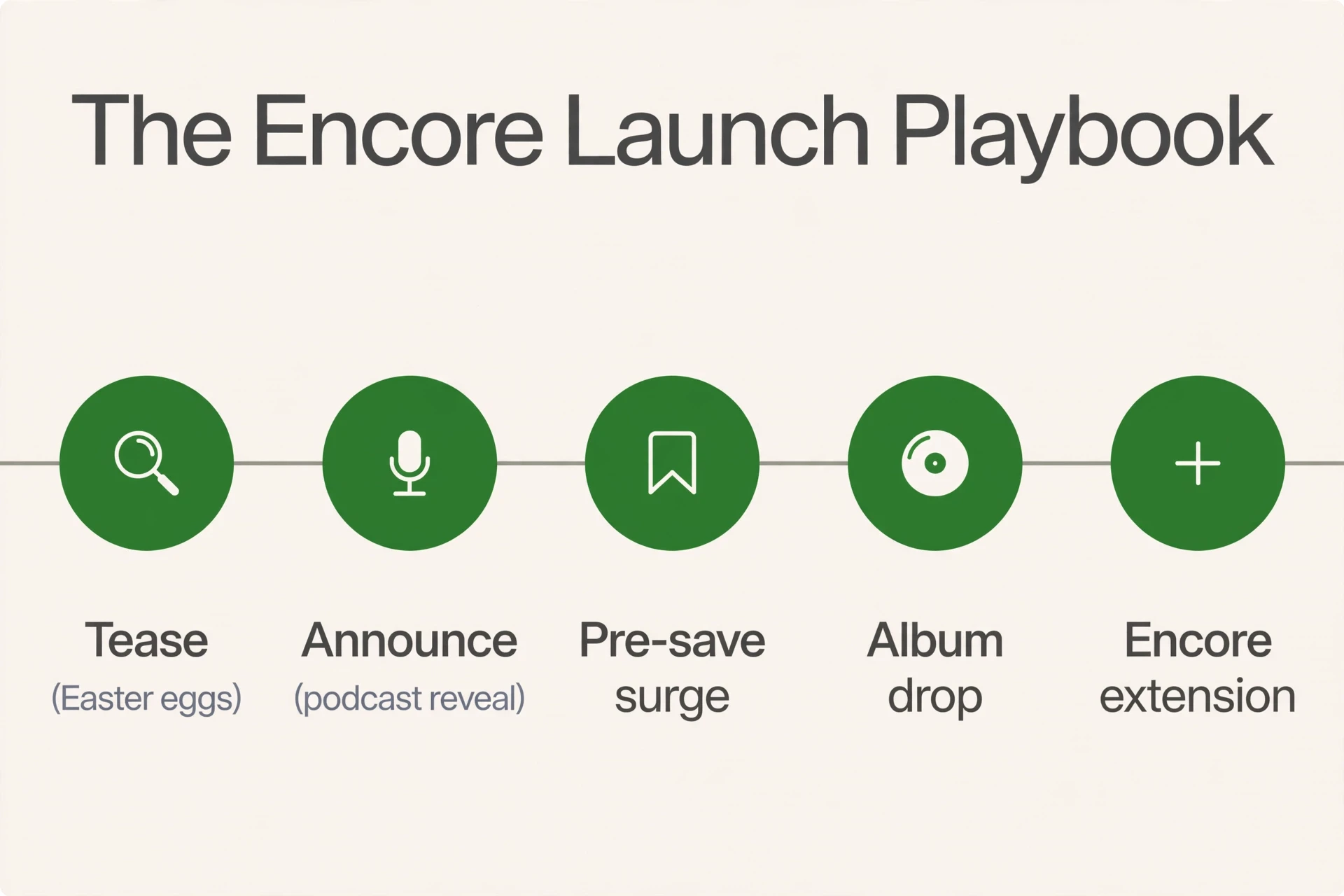
For the original “Showgirl” album, Swift didn’t announce on a morning show or in a press release. She revealed it on “New Heights,” the podcast co-hosted by her then-fiancé and his brother — meeting the audience inside a show they already loved, inside a conversation that already felt personal. The Encore announcement followed the same instinct in a different venue: a direct Instagram post to her own followers, no intermediaries, no embargoed press cycle — a distribution-first reflex at the heart of Taylor Swift Encore album marketing.
This is platform-native launching, and it is the third pillar of Taylor Swift Encore album marketing. The principle: attention is cheapest where trust is already highest. A podcast audience that tunes in weekly for football banter receives an album announcement as a gift, not an interruption. An Instagram following built over a decade receives it as a personal update, not an ad. Contrast that with buying the same reach through paid media — same eyeballs, radically different reception.
For your launches, the application is direct. Don’t default to a press release blasted into the void. Find the room where your buyers already gather — the niche podcast they trust, the community forum they argue in, the newsletter they actually open — and make your announcement there first. Exclusivity compounds the effect: when one community gets the news first, they become the ones who spread it, and “I heard it on New Heights before anyone else” is itself a shareable story. The Taylor Swift Encore album marketing lesson is that distribution is a creative decision, not a media-buying one.
Strategy 4: Manufacture scarcity with variants and collectibles
Here is the most commercially aggressive move in the Taylor Swift Encore album marketing arsenal — and the one most directly responsible for those absurd sales numbers. Swift doesn’t sell one album; she sells a collection. The original “Showgirl” rollout included multiple Target-exclusive CD editions, a special vinyl pressing, and limited-edition vinyl made available for just 48 hours. The result: 1.2 million vinyl records sold on the first day alone, the biggest vinyl week in the modern tracking era, and fans buying three or four copies of the same album to complete the set.
This is manufactured scarcity executed with total confidence — the commercial engine of Taylor Swift Encore album marketing. Each variant is genuinely differentiated — different artwork, different bonus material, different packaging — so collectors feel they are completing something rather than being milked. The 48-hour window adds urgency without discounting; the exclusivity of retail-specific editions turns shopping into a hunt. And the economics are extraordinary: in a streaming era where the marginal album sale is nearly worthless, Swift engineered a physical-goods frenzy that produced 3.48 million pure album sales in a week.
Every business has a version of this. Limited-edition packaging, numbered runs, early-bird tiers with genuinely different deliverables, “founding member” pricing that never returns — the mechanics are identical. The Taylor Swift Encore album marketing rule is that scarcity must be real (a true deadline, a true limited run) and the variants must be meaningfully different. Fake urgency trains customers to wait; real scarcity trains them to act. When your next launch approaches, don’t ask “how do we sell more units” — ask “how do we give our best customers a reason to buy twice?”

Strategy 5: Treat pre-saves as a conversion funnel, not a vanity metric
“The Life of a Showgirl” became the most pre-saved album in Spotify history — 6 million pre-saves before release day. In the Taylor Swift Encore album marketing system, the pre-save is not a hype metric; it is a conversion funnel with a measurable job. Every pre-save is a committed future stream, an algorithmic signal, and a calendar event all at once. Six million pre-saves meant six million day-one listeners the moment the album dropped — which meant the record-breaking first-day numbers, which meant the headlines, which meant the second wave of curious listeners.
Marketers outside music leave this funnel on the table constantly. The pre-save is the product-launch equivalent of an email waitlist, a beta signup, or a “notify me” button — a low-friction micro-commitment that converts vague interest into a scheduled action. Most brands treat waitlists as vanity counters (“join 10,000 others!”). Swift’s operation treats them as inventory: each pre-save is a guaranteed unit of launch-day momentum, and the team clearly optimized the entire pre-launch period around maximizing that number.
Steal the discipline behind Taylor Swift Encore album marketing, not just the tactic. Define the single micro-commitment your launch needs — the waitlist signup, the calendar hold, the free-trial registration — and make everything in your pre-launch feed that number. Gate your best teaser content behind it. Show the counter publicly so momentum is visible. And on launch day, activate the list immediately, the way six million pre-saves activated into six million first-day streams. The Taylor Swift Encore album marketing insight is that launch day is won or lost in the weeks before it, one small commitment at a time.
Strategy 6: Make your fans the media channel
Paid media barely appears in the Taylor Swift Encore album marketing mix, because the fanbase is the media mix. Swifties don’t just consume the launch; they produce it — theory videos dissecting lyrics, unboxing streams of vinyl variants, “get ready with me” content for release day, friendship-bracelet trading that started as a lyric reference and became a concert tradition so massive it reportedly caused craft-store bead shortages. The hashtag ecosystems (#SwiftTok and its successors) function as a volunteer creative department numbering in the millions.
This didn’t happen by accident. Swift spent years rewarding participation: inviting fans to secret listening sessions at her home before the “Lover” album, replying to fans directly on social platforms, wearing the friendship bracelets fans made her, and publicly celebrating fan theories. Every reward taught the community a lesson — participating gets noticed — and the community scaled the lesson into a culture. By the Encore launch, the machine runs itself: within a day of the “Cleveland!” reveal, the Cleveland Cavaliers’ official accounts were posting about it, sports media was covering the crossover, and lyric searches were trending nationally. Zero ad spend required — that is Taylor Swift Encore album marketing replacing a media budget with a community.
The transferable principle is community-as-distribution. You don’t need millions of fans; you need a core of participants whose contributions you visibly reward. Feature customer creations in your marketing. Respond to the people who make content about you. Give your power users early access and public credit. The Taylor Swift Encore album marketing lesson is that user-generated content isn’t a happy accident — it’s the output of a system that consistently answers the fan’s unspoken question: “If I make something about this brand, will anyone care?” Swift’s answer has been yes for a decade, and the Encore is what a decade of yes compounds into.
Strategy 7: Use naming as SEO and reputation armor
This is the subtlest Taylor Swift Encore album marketing tactic and possibly the cleverest. Swift’s team understands that what you name things determines what the internet shows people — search-engine reputation management conducted through art. The examples are striking: when critics attacked her private jet use, she attended a New York Jets football game, and searches for her name plus “jets” began surfacing football results instead of flight-tracking outrage. She titled a vault track with a deliberate double-L spelling so that searches for the phrase would land on her music rather than on controversy. Fans have even noticed that typing “The Life of…” into search now surfaces her album ahead of a famous competing record title.
Whether every instance is deliberate or not, the strategic pattern behind Taylor Swift Encore album marketing is real and replicable: own the search results for the phrases that matter to your brand by creating the definitive content for them. Most companies play SEO defense — monitoring reviews, responding to complaints. Swift plays offense: she manufactures the artifacts (songs, titles, moments) that occupy the results. A brand facing a recurring PR headache can learn from this directly. Don’t just rebut the narrative; publish the thing that outranks it. A comparison page, a definitive guide, a well-timed announcement — anything that gives search engines a better, more authoritative answer than the criticism.
Applied to product marketing, the same instinct governs naming. The Encore’s song titles are search-optimized cultural hooks: “Cleveland!” is a single-word trend magnet that instantly recruited an entire city’s sports media into the promotional apparatus. When you name a feature, a campaign, or a product, ask what people will type into Google — and whether your creation will be the first thing they find. In Taylor Swift Encore album marketing, the title isn’t just branding. It’s keyword strategy wearing a party dress.
Strategy 8: Build a cross-media flywheel around the launch
The Encore didn’t launch as an album; it launched as a multi-format event. The original “Showgirl” era paired the record with a theatrical listening-party film that opened at No. 1 at the box office, and December brings both a full concert film and a six-episode documentary series to Disney+. Swift even contributed an original song to a major animated film release. Each format feeds the others: the film markets the album, the album markets the documentary, the documentary deepens fandom, deeper fandom buys the next variant.
This is the flywheel that Taylor Swift Encore album marketing runs on, and it’s the antidote to the single-channel launch. Most brands launch in one format — a product page, a webinar, a press push — and wonder why momentum dies in a week. Swift launches in five formats at once, so the audience keeps encountering the story in new contexts for months. The box-office film reached people who don’t stream albums on release day. The documentary will reach people who missed the film. Each touchpoint re-qualifies the audience for the next one.
You don’t need a Disney+ deal to copy this. A product launch can ship simultaneously as a landing page, a short demo video, a founder podcast appearance, a written teardown, and a customer story — five formats, one narrative, each capturing a different slice of attention. The Taylor Swift Encore album marketing principle: never let your launch live in one medium. Attention is fragmented; your launch should be too — deliberately, with every piece pointing back to the same conversion.
Strategy 9: Lead with gratitude, not hype
Read Swift’s Encore announcement again and notice what’s missing: hype. No superlatives about the music, no sales projections, no bombast. Instead, the message was gratitude — the new songs, she explained, grew out of thankfulness for how listeners received the original album, written spontaneously during what was supposed to be a celebration trip. After the record-breaking first week, her public statement was a long, specific thank-you: naming the theaters, the vinyl buyers, the streamers, the readers of the poems tucked into the packaging.
This is emotionally intelligent positioning, and it’s doing real work inside Taylor Swift Encore album marketing. Gratitude reframes the transaction. A brand shouting “biggest ever!” invites skepticism; an artist saying “I can’t believe you did this, here’s more music to say thanks” invites affection. The Encore literally positions four new songs as a thank-you note — which makes buying them feel like accepting a gift rather than completing a purchase. It also inoculates against cynicism: it’s very hard to call a gratitude project a cash grab, even when it will obviously sell millions.
For your brand, the lesson is about the emotional frame around every launch. Lead with what the customer made possible, not with what you’re selling. “You asked for this” beats “we built this.” Thank-you pricing, community-requested features, and “by popular demand” restocks all run on the same psychology. The Taylor Swift Encore album marketing takeaway: the most persuasive launch copy doesn’t brag about the product — it credits the audience.
Strategy 10: Compress the news cycle — announce fast, ship faster
The final Taylor Swift Encore album marketing lesson is about tempo. The Encore was announced on September 23 and released on September 25 — a 48-hour fuse. This continues a long-standing Swift instinct: the surprise-release DNA that once dropped entire albums overnight, the sub-five-month gap between the “Folklore” and “Evermore” sister records, the extended editions that materialized hours after the originals. The pattern is always the same: minimize the gap between announcement and availability.
The Taylor Swift Encore album marketing logic is airtight. Long pre-launch runways leak attention — every week between announcement and ship date is a week for excitement to decay, for competitors to respond, for the news cycle to move on. A 48-hour fuse does the opposite: it concentrates all the anticipation, all the coverage, and all the purchasing into a single explosive window. It also denies oxygen to negativity; there is simply no time for a backlash narrative to form before the product is already in people’s hands and the conversation has moved to the content itself.
Most brands do the reverse: announce early to “build buzz,” then watch the buzz rot for six weeks. Unless you need the runway for genuine operational reasons (enterprise sales cycles, hardware manufacturing), steal Swift’s tempo. Announce when you’re ready to ship, ship days later, and let the compression do the marketing for you. In Taylor Swift Encore album marketing, speed isn’t just logistics — it’s the strategy. The shorter the fuse, the bigger the bang.
Your Encore playbook: the 10-move checklist
You don’t need a stadium tour to run Taylor Swift Encore album marketing on your next launch. Tape this checklist to the wall:
1. Sequel your wins. Before building something new, extend your last success with a meaningful addition — the “Encore” edition of your best offer.
2. Plant Easter eggs. Hide something for your audience to find and decode; reward the detectives publicly.
3. Announce natively. Launch first in the community, podcast, or channel where trust is already highest.
4. Sell the collection. Create genuinely differentiated variants with real scarcity — limited runs, exclusive editions, true deadlines.
5. Funnel the pre-commitment. Define one micro-commitment (waitlist, pre-save, beta signup) and optimize the whole pre-launch around it.
6. Reward your creators. Feature fan and customer content visibly; answer “will anyone care?” with a loud yes.
7. Name like an SEO. Choose titles and names that will own the search results you care about.
8. Launch in five formats. Never let a launch live in one medium — ship the page, the video, the story, the appearance, the teardown together.
9. Lead with gratitude. Frame the launch as a thank-you to the audience that made it possible.
10. Shorten the fuse. Announce when you can ship, and ship within days — compression concentrates demand.
Run even half of these Taylor Swift Encore album marketing moves with discipline, and your next launch will feel less like an announcement and more like an event. That’s the real product Taylor Swift Encore album marketing sells — not songs, but inevitability.
Want launch marketing that trends on its own?
Studying the Meta VR glasses launch taught us how hardware giants engineer inevitability; Apple Pay’s 2026 playbook showed how to turn a utility into a habit. Like every great Taylor Swift Encore album marketing case study, the lesson is the same from the culture side: launches win when the audience does the marketing for you. Building that kind of launch engine — the teases, the variants, the community flywheel, the multi-format rollout — is exactly what we do at KKeyQik. If your next product, campaign, or brand launch deserves its own Encore moment, talk to our team and let’s plan the drop.
For another launch-event masterclass from a different industry, see our breakdown of GTA 6 marketing.
Sources
Encore announcement, tracklist, and release details: USA Today; People; That Eric Alper. First-week sales records and vinyl figures: Music Week. Marketing playbook analysis: ListenFirst; afaqs!; PR.co. Easter egg engagement research: University of Northern Iowa (honors thesis). Search trend data: Google Trends US “Trending Now” (active only), September 25, 2026.
Frequently Asked Questions
Taylor Swift's Encore album rollout is covered as a marketing case study — a surprise release strategy that turned an album drop into a cultural event. It demonstrates how scarcity, timing, and fan engagement can generate enormous organic reach.
Swift uses surprise drops and cryptic teasers to make each release feel like an event fans discovered together. The lesson: controlled mystery and sudden payoff generate more excitement than long, predictable promotional buildups.
Easter eggs, hidden messages, and fan theories turn listeners into active participants who create content for the brand. Giving your audience puzzles and secrets to decode converts passive consumers into an engaged community.
Swift treats her fan base as a community with its own language, rituals, and inside references. Brands that cultivate genuine community — not just followers — earn loyalty that survives algorithm changes and competitive pressure.
Each release is accompanied by variants, editions, and collectibles that reward superfans and drive repeat purchases. Tiered offerings that honor your most devoted customers can lift revenue without alienating casual buyers.
Swift's social presence feels personal and direct, which makes massive-scale marketing feel intimate. Founder-led or personality-driven content consistently outperforms corporate-feeling posts for engagement.
The timing, sequencing, and narrative around the release are engineered as carefully as the music. For product launches, the same applies: the story arc of the rollout often matters more than any single asset.
Swift reframes the artist-fan relationship as a partnership, rewarding loyalty with access and acknowledgment. Customer marketing that recognizes and rewards long-term supporters builds the emotional switching costs competitors cannot easily overcome.
She sells belonging and shared experience, not just songs. Marketing that gives people an identity to join — a community, a cause, a story — creates demand that transcends the product itself.
Build genuine community, reward your superfans, use mystery strategically, and make launches feel like shared events. You do not need stadium scale — a local business can create the same dynamics with its own loyal customers.