

Introduction
Tomorrow, one of the most anticipated products in entertainment history goes on sale. Grand Theft Auto VI launches on Thursday, November 19, 2026, for PlayStation 5 and Xbox Series X|S, and it arrives carrying numbers no launch has carried before. Both Sony and Microsoft have confirmed it is the most pre-ordered game in the history of their stores.
Independent estimates put digital pre-orders past ten million copies before a single launch-day sale. The second trailer drew 475 million views across platforms in its first day. A 27-minute gameplay showcase premiered on Netflix. The game itself went gold, pre-loading opened nine days early, and a launch festival is already scheduled for the Saturday after release.
Here is the part that matters for your business: none of that happened by accident, and none of it required a single traditional advertisement in the final stretch. Rockstar spent the launch week of GTA 6 doing something every small business can learn from — it treated the launch itself as the marketing. The trailers were events. The pre-order became the story. The download was the news. The date, once it finally held, became a promise the whole world could plan around.
That is why GTA 6 launch marketing deserves a closer look than the usual launch-week coverage gives it. Most commentary about this launch stops at the spectacle: the view counts, the records, the size of the download. The useful part sits underneath. Rockstar built a launch machine over three years, then spent the final week pulling levers any business can recognise — scarcity, social proof, surprise, honesty about delays, and a plan for the day after launch day. The scale is different from yours. The levers are not.
This post breaks down what Rockstar actually did in the run-up to November 19, in plain terms, and pulls out seven GTA 6 launch marketing lessons you can apply to your next product, service, or opening — starting this week. The numbers come from Rockstar’s own announcements, Take-Two’s investor updates, and independent reporting, and wherever a figure is an outside estimate rather than an official number, this post says so.
GTA 6 Launch Week: The Timeline That Built the Moment
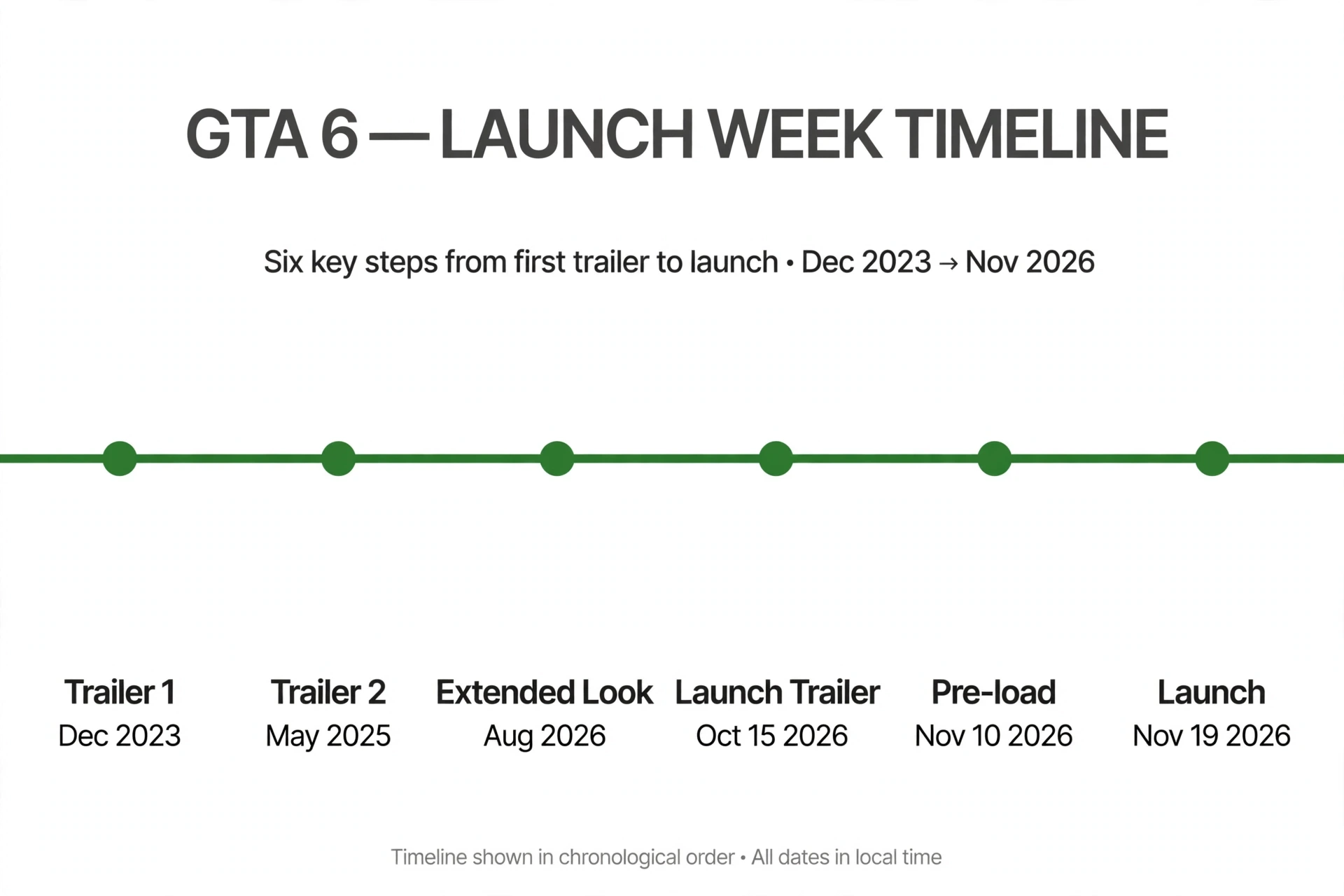
The GTA 6 launch did not start this week. It started on December 4, 2023, when Rockstar posted the first trailer a day early after it leaked online. That trailer passed 90 million YouTube views in its first 24 hours, a record for a game reveal. From that day to launch day is 1,749 days — nearly five years of waiting, and Rockstar spent most of it saying almost nothing.
The final stretch moved fast. On May 6, 2025, the second trailer appeared without warning and drew 475 million views across platforms in its first day, which Rockstar called the biggest video launch of all time. On August 27, 2026, a 27-minute gameplay showcase called An Extended Look premiered on Netflix, drawing 31.1 million views in its first four days and becoming the platform’s most-watched title that week. On October 15, 2026, Rockstar released a 90-second Launch Trailer, again with no warning, captured on PlayStation 5.
Then came the week that matters for this post. On November 9, Take-Two told investors that development was complete and pre-orders were reaching unprecedented levels, and Rockstar and PlayStation announced Grand Theft Auto VI: The Festival for Saturday, November 21. On November 10, pre-loading opened — two days earlier than first announced — for a download of up to 212 gigabytes, and Sony and Microsoft each confirmed the game as the most pre-ordered title in their stores’ history. Boxed copies reached shops on November 12 carrying a download code rather than a disc. The game unlocks at midnight local time as November 19 arrives, rolling territory by territory around the world, and the official soundtrack album releases the same day.
Two delays sit in the middle of that timeline, and they matter as much as the records. Rockstar moved the date from 2025 to May 26, 2026, on May 2, 2025, and then to November 19, 2026, on November 6, 2025. Both announcements were short, posted on Rockstar’s own Newswire, and used the same reason: the extra months would let the team finish the game with the level of polish players expect. The November 19 date has held for a full year since, confirmed again in the launch trailer and in every pre-load announcement.
That timeline is the spine of this GTA 6 launch marketing breakdown. Every lesson below maps to a moment on it, and every one of them works at a scale far smaller than Rockstar’s.
Lesson 1: Pre-Orders Are the Real Launch — Sell the Moment Before It Arrives
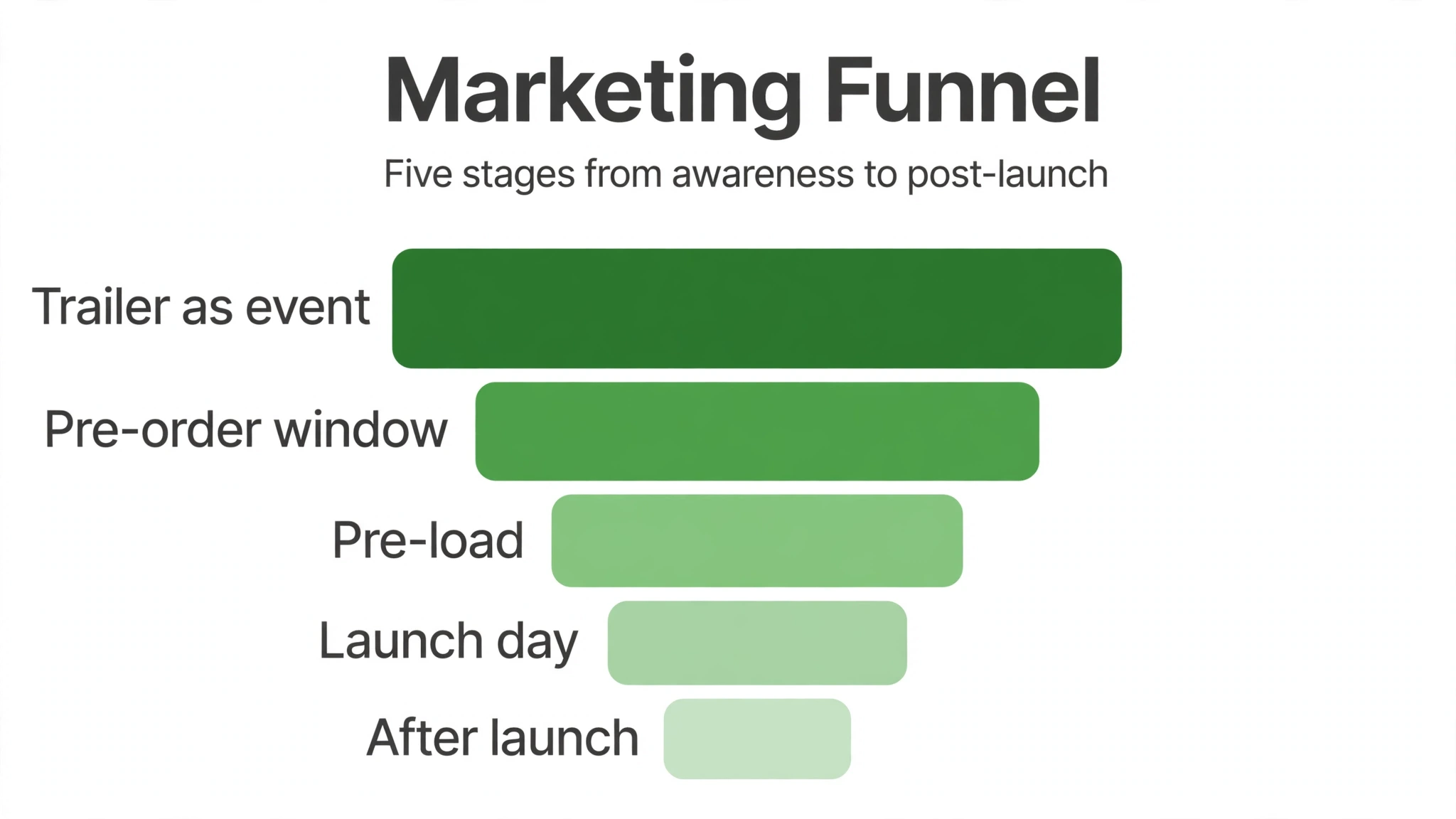
The most important GTA 6 launch marketing lesson is also the easiest to miss, because it happened months before launch week. Rockstar did not wait until November 19 to start selling. Pre-orders opened in late June 2026, nearly five months before release, and by launch week the pre-order had become the story itself.
On November 10, Sony confirmed GTA 6 as the most pre-ordered game in PlayStation Store history, and Microsoft confirmed the same record for the Microsoft Store on the same day. Take-Two’s chief executive told investors that orders were reaching unprecedented levels. Independent researchers at Sensor Tower estimated roughly 10.3 million digital pre-orders and about a billion dollars in pre-order revenue through November 11 — an outside estimate, not an official Rockstar figure, but one that newsrooms around the world reported because the direction was unmistakable.
Think about what that means for GTA 6 launch marketing. The game had already broken records before anyone could play it. The launch-day sales figure, when it comes, will be a second headline on top of a first one. Rockstar effectively launched twice: once when pre-orders opened, and once when the game itself arrived. The first launch built the audience for the second.
Small businesses can run the same GTA 6 launch marketing play at their own scale, and many already do without realising it. A restaurant that takes reservations before opening night is pre-selling. A consultant who opens a waitlist for a new service is pre-selling. A shop that lets customers reserve a limited product before it lands is pre-selling.
The mechanism is the same in every case: you ask people to commit before the thing exists, and that commitment does two jobs at once. It gives you cash flow and a headcount before launch day, and it gives you a story to tell — “we are already half booked,” “the first batch is already reserved” — that makes the next customer more likely to commit too.
The discipline is in the follow-through. A pre-order only builds trust if the thing arrives when you said it would, in the condition you promised. Rockstar’s pre-order window worked because the date behind it held. If your pre-sale slips by weeks with no explanation, the same mechanism works in reverse: every early customer becomes a disappointed one, and they tell people. So open the order book early, keep the window honest, and treat the pre-order count as a GTA 6 launch marketing asset — report it, celebrate it, and let it do the persuading for you.
Lesson 2: Make the Trailer the Event, Not the Ad
Rockstar has never bought its way to attention for GTA 6, and the launch-week numbers show why it never needed to. Trailer 1 passed 90 million YouTube views in 24 hours. Trailer 2 drew 475 million views across platforms in a single day. The Launch Trailer on October 15, 2026, arrived with no announcement at all — no countdown, no teaser post, no press release — and still dominated the conversation for days. The trailers were not advertisements for the launch. They were the launch, in instalments.
That is the second GTA 6 launch marketing lesson, and it is the one most small businesses get backwards. The usual approach is to build something, then make an announcement about it, then hope the announcement travels. Rockstar inverted the order: the announcement was the product, for a day. Each trailer was a self-contained event with its own news cycle, its own reaction videos, its own frame-by-frame breakdowns, and its own wave of coverage. The game itself barely needed introducing by the time launch week arrived, because the trailers had already done the introducing three times over.
Notice also how Rockstar handled the leak of Trailer 1. The plan was to release it on December 5, 2023. When it leaked, Rockstar did not issue takedowns and wait for the scheduled hour. It posted the trailer early, the same day, and turned a leak into a launch. Speed beat the schedule, and the audience rewarded it with a record. That instinct — respond to the moment in front of you rather than the calendar behind you — is worth more than any media plan.
For a small business, the equivalent of a trailer is any piece of content that is worth seeking out on its own, not just worth scrolling past. A before-and-after video of a real project. A short film of your product being made. A founder explaining, on camera, why this launch matters.
The format is less important than the test: would someone share this if you never asked them to? If the answer is yes, you have a trailer. If the answer is no, you have an ad, and ads need budgets that trailers do not. Release it when the moment is right, not when the calendar says so, and if something leaks or slips, move fast and own the timing. That is GTA 6 launch marketing at small-business scale: one piece of content worth seeking out.
Lesson 3: Turn Logistics into Marketing — The 212GB Download Was a Headline
Every launch has boring logistics behind it. Rockstar made its logistics famous. GTA 6 needs up to 212 gigabytes of free space, one of the largest console downloads ever, and Rockstar opened pre-loading on November 10 — two days earlier than first announced, nine days before launch — so players could download the game before they could play it. Boxed copies reached shops on November 12, and they carried a download code instead of a disc. The game unlocks at midnight local time as November 19 arrives, rolling around the world territory by territory.
Each of those facts became a news story. The size of the download was reported as a story. The early pre-load was reported as a story. The code-in-a-box detail was reported as a story. The rolling midnight unlock was reported as a story. Rockstar took the least glamorous part of a launch — the plumbing — and turned it into a week of coverage, because it understood something most businesses forget: your customers care about logistics more than you think, and they talk about it more than you expect.
The third GTA 6 launch marketing lesson is to stop hiding the operational details and start publishing them. If your launch involves a wait, say how long and why. If your product needs setup, show the setup. If delivery takes three days, say so before the customer asks, and explain what happens on each of those days. Customers do not punish honesty about logistics; they punish surprises. A customer who knows the download is 212 gigabytes clears space in advance and feels prepared. A customer who discovers it at midnight on launch night feels misled, and tells people.
There is a second layer to this GTA 6 launch marketing move. Pre-loading is also a commitment device. A player who has spent hours downloading 212 gigabytes is not a casual browser any more. They have invested time and hard-drive space in your launch before it begins, and that investment makes them more likely to show up on the day. Your version of this is any step a customer can take before launch day that deepens their commitment: a setup call, a questionnaire, a reservation deposit, an onboarding checklist. Give people something useful to do while they wait, and the wait stops feeling like waiting.
Lesson 4: Let Other Platforms Carry Your Story
Rockstar did not keep GTA 6 on its own channels. The 27-minute gameplay showcase premiered on Netflix on August 27, 2026, and drew 31.1 million views in its first four days, becoming the platform’s most-watched title that week. The official soundtrack album releases alongside the game on November 19, and three of its tracks debuted in the top ten of their Billboard charts. Creators reacted to the Launch Trailer on their own channels — one well-known streamer drew 1.7 million views for a single reaction video. A Miami Instagram account posted fifteen seconds of a sunny street and a row of custom cars, and that post travelled on its own.
That is the fourth GTA 6 launch marketing lesson: the best distribution for your launch is someone else’s audience. Rockstar understood that its own channels, large as they are, have a ceiling. Netflix has a different audience, and a different kind of attention — people who would never visit a gaming channel will watch a 27-minute showcase if it appears on the service they already open every evening. The soundtrack reaches people who will never play the game. The creators reach people who trust a familiar face more than a brand account.
The small-business version of this GTA 6 launch marketing move is simpler than it looks. You do not need a Netflix deal. You need one partner whose audience overlaps with yours but is not identical to it. A local business that serves the same street. A supplier who will show your product to their customers. A customer with a real following who genuinely likes what you do. A community group, a podcast, a newsletter, a trade body. The test is the same as Rockstar’s: does this put your launch in front of people who would not otherwise see it, in a place they already trust?
Two rules make this work. First, give the partner something worth sharing — a first look, an exclusive detail, a story their audience has not heard — not a request to repost your advert. Second, let them tell it in their own voice. The reaction video worked because it was a genuine reaction, not a scripted endorsement. If you hand a partner your exact wording, you get your reach with none of their credibility. Hand them the story and let them tell it their way.
Lesson 5: Honesty About Delays Builds More Trust Than Silence
GTA 6 was delayed twice, and Rockstar’s handling of those delays is one of the most useful GTA 6 launch marketing lessons in this post — because almost every small business will face a delayed launch, and almost every one of them handles it worse than Rockstar did.
The facts are straightforward. On May 2, 2025, Rockstar announced the game would move from 2025 to May 26, 2026. On November 6, 2025, it announced a second move, to November 19, 2026. Both announcements were short, posted on Rockstar’s own Newswire, and gave the same reason: the extra months would let the team finish the game with the level of polish players expect and deserve. The company apologised for the longer wait. Then it stopped talking about the date and got on with the work. The November 19 date has held for a full year, and the launch trailer, the pre-load announcements and the store pages have all pointed at the same day ever since.
There are three things to copy from this piece of GTA 6 launch marketing. First, Rockstar announced the delay itself, on its own channel, before the rumour mill could. A delay you announce is news. A delay your customers discover is a betrayal.
Second, it gave one clear reason, in plain language, and did not dress it up. “We need more time to make it good” is a reason any customer can understand. A paragraph of corporate language about “optimising the experience pipeline” is not. Third, it apologised once and moved on. It did not keep apologising, and it did not promise the new date with fanfare it could not guarantee. It simply held the date, month after month, until holding it became the story.
The contrast matters. In the weeks before launch, rumours of a third delay circulated anyway — search interest in a possible delay spiked in launch week — but Rockstar did not chase every rumour. It let the held date, the completed development, the open pre-load and the store records answer the question. Evidence beats reassurance. If your launch slips, announce it yourself, give one honest reason, apologise briefly, and then let the work speak. And once you set a new date, treat it as a promise, not a target. A date you hold for a year becomes a trust signal. A date you move twice in six months becomes a warning.
There is also a quieter GTA 6 launch marketing point about what Rockstar did not promise. Reports have pointed to a PC version arriving in early 2027, but Rockstar has announced no PC version at all, and the launch remains a console launch for PlayStation 5 and Xbox Series X|S. The company did not confirm a product it was not ready to sell. Small businesses do the opposite all the time — announcing features, locations, or services that do not exist yet, then scrambling when customers ask for them. A launch promise should describe what you can deliver on the day you name. Everything else is a roadmap, and roadmaps should be labelled as such.
Lesson 6: Launch Day Is the Middle, Not the End
Most launch plans stop at launch day. Rockstar’s did not. Before the game was even out, it had already scheduled the next event: Grand Theft Auto VI: The Festival, announced on November 9 with PlayStation for Saturday, November 21 — two days after launch. The official soundtrack album releases on launch day itself, giving the launch a second product and a second audience. The conversation about what comes next — the online mode, the updates, the next chapter — is already running, and Take-Two’s leadership has hinted at it publicly without giving away anything it cannot deliver.
That is the sixth GTA 6 launch marketing lesson: plan the week after launch with the same care as the week before it. Launch day is a spike, and spikes fall. What keeps a launch alive is the second moment, scheduled while the first one is still warm. The Festival gives players something to look forward to on Saturday, when the first-day rush would otherwise fade. The album gives non-players a reason to join the conversation on launch day itself. Each one extends the news cycle by a day or two, and together they turn a single day into a launch week.
Small businesses usually do the opposite. They pour everything into opening day, then go quiet for a month while they recover. The quiet month is where launches die. The fix is to plan the second moment before the first one happens. A launch event on Friday and a customer story on Monday. An opening on Saturday and a workshop the following weekend. A product release this week and a user showcase next week. The second moment does not need to be big. It needs to exist, and it needs a date, because a dated second moment tells your audience the launch is a beginning, not a one-off.
It also gives your early customers something to do. The people who show up first are your most valuable audience — they are the ones who will tell others — and they need a next step. Rockstar gave its earliest players a festival two days later. Your version might be a follow-up call, a feedback session, an early-access group, or a simple thank-you with an invitation to the next thing. The point is the same: the customer who has a reason to come back on day three is a customer, not a one-time buyer.
Lesson 7: Let the Numbers Do the Talking
The final GTA 6 launch marketing lesson is about proof. Rockstar barely had to describe how big this launch is, because the numbers did it for them. The most pre-ordered game in PlayStation Store history. The most pre-ordered game in Microsoft Store history. A trailer with 475 million views in a day. A 27-minute showcase with 31.1 million Netflix views in four days
A previous game that made $800 million on its first day in 2013 and crossed a billion dollars in three days — a Guinness record that has stood for thirteen years. Each figure is specific, checkable, and hard to argue with, and together they create a sense of inevitability: this launch is big, everyone knows it, and you do not want to miss it.
That is social proof at industrial scale, and the mechanism behind this GTA 6 launch marketing works at any size. Customers do not trust a business that says it is popular. They trust the evidence: the number of pre-orders, the size of the waitlist, the count of five-star reviews, the names of recognisable clients, the queue outside the door. Specific numbers persuade. Vague claims do not. “Our biggest launch ever” is a claim. “1,200 people pre-ordered in the first week” is proof. The first invites doubt. The second invites a decision.
Two cautions travel with this GTA 6 launch marketing lesson. First, only report numbers you can stand behind. Rockstar’s store records came from Sony and Microsoft themselves. The pre-order revenue figure came from an outside research firm and was reported as an estimate, not as a Rockstar number — and this post has labelled it that way throughout. If your number is an estimate, say so. If it is a projection, say so. A single inflated claim, once caught, costs more trust than the claim ever bought.
Second, do not confuse big numbers with the only numbers. A small business does not need millions. It needs numbers that are true and specific to its world: the percentage of customers who return, the number of projects finished on time, the years in business, the towns served. Small, honest numbers beat big, vague ones every time.
Your Small-Business Launch-Week Playbook: GTA 6 Launch Marketing, Scaled Down
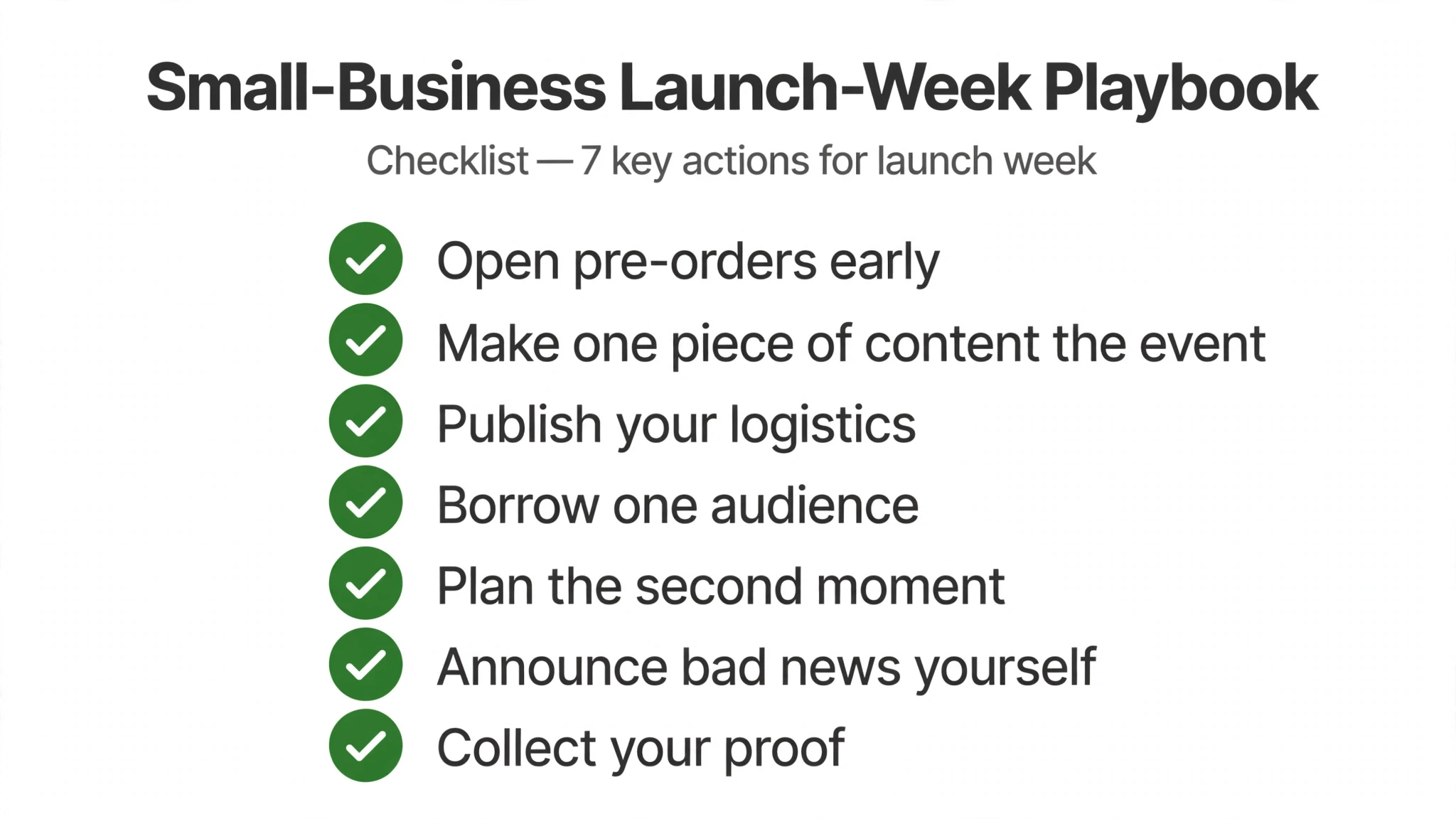
The seven GTA 6 launch marketing lessons above are the strategy. This section is the execution — a short playbook that turns GTA 6 launch marketing into a plan for a launch of any size. Work through it in order, and start at least a month before your date.
First, open the order book early. Set a pre-order, reservation, or waitlist window that opens weeks before launch day, and give people a reason to commit now rather than later: an early price that ends, a limited first batch, a bonus for the first fifty. Report the numbers as they grow, because the count itself becomes your marketing.
Second, make one piece of content the event. Pick a single video, reveal, or announcement and build a moment around it. Release it when the moment is right, not when the calendar says so, and make it worth sharing on its own merits. One strong trailer beats five forgettable posts.
Third, publish your logistics. Tell customers what to expect, when, and what they need to do to prepare. If there is a download, a setup, a wait, or a queue, say so early and explain it plainly. Logistics that customers understand in advance become part of the excitement. Logistics they discover at the last minute become complaints.
Fourth, borrow one audience. Find a partner, a platform, a creator, or a community whose audience overlaps with yours, and give them a genuine first look. Let them tell the story in their own voice. One borrowed audience, well chosen, is worth more than a month of posting to your own followers.
Fifth, plan the second moment. Schedule something for the days after launch — a follow-up event, a customer story, a new detail, a thank-you with a next step — and announce it before launch day. A launch with a second moment is a beginning. A launch without one is a firework.
Sixth, handle bad news yourself. If the date slips, announce it on your own channel, give one honest reason, apologise once, and set a new date you can hold. Then let the work, not more words, rebuild confidence.
Seventh, collect your proof. Decide in advance which numbers you will report — pre-orders, reservations, sign-ups, reviews — and report them specifically and honestly. Numbers are the cheapest advertising there is, because they are true.
What to Watch Next
The GTA 6 launch marketing story is not finished, and the next two days will add the numbers everyone is waiting for. The game unlocks at midnight local time on November 19, and the first-day sales figures will be measured against a bar Rockstar itself set thirteen years ago, when GTA V made $800 million in a day and crossed a billion dollars in three. The Festival follows on Saturday, November 21, and the soundtrack album arrives with the game. Watch whether the launch-week playbook keeps working after launch day — whether the second moment lands, whether the records keep coming, and whether the date that held for a year turns into the sales record the industry expects.
For your own launch, the timing is simpler. You do not need a thirteen-year record to beat, and you do not need 475 million views. You need a date you can hold, a pre-order window that opens early, one piece of content worth sharing, honest logistics, one borrowed audience, a second moment, and proof you can stand behind. That is the whole playbook, and it is the same one Rockstar just ran in front of the entire world.
Conclusion
GTA 6 launches tomorrow, and it launches as the most pre-ordered game in the history of two major stores, behind a trailer that drew 475 million views in a day, a Netflix showcase watched by 31.1 million people in four days, and a pre-load that opened nine days early for a 212-gigabyte download.
Rockstar did not buy that attention in launch week. It built it over three years, one trailer at a time, and then spent the final week pulling the levers that turn attention into sales: pre-orders as the real launch, trailers as events, logistics as headlines, other platforms as distribution, honesty about delays, a second moment after launch day, and numbers that speak for themselves.
Your launch will be smaller. The GTA 6 launch marketing levers are the same. Open the order book early, make one piece of content the event, publish your logistics, borrow one audience, plan the second moment, announce bad news yourself, and let honest numbers do the talking. Do those seven things and your launch will not just happen — it will build, the way this GTA 6 launch marketing campaign did.
If your next launch deserves a plan like Rockstar’s, scaled to your business, talk to the team that builds launches for a living. Visit KKeyQik to start the conversation about your website and marketing, and bring the date you want to hold. We will help you make it a launch worth counting down to.
Frequently Asked Questions
Grand Theft Auto VI launches on Thursday, November 19, 2026, for PlayStation 5 and Xbox Series X|S. The game unlocks at midnight local time as November 19 arrives, rolling out territory by territory around the world. Pre-loading opened on November 10, 2026, so players who pre-ordered digitally could download the game before launch day.
GTA 6 launch marketing is the way Rockstar built demand for the game over three years and then converted it in launch week. The core of it was treating the trailers as events rather than adverts, opening pre-orders months early, turning the pre-load into news, letting other platforms such as Netflix carry the story, and scheduling a second moment — The Festival on November 21 — for the days after launch. Each piece was designed to be worth talking about on its own.
Both Sony and Microsoft confirmed on November 10, 2026, that GTA 6 is the most pre-ordered game in the history of their stores. Independent researchers at Sensor Tower estimated roughly 10.3 million digital pre-orders through November 11, which is an outside estimate rather than an official Rockstar figure. Take-Two's chief executive told investors that pre-orders were reaching unprecedented levels.
The first trailer, released in December 2023, passed 90 million YouTube views in its first 24 hours, a record for a game reveal. The second trailer, released without warning on May 6, 2025, drew 475 million views across platforms in its first day, which Rockstar called the biggest video launch of all time. The 90-second Launch Trailer arrived on October 15, 2026, again with no advance announcement.
Pre-loading lets players download the game before they can play it, so it is ready the moment launch day arrives. Rockstar opened GTA 6 pre-loading on November 10, 2026, two days earlier than first announced, for a download of up to 212 gigabytes. Boxed copies reached shops on November 12 carrying a download code rather than a disc, so the game is effectively digital-only whichever way it is bought.
Yes, twice. Rockstar moved the release from 2025 to May 26, 2026, on May 2, 2025, and then to November 19, 2026, on November 6, 2025. Both announcements were short, posted on Rockstar's own Newswire, and gave the same reason: the extra months would let the team finish the game with the level of polish players expect. The November 19 date has held for a full year since, and no third delay has been announced. No PC version has been announced either.
Grand Theft Auto VI: The Festival is a launch event announced on November 9, 2026, by Rockstar and PlayStation for Saturday, November 21 — two days after the game launches. It is Rockstar's second moment after launch day: a scheduled reason for players and the press to keep talking about the game once the first-day rush has passed. The official soundtrack album also releases alongside the game on November 19.
Start with the same levers at your own scale. Open pre-orders, reservations, or a waitlist weeks before launch day and report the numbers as they grow. Make one piece of content the event — a video or reveal worth sharing on its own. Publish your logistics so customers know what to expect. Borrow one audience through a partner, creator, or community. Plan a second moment for the days after launch, and collect honest, specific numbers you can stand behind.
Rockstar released only a handful of trailers across nearly five years, and that scarcity was deliberate. Because each trailer was rare, each one became an event with its own news cycle, reaction videos, and frame-by-frame breakdowns. The audience filled the gaps with discussion, theories, and speculation, effectively doing the marketing themselves. The lesson for small businesses is to engineer one unforgettable moment rather than drowning people in constant content.
Watch the first-day sales figures, which will be measured against the bar GTA V set in 2013 — 800 million dollars on its first day and a billion dollars in three days. Watch whether The Festival on November 21 lands as a second moment, and whether the soundtrack album finds its own audience. For your own launch, the more useful thing to watch is whether the playbook holds: a date that was kept, pre-orders that became the story, and a plan for the day after launch day.