

Introduction
Tomorrow morning, lines will form outside coffee shops across America before most offices have even opened. People will arrive early, order a seasonal drink, and walk out holding a red plastic cup like they have won something. Some will photograph it before they take a sip. Some will post it before they reach their car. By lunchtime, many stores will be out of cups entirely, and the people who missed out will already be planning to try again next year.
That is Starbucks Red Cup Day, and it returns on Tuesday, November 17, 2026. The mechanics are almost comically simple: buy any handcrafted holiday beverage at a participating store and receive a limited-edition reusable red cup, while supplies last. There is no complicated loyalty tier to decode, no app maze to navigate, no minimum spend beyond the drink itself. One purchase, one cup, one day only.
And yet this single-day giveaway has become one of the most reliable traffic events in American retail. Searches for the free holiday cup were climbing again on November 16, the day before the event, exactly as they do every year. The holiday menu had already been out for eleven days. The cups themselves cost the company a fraction of the drink they accompany. What Starbucks is really giving away is not plastic. It is a reason to show up, a reason to post, and a reason to come back.
That is why Red Cup Day belongs in a holiday marketing conversation rather than a coffee conversation. Strip away the brand name and the green aprons, and what remains is a masterclass in holiday marketing: a seasonal ritual, a one-day window, a collectible object, and a loyalty loop that keeps paying long after the cups run out. None of those ingredients requires a global store network. A neighbourhood bakery, a boutique fitness studio, a local salon, or an online shop with a few hundred customers can run a smaller version of the same playbook and get a real share of the same effect.
This post breaks down what Starbucks is doing on November 17, why each piece works, and how a small business can borrow seven specific holiday marketing strategies from it — without a corporate budget and without giving the store away.
What Is Starbucks Red Cup Day 2026?
Red Cup Day is Starbucks’ annual one-day giveaway, and the 2026 edition lands on Tuesday, November 17. Any customer who orders a handcrafted holiday beverage at a participating coffeehouse in the United States receives a free limited-edition reusable red cup, while supplies last. The offer covers any size and any style — hot, iced, or blended — and it works in the cafe, at the drive-thru, through the Starbucks app, and through delivery partners.
The qualifying menu is broad. This year’s holiday lineup includes returning favourites such as the Peppermint Mocha, Caramel Brulée Latte, Sugar Cookie Latte, and Gingerbread Latte, alongside new arrivals including the Tiramisu Velvet Latte and the Apple Pomegranate Refresher. The holiday menu itself launched on November 5, twelve days before Red Cup Day, which means the drinks were already familiar by the time the giveaway arrived. That sequencing is deliberate, and it matters more than it looks.
The cup itself is redesigned every year, which is the entire point. The 2026 edition is made with 95 percent recycled material and carries an illustration of a coffee tree branch tied up in a red bow, created by the company’s in-house creative studio. It is a grande-sized reusable cup, built to be used again rather than thrown away. And reuse is rewarded: bringing a clean reusable cup back to a store earns a small discount on the drink and bonus Stars for loyalty programme members, turning a one-day souvenir into a habit that brings the customer back through the door all winter. Starbucks’ official Red Cup Day announcement has the full details of the 2026 cup and the giveaway rules.
The giveaway has run every year since 2018, which makes 2026 the ninth edition. Customers now expect Red Cup Day the way they expect the first holiday lights on their street. It is no longer a promotion people discover; it is a date people plan around.
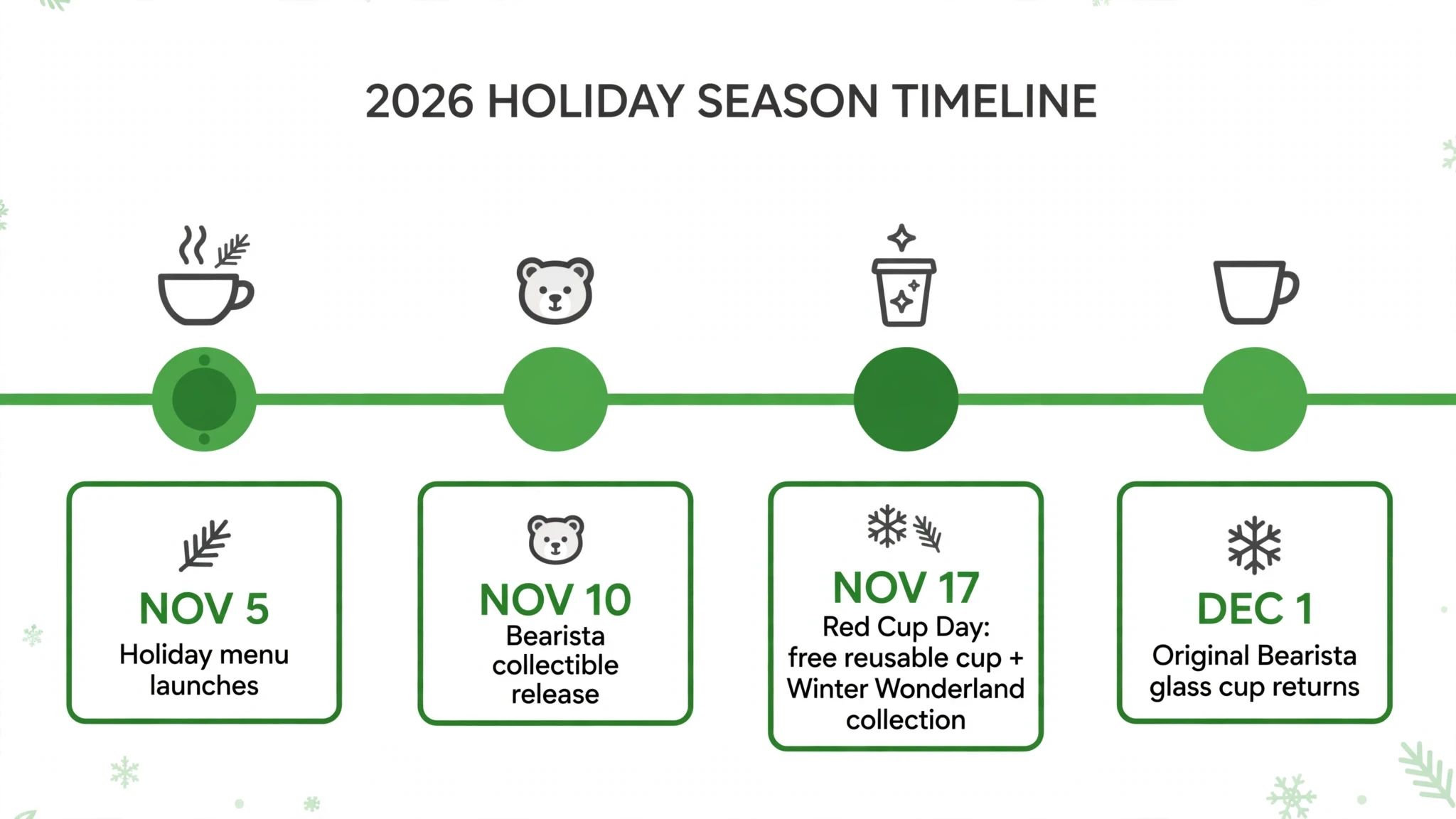
That history is part of the marketing. The company has also learned to surround the day with a small calendar of related moments: the holiday menu on November 5, a collectible Bearista glass cup release on November 10, the Winter Wonderland merchandise collection arriving on the same day as Red Cup Day, and the return of the original Bearista glass cup on December 1. Each date gives fans a reason to check back, and each one feeds the next. ConsumerAffairs’ rundown of the 2026 holiday lineup covers all four dates in one place.
For a small business owner watching from the sidelines, the scale is beside the point. The holiday marketing structure is the lesson. Starbucks built a season out of a single day, and it did so with four tools any business can pick up: a ritual, a deadline, an object worth keeping, and a reason to return. The seven strategies below take each of those tools apart.
Why Red Cup Day Works: The Psychology in Plain Terms
Before the holiday marketing strategies, it helps to understand why a plastic cup creates queues. The answer is not the cup. It is what the cup represents, and the psychology is well understood by anyone who has ever queued for a limited sneaker release or refreshed a page for concert tickets.
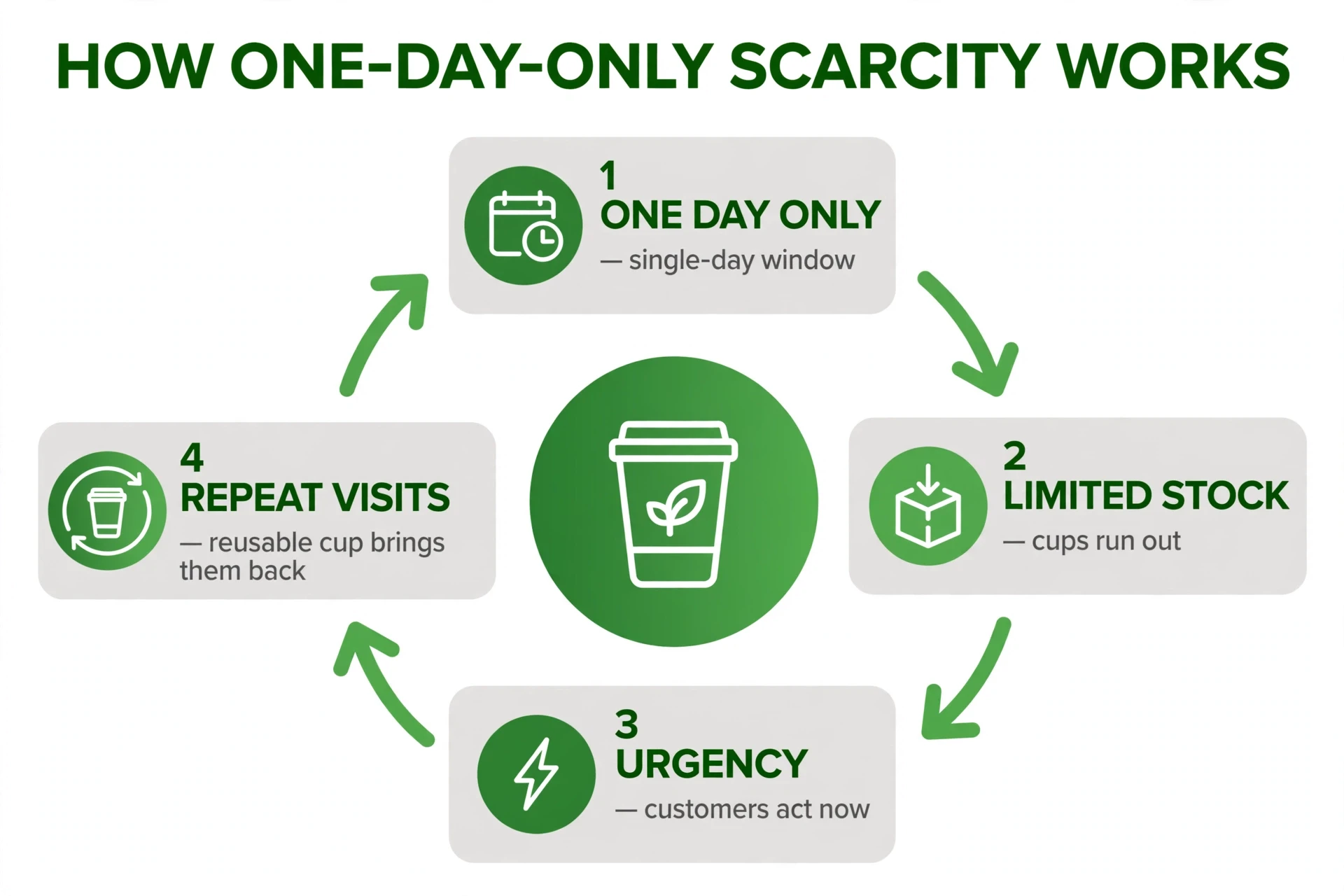
First, the giveaway is time-boxed to a single day. A reward that is available all month is a nice-to-have. A reward that disappears at closing time is a decision that has to be made now. That urgency converts casual interest into action, and it concentrates a whole season of demand into a single morning of foot traffic.
Second, the cup is collectible because it changes every year. A permanent product can be bought later. A design that exists only in 2026 cannot. Collectors, completists, and casual fans all feel the same pull: miss this year and the set is incomplete. The annual redesign is what turns a giveaway into a tradition people follow.
Third, the cup is visible. A paper receipt is private. A bright red reusable cup is carried through offices, gyms, campuses, and commutes for weeks afterwards. Every refill is a small, silent advertisement that Starbucks never had to pay for. The product does the promoting, which is the cheapest distribution a brand can buy.
Fourth, the event is social by design. People photograph the cup, compare designs with friends, and post about whether their store still had stock. That sharing is not an accident. The cup is photogenic, the hunt for one is a story, and the one-day window gives everyone something to talk about on the same day. Social platforms reward that kind of synchronised conversation, and the algorithm does the rest.
Fifth, the giveaway is attached to a purchase the customer was already considering. Nobody buys a holiday drink they do not want just to get a cup. The reward nudges people who were already leaning toward a seasonal drink to buy it today instead of next week, and to buy it at Starbucks instead of somewhere else. That is the difference between a promotion that buys traffic and one that borrows it.
A small business does not need a national footprint to use any of this. It needs a calendar date, a limited object, and a reason for customers to show up on that date rather than any other. The strategies below show how.
Lesson 1: Turn a Giveaway Into a Ritual People Expect
The most valuable thing Starbucks owns in this holiday marketing promotion is not the cup. It is the calendar date. Red Cup Day has run every year since 2018, and that repetition has transformed a marketing tactic into a seasonal ritual. Customers do not need an advertisement to tell them it is coming. They remember it from last year, they remind each other, and they show up expecting it.
Rituals work because they remove the hardest part of marketing: earning attention from scratch. A one-off promotion has to fight for notice every single time. A recurring event arrives with an audience already assembled. The anticipation does the advertising. People search for the date, ask friends whether they are going, and plan their morning around it. By the time the day arrives, the demand already exists.
For a small business, the lesson is to stop inventing a new holiday marketing promotion every month and start building one event customers can count on. Pick a date that fits your business and repeat it every year on the same day. A bakery could run a free seasonal cookie with any holiday order on the first Saturday of December. A salon could hold an annual holiday styling morning. A fitness studio could open a free community class on the same weekend every November. The first year, you will have to promote it hard. By the third year, your regulars will be asking you about it before you announce it.
The key is consistency. A ritual that moves dates, changes rules, or disappears for a year is not a ritual. It is just another promotion. Keep the date, keep the format, and let the expectation compound. The cup changes every year, but the date does not. That stability is what makes people trust the holiday marketing event enough to plan around it.
A practical starting point: choose one annual moment for your business and commit to it for three years. Announce it early, repeat the same simple rule every time, and change only the small details — the design, the flavour, the colour — so returning customers feel both familiarity and novelty. That combination is exactly what keeps Red Cup Day fresh after nine years.
Lesson 2: Use Scarcity Honestly — One Day Only, While Supplies Last
Every marketer knows scarcity sells. What fewer marketers appreciate is that scarcity only works when it is real. Red Cup Day is limited in two directions at once: it lasts a single day, and each store has a finite number of cups. When the cups run out, they run out. There is no restock, no rain check, no extension. That honesty is what makes the urgency believable.
Customers have learned to spot manufactured urgency. A countdown timer that resets every time you reload the page trains people to ignore the next one. A “limited offer” that is still running three months later trains them to wait. Starbucks avoids that trap by making the limit structural. The day ends, the stock ends, and the people who waited genuinely miss out. The disappointment of the people who miss it is, paradoxically, part of what makes the event valuable. It proves the reward was real.
Small businesses can use the same holiday marketing principle at their own scale, and they should. A limited run of fifty gift boxes, a one-day tasting event, a seasonal service available only during a single weekend — these are honest limits, and customers respect them. The mistake is to fake the limit. If you say only twenty are available, make sure only twenty are available. If you say the offer ends Friday, end it Friday.
There is a second benefit to real scarcity: it protects your margins. A giveaway that runs all month can quietly eat a quarter of your profit. A giveaway that runs for one day has a fixed, predictable cost. You know exactly how many units you are giving away, you know the maximum exposure, and you can measure the return against a number you chose in advance. That discipline is what separates a holiday marketing promotion from a leak.
Set your limit before you announce the event, write it down, and honour it even when it hurts. The customers who miss out this year are the customers who arrive early next year. That is not a failure of the promotion. That is the promotion working.
Lesson 3: Give Customers Something They Will Carry, Not Something They Will Bin
Most promotional giveaways end up in a drawer or a bin. A branded pen, a paper flyer, a discount code on a receipt — these are forgotten before the customer reaches the car. The red cup survives because it is useful, durable, and designed to be seen. It holds a drink, it goes in a car cupholder, it sits on a desk. Every time it is used, the brand travels with it.
That is the test every small business should apply to its own holiday marketing giveaway: will the customer still be using this in a month? If the answer is no, the money is better spent elsewhere. A reusable tote, a well-made sample, a beautifully designed calendar, a small plant in a branded pot — objects with a life after the event keep working long after the event ends. The best promotional item is one the customer would have been happy to receive even without your logo on it.
There is also a design lesson here. The 2026 cup is not a logo slapped on plastic. It is an illustrated object with a clear design idea — a coffee tree branch tied in a red bow — made with mostly recycled material. People keep it because it looks good, not because they feel obliged. The sustainability angle helps too: customers increasingly prefer brands that show, rather than claim, that they care about waste. A reusable item is a quiet statement that the business thinks about its footprint.
For a small business, the practical version is simple. Spend your giveaway budget on fewer, better objects rather than many cheap ones. One hundred well-made reusable items that customers actually keep will do more for your visibility than a thousand flyers that go straight into recycling. And design the object for the place it will be used — a tote for a grocery shop’s customers, a small notebook for a co-working space, a sample kit for a skincare studio. The object should fit the customer’s day, not just your logo.
Lesson 4: Make the Reward a Reason to Return, Not Just a Reason to Show Up
The smartest part of Red Cup Day is what happens after November 17. The cup is reusable, and bringing it back earns the customer a small discount on future drinks plus bonus loyalty Stars. That single detail converts a one-day event into a weeks-long habit. The customer who received a cup on Tuesday has a reason to return on Wednesday, and every refill is another visit that might not have happened otherwise.
Too many small business holiday marketing promotions end the moment the customer walks out the door. A free sample with no follow-up, a discount with no next step, an event with no reason to return — these create a spike and then silence. The goal of a holiday marketing promotion should never be a single transaction. It should be the second visit, and the third, and the habit that forms after that.
Think about what your version of the refill looks like. A bakery that gives away a seasonal cookie could stamp a small card that earns a discount on the next three visits. A salon that runs a holiday styling morning could book the follow-up appointment before the customer leaves. A gym that hosts a free community class could offer attendees a short trial that starts the following week, not the same day, so the return visit is built into the offer. The mechanism matters less than the principle: the giveaway should open a loop, not close one.
Loyalty programmes work best when the reward is simple and immediate. Customers should understand the deal in one sentence and feel the benefit on their very next visit. If the programme needs a diagram to explain, it is too complicated. A cup that earns a small saving every time it is refilled is a programme anyone can grasp in five seconds. Aim for that level of clarity.
The metric to watch is not how many people showed up on the day. It is how many of them came back within two weeks. That number tells you whether your promotion built a habit or just bought a crowd.
Lesson 5: Build a Season of Moments, Not a Single Event
Red Cup Day gets the headlines, but it is not the whole campaign. Look at the calendar around it and a pattern appears. The holiday menu arrives November 5. A collectible Bearista release follows on November 10. Red Cup Day and the Winter Wonderland collection land together on November 17. The original Bearista glass cup returns on December 1. That is four distinct moments across four weeks, each with its own reason to visit, its own social conversation, and its own audience.
This is the difference between a holiday marketing campaign and an event. An event is a spike. A campaign is a season. By spacing the moments across the month, Starbucks gives customers four reasons to pay attention instead of one, and gives its own social channels four stories to tell instead of repeating the same announcement. Each moment also reaches a slightly different audience: the menu launch reaches drink lovers, the collectible release reaches collectors, Red Cup Day reaches everyone, and the December return reaches the people who missed the earlier drops.
Small businesses usually approach holiday marketing the opposite way. They pour everything into a single big day — a Black Friday sale, a launch party, a holiday open house — and then go quiet for weeks. The result is a spike followed by silence, and silence is where competitors win attention back.
The fix is to plan the season as a sequence. Map the six weeks from mid-November to the end of December and place one small moment in each week. A retailer could run a gift guide in week one, a maker spotlight in week two, a one-day giveaway in week three, a customer story in week four, and a last-order deadline in week five. None of these needs to be large. What matters is the rhythm: a reason to check back, every week, all season.
This is also where social media marketing earns its keep. A season of moments gives you a content calendar almost for free, because each moment is a post, a story, a short video, and an email. One event gives you one post. A season gives you a month of material. Plan the moments first and the content writes itself.
Lesson 6: Let Your Customers Do the Marketing
On Red Cup Day, Starbucks does not need to buy much attention, because its customers supply it. People photograph their cups, film their morning coffee run, compare designs, and post about whether their local store still had stock. That content is more persuasive than any advertisement, because it comes from a real person rather than a brand account.
The reason it works is that the event gives people something worth sharing. A cup is photogenic. The hunt for one is a small story with a happy ending or a funny failure. The one-day window means everyone is talking about the same thing on the same day, which is exactly the kind of synchronised conversation social platforms amplify. Starbucks did not ask customers to post. It built an event that people wanted to post about, and then got out of the way.
Small businesses often approach social media backwards. They post about their products and wonder why nobody shares them. Sharing is not something you request. It is something you earn by giving people a moment worth capturing. A beautifully presented seasonal product, a small in-store surprise, a limited item with a striking design, a wall or corner designed for photographs — these are the raw materials of user-generated content.
There is a useful comparison in how online communities behave. When the fan fiction archive AO3 returned after a seventeen-day outage earlier this month, readers flooded social platforms with homecoming posts — not because anyone asked them to, but because the return mattered to them. We covered those community marketing lessons in detail, and the principle is identical: people promote what they feel part of. A giveaway that makes customers feel like insiders will be shared. A discount code will not.
Three practical moves make this work. First, design the moment to be photographed: good light, a clear focal object, a clean background. Second, make the sharing easy: a short, obvious hashtag or a simple prompt on a sign near the counter. Third, reshare what customers post, with credit, on the same day. Nothing encourages the next person to post like seeing the previous person’s photo on your page within the hour.
Lesson 7: Design for the Camera and the Feed
The 2026 red cup is a design object before it is a drinking vessel. An illustration of a coffee tree branch tied in a red bow, printed on a reusable cup made with mostly recycled material, is the kind of thing that looks good in a photograph. That is not vanity. It is strategy. In a feed full of competing images, the product that photographs well gets shared, and the product that gets shared gets discovered.
Small businesses underestimate how much of their holiday marketing now happens through a phone camera. A customer decides whether to post about your product in about two seconds, and the decision is almost entirely visual. Is it colourful? Is it unusual? Does it look good next to the other things in their feed? If the answer is yes, you have a chance. If the answer is no, no amount of caption writing will save it.
This applies far beyond physical products. A service business can design its experience for the camera too: a salon’s finished style photographed against a clean wall, a restaurant’s seasonal dish plated with one striking garnish, a studio’s class photographed in good light with a consistent backdrop. The goal is not to stage fake moments. It is to make real moments easy to capture well.
There is an SEO angle here as well. Images that get shared widely earn links, mentions, and branded searches, and all of those feed back into how visible your business is in search results. Visual content is not decoration. It is distribution.
Before your next seasonal promotion, photograph it the way a customer would: phone camera, natural light, no staging. If the photo looks ordinary, change the object, not the filter. A bold colour, a clear shape, a small detail that rewards a closer look — these are cheap to add and expensive to ignore. The red cup proves the point. It is, after all, just a cup. What makes it shareable is the thought that went into how it looks.
Your Own Red Cup Day: A Small Business Playbook
Borrowing these seven holiday marketing strategies does not require a corporate budget. It requires a calendar, a small budget for a good object, and the discipline to follow through. Here is a compact version of the playbook, sized for a business with a few hundred customers rather than a few million.
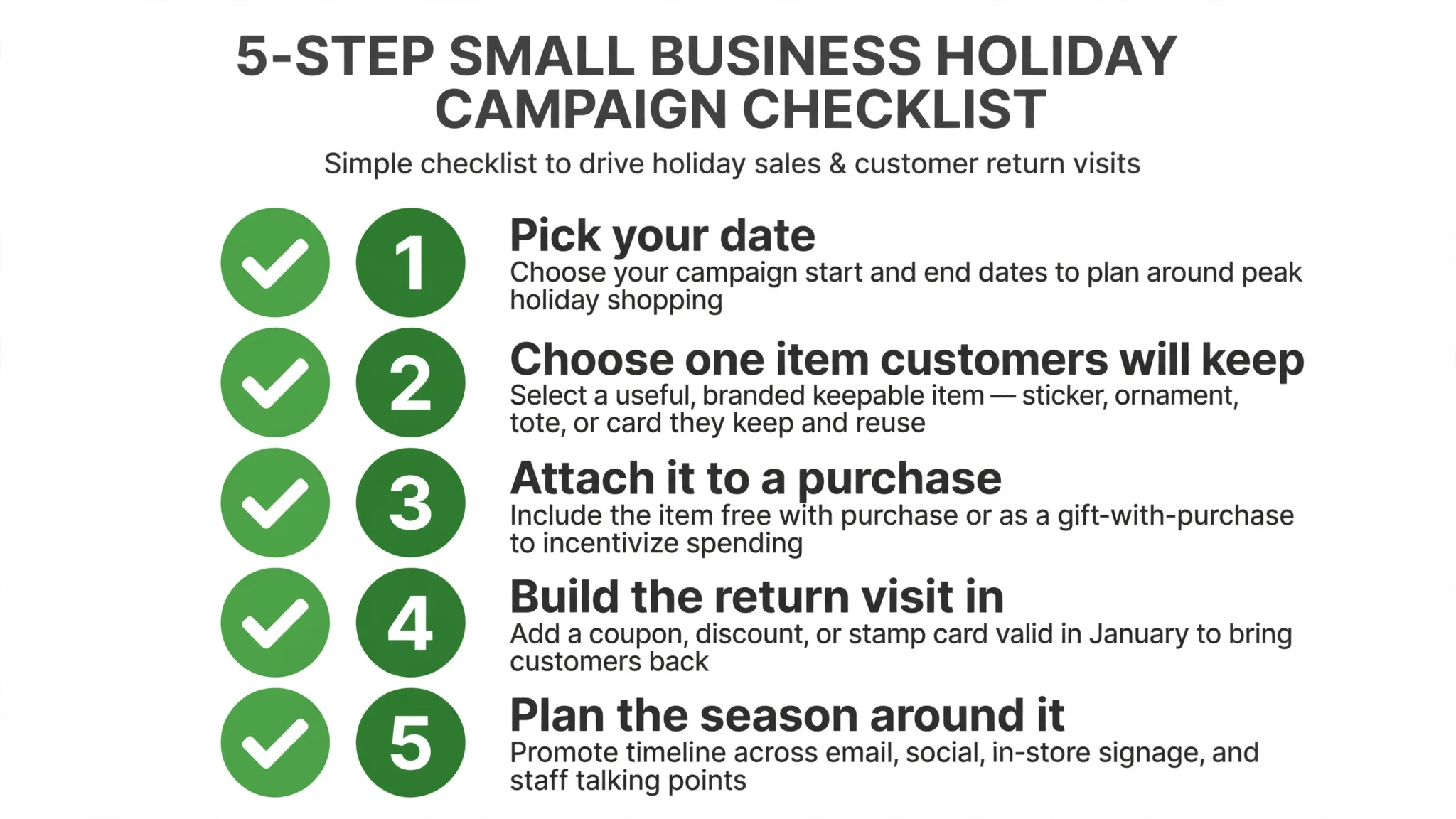
Step one: pick your date. Choose a single day in the next four weeks and put it on the calendar. A Saturday morning works well for most local businesses, because customers are out and in a spending mood. Announce the date at least two weeks ahead, and repeat the announcement weekly until the day arrives.
Step two: choose your object. Pick one item customers will keep and use. A reusable tote, a small seasonal sample kit, a limited-edition ornament, a branded notebook — the item should cost little, look good, and fit your customer’s daily life. Order a fixed quantity and decide the number in advance. Fifty is a sensible starting point for most small businesses.
Step three: attach it to a purchase. The reward should come with something the customer already wants, not instead of it. A free item with any holiday purchase, a small gift with a seasonal service, a sample with every order over a modest threshold — the purchase is the point, and the gift is the nudge. Keep the rule to one sentence so staff can explain it without thinking.
Step four: build the return visit in. Decide what brings the customer back. A stamp card, a discount on the next visit, a follow-up appointment booked on the spot, a second small drop a week later — pick one mechanism and make it part of the event, not an afterthought. Tell the customer about it when you hand over the gift, while the goodwill is fresh.
Step five: plan the season around it. Place two or three smaller moments around your big day: a teaser a week before, a behind-the-scenes post a few days before, and a thank-you post the day after featuring customer photos. That sequence turns one day of effort into a week of content.
Step six: measure the right numbers. Count how many gifts you gave away, how many of those customers returned within two weeks, and how many posted about it. Those three numbers tell you whether the event built loyalty or just cost money. If the return rate is low, the problem is usually the follow-up, not the gift.
Local businesses have one advantage Starbucks does not: they can be personal. A handwritten note with the gift, a staff member who remembers a regular’s usual order, a photo wall featuring real customers — these small touches cost nothing and create the feeling of belonging that no national campaign can copy. Use that advantage. It is the one thing scale cannot buy.
Mistakes to Avoid
A good holiday marketing playbook needs a short list of things not to do. The most common is giving away too much. A promotion that runs too long, offers too generous a reward, or has no cap will cost more than it returns. Set your budget before you announce anything, and treat it as a hard number.
The second mistake is copying the surface without the structure. A red cup without a date, a deadline, and a return mechanism is just a cup. The object is the least important part of the promotion. The calendar, the scarcity, and the follow-up are what make it work. Spend your planning time on those.
The third mistake is forgetting your existing customers. Promotions aimed only at new buyers can quietly annoy the regulars who already keep you in business. Make sure your loyal customers get the reward too, ideally first. An early-access hour for regulars, or a small extra for loyalty members, costs little and says a lot about who you value.
The fourth mistake is silence after the event. If customers post photos and you never respond, you have wasted the most valuable part of the day. Block an hour the following morning to reply to every post, reshare the best photos, and thank people by name. That hour is the cheapest marketing you will do all season.
Finally, do not confuse a giveaway with a strategy. A single event can create a spike, but only a repeatable system creates growth. If your Red Cup Day works, schedule next year’s date before the glow fades, and start building the ritual while the memory is fresh.
Conclusion
Starbucks Red Cup Day 2026 is, on the surface, a free cup with a holiday drink on Tuesday, November 17. Underneath, it is seven disciplined holiday marketing decisions: a ritual repeated every year, scarcity that is real, an object worth keeping, a reward that brings people back, a season of moments instead of a single event, customers who market the brand themselves, and a design that photographs well. None of those decisions requires a global brand. Each one can be borrowed, shrunk, and run by a business of any size.
The holiday season rewards businesses whose holiday marketing gives customers a reason to show up on a specific day, remember the visit, and come back the following week. A free cup is not the strategy. The strategy is everything around the cup. Build your version of it, measure what comes back, and repeat it next year — ideally a little better, and ideally on the same date.
If you want help turning a seasonal idea into a holiday marketing campaign that actually brings customers back, KKeyQik builds holiday marketing campaigns for small businesses across SEO, social media, and local search. Tell us about your busiest season and we will help you plan the moments around it.
Frequently Asked Questions
Starbucks Red Cup Day 2026 falls on Tuesday, November 17. It is a one-day-only event at participating coffeehouses across the United States, and the free reusable cups are available only while each store's supply lasts. The holiday menu itself launched earlier, on November 5, so the drinks are already on the menu by the time the giveaway day arrives.
Order any handcrafted holiday beverage on November 17 and you will receive a free limited-edition reusable red cup with it, while supplies last. The offer works in the cafe, at the drive-thru, through the Starbucks app, and through delivery partners. Any size counts, and hot, iced, and blended drinks all qualify.
Any handcrafted beverage from the holiday menu qualifies, in any size. That includes returning favourites such as the Peppermint Mocha, Caramel Brulée Latte, Sugar Cookie Latte, and Gingerbread Latte, plus new arrivals like the Tiramisu Velvet Latte and the Apple Pomegranate Refresher. If you are unsure whether your order qualifies, ask the barista before you pay.
No membership is required for the free cup itself. Anyone who buys a qualifying holiday beverage on November 17 receives one, while supplies last. Rewards members do get extra value from the cup afterwards, because bringing a clean reusable cup back earns a small discount on the drink and bonus Stars on the visit.
The cup is redesigned every year, which is part of why people collect them. The 2026 edition is made with mostly recycled material and features an illustration of a coffee tree branch tied up in a red bow, created by the company's in-house creative studio. It is a grande-sized reusable cup, designed to be used again rather than thrown away.
The cups are available only while supplies last, and stores do not restock them once they are gone. That is why the busiest stores often run out by the afternoon. Going early in the day gives you the best chance. Even if the cups are gone, the full holiday menu is still available, and the Winter Wonderland merchandise collection launches the same day.
Yes, that is the point of the design. The cup is reusable, and bringing it back to a store earns you a small discount on your drink plus bonus Stars if you are a Rewards member. Reusing the cup all winter turns a one-day souvenir into a habit, and it is also the reason the cup keeps advertising the brand every time it is carried out of the house.
The season is built as a calendar of moments. The holiday menu launched on November 5, a collectible Bearista glass cup release followed on November 10, Red Cup Day and the Winter Wonderland collection arrive on November 17, and the original Bearista glass cup returns on December 1. Each date gives fans a separate reason to visit, which is a useful pattern for any business planning a holiday campaign.
Pick one date, choose one item customers will genuinely keep and use, and attach it to a purchase they already want to make. Cap the quantity so the scarcity is real, announce the date at least two weeks ahead, and build the return visit into the offer — a stamp card, a follow-up appointment, or a second small drop the following week. The object matters less than the calendar, the deadline, and the reason to come back.
It works because it combines four things at once: a ritual customers expect, a deadline that forces a decision, a collectible object that changes every year, and a reward that brings people back afterwards. The one-day window concentrates demand into a single morning, the limited stock makes the reward feel real, and the photogenic cup turns customers into promoters. Any business can borrow that structure at its own scale.