


Introduction
A quarterback threw three interceptions, nearly lost the game, then won it with three seconds to spare — and the moment everyone talked about afterwards was not the touchdown. It was a few seconds of him skipping across the field, pumping his fists, apparently celebrating alone.
That is the strange arithmetic of viral video marketing in 2026. The game itself lasted more than three hours. The clip that travelled the furthest lasted about ten seconds, showed almost nothing that mattered on the scoreboard, and left out the one detail that changed what it meant. By the next morning it had been watched, reposted, mocked, defended, and turned into a debate about the NFL Draft — all before most people had seen a single highlight of the actual game.
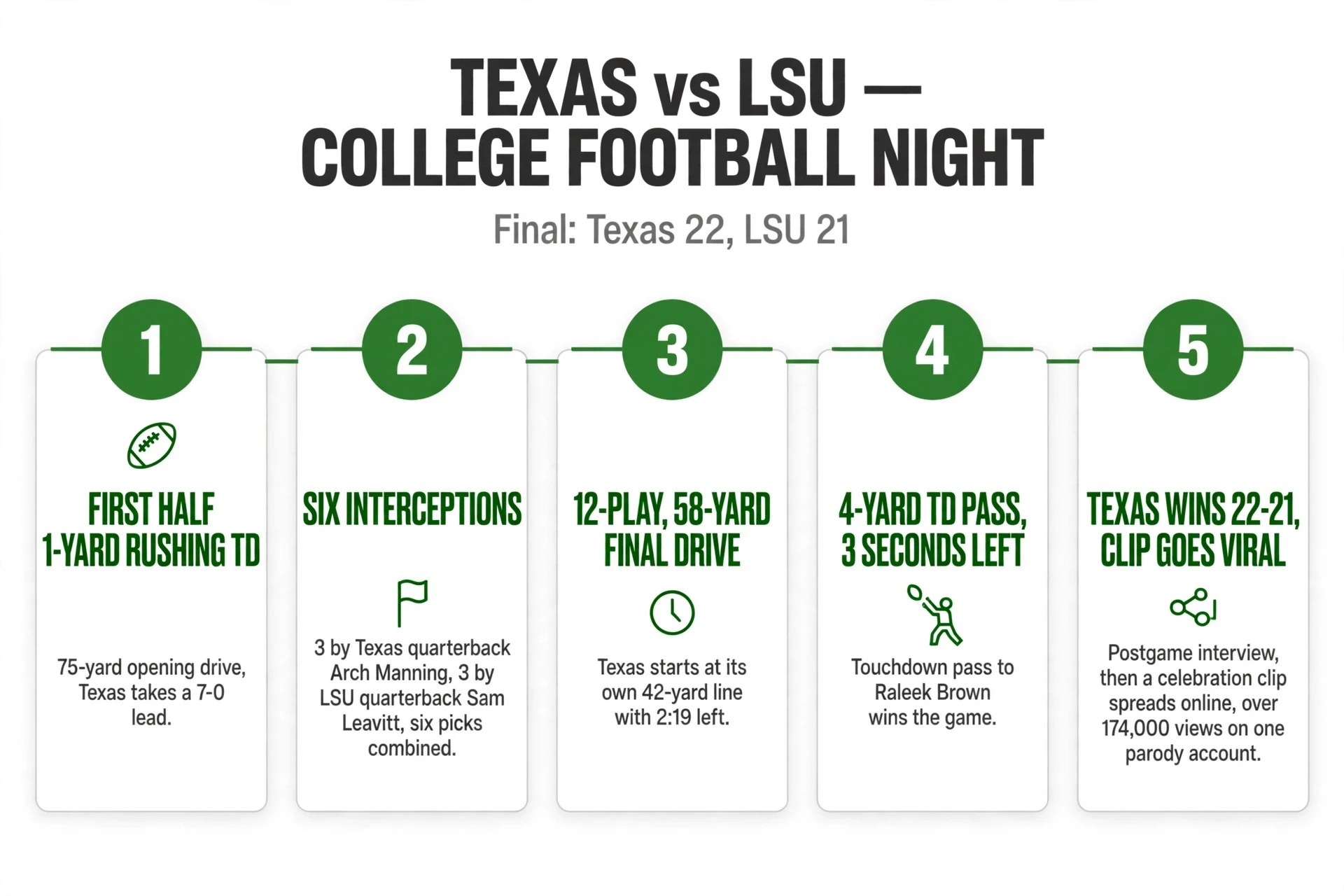
The clip came from Saturday night’s game between No. 6 Texas and No. 21 LSU at Tiger Stadium in Baton Rouge. Texas won 22–21 on a last-second touchdown, ending a 75-year losing streak in that stadium and keeping its College Football Playoff hopes alive. Arch Manning, the Texas quarterback, had a rough night by any measure: 19 completions on 35 attempts, 174 passing yards, a career-high three interceptions, and four sacks. Then he led a 12-play, 58-yard final drive and threw a four-yard touchdown pass to Raleek Brown with three seconds left, erasing an 11-point deficit.
None of that is what went viral. What went viral was the celebration afterwards — or rather, a cropped version of it. And that gap between what happened and what people saw is exactly where the viral video marketing lessons live.
Small businesses cannot buy a moment like this. But they can learn a great deal from one about viral video marketing. The mechanics that carried a ten-second clip of a college quarterback across millions of feeds are the same mechanics that carry a bakery’s behind-the-scenes video, a plumber’s honest explainer, or a boutique’s try-on reel. Virality is not luck with better lighting. It is a set of behaviours that platforms reward and audiences repeat. This post breaks down what happened in Baton Rouge, why the clip spread the way it did, and seven viral video marketing lessons any small business can put to work — without a stadium, a famous surname, or a six-figure production budget.
What Actually Happened in Baton Rouge
The facts matter here, because the first lesson of this story is that the viral version of events was incomplete. Here is the fuller picture, as reported across multiple outlets after the game.
Texas arrived at Tiger Stadium on Saturday night ranked sixth in the country. LSU, ranked 21st, had not lost to Texas at home in 75 years. The game was messy on both sides: Manning threw three interceptions, and LSU quarterback Sam Leavitt threw three as well, for a combined six picks on the night. Manning also ran for a one-yard touchdown in the first half, capping a 75-yard opening drive, and celebrated in the end zone by staring into the stands — a gesture the home crowd answered by throwing drinks at him as he turned back toward the field.
Texas trailed for much of the evening. With 2:19 left and the ball on its own 42-yard line, Manning led the final drive: 12 plays, 58 yards, three converted third downs, finished by the four-yard touchdown pass to Brown with three seconds on the clock. The 22–21 win moved Texas to 8–2 overall and 5–2 in the SEC, while LSU fell to 6–4 and effectively out of the playoff picture.
Then came the clip. Cameras caught Manning skipping across the grass, pumping his fists, with no teammates visibly celebrating beside him. Cut that way, it looked like a player celebrating a poor personal performance all by himself — and social media did what social media does. The clip spread fast. One parody account’s version alone drew more than 174,000 views. The mockery piled up through the night.
But the clip left out one important detail, and several outlets clarified it within hours: Manning had just finished a postgame television interview with ESPN’s Holly Rowe. He was not celebrating alone in the middle of nowhere. He was walking from the interview spot toward his teammates and his father, Cooper Manning, who was waiting in the stands. The skip and the fist pumps were the tail end of a celebration, not the whole of it — and the walk to join his family was cropped out of the frame.
The conversation did not stop there. NFL insider Ian Rapoport posted the final play on X and called the throw “an unreal throw.” That post was widely mocked in turn, with fans and former players including Dez Bryant and Chris Long pushing back on the description. Analyst Ryan Clark added that no NFL scout could responsibly call Manning a first-round pick on the basis of that night. Each new take gave the clip another reason to circulate, and each round of replies pulled in a fresh audience that had never watched the game.
That is the anatomy of a viral moment: a real event, a short clip, a missing piece of context, a famous name, and a disagreement that keeps people talking. Small businesses can learn from every layer of it.
Why the Clip Spread: The Mechanics in Plain Terms
Before the lessons, it helps to see why this particular clip travelled so far, because viral video marketing runs on the same few forces every time.
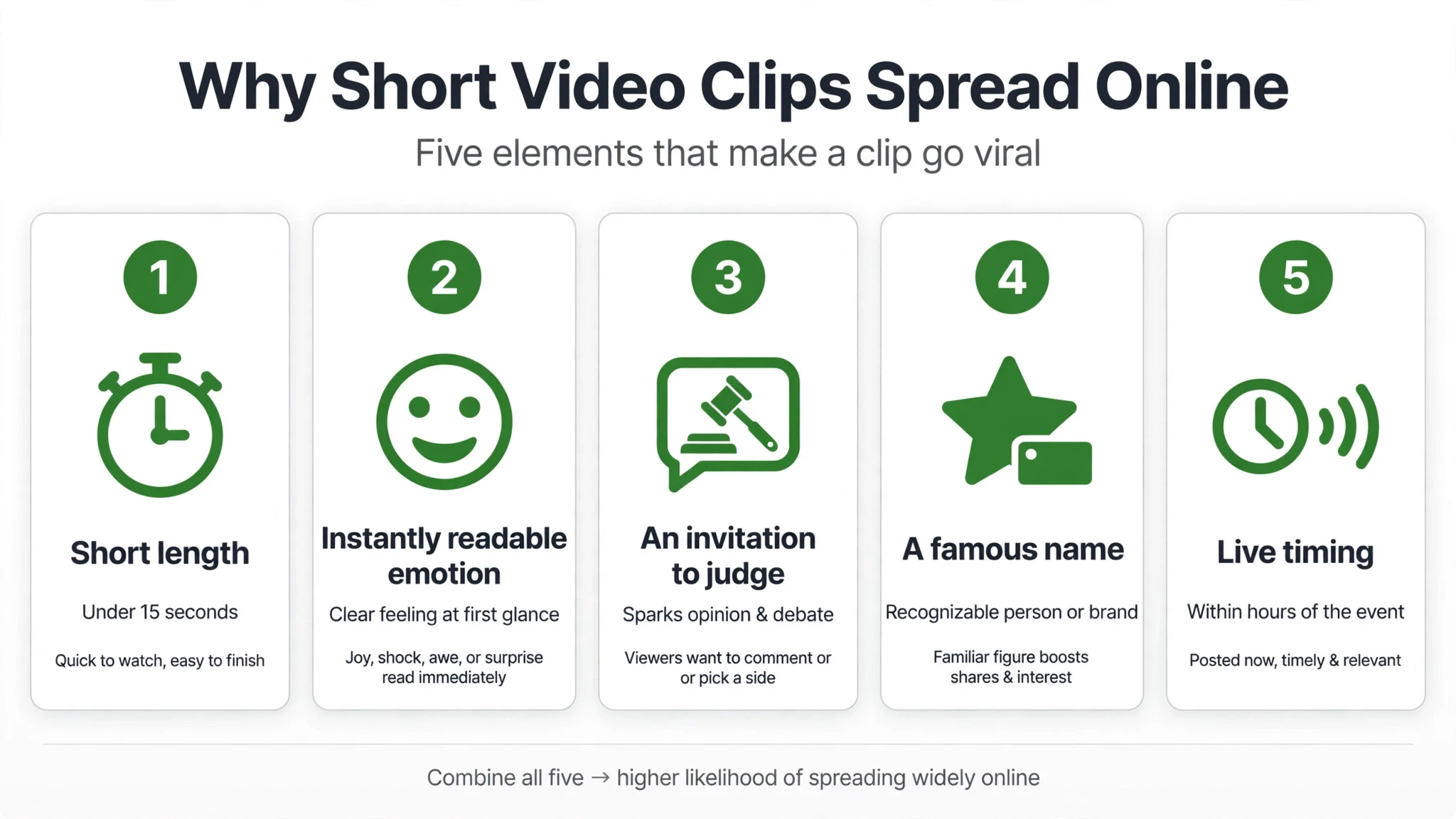
First, the clip was short. Ten seconds is short enough to watch without thinking, short enough to rewatch, and short enough to share without asking anyone for their time. Platforms measure completion rates, and a ten-second video that nearly everyone finishes looks like a hit to every recommendation system it touches.
Second, the clip was emotionally legible at a glance. You did not need to know the score, the stakes, or even the sport to read it: a young man celebrating by himself after a bad game. That instant readability is what makes a clip work on a silent, scrolling feed. If a viewer needs a caption, a backstory, or a second watch to understand the point, the moment is already lost.
Third, the clip invited a verdict. Was he celebrating too much after a bad game? Was the criticism unfair? Was the throw actually good? Every viewer could form an opinion in seconds and feel qualified to post it. Content that invites a judgement gets comments, and comments are the fuel that pushes a video into more feeds.
Fourth, the clip arrived attached to a name people already had opinions about. Manning is one of the most talked-about players in college football, and the Manning surname carries decades of attention with it. A clip of an unknown player doing the same thing would have stayed small. The name was the distribution.
Fifth, the moment was live and current. The game had ended hours earlier. People were still arguing about it. A clip posted a week later, after the conversation had moved on, would have been a footnote. Timing is not a minor detail in viral video marketing; it is often the whole difference between a clip that spreads and one that sits still.
A small business does not need a famous name or a stadium. It needs the same ingredients at its own scale: short, readable, opinion-forming, timely content about something its audience already cares about. The seven lessons below show how to build that.
Lesson 1: Context Is the Real Content
The most important fact about the Manning clip is the fact it did not show. He had just finished an interview. He was walking toward his father and his teammates. The celebration that looked lonely was, in reality, a few steps on the way to a reunion — and the version without that context told a completely different story.
This is the first rule of viral video marketing: a clip is never just a clip. It is a clip plus whatever the viewer assumes about the seconds before and after it. Audiences fill gaps automatically, and they usually fill them with the most dramatic interpretation available. A celebration without its context reads as arrogance. A reaction without its trigger reads as overreaction. A result without its process reads as luck.
For a small business, the practical lesson is to control the context before someone else supplies it. That means thinking about what a viewer sees in the first frame and what they will assume if they watch only five seconds. If your video shows a finished product, show a glimpse of the work that went into it. If it shows a happy customer, show the problem that came before. If it shows a bold claim, show the evidence in the same frame, not three clips later.
It also means resisting the temptation to crop out the boring parts. The boring parts are often the parts that make the exciting parts believable. Manning’s walk toward his father was not dramatic, but it was the truth of the moment, and the clip paid for leaving it out with a night of mockery. Your videos will be shared, cropped, reposted, and quoted out of context whether you like it or not. Build them so that the version that survives is still fair to you. Put the context inside the clip itself — in the opening line, in the on-screen text, in the first three seconds — because the caption underneath it will not always travel with it.
Lesson 2: Win the First Three Seconds or Lose the Viewer
Nobody watched the Manning clip because they had committed to it. They watched because the first frame was already interesting: a quarterback skipping across a field, alone, after a game his team had nearly lost. The question formed instantly — what is he doing? — and the clip answered it before the viewer could scroll past.
That is the whole job of the opening of a short video. Platforms give you roughly three seconds before a thumb decides. In those three seconds, a viewer is not judging your production quality or your brand. They are judging whether the next few seconds are worth more than whatever is below your video. A slow logo animation, a polite introduction, or a wide establishing shot all fail that test, because they ask for patience a scrolling feed never gives.
For a small business, the fix is simple and uncomfortable: start with the most interesting thing you have. If you are a roofer, start with the leak, not the company name. If you are a baker, start with the cake coming out of the oven, not the shopfront. If you are a fitness coach, start with the client’s before-and-after moment, not your credentials. The hook is not a gimmick; it is a courtesy — and in viral video marketing, it is the difference between a video that is watched and one that is never seen.
The Manning clip also shows what a strong opening does after the first watch. People rewatched it to check what they thought they saw. They sent it to friends with a one-line question. They opened the replies to see whether anyone else had noticed the same thing. A good opening does not just stop the scroll. It starts the conversation, and the conversation is what carries a video past its first audience into its second and third.
Lesson 3: Raw Beats Polished
Look closely at what went viral and what did not. The polished broadcast highlights of the game — the touchdown pass, the final drive, the professional commentary — were watched, certainly. But the clip that travelled furthest was a shaky, unpolished, few-seconds-long fragment of a man skipping on grass. It had no graphics, no music, no editing, and no production value at all. It had something better: it felt real.
That is a consistent pattern in viral video marketing, and it is good news for small businesses. Audiences have learned to recognise advertising, and they scroll past it by reflex. What they stop for is content that feels like something a person actually filmed — a real moment, a real reaction, a real place. The Manning clip worked because nobody staged it. It was a camera catching a human being in an unguarded second, and that honesty is visible even on a phone screen.
Small businesses often make the opposite mistake. They wait until they can afford a proper shoot, a script, and a lighting setup, and in the meantime they post nothing. The lesson of Baton Rouge is that the most shareable thing you own is probably the unglamorous truth of your work: the mess before the clean-up, the mistake you caught in time, the customer’s genuine reaction, the owner talking plainly to the camera without a teleprompter. Film it on a phone. Keep the lighting honest. Leave in the small imperfections that prove it happened.
That does not mean quality is irrelevant. Clear audio matters, a steady frame matters, and good light matters. But polish is a finishing touch, not the substance. If you have to choose between a perfect video nobody sees and a rough video people share, choose the rough one every time — and then make the next one a little cleaner.
Lesson 4: Give People Something to Argue About
The Manning clip did not spread because everyone agreed about it. It spread because everyone disagreed. Some people thought the celebration was tone-deaf after three interceptions. Others thought the mockery was unfair, given the context of the interview and the win. Then Rapoport’s “unreal throw” post gave the argument a second front, and Ryan Clark’s draft assessment gave it a third. Each disagreement pulled a new group of people into the replies, and each reply pushed the clip into more feeds.
Debate is the most reliable engine in viral video marketing, and it is the one small businesses use least — because it feels risky. It does not have to be. You do not need to pick a fight or insult anyone. You need a clear, specific point of view that reasonable people could disagree with. A coffee shop that says most people brew their coffee wrong will get more engagement than one that says coffee is great. A tax accountant who says most small businesses overpay in one specific area will get more shares than one who says taxes are important. A landscaper who shows why the popular way to water a lawn wastes money will get more comments than one who posts a pretty garden.
The key is to argue about the work, not about people. Take a position on a method, a trend, a common mistake, or a piece of conventional wisdom in your industry — and then show your reasoning. When viewers disagree, they comment. When they agree strongly, they share. Both behaviours help the video, and both are the currency of viral video marketing. What kills reach is content nobody can have an opinion about: the generic, the vague, the safe. If your video could have been posted by any business in your industry, it will be treated like it was posted by none of them.
One caution from the Manning story: debate has a cost when it turns personal. The clip invited judgement of a 21-year-old’s character, not just his play, and the pile-on was ugly at times. Keep your debates about ideas, methods, and results. The argument should make your audience smarter, not meaner — and it should make your business look like the one with the clearest thinking in the room.
Lesson 5: Speed Beats Perfection
The clip was everywhere within hours of the final whistle. By the next morning, the conversation had already moved through several rounds: the clip, the context correction, the Rapoport post, the mockery of the Rapoport post, the draft debate. Anyone who waited until Monday to post a considered take was speaking to an audience that had already formed its opinions.
That speed is not optional in viral video marketing. Trends have a short half-life, and the window in which a moment is still being talked about is measured in hours, not days. The brands and creators who benefit from a viral moment are usually the ones who post while the conversation is still forming — with a quick reaction, a relevant clip, or a useful angle — rather than the ones who produce a polished response after the moment has passed.
For a small business, this means having a simple process ready before the moment arrives. Know who films, who posts, and what your approval step looks like — and keep that approval step short. If a local event, a news story, a seasonal moment — the same kind of calendar thinking behind Starbucks Red Cup Day — or a customer story is trending in your area today, a phone video posted this afternoon will outperform a produced video posted next week. You can always follow up with a better version later; you cannot recover the hours when everyone was paying attention.
It also means watching for moments that connect to your work, not just moments in your industry. The Manning clip was a sports story, but its lessons belong to every business that makes video. A restaurant can learn from a sports clip. A gym can learn from a movie premiere. A plumber can learn from a celebrity apology. The connection does not have to be literal — it has to be useful. Your audience will accept the leap if the lesson is real and the link is honest.
Lesson 6: Your Audience Will Remix You — Let Them
One of the most telling details of the Manning story is where the clip’s biggest numbers came from. The most-viewed version was not the broadcast’s own post. It was a parody account’s repost, which drew more than 174,000 views on its own. The clip was copied, captioned, memed, and argued over by accounts that had nothing to do with the original broadcast — and every copy extended its reach.
That is how viral video marketing actually works. You do not control distribution; your audience does. A video spreads because people take it, add their own caption, stitch it, duet it, quote it, or drop it into a group chat with a single line of commentary. The original post is only the starting point. The remixes are the distribution network.
Small businesses often fight this instinct. They watermark everything, they ask people not to repost, they worry about losing control of the message. The Manning clip shows the cost of that thinking: control is not available, and chasing it only slows the spread. A better approach is to design videos that are easy to remix. Make the point clear enough that a stranger can caption it accurately. Keep the format simple enough that a customer can copy it. Leave space — literally, in the frame, and figuratively, in the idea — for someone else to add their own take.
That also means watching what people do with your content and responding to it. When someone stitches your video with a question, answer it. When a customer posts their own version of your idea, share it and credit them. When a parody or a joke lands, laugh along if it is fair. The businesses that grow fastest on short-form video are rarely the ones with the best originals. They are the ones whose audiences feel like participants rather than spectators, and who treat every remix as a gift rather than a theft. The same community-first dynamic carried a fan community through a long platform outage — the community marketing lessons from the AO3 outage show how an audience that feels it owns the story will defend it too.
Lesson 7: Verify Before You Amplify
There is a darker lesson in this story, and it matters more than the other six. The same machinery that carried the Manning celebration clip also carries things that never happened. Sporting News reported that after Texas’s 35–10 loss at Georgia, an AI-generated clip appeared to show Manning in tears on the bench. The video spread on YouTube and Instagram, and many fans believed it — but the moment never happened. It was a deepfake, and Manning became one of several high-profile athletes targeted by fabricated clips this season.
The celebration clip and the crying clip are two sides of the same coin. Both were short. Both were emotionally readable. Both invited a verdict. One was real but misleading without context; the other was simply false. In both cases, the audience’s first instinct — to share before checking — did the damage before anyone could correct it.
For a small business, the lesson is blunt: never amplify what you have not verified, and never build content on a clip, a claim, or a statistic you cannot trace to a real source. The temptation is real, especially when a trending clip fits your message perfectly. But the cost of sharing something false is far higher than the cost of missing a trend. A business that shares a fake video, a wrong statistic, or a misleading quote loses something it cannot buy back with reach: trust. And in a feed full of fabrication, trust is the scarcest currency a small business owns.
Apply the same rule to your own content. If you quote a number, name the source. If you show a customer result, make sure it is real and fairly described. If you react to a viral moment, check the fuller story first — as several outlets did with the interview context — before you add your voice to the pile. The few minutes verification takes are the cheapest insurance in viral video marketing, and they are what separate a business people trust from an account people scroll past.
A Small-Business Viral Video Marketing Checklist
The seven lessons above are principles. Here is how the lessons of viral video marketing turn into a working routine for a business with a phone, a few hours a week, and no production team.
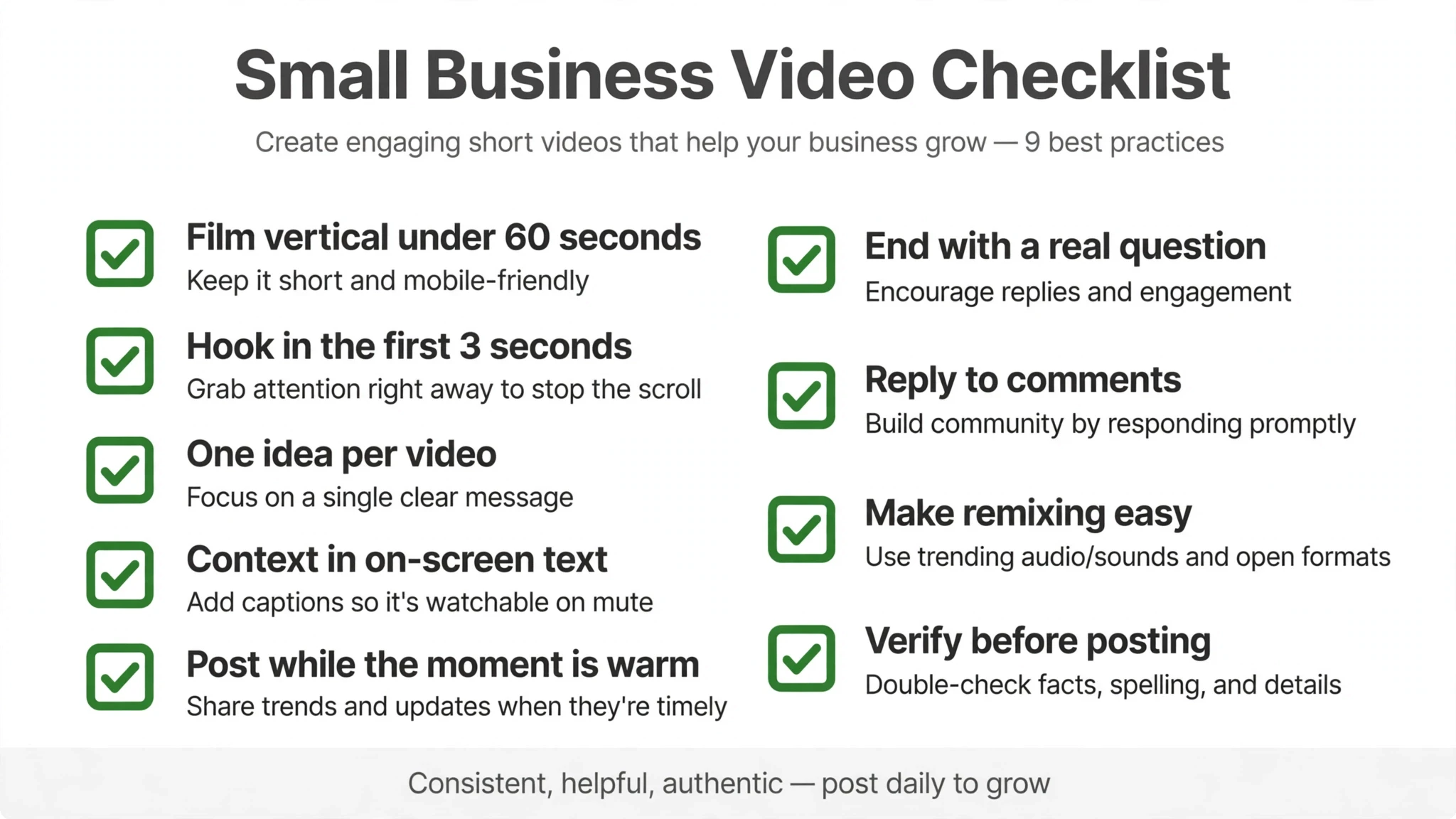
Start with the moment, not the script. Keep a running list of things your customers already talk about: the question you answer every week, the mistake you fix most often, the result that surprises people, the local event everyone is discussing. Those are your topics. Write each one as a single sentence, and film the video that sentence promises.
Film in vertical, under 60 seconds, and ideally under 30. Put the hook in the first three seconds — the result, the mistake, the surprising claim — and say it out loud while showing it on screen. One idea per video. If you catch yourself explaining two things, you have two videos.
Add context inside the clip. A line of on-screen text that states the situation, the date, or the outcome means your video still makes sense when it is shared without its caption. Assume the viewer will see it muted, cropped, and out of context — because that is exactly how viral clips travel.
Post while the moment is warm. If something relevant happened today, film today and post today. If you film on Monday and post on Friday, you have given the conversation four days to move on without you.
Invite a response, honestly. End with a real question, not a generic plea for likes. Ask viewers which method they use, whether they have seen the same mistake, or what they would do in the situation you showed. Then reply to the comments that come in, because the replies are where a video’s second wave of reach is built.
Make remixing easy. Keep your videos clean and simple enough that a customer or a creator can build on them. When someone does, acknowledge it publicly. That acknowledgement is often worth more than the original video.
And verify, every time. Before you post a claim, a clip, or a reaction, check the source. One false post costs more trust than ten good posts can rebuild.
What Not to Do
A few cautions are worth stating plainly, because the Manning story shows all of them in one place.
Do not chase virality by embarrassing someone. The clip’s mockery phase was the least useful part of the whole episode, and it did nothing for anyone’s reputation. Content that punches down travels fast and ages badly.
Do not fake a moment. Staged “candid” videos, bought reactions, and misleading edits are easy to spot now, and audiences punish them. The Manning clip worked because it was genuine. Your content has to be genuine too, or the audience will treat it as advertising in disguise — which is to say, they will ignore it.
Do not copy a trending format without understanding why it works. A format is a container. The Manning clip’s format — a short, raw, emotional fragment — worked because of the story inside it. The same format with nothing inside it is just a short video.
And do not judge a video by its first hour. Some clips spread in minutes; others build slowly through shares and saves. The metrics that matter for a small business are not views alone but what the views do: profile visits, follows, enquiries, and customers who mention the video when they walk in. A video with 2,000 views that brings in five customers is worth more than a video with 200,000 views that brings in none.
Conclusion
Arch Manning’s night in Baton Rouge will be remembered for two things: a last-second touchdown that kept Texas’s season alive, and a ten-second clip that showed how quickly a moment can escape its context. The touchdown decided the game. The clip decided the conversation — and the conversation is where viral video marketing lives.
The lessons of viral video marketing are not complicated. Put the context inside the clip. Win the first three seconds. Choose raw and real over polished and safe. Give people an honest argument. Move fast. Let your audience remix you. And verify before you amplify, because the same feed that makes a business famous can make it untrustworthy in a single post.
None of that requires a stadium, a famous name, or a production budget. It requires a phone, a point of view, and the discipline to post while the moment is still warm. The next viral clip in your industry is probably already happening somewhere — a customer reaction, a local event, a small moment that says something true about your work. Film it, frame it honestly, and give people a reason to pass it on.
If you want help turning moments like these into a video strategy that actually brings in customers, that is what KKeyQik does. Our team builds social media and video marketing around real businesses, real audiences, and real results — short-form content, campaign planning, and distribution that turns views into enquiries. And if you want the pages around those videos to rank as well as they spread, our SEO services for small businesses cover that side too. Visit KKeyQik to start the conversation, and see how a small business can use viral video marketing without guessing.
Frequently Asked Questions
After Texas beat LSU 22–21 on a last-second touchdown, cameras caught Arch Manning skipping across the field and pumping his fists, apparently celebrating alone. The clip spread quickly, with one parody account's version drawing more than 174,000 views. What the clip left out was that Manning had just finished a postgame television interview with ESPN's Holly Rowe and was walking toward his teammates and his father, Cooper Manning. The celebration looked lonely only because the context was cropped out of the frame.
Viral video marketing is the practice of creating short videos designed to be shared widely across social platforms, so that the audience itself becomes the distribution channel. Instead of paying for every view, a business earns views through shares, stitches, duets, and reposts. The Manning clip is a useful example: it was short, emotionally readable, and easy to react to, which is why it travelled far beyond the people who watched the game.
Shorter is usually better. The most shareable clips tend to run under 60 seconds, and many of the strongest ones are under 30 seconds. Short videos get watched to the end more often, and completion rate is one of the strongest signals platforms use when deciding what to show next. For a small business, a 20 to 40 second video with one clear idea will usually outperform a polished three-minute video that nobody finishes.
Yes. The Manning clip had no production budget at all — it was a raw, unpolished fragment of a real moment, and it travelled further than the game's professionally produced highlights. Small businesses can do the same by filming genuine moments on a phone: the work in progress, the finished result, the customer's real reaction, or the owner answering a common question plainly. Authenticity and a clear hook matter far more than expensive equipment.
Videos spread when they combine a few traits: they are short, they are emotionally readable at a glance, they invite a reaction or an opinion, they arrive while the topic is still current, and they are easy to share or remix. The Manning clip had all five. A video that is long, vague, late, or impossible to have an opinion about will struggle no matter how well it is made. Check your next video against those five traits before you post it.
They can, when the connection is honest and the lesson is useful. A sports clip can teach a restaurant about timing, a gym about authenticity, or a plumber about context — as long as the link is real and the advice stands on its own. The mistake is forcing a connection that is not there, or posting about a trend only to chase attention. If you cannot explain in one sentence why the moment matters to your customers, skip it.
Stay calm and add the missing context quickly, in the same place the clip is spreading. A short reply, a follow-up video, or a pinned comment that fills in what was cropped out will often travel as far as the original. The Manning story shows why speed matters: the interview context was clarified within hours, and that correction became part of the conversation. Never delete the conversation — correct it, and let your audience help carry the correction.
Start with the most interesting thing you have, in the first three seconds. Show the result, the mistake, or the surprising claim before anything else. A roofer should open with the leak, a baker with the cake coming out of the oven, and a coach with the client's transformation. Viewers decide in about three seconds whether to keep watching, so a slow introduction or a logo animation will lose most of them before your message begins.
Make the video easy to build on. Keep the idea simple and clear enough that a stranger can caption it accurately, leave room for someone else to add their take, and use a format customers can copy. When someone stitches your video, answers it, or posts their own version, acknowledge it publicly and credit them. Audiences share more when they feel like participants rather than spectators.
Views alone do not tell you much. Watch what the views do: profile visits, new followers, website clicks, enquiries, and customers who mention the video when they contact you. A video with 2,000 views that brings in five customers is worth more than a video with 200,000 views that brings in none. Track the actions that follow the video, not just the number on the view counter.