

Introduction
On October 1, 2026, “tj maxx closing” was one of the fastest-rising searches in America — up more than 1,000% on Google Trends, with over 100,000 people suddenly asking whether their favorite discount retailer was going under. The reality behind the TJ Maxx closing stories is far less dramatic: the chain closed a handful of stores in 2026 while opening enough new locations to finish the year with more US stores than it started. But by the time most people learned that, the scary version of the TJ Maxx closing story had already won the search results.
That gap — between what happened and what the internet believes happened — is exactly why the TJ Maxx closing stores trend belongs on a marketing blog. For multi-location brands, a single store closure is a real-estate decision; a “tj maxx closing” news cycle is a marketing event. The retailers that navigate a TJ Maxx closing moment well control the narrative, protect their local search visibility, and turn a downsizing headline into a growth story. The ones that handle it poorly let an algorithm write their obituary.
This post unpacks what really happened with the TJ Maxx closing stores stories of 2026, then distills seven retail marketing lessons any multi-location business — retail, restaurant, fitness, services — can steal. If you would rather have a team apply them for you, KKeyQik helps multi-location businesses turn marketing systems into measurable growth.
What Actually Happened With the TJ Maxx Closing Stores Stories
Before the lessons, the facts — because the details behind the TJ Maxx closing headlines are what make the marketing mechanics visible:
A handful of closures, not a collapse. The TJ Maxx closing headlines of 2026 trace back to just a few confirmed locations: the three-story flagship at 360 Newbury Street in Boston, which closed in early January after nearly a decade in one of the city’s best-known shopping districts; a Silver Spring, Maryland store at the Ellsworth Place mall, ending a ten-year run; plus locations in Cumberland, Maryland and Gilbert, Arizona. Each was framed by the company as routine real estate management. “We are always assessing and reviewing our real estate strategies, and our decision to close this store reflects that thinking,” a TJ Maxx spokesperson told The U.S. Sun.
The Boston closure drew the most ink. A Massachusetts WARN filing identified the Newbury Street store as a permanent closure affecting 117 workers, most of whom were offered positions at nearby stores, as reported by Fast Company. Closures of landmark locations always generate outsized coverage — and search volume — relative to their actual business significance.
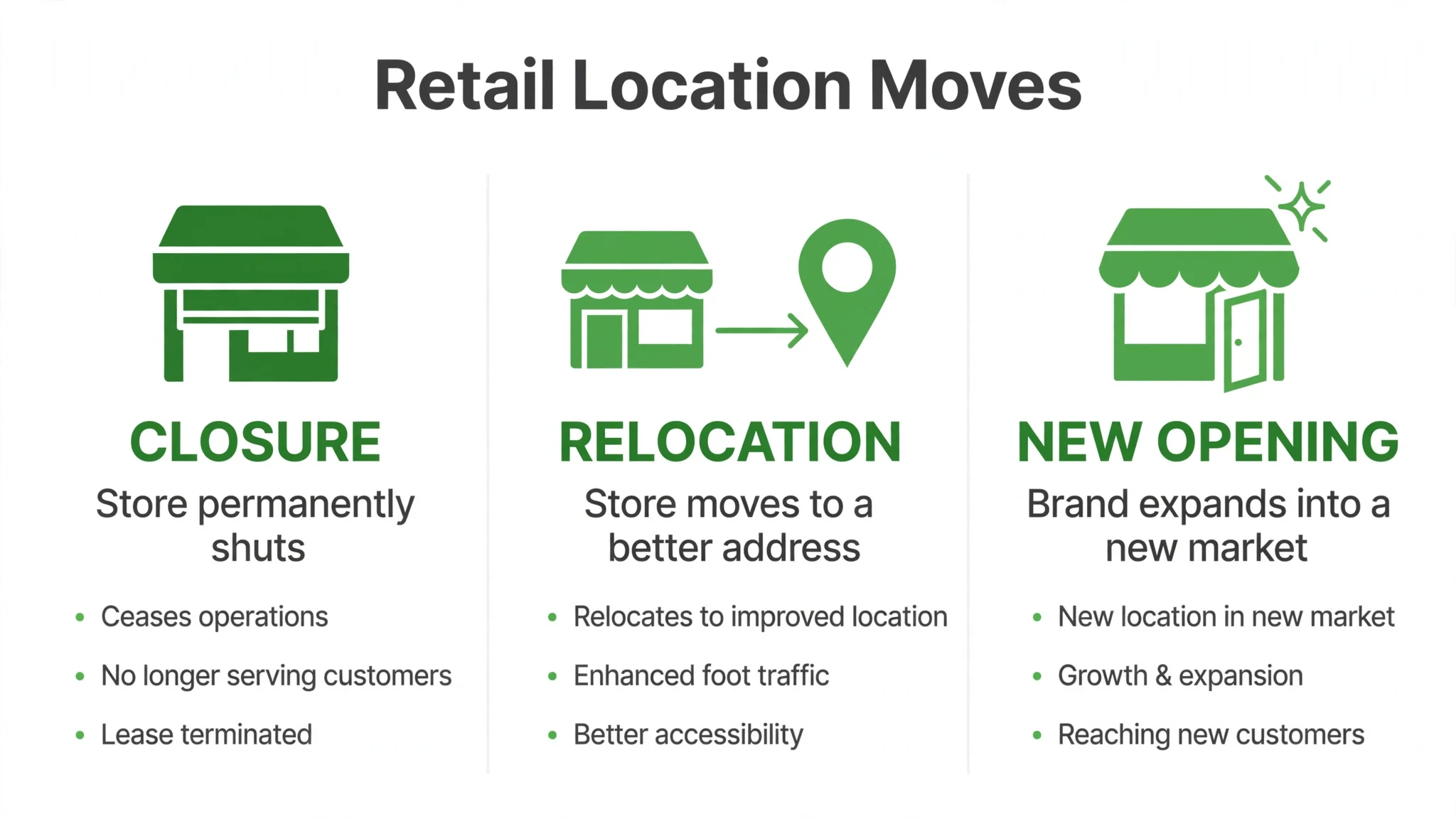
Relocations are not closures. Several 2026 “closing” sightings were actually moves: the Meriden, Connecticut store relocated from Meriden Mall to The Shops at Stone Bridge in Cheshire; Paramus, New Jersey is moving from 34 East Ridgewood Avenue to The Fashion Center; Charlotte, North Carolina moved from 4726 South Boulevard to Seneca Square; and the Carolina, Puerto Rico store moved within Plaza Carolina (see the verified 2026 closing-and-relocation list). A location disappearing from one shopping center is not the same as a brand leaving a market — but Google doesn’t always know the difference.
The bigger picture is expansion. TJX ended fiscal 2026 with 1,348 US TJ Maxx stores, up from 1,333 at the start — 21 more stores, not fewer. The company’s CFO, John Klinger, said on the earnings call that strong comparable sales growth now lets the company “put stores closer together than we thought before,” while smaller formats open up densely populated urban areas. TJX now operates more than 5,000 stores worldwide across its brands and has raised its long-term target to 7,500 locations. As one retail analyst put it, “a handful of closures in expensive markets funds that growth rather than slowing it.”
That is the story every multi-location brand eventually lives through: you prune a few expensive locations, plant several more, and the internet only notices the pruning. Here is how to market through it.
Lesson 1: Own the Narrative Before the Headline Owns You
The most important number in the TJ Maxx closing stores story is not a store count — it is a search count. More than 100,000 people searched “tj maxx closing” in a matter of hours. Most of them did not find TJX’s real-estate strategy memo explaining the TJ Maxx closing decisions. They found third-party “doomed locations” listicles, dramatic thumbnails, and rumor-mill coverage. The company was playing chess with store leases; the internet was playing telephone.
This is the first retail marketing lesson, and it applies far beyond retail: whenever TJ Maxx closing-style news touches your business — any move that looks like bad news from the outside, you must publish the inside story before someone else publishes theirs. Narrative abhors a vacuum. If the brand doesn’t explain a closure in plain language, a content farm will explain the TJ Maxx closing rumors in alarming language — and Google will reward whichever page answers the search first.
What narrative control looks like in practice:
– A short, human press statement beats silence every time. TJX’s spokesperson line about “always assessing and reviewing our real estate strategies” is corporate, but it exists — and every reporter used it. Having one quotable sentence ready before news breaks means your words, not a competitor’s speculation, anchor the coverage. – Prepare the explainer before the event. If you know a closure announcement is coming, draft the customer-facing version in advance: what closed, why (in customer terms), where customers should go instead, and what’s opening next. Publishing within hours — not days — of the news is what wins the narrative. – Brief your local team. The employees at the closing location are the story’s first witnesses. Give them a simple, honest one-paragraph version they can share. Their version will travel whether you write it or not.
This is the same discipline we explored when a celebrity apology became a crisis-communication masterclass: speed plus a single consistent message beats a perfect message delivered late. The TJ Maxx closing stores spike is proof that even routine business decisions need a communications plan in the age of instant search.
Lesson 2: Treat Every Location Like Its Own Local Brand
The TJ Maxx closing stores trend is proof that when a store closes, its digital footprint doesn’t close with it — at least not automatically. The Boston Newbury Street TJ Maxx lives on in hundreds of directory listings, old Google Maps reviews, Yelp pages, and cached “directions” links. If those listings aren’t updated, a customer searching “TJ Maxx near me” in Back Bay can still be routed to a shuttered storefront. Nothing erodes trust like following directions to a dark store.
The retail marketing lesson: location management is marketing. For multi-location brands, the Google Business Profile of each store is often the most-viewed marketing asset the brand owns — more views than the homepage. The TJ Maxx closing stores stories are a reminder to run your location data like a campaign:
– Mark closed locations as permanently closed promptly on Google Business Profile and major directories. “Permanently closed” is kinder than leaving a listing active; it tells customers and algorithms the truth and stops wasting ad impressions and organic traffic. – Redirect the location’s local signals. If the store’s page on your website still exists, don’t just delete it. Turn it into a “this location has moved” page that funnels visitors to the nearest open stores, with a map and directions. Deleted pages are dead ends; transitioned pages are salespeople. – Audit quarterly. Business hours, holiday schedules, photos, and review responses decay fast. A quarterly location-data audit is cheap insurance against the slow rot that makes closures look like neglect. – Keep reviews working for you. Old reviews of a closed location don’t disappear — and they still influence brand sentiment. Where platforms allow it, respond to recent reviews with a brief note pointing customers to the nearest open location.
Local search is where store-closure stories are won or lost for the customer on the ground. If your brand has more than one location, your local SEO foundation deserves the same attention as your ad creative — because for a large share of your customers, it is your ad creative.
Lesson 3: Sell the Relocation, Not the Closure
Look again at the TJ Maxx closing stores locations list: a meaningful share of the 2026 “closures” were relocations — Meriden to Cheshire, Paramus to The Fashion Center, Charlotte to Seneca Square, Carolina within Plaza Carolina. Each of these is a net positive for customers (a better, newer, better-located store), yet each generated “closing” headlines first and “moving” clarifications second, if at all.
Here is the retail marketing lesson hiding in that pattern: never let a relocation be reported as a closure. The two events look identical from the parking lot — a “closed” sign at the old address — but they mean opposite things for the customer. A closure says “we’re leaving you.” A relocation says “we’re investing in you.” The marketing job is to make sure the second story lands first:
– Announce the move as an upgrade, not a shutdown. Lead with the new address, the opening date, and what’s better about the new space. The old location’s last day is a footnote, not the headline. – Run a “we’ve moved” campaign. Email the old location’s customer list, pin the new address on social, update every map pin the same week, and put signage at the old site pointing to the new one for months afterward. Treat the relocation like a mini grand opening — because for that market, it is. – Time the announcement deliberately. If a lease ends in March and the new store opens in May, the gap will be read as a closure unless you fill it with a countdown. “New store opening May 2 — see you there” is a story; silence plus a dark storefront is a rumor.
TJX handled the substance correctly — employees were offered transfers, nearby stores absorbed demand — but the relocations still showed up on “doomed locations” lists. That is the cost of letting logistics do the talking instead of marketing. Every multi-location business should have a relocation playbook on the shelf before it needs one.
Lesson 4: Redirect Traffic — Foot Traffic and Digital — on Purpose
A closed store still has traffic: the email subscribers who shopped there, the social followers who tagged it, the loyalty members who earned rewards there, and the thousands of monthly visits to its location page on your website. Most brands let that traffic evaporate. Smart ones redirect it.
The TJ Maxx closing stores stories show both sides of this coin. On the positive side, the company offered affected Boston employees transfers after the TJ Maxx closing announcement to nearby stores and kept other Boston-area locations fully available — the human and operational version of a redirect. But the digital version of a TJ Maxx closing moment is where most multi-location brands underperform. The retail marketing lesson: every closing location should have a traffic-migration plan with a named owner:
– Email and SMS first. The old location’s subscriber segment gets a “here’s your new home store” sequence: nearest locations with drive times, any grand-opening events at the relocation, and a warm handoff — not a corporate goodbye. These are your most loyal customers; losing one because you never told them where to go next is unforgivable churn. – Social handoff. If the closed store had its own social presence, pin a final post with the nearest locations and redirect followers to the main brand account or the nearest store’s page. Orphaned local accounts that go silent look like brand decay. – Paid search hygiene. If you run location-targeted ads, audit them the week a closure happens. Serving “shop in person” ads for a store that no longer exists burns budget and confuses the customers you most want to keep. – Website location finder. Your store locator is a conversion tool. Make sure a search for the closed location’s neighborhood returns the nearest open stores with clear “closest to you” labeling, not a blank result or — worse — the closed listing still ranked first.
Think of it this way: closing a store doesn’t close the customer relationship unless you let it. The brands that retain customers through a footprint change are the ones that treat the customer’s next visit as something to engineer, not something to hope for. This is the same retention thinking behind subscription marketing’s monthly rituals — predictable, owned touchpoints that keep customers inside your ecosystem even when the scenery changes.
Lesson 5: Let Your Data Drive the Decisions — and Say So Publicly
One of the most telling quotes in the TJ Maxx closing stores coverage didn’t come from the company. Elizabeth Lafontaine of Placer.ai, a foot-traffic data company, told Inc. that growing chains “benefit from more strategic location selection,” and that fleet expansion means “creating the right store formats in the right locations for the right audience, which can require some pivots over time.” Read that as a marketer: the closures weren’t vibes-based. They were data-based.
The CFO said the same thing in earnings language: strong comparable sales growth means the company can now “put stores closer together than we thought before,” while smaller formats unlock densely populated urban areas and rural markets where department stores have pulled back. Every closure is the flip side of a calculated opening.
The retail marketing lesson has two halves. First, make location decisions with foot-traffic and customer data, not gut feel — visit frequency, trade-area overlap, cannibalization, drive-time analytics. Second, let the public see a little of that rigor. You don’t need to publish your models, but a line like “we’re relocating to be closer to where our customers actually shop” reframes a closure as customer-centricity. Data is the difference between “they’re shutting down” and “they’re optimizing” — and customers can tell which story respects them.
For smaller multi-location businesses, the same principle scales down. Before renewing a lease or signing a new one, look at the numbers you already have: point-of-sale data by zip code, delivery radii, website traffic by location page, and review sentiment by store. The SEO reporting discipline applies here too — measure, then move. Brands that decide with data market with confidence; brands that decide on instinct market on hope.
Lesson 6: Make Expansion the Louder Story
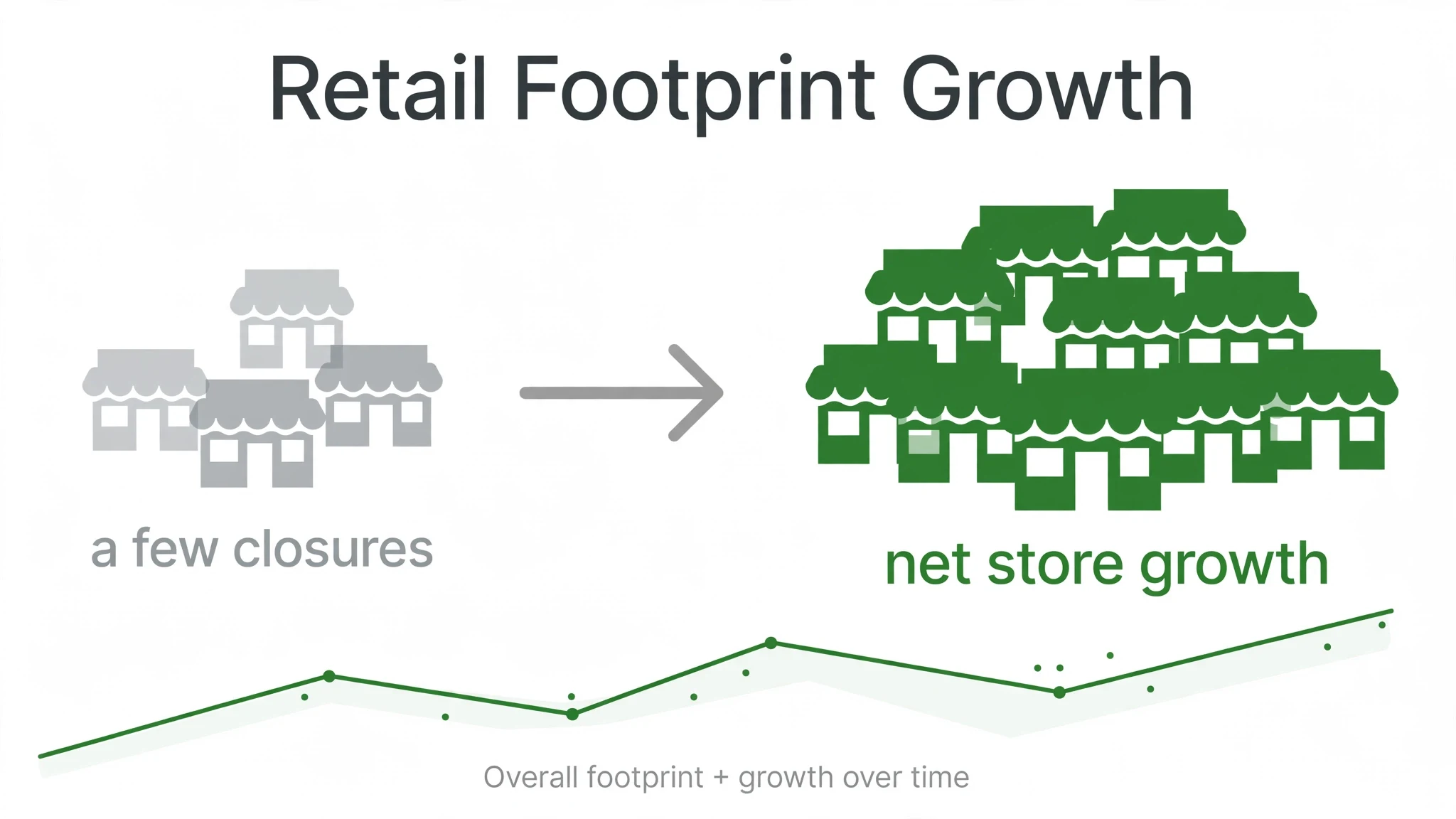
Here is the uncomfortable truth of the TJ Maxx closing stores news cycle: the company opened a net 21 more US stores than it started the year with, raised its global target to 7,500 locations, and posted what was reported as 34 consecutive years of comparable sales growth — and the dominant search trend was still “tj maxx closing.” Good news doesn’t travel unless marketing carries it.
The retail marketing lesson: whenever you prune, plant loudly. Every closure should be paired with visible expansion news, because the human brain (and the news algorithm) weights losses heavier than gains. A few practical plays:
– Publish your openings with the same energy as your closings get. Grand openings, hiring announcements, “now open” social content, local press outreach — make the growth story louder than the TJ Maxx closing chatter. TJX’s official store information listed new openings and relocations scheduled for September and October 2026; that information existed, but it wasn’t the story anyone told. – Put the numbers in your owned channels. A simple “2026: 4 locations refined, 25+ opened, 21 net new stores” graphic on your newsroom page gives every reporter — and every curious searcher — the context that listicles skip. Owned media is the only media you control completely. – Celebrate formats, not just counts. TJX’s move into smaller formats for dense urban areas and secondary markets is genuinely interesting — it’s a strategy story, not just a numbers story. “How we’re designing stores for city neighborhoods” is content marketing; “we closed 4 stores” is damage control. Lead with the interesting one. – Arm your advocates. Employees, landlords, and local chambers of commerce will repeat whatever narrative is simplest. Give them the growth version: one slide, one paragraph, one stat. When the Boston closure broke, the TJ Maxx closing response line — “other TJ Maxx stores in the Boston area remain available” — did quiet, effective work — every article carried it.
Growth marketing isn’t just about acquiring customers; it’s about making sure your growth is the story people tell about you. If you’re expanding while the internet talks about your closures, your expansion marketing has a volume problem.
Lesson 7: Build Owned Content for “Your Brand + Closing” Searches
The most forward-looking lesson from the TJ Maxx closing stores spike is an SEO one. Over 100,000 people searched a variation of “is TJ Maxx closing.” What ranked? Third-party listicles, rumor sites, and aggregator pages — most of them monetized with ads, none of them accountable to the brand. TJX had no owned page designed to answer that exact question.
Every established brand should own the “[brand] + closing / shutting down / going out of business” search result — because one day, someone will search it. The retail marketing lesson: build the “no, we’re fine, here’s what’s actually happening” page before you need it:
– A living store-status page. A single, always-current page on your domain listing recent openings, relocations, and closures with dates and reasons. When the rumor spike hits, this page is your SEO anchor — and it’s the link your social team, PR team, and customer service team all share. – FAQ content that matches the query. “Is [brand] closing stores?” “Why did the [city] location close?” “Where is the nearest open store?” These are real questions with real search volume during a news cycle. Answer them in plain language on your own domain and you capture the traffic that’s currently going to rumor mills. – Schema and freshness. Keep the page updated and use proper structured data so Google can feature your answer directly. A last-updated date of “this week” beats a listicle from last quarter. – Don’t stop at closures. The same owned-content logic applies to recalls, executive changes, pricing rumors, and acquisition gossip. The brands that rank for their own controversies are the brands that prepared for them.
This is search marketing as reputation insurance. Most SEO programs chase commercial keywords; the smart ones also defend the brand’s name against the questions people ask when they’re worried. The TJ Maxx closing stores trend is a free case study in why that defense matters — 100,000 searches is an audience, and right now that audience belongs to whoever published fastest, not whoever knew most.
The Bottom Line
The TJ Maxx closing stores stories of 2026 were never really about a retailer in trouble. They were about what happens when routine business decisions collide with an attention economy that rewards alarm over accuracy — on the very day TJ Maxx closing searches spike: a net expansion of 21 stores became a “TJ Maxx closing stores” panic; relocations became “doomed locations” lists; and the brand’s growth story got buried under its own pruning.
For multi-location businesses, the seven lessons are a playbook for brand turnaround marketing: own the narrative before the headline owns you, treat every location’s digital footprint as a marketing asset, sell relocations as upgrades, redirect traffic deliberately, decide with data and show your work, make expansion the louder story, and build owned content for the searches you hope never trend. None of this requires a Fortune 500 budget — it requires a plan, a named owner, and the discipline to execute before the news cycle does it for you.
If your brand operates across multiple locations and you want the marketing infrastructure to match — location SEO, reputation management, and growth campaigns that make your expansion the story — talk to the team at KKeyQik. We help multi-location businesses turn operational changes into marketing momentum.
Frequently Asked Questions
No. A small number of individual TJ Maxx locations closed in 2026, but parent company TJX opened more stores than it closed — ending fiscal 2026 with 1,348 US TJ Maxx stores, up from 1,333. The closures were selective real-estate decisions, not a nationwide pullback.
Confirmed closures include the three-story store at 360 Newbury Street in Boston, the Ellsworth Place mall location in Silver Spring, Maryland, plus locations in Cumberland, Maryland and Gilbert, Arizona. Several other 2026 "closings" on the internet were actually store relocations to new addresses in the same market.
TJX described it as part of its ongoing review of real-estate strategy — a high-rent urban location where the economics no longer worked. A Massachusetts filing showed 117 workers affected, most of whom were offered transfers to nearby stores, and other TJ Maxx locations in the Boston area stayed open.
Nothing in the company's reported numbers points that way. TJX grew its US store count through 2026, operates more than 5,000 stores worldwide across its brands, and raised its long-term target to 7,500 locations. The "closing" headlines describe footprint pruning, not a business in retreat.
A closure is a permanent exit from a location; a relocation moves the store to a better address in the same market. In 2026, TJ Maxx relocated stores including Meriden, Connecticut (to Cheshire), Paramus, New Jersey, Charlotte, North Carolina, and Carolina, Puerto Rico — moves that are net positives for customers but were sometimes reported as closings.
Announce it early in plain, customer-first language: what is closing, why, where customers should go instead, and what is opening next. Publish the explanation on owned channels before rumors fill the vacuum, brief store staff with a one-paragraph version, and give every news outlet a single quotable statement.
Mark the location as permanently closed promptly, turn its website location page into a "this location has moved/closed — here are your nearest stores" page with directions, and audit directory listings quarterly. Leaving a dead listing active sends customers to a dark storefront and wastes organic and paid traffic.
Run a traffic-migration plan: email and SMS the closed store's customers with nearest locations and drive times, hand off its social followers to the main account or nearest store page, pause location-targeted ads for the closed store, and make the store locator return the nearest open stores with clear labeling.
Footprint rebalancing. Chains use foot-traffic data, trade-area overlap, and lease economics to prune expensive or underperforming locations while opening better formats in stronger markets. TJX, for example, has leaned into smaller store formats for dense urban areas and secondary markets — strategy, not distress.
Build a living store-status page on the company's own domain that answers "is [brand] closing?" in plain language, keep it current with dates and reasons, and support it with FAQ content that matches the exact queries people search. During a rumor spike, that owned page becomes the SEO anchor every reporter, employee, and customer shares.