

Introduction
If your advertising felt more expensive in the last few weeks, you are not imagining it, and your campaigns are probably not broken. Election week advertising costs rise for a reason that has nothing to do with the quality of your creative or the skill of the person managing your account. A very large, very urgent buyer has entered the same auctions you use, with a deadline that cannot move. The midterm elections take place on Tuesday, November 3, 2026, and the final days before polling day are among the most crowded moments in the American advertising calendar. For a small business heading into the holiday season, election week advertising costs matter: the same weeks when you need to reach gift buyers are the weeks when political campaigns are buying as much attention as they can.
Search behaviour confirms the moment. On November 1, Google Trends in the United States showed “where to vote” as an active, fast-rising search, up 800 percent, alongside the first stirrings of “black friday 2026” searches. Voters are looking for practical polling information, shoppers are beginning to look for holiday deals, and advertisers of every kind are competing for the same screens. That is the setting for election week advertising costs in 2026, and it rewards a different kind of plan from the one that works in a quiet month.
The scale of the political buying is the first thing to understand. AdImpact projects about 11.6 billion dollars in political advertising across the 2025-2026 election cycle, a figure that would pass both the previous midterm record and the last presidential cycle. Roughly half of that money is expected to go to broadcast television, with connected television taking a fast-growing share of around 2.6 to 2.7 billion dollars, and digital platforms including Meta and Google accounting for about 1.6 billion dollars. These are projections, not final spending totals, but they explain why the auction feels different right now. When a buyer with a fixed deadline and a national footprint enters a local market, the price of attention moves, and smaller advertisers feel that movement first.
The pressure is not evenly spread. Political spending concentrates in states and media markets with competitive races, and reporting on this cycle names Texas, Wisconsin, Michigan, Maine, Pennsylvania, Iowa and Ohio among the places where demand has intensified. In some targeted markets, premium connected television CPMs – the cost per thousand impressions – have climbed from around 34 or 35 dollars to 43 dollars. Linear television CPMs in Texas have been reported up by 10 to 15 percent on typical buys, with some programming commanding increases of 30 to 50 percent. On Meta, the company’s own average price per ad rose 12 percent year over year in both the first and second quarters of 2026, a rise that lands on top of the normal fourth-quarter climb as retailers crowd in for the holidays. None of this means every small business will see the same increase. It means the market you buy in has changed, and your plan should change with it.
This post explains election week advertising costs in plain language, then gives you seven practical moves you can use this week. The goal is not to help you outspend a political campaign. You cannot, and you should not try. The goal is to protect your holiday sales, keep your cost per customer under control, and arrive on the other side of November 3 with your audience, your creative and your budget intact. Each move ends with a concrete action, and the final section turns the seven moves into a short checklist you can run before you touch another campaign setting.
What Is Actually Happening in the Auction
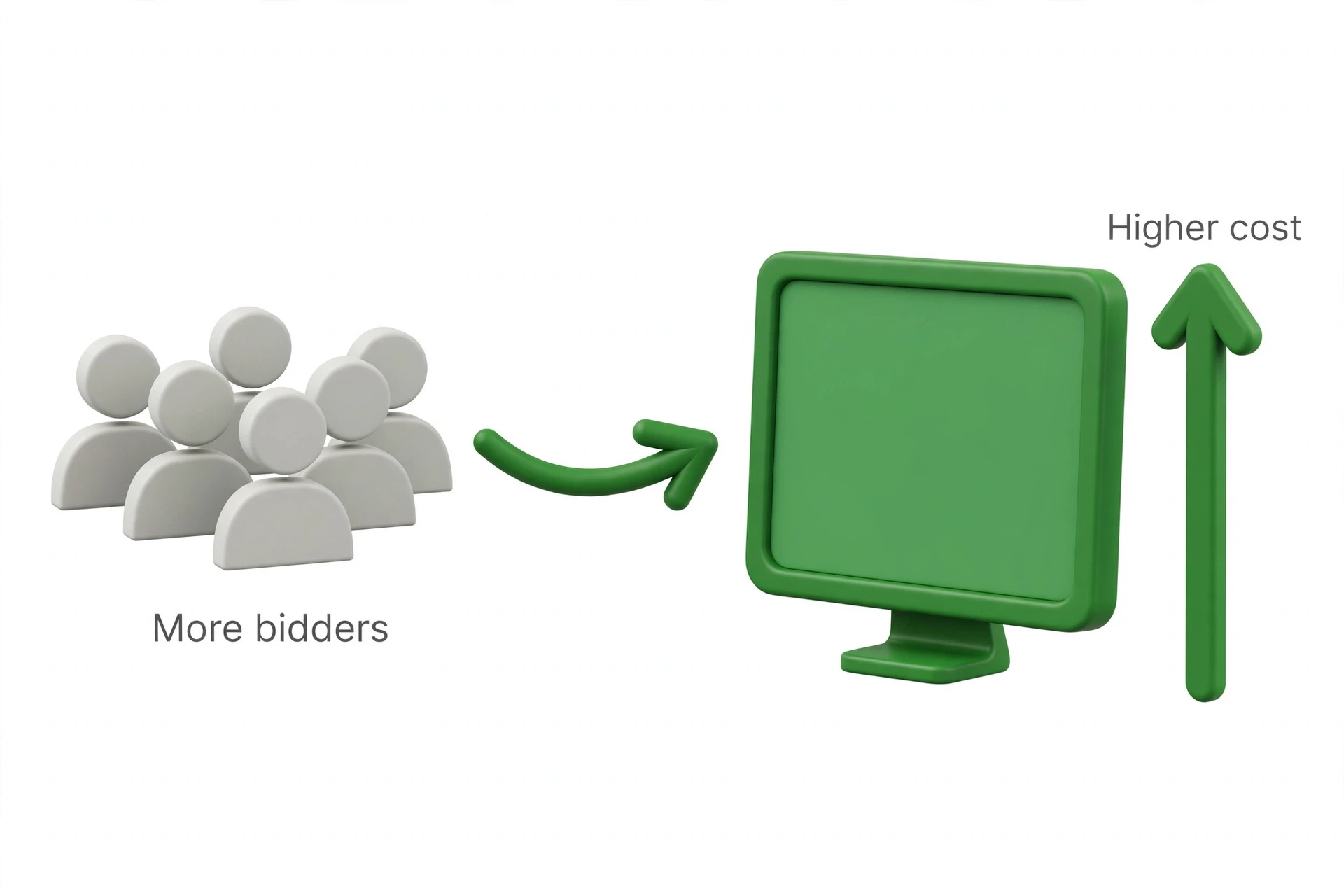
Election week advertising costs start in the auction. Advertising on Meta, Google, YouTube and connected television is sold in auctions. When you run an ad, you are bidding, in real time, against everyone else who wants to reach a similar person at a similar moment. Most of the year, your competitors are other businesses. In the final weeks before an election, a second class of buyer joins the auction: campaigns and political action committees that must reach voters before a date that cannot be postponed. They are not trying to sell a product, and they are not optimising for return on advertising spend in the way a retailer does. They are trying to win attention before Tuesday, and they will pay what the market asks.
That distinction explains several symptoms small advertisers report when election week advertising costs spike. Your CPM rises even though you changed nothing. Your cost per click creeps up while your click-through rate stays roughly steady. Your reach becomes less predictable, with some days delivering well and others stalling. You may even find a placement displaced: on broadcast and some television inventory, a commercial spot can be pre-empted, with the advertiser typically receiving replacement inventory later. These are not signs that your account is failing. They are signs that demand for the same inventory has surged.
There is a second, quieter effect worth naming. Attention itself becomes scarcer. Feeds fill with political messages, news coverage intensifies, and users scroll past more content without engaging. A creative that performed well in September can look tired in late October, not because the creative changed, but because the feed around it changed. That is why the advice in this post keeps returning to the same idea: in election week, relevance and timing matter more than volume. A smaller number of well-targeted, well-timed messages will usually beat a larger number of generic ones bought at peak prices.
Geography sharpens the picture for election week advertising costs further. If your customers are concentrated in a market with a closely watched Senate, gubernatorial or House race, you are likely to feel the squeeze more sharply than a business selling nationally or in a less contested market. If your customers are spread across the country, your average costs may move less, but your performance may still become more volatile. The practical lesson is the same either way: do not judge this week against a quiet week. Judge it against your own baseline from before the political buying intensified, and look for movement in three numbers in particular – CPM, cost per click, and cost per acquisition. When all three move together, the market is usually the cause. When only one moves, the cause is more likely inside your own campaign, such as tired creative or an audience that is too narrow.
Move 1: Set an Election-Week Baseline Before You Change Anything
The most common mistake when election week advertising costs rise is to panic and change everything at once. A business sees CPM rise, pauses campaigns, rewrites headlines, shifts budgets and changes audiences in a single afternoon, and then has no way of knowing which change helped and which hurt. The fix is unglamorous but essential: write down your baseline before you touch a setting.
Pull your average CPM, cost per click, click-through rate, reach and cost per acquisition for the four weeks before political spending reached its final push. If you advertise on Meta, those numbers live in Ads Manager. If you advertise on Google, they live in your campaign reports. If you work with an agency, ask for a one-page summary. You do not need a complicated dashboard. You need a simple reference point, so that when someone says costs are up, you can answer the only question that matters: up compared with what, and by how much?
That baseline does two useful jobs. First, it stops you from mistaking a market-wide rise for a campaign failure, which is the error that leads to unnecessary creative rewrites and audience churn. Second, it gives you a trigger for action. Decide in advance what movement justifies a change: for example, a CPM rise of more than a quarter above baseline sustained for three days, or a cost per acquisition that stays above your break-even point for a week. A trigger written down in advance is far easier to follow than a feeling formed at midnight while staring at a dashboard.
Concrete action: Before the next campaign change, record your pre-election baseline for CPM, cost per click and cost per acquisition, and write down the threshold at which you will act. Share it with anyone else who touches the account, so a single bad day does not trigger a wholesale rebuild.
Move 2: Protect the Audiences You Already Own
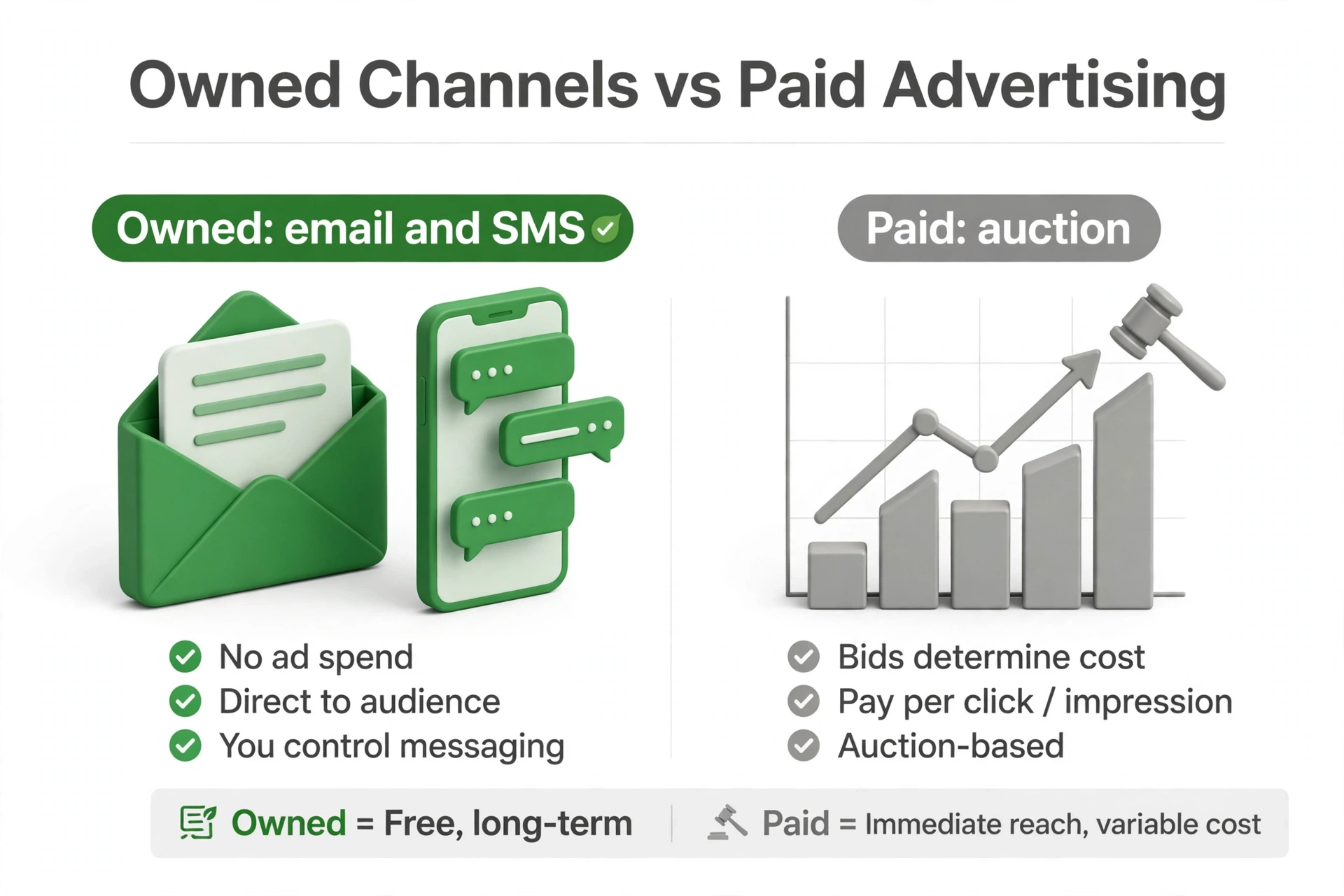
The single most useful response to election week advertising costs is also the cheapest: talk more to the people who already know you, and spend less trying to win strangers at peak prices. Email and text messaging do not require you to win an auction each time you contact a customer. Social media, by contrast, is rented attention: every impression must be bought again, and this week the rent has gone up.
That does not mean abandoning paid advertising. It means rebalancing it. Several small-business advisers quoted in holiday-season coverage this autumn make the same recommendation in different words: concentrate paid spending on retargeting – people who have visited your website, opened a previous message, or bought from you before – and let your owned channels carry the broader message for a few weeks. Retargeting audiences are smaller, but they convert at higher rates, which is exactly what you need when each impression costs more. A warm audience also forgives a slightly higher CPM, because the sale at the end of the click is more likely.
Owned channels need care, not volume. Inboxes are crowded right now, and a generic blast to your whole list is easy to ignore. Segment the list instead: recent buyers, repeat customers, people who browsed but did not purchase, and subscribers who have not opened a message in months each deserve a different message. A recent buyer might welcome early access to a holiday collection. A browser who abandoned a basket might need a reminder about delivery cut-offs. A lapsed subscriber might respond to a genuine story about what your business is doing this season, rather than another offer. Personal relevance is the advantage owned channels have over the auction; use it.
Concrete action: This week, send one segmented message to your existing customers – recent buyers first – with a genuinely useful piece of holiday information, such as a gift guide, a delivery deadline, or early access. Keep paid prospecting at its current level or lower until after November 3, and move the difference into retargeting.
Move 3: Shift Budget by Geography, Not by Gut Feeling
Election week advertising costs are local before they are national. A campaign targeting a contested state can face a very different auction from the same campaign targeting a quieter one. That makes geography one of the most practical levers you have, and one of the least used by small advertisers who set a campaign once and leave its location settings alone.
Start by breaking your results down by state or media market, if your platform allows it. Look for the places where CPM and cost per acquisition have risen most sharply against your baseline. Those are the markets where political demand is biting hardest. You have three sensible options for those markets, and the right one depends on your margins. You can hold spending steady and accept a higher cost per customer for a few days, if the sale is still profitable. You can reduce spending in the hottest markets and reallocate it to quieter markets where the same budget buys more reach. Or you can pause prospecting in the hottest markets while keeping retargeting running, so you do not disappear entirely from customers who already know you.
What you should not do is cut spending everywhere equally, because that punishes the markets that are still efficient. Nor should you raise budgets everywhere to chase the same reach, because that is how a fixed budget buys fewer customers at higher prices. Geography lets you be selective, and selectivity is the whole game in a crowded auction.
There is a related point about placement. Some advertisers in this cycle have moved spending toward streaming services that do not accept political advertising, such as subscription video platforms, only to find that displaced commercial money has lifted prices there too. The lesson is not that any single placement is safe. It is that you should test a shift on a small share of budget first, measure the cost per acquisition, and only then scale what actually works for your business.
Concrete action: Break your last two weeks of results down by state or market, identify the two markets with the sharpest cost rises, and move a portion of prospecting budget from those markets into your best-performing quieter markets or into retargeting for one week. Measure before you scale.
Move 4: Refresh Creative for a Noisier Feed
When election week advertising costs climb and feeds get noisier, the creative that wins is rarely the loudest. It is the clearest. Political messages, news updates and holiday promotions are all competing for the same scroll, and users in that environment make faster judgements about what deserves their attention. A small business cannot out-shout that noise with budget. It can out-clarify it with a message that is instantly understood.
That has practical consequences for your ads this week. First, lead with the benefit, not the brand story. A headline that says what the customer gets, and for whom, will outperform a clever line that takes three seconds to decode. Second, vary your creative instead of running one ad harder. Meta’s own delivery system now leans heavily on creative variety to find buyers, and several media buyers this year have noted that more varied creative matters more than ever as audience settings become more automated. Three or four genuinely different ads for your best product – different hooks, different images, different opening lines – will usually teach you more than three or four near-identical versions of the same idea.
Third, check frequency. If the same person is seeing your ad more than two or three times in a week on a prospecting campaign, engagement tends to fall and costs tend to rise, because the platform reads low engagement as a weak ad. In a crowded week, that penalty arrives faster. Fresh creative, rotated regularly, is the simplest cure, and it costs far less than raising your bid to force a tired ad in front of more people.
Video deserves a particular mention here. Short, direct video that shows the product being used, or a real customer explaining a real result, tends to hold attention better than a static image with a long caption in a busy feed. You do not need a large production. A clear, well-lit phone video with a strong first three seconds can outperform a polished graphic that says nothing new. The point is not production value. It is clarity in the first moment, before the scroll continues.
Concrete action: Launch two fresh creative variations for your best-selling product this week, each leading with a different customer benefit, and cap prospecting frequency. Retire any ad whose click-through rate has fallen for two consecutive weeks.
Move 5: Use Search and Local Visibility While Social Auctions Are Hot
Not every channel is equally affected by election week advertising costs. Search advertising and local visibility behave differently from social feeds, because they respond to intent rather than interrupting a scroll. When someone searches for a product, a service, or a business near them, they are already looking. That intent is valuable in any week, and it becomes relatively more valuable when social auctions are crowded.
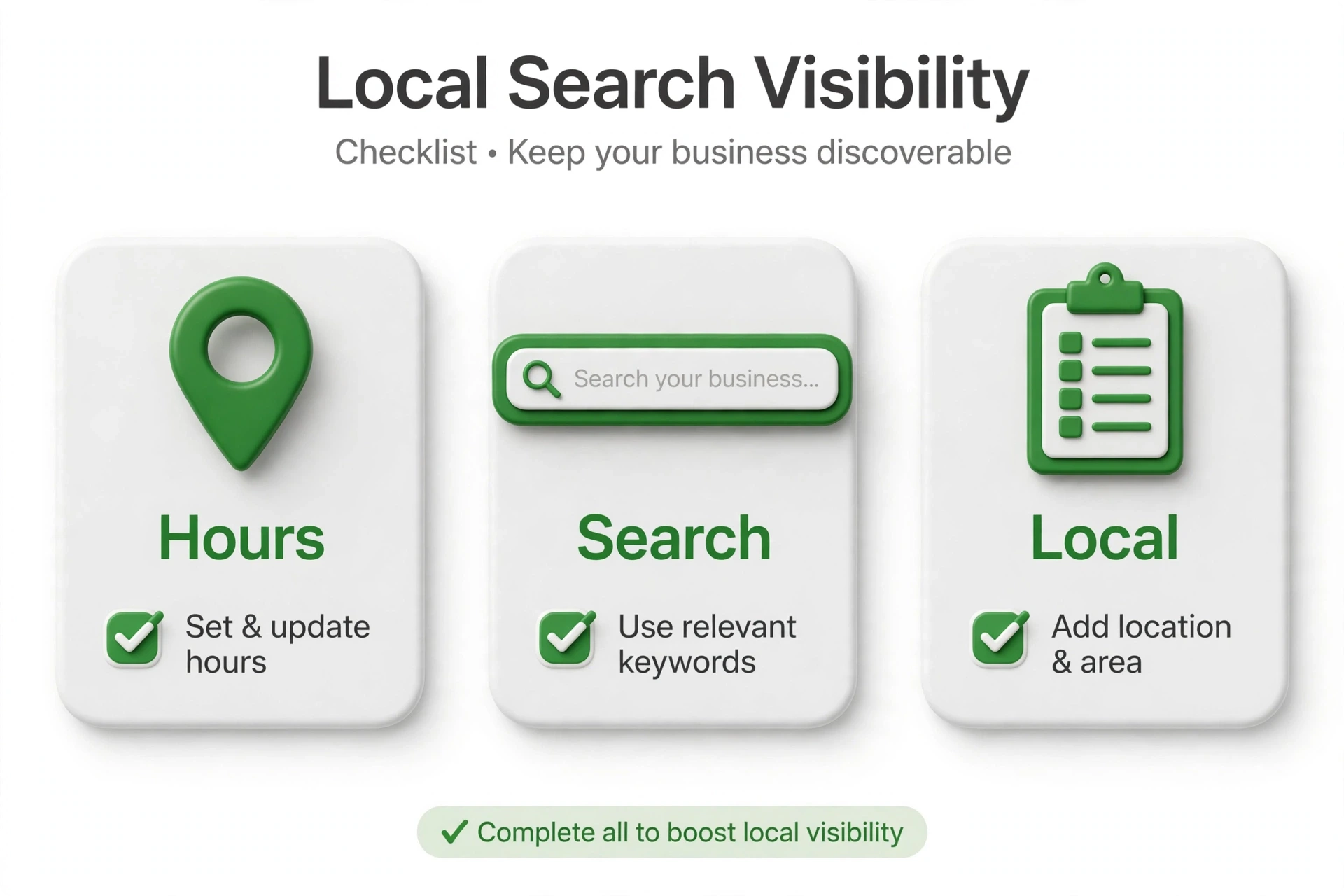
For a local business, this is the week to make sure the basics are flawless. Your Google Business Profile should show correct hours, an accurate address, a working phone number, and a short note about any holiday or seasonal change. Your website should answer the practical questions a holiday shopper asks: what you sell, how to buy it, when it arrives, and how to contact you. Your product and service pages should carry clear, descriptive titles and meta descriptions, because those are what searchers see before they click. None of this is glamorous, and none of it requires winning an auction. It is the kind of visibility that keeps working while auction prices move around it.
Search campaigns deserve the same discipline as social campaigns this week. Check which search terms are actually driving clicks, and whether any of them have become more expensive as political advertisers bid on overlapping audiences on Google and YouTube. Reporting this cycle notes political spending on Google reaching tens of millions of dollars in a single week in October, with the large majority of it on YouTube video. If election week advertising costs have pushed your search costs up, tighten your keyword targeting toward the terms closest to a purchase, and pause the broad, exploratory terms that were affordable in a quiet month but are not affordable now. Intent is your filter: the closer a search is to buying, the more it is worth paying for.
Concrete action: Audit your Google Business Profile and your top five landing pages today for accuracy and clarity, then tighten search campaigns to high-intent keywords for the next two weeks. Let broad discovery wait until the auction cools.
Move 6: Have Your Holiday Campaigns Ready Before the Auction Cools
One of the most consistent pieces of advice from small-business advisers this autumn is also the easiest to overlook: prepare your holiday campaigns now, so they can launch the moment the election passes. Election week advertising costs have a deadline behind them: political demand has a deadline. Commercial demand does not. The week after November 3, political buying falls away and inventory opens up again, often quite quickly. The businesses that benefit most from that opening are the ones whose campaigns are already built, approved and ready to switch on – not the ones still writing headlines in the second week of November.
Preparation means more than having a sale in mind. It means having the creative finished, the landing pages checked, the email and text sequences written, and the budgets agreed. It means knowing which offer goes to which audience, and what you will measure in the first three days after launch. A gift guide, a seasonal collection page, a customer-reward message for repeat buyers, and a clear delivery or collection deadline are all assets you can build this week, while prospecting is expensive, and deploy next week, when it is cheaper.
There is a second timing opportunity worth noting. Several media buyers this year have described a quieter window in late December and January, sometimes called Q5, when peak holiday CPMs ease and the same budget reaches further. If your product allows it, holding a portion of budget for that window – rather than spending everything at peak prices – can be a sensible way to extend the season. That is not a reason to go silent in November. It is a reason to plan the season as a sequence: owned channels and retargeting now, a full holiday push when the auction cools, and a measured follow-up in the quieter weeks after Christmas for customers you acquired during the peak.
Concrete action: Finish one complete holiday campaign this week – creative, landing page, email sequence and budget – and set its launch for the days immediately after November 3. Do not wait until the auction cools to start building it.
Move 7: Decide in Advance When to Go Dark, and When Not To
Going dark – pausing paid advertising entirely – is the most tempting response to election week advertising costs, and the one that needs the most careful thought. It protects the immediate budget, which is a real benefit for a small business with tight margins. It also sacrifices visibility at the exact moment customers are beginning their holiday shopping, and it can cost more to recover than it saved. Audiences cool, delivery systems lose recent learning, and competitors who stayed visible capture the attention you vacated.
Reporting on this cycle suggests going dark remains a minority response among advertisers, and experienced buyers generally warn against it as a default. A better approach is to go dark selectively, if at all. Pause the campaigns that are genuinely unprofitable at current costs, and keep the campaigns that still make money, even if they make less than they did in September. Keep retargeting running, because losing touch with warm audiences is harder to reverse than pausing a cold prospecting campaign. And set a restart date in advance – for most businesses, the days after November 3 – so a pause does not drift into a month of silence.
If you do pause, use the pause productively. That is the week to fix landing pages, refresh creative, clean up your email list, and build the holiday campaign described in Move 6. A pause spent building is very different from a pause spent waiting. One returns you to the market stronger. The other returns you to the market behind.
Concrete action: If any campaign is unprofitable at current election-week costs, pause that campaign only, keep retargeting live, and write down its restart date. Never pause your entire presence without a restart plan.
What to Do the Week After November 3
The end of the election does not automatically restore normal election week advertising costs, but it does change the market in your favour. Political demand drops, inventory opens, and the advertisers who prepared during the squeeze can move first. Your first job in that week is to re-measure, not to assume. Compare your CPM, cost per click and cost per acquisition against the baseline you set in Move 1, and confirm that costs have actually eased in your markets before you scale budgets back up. National averages can hide local differences, and a market with a runoff or a recount may stay crowded longer than others.
Your second job is to launch the holiday campaign you prepared, in stages rather than all at once. Start with your owned channels and your warmest audiences, confirm that landing pages and fulfilment are handling the volume, and then expand prospecting as costs allow. Your third job is to protect your margins. Holiday discounting on top of peak advertising costs is how a busy season becomes an unprofitable one. Bundles, gift cards, early access for existing customers, and clear delivery deadlines can all create urgency without giving away the margin that pays for the advertising in the first place.
Finally, keep the record. Note which markets rose most, which creative held up best, and which channels carried you through the squeeze. That record is the most valuable asset this week produces, because the same pattern will return in the next election cycle. A business that learns its own election-week pattern once does not have to learn it again from scratch.
Five Mistakes to Avoid This Week
First, do not judge a campaign by a single day. Election-week performance is volatile by nature, and a single bad day can reflect a news event, a surge in political buying, or a platform fluctuation rather than a broken campaign. Look at three-day and seven-day trends before acting.
Second, do not compete on the same broad audiences as everyone else. Narrow, overlapping audiences force you to bid against yourself and against the market at the same time. Broader, cleaner audiences with varied creative usually deliver more efficiently, particularly when delivery systems are automated.
Third, do not send more messages simply because you are worried about being seen. Frequency without relevance is noise, and noise trains customers to ignore you. One useful message beats three generic ones, on email as surely as on social media.
Fourth, do not ignore your own numbers in favour of industry averages. A national CPM figure, however widely reported, tells you nothing about your market, your audience, or your margins. Your baseline is the only benchmark that should trigger a budget decision.
Fifth, do not make a political statement with your brand in an attempt to ride the news cycle. This post is about advertising costs, not about candidates or parties, and that restraint is deliberate. A small business that takes a partisan position to chase attention risks alienating a large share of its own customers for a short-lived spike. Stay focused on your customers, your products, and the practical help you can offer them this season. Neutral, useful marketing ages far better than reactive marketing.
Your Election-Week Checklist
Use this checklist before you change another setting. It gathers the seven moves into a single page you can work through in under an hour.
- Record your pre-election baseline for CPM, cost per click and cost per acquisition, and set a threshold for action.
- Send one segmented message to existing customers, recent buyers first, with genuinely useful holiday information.
- Break results down by market, and shift prospecting budget away from the hottest markets into quieter ones or retargeting.
- Launch two fresh creative variations for your best product, each leading with a different benefit, and retire tired ads.
- Audit your Google Business Profile and top landing pages, and tighten search campaigns to high-intent keywords.
- Finish one complete holiday campaign, ready to launch in the days after November 3.
- Pause only the campaigns that are unprofitable at current costs, keep retargeting live, and set a restart date.
Work through that list in order, and you will have done more in an hour than a week of reactive budget changes would achieve. Election week advertising costs are a market condition, not a verdict on your business. Markets move, auctions cool, and the businesses that plan through the squeeze are the ones best placed to benefit when the pressure lifts.
Conclusion
Election week advertising costs in 2026 are high for a clear, temporary reason: an enormous amount of political money is competing for the same attention small businesses need for the holidays, in the same weeks, with a deadline that cannot move. That pressure is real, it is concentrated in contested markets, and it is felt most sharply by the smallest advertisers. But it is also temporary, measurable, and manageable. Set a baseline, lean on the audiences you already own, spend selectively by geography, refresh your creative for a noisier feed, strengthen search and local visibility, prepare your holiday campaigns now, and pause selectively rather than disappearing entirely. Do those seven things, and you will reach the other side of November 3 with your budget, your audience, and your holiday season intact.
If rising advertising costs are eating into your holiday margins, or if you are unsure which of these moves matters most for your market, it is worth getting a clear view of your own numbers before the next budget decision. KKeyQik helps small businesses plan advertising that protects margins through crowded seasons, from search and social campaigns to the owned channels that keep working when auctions get expensive. Explore our SEO services for small business, our social media marketing services, and our video marketing services for small business to see how a planned, measured approach to advertising can carry your business through election week and into the holidays. For a closer look at how seasonal moments shape small-business results, see our recent posts on Halloween marketing lessons and Samsung News shutdown lessons on owned audiences.
Sources
These election week advertising costs sources informed the figures and reporting cited above.
- Google Trends US, Trending Now (active trends only, November 1, 2026)
- AdImpact 2025–2026 political advertising projection, via TalkMarkets
- Battleground CTV CPMs reaching $43, The Streaming Wars
- Midterm ads and CTV prices, PPC Land
- Election season effects for non-political advertisers, Avenue Agency
- Election cycles and Meta advertising, JumpFly
- Meta ad costs rising, Vanaxity
- Holiday retail sales and small-business readiness, Small Business & Entrepreneurship Council
- Why Meta ads CPM keeps rising, AdAdvisor
Frequently Asked Questions
Election week advertising costs rise because political campaigns enter the same advertising auctions small businesses use, with a fixed deadline of Election Day. That extra demand competes for the same impressions on Meta, Google, YouTube and connected television, which can push up CPMs, cost per click and cost per acquisition, especially in markets with competitive races.
The midterm elections take place on Tuesday, November 3, 2026. Advertising pressure is usually heaviest in the final weeks before polling day, and it tends to ease in the days after the election as political demand falls away and more inventory becomes available to ordinary advertisers.
AdImpact projects about 11.6 billion dollars in political advertising across the 2025–2026 election cycle, with roughly half expected for broadcast television, a fast-growing share for connected television, and about 1.6 billion dollars for digital platforms including Meta and Google. These are projections, not final totals, but they explain why auctions feel more crowded this autumn.
No. Costs vary by market, audience and channel. Businesses targeting states or media markets with closely watched races are more likely to see sharp rises, while businesses selling nationally or in less contested markets may see smaller changes or mainly more volatile performance. Your own baseline, not a national average, is the best guide to what has changed for you.
Pausing everything is rarely the best default. It protects the immediate budget but sacrifices visibility just as holiday shopping begins, and audiences and campaign learning can be harder to recover. A more selective approach is to pause only campaigns that are unprofitable at current costs, keep retargeting running, and set a restart date for the days after November 3.
Owned channels are the strongest alternative: email and text messaging reach people who already know your business without requiring you to win an auction for each impression. Search advertising and local visibility also help, because they respond to existing intent. Segmented, useful messages to existing customers usually perform better than generic blasts during a crowded week.
Compare CPM, cost per click and cost per acquisition against a baseline from before political spending intensified. When all three move together across an account, the market is usually the cause. When only one moves, or only one campaign is affected, the cause is more likely inside the campaign, such as tired creative, a narrow audience, or overlapping ad sets competing with each other.
Political spending concentrates in states and media markets with competitive races, so the auction in a contested market can look very different from the auction elsewhere. Breaking results down by state or market lets a business shift prospecting budget from the hottest markets into quieter ones or into retargeting, instead of cutting spending everywhere equally.
Prepare a complete holiday campaign in advance: finished creative, checked landing pages, written email and text sequences, and an agreed budget, ready to launch in the days after November 3. Businesses whose campaigns are ready when political demand falls can move first, while businesses still building at that point lose the opening week of the post-election window.
Lead with a clear customer benefit rather than a clever line, vary creative instead of running one ad harder, and watch frequency so the same person is not shown a prospecting ad too often. Short, direct video showing a product being used or a real customer result can hold attention better than a static image with a long caption in a busy feed.