


Updated: September 2026 · By the KKeyQik Team
The short answer: 3–5 quality posts per week on your primary platform, 1–2 on secondary platforms, and Stories whenever something real happens. That’s the cadence most small businesses can sustain without burning out — and sustainability beats intensity every time. A business posting three good posts weekly for a year will outperform one posting daily for a month and then going silent. Below is the platform-by-platform breakdown and the logic behind it. (For the full system posting frequency fits into, see our guide to social media marketing services.)
How often should business post on social media? It’s one of the most overthought questions in small business marketing. The algorithm doesn’t reward a magic number — it rewards consistency over time and content people actually engage with. Three posts a week that earn saves and comments will always beat seven posts a week that earn nothing. Frequency is a multiplier on quality, not a substitute for it.
Key takeaways
- Start with 3–5 posts per week on one primary platform. Master that before adding a second.
- Consistency beats volume: the same cadence every week for six months outperforms bursts followed by silence.
- Reels and short video earn the most reach per post in 2026 — if you can only make three posts, make them video.
- Stories don’t count toward your posting cadence — post them freely; they’re ephemeral and the algorithm treats them separately.
- The right social media posting frequency is the one you can sustain for a year. Pick a number, protect it, and increase only when the current cadence feels easy.
- Revisit how often to post on social media every quarter — your capacity and your audience both change.
- The short answer to how often should business post on social media: 3–5 quality posts weekly on your main platform, 1–2 elsewhere.
How Often Should Business Post on Social Media? Platform-by-Platform Guide (2026)

The honest answer to how often should business post on social media depends on the platform — each one has its own rhythm, audience expectations, and shelf life for content. Use this table as your starting business posting schedule, then adjust based on the quality check later in this guide:
| Platform | Sustainable cadence | What to post |
|---|---|---|
| 3–5 feed posts/week + Stories most days | Reels first, carousels second; Stories for behind-the-scenes | |
| 3–4 posts/week | Community content, events, offers — your existing customers live here | |
| TikTok | 3–7 short videos/week | Raw, trend-aware, entertaining — only if your audience is there |
| 2–3 posts/week | Insights, lessons, company news — B2B only, skip it otherwise | |
| YouTube / Shorts | 1–2 videos/week | Deeper how-tos and explainers; Shorts for discovery |
| X (Twitter) | 3–5 short posts/week | Opinions, updates, conversations — only if your industry talks there |
Two notes on the table. First, these are starting points, not targets — a sustainable 3 beats an aspirational 7 you abandon by February. Second, “feed posts” means permanent content; Stories, Lives, and community posts sit outside this cadence because the algorithms treat ephemeral and permanent content separately. That’s the framework for deciding how often should business post on social media without burning out.
How Many Times to Post on Instagram in 2026
Instagram deserves its own section because it’s where most small businesses wonder how many times to post on instagram — and where the answer matters most. When clients ask us how often should business post on social media, we tell them to start with Instagram and get it right there first.
The 2026 Instagram rhythm that works: 3–5 feed posts per week (at least half Reels), Stories on most days, and one Live per month if you can manage it. Reels earn the most non-follower reach per post; carousels earn the most saves; Stories keep you top-of-feed with existing followers. You need all three working together — Reels for discovery, carousels for depth, Stories for relationship. This is the cadence we recommend when clients ask how often should business post on social media for Instagram specifically.
What about posting daily on Instagram? For most small businesses, daily feed posting degrades quality within weeks — and on Instagram, quality decay is punished fast because ranking leans heavily on saves, shares, and watch time. Three excellent Reels a week will outperform seven mediocre ones. The exception: if you have a dedicated content person and a backlog of ideas, daily can work — but that’s a staffing decision, not a strategy. The question isn’t really how often should business post on social media — it’s whether each post earns its place.
Why Consistency Beats Volume
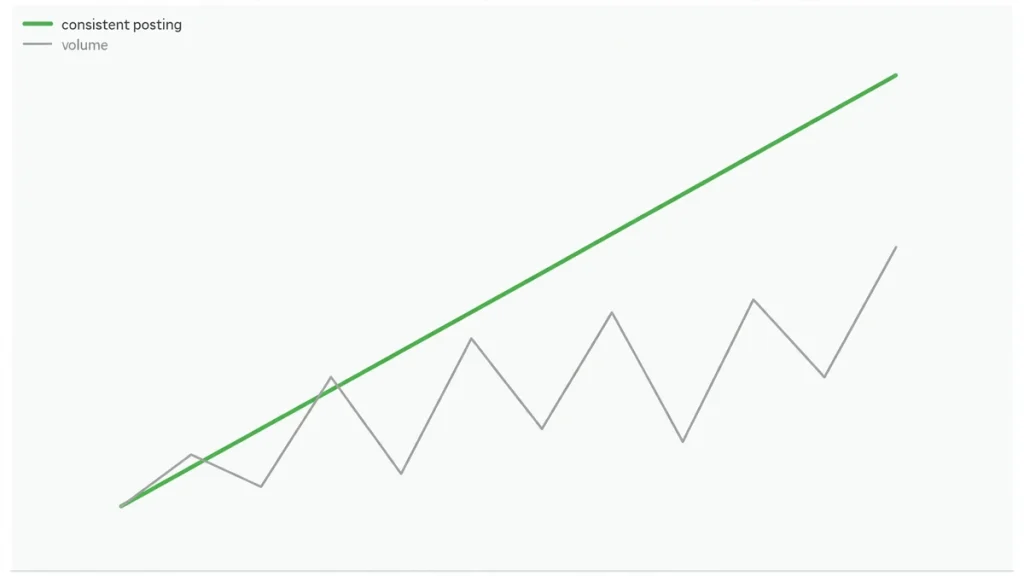
Every platform’s algorithm learns what to expect from your account. An account posting three times weekly for six months builds a predictable audience habit — followers learn when to look, and the algorithm learns who to show it to. An account posting fifteen times one week and zero the next teaches the algorithm nothing except unreliability. This is why how often should business post on social media is the wrong first question — the right one is how consistently you can show up.
There’s also a production reality: daily posting for a small team means cutting corners within weeks — stock photos, recycled quotes, filler. Your audience can tell, and they stop engaging. Engagement decay is how accounts die quietly: the posts keep going out, nobody sees them, and the owner concludes “social media doesn’t work.” What didn’t work was the unsustainable cadence. Sustainable always wins — which is the real lesson behind how often should business post on social media.
What the Platforms Say About Social Media Posting Frequency
So how often should business post on social media according to the platforms themselves? Meta’s guidance for business accounts consistently emphasizes regular posting and using scheduling tools to maintain it — the Meta Business Help Center documents how to schedule posts in advance so a busy week never breaks your streak. Instagram’s own Help Center explains how Reels distribution works and why accounts that post Reels consistently see more discovery.
The pattern across every platform’s official guidance is the same: they reward accounts that publish regularly and punish long silences, but none of them publish a magic number — because there isn’t one. The platforms want sustained, engaging output. Everything else is commentary. Treat any guru’s “post 11 times a day” advice with the skepticism it deserves, and check the official docs when the algorithm changes.
Choosing Your Business Posting Schedule in 5 Steps
Here’s how to answer how often should business post on social media for your specific situation — not in theory, but as a number you can commit to:
- Pick your primary platform — the one where your customers actually are. One platform done well beats three done badly.
- Start at 3 posts per week. This is the minimum viable cadence: enough to stay visible, light enough to keep quality high.
- Run it for 60 days without missing a week. If you can’t sustain 3, the problem is the system (batching, planning), not the number — fix the system first.
- Scale to 5 only when 3 feels easy. The jump from 3 to 5 should come from efficiency (batching, templates, repurposing), not from working more hours.
- Add a second platform only when the first runs on autopilot. Repurpose, don’t duplicate effort — one shoot feeds every platform.
Write your number down and treat it like an appointment. The businesses that win at social media posting frequency aren’t the ones with the highest number — they’re the ones that kept their number for a year. Answer how often should business post on social media once, commit for a year, and let compounding do the rest.
The Batching System Behind a Sustainable Business Posting Schedule
Once you’ve decided how often should business post on social media, the next question is how you’ll produce it all without drowning. The answer is batching: one content day per month that produces the entire month’s posts.
The system: one morning filming (all Reels and video in one session), one midday design block (carousels and graphics from templates), one afternoon writing and scheduling (captions plus scheduling in Meta Business Suite — free and native). Stories stay unscripted and real-time. If scheduling feels technical, the Meta Business Help Center’s scheduling guides walk through it step by step.
Batching is what makes a business posting schedule real instead of aspirational. Without it, “3 posts a week” means three weekly scrambles. With it, it means one focused day and 29 days of showing up automatically. That’s the real answer to how often should business post on social media: as often as your batching system allows without quality slipping.
Quality Check: Is Your Cadence Working?

Run this check monthly to audit how often should business post on social media for your accounts — and revisit how often to post on social media based on what the signals tell you, not on what you wish were true:
| Signal | What it means |
|---|---|
| Reach per post is stable or growing | Your cadence is sustainable and the algorithm trusts your account |
| Saves and shares per post are rising | Quality is holding at this volume — safe to consider increasing |
| Engagement per post is falling as you post more | You’re past your quality limit — cut back, don’t push through |
| You’re dreading content days | The cadence is unsustainable regardless of the numbers — reduce before you quit entirely |
Posting Frequency Mistakes That Quietly Kill Reach
Most wrong answers to how often should business post on social media come from these five mistakes:
- Copying a competitor’s volume. You see a rival posting daily and assume you must too — without seeing their team, budget, or engagement. Match your capacity, not their output.
- Counting Stories as posts. Stories are ephemeral and ranked separately; they don’t replace feed posts for discovery. Post Stories freely, but keep them outside your cadence math.
- Posting in bursts. Ten posts during a slow week and none during a busy one trains the algorithm to ignore you. Spread output evenly — scheduling tools exist for exactly this.
- Increasing frequency before fixing quality. If engagement per post is falling, more posts just means more ignored posts. Fix the content first, then consider the cadence.
- Treating every platform the same. LinkedIn twice a week can outperform Instagram daily for a B2B firm. The right social media posting frequency is platform-specific — that’s what the table above is for.
Ready to talk about your social media?
If you can’t remember the last time you posted — or you’re posting daily and hearing crickets — the fix is a sustainable system, not more effort. Contact the KKeyQik team to book a discovery call: we’ll look at your business, your audience, and your current posting, and talk through what a workable cadence could look like for you.
Further reading: our complete guide to social media marketing services — what’s included, how engagements are structured, and how to choose an agency.
About the KKeyQik Team
KKeyQik is a digital marketing agency helping small businesses grow with SEO, social media marketing, PPC (Google Ads and Meta Ads), web development, video editing, and graphic design. The KKeyQik Team publishes practical, no-fluff guides for business owners who want marketing that pays for itself.
Frequently Asked Questions
Three quality posts per week on one primary platform is the minimum viable cadence: enough to stay visible, light enough to keep quality high. Run it for 60 days without missing a week before considering more. If you cannot sustain three, fix the system — batching and planning — not the number.
A predictable rhythm can help your audience build a habit around your content, though no schedule guarantees extra reach on its own. What matters more is showing up reliably week after week with content people engage with. Pick times you can protect consistently rather than chasing a perfect slot.
Batch production: one filming day, one design block, and one writing-and-scheduling session per month. Templates and repurposing stretch one shoot across platforms. The moment production starts relying on stock photos and recycled quotes, your cadence has outgrown your system — scale back or fix the workflow.
One Live per month is a reasonable add-on once your feed cadence runs smoothly. Lives deepen relationships with existing followers rather than driving discovery, so treat them as a loyalty tool. Don't add Live until your three-to-five weekly feed posts feel easy to sustain.
Feed posts and Reels are permanent and drive discovery; Stories are ephemeral and keep you visible to existing followers. Use Reels for reaching new people, carousels and feed posts for depth, and Stories for behind-the-scenes moments and polls. Keep Stories outside your cadence math — post them freely whenever something real happens.
Watch for quality decay: stock photos replacing real creative, recycled quotes, filler posts — and engagement per post falling as volume rises. Another signal is dreading content days. When these appear, cut back before you quit entirely; a smaller sustainable cadence beats an abandoned ambitious one.
Only if your industry actually talks there. X rewards opinions, updates, and conversation at three to five short posts per week — a very different muscle from visual platforms. For most local and B2C small businesses, the audience isn't there; for some B2B and media-adjacent niches, it's essential. Check where your customers make decisions before committing.
If discovery is the goal, short-form video tends to reach beyond your current followers. If depth and saves matter more, carousels let you teach something substantive. Many small businesses do best mixing both: video for reach, carousels for the ideas worth saving. Let your own analytics decide the mix after a quarter.
Quarterly. Your capacity changes (hiring, seasons, workload) and your audience changes too. Run the quality check each quarter: is reach per post stable, are saves and shares rising, and does the cadence still feel sustainable? Adjust one variable at a time so you know what caused the change.
Timing is a minor lever compared to consistency and content quality. The priority is picking a cadence you can protect for a year and keeping it steady. Once that habit is solid, your own analytics will show when your particular audience is active, which is a better guide than generic best-time charts.