

Updated: September 2026 · By the KKeyQik Team
Most small businesses don’t have an Instagram problem — they have a planning problem. Posting happens when someone remembers, content is whatever’s easiest that day, and a month later the feed looks like a yard sale. A 30-day content plan fixes that: one planning session, four content pillars, and every day accounted for before the month starts. Below is the exact template we use with clients — steal it wholesale. (For the full system this plan plugs into, see our guide to social media marketing services.) Most Instagram marketing for small business fails at the planning stage, not the posting stage — this template fixes the planning.
Instagram marketing for small business is the use of Instagram’s formats — Reels, carousels, Stories, and Lives — to attract local or niche audiences, build trust, and convert followers into customers. It works on consistency and relevance, not follower counts: a thousand local followers who buy beat a hundred thousand spectators every time.
Key takeaways
- Plan the month before it starts — 30 days of content decided in one 2-hour session beats 30 daily scrambles.
- Four content pillars keep you balanced: educate, prove, humanize, convert. Every post should serve exactly one.
- Reels should be at least half your output in 2026 — they’re the only format still getting meaningful non-follower reach.
- Batch creation is the whole game: one shoot day, one design session, one scheduling session per month.
- Repurpose everything — one shoot should feed Reels, carousels, Stories, and your other platforms.
- Judge your Instagram marketing for small business on saves, shares, profile visits, and DMs — not on follower count.
The 4 Content Pillars of Instagram Marketing for Small Business
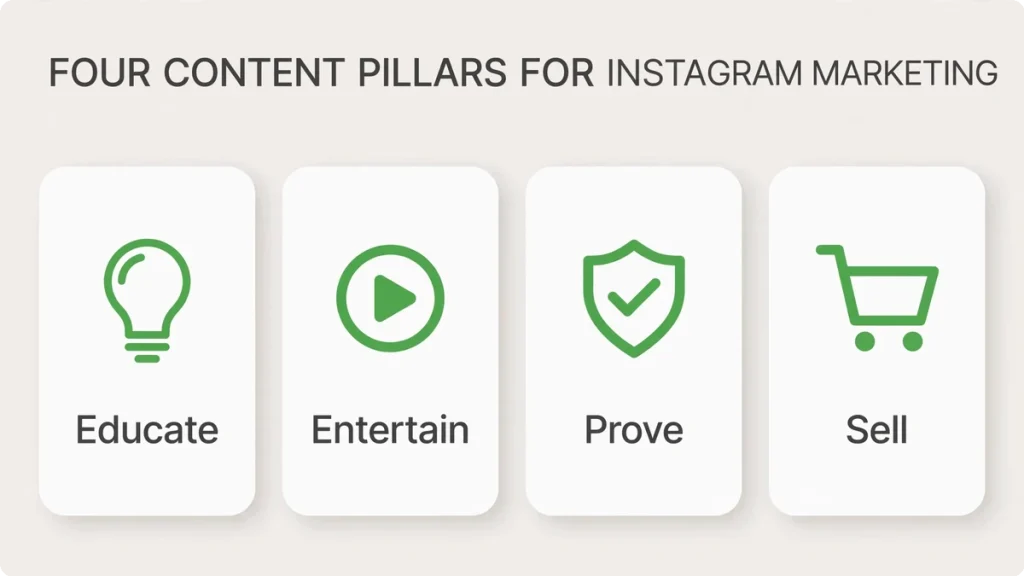
Small business Instagram strategy falls apart when every post is a guess. Pillars remove the guessing: assign one pillar to each post and the calendar fills itself. Here is what each pillar does for your Instagram marketing for small business:
- Educate. Teach something useful in 30 seconds: tips, how-tos, mistakes to avoid, myth-busting. This is your reach pillar — valuable content gets saved and shared, and saves are the strongest ranking signal on Reels. Aim for roughly 40% of your posts here.
- Prove. Proof you deliver: before/afters, client results, testimonials, process walkthroughs. This is your trust pillar — the content prospects check before they contact you. Collect proof constantly: a photo taken on the job today is next month’s best-performing post.
- Humanize. The people behind the business: team introductions, day-in-the-life, bloopers, opinions. This is your connection pillar — people buy from people, especially locally. You don’t need polish here; you need honesty.
- Convert. Direct offers: promotions, new services, booking reminders, limited availability. This is your revenue pillar — and it should be the smallest, roughly 1 in 5 posts. A feed that’s all offers is a feed nobody follows.
The 30-Day Content Plan Template
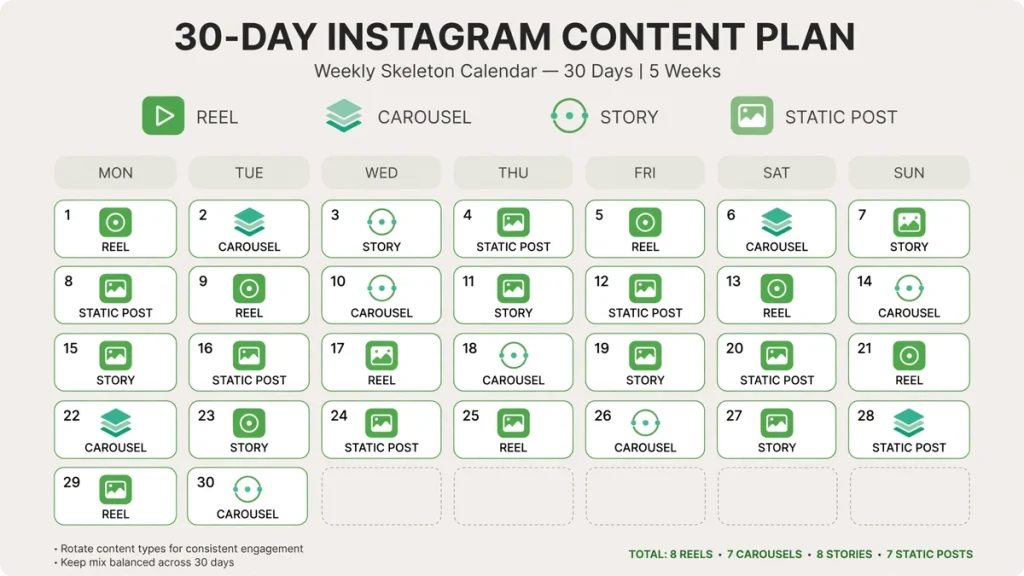
The rhythm: 5 posts per week (3 Reels, 1 carousel, 1 static or Story-highlight-worthy post), rotating through the pillars. This cadence keeps Instagram marketing for small business sustainable — frequent enough to grow, light enough to maintain alongside running the business. Here’s the weekly skeleton — repeat it four times with fresh topics:
| Day | Format | Pillar | Example topic |
|---|---|---|---|
| Monday | Reel | Educate | “3 mistakes people make when [your service]” |
| Tuesday | Stories (3–5 frames) | Humanize | Behind the scenes of today’s work |
| Wednesday | Carousel | Educate | “5 things to check before hiring a [your trade]” — swipeable checklist |
| Thursday | Reel | Prove | Before/after of this week’s job with a quick voiceover |
| Friday | Static post or Reel | Convert / Humanize (alternate) | Week A: limited booking slots for next week. Week B: team member spotlight. |
Fill a month by brainstorming 6 topics per pillar (24 total) in your planning session — that covers four weeks with room to swap. Keep a running “content ideas” note on your phone; the best topics come from real customer questions. When a customer asks you the same thing twice, that’s next week’s Educate post. That phone note is the unsung hero of Instagram marketing for small business — real customer language beats brainstormed topics every time.
Week by Week: Your First Instagram 30 Day Content Plan
The skeleton above tells you what to post; this is how a real first month unfolds. The goal of Instagram marketing for small business in month one isn’t virality — it’s proving you can show up consistently. Give each week a theme so the month feels intentional rather than random:
- Week 1 — Foundations. Introduce the business, the team, and the problem you solve. Two Educate posts answer the questions new followers always ask; one Prove post shows a recent result; one Humanize post puts faces to the name.
- Week 2 — Proof. Lean into results: before/afters, a short client-testimonial Reel, a carousel breaking down your process step by step. This is the week a skeptical visitor decides you’re legitimate.
- Week 3 — Personality. Show the humans: day-in-the-life Stories, a team-member spotlight, your take on a common industry myth. Connection content earns comments, and comments tell the algorithm people care.
- Week 4 — Conversion. Now that the grid proves you’re good at what you do, make the ask: limited availability, a seasonal offer, a clear booking reminder. One confident Convert post outperforms four shy ones.
After week 4, audit the month: which pillar earned the most saves? Which Reel pulled non-follower reach? Double down on what worked and drop one format that flopped. That monthly review is what turns an Instagram content plan from a calendar into a growth system — and it’s the habit that separates Instagram marketing for small business that compounds from posting that just fills time.
How to Batch a Month of Content in One Day
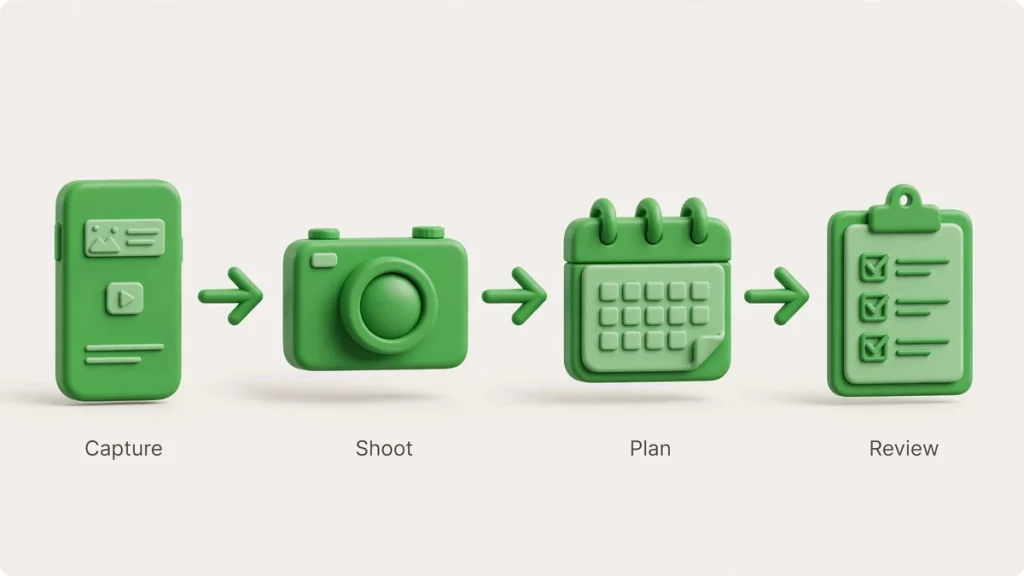
Batching is the difference between an Instagram content plan you keep and one you abandon by week two — and it’s the highest-leverage habit in Instagram marketing for small business. One focused day a month produces everything:
- Morning — shoot. Film all 12 Reels back-to-back in one location with outfit changes between batches. Talking-head tips, before/afters, and process clips all come from the same session. Frame everything slightly wider than you need so you can re-crop for different formats later.
- Midday — design. Build all 4 carousels from one template in your brand fonts and colors. Consistency here is what makes the grid look professional. Export a few slides as standalone statics for weeks when you’re short on Reels.
- Afternoon — write and schedule. Captions follow a simple formula: hook (first line), value, call to action. Schedule everything in Meta Business Suite — free, native, and it posts Reels, carousels, and Stories. If you get stuck, the Meta Business Help Center’s scheduling guides walk through each step.
- Ongoing — Stories stay live and unscripted. Stories are the one format you don’t batch: film the real day as it happens, 3–5 frames, polls and question stickers included. For Instagram marketing for small business, Stories are where followers become familiar enough to buy.
Tools That Keep Your Instagram Content Plan Running
You don’t need a marketing stack — you need three things. First, a scheduler: Meta Business Suite is free and posts every format natively, so there’s no reason to pay for scheduling software until you’re running multiple accounts.
Second, a content-ideas note on your phone, shared with anyone customer-facing — the front desk hears better content ideas in a day than a brainstorm produces in a month.
Third, a repurposing habit: every Reel becomes a carousel (key frames as slides, script as text), every carousel becomes 3–5 Story frames, and the best of both get adapted for your other platforms. One hour of raw material should yield a week of output.
When platform features change, check the Instagram Help Center rather than guru threads — the official docs are the only source that updates when the product does. None of this requires budget, which is the point: Instagram marketing for small business should run on systems, not spending.
Caption Formula That Works on Every Post
Captions don’t need to be clever — they need to be complete. This three-part formula works on every post in your Instagram content plan:
| Line | Job | Example |
|---|---|---|
| 1 — Hook | Stop the scroll; make the value obvious | “Your [service] is probably overpriced if…” |
| 2–4 — Value | Deliver what the hook promised, fast | The three checks / the quick explanation |
| Last — CTA | One action: save, comment, DM, or book | “Save this for when you need it — or DM us ‘QUOTE’ and we’ll price your job.” |
Two refinements lift results. Put the words your customer would search — your service plus your area — in the first line when it fits naturally, and end Educate posts with “save this”: saves are the engagement most correlated with reach. For Convert posts, name the next step and the deadline — “DM ‘BOOK’ by Friday, three slots left next week” beats “link in bio” every time. Small detail, big difference in Instagram marketing for small business.
Instagram SEO: Help Customers Find Your Small Business
Instagram now works like a search engine — people search it for local services the way they search Google. A few one-time setup steps make your Instagram marketing for small business discoverable:
- Name field, not just username. Your profile’s name field is searchable — “Bright Smile Dental | Austin TX” beats a clever tagline nobody searches for.
- Keyword in bio. One plain-English line saying what you do and where: “Family-run bakery in Ghaziabad — custom cakes, same-week delivery.” Skip hashtags in the bio; they add no search value there.
- Keywords in captions. Write captions the way customers talk: “How we deep-clean a 3BHK in Indirapuram” matches searches that “transformation Tuesday ✨” never will.
- Alt text on images. Instagram lets you add alt text per image — describe the photo with your service and area. It helps accessibility and gives the algorithm more to work with.
- Geotag every post. Tag your city or neighborhood, not just your shop — people browse location tags when choosing local businesses.
These are set-and-forget: do them once and every post in your Instagram 30 day content plan benefits. Meta documents the current profile and search options in the Meta Business Help Center, worth a skim whenever Instagram ships a profile change.
What to Track (and What to Ignore)
Check these weekly — they tell you whether your Instagram marketing for small business is actually working:
- Reels non-follower reach — are you escaping your existing audience?
- Saves and shares per post — the two signals that predict growth.
- Profile visits and website taps — is content turning into interest?
- DMs and inquiries mentioning Instagram — the metric that actually pays.
Ignore for now: total follower count (vanity until the above move) and likes (the weakest signal on the platform). Run the review on the same day each week — ten minutes with a simple spreadsheet beats an hour of scrolling analytics. After a month, give your best organic format double the slots next month and cut the worst performer without sentimentality. That ten-minute weekly habit is the entire measurement system your Instagram marketing for small business needs.
6 Instagram Content Plan Mistakes That Waste Your Month
Most Instagram marketing for small business fails in one of six predictable ways — here’s how to dodge all of them:
- Posting offers before proof. A new visitor who sees three promos and zero results has no reason to trust you. Earn the ask with Educate and Prove first.
- Batching everything, including Stories. Scheduled Stories feel like ads; real-time Stories feel like access. Keep Stories human.
- Changing the plan mid-month. One viral tip from a guru is not a reason to abandon your pillars. Finish the month, review the data, then adjust.
- Skipping the hook. The first caption line and the first second of the Reel decide everything. Write the hook before you film, not after.
- Posting and ghosting. Reply to every comment in the first hour. Early replies multiply comment counts, and comment velocity is a ranking input.
- No next step. Every post should make one action obvious — save, DM, comment, book. Content without a CTA is entertainment; you’re running a business.
Ready to talk about your social media?
If a month of content in one day sounds great but you don’t have the day — that’s exactly the kind of system we build. Contact the KKeyQik team to book a discovery call: tell us about your business and your Instagram, and we’ll walk through what a workable Instagram marketing for small business plan could look like for you.
Further reading: our complete guide to social media marketing services — what’s included, how engagements are structured, and how to choose an agency.
About the KKeyQik Team
KKeyQik is a digital marketing agency helping small businesses grow with SEO, social media marketing, PPC (Google Ads and Meta Ads), web development, video editing, and graphic design. The KKeyQik Team publishes practical, no-fluff guides for business owners who want marketing that pays for itself.
Frequently Asked Questions
Yes — shrink the skeleton rather than the system. Post one Educate Reel, one Prove post, and one Convert or Humanize post each week, and keep the weekly themes so the month still builds toward a goal. Consistency at a lower cadence beats a full schedule you abandon by week two.
Build an idea backlog during your planning session from real customer questions — every repeat question becomes an Educate post. Keep a running note on your phone and add to it through the month so week four is drawn from fresh material, not from scratch.
Reels are the only format still getting meaningful non-follower reach, which makes them your discovery engine. Carousels earn the most saves and Stories nurture existing followers, but neither brings in new audiences the way Reels do. Without Reels, your growth depends entirely on people who already follow you.
Skip it or file it under the closest pillar — forcing off-brand trends breaks the balance the pillars exist to protect. If a trend genuinely fits your audience, swap it in as one Educate or Humanize post, but keep the rest of the month's mix intact so one viral swing doesn't unbalance the plan.
Give each week a theme. Week one is Foundations: introduce the business, the team, and the problem you solve. Week two is Proof: lean into results and walk through your process. Week three is Personality: day-in-the-life content and your take on an industry myth. Week four is Conversion: now that the grid proves your competence, make the ask with one confident offer post.
Real customer questions are the best source. Brainstorm six topics per pillar in your planning session, then keep a running content-ideas note on your phone. When a customer asks you the same thing twice, that is next week's Educate post. Real customer language beats brainstormed topics every time.
Judge it on saves, shares, profile visits, and DMs, not on follower count. A thousand local followers who buy beat a hundred thousand spectators. After week four, audit the month: which pillar earned the most saves, and which Reel pulled non-follower reach? Double down on what worked.
A feed that is all offers is a feed nobody follows. The Educate, Prove, and Humanize pillars build the trust and attention that make the Convert posts work. One confident ask in week four outperforms four shy ones scattered across the month.
Reply quickly and visibly: acknowledge the issue, move the details to DMs, and post the resolution when it's fixed. Public handling of a complaint builds more trust than a hundred polished posts — and unanswered complaints cost you more than any production choice.
Run the monthly review that turns the calendar into a growth system. Identify which pillar earned the most saves, which format pulled the most non-follower reach, and drop one format that flopped. Then plan the next month with those lessons baked in. Compounding comes from iterating, not from repeating the same template blindly.