


Today, October 22, 2026, a courtroom goes quiet for the first time in 30 years — Judge Judy retires. Judy Justice airs its final episode, closing the on-camera television career of Judith Sheindlin — the Brooklyn-born jurist the world knows simply as Judge Judy.
The timing is almost cinematic. Yesterday, October 21, she celebrated her 84th birthday. Today, the gavel comes down one last time.
The numbers tell the story of a career with almost no parallel in television. Judge Judy premiered in September 1996 and ran for 25 seasons through 2021, routinely drawing nine to ten million viewers a day and standing as the highest-rated program in all of daytime television and first-run syndication from 2009 until its finale. She followed it with Judy Justice, which launched on streaming in November 2021 and ran four seasons on Amazon Freevee and Prime Video. Along the way she earned a place in the Guinness World Records as the longest-serving television arbitrator in courtroom programming history and a Lifetime Achievement Emmy. CBS marked the milestone with a 30th-anniversary special, Judge Judy: Unfiltered, Unforgettable, in September.
But this is not a nostalgia post. As Judge Judy retires, business owners and marketers are getting something rarer than a cultural moment: a complete, finished case study in personal branding. Thirty years of uninterrupted brand equity, built in public, with every decision visible in hindsight.
Consider what makes this case study so unusual. Most personal brands never get a clean ending — they fade, they get canceled, they dilute into irrelevance. Judge Judy retires on her own terms instead: she is closing a 30-year run on a high, with a Daytime Emmy pedigree, a streaming successor already proven across four seasons, and a succession plan already on the air. That is not luck. It is the result of branding decisions that compound, and every one of them is transferable to a business of any size.
Here are eight lessons your business can borrow from the way Judge Judy built — and, now that Judge Judy retires, is handing off — one of the most durable personal brands in media history.
1. Consistency Is Compounding
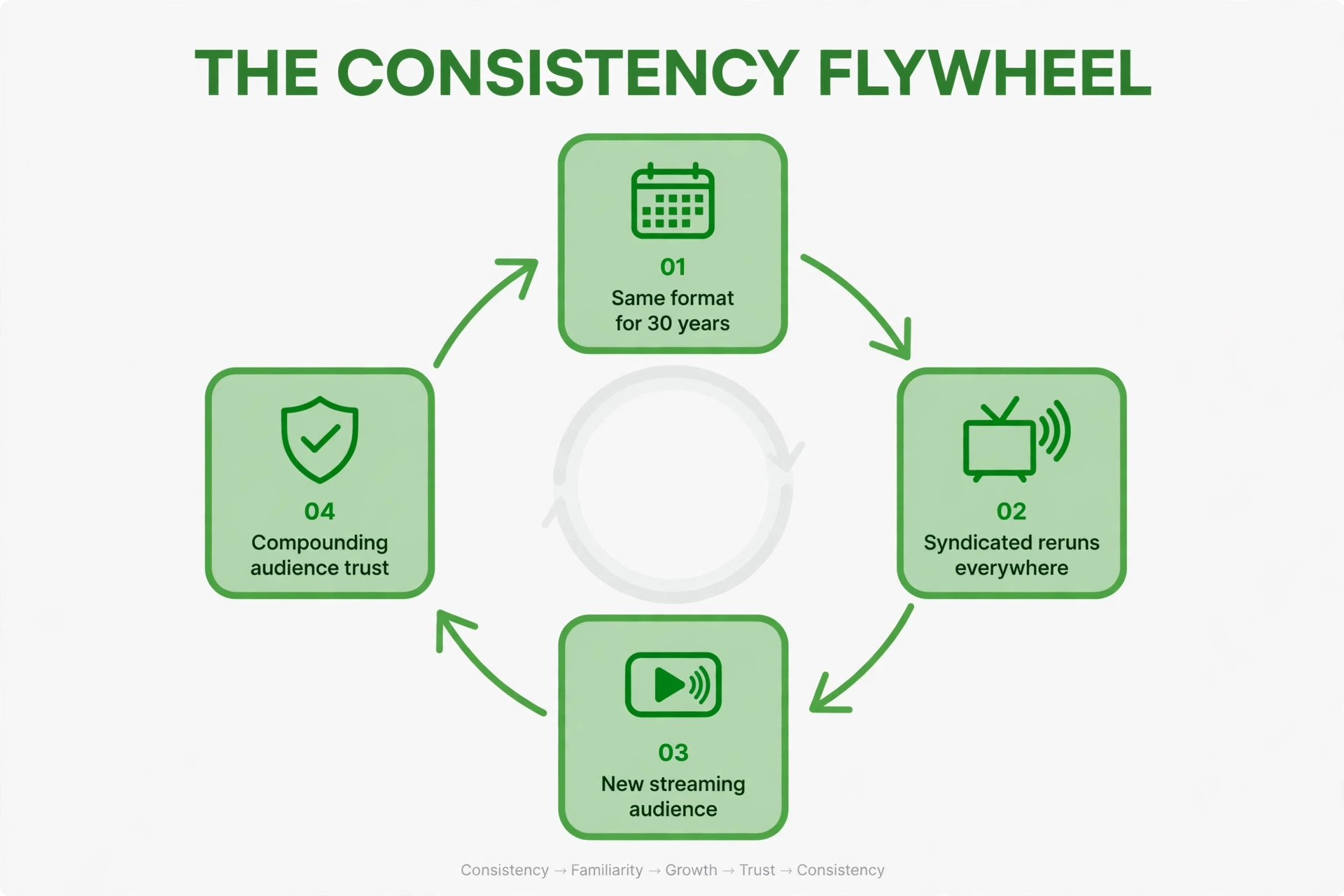
Ask anyone to describe Judge Judy and you will hear the same words, whether the person watched in 1998 or 2024: no-nonsense, rapid-fire, tough-talking, the lace collar, the withering stare, the ruling that arrives before the litigant finishes the sentence. That persona did not drift. Over 30 years, across two shows, two networks’ worth of distribution, and a full technological leap from broadcast syndication to streaming, the core product never wobbled.
That is not rigidity — it is strategy. In branding, consistency is what converts impressions into recognition, and recognition into trust. Every time a viewer tuned in, they received exactly the experience they were promised. Psychologists call this the familiarity effect; marketers should call it the cheapest growth lever in existence. It costs nothing to keep your message steady, and it costs everything to rebuild credibility after a confusing pivot.
Most businesses do the opposite. They rebrand their voice every quarter, chase every platform trend, and rewrite their homepage headline every time a competitor ships something new. The result is a brand that is always new and never known.
Long before Judge Judy retires, she understood what strong brand positioning requires: decide who you are, then repeat it until the market can repeat it back. Thirty years of the same promise, delivered the same way, is how a daytime show becomes a household institution. Your business does not need three decades to start — but it does need the discipline to stop changing its story.
2. Own a Lane So Narrow It Has Your Name on It
Judge Judy did not set out to be a general-purpose celebrity. She did not host a talk show, review movies, or sell lifestyle advice. She owned one sharply defined lane: small-claims disputes, adjudicated at speed, by a real judge. Everything about the brand — the set, the format, the bailiff, the pace — reinforced that single arena.
Niche domination is one of the most underused plays in small-business marketing. Founders fear that narrowing their focus will shrink their audience, so they market to everyone and resonate with no one. Judge Judy’s career proves the opposite arithmetic: a sharply defined niche creates sharper recall, and sharper recall expands the audience on its own. She never needed to be everything to everyone; she needed to be the unmistakable answer to one question.
For your business, the equivalent move is ruthless focus on the one problem you solve better than anyone else, for the one customer who feels it most acutely. Become the obvious choice in a small room before you try to fill a stadium. The room gets bigger on its own when the reputation is strong enough.
3. Make One Unmistakable Promise — and Keep It Every Episode
Every Judge Judy episode carried the same implicit contract with the viewer: real cases, real rulings, zero wasted time. No staged drama for its own sake, no meandering testimony, no soft landings for dishonest litigants. You knew, before the theme music ended, exactly what you were getting.
That clarity is the heart of personal branding. A brand is a promise plus proof, repeated until belief hardens into loyalty. Judge Judy’s promise was never “entertainment” in the abstract — it was a specific, repeatable experience, delivered thousands of times without deviation. When a brand’s promise is that legible, the audience does the marketing: they describe it to friends in a single sentence.
Too many businesses write their promise in fog. “Solutions for your needs.” “Quality you can trust.” These phrases promise nothing, so they deliver nothing memorable. Write down what a customer gets from you in one plain sentence. If you cannot, neither can they — and a promise nobody can repeat is a promise nobody will share.
4. Be Real Before You Try to Be Polished
Here is a detail that should embarrass every “personal brand” built on filters: Judge Judy was not a media personality who learned the law for television. She was a real judge first — appointed to New York City’s criminal court by Mayor Ed Koch in 1982, promoted to supervising judge of Manhattan’s family court in 1986 — and the cameras found her, not the other way around. She was 53 when Judge Judy premiered, with no interest in performing youth, trendiness, or relatability.
Her authority on screen came from genuine substance off screen. Viewers could feel that the rulings were real because the judge was real. The no-nonsense persona was not a character invented by producers; it was the same courtroom demeanor that had made her the subject of a Los Angeles Times profile years before television entered the picture.
The branding lesson is uncomfortable for an era of curated feeds: substance outperforms styling. Audiences are remarkably good at detecting performance. A business owner who has actually solved the problem — who can speak from scars, not scripts — carries a credibility that no production budget can manufacture. Invest in becoming excellent at what you do, and let the brand be the honest exterior of that excellence. Polish without substance is decoration; substance without polish still commands a room.

5. Let Earned Attention Arrive Before Paid Attention
Judge Judy’s television career did not begin with an advertising budget. It began with journalism. In February 1993, a Los Angeles Times profile spotlighted her as a reform-minded family court judge; that piece led to a segment on CBS’s 60 Minutes; the national exposure led to her first book; and the book led to the offer for a syndicated series in 1995. Earned media built the foundation, and only then did the machinery of distribution arrive.
Too many businesses invert this order. They spend on ads to rent attention before they have given the world a reason to pay attention voluntarily. Judge Judy’s path suggests a sturdier sequence: do something worth covering, become worth quoting, and let credible third parties introduce you to the public. A 60 Minutes segment is not a media buy — it is a verdict from a trusted source, and audiences treat it accordingly.
For a modern business, the equivalent of that 1993 newspaper profile is a social and content presence that gives journalists, podcasters, and industry voices something genuine to discover. Publish real expertise. Take clear positions. Be quotable. When third parties carry your story, it arrives with borrowed trust that no ad spend can replicate — and it keeps working long after the campaign budget runs dry.
6. Build a Distribution Flywheel That Outlives Any Single Release
One of the most telling data points of the Judge Judy era: when Judy Justice launched its first streaming season, the reruns of the original Judge Judy outperformed the new episodes. Think about what that means. Content she had already made — years earlier — was working harder than brand-new content. That is not a quirk of television; it is the purest definition of a distribution flywheel.
Her catalog was enormous, evergreen, and endlessly re-watchable: self-contained episodes, a consistent format, and a premise that never expired. Every new viewer who discovered a rerun became a potential viewer of everything else. The old work kept recruiting for the new work.
This is exactly how smart content marketing operates. A single great article, video, or guide — optimized to be found and re-shared — can keep generating attention years after publication, compounding while you sleep. Reruns are television’s version of evergreen SEO content: assets that rank, circulate, and convert on autopilot. Businesses that publish only disposable, time-sensitive content are running on a treadmill; businesses that build a library of durable assets own a flywheel. Judge Judy’s back catalog outperformed her new episodes because she had spent decades building inventory that never stopped working. Your marketing library should be designed with the same intent: create once, distribute forever.
7. Change the Container, Not the Core
In 2021, after 25 seasons of syndicated broadcast television, Judge Judy did something most legacy brands fail at: she moved platforms without losing herself. Judy Justice premiered on IMDb TV — later Amazon Freevee, now folded into Prime Video — making her courtroom show the first standard courtroom series to release new episodes exclusively through a streaming service, five years before Judge Judy retires. Same judge, same gavel, same verdicts. New container.
This is the discipline most businesses lack during a channel shift. When audiences migrate — from broadcast to streaming, from desktop to mobile, from feeds to short video — panicking brands reinvent their identity along with their format. They mistake the platform for the product. Sheindlin understood the distinction: the core was the promise (real cases, real rulings, her way); the container was merely where it was served.
Your brand will face its own container changes. The platforms where you acquire customers today will not be the platforms of 2030. The businesses that survive those migrations are the ones whose customers follow the brand, not the channel. Build loyalty to the promise, keep the format flexible, and you can move from any dying platform to the next one with your audience in tow.
8. Retire the Show — Never the Brand
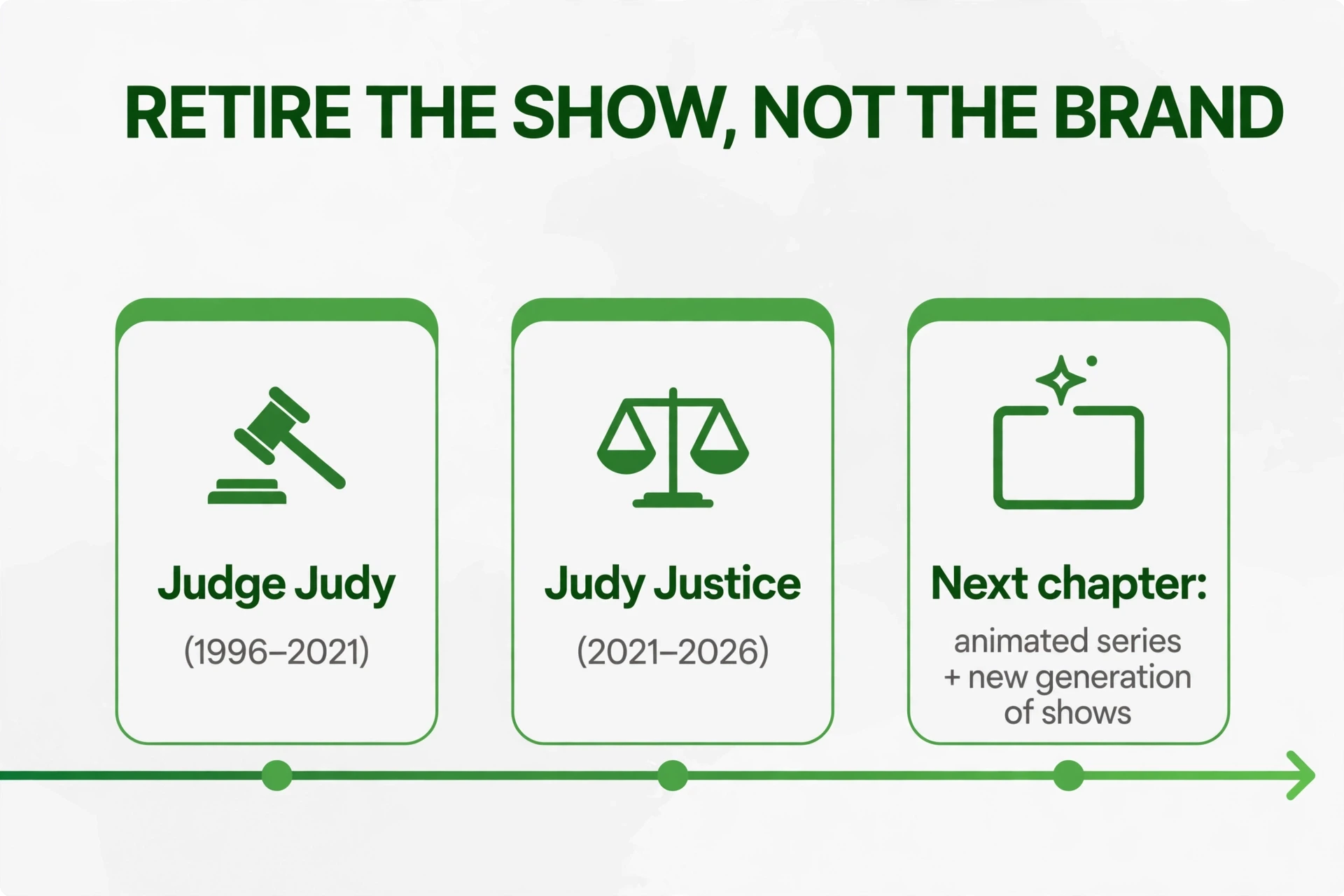
The most instructive move of this entire story is happening right now. As Judge Judy retires from the on-camera bench, she is not stepping away from the brand. Speaking to PEOPLE, she put it plainly: “I have a lot of other things of interest. I don’t want to do hair and makeup anymore, but I still want my message to get out there.” And on her legacy: “I don’t have to prove anything else. I did it.”
What follows — planned well before Judge Judy retires — is a masterclass in succession planning. She created and is producing Adam’s Law, a small-claims courtroom series fronted by her son Adam Levy — a former two-term district attorney of Putnam County — passing the format to a successor who carries both the family name and real legal credentials. In parallel, she is developing Judyverse, an adult animated series inspired by AI and internet video culture, featuring a tiny animated “Baby Judge Judy” — the same brand, translated into an entirely new medium for an entirely new generation.
Notice the architecture: as Judge Judy retires, the person steps back and the brand continues. Most founders make themselves the single point of failure in their business — the brand is their face, their calendar, their energy, and it collapsells the moment they step back. Judge Judy spent 30 years building an asset that is now bigger than her schedule. The format, the tone, the audience, and the trust can be carried forward by successors and new formats because she built a brand, not just a job.
Start designing your exit from day one. Document the voice, the standards, and the promise so clearly that someone else could carry them. A brand that requires your daily presence is a career; a brand that outlives your daily presence is an asset. Thirty years in, as Judge Judy retires, she is cashing the difference.
Put These Lessons to Work This Week
Reading about Judge Judy’s brand is pleasant; building one is profitable. Here is how to translate the eight lessons into four concrete moves you can make before next week:
- Write your one-sentence promise. If a customer asked a friend what you do, what would the friend say? Write that sentence down, test it on three people, and refine it until it is unmistakable. Then put it everywhere — homepage, profiles, email signature — and stop changing it.
- Audit your consistency. Pull up your last ten posts, ads, or emails. Do they sound like the same company? If the tone, colors, and message wander, pick one standard and lock it in. Consistency is free; inconsistency is expensive.
- Create one evergreen asset. Identify the single most useful thing you know — the guide, checklist, or explainer your customers always need — and publish it in a durable format. Optimize it to be found. Then point everything else back to it. This is your first rerun.
- Plan the succession of your expertise. Document your process, your standards, and your voice so that your team — or your future self — can carry the brand without you in the room. The goal is a business that grows even on the weeks you are not performing.
The Verdict: Your Brand Is the Longest Case You Will Ever Argue
Thirty years, two shows, one unmistakable promise — and a finale that is really a handoff. Now that Judge Judy retires, her career stands as proof that personal branding, done with discipline, is not vanity. It is infrastructure: the asset that makes every future move easier, from a platform change to a retirement.
The gavel falls today as Judge Judy retires. The brand endures. The question for your business is simpler than any case she ever heard: are you building something that lasts 30 years, or just filling this quarter’s calendar?
If you want a brand built with that kind of discipline — a clear promise, a defined niche, and content that keeps working long after it ships — talk to the team at KKeyQik. We build marketing systems designed to compound, not just campaigns designed to end.
Frequently Asked Questions
Yes. On September 9, 2026, Judith Sheindlin announced she would conclude her on-camera television career with the finale of Judy Justice, which aired October 22, 2026 — one day after her 84th birthday. She is stepping away from the on-camera courtroom bench after 30 years in television, but she is not leaving the industry: she remains active as a creator and producer on new projects.
Thirty years in total. Judge Judy ran for 25 seasons from September 1996 through July 2021 in broadcast syndication, and Judy Justice ran for four seasons from November 2021 through October 2026 on streaming platforms (IMDb TV, then Amazon Freevee, then Prime Video). The combined run makes her the longest-serving television arbitrator in courtroom programming history, a distinction recognized by Guinness World Records in 2015.
Sheindlin has said the decision was about life stage, not ratings. Speaking to PEOPLE, she explained: "I have a lot of other things of interest. I don't want to do hair and makeup anymore, but I still want my message to get out there." She also expressed contentment with her legacy, adding: "I don't have to prove anything else. I did it." The exit is deliberate and on her own terms.
She is moving behind the camera. Sheindlin is developing Judyverse, an adult animated series inspired by AI and internet video culture that features a tiny animated "Baby Judge Judy." She also created and is producing Adam's Law, a small-claims courtroom series fronted by her son Adam Levy, a former two-term district attorney of Putnam County. Both projects keep the brand alive in new formats.
She was a real judge with a full legal career. After earning her law degree from New York Law School in 1965, she worked as a prosecutor in New York City's family court starting in 1972. In 1982, Mayor Ed Koch appointed her a criminal court judge, and in 1986 she became the supervising judge of Manhattan's family court. A 1993 Los Angeles Times profile of her courtroom work led to a 60 Minutes segment, which led to the offer for her own show. She retired from the bench in 1996 when Judge Judy premiered.
Three things: an unchanging core promise (real cases, real rulings, no wasted time), total consistency over three decades (the same no-nonsense persona across two shows and two eras of television), and genuine authority (she was a real judge first, not a performer). Viewers always knew exactly what they would get, and she delivered it thousands of times without deviation. That reliability is what turned a daytime show into a household institution.
She separated her brand's core from its container. The promise — sharp, fast, honest adjudication — never changed, but the delivery evolved: from broadcast syndication to streaming with Judy Justice, the first standard courtroom series released exclusively on a streaming service. She also built a massive evergreen catalog; her reruns outperformed even new episodes at times, because the content never expired. Consistency at the core, flexibility at the edges.
The central lesson is that consistency compounds. Judge Judy decided who she was and repeated it until the market could repeat it back — 30 years of the same promise, delivered the same way. For a business, that means locking in one clear message, one tone, and one standard of delivery, then holding them steady across every channel. Rebranding your voice every quarter confuses customers; staying the course builds the kind of recognition that turns into trust and referrals.
Through earned attention, not paid promotion. Her television career began with a newspaper profile — the Los Angeles Times covered her courtroom work in 1993, which led to 60 Minutes, which led to a book, which led to the show offer. Credible third parties introduced her to the public, and that borrowed trust became her foundation. For businesses, the modern equivalent is publishing real expertise that journalists, podcasters, and industry voices want to quote and share.
Yes, and it is the most instructive part of the story. Adam's Law, created and produced by Sheindlin, hands the courtroom format to her son Adam Levy — who brings real legal credentials as a former district attorney — while Judyverse translates the brand into animation for a new generation. The person is retiring; the brand is continuing. For founders, the takeaway is to document your voice, standards, and promise so clearly that your business can thrive beyond your daily presence.