

Updated: September 2026 · By the KKeyQik Team
You have a small budget and two options: spend months building an organic audience for free, or pay to put your message in front of people tomorrow. Most advice treats this as a loyalty test — “organic forever” or “paid or nothing” — but it’s actually a sequencing question. The right answer depends on what you need, how fast you need it, and what you already have. This guide gives you the decision framework for organic vs paid social media. (For the full system both options plug into, see our guide to social media marketing services.)
Organic vs paid social media is the choice between earning attention over time (unpaid content, community, consistency) and buying it on demand (ads with targeting, budgets, and immediate reach). Organic builds assets — audience, trust, content library. Paid buys outcomes — traffic, leads, sales — on a timeline you control. Most small businesses need both eventually; the question is which one first.
Key takeaways
- This is a sequencing question, not a loyalty test — the right first move depends on your timeline, assets, and proof.
- Organic first if: you have more time than money, no proven offer yet, or you need to learn what resonates before paying to amplify it.
- Paid first if: you have a proven offer, a working landing page, and you need customers this quarter — not next year.
- Never pay to amplify content that flops organically. Your best organic posts are pre-tested ad creative — promote winners, not guesses.
- The endgame is both: organic builds the brand and the proof, paid scales what the proof validates.
- The organic vs paid social media debate ends where your proof begins — follow the evidence, not the ideology.
- Your small business social media budget should follow proof, not hope — spend where the evidence already points.
Organic vs Paid Social Media: Head-to-Head Comparison
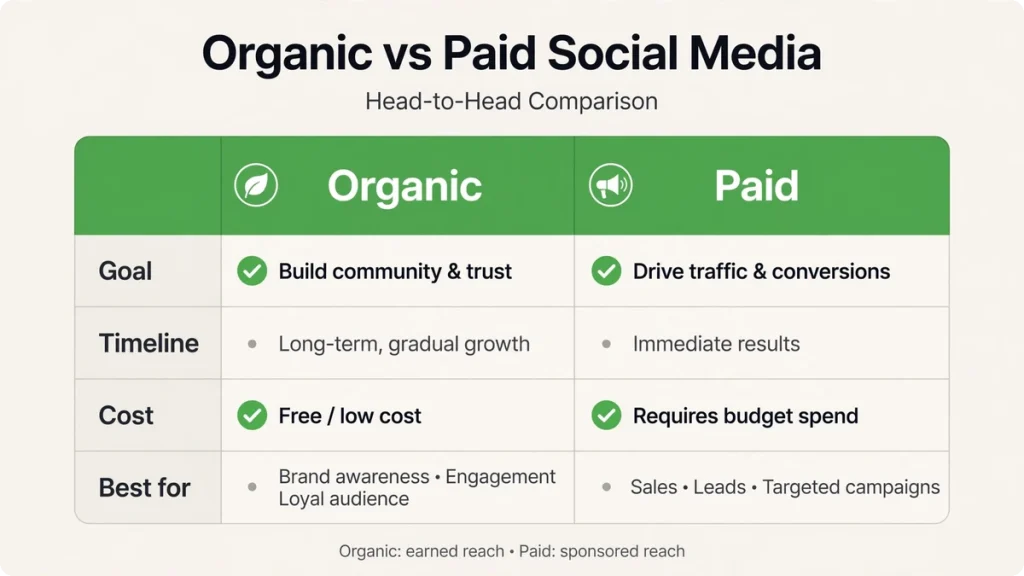
Before the framework, the facts. This organic vs paid social media comparison strips away the hype:
| Organic social media | Paid social media | |
|---|---|---|
| Cost | Time and consistency — no ad spend | Ad budget plus creative and management |
| Speed | Months to meaningful reach | Traffic within days of launch |
| Control | Algorithm decides who sees it | You choose audience, timing, and scale |
| Compounding | Yes — content library and audience grow over time | No — stop paying, traffic stops |
| Trust building | Strong — regular presence builds familiarity | Weaker — ads rent attention, they don’t build relationships |
| Best for | Brand building, community, learning what works | Lead generation, promotions, scaling winners |
Organic vs Paid Social: The Real Cost Comparison
“Free” organic and “expensive” paid is the wrong framing. The real organic vs paid social media trade-off is time versus money — and for a small business social media budget, time is often the scarcer resource.
Organic costs hours: planning, creating, posting, engaging — every week, for months before it compounds. Those hours are real money if your time has value (it does). Paid costs cash but buys speed and targeting: your message in front of the right people tomorrow, with data on what worked by next week.
The honest math: if you have more time than money, organic is your channel — invest the hours and be patient. If you have more money than time, paid gets you in the game while organic builds in the background. If you have neither, fix that first — marketing without time or money is just wishing. Most small businesses sit in the middle: some hours, some budget. That’s exactly who the hybrid play below is for. That’s the organic vs paid social media math every small budget should do before spending a cent.
A practical rule for your small business social media budget: never spend on ads what you can’t afford to lose while learning. Paid social has a tuition phase — your first campaigns buy data, not customers. Budget for the learning, and you’ll make better decisions than the business that “tried ads once” with a tiny test and quit.
The Organic vs Paid Social Media Decision Framework: If X, Then Y
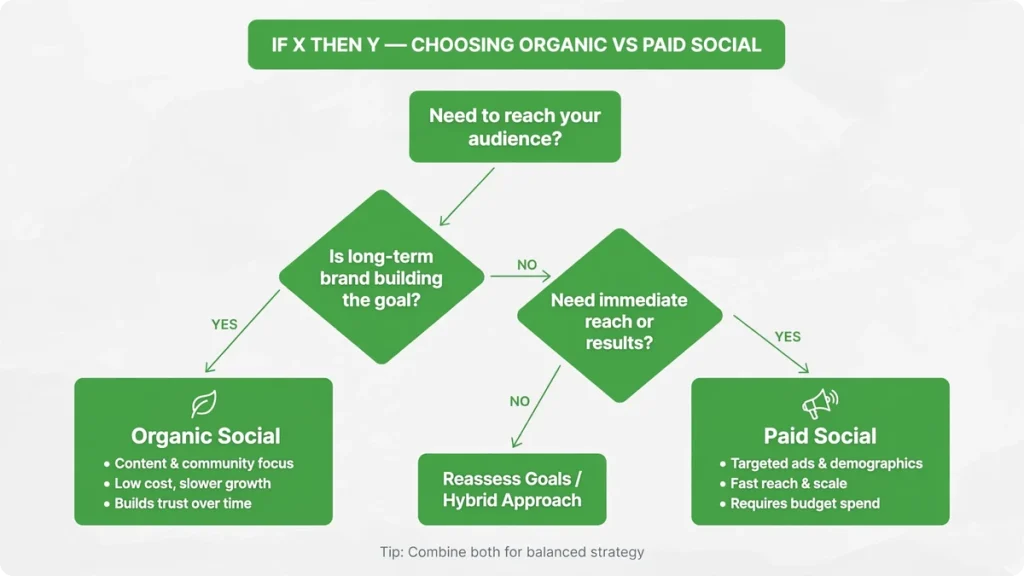
Use this organic vs paid social media decision framework to get your answer in 60 seconds:
- If you have no proven offer yet → start organic. Paying to amplify a message nobody wants is the fastest way to burn a small budget. Post, learn what resonates, then consider paid.
- If you need customers in the next 90 days → start paid. Organic won’t move fast enough. But keep the budget tight and the targeting narrow — small budgets die on broad audiences.
- If your organic content already gets engagement → add paid behind your winners. Boost top-performing posts to lookalike and interest audiences before building full campaigns. This is the organic vs paid social media sweet spot — scaling proof instead of gambling.
- If you have time but no money → go all-in on organic. Three quality posts a week, real community engagement, and six months of patience will build what a small ad budget can’t buy.
- If you have money but no time → paid with professional management. Unmanaged ad accounts bleed budget; the management cost is what makes the spend work.
- If you’re launching something new → organic to validate, paid to scale. Soft-launch content to your audience, watch what lands, then put budget behind the proven angle.
Should Small Business Run Facebook Ads?
Should small business run Facebook ads? It’s the specific version of the organic vs paid social media question — and it deserves a direct answer: yes, if you have a proven offer and a working landing page; no, if you’re still figuring out what to sell.
Facebook and Instagram ads (they run on the same ad system) are the most accessible paid social for small businesses: precise local targeting, visual formats, and budgets you control daily. They work best as an amplifier — taking content and offers that already convert and putting them in front of more of the right people. The Meta Business Help Center documents the ad formats and targeting options so you can see what’s possible before spending anything.
When should small business run Facebook ads? When three things are true: (1) you know who buys and why, (2) your landing page or profile converts visitors, and (3) you can fund a learning phase without panic. If any of those are missing, run organic first — ads amplify, they don’t fix. That’s the direct answer to should small business run Facebook ads — and to the broader organic vs paid social media question.
And when should you NOT? If your offer is unproven, your website is unfinished, or you’d need the ads to work immediately to survive. Paid vs organic social media rewards preparation and punishes desperation — the paid side most of all. There’s no shame in waiting: the businesses that win with ads are the ones that started them when they were ready, not when they were desperate.
The Hybrid Play Most Small Businesses Should Run
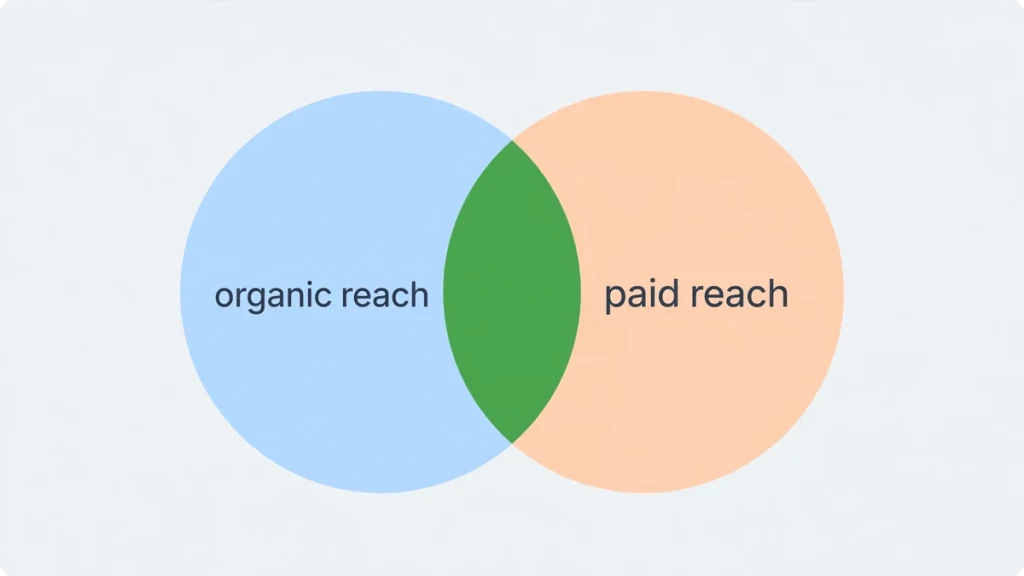
The hybrid play is where organic vs paid social media stops being a debate and becomes a system:
| Phase | What you do | Why this order |
|---|---|---|
| Phase 1 — Prove (months 1–3) | Organic only: consistent posting, community engagement, learn what resonates | Builds proof and creative without spending |
| Phase 2 — Amplify (months 3–6) | Small paid budget behind proven organic winners | You’re scaling what already works, not gambling |
| Phase 3 — Scale (month 6+) | Dedicated campaigns with fresh creative, informed by organic learnings | Paid becomes a growth channel, not an experiment |
Notice what’s missing from this playbook: paying for reach before you have anything worth reaching people with. That’s the mistake — not choosing paid, but choosing it first.
How to Test Paid Social on a Small Business Social Media Budget
Ready to test? This is the lowest-risk way to answer the organic vs paid social media question with data instead of opinions — a first test that won’t waste your small business social media budget:
- Start with your best organic post. Take the post with the most saves, shares, or comments from the last 90 days. It’s pre-tested creative — you already know it resonates.
- Boost it to a tight audience. Narrow geography (your service area), relevant interests, and an age range that matches your customers. Small budgets die on broad audiences.
- Run it for 7–14 days. Short enough to limit waste, long enough for the algorithm to learn. Don’t judge on day two.
- Measure one thing. Pick the metric that matters (leads, not likes) and compare cost per result against your organic baseline.
- Scale winners, kill losers. If it works, increase budget gradually. If it doesn’t, you bought valuable data about what your audience ignores — that’s worth knowing.
Meta’s own Business Help Center guides walk through campaign setup step by step. Between the official docs and your organic data, you have everything needed for a smart first test.
5 Signs Your Organic Engine Is Ready for Paid Fuel
- Consistent engagement. Your posts regularly earn saves, shares, and comments — proof the content works.
- A proven offer. People buy when they find you; you just need more of them to find you.
- A landing page that converts. Paid traffic to a broken page is just expensive bouncing.
- Creative backlog. You have winning posts to amplify — you’re not starting from zero.
- Patience for the learning phase. You understand the first budget buys data, and you’re okay with that.
If you check three or more, the organic vs paid social media question is settled for you: it’s time to add paid. If you check fewer than three, keep building organic — paid will still be there when you’re ready.
Red Flags on Either Side
Watch for these organic vs paid social media red flags, whichever side you’re leaning toward:
- An agency that pushes paid before looking at your organic content is selling spend, not strategy.
- Anyone promising organic virality on a schedule is selling fantasy — organic is a system, not a slot machine.
- Boosting every post with no strategy is the worst of both worlds: paid money with organic thinking.
- Running ads to a broken landing page or an unclear offer — fix the destination before buying the traffic.
Ready to talk about your social media?
Still weighing organic vs paid social media for your business? The expensive mistake is guessing. Contact the KKeyQik team to book a discovery call: tell us about your business, your timeline, and what you’ve tried so far, and we’ll talk through where your next dollar of effort should go.
Further reading: our complete guide to social media marketing services — what’s included, how engagements are structured, and how to choose an agency.
About the KKeyQik Team
KKeyQik is a digital marketing agency helping small businesses grow with SEO, social media marketing, PPC (Google Ads and Meta Ads), web development, video editing, and graphic design. The KKeyQik Team publishes practical, no-fluff guides for business owners who want marketing that pays for itself.
Frequently Asked Questions
Plan a small, fixed test budget you can afford to lose while gathering data — your first campaigns buy information about audiences and creative, not customers. Keep targeting tight and run the test long enough for the platform to learn before judging results, then only scale what the data validates.
Promote your proven organic winners — posts with the strongest saves, shares, and comments from your own followers. Organic engagement is a built-in pre-test: amplifying content that already resonates costs less to scale than guessing on new creative.
Organic performance doubles as a built-in pre-test: if a post earns no engagement from your own followers, paying to amplify it rarely fixes the underlying problem. The post's message or hook usually needs work first — put budget behind proven winners instead of guesses.
Treating the first campaign as a purchase of customers rather than a purchase of data — early campaigns buy learnings about audiences, creative, and offers. Budget for that learning phase, keep targeting narrow, and only scale what the data validates.
Organic builds the brand, the audience, and the proof — it's where you learn what resonates. Paid scales the validated winners to targeted audiences far faster than organic reach alone. The endgame is both: proof from organic, scale from paid.
Give it real time — organic typically needs several months of consistent posting before it compounds, and judging it after a few weeks guarantees a wrong verdict. Track whether engagement and profile actions trend upward over months, not whether any single post went viral.
It's a smart starting point, not a full strategy. Boosting winners to lookalike and interest audiences scales proven creative cheaply, but it's still a subset of paid — full campaigns with dedicated creative and funnel structure do more once you've validated the offer.
Boosting is a one-click way to put more reach behind an existing post; a campaign gives you full control over objectives, placements, creative variants, and funnel stages. Use boosts for cheap reach on proven winners, and campaigns when you need leads or sales tied to measurable outcomes.
No — organic still builds the trust and proof that make paid cheaper and more effective. Keep a consistent organic baseline (a few quality posts a week) so visitors arriving from your ads find a living, credible brand when they check you out.
Keep targeting narrow and budgets small while you learn — small budgets die on broad audiences. Only scale a campaign once it produces leads at an acceptable cost, and treat every budget increase as a test, not a celebration.