

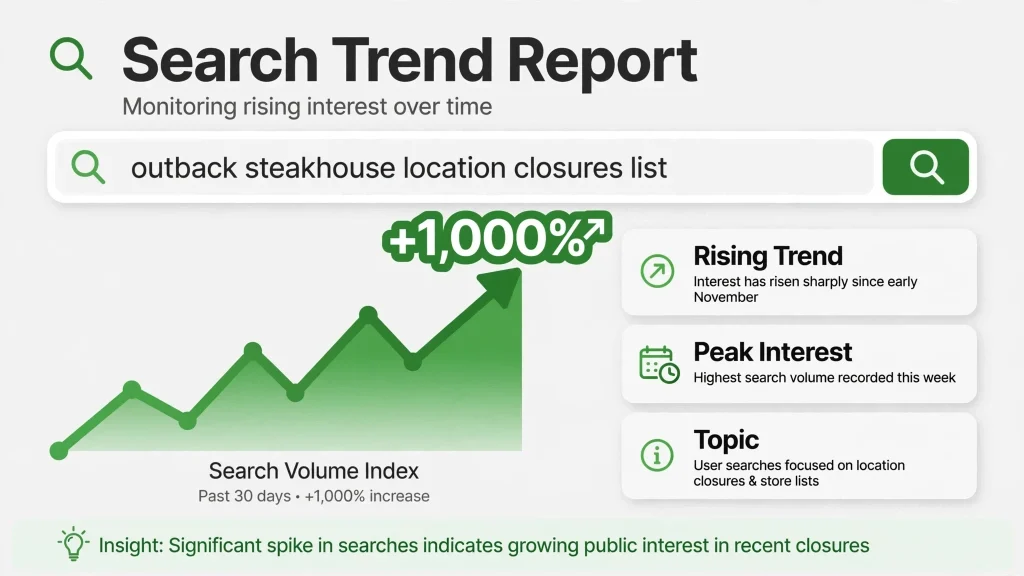
When Americans started typing “outback steakhouse location closures list” into Google in early November 2026, they were not looking for a marketing case study. They were looking for a straight answer: is the restaurant near me closing? Yet the surge itself is the case study. The phrase passed 100,000 searches and rose more than 1,000 percent in a single day, landing among the most active searches in the United States. The Outback Steakhouse closures turned a story about ten shuttered dining rooms into one of the most searched topics in the country, and every one of those searches was a customer trying to make a decision.
That is the part small businesses should pay attention to. The Outback Steakhouse closures are a restaurant story on the surface, but underneath they are a local search story. When a business changes its footprint, customers do not wait for a press release. They search. They check maps. They read the first result that looks like an answer. And the businesses that handle that moment well keep their customers; the ones that handle it badly send people to a locked door, an outdated listing, or a competitor.
This post explains what actually happened with the Outback Steakhouse closures, separates the facts from the rumours, and turns the episode into seven practical local SEO and reputation lessons. None of them requires a national brand budget. Each one applies just as well to a single-location café, a two-shop retailer, or a service business that is moving, merging, or closing a branch. If you run a business with a physical address that customers search for, these are the moves worth making before you ever need them.
What Actually Happened With the Outback Steakhouse Closures
The story behind the search surge is more specific than the headlines suggest, and the specifics matter, because the first lesson of any closure is that accuracy beats speed.
Outback Steakhouse itself has not filed for bankruptcy, and there is no announced plan for a nationwide shutdown. What happened is that one of the chain’s largest franchise operators, Out West Restaurant Group, formally known as Cerca Trova Restaurant Group Holdings, filed for Chapter 11 bankruptcy protection in Delaware on Monday, November 2, 2026. The San Diego-based operator runs 61 Outback Steakhouse restaurants across California, Arizona, Nevada, Colorado, and New Mexico.
Court documents show that the franchisee closed ten underperforming restaurants between October 11 and October 25, 2026, and then asked the court to reject the leases on those sites. The ten locations were:
- Arizona: Tucson, 4871 E. Grant Road; Mesa, 1860 E. McKellips Road
- California: Buena Park, 7575 Beach Blvd.; Valencia, 25261 N. The Old Road; Foothill Ranch, 26652 Portola Parkway
- Colorado: Colorado Springs, 7065 Commerce Center Drive; Highlands Ranch, 15 W. Springer Drive; Aurora, 2066 S. Abilene St.; Littleton, 8601 W. Cross Drive
- Nevada: Reno, 3645 S. Virginia St.
Three more restaurants operated by the same franchisee had closed earlier in 2026, bringing its total for the year to thirteen. The remaining 61 restaurants are expected to keep operating while the restructuring runs its course.
The day before the bankruptcy filing, Outback’s parent company, Bloomin’ Brands, signed an agreement to buy substantially all of the franchisee’s assets for $26.3 million, acting as the opening bidder in a court-supervised sale process. The company has said the proceedings involve franchisee-operated stores rather than its own corporate restaurants, and that there should be no immediate effect on guests, staff, or daily operations at the locations that stay open.
The Outback Steakhouse closures also sit inside a longer story. Bloomin’ Brands has been running a multi-year turnaround plan for the chain since late 2025, aimed at improving food quality, refreshing restaurants, and removing sites with limited growth potential. The company closed 21 restaurants across its brands in 2025 and chose not to renew the leases on 22 more locations, most of them expiring over the next four years. It had already closed 41 locations in early 2024. Meanwhile, beef prices rose 9.4 percent year over year in July 2026, squeezing margins across the steakhouse category. The chain still operates roughly 660 restaurants in the United States, and its parent company is due to report third-quarter results on November 6, when more detail is likely to follow.
For a small business owner, the numbers are less important than the pattern. A well-known brand changed its footprint, customers searched for answers in huge numbers, and the information they found came from news reports, court filings, and listing sites — not from the brand’s own channels. Every lesson below starts from that gap between what customers search for and what businesses publish.
1. “Is It Closing?” Is a Search Moment — Own the Answer
The most searched version of this story was not a brand name on its own. It was a question phrased as a list: “outback steakhouse location closures list”. People wanted a specific, checkable answer about their own neighbourhood. That is how closure searches work. Customers rarely search for a corporate strategy. They search for their street, their suburb, their regular restaurant.
The Outback Steakhouse closures show what happens when a business does not own that answer. Within hours of the bankruptcy filing, the top results for the query were news articles, and the location details came from court documents quoted in those articles. That is not a criticism of the journalism — it is an observation about who controlled the information. The first clear, complete list of closed addresses reached the public through the press, days after the doors had already shut.
A small business can do better with far less effort, because the scale is smaller and the audience is local. If you close, move, or merge a location, publish the answer yourself, in plain language, on a page you control. Name the location, give the date, and say plainly where customers should go instead. Use the words customers actually type: “closing”, “closed”, “moving to”, and the neighbourhood or street name. A short page titled “Our [Neighbourhood] Location Is Closing — Here’s Where to Find Us Now” will do more for your local visibility than any amount of silence.
There is a second benefit. Search engines reward the page that answers the question most directly. When the Outback Steakhouse closures became news, the businesses that published a clear, honest update tended to rank for the very queries their customers were typing. The Outback Steakhouse closures prove the demand exists. The businesses that meet it are the ones that show up first.
2. Mark Closed Locations Properly, or Zombie Listings Will Send Customers to a Locked Door
The most damaging local SEO mistake in a closure is also the most common: the business shuts the doors and leaves its Google Business Profile running as if nothing changed. The listing keeps appearing in search results and on Maps, showing old hours and old information, and customers keep following it. They drive to a restaurant that no longer serves food, or they call a number nobody answers, and the frustration attaches itself to the brand rather than to the listing.
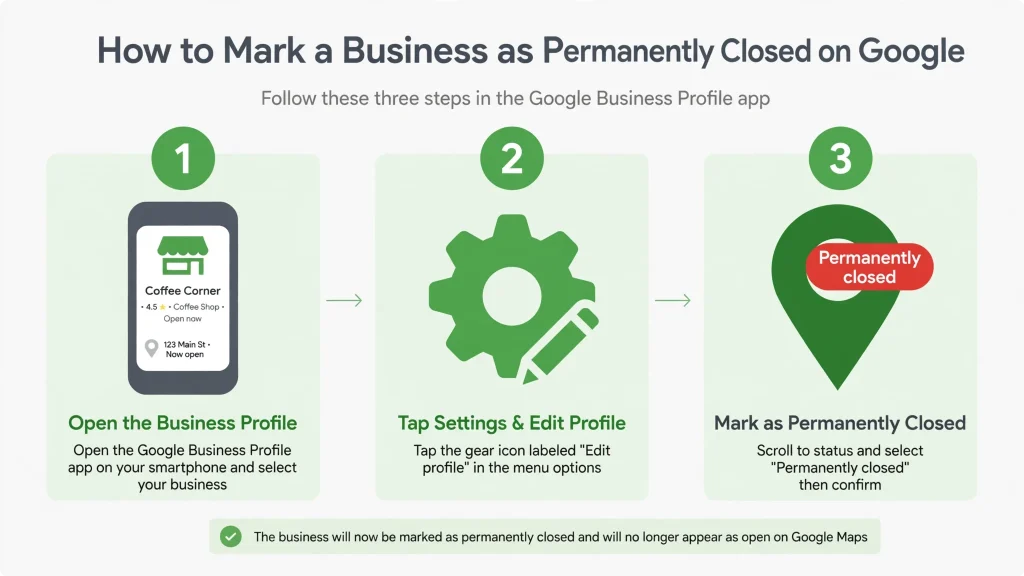
The correct move is simple, and it is free. A closed location should be formally marked as permanently closed in its Google Business Profile, through the business information settings, under the hours section. Once saved, the listing shows a clear “permanently closed” label in Search and Maps. It may remain findable for a while, but nobody is misled about whether it is open.
The Outback Steakhouse closures illustrate why the distinction between “temporarily closed” and “permanently closed” matters. A temporary closure tells Google and your customers that you are coming back; the listing stays live, and your reviews, photos, and history stay attached. A permanent closure is an ending. If there is any real chance of reopening, the temporary setting is the right tool, because reversing a permanent closure can require re-verification and the visibility you rebuild afterwards may not match what you had. Use the permanent label only when the location has truly finished trading.
3. Your Citations Are a Network — One Stale Address Poisons the Rest
A Google Business Profile is only the most visible listing a business has. The same name, address, and phone number appear across dozens of directories, review sites, mapping services, and delivery apps. When a location closes, every one of those references becomes a small decision point for a customer. If half of them still show the old address as open, customers get conflicting answers, and conflicting answers are what send people to competitors.
The Outback Steakhouse closures make this visible at scale. Local coverage of the Outback Steakhouse closures quoted individual location pages, listing sites certified individual restaurants as closed on specific dates, and review pages carried comments from regulars who had just learned their local dining room was gone. Each of those pages is a separate source of truth, and they do not update themselves. A brand with hundreds of locations needs a process to sweep them. A small business with two or three locations needs an afternoon.
Start with a citation audit whenever a location changes. List every place your business appears — Google, Apple Maps, Bing Places, Yelp, TripAdvisor, Facebook, and the directories that matter in your industry — and check the closed location on each one. Update the address or hours where the platform allows it, and mark the location closed where that is the honest status. Where you cannot edit a listing directly, use the platform’s reporting or ownership claim process to request the correction.
The reason this matters for search is consistency. Search engines compare the details they find about your business across the web, and consistent information builds confidence in your listings. A closed location that still appears as open on three directories and closed on two others sends a confusing signal, and confusing signals rarely rank well. Fix Google first, because it drives the most local searches, then Apple Maps, because it drives the most navigation, then the directories that send you actual customers. Keep a simple spreadsheet of where you are listed, so the next time a location changes you are not starting from memory. The Outback Steakhouse closures were a reminder that the internet remembers old addresses for years. The businesses that clean up after themselves are the ones customers can still find.
4. Outback Steakhouse Closures: If You Don’t Tell Your Story, the News Cycle Will Tell It for You
One of the most striking features of the Outback Steakhouse closures is how quickly the narrative formed without the brand’s voice in it. The franchisee’s bankruptcy filing was a court document. The list of closed restaurants came from that filing. The context — beef prices, the turnaround plan, the $26.3 million purchase agreement — came from earnings coverage and trade press. By the time most customers searched for answers, the story had already been written by other people, and it carried their framing: decline, struggle, shrinkage.
None of that framing was invented. But it was incomplete, because it was assembled from filings and financial coverage rather than from the brand explaining what it was doing and why. A turnaround plan that closes weak sites to protect strong ones is a strategy. Reported only as a list of Outback Steakhouse closures, it reads as a retreat. The difference between those two readings is a communications plan.
Small businesses face the same dynamic at a smaller scale, and the stakes are arguably higher, because a single bad local news story can define a business in its community. If you close a location, say so yourself, first, and in your own words. Publish a short statement on your website and your social profiles on the same day the change takes effect. Explain the reason honestly — rising costs, a lease ending, a decision to focus on your strongest site — and say what happens next for customers and staff. You do not need to share financial details. You do need to share facts before rumours do.
The same principle applies to the channels customers actually read. A notice pinned to the top of your Facebook page, an update on your Google Business Profile, and a short email to your customer list will reach more of the people who matter than any press coverage. The goal is not to spin the news. It is to make sure the first thing a customer finds is your version of events, written in your voice, with a clear next step. There is also a search benefit to publishing first: a page on your own site, using the same words customers are searching for, gives search engines an authoritative source to show. The Outback Steakhouse closures generated enormous search demand, and almost all of it flowed to publishers. A business that publishes its own update captures some of that demand for itself.
5. How You Close Is Part of Your Reputation
The Outback Steakhouse closures are a reminder that closures are emotional events, not just logistical ones. Regular customers lose a place that was part of their routines — birthday dinners, Friday nights, first dates. Staff lose a workplace. A community loses a familiar landmark. How a business handles that ending shapes how people remember it, and in local search, memory shows up as reviews.
The Outback Steakhouse closures offer a small but telling example. When the Evansville, Wyoming location closed abruptly in August 2026, the team posted a farewell note on the front door. It was a simple gesture, and it was widely shared. Customers who saw it described the restaurant warmly, even as they mourned its loss. Compare that with a closure discovered only when a customer pulls into a dark car park. The first version earns goodwill. The second earns a one-star review that says, in effect, you did not care enough to tell us.
For a small business, the farewell matters more than the announcement. Thank the customers by name if you can — the regulars, the families, the community groups. Thank the staff publicly, and mean it. Say where people can find you next, and make the transition easy: a map to the nearest location, a phone number that still works, an offer to help regulars find their way to the other site. These are small acts, and they cost almost nothing, but they are the difference between a closure that ends a relationship and one that moves it.
Reviews deserve special attention here. When a location closes, the reviews attached to it do not simply vanish. They stay visible on the listing, as part of the public record, and they keep shaping how people see your brand. You cannot delete a bad farewell review, but you can respond to it, and a thoughtful response to a disappointed regular — acknowledging the loss, thanking them, pointing them to the nearest location — does more for your reputation than any defensive reply ever will.
The broader lesson is that reputation management is not a separate activity from operations. The way you close a location is a marketing act, in the same way the way you open one is. Customers remember endings. Make yours a good one, and the people who loved that location will follow you to the next one.
6. Reviews Don’t Move With You — Rebuild Social Proof After the Outback Steakhouse Closures
Here is a detail of the Outback Steakhouse closures that many business owners miss: when a location closes, the reviews earned at that location do not transfer to the surviving ones. A restaurant that spent years building a four-and-a-half-star profile at one address cannot carry those stars to another address. Each Google Business Profile stands on its own, and the review count, the rating, and the history stay with the closed listing.
That matters more than it sounds, because reviews are one of the strongest signals in local search. A location with hundreds of recent reviews ranks better and converts better than a location with a handful. When one site closes and the other sites have thin review profiles, the business as a whole looks weaker in search, even though nothing about the surviving locations has changed.
The practical response is to treat the surviving locations as if they were new openings. After a closure, run a deliberate review request push at every location that remains. Ask happy customers in person, follow up by email or text after a visit, and add a review link to receipts and confirmation messages. Do it steadily for a few weeks, not as a single burst. A sudden flood of reviews looks suspicious to both customers and platforms; a steady flow looks like a healthy business.
There is also a retention angle here. Some of the customers who loved the closed location will try the next nearest one, and their first visit is a moment of risk. If the experience is good, ask them to say so. A review from a customer who followed you from the old location to the new one is worth more than a generic five-star rating, because it tells the next searcher that the move was worth making.
The Outback Steakhouse closures also underline a longer-term point: do not let one location carry all of your social proof. If your business has several sites, build reviews at each of them all the time, not only when one of them is in trouble. A balanced review profile across your locations is an insurance policy. When one site closes, the others already have the credibility to carry the business forward in search.
7. A Smaller Footprint Can Be a Strategy — If You Frame It That Way
The final lesson from the Outback Steakhouse closures is about narrative. The same set of facts can be told as a story of decline or as a story of discipline, and the telling shapes everything that follows — customer confidence, staff morale, and search visibility.
Bloomin’ Brands has been clear, in its own way, that the Outback Steakhouse closures are part of a plan: shut the weakest sites, stop renewing leases that no longer make sense, refresh the restaurants that remain, and invest in food quality. The company completed dozens of restaurant refreshes during 2026 and has said the trimmed-down chain can hold on to the customers it has been losing. Whether that plan works is a question for the next few quarters. But the framing itself is instructive. A smaller footprint, explained as focus, reads very differently from a smaller footprint explained as failure.
Small businesses can use the same framing honestly. Closing a weak location to protect a strong one is a sound decision, and customers respect it when it is explained plainly. “We are closing our [Neighbourhood] shop so we can put everything into the [Other Neighbourhood] location you already love” is a message customers understand. It signals care, not collapse. It gives regulars a reason to follow you rather than a reason to worry.
The key is to pair the message with visible investment in what remains. If you close one site, show customers what the surviving site is getting: a refreshed interior, a better menu, longer hours, new services. The Outback Steakhouse closures are paired with a refresh programme for exactly this reason — the story is not just “we closed ten restaurants”, it is “we closed ten restaurants and we are improving the rest”. Your version can be smaller in scale and just as effective.
This is also where search and reputation meet. A business that publishes a confident, forward-looking update about its plans gives search engines fresh, positive content to show. A business that goes quiet after a closure leaves the field to news reports and speculation. The choice is not between honesty and optimism. It is between telling your own story and letting someone else tell it for you.
The Small-Business Location Closure Checklist
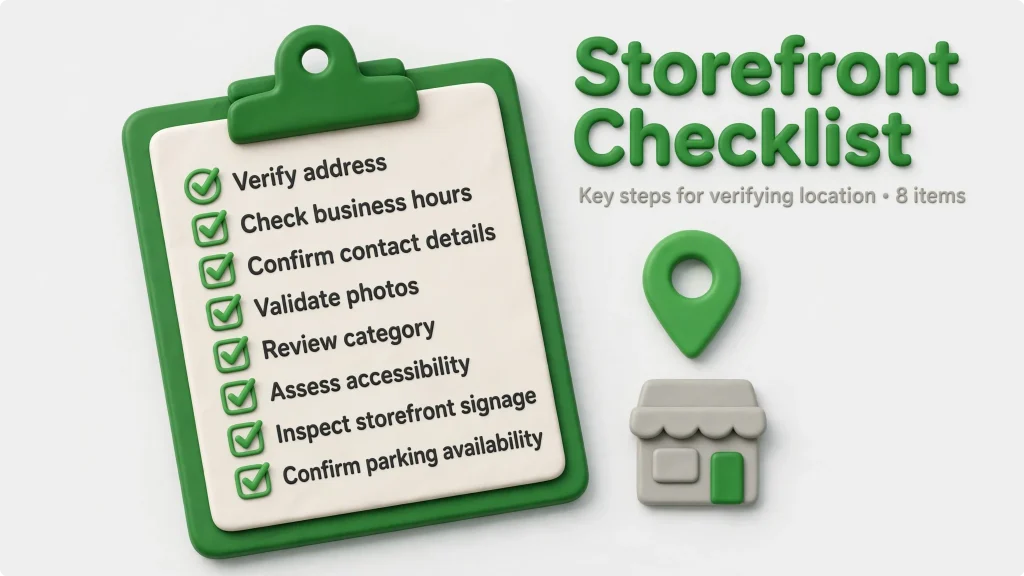
If you ever need to close, move, or merge a location, work through this list in order. It takes an afternoon, and it prevents most of the damage closures cause in search.
- Publish the news yourself, first. A short page on your website with the location, the date, and where customers should go instead. Use the words customers search for.
- Mark the listing permanently closed. Update the Google Business Profile for the closed location, and set Apple Maps and Bing Places to match.
- Sweep your citations. Check every directory, review site, and delivery app where the closed location appears, and correct or close each listing.
- Redirect the old pages. If the closed location had its own page on your website, redirect it to the nearest open location or to a clear closure notice. Do not leave it returning an error.
- Tell your customers directly. Email your list, post on your social profiles, and pin the update where regulars will see it. Do not rely on search alone.
- Thank people properly. A farewell note, a public thank you to staff and regulars, and a warm handover to the nearest location.
- Rebuild reviews at the locations that remain. A steady review request push for several weeks after the closure, focused on the surviving sites.
- Watch the search results. For two weeks after the closure, search for your business name plus the closed neighbourhood each day, and correct anything misleading that appears.
Keep this list somewhere you can find it. The businesses that handle closures well are rarely the ones improvising in the moment. They are the ones that had a plan before they needed one.
What the Outback Steakhouse Closures Mean for Your Business
The Outback Steakhouse closures will fade from the trending lists within days, as every search surge does. The lessons will not. Customers will keep searching for answers about the businesses they rely on, and they will keep judging those businesses by what they find. A clear answer, an honest listing, a thoughtful farewell, and a confident plan for what comes next are not luxuries. They are the basics of local marketing, and they matter most at the exact moment a business is under pressure.
If you run a business with one location, the lesson of the Outback Steakhouse closures is simpler still: build your local presence now, while things are calm. Keep your Google Business Profile accurate. Build reviews steadily. Publish the pages that answer your customers’ questions. Then, if you ever need to change your footprint, you will be doing it from a position of strength, with an audience that trusts you and a search presence that works for you rather than against you.
The Outback Steakhouse closures show what a search surge looks like when a big brand changes shape. Your business may never trend nationally, but your customers search for you the same way, with the same questions, and the same expectation of a straight answer. Meet that expectation, and a difficult moment becomes a demonstration of how well you look after the people who keep you in business.
Ready to protect your local visibility? KKeyQik helps small businesses across the United States build local SEO that survives anything — accurate listings, review strategies that keep working, and content that answers the questions your customers are already asking. Explore our SEO services for small business or get in touch to talk about your local search presence.
Frequently Asked Questions
Outback Steakhouse's largest US franchisee, Out West Restaurant Group, closed ten underperforming restaurants between October 11 and October 25, 2026, and filed for Chapter 11 bankruptcy protection in Delaware on November 2, 2026. The closures cover locations in Arizona, California, Colorado, and Nevada. Outback Steakhouse itself has not filed for bankruptcy, and the remaining restaurants operated by the franchisee are expected to keep trading while the restructuring runs its course.
No. There is no announced plan for a nationwide shutdown. The closures involve restaurants operated by one franchisee, Out West Restaurant Group, which runs 61 Outback locations across five southwestern states. The chain still operates roughly 660 restaurants in the United States, and its parent company, Bloomin' Brands, has agreed to buy substantially all of the franchisee's assets for $26.3 million.
Court documents list ten locations closed between October 11 and October 25, 2026: Tucson and Mesa in Arizona; Buena Park, Valencia, and Foothill Ranch in California; Colorado Springs, Highlands Ranch, Aurora, and Littleton in Colorado; and Reno in Nevada. The same franchisee had closed three more restaurants earlier in 2026, bringing its total for the year to thirteen.
The franchisee, formally known as Cerca Trova Restaurant Group Holdings, filed for Chapter 11 protection in order to sell the majority of its assets through a court-supervised process. The filing followed a difficult period for casual dining, with beef prices up 9.4 percent year over year in July 2026 and a multi-year turnaround plan at Bloomin' Brands that has been removing underperforming restaurants across the group.
Bloomin' Brands signed an agreement on November 1, 2026, to acquire substantially all of Out West Restaurant Group's assets for $26.3 million, acting as the opening bidder in the bankruptcy sale process. The company has said the proceedings involve franchisee-operated stores rather than its own corporate restaurants, and that there should be no immediate effect on guests, staff, or daily operations at the locations that stay open.
Sign in to the Google Business Profile for that location, open Edit profile, go to Business information, and find the business status section under Hours. Select "Mark as permanently closed" and save. The listing will then show a clear "permanently closed" label in Google Search and Maps, so customers are not sent to a location that no longer trades.
Temporarily closed tells Google and your customers that you are coming back; the listing stays live and your reviews, photos, and history stay attached. Permanently closed says the business at that location has finished trading. If there is any real chance of reopening, use the temporary setting, because reversing a permanent closure can require re-verification and the visibility you rebuild afterwards may not match what you had.
No. Reviews earned at a closed location stay with that location's Google Business Profile and do not move to your surviving locations. Each profile stands on its own, with its own review count and rating. After a closure, the practical response is a steady review request push at every location that remains, so those profiles build their own social proof rather than relying on the closed site's history.
Publish the news yourself, on the same day the change takes effect, in plain language on a page you control. Name the location, give the date, explain the reason honestly, and say clearly where customers should go instead. Share the same update on your Google Business Profile, your social profiles, and by email to your customer list, so the first thing a customer finds is your version of events rather than a rumour.
Yes, when it is a deliberate choice rather than a failure. Closing a weak location to focus on a stronger one can cut costs, sharpen service, and protect the reputation of the sites that remain. The key is to explain the decision honestly, invest visibly in the locations that stay open, and look after the customers and staff affected by the change, so the smaller footprint reads as focus rather than retreat.