

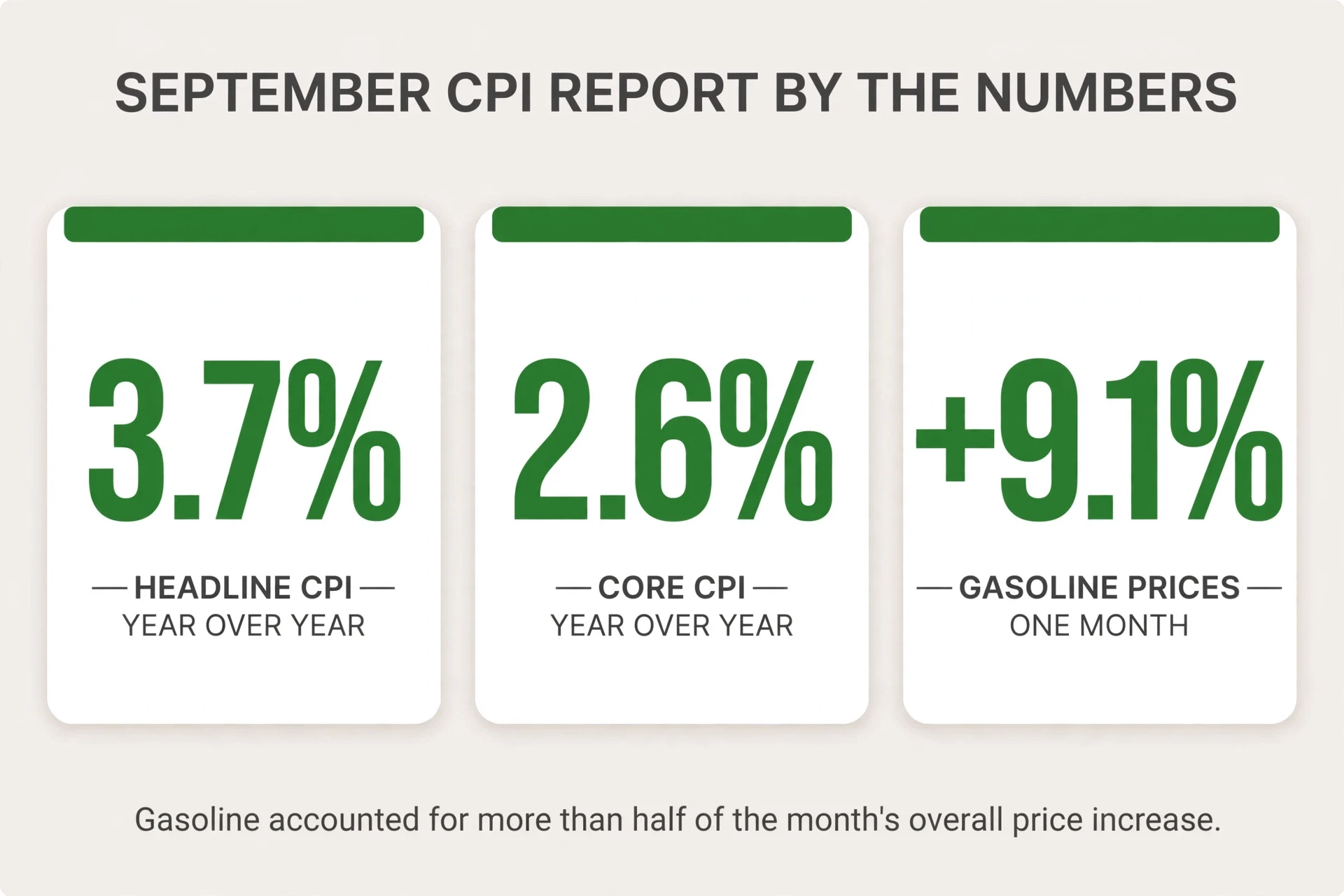
On Wednesday, October 14, 2026, the Bureau of Labor Statistics gave American marketers a number they cannot afford to ignore: 3.7%. That is where September’s annual inflation rate landed in the September 2026 CPI report — up from 3.4% in August, hotter than the 3.6% economists surveyed ahead of the release had expected, and the kind of reading that moves consumer behavior and marketing math at the same time.
Behind the headline, the September 2026 CPI report told an even sharper story. Gasoline prices surged 9.1% in a single month — accounting for more than half of the entire monthly increase — as fuel-market disruptions tied to the U.S.-Iran war pushed pump prices higher. Core inflation, the measure that strips out volatile food and energy prices, accelerated to 2.6% from 2.4%, overshooting forecasts. Shelter costs kept climbing. And with the Federal Reserve’s October 27–28 policy meeting now directly ahead, the question of whether interest rates stay restrictive — or move higher — is back on every finance team’s agenda.
Most marketers will file this under macro noise. That would be a mistake. An inflation print like the September 2026 CPI report hits a marketing operation on two fronts at once.
On the demand side, it reshapes what consumers are willing to buy and how they justify spending. On the supply side, it quietly raises the cost of reaching them — the same ad budget buys fewer impressions, fewer clicks, and fewer customers than it did a year ago. The brands that win in this environment are rarely the ones with the biggest budgets. They are the ones that adjust the fastest. Reading the September 2026 CPI report as a marketer means asking two practical questions: what will your customers do differently, and what will your reach cost tomorrow?
Here are seven inflation-proof marketing moves drawn directly from what the September 2026 CPI report tells us about American consumers right now.
What the September 2026 CPI Report Actually Showed
Before the strategy, the facts — because the September 2026 CPI report is worth understanding on its own terms.
The Bureau of Labor Statistics released the September 2026 CPI report on October 14. Headline inflation rose 0.6% for the month on a seasonally adjusted basis — matching expectations and accelerating from August’s 0.4% — and 3.7% over the previous twelve months, up from 3.4% in August and above the 3.6% consensus forecast. Gasoline did most of the damage: pump prices jumped 9.1% in September and stood 34.2% higher than a year earlier, with the broader energy index up 5.2% for the month. Analysts noted that gasoline alone accounted for more than half of the monthly increase in the overall index.
Underlying inflation strengthened as well. Core CPI rose 0.3% from August and 2.6% over twelve months, against expectations of 0.2% and 2.5%. The annual core rate accelerated from 2.4% in August, even though the monthly pace held steady at 0.3%. Price gains spread beyond energy: recreation, used vehicles, education, airline fares, and medical care all moved higher. Shelter — the heaviest component in the index — rose 0.4% for the month and 3.2% from a year earlier. Food prices, notably, were unchanged.
The timing matters for planning. The September 2026 CPI report landed less than two weeks before the Federal Reserve’s October 27–28 meeting, and the hotter-than-expected core reading has cooled expectations of near-term rate relief. For marketers, the takeaway is simple: the cost pressures squeezing your customers are not fading, and the cost pressures squeezing your media budget are not either.
Why a CPI Print Lands in Your Marketing Funnel
It helps to see exactly how an inflation report travels from a government spreadsheet into your campaign dashboards. It makes two trips.
The first trip is through your customers’ wallets. When prices rise faster than paychecks, spending behavior changes in predictable ways: essentials get protected, discretionary purchases get postponed, and value becomes the deciding factor. Research on inflation-era consumer behavior consistently finds the same pattern — one analysis citing American Marketing Association research notes that nearly six in ten consumers adjust their spending habits during inflationary periods, gravitating toward discounts and value-oriented options. Your product did not change. The mental math your buyers do before purchasing it did.
The second trip is through your media costs. Digital advertising is itself subject to inflation: as more advertisers compete for the same attention and platforms adjust pricing, the cost of reaching a thousand people drifts upward year after year. That means a flat marketing budget is not a stable marketing budget — it is a shrinking one. Picture filling the same grocery cart with the same hundred dollars as prices rise: the cart comes home emptier.
A campaign budget held flat from 2025 to 2026 buys fewer impressions, fewer clicks, and fewer conversions, even if nothing about your targeting or creative changed. Agencies hear the same refrain constantly: we are spending about what we did last year, but we are not getting what we used to. The platform is not broken. The dollars just do not stretch as far.
That double squeeze — cautious buyers on one side, pricier reach on the other — is why the September 2026 CPI report belongs in your marketing planning, not just your news feed. The September 2026 CPI report demands a response, and here is how to make it.
Lesson 1: Re-Audit What Your Budget Actually Buys
Most marketing budgets are set once a year and then treated as fixed. Inflation makes that habit expensive. If your 2026 media plan was built on 2025 cost assumptions, you are almost certainly overestimating your reach — and underestimating what competitors are paying for the same audiences. The September 2026 CPI report is the latest confirmation that last year’s prices are gone.
Start with a media-cost audit. Pull your actual CPMs, CPCs, and cost-per-acquisition figures for the last twelve months, channel by channel, and compare them against the baselines your annual plan assumed. You will usually find two things: a handful of channels where auction prices have crept up steadily, and at least one where you are paying meaningfully more for the same placement than you were in January. Reset your KPI targets against real current costs, not the ones in the spreadsheet from December.
Then reallocate with inflation in mind. Dollars locked into high-inflation, low-differentiation placements — broad display, generic paid social prospecting — buy less every quarter. Shifting even a modest share of that spend into compounding assets changes the math: search engine optimization, email list growth, and owned content do not re-price at every auction. An organic ranking you earn this quarter keeps delivering clicks next quarter at no marginal media cost, which is the closest thing marketing has to an inflation hedge. The September 2026 CPI report is your reminder to run this audit now, while there is still budget year left to redirect — not in January, when the money is already committed.
Lesson 2: Rewrite Your Message Around Value, Not Price
When consumers are in value-seeking mode, the brands that keep selling on features and aspiration start sounding out of tune. The September 2026 CPI report says your buyers are doing harder math at the checkout — so do the math with them, in your messaging.
Value messaging is not the same as discounting, and the distinction matters. Blanket discounts train customers to wait for the next sale; value framing gives them reasons to buy at your price. Lead with cost-per-use instead of sticker price. Emphasize durability and longevity — in an inflationary market, “buy it once” is a powerful promise. Talk about what the purchase replaces or prevents: the service call avoided, the replacement not needed, the hours saved.
Bundles work especially well here because they let customers feel they outsmarted rising prices without you having to cut yours. Every component of the September 2026 CPI report — fuel, shelter, services — is an argument your customer is already having with themselves; value messaging simply joins their side of it.
Run a messaging audit this week. Read your homepage hero, your top three ad headlines, and your last five email subject lines as if you were a buyer who just saw that gasoline is up 34% year over year. Does the value story lead, or is it buried three scrolls down? In the months after a hot CPI print, the brands that say “here is why this is worth it” out-convert the brands still saying “here is what is new.”
Lesson 3: Protect Retention Like It’s Your Media Plan
Here is the quiet arithmetic of inflation-era marketing: when buyers hesitate, acquisition gets more expensive — longer consideration cycles, lower conversion rates, higher cost per new customer. Every customer you keep is one you do not have to re-acquire at inflated prices. Retention is not a loyalty-program nicety in this environment; it is a cost-control strategy. The September 2026 CPI report makes the math explicit: re-acquiring customers in a rising-cost environment is the most expensive line item you can choose.
Put real weight behind the channels you own. Email and SMS lists are among the highest-ROI assets most small businesses underuse: no auction, no algorithm, no per-send price that rises with inflation. Segment by recency and re-engage lapsing buyers with value-first messages — usage tips, restock reminders, loyalty rewards — before reaching for discounts. Build win-back flows that trigger automatically, and make referrals rewarding enough that happy customers do your prospecting for you.
The compounding effect is what matters. A customer acquired last year at last year’s prices, kept engaged through this year’s uncertainty, is a direct hedge against rising acquisition costs. While competitors pour money into expensive prospecting to replace churned buyers, you are growing from a base that already trusts you. The September 2026 CPI report rewards the brands that invested in relationships before they needed them — and it is not too late to start.

Lesson 4: Say the Price Part Out Loud
If your own input costs are rising — and after the September 2026 CPI report, your customers will assume they are — the worst pricing strategy is silence. Buyers who discover a price increase on their own feel ambushed; buyers who hear it from you, with context, mostly accept it as business.
The playbook for price communication is straightforward: announce it yourself, explain the mechanism in plain language, and be specific about what changes and what does not. A clear statement — our costs moved, so this plan changes on this date, and everything you use today stays the same — beats a quiet checkout-page update every time. Specificity collapses the rumor space: when the facts are complete, there is nothing for anxious customers to speculate about.
Wherever possible, attach new value to the change. A price increase announced alongside an improved feature, a better guarantee, or a bundled extra reads as an upgrade; the same increase announced alone reads as a tax. You do not need to apologize for running a business in an inflationary economy — your customers are living in the same one. What they will not forgive is feeling managed. The September 2026 CPI report gives you the context; your job is to give customers the specifics. Tell them early, tell them plainly, and give them a reason to stay that is not just inertia.
Lesson 5: Don’t Go Dark — Buy the Quiet
When inflation spooks the market, the most common mistake brands make is also the most visible: they slash the marketing budget to protect margins, go quiet for two quarters, and then wonder why competitors own the conversation when demand returns. Cutting spend feels prudent. It is usually just expensive in a different way.
Here is the opportunity hiding inside everyone else’s cuts. When competitors pull back, ad auctions soften, share of voice gets cheaper, and the brands that stay visible capture attention at a discount. Marketing history is full of companies that gained durable market share by maintaining presence while rivals went silent — the recovery disproportionately rewards whoever never left. You do not need to spend more; you need to spend consistently while others spend less. Inflation scares like the one in the September 2026 CPI report are exactly when quiet share of voice gets cheapest to buy.
If margins are genuinely tight, change the mix rather than the total. Shift weight from brand-awareness placements toward direct-response and demand-capture work that pays back faster, but keep the lights on. The September 2026 CPI report will fade from the headlines in a week. Your absence from the market, if competitors stay visible, will be remembered much longer. Never zero out the budget — buy the quiet instead.
Lesson 6: Tilt the Funnel Toward Demand Capture
In cautious markets, creating new demand gets harder and capturing existing demand gets more valuable. The September 2026 CPI report argues for rebalancing your funnel: put more weight on the bottom, where buyers with intent are already searching, and less on expensive top-of-funnel prospecting that asks hesitant consumers to care about something new.
Practically, that means doubling down on high-intent search. Comparison content, “best of” guides, pricing and alternatives pages, and FAQ-rich service pages convert researchers into buyers precisely when buyers are doing more research. Local search deserves special attention right now: with gasoline up 9.1% in a single month, consumers are consolidating trips and favoring nearby options — “near me” queries, local inventory visibility, and clear pickup or delivery options win disproportionate share when driving costs sting. The gasoline line in the September 2026 CPI report is the reason: make sure your local listings, location pages, and delivery messaging are current.
Retargeting belongs in this bucket too. A visitor who compared your pricing yesterday is worth more than a cold prospect today, and reaching them again costs a fraction of finding someone new. In an inflationary quarter, your warmest audiences are your most efficient ones — mine them before you buy colder ones. And keep your social media marketing focused on the value story: organic social is a free channel for reinforcing why your offer is worth it, right when buyers need convincing.
Lesson 7: Market to the Moment the Data Creates
Economic data does not just describe the market — it creates marketing moments. The September 2026 CPI report is itself a content opportunity: timely, trend-driven coverage of a rising search query earns links, shares, and rankings while interest is hot. But the deeper lesson is to build an economic calendar next to your marketing calendar. Let every CPI release — starting with this September 2026 CPI report — become a standing agenda item, not a scramble.
Watch the components, not just the headline. The 9.1% gasoline surge is a messaging brief: emphasize delivery, bundle products to reduce trips, highlight anything that saves fuel or travel time. Rising shelter costs are a brief for home-related businesses: value content around maintaining rather than replacing, financing clarity, and long-term cost control. Each CPI component maps to a set of customer anxieties — and each anxiety is a campaign angle waiting for a headline. Video content is particularly effective here: a sixty-second explainer that translates an intimidating economic headline into plain advice for your customers builds trust faster than any banner ad.
Set a simple operating rhythm: when the CPI prints each month, spend thirty minutes translating it into customer language. What got more expensive? Who feels it most? What can we say that is genuinely useful — not opportunistic? Brands that respond to the economy their customers actually live in sound relevant without trying. The September 2026 CPI report gave you this month’s brief. Use it before October’s arrives.
Your Inflation Marketing Checklist
The September 2026 CPI report, distilled into action:
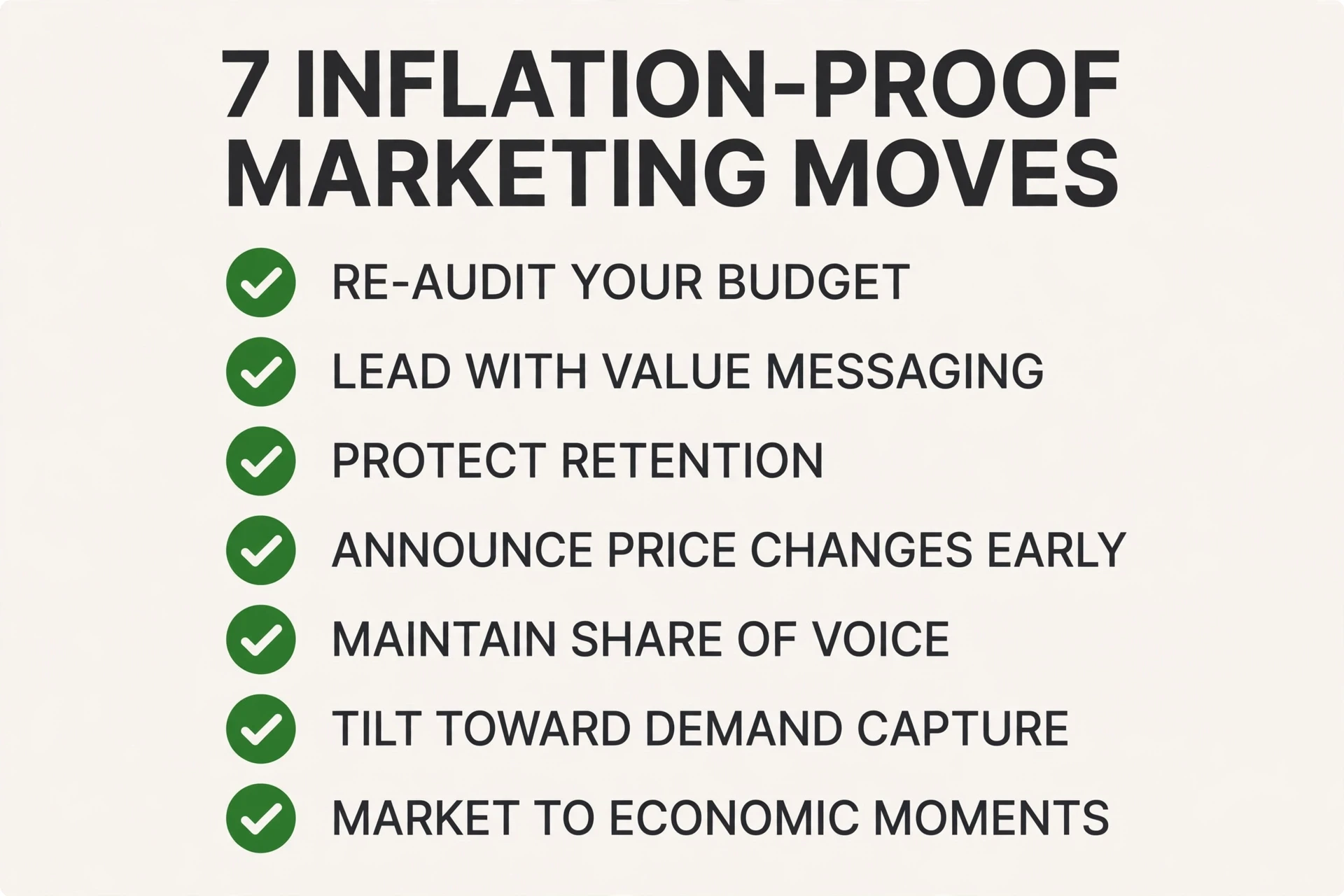
1. Re-audit your media costs against current CPMs and CPCs — your 2026 plan was built on 2025 prices.
2. Rewrite core messaging around value and cost-per-use, not features and novelty.
3. Shift weight into retention: email, SMS, loyalty, and win-back flows you own outright.
4. Communicate any price changes early, specifically, and paired with added value.
5. Maintain visibility while competitors cut — consistency buys cheap share of voice.
6. Tilt the funnel toward demand capture: high-intent SEO, local search, retargeting.
7. Translate each month’s CPI components into campaign angles your customers feel.
Inflation at 3.7% does not have to mean growth at zero. The brands that treat the September 2026 CPI report as a planning input — adjusting budgets, messages, and channels while competitors wait for “normal” to return — come out of inflationary stretches with stronger positioning than they went in with. The September 2026 CPI report is your signal. The seven moves above are your response.
If turning economic headwinds into marketing advantage sounds like a lot to run alongside everything else, that is exactly what a growth partner is for. KKeyQik helps growing brands make every marketing dollar work harder — from search engine optimization that compounds while ad costs climb, to social media marketing that keeps your value story in front of customers daily, to video content that explains your worth better than any spec sheet. When the economy gets expensive, your marketing has to get smarter.
Sources:
BeInSure, “Consumer price index (CPI): US inflation rises to 3.7% in September”: https://beinsure.com/news/cpi-us-inflation-rises-to-3-7/
CryptoTimes, “US CPI Data Live Today: Inflation Rises to 3.7% in September, Exceeds Forecasts”: https://www.cryptotimes.io/2026/10/14/us-cpi-live-inflation-data-bitcoin-price-fed-rate-discussion/
WRE News, “September CPI Jumps to 3.7%: Mortgage Rate Implications”: https://wrenews.com/september-2026-cpi-inflation-3-7-mortgage-rates-october-14/
FasterCapital, “How Consumer Price Index Impacts Your Marketing Decisions”: https://fastercapital.com/articles/How-Consumer-Price-Index-Impacts-Your-Marketing-Decisions.html
Inner Spark Creative, “The Hidden Cost of Keeping Your Advertising Budget the Same”: https://www.innersparkcreative.com/news/the-hidden-cost-of-keeping-your-advertising-budget-the-same
Want to put this to work for your business? KKeyQik plans and delivers Google Ads and Meta Ads campaigns for small businesses, with an in-house team available 24/7. See our ads management service or get a quote within 24 hours.
Frequently Asked Questions
The Bureau of Labor Statistics released the September figures on October 14, 2026. Headline inflation came in at 3.7% year over year (up from 3.4% in August) and 0.6% for the month. Core inflation, which excludes food and energy, rose to 2.6% annually. Gasoline prices surged 9.1% in a single month and accounted for more than half of the overall monthly increase.
An inflation print like the September CPI report hits marketing on two fronts. On the demand side, consumers recalibrate spending — protecting essentials and hunting for value. On the supply side, the cost of reaching them creeps upward, so a flat ad budget quietly buys fewer impressions and clicks. Treating the CPI report as a planning input helps you adjust before both sides squeeze your ROI.
When prices outpace paychecks, buying behavior shifts in predictable ways: essentials get protected, discretionary purchases get postponed, and value becomes the deciding factor. Research on inflation-era behavior, including analysis citing American Marketing Association findings, notes that nearly six in ten consumers adjust their spending habits during inflationary periods. Your product hasn't changed — the mental math your buyers do before purchasing has.
Cutting to zero is usually the costliest option. When competitors pull back, ad auctions soften and share of voice gets cheaper, so consistent brands capture attention at a discount. If margins are tight, change the mix rather than the total — shift weight toward direct-response and demand-capture work — but keep your brand visible. Going dark for two quarters costs more in lost ground than it saves in spend.
Lead with cost-per-use instead of sticker price, emphasize durability and longevity, and explain what the purchase replaces or prevents. Bundles work well because they let customers feel they've outsmarted rising prices without you cutting yours. Blanket discounts train customers to wait for the next sale; value framing gives them reasons to buy at your price today.
Media inflation is the steady upward drift in what it costs to reach an audience — CPMs, CPCs, and acquisition costs rising even when your targeting and creative stay the same. Fight it by auditing actual channel costs against your plan's assumptions, then shifting a share of spend into compounding assets like SEO, email lists, and owned content that don't re-price at every auction. An organic ranking earned this quarter keeps delivering clicks next quarter at no extra media cost.
Announce it yourself, before customers discover it on their own. Explain the mechanism in plain language, be specific about what changes and what stays the same, and wherever possible attach new value — an improved feature, a better guarantee, or a bundled extra. Customers living through the same inflation you are will generally accept a well-explained change; what they won't forgive is feeling managed.
When buyers hesitate, acquisition gets more expensive — longer consideration cycles and lower conversion rates push up the cost per new customer. Every customer you keep is one you don't have to re-acquire at inflated prices. Lean into channels you own outright: email, SMS, loyalty programs, and automated win-back flows. A customer acquired last year at last year's prices is a direct hedge against this year's rising acquisition costs.
With gasoline up 9.1% in a single month, consumers consolidate trips and favor nearby options. That makes "near me" queries, accurate local listings, visible local inventory, and clear pickup or delivery options disproportionately valuable. Make sure your Google Business Profile, location pages, and delivery messaging are current — when driving costs sting, proximity wins.
Build a simple monthly rhythm: when the CPI prints, spend thirty minutes translating it into customer language. What got more expensive? Who feels it most? What can you say that's genuinely useful? Keep an economic calendar next to your marketing calendar — CPI releases, Fed meetings, jobs reports — and pre-write the value angles. Brands that respond to the economy their customers actually live in stay relevant without forcing it.