

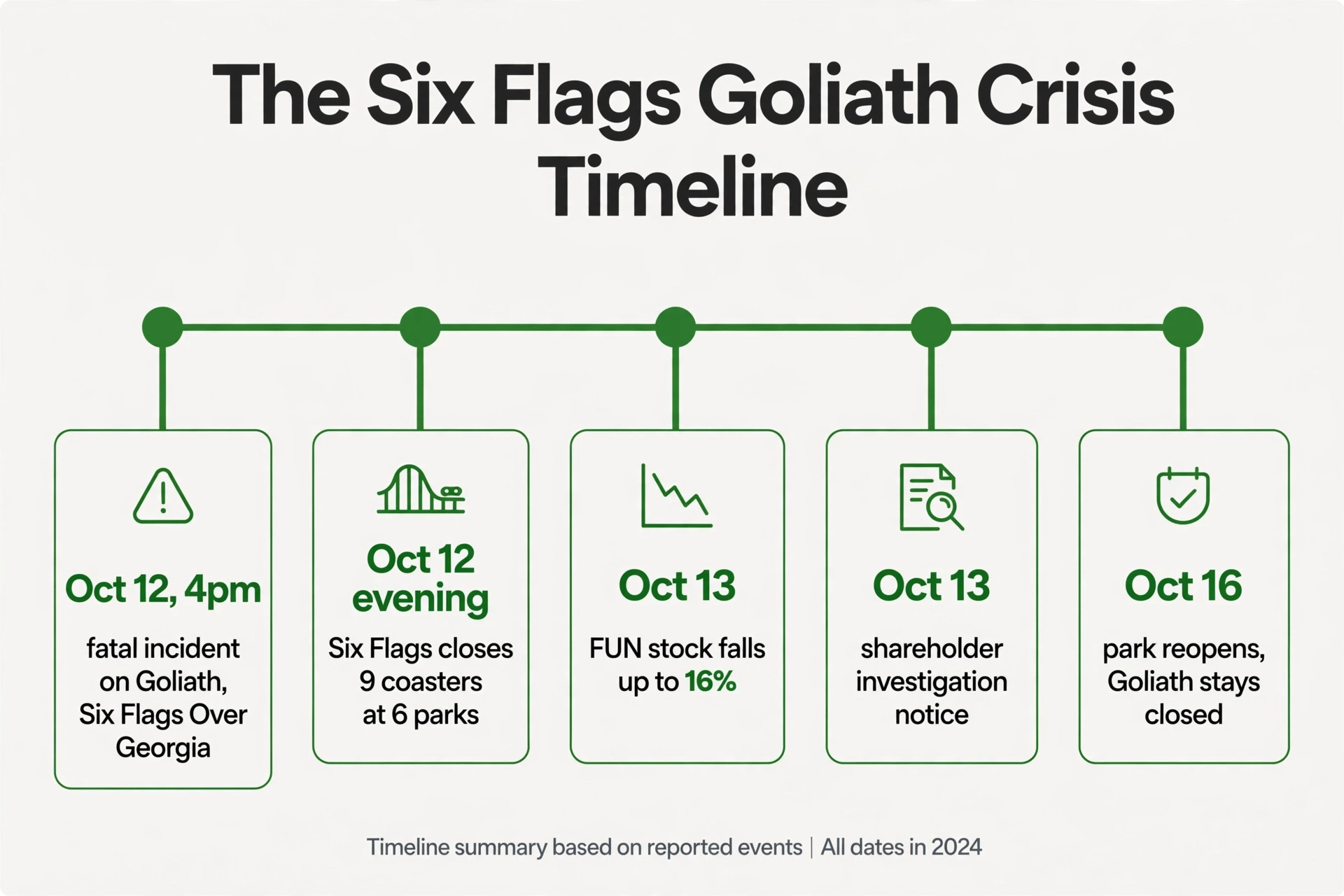
On the afternoon of Monday, October 12, 2026, a family trip to an amusement park became the Six Flags Goliath tragedy — one of the worst days in the company’s history. A 42-year-old man was thrown from the Goliath roller coaster at Six Flags Over Georgia, struck other riders on the way down, and died. Several others were injured. By Monday night, the company had temporarily closed nine similar coasters across six of its parks, and by Tuesday its stock had fallen as much as 16% to its lowest level since December 2009, according to CNBC reporting.
This is a tragedy first — a man lost his life, and no marketing lesson should ever pretend otherwise. But it is also, unavoidably, a crisis-communications case study unfolding in real time. The Six Flags Goliath tragedy puts every textbook crisis-PR principle under the same microscope: how fast a brand responds, what it says first, whether its actions match its words, and how it keeps communicating when the facts are still developing.
Most brands will never face anything remotely like the Six Flags Goliath tragedy. A roller coaster accident is an extreme, high-stakes, life-and-death scenario. But the same principles apply on every smaller scale where a brand’s reputation is on the line: a product recall, a data breach, a viral customer complaint, a bad batch, a social media blowup. Crises differ in scale, not in structure — and the Six Flags Goliath tragedy is the most extreme proof of that pattern. When something goes wrong in public, your customers, your investors, and your employees all ask the same four questions in the same order: What happened? Are you taking responsibility? What are you doing about it? Can I still trust you?
Here are seven crisis-PR lessons the Six Flags Goliath tragedy puts on display for every brand in 2026.
What Happened on Goliath — the Facts as We Know Them
Before the lessons, the facts of the Six Flags Goliath tragedy, because crisis analysis without verified facts is just speculation.
According to reporting from the Associated Press and Cobb County police, a man identified as Hassan Jihad Ibn Kariem, 42, was ejected from the Goliath roller coaster at Six Flags Over Georgia in Austell, Georgia, shortly before 4 p.m. on Monday, October 12. Kariem, an IT manager and technology teacher at Wesley International Academy, an Atlanta charter school where he had worked for more than twelve years, was at the park celebrating a family birthday. Preliminary interviews with witnesses and park employees indicated he struck other passengers before falling beneath the attraction. Officers found him unresponsive and not breathing; he was later pronounced dead. Local television reporting put the number of additional injured riders at four, though the severity of their injuries has not been publicly confirmed.
Goliath is a hypercoaster that opened in 2006, with a 200-foot first hill and top speeds of about 70 miles per hour. It does not take riders upside down and uses lap-bar restraints rather than over-the-shoulder harnesses. In the Six Flags Goliath tragedy, as of this writing, investigators have not determined how Kariem left his seat. The Cobb County Police Department’s Major Crimes Unit is investigating alongside the Georgia Office of Insurance and Safety Fire, and the possible causes under examination include mechanical malfunction, restraint failure, and operator error — none of them confirmed.
Six Flags’ corporate response to the Six Flags Goliath tragedy moved fast and visibly. Six Flags temporarily closed nine coasters at six parks “out of an abundance of caution,” according to a company spokesperson: a separate Goliath at Magic Mountain in California, Raging Bull at Great America in Illinois, Nitro at Great Adventure in New Jersey, Fury 325 and Thunder Striker at Carowinds in North Carolina, and Behemoth and Leviathan at Canada’s Wonderland in Ontario. The company said staff and local authorities responded immediately, that the park is cooperating with the investigation, and that it is providing support to the guests and staff who were impacted. “We are deeply saddened by the guest incident at our park today,” the spokesperson said via the Associated Press.
The financial fallout from the Six Flags Goliath tragedy was immediate. Six Flags Entertainment (NYSE: FUN) fell sharply on Tuesday, October 13 — down as much as 16% intraday to its lowest since December 2009, per CNBC. A shareholder-investigation notice followed, alleging potential securities-law violations on behalf of investors who lost money. And the calendar made everything worse: the closures landed in mid-October, square in the Halloween season that drives a large share of a regional theme park’s annual revenue. The park was scheduled to resume operations on Friday, October 16, with Goliath itself remaining closed while the investigation continues.
Now, the lessons.
Lesson 1: Speed Sets the Narrative — the First Hours Belong to Whoever Shows Up
The single biggest decision in any crisis is not what you say. It is when. In the hours after something goes wrong, the public narrative fills itself: witnesses post, local news goes live, speculation starts trending. If the brand is not present in that window, the story gets written without it, and everything after that is a correction — which is always weaker than a first draft.
In the Six Flags Goliath tragedy, the company understood this. It had a public statement out on the day of the incident — the “deeply saddened” message, the confirmation that rides were closed out of an abundance of caution, the note that it was cooperating with investigators and supporting affected guests and staff. That statement did not answer every question; it could not, because investigators had not yet determined the cause. But it occupied the first slot in the story: the company was present, it was treating the incident as serious, and it was acting.
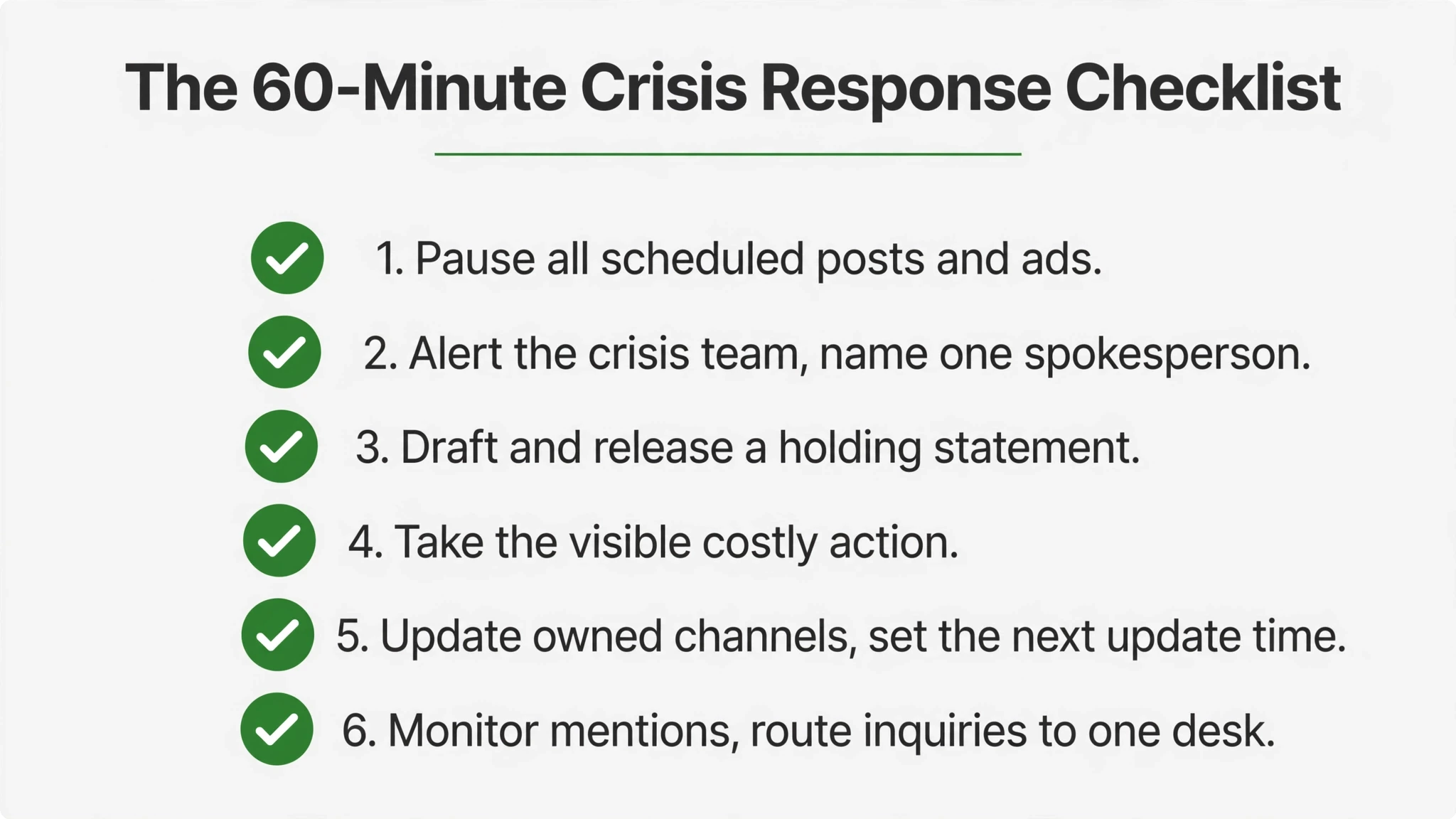
That is the job of the first-hour response, and the Six Flags Goliath tragedy shows it working. It is not to explain the unexplainable; it is to demonstrate that a responsible adult is in charge. Marketers call this the “holding statement,” and every brand — theme park or software company — should have one pre-drafted, approved, and reachable at all times. A good holding statement does five things in under a hundred words: acknowledges the incident, expresses concern for those affected, states the immediate action taken, names the authority leading the investigation, and promises the next update. It buys the one thing money cannot buy after a crisis: a little credibility to spend on the next update.
Brands that wait for “all the facts” before saying anything almost always regret it. The Six Flags Goliath tragedy shows why: by the time Monday night’s local newscasts aired, the company’s position was already on the record. When Tuesday’s market coverage of the Six Flags Goliath tragedy arrived, reporters were quoting the company’s actions alongside the stock drop, not quoting the company’s silence.
Lesson 2: Lead With Empathy, Not Legalese
Read the company’s first statement after the Six Flags Goliath tragedy again: “We are deeply saddened by the guest incident at our park today.” It is plain, human language. It centers the person who was hurt, not the corporation’s exposure. In the Six Flags Goliath tragedy, that human-first framing is what made the company’s early statements credible.
Legal departments, understandably, want precision: no admissions, no speculation, no promises that create liability. That discipline is important — especially when, as here, liability is genuinely unestablished and an investigation is ongoing. But there is a difference between legal discipline and legal language. “The guest incident” is as far as this statement bends toward corporate euphemism, and it still reads as a human reaction first.
The deeper lesson is about the center of gravity. The Six Flags Goliath tragedy is, at its center, the story of Hassan Jihad Ibn Kariem — an educator who had worked at the same school for more than a decade, a man who had beaten cancer twice and a serious bout of COVID-19, who survived a car fire with his daughter just weeks earlier, and who died on a ride while celebrating a family birthday. That human story is what made the Six Flags Goliath tragedy land nationally. A brand that treats a crisis as a stock-price problem first and a human problem second will always sound hollow — a lesson the Six Flags Goliath tragedy drives home — because the public is always reading it as a human story.
Practical translation for your brand: the first paragraph of any crisis response is about the people affected, never about the company. Name the support you are providing — Six Flags pointed to support for impacted guests and staff, which is the right instinct. Save the operational details for paragraph two. And keep the human focus through the whole arc of the crisis, not just the first statement, because the audience’s memory of your empathy is what they carry into the recovery phase.
Lesson 3: Actions Speak Louder Than Press Releases — Close the Rides
Here is where the Six Flags Goliath tragedy becomes a genuinely instructive case study. The company’s statement was fine. But its most persuasive communication was not the statement at all — it was the decision to temporarily close nine coasters at six parks on the same day, before anyone had told them to, “out of an abundance of caution.”
That is the strongest possible signal a brand can send in a safety crisis: we are not waiting for proof before we protect people. It is costly — those closures hit during Halloween season, the company’s biggest remaining revenue stretch of the year — and that cost is precisely what makes it credible. A company that shutters revenue-generating assets voluntarily is a company that is not gambling with its customers’ safety. The public can read that calculation.
Contrast this with the counterfactual: if Six Flags had closed only the one ride, or waited for investigators to order closures, every subsequent statement about safety would have carried an asterisk. “We take safety seriously” is the most hollow sentence in crisis PR when the brand’s actions do not match it. By closing similar attractions preemptively during the Six Flags Goliath tragedy, Six Flags gave its own statement something to stand on.
The general principle for marketers: in a crisis, find the one visible, costly action that proves your stated values, and take it early. A software company hit by a data breach publishes what it found and offers concrete remediation, not just apologies. A food brand facing contamination questions pulls product from shelves nationwide instead of quarantining a single lot. Words tell the audience what you believe; voluntary actions tell them whether you mean it.
Lesson 4: One Voice, One Message — Especially When Multiple Authorities Are Involved
Crises that involve regulators, police, and civil litigation are message-control nightmares, because multiple institutions are now speaking about your brand and you do not control any of them. In the Six Flags Goliath tragedy, at least three separate bodies are producing the public record: the Cobb County Police Department’s Major Crimes Unit, the Georgia Office of Insurance and Safety Fire, and the company itself. Witnesses are talking to television stations. A shareholder-investigation notice is circulating. Local officials are briefing.
In that environment, the single most dangerous thing a brand can do is let more than one of its own voices freelance. The Six Flags Goliath tragedy shows why message discipline matters: when a company spokesperson says one thing, a park manager says another on camera, and an anonymous “insider” leaks a third version to a reporter, the audience does not average them out — it picks the most damaging one and assumes the others are cover-ups. Consistency is not a nicety in crisis PR; it is the entire game.
The discipline is simple to describe and hard to execute: designate one authorized spokesperson, route every media inquiry through one desk, and make sure every public-facing employee — from the ride operators to the social media team — knows exactly what to say and what to point to. The script for everyone else is short: acknowledge, express care, refer to the official channel, and say when the next update is coming. Nothing else.
Marketers should also note the channel discipline. In a fast crisis, the brand’s owned channels — its website statement page, its verified social accounts — become the single source of truth that reporters, customers, and even employees refresh. Six Flags’ coordinated statement through the wire and the AP did this job. The modern version adds one more rule: pause scheduled marketing content instantly. Nothing reads worse than a cheerful promotional post firing off on autopilot between crisis updates. Every marketing calendar should have a kill switch, and someone should be authorized to pull it without a committee meeting.
Lesson 5: Have the Playbook Before You Need It — Crisis PR Is Written in Calm Weather
The most underappreciated fact about good crisis responses is that they are mostly written before the crisis happens. The holding statement, the spokesperson list, the chain of approval, the dark-site template, the social media pause protocol, the contact tree for the executive team — all of this gets built in calm weather or it does not get built at all, because nobody writes a good playbook in the middle of a 911 call.
The Six Flags Goliath tragedy shows what “before” looks like for a company that operates physical infrastructure with known, accepted risk. Amusement parks live with the reality that rides carry inherent danger; their crisis machinery has to be permanent, rehearsed, and board-level. The speed of the precautionary closures and the same-day statement suggests a company that had thought about this scenario in advance. The Six Flags Goliath tragedy response has the shape of advance preparation, not improvisation.
Most brands reading this do not operate roller coasters. But every brand has its own version of the scenario: the e-commerce store has the payment-data breach, the SaaS company has the outage that strands customers, the agency has the campaign that offends someone important. The crisis-PR playbook for a marketing-led brand should contain, at minimum: pre-approved holding statements for the three most likely crisis types; a designated spokesperson and two backups, all media-trained; a social listening setup that alerts in minutes, not days; a dark-site or statement-page template that can go live in an hour; and a decision rule for who can authorize the big costly action — the recall, the refund, the shutdown — without waiting for a board vote.
One more playbook item the Six Flags case highlights: the record of your own diligence. When scrutiny arrives, reporters and regulators ask what you did before the incident — inspections, maintenance logs, past incidents, and how you handled them. In this case, attention immediately turned to the ride’s inspection history and to a recent, separate story about another coaster. A brand’s pre-crisis conduct becomes its post-crisis evidence. The search engine optimization world has a version of this: the content you publish during calm times — transparent safety pages, clear policies, honest documentation — becomes the material that surfaces when people start searching your brand’s name in a crisis. Reputation is built before you need it.
Lesson 6: Keep Communicating as the Story Develops — Don’t Let the News Cycle Write the Sequel
The first statement is only the opening chapter. In the Six Flags Goliath tragedy, the story kept developing: the stock drop on Tuesday, the shareholder-investigation notice, the park’s scheduled reopening on Friday with Goliath remaining closed, the ongoing investigation with its cause still undetermined. Each development is a fresh news cycle, and each one gives the brand a choice: communicate proactively or let others fill the gap.
In the Six Flags Goliath tragedy, the reopening question is a textbook example. When a park says it will resume operations while the attraction at the center of the investigation stays closed, that decision needs its own clear, human explanation — what is reopening, what is not, why the distinction is safe, and what visitors can expect. If the company does not explain it, commentators will, and their version will be less charitable. The same applies to the investigation updates: even “the investigation is ongoing and we are cooperating fully; we will share findings when authorities release them” is a communication, and it is infinitely better than silence.
Silence in the development phase is the most common unforced error in crisis PR. Brands spend enormous energy on the first statement and then go quiet, assuming the news will move on. Sometimes it does. But quiet reads as retreat, and it hands the sequel to whoever is loudest — which, in a liability story like the Six Flags Goliath tragedy, is usually lawyers, activists, or the algorithm. The right cadence is regular, scheduled updates even when there is nothing new: “Here is what we know, here is what is still being investigated, here is when you will hear from us next.” Predictability is a trust technology. In the Six Flags Goliath tragedy, the park’s reopening decisions will test whether the company keeps that rhythm.
There is also a proactive-marketing dimension. When the crisis eventually recedes, the brand has to rebuild the search results and the social conversation around its name. That is where content marketing and social media discipline earn their keep: consistent, honest, useful content over months — safety programs, community initiatives, customer stories — gradually rebalances what the internet says about you. Recovery is a campaign, not a press release.
Lesson 7: Protect the Long Game — Reputation Compounds, and So Does Damage
The final lesson is about time horizons. In the Six Flags Goliath tragedy, the immediate costs are visible: a closed ride, closed sister coasters, a stock at multi-decade lows, an investigation, litigation risk. But the deeper cost is the slow one — the family that quietly decides the season pass is not worth it this year, the parent who sees the headlines and picks a different park next summer, the investor who reprices the whole category. Reputation damage compounds downward exactly the way brand equity compounds upward: one quiet decision at a time, by millions of people, over months.
This is why crisis PR is not a communications expense but a business strategy. The Six Flags Goliath tragedy’s Halloween-season timing shows how a crisis can strike a company’s most important revenue window; the stock reaction shows how fast financial markets translate brand damage into enterprise value; the shareholder notice shows how a crisis becomes a legal and governance event. Every one of those layers is shaped by how the company communicates. The brand is not separate from the business here — the brand is the business, under stress.
The forward-looking move is to treat trust as inventory. Brands that bank credibility in good times — transparent operations, responsive customer service, honest advertising, community presence — have reserves to draw on when the worst happens. Brands that spend every day of goodwill they earn are one bad headline away from zero. And after a crisis, rebuilding that inventory is deliberate, measurable work: surveys of brand trust, sentiment tracking on social, search-result composition for your own brand name, and — the hardest metric — customers coming back.
There is a related marketing lesson about product reality, too. No amount of communications skill fixes an unsafe product. The investigation into the Six Flags Goliath tragedy will eventually establish what failed; the brand’s long-term recovery from the Six Flags Goliath tragedy depends on the answer. Crisis PR can protect a good brand that had a bad day. It cannot protect a brand from a bad truth. The smartest crisis strategy any company can run is the one that makes crises less likely: genuine safety, genuine quality, genuine honesty — and marketing that tells that story before anyone asks.
What This Means for Your Brand
You do not need to operate a roller coaster to face your own version of a Six Flags Goliath tragedy. If your business takes payments, ships products, runs software, or speaks publicly, you have a crisis scenario with your name on it — you just have not met it yet. The question is whether you will meet it with a plan or with panic.
The Seven Lessons, in one line each: respond within hours, not days; lead with empathy, never legalese; take one visible, costly action that proves your values; speak with one voice through one channel; write the playbook in calm weather; keep communicating through every development; and treat trust as inventory you build before you spend.
If reading about the Six Flags Goliath tragedy made you realize your brand’s crisis plan is a blank page, that realization is worth acting on. KKeyQik helps brands build the communications foundation that carries them through calm and crisis alike — search engine optimization that makes your owned story findable, social media management that keeps your channels credible and responsive, video content that lets your leadership speak directly to customers when it matters, and strategy built on honesty rather than hype. Don’t wait for your bad day to start building trust. Talk to KKeyQik today and put a crisis-ready communications foundation under your brand.
Want to put this to work for your business? KKeyQik plans and delivers social media campaigns for small businesses, with an in-house team available 24/7. See our social media marketing service or get a quote within 24 hours.
Frequently Asked Questions
On Monday, October 12, 2026, a 42-year-old man identified as Hassan Jihad Ibn Kariem was ejected from the Goliath roller coaster at Six Flags Over Georgia in Austell, Georgia. He struck other riders before falling beneath the attraction and died. Several other riders were injured. Investigators have not yet determined how he left his seat, and the cause remains under investigation by the Cobb County Police Department's Major Crimes Unit and Georgia state authorities.
Six Flags temporarily closed nine similar coasters across six parks "out of an abundance of caution" on the day of the incident. The closed rides included Goliath at Magic Mountain in California, Raging Bull in Illinois, Nitro in New Jersey, Fury 325 and Thunder Striker in North Carolina, and Behemoth and Leviathan at Canada's Wonderland. From a crisis-PR standpoint, this was the company's most persuasive move: a visible, costly action proving it was not waiting for proof before protecting guests.
A company spokesperson said via the Associated Press: "We are deeply saddened by the guest incident at our park today." The statement confirmed that staff and local authorities responded immediately, that the park was cooperating with the investigation, and that the company was providing support to impacted guests and staff. Crisis-PR experts consider a fast, human first statement like this the essential "holding statement" every brand should have pre-drafted.
Six Flags Entertainment (NYSE: FUN) fell sharply on Tuesday, October 13, dropping as much as 16% intraday to its lowest level since December 2009, according to CNBC reporting. A shareholder-investigation notice followed, alleging potential securities-law violations on behalf of investors who lost money. The episode shows how quickly brand damage converts into enterprise value in a public crisis.
A holding statement is a short, pre-approved response a company can release within the first hour of a crisis. It acknowledges the incident, expresses concern for those affected, states the immediate action taken, names the authority leading the investigation, and promises the next update. It does not try to explain the unexplainable — it demonstrates that a responsible team is in charge while the facts are still developing.
Never stay silent while waiting for every fact, never let multiple spokespeople freelance different versions of events, and never let scheduled promotional content run on autopilot between crisis updates. In the Six Flags case, the danger of conflicting messages was real: police, state investigators, witnesses, local officials, and the company were all part of the public record. One authorized voice and one official channel prevent the audience from choosing the most damaging version.
Through regular, scheduled updates even when there is nothing new to announce: what is known, what is still being investigated, and when the next update is coming. Predictability is a trust technology. Going quiet after the first statement reads as retreat and hands the story's sequel to the loudest voices — lawyers, activists, or the algorithm — which is especially costly when a liability question is unresolved.
The incident occurred in mid-October, square in the Halloween season that drives a large share of a regional theme park's annual revenue. A crisis that strikes a company's most important revenue window magnifies both the operational and financial damage, which is why the precautionary ride closures carried so much weight as a trust signal: the company accepted real, immediate cost to protect people.
Recovery is a campaign, not a press release. Brands rebuild through consistent, honest, useful content over months: transparent safety and quality programs, responsive customer service, community presence, and customer stories that gradually rebalance what the internet says about them. Measurable signals include brand-trust surveys, social sentiment, search-result composition for the brand's own name, and customers returning.
Write the playbook in calm weather. The holding statement, the spokesperson list, the approval chain, the statement-page template, the social media pause protocol, and the decision rule for who can authorize a costly protective action all have to be built before the crisis arrives. And the deepest lesson: crisis PR can protect a good brand that had a bad day, but it cannot protect a brand from a bad truth — so the best crisis strategy is the one that makes crises less likely in the first place.