

Updated: September 2026 · By the KKeyQik Team
Before you post another thing, stop. Most small business social media fails aren’t content problems — they’re foundation problems: a profile that doesn’t say what you do, content with no job to do, and numbers nobody looks at. A social media audit finds all of that in about an hour. These fifteen questions are the audit — answer them honestly and you’ll know exactly what’s broken and what to fix first. (For the full system these questions plug into, see our guide to social media marketing services.)
A social media audit is a structured review of your profiles, content, audience, and results — designed to answer one question: is this earning its keep? It covers what visitors see first, what you’ve been posting, who’s engaging, and whether any of it connects to business outcomes. No tools required, no agency required — just honesty and an hour. For official platform guidance, see Meta Business Help Center, and for social media usage data, see Pew Research’s social media fact sheet.
Key takeaways
- Run this audit quarterly, or before any new agency engagement — it’s the fastest way to find what’s actually broken.
- Most audits reveal the same three problems: unclear positioning, content with no strategy, and reporting nobody reads.
- Answer every question with evidence (a screenshot, a number, a link) — “I think it’s fine” is how problems hide.
- Fix in priority order: positioning first, content system second, growth tactics last. Tactics on a broken foundation just fail faster.
- If more than five answers are red flags, stop posting and fix the foundation before spending another dollar on content or ads.
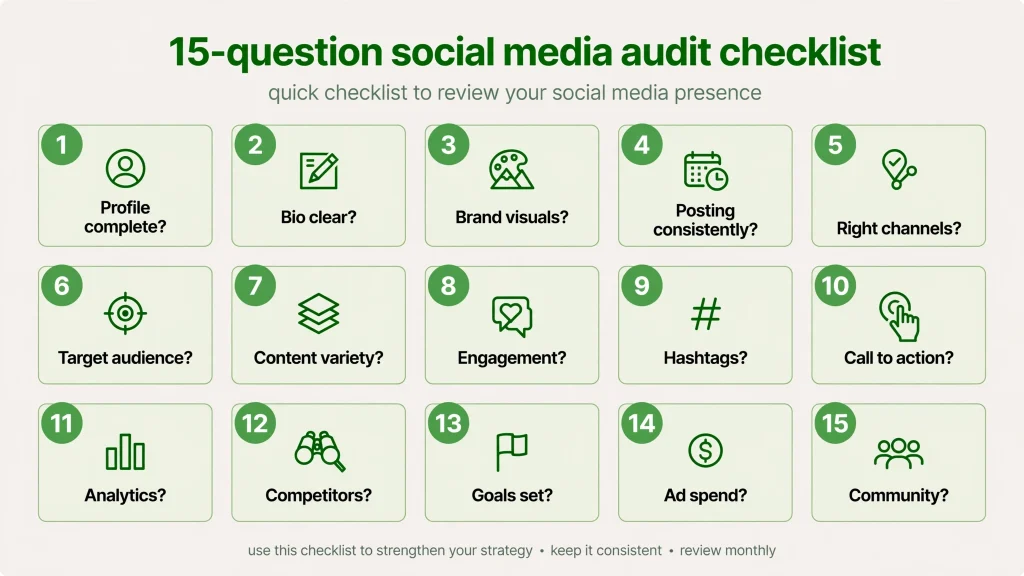
The 15 Social Media Audit Questions
Profile & first impressions
- Does your bio say what you do and who it’s for in one glance? A stranger should understand your business in three seconds. Clever taglines that need explaining are costing you followers. A social media audit starts with this first impression.
- Is your profile photo, link, and contact info current? Dead links, old logos, and missing contact buttons are silent killers — check on mobile, where most visitors see you.
- Do your last nine posts look like one brand? Scroll your own grid as a stranger. Inconsistent visuals, tones, and topics signal randomness — and randomness doesn’t convert.
Content & strategy
- Can you name your content pillars? If every post doesn’t ladder up to 3–4 defined themes (educate, prove, humanize, convert), you’re posting, not marketing.
- What was your best-performing post last month — and do you know why it worked? If you can’t answer both halves, you’re not learning from your own data.
- When did you last post something designed to convert, not just engage? Education and entertainment build audience; offers build revenue. Both need a slot.
- Is video at least a third of your output? Every major platform rewards short video above static formats in 2026. A text-and-image-only feed is fighting the algorithm with one hand tied. A social media audit checks this content mix.

Audience & community
- Are the right people following you? Check ten recent followers — are they potential customers, or other businesses, bots, and engagement pods? A thousand wrong followers are worth less than a hundred right ones.
- What’s your average response time to comments and DMs? Unanswered questions on your own posts are prospects walking out of an empty store.
- When did you last have a real conversation in your comments? Not replies — conversations. Comment sections with back-and-forth signal a living brand; broadcast-only feeds signal a billboard. A good social media audit measures real engagement.
Paid & conversion path
- Can a visitor go from your profile to becoming a lead in two clicks? Trace the path yourself: bio link → landing page → contact form. Every extra step loses people. Your social media audit should test this path.
- Have you ever put paid spend behind your best organic content? Your top organic posts are pre-tested ad creative. If winners never get budget, you’re leaving reach on the table.
Measurement
- Do you know which three metrics define success for your accounts? Name them. If the answer is “followers and likes,” reread the vanity metrics problem — then pick metrics tied to business outcomes.
- When did you last change your content plan because of data? A strategy that never updates isn’t a strategy — it’s a habit. The audit only matters if the answers change what you do.
- Could you explain last month’s performance to a stranger in two minutes? If not, your reporting — even if it’s just your own notes — isn’t clear enough to act on. This is where a social media audit pays for itself.
How to Score Your Social Media Audit Answers
| Score | What it means | What to do |
|---|---|---|
| 12–15 solid answers | Healthy foundation | Keep the system; optimize the weakest two answers |
| 8–11 solid answers | Cracks showing | Fix positioning and content pillars before anything else |
| 5–7 solid answers | Foundation broken | Pause new tactics; rebuild profile, pillars, and measurement |
| Under 5 | Starting over territory | Treat it as a fresh launch — audit, strategy, then posting |

Social Media Audit: What to Fix First in Priority Order
- Positioning (questions 1–3). If strangers can’t tell what you do, nothing else matters. Fix bio, visuals, and grid coherence this week.
- Content system (questions 4–7). Define pillars, set a sustainable cadence, and give conversion content a permanent slot. This is a two-week project, not a tweak.
- Measurement (questions 13–15). Pick three business-tied metrics and a monthly review habit. Without this, you’ll be back here in six months with the same problems.
- Community and conversion path (questions 8–12). Tighten response times, fix the bio-link journey, and test paid behind winners — only after the foundation holds. A thorough social media audit keeps this tight.
How Often to Run a Social Media Audit
| Situation | Audit frequency |
|---|---|
| Steady-state posting, system working | Quarterly — fifteen questions, one hour |
| Before hiring an agency or freelancer | Immediately — hand them the answers as the brief |
| After a rebrand, new offer, or new platform | Immediately — foundations shift when the business does |
| Growth stalled for 2+ quarters | Immediately — and answer with data, not memory |
Ready to talk about your social media?
If this audit surfaced more red flags than you’d like, that’s actually good news — you now know exactly what to fix, and in what order. Contact the KKeyQik team and send us your three weakest answers. We’ll reply honestly with what we’d fix first — and whether you need us to do it or can handle it in-house.
Further reading: our complete guide to social media marketing services — what’s included, how engagements are structured, and how to choose an agency.
About the KKeyQik Team
KKeyQik is a digital marketing agency helping small businesses grow with SEO, social media marketing, PPC (Google Ads and Meta Ads), web development, video editing, and graphic design. The KKeyQik Team publishes practical, no-fluff guides for business owners who want marketing that pays for itself. Our social media audit framework follows the same practical approach.
Frequently Asked Questions
Get both perspectives: the owner answers for strategy and results, while whoever posts daily answers for what's actually happening in the accounts. Where their answers disagree, you'll usually find your biggest blind spot — and the fix becomes obvious.
Run it yourself first — you know your business and your customers, and answering honestly with evidence is the whole exercise. Bring in outside help when the answers point to fixes you can't execute in-house, like a website rebuild or a paid strategy.
Trying to fix everything at once. The audit gives you a priority order for a reason — tackle the top one or two red flags, give the changes a month to show in your data, then move down the list. Scattered fixes produce scattered results.
You usually don't need to — a short break to rebuild is barely noticed, and returning with clearer, stronger content beats grinding out weak posts. If followers ask, a simple note that you're refreshing your content goes over far better than silence or excuses.
Track the middle steps: ask new leads how they found you, use tracked links from your bio, and compare lead volume in months with consistent posting against months without. You may not get perfect attribution, but the trend tells you whether social is pulling its weight.
Generally no — purging looks dramatic and rarely moves the needle. Focus instead on attracting the right people with content that speaks to their problems; the wrong followers quietly matter less as your real audience grows.
Pin your three strongest posts, update your profile photo and bio line, and archive anything that contradicts your current positioning. These one-hour fixes change the first impression every new visitor gets — and first impressions decide follows.
Trace the path yourself: tap your bio link, land on the page, and try to reach a contact form — it should take two clicks, not five. Every extra step loses people, so audit the bio-link-to-lead path on mobile, where most visitors will walk it.
Content pillars are the three or four themes every post ladders up to — for most small businesses, something like educate, prove, humanize, and convert. If you can't name your pillars, you're posting, not marketing; write them down and give each a permanent slot in your calendar.
Count your solid answers: 12 to 15 means a healthy foundation (optimize the weakest two), 8 to 11 means cracks are showing (fix positioning and pillars first), and fewer than that means the foundation is broken — pause new tactics and rebuild. The score matters less than the priority order it gives you: positioning first, content system second, growth tactics last.