

Something extraordinary happened in American finance this month, and most marketing teams are still treating it like a policy story. On October 1, the U.S. Treasury began automatically opening Trump Accounts for tens of millions of children — a single administrative move that, according to the Treasury, has already enrolled more than 60 million kids and could push Trump Accounts 2026 past 70 million accounts within a month.
Let that number land. The entire U.S. population of children under 18 is roughly 73 million, which the Treasury estimates are eligible. In a matter of weeks, a savings program that launched on July 4 went from about 7 to 8 million enrolled children to the largest youth investment initiative in the country’s history. Search interest in “Trump Accounts 2026” has surged past 100,000 searches with a 1,000% rise on Google Trends US, and millions of parents are asking the same questions: What is this account? Do I need to do anything? Is it real?
Whenever tens of millions of families suddenly hold a financial product they did not ask for, do not fully understand, and need help claiming, a marketing window opens that comes along once in a generation. Banks, credit unions, fintech apps, and financial advisors are all racing to become the brand families associate with Trump Accounts 2026. The winners will not be the institutions with the biggest ad budgets. They will be the ones that move fastest with the smartest plays.
Below is the playbook — seven marketing moves, drawn from what the smartest financial brands are already doing, that any financial services marketer can adapt right now.
How Trump Accounts 2026 Actually Work
Before the marketing, the facts. Trump Accounts 2026 were created by the One Big Beautiful Bill Act and launched on July 4, 2026, as tax-deferred investment accounts for American children under 18 who hold Social Security numbers. The accounts are administered through a dedicated Trump Accounts app and platform, with account infrastructure managed through Robinhood and the Bank of New York Mellon, and balances trackable in real time.
The headline feature is a one-time $1,000 seed contribution from the Treasury for children born between January 1, 2025, and December 31, 2028 — a pilot designed to give the youngest Americans an invested stake from birth. Families, friends, and employers can add up to $5,000 per year, including as much as $2,500 from an employer. Treasury rules also allow direct stock donations to the accounts, subject to a five-year holding period before sale.
The October inflection point is the shift from opt-in to automatic. Until this month, families had to actively enroll by filing IRS Form 4547 with a tax return or applying through the official Trump Accounts website. That friction showed: research from the nonprofit Commonwealth, released in late September, found that only about 5% of eligible low- and moderate-income households had opened an account.
Temporary regulations issued by the Treasury and the IRS flipped the model — eligible children are now enrolled automatically, with roughly 2 million new accounts expected each year going forward, and the Social Security Administration is coordinating to enroll newborns during hospital birth registration when families apply for Social Security numbers.
One nuance matters enormously for marketers: automatic enrollment creates the account, but it does not fully activate it. The auto-enrolled accounts start limited to government and nonprofit contributions. To unlock the $1,000 seed contribution and enable family and employer contributions, a parent or guardian still has to claim the account — verifying identity and legal authority through the Treasury’s application. In other words, 60 million families now have a dormant financial relationship waiting for someone to help them switch it on.
That “claim gap” is the single biggest marketing opportunity in Trump Accounts 2026.
The private sector is already in motion. Around 50 companies have committed to contributing to Trump Accounts 2026 for employees’ children — Goldman Sachs pledged to match the $1,000 Treasury contribution, PayPal’s CEO publicly framed participation as investing in employees’ families, and firms including JPMorgan Chase, Wells Fargo, Bank of America, Visa, BlackRock, Mastercard, SoFi, and Citi are involved. Technology entrepreneur Michael Dell and his wife committed $6.25 billion to add $250 for children born between 2016 and 2024 in lower-income ZIP codes. The IRS even brought in a senior advisor specifically to help administer the program.
The infrastructure is real, the money is moving, and the audience is already searching. That is the stage. Now the plays.
Play 1: Newsjack the Enrollment Wave While It Is Still Rising
The play. “Trump Accounts 2026” is sitting at 100K+ searches with a 1,000% rise on Google Trends US — a demand spike most marketers would pay dearly to manufacture. The fastest brands are publishing now, while the query is still climbing, instead of waiting for a quarterly content calendar to catch up.
Why it works. Search interest in a brand-new program like Trump Accounts 2026 follows a predictable arc: confusion, then a flood of questions, then established habits. Right now Trump Accounts is squarely in the confusion phase — parents searching for basics like eligibility, the $1,000 deposit, and whether they need to act. Content published during the confusion phase earns the backlinks, the featured snippets, and the brand association that latecomers can never buy back. Speed is the entire strategy.
Steal it. Stand up a dedicated Trump Accounts 2026 hub on your site this week: one pillar explainer plus fast-turn FAQ content answering the exact questions surging in search (“do I need to claim my child’s Trump Account,” “Trump Accounts vs 529,” “is the $1,000 automatic”). Optimize for the question phrasing parents actually type, not the Treasury’s official terminology for Trump Accounts. If your search engine optimization program is already tracking trending queries, this is the moment that capability pays for itself — the brands ranking on page one by November will own this topic for years.
Play 2: Own the Explainer — Become the Brand That Made It Simple
The play. When Trump Accounts 2026 confuses 60 million families, the brand that explains it best wins the relationship. SoFi published a full 12-minute educational guide walking parents through the rules, the seed money, contribution limits, and comparisons with 529 and UTMA accounts. The American Bankers Association’s Banking Journal urged banks to produce one-page branch explainers, short videos and infographics for digital channels, and translated materials for multilingual communities. The pattern is unmistakable: the winners are investing in clarity, not slogans.
Why it works. Financial confusion is a trust-building opportunity disguised as a customer-service burden. A parent who learns how Trump Accounts 2026 works from your video remembers your brand as the one that helped — and when that parent later needs a checking account, a mortgage, or an advisor, the consideration set is already tilted. Explainer content also has a compounding distribution advantage: schools, nonprofits, HR departments, and parenting groups all need something accurate to share, and they will share the clearest version they can find. Every share is earned media you did not pay for.
Steal it. Produce a three-tier explainer kit: a 60-second vertical video answering “what is a Trump Account” for social, a one-page visual guide for email and branches, and a deep pillar page for search. Keep the language at an eighth-grade reading level, lead with what the parent must do (claim the account), and close every asset with a single next step.
Translate the core pieces into the top two or three languages your market speaks — the ABA specifically flagged multilingual families as underserved, which means the competition for their attention is near zero. Video explainers like these are exactly where video marketing earns its highest ROI: one clear minute of video can do the work of a thousand words of fine print.

Play 3: Market Through Employers, Not Just to Parents
The play. Roughly 50 major companies have committed to contributing to employees’ children’s Trump Accounts 2026, with Goldman Sachs matching the $1,000 federal seed. PayPal’s chief executive publicly tied participation to investing in employees and their families. The smartest financial brands are treating HR departments and benefits teams as a Trump Accounts distribution channel — not just running consumer ads, but equipping employers to announce, explain, and administer contributions.
Why it works. Employer contributions carry something consumer advertising cannot buy: a trusted messenger. When a contribution arrives through a benefits enrollment email, it lands with the credibility of the employer and the convenience of payroll-adjacent timing. Up to $2,500 per year can come from an employer, which makes the workplace one of the highest-value acquisition surfaces in the entire program. A single enterprise partnership can put your brand in front of thousands of eligible families at the exact moment they are making benefits decisions.
Steal it. Build an employer toolkit the way you would build a partner-marketing program: co-branded announcement templates, a 10-minute benefits-webinar deck, intranet FAQ copy, and a one-click enrollment explainer HR teams can forward without editing. Then take it to mid-market employers, not just the Fortune 500 — the giants are already claimed, but thousands of regional employers have no idea this benefit exists and would welcome a partner who makes them look good to their workforce. If you run paid advertising campaigns, test a B2B creative track aimed at HR and benefits decision-makers on LinkedIn alongside your consumer track; the cost per qualified employer conversation will surprise you.
Play 4: Market Trust — Because Scams Follow Confusion
The play. Every new federal benefits program attracts the same shadow: misinformation, phishing, and outright scams. The Banking Journal explicitly warned that predatory activity spreads quickly around new programs and urged banks to teach families how to use the accounts safely. The brands publishing “how to spot a Trump Accounts 2026 scam” content are not doing public service for its own sake — they are positioning themselves as the safe harbor in a confusing moment.
Why it works. Trust is the scarcest commodity in financial marketing, and it is never cheaper to earn than during a fraud scare. A parent who has just received a suspicious text about their child’s account will remember exactly which brand warned them first. Safety content also earns distribution that product content never gets: local news stations, school newsletters, and community Facebook groups amplify warnings far more eagerly than they amplify product pitches. And there is a defensive dimension — every scam that succeeds in the Trump Accounts name erodes confidence in the category, which hurts every legitimate player.
Steal it. Publish a plain-language safety checklist: the government will never ask for account credentials by text, claiming happens only through the official application, and no legitimate representative charges a fee to “unlock” the $1,000. Push it through every owned channel and pitch it to local media as a consumer-protection segment — television producers are hungry for exactly this story right now. Make the byline a real human from your team, not a logo; in moments of fear, people trust faces. Then keep the drumbeat going: a monthly “scam watch” email is a retention asset that keeps your brand in the inbox long after the enrollment headlines fade.
Play 5: Go Where the Unclaimed Accounts Are
The play. The most striking number in the whole Trump Accounts 2026 story is not 60 million — it is 5%. That is the share of eligible low- and moderate-income households that had enrolled under the old opt-in system, according to late-September nonprofit research. Automatic enrollment fixes the paperwork barrier, but it does not fix the Trump Accounts 2026 awareness barrier: millions of families now have accounts they do not know about, in communities where trust in financial institutions is thinnest. The Banking Journal’s prescription was direct — partner with schools, early-childhood programs, nonprofits, and social-service agencies to reach these families.
Why it works. Community partnerships convert in a way advertising cannot, because the endorsement comes from an institution the family already trusts. A flyer sent home in a backpack, a five-minute slot at a PTA meeting, or a table at a community health fair reaches parents in a context where financial advice is welcome rather than intrusive. There is also a first-mover vacuum: national ad budgets are aimed at affluent suburbs, which means community-level outreach faces almost no competition for attention. And the lifetime value math is compelling — a family you help claim a child’s account at birth is a banking relationship measured in decades.
Steal it. Map the ten highest-need ZIP codes in your footprint and approach one school district, one Head Start network, and one community nonprofit in each with a ready-made partnership packet: bilingual one-pagers, a 15-minute parent-night presentation, and a QR code that leads to your explainer hub. Offer to co-host “claim your account” workshops — the nonprofit gets a genuinely useful service for its families, and you get face time with thousands of parents at the moment of highest intent.
Track it like any other channel: cost per workshop, accounts claimed per event, downstream product adoption. Community marketing done with real measurement beats a billboard every time.
Play 6: Build the Claim-the-Account Journey
The play. Here is the detail most marketers are missing: automatic enrollment creates the account, but the $1,000 seed and family contributions stay locked until a parent claims it through the Treasury’s application — verifying identity and legal authority along the way. That means Trump Accounts 2026 has just manufactured the largest pool of high-intent, incomplete conversions in financial services history: tens of millions of families who are one verified claim away from activating real money. The brands building email and SMS journeys around that single action are fishing where the fish are.
Why it works. A claim journey converts better than any cold acquisition funnel because the hardest work — awareness and eligibility — is already done by the government. The parent does not need to be persuaded that Trump Accounts exists; they need a nudge, a checklist, and a reassuring guide through identity verification. Each completed Trump Accounts 2026 claim also deepens the data relationship: you learn the child’s age band, the family’s contribution capacity, and the moment they became financially engaged — segmentation gold for the next eighteen years of lifecycle marketing. And every unclaimed account is perishable attention; whoever helps the family claim it first becomes the default financial brand for that child.
Steal it. Design a five-touch claim journey: touch one announces “your child may already have an account” (awareness), touch two explains the $1,000 seed in plain language (motivation), touch three walks through the claim steps with screenshots (enablement), touch four addresses the identity-verification anxiety head-on (objection handling), and touch five creates gentle urgency around acting before the next contribution window (activation).
Gate none of it behind a product pitch — the claim help is the product for now. Capture the email or phone number at touch one with a simple eligibility checker, and you have built a permission-based list of the most valuable young-family audience in America. Pair the journey with paid ads retargeting for visitors who start the checker but do not finish; abandonment flows work just as well for government paperwork as they do for shopping carts.
Play 7: Time Paid Media to the Program’s Calendar
The play. Trump Accounts 2026 is not a single moment — it is a calendar of predictable attention spikes. October brought the auto-enrollment surge. The Social Security Administration’s hospital-registration coordination will create a steady drumbeat of newborn enrollments. Tax season will revive Form 4547 searches. Each spike is a media-buying opportunity with built-in intent, and the brands pre-building creative for each one will buy attention at a fraction of the cost of reacting late.
Why it works. Paid media efficiency is mostly about timing: the same dollar buys dramatically more attention when the audience is already searching than when you have to manufacture the interest. “Trump Accounts 2026” at 100K+ searches and 1,000% growth is about as close to free intent as paid search gets — and early auction data on new government-program keywords consistently shows lower costs before the big national advertisers arrive. Calendar-based planning also forces creative discipline: a hospital-registration creative (“your newborn may already be enrolled — here’s what to do before you leave the hospital”) will always outperform generic brand creative, because it meets the parent at the exact moment of relevance.
Steal it. Build a 12-month Trump Accounts 2026 media calendar now: October (auto-enrollment surge), the holiday season (family-contribution gifting angles — contributions from grandparents are explicitly allowed), tax season (Form 4547 and the $1,000 seed), and the back-to-school window (pair with 529 comparison content). For each window, pre-write Trump Accounts 2026 search ad copy, one social creative, and one landing-page variant — then launch the moment the search curve ticks up, not after.
Set up alerts on the core queries so media buying, not meetings, is your first response to a spike. The paid advertising teams that treat government program calendars the way retailers treat holiday calendars will consistently outmaneuver competitors who plan by quarter.
The Lifetime-Value Flywheel: Account, Claim, Relationship
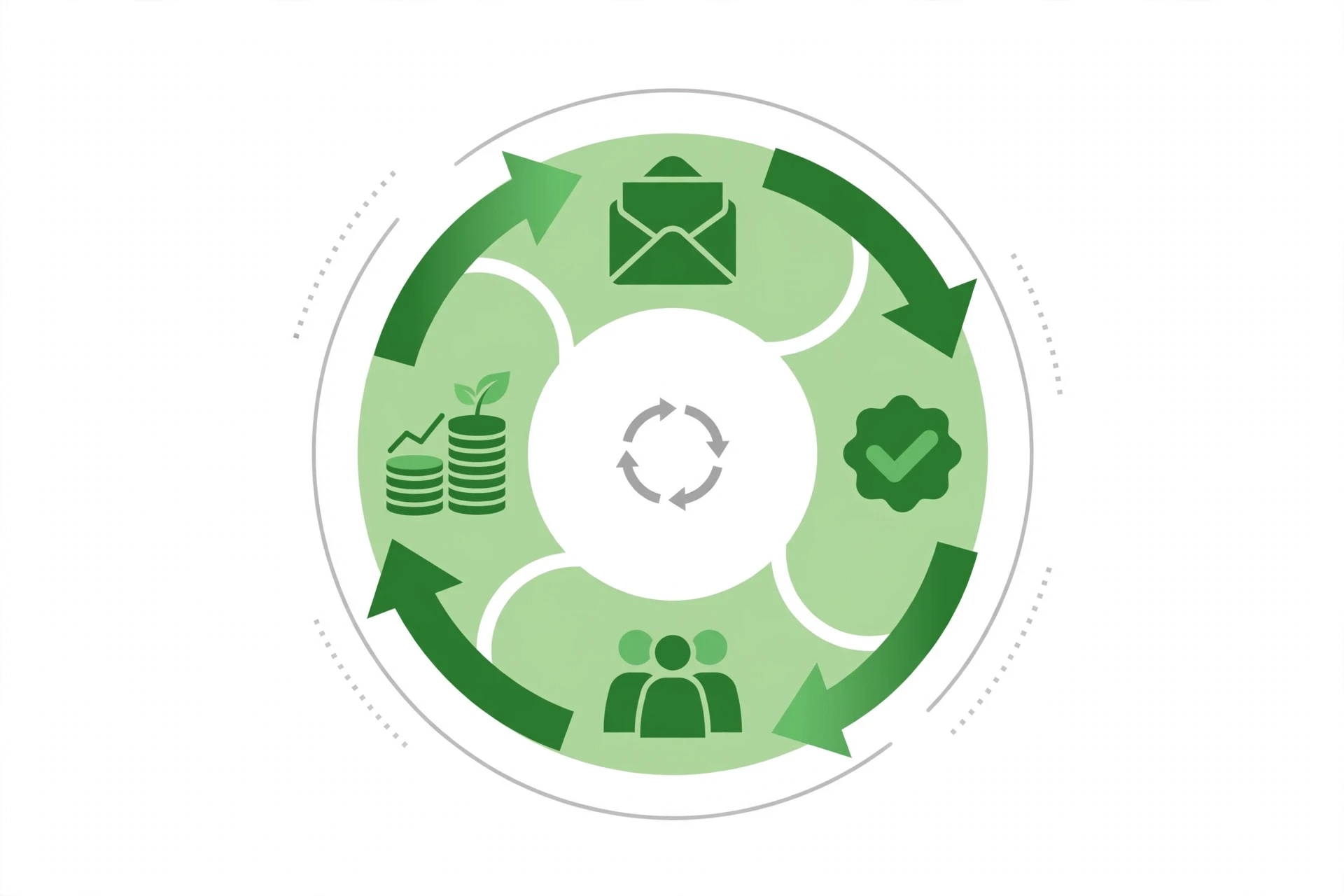
Step back and look at what these seven plays build together. A parent searches in confusion and finds your explainer (Play 1, Play 2). Their employer announces the benefit using your toolkit (Play 3). Your scam-awareness content makes you the trusted name (Play 4). A school workshop reaches the family advertising never would (Play 5). Your claim journey walks them through activation (Play 6). Your timed media catches each new wave of parents (Play 7).
That is the Trump Accounts 2026 flywheel: each turn deepens a relationship measured not in clicks but in years. A claimed account for a newborn is an eighteen-year conversation — birthday contribution reminders, 529 comparison guides at kindergarten, first-job investing content at sixteen.
The institutions that enter the relationship at the claim moment inherit the entire downstream lifetime value: the family’s deposits, the child’s first accounts, the referrals to other young parents. Customer acquisition cost in financial services is brutally high; here, the government just paid most of it for you. The only question is who shows up to collect.
What to Avoid: Market a Financial Product Like One
A quick cautionary section, because financial marketing carries obligations that a sneaker launch does not:
Compliance is the campaign. Financial advertising is regulated — claims about growth, returns, or tax treatment must be accurate, balanced, and properly disclosed. Every piece of Trump Accounts 2026 content your brand publishes should pass legal review before it ships, especially anything describing the $1,000 seed, contribution limits, or tax-deferred status. A viral explainer with one wrong number is a liability, not an asset.
Never promise outcomes. Tax-deferred growth is a feature of the account structure, not a guarantee of returns. Marketing that implies a child “will have” a certain balance at 18 invites regulatory trouble and erodes the exact trust you are trying to build. Describe mechanics, not destinies.
Stay neutral and factual. Trump Accounts 2026 is a federal program with a politically charged name. The winning brand posture is boring on purpose: explain Trump Accounts 2026 as the program exists today, serve every eligible family, and keep partisan framing out of your creative entirely. Families across the political spectrum hold these accounts; your marketing should welcome all of them.
Protect the data you collect. Eligibility checkers and claim journeys collect sensitive family information. Publish a clear privacy notice, minimize what you ask for, and never use children’s data for purposes beyond what the parent consented to. In financial services, a privacy misstep does not just cost fines — it permanently forfeits trust.
Do not invent urgency that is not there. The program’s real deadlines and real mechanics are compelling enough. Manufactured countdowns (“claim in 48 hours or lose everything”) will be fact-checked by competitors, journalists, and regulators alike — and the brand caught exaggerating becomes the cautionary tale.
The Playbook, Summarized
The Trump Accounts 2026 moment rewards the same fundamentals that win every market disruption: move while attention is rising, explain better than anyone else, borrow trust from employers and communities, protect the audience from harm, build the journey that converts intent into action, and buy media on the program’s calendar instead of your own. Underneath it all, a flywheel turns confusion into claimed accounts, claimed accounts into relationships, and relationships into decades of lifetime value.
Sixty million families just received a Trump Accounts 2026 product they did not ask for and barely understand. Someone is going to be the brand that helps them through it. Make sure it is you.
If you want a campaign built for moments like this — rapid-response content, lifecycle journeys, and paid media timed to real-world attention spikes — KKeyQik designs financial services marketing programs that turn breaking developments into lasting customer relationships. The enrollment wave is happening now; the brands that move this month will own this audience for years.
Want to put this to work for your business? KKeyQik plans and delivers website copy, blog posts and other content for small businesses, with an in-house team available 24/7. See our content writing service or get a quote within 24 hours.
Frequently Asked Questions
Trump Accounts are tax-deferred investment accounts for American children under 18 who hold Social Security numbers. Created by the One Big Beautiful Bill Act and launched on July 4, 2026, they are designed to give every eligible child an invested stake from an early age, with accounts administered through a dedicated app and platform.
Any U.S. child under 18 with a Social Security number is eligible. In October 2026, the Treasury began automatically enrolling eligible children under temporary regulations, a move the Treasury says has already created more than 60 million accounts.
Children born between January 1, 2025, and December 31, 2028, qualify for a one-time $1,000 Treasury seed contribution as part of a pilot program. Importantly, automatic enrollment alone does not trigger the deposit — a parent or guardian must claim the account through the Treasury's application and verify identity and legal authority.
Yes. Auto-enrolled accounts start out limited to government and nonprofit contributions. To unlock the $1,000 seed contribution and enable contributions from family members, friends, and employers, a parent or guardian needs to claim the account through the official application.
Families, friends, and employers can contribute up to $5,000 per year in total, including as much as $2,500 from an employer. Treasury rules also allow direct stock donations to the accounts, subject to a five-year holding period before sale.
Yes — up to $2,500 per child per year can come from an employer. Around 50 major companies have already committed to contributing for employees' children, with some, like Goldman Sachs, pledging to match the $1,000 federal seed contribution.
Both are long-term savings vehicles for children, but they serve different purposes. 529 plans are built specifically for education expenses with tax-free withdrawals for qualified costs, while Trump Accounts are broader investment accounts that convert to traditional IRA-style accounts when the child reaches adulthood. Many families may end up using both side by side.
New federal programs always attract fraud, and families should be cautious. The government will never ask for account credentials by text message, claiming happens only through the official application, and no legitimate representative charges a fee to unlock the $1,000 deposit. When in doubt, verify through official Treasury channels.
The most effective plays are educational: publish clear explainers while search interest is surging, equip employers with benefits toolkits, partner with schools and nonprofits to reach underserved families, build email journeys that help parents claim auto-enrolled accounts, and time paid media to the program's calendar of enrollment moments.
Right now. October 2026 brought the auto-enrollment surge, and the calendar ahead includes the Social Security Administration's hospital-registration rollout for newborns and the tax-season revival of enrollment searches. Brands that publish and buy media while attention is rising will own this topic far more cheaply than latecomers.