

In September 2026, the Federal Trade Commission confirmed that Amazon had issued more than $845 million in automatic refunds to eligible Prime customers — part of a landmark $2.5 billion settlement over how the company enrolled shoppers in Prime and how hard it made it to cancel. The payments keep flowing: under a revised court order approved in September 2026, automatic refunds continue through April 2027. Search interest spiked hard enough to land “amazon ftc refund september 2026” on Google’s active US trends list.
If you sell or advertise on Amazon, this story is not just regulatory news to scroll past. It is a live case study in the two forces that now decide who wins in ecommerce: customer trust and advertising transparency. And in the same season, the FTC and 22 states filed a separate lawsuit accusing Amazon of quietly inflating what advertisers paid in its Sponsored Ads auctions — allegedly extracting more than $20 billion from roughly 1.2 million advertisers since 2019, over half a million of them small and medium-sized businesses.
Two enforcement actions. One platform. A clear message for every brand doing business inside Amazon’s ecosystem: the era of “growth at any cost” interface design and opaque ad pricing is over. This guide breaks down seven ecommerce marketing lessons from the Amazon FTC refund wave that sellers and advertisers can apply right now — whether you run a seven-figure Amazon store or are just testing the marketplace for the first time. The brands that treat trust as a growth channel, not a compliance chore, are the ones that will come out of this cycle stronger.
What Actually Happened: The Amazon FTC Refund Wave in Plain Terms
Before the lessons, the facts — because getting them straight is half the value of the Amazon FTC refund story.
In September 2025, Amazon agreed to a $2.5 billion settlement with the FTC to resolve allegations that it enrolled tens of millions of consumers in Prime subscriptions without their clear knowledge or consent and made cancelling unreasonably difficult. The deal required $1.5 billion in consumer refunds, a $1 billion civil penalty, and an order to stop the disputed enrollment and cancellation practices. Amazon did not admit wrongdoing, and an independent supervisor monitors The Amazon FTC refund program, which Amazon itself administers using its own billing records.
A federal court approved a revised Amazon FTC refund order in September 2026 that expanded who gets paid: customers who used between 11 and 20 Prime benefits in a year — previously excluded — began receiving automatic payments on October 1, 2026. Refunds arrive by mailed check, PayPal, or Venmo, and nothing needs to be filed; the claims window closed on July 27, 2026. The per-person cap rose from $51 to $200 total, and if accepted payments fall short of the required threshold by February 2027, a supplemental round of up to $149 per person could begin by April 2027. The FTC’s own refunds page confirms more than $845 million had already been paid out by September 2026.
Running in parallel, on August 31, 2026, the FTC and the attorneys general of 22 states sued Amazon in federal court in Washington state over its advertising auctions. The complaint alleges that starting in 2019, Amazon inserted undisclosed “soft reserve” prices into its Sponsored Products, Sponsored Brands, and Sponsored Display auctions — effectively converting what advertisers were told were second-price auctions (winner pays a penny more than the runner-up) into auctions where winners paid their full bid.
Per the complaint, advertisers paid their own maximum bid 30 to 40 percent of the time in 2021, about 70 percent in 2022, and roughly 80 percent by 2024. Amazon rejects the claims, saying no advertiser ever paid more than its chosen bid ceiling, that reserve prices are standard practice, and that its inflation-adjusted average cost per click stayed flat from 2019 through 2024 while conversion rates rose. These are allegations, not findings — but they are the allegations now shaping every advertiser’s audit checklist.
That is the full picture behind the Amazon FTC refund headlines: a consumer trust case that became the largest refund program of its kind, and an advertiser pricing case that asks whether the auctions sellers bid in worked the way they were described. Both carry ecommerce marketing lessons. Here are seven.
Amazon FTC Refund Timeline: The Key Dates Sellers Should Know
The Amazon FTC refund story unfolded over two years. Keep these dates straight and the lessons land harder:
- September 2025 — The $2.5 billion Amazon FTC refund settlement is agreed: $1.5 billion in consumer refunds, a $1 billion civil penalty, and an order to end the disputed enrollment and cancellation practices.
- November 2025 — Amazon begins sending the first Amazon FTC refund payments to eligible Prime customers.
- January 2026 — Claim notices go out; the Amazon FTC refund claims process opens for eligible shoppers.
- July 27, 2026 — The Amazon FTC refund claim-filing window closes. From here on, every remaining payment is automatic.
- August 31, 2026 — The FTC and 22 states file the Sponsored Ads pricing suit, giving the Amazon FTC refund story a second front on the advertiser side.
- September 2026 — A federal court approves the revised Amazon FTC refund order: eligibility expands to the 11–20 Prime-benefit tier, the per-person cap rises to $200, and the FTC confirms more than $845 million paid. “Amazon FTC refund September 2026” lands on Google’s active US trends.
- October 1, 2026 — Automatic Amazon FTC refund payments begin for the newly eligible 11–20 benefit group.
- February 2027 — The threshold check that decides whether supplemental Amazon FTC refund payments (up to $149 per person) go out.
- April 2027 — The final Amazon FTC refund payment rounds conclude.
Lesson 1: Dark Patterns Convert — Until They Cost $2.5 Billion
The FTC’s case against Amazon’s Prime enrollment was, at its core, a case about interface design. The complaint described sign-up flows that exploited how shoppers actually read screens — burying auto-renewal terms where mobile users would not see them, and presenting a decline option worded as “No, I don’t want Free Shipping,” which made the “no thanks” button sound like a punishment. On the cancellation side, internal documents showed employees themselves describing the process with words like “a bit of a dark pattern”: subscribers were routed through a maze of screens, retention offers, and warnings before they could complete a cancellation.
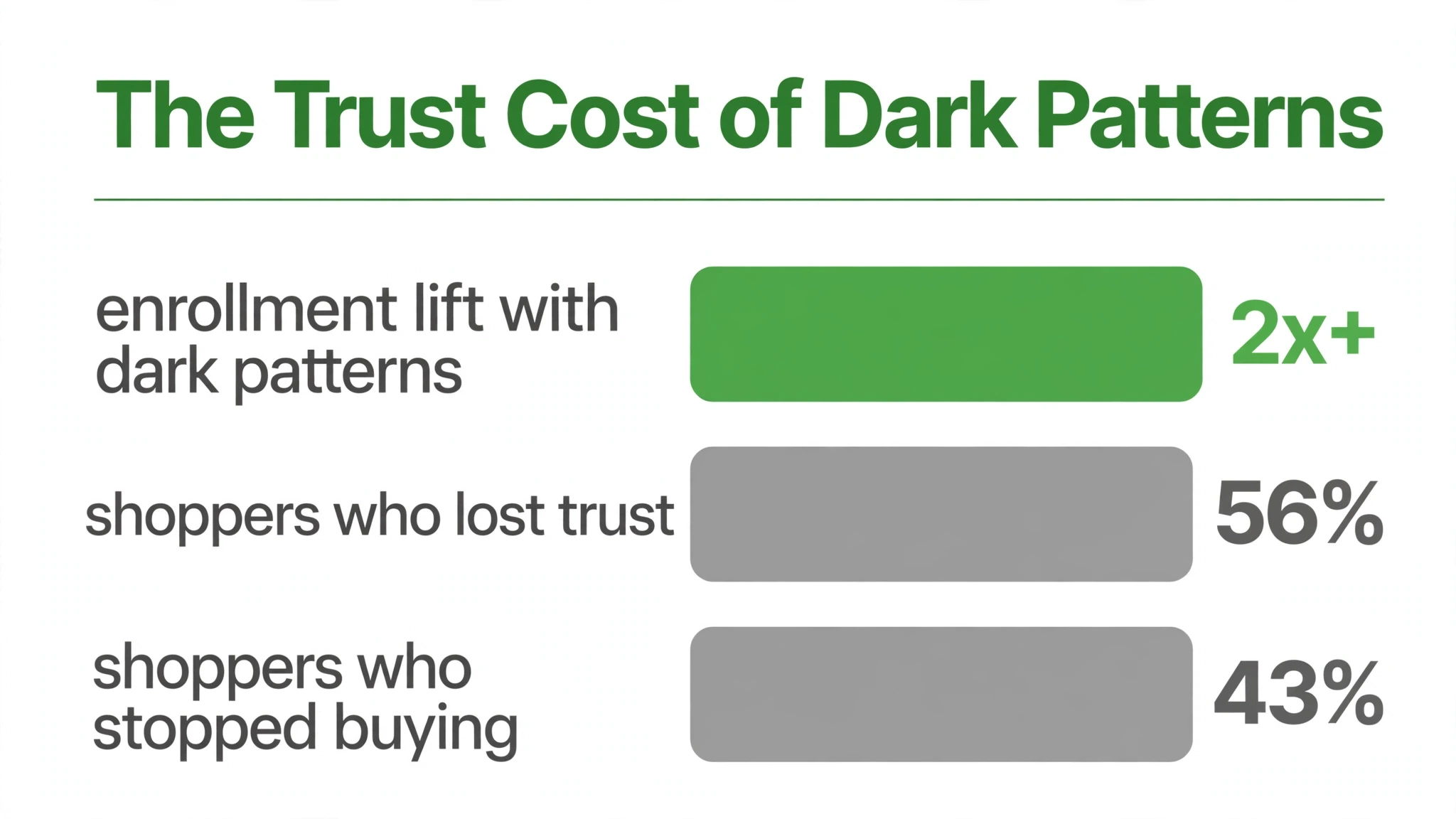
This is the dark-pattern trap, and it is the first ecommerce marketing lesson of the Amazon FTC refund wave: design tricks that juice short-term conversion have a long-tail cost. They work — research has shown that consumers exposed to manipulative interface design were more than twice as likely to enroll in a subscription than a neutral control group, with aggressive designs pushing that to nearly fourfold. An FTC and international-consumer-protection sweep of 642 subscription platforms across 26 countries found 76 percent used at least one dark pattern. Cambridge research found pre-selected options raise acceptance by more than 27 percent on average. The machinery is effective. That is precisely why it is dangerous.
Because the bill eventually comes due, and it is bigger than the gains. Beyond the $2.5 billion, there is the trust data: 56 percent of consumers say they lost trust in a website after encountering manipulative design, and 43 percent stopped buying from that retailer entirely. For a small ecommerce brand, that math is brutal. A dark pattern might lift your trial sign-ups this quarter — but if nearly half of the people who notice it never buy from you again, you have traded a renewable customer relationship for a one-time conversion. Amazon could absorb a $2.5 billion lesson. Your store cannot.
Audit your own funnels the way a regulator would. Read your checkout and sign-up flows on a phone, screen by screen, asking one question: would a hurried, distracted customer understand exactly what they are agreeing to? Kill pre-checked add-ons. Make the “no” button as honest as the “yes” button. State the price, the renewal date, and the cancellation path before the customer pays — not three screens later. The Amazon FTC refund saga is proof that the most expensive words in ecommerce are the ones hidden in small print. Transparency is not the enemy of conversion; in a market where shoppers have learned to distrust the fine print, it is becoming the conversion advantage.
Lesson 2: Make Cancelling as Easy as Signing Up — It Builds Retention, Not Just Compliance
The second ecommerce marketing lesson from the Amazon FTC refund case flips the usual fear on its head. Most subscription businesses resist one-click cancellation because they assume friction saves revenue. The evidence — and the enforcement trend — says the opposite is now true.
Regulators have made the symmetry principle explicit: cancelling should be as simple as signing up. The FTC’s Restore Online Shoppers’ Confidence Act has powered 47 enforcement actions since 2020, and while a court vacated the agency’s broader click-to-cancel rule in 2025 on procedural grounds, enforcement has only accelerated through individual cases — against Amazon, JustAnswer, Uber, Chegg, and LA Fitness, among others. States including California, Colorado, Connecticut, Massachusetts, Minnesota, New York, and Utah have tightened their own statutes. The direction is unmistakable: hard-to-cancel is now a liability, not a strategy.
But the business case is stronger than the legal one. Think about what a painful cancellation flow actually teaches a customer. It teaches them that your brand cannot be trusted with their money — the exact opposite of what a subscription needs to survive. Customers who cancel easily and are treated well on the way out re-subscribe at far higher rates than customers who had to fight their way out, because the memory attached to your brand is “they were fair,” not “they trapped me.” Every cancelled subscriber who leaves with their trust intact is a win-back campaign waiting to happen; every one who leaves angry is a chargeback, a one-star review, and a complaint to the FTC.
Put this into practice this week. Add a visible “manage subscription” link in your account area and every billing email. Let customers cancel in the same number of clicks it took to subscribe — two or three, not twelve. Send a confirmation the moment a cancellation completes, and honor it immediately in your billing system. Then do what the smart subscription brands do: follow the easy cancellation with a genuine win-back sequence — a “here is what you will miss” summary, a pause option, a discount for returning — sent after the customer has had space to breathe. The Amazon FTC refund story shows where the friction-first playbook ends. The retention-first playbook starts with the radical idea that letting people leave gracefully is how you earn the right to ask them back.
Lesson 3: Your Store Rents Amazon’s Trust — a Refund Wave Shakes the Whole Building
Here is an ecommerce marketing lesson most Amazon sellers miss: customers do not cleanly separate the platform from the seller. When headlines say Amazon enrolled tens of millions of people in Prime without clear consent, the shopper reading that headline does not think “that was the subscription team in Seattle.” They think “Amazon,” full stop — and your product listing, your Sponsored Products ad, and your brand store all sit inside that trust halo.
That is the double-edged reality of marketplace selling. Amazon’s brand does enormous lifting for you: the Prime badge, the review system, the one-click checkout, the generous returns — all of it borrows credibility to your listings. But borrowed credibility cuts both ways. During a trust event like the Amazon FTC refund wave, marketplace skepticism rises across the board. Shoppers scrutinize listings more closely, question prices more aggressively, and trust star ratings a little less. Sellers who have built their own trust signals inside the marketplace feel this least; sellers who coasted on the platform’s aura feel it most.
So build trust assets that belong to you, not the platform. Keep your pricing honest and consistent — no inflated “was” prices, no review manipulation, no fake urgency on listings. Answer customer questions in the Q&A section thoroughly and in your brand’s voice; it is one of the few places your personality shows through. Make your product images and A+ content genuinely informative rather than hype-driven, because an informed buyer is a buyer who does not return the product.
And run your off-Amazon presence — your own site, your email list, your social channels — as the trust anchor your marketplace listings point back to. Brands with a real website and a real story convert Amazon traffic better and survive platform trust shocks that sink anonymous resellers. If you are investing in search engine optimization for your own domain, this is exactly the kind of brand-equity content that compounds: a trustworthy site makes every marketplace impression convert harder.
The deeper point: platform risk is real, and diversification is the hedge. The sellers who weathered past Amazon fee hikes, policy changes, and Buy Box wars were the ones with direct customer relationships. Use every marketplace sale as the start of a direct relationship — inserts that invite (never bribe) reviews, packaging that tells your story, and a brand presence worth remembering. Amazon’s $845 million in refunds is a reminder written in nine figures: the platform’s trust is rented, and the rent just went up for everyone. Own as much of your customer relationship as the rules allow.

Lesson 4: Audit Your Ad Spend Like the FTC Audited Amazon
The August 2026 advertising lawsuit carries the sharpest ecommerce marketing lesson for anyone running paid advertising campaigns: never assume the auction works the way the help docs describe it.
The FTC’s core claim is technical but worth understanding. In a true second-price auction, the winner pays just above the runner-up’s bid — so a $5 bid against a $3 rival costs about $3.01. The complaint alleges Amazon’s undisclosed “soft reserve” — described in internal documents as an “invented auction participant” — pushed the price the winner paid above what real competing bids would have produced, so advertisers increasingly paid their entire bid. The share of Sponsored Products advertisers paying their own full bid allegedly rose from 30–40 percent in 2021 to about 80 percent in 2024, with surcharges climbing further on high-volume days like Prime Day and Black Friday. The FTC says more than $20 billion was extracted from roughly 1.2 million advertisers, including over 500,000 small and medium-sized businesses.
Amazon’s defense is equally worth hearing: the company says no advertiser ever paid more than the maximum bid it chose, that reserve prices are standard auction mechanics, that relevance ranking saved advertisers an estimated $8 billion, and that inflation-adjusted average cost per click was flat from 2019 to 2024 while conversions rose 24 percent from 2021 to 2025. It also says it updated its Amazon Ads help content to explain reserve prices explicitly after the FTC raised concerns. The court will decide who is right. But you do not need to wait for a verdict to take the practical lesson: audit what you actually pay, because the gap between auction theory and auction reality is where margins quietly disappear.
Start with your own records — which, notably, the FTC’s case suggests preserving from 2019 onward in case any relief process ever opens. Pull your Sponsored Products search-term reports and look at your effective cost per click against your bids: if your average CPC routinely sits at or near your max bid across competitive terms, you are paying first-price economics regardless of what the auction is called. Benchmarks help here: recent industry data put pet-category CPC around $1.88, up nearly 13 percent year over year, with ROAS down about 17 percent to 3.28x — useful context for whether your own trends are a you-problem or a market problem. Trim bids on terms where the CPC-to-margin math fails, segment branded from non-branded spend so you can see true incremental cost, and watch pricing closely around Prime Day and Black Friday, when the complaint alleges surcharges ran hottest.
And keep perspective: there is no reason to abandon the channel over a pending lawsuit. Amazon’s ad business did $68.6 billion in 2025 revenue — it remains one of the highest-intent advertising environments on earth. The lesson is not “stop spending.” It is “spend like an auditor”: measure actual CPC against bid, track ROAS by campaign type rather than account average, and test other marketplaces with small budgets so you have a comparison baseline. The advertisers who will benefit most from whatever this case produces — more disclosure, changed auction rules, or nothing at all — are the ones who already know their numbers cold.
Lesson 5: Newsjack the Moment — Refund Headlines Are Free Attention for Honest Brands
Every enforcement wave creates a surge of shopper attention, and attention is inventory. The fifth ecommerce marketing lesson from the Amazon FTC refund story is that honest brands can newsjack a trust crisis — carefully — while opportunists get burned.
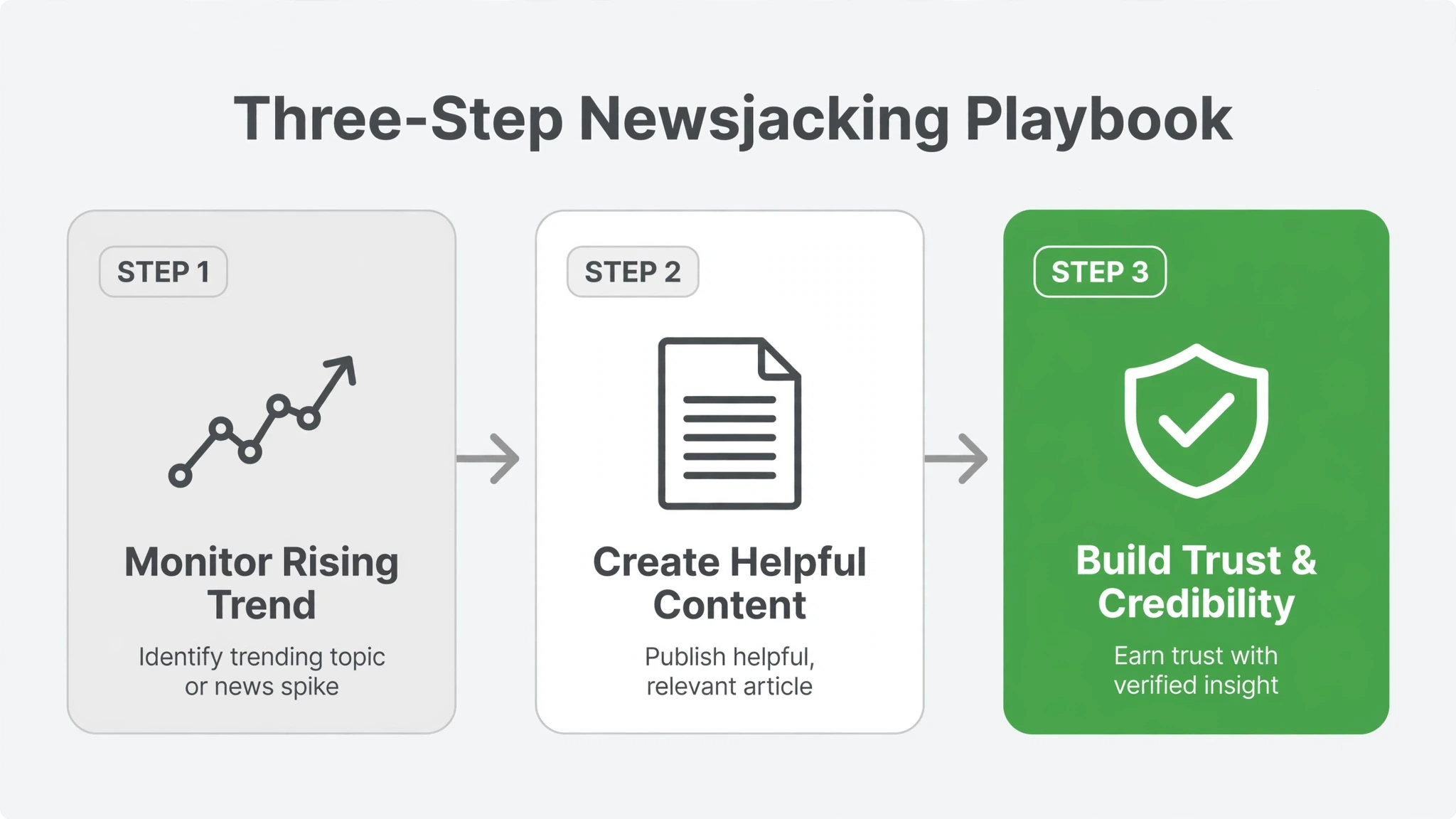
The mechanism is simple: when “amazon ftc refund” trends, millions of shoppers are actively thinking about Amazon billing, subscriptions, and refunds. A seller who publishes genuinely useful content into that conversation earns attention that would normally cost ad dollars. The key word is genuinely. The playbook that works is service journalism for your niche: “How to check whether your Prime refund arrived,” “What the Amazon refund news means for marketplace shoppers,” “Why your favorite small brands sell on Amazon anyway.” Content like this ranks, gets shared, and positions your brand as the adult in the room.
There is also a legitimate promotional angle, and it runs through contrast. Shoppers burned by subscription traps are actively looking for brands that do the opposite. If your business offers one-time purchases with no auto-renewal, say so plainly on your listings and your site — “no subscription, no auto-renew, cancel anytime” is a trust badge in 2026. If you run a subscription, publish your cancellation policy where customers can find it in one click and mention it in your product copy. In a market where the dominant platform just paid $2.5 billion over subscription practices, radical billing transparency is not just ethics — it is differentiation. Brands that make “easy to leave” part of their value proposition are converting the exact customers Amazon’s headlines are alienating.
What not to do: do not claim any affiliation with The Amazon FTC refund program, do not promise customers they will get refunds, and do not use the settlement as a scare tactic to poach (“Amazon is stealing from you — buy from us instead”). Regulators punish deceptive marketing built on real enforcement news just as readily, and shoppers smell opportunism instantly. The line is bright: educate and differentiate, never exploit. Done right, newsjacking a moment like the Amazon FTC refund wave builds the asset every small brand needs most — a reputation for straight talk in a marketplace full of fine print.
Lesson 6: Scammers Move Faster Than Brands — Protect Your Customers Before They Do
Every large refund program spawns a shadow industry of scams, and the Amazon FTC refund wave is no exception. The FTC has warned explicitly that Amazon will not call, text, or email consumers about their refunds to demand money or information, and that no legitimate representative requests payment to process a refund. Yet scammers are already impersonating The Amazon FTC refund program — phishing emails, fake claim portals, and phone calls targeting people who heard the headlines and are waiting for money.
This is the sixth ecommerce marketing lesson, and it is a brand-safety one: when criminals impersonate the ecosystem you sell in, your customers’ safety becomes your marketing problem. A shopper who gets phished by a fake “Amazon refund” email does not carefully attribute the blame to criminals; the emotional residue lands on Amazon and, by extension, on the sellers in its marketplace. Proactive brands turn this into a trust-building moment instead of a trust leak.
The playbook is straightforward and cheap. Publish a short, clear scam-warning post on your site and pin it on your social channels: real Amazon refunds arrive only by mailed check, PayPal, or Venmo; electronic payments must be accepted within 30 days and checks cashed within 60; The Amazon FTC refund claim-filing window closed on July 27, 2026, so any message urging you to “file now” or pay a fee is a red flag; the FTC never contacts individuals about refunds. Link to the FTC’s official Amazon refunds page so customers have one authoritative source. Then go one step further: tell your own customers exactly how YOU will and will not contact them about billing — “we will never ask for your password or payment details by email” — and put it in your order confirmation emails. It costs nothing and it inoculates your audience.
For sellers, there is a secondary angle: monitor your own brand for impersonation. Set up alerts for your brand name plus “refund” or “support,” watch for fake customer-service numbers posted in review sections or Q&A, and report impersonator listings promptly. In a refund-news cycle, the brands that visibly protect their customers earn a kind of loyalty that discounts cannot buy. Trust is the product every honest seller is really selling — and scam season is when customers notice who is looking out for them.
Lesson 7: Compliance Is a Marketing Asset Now — Wear It Proudly
The final ecommerce marketing lesson from the Amazon FTC refund saga is the one that reframes everything above: in 2026, compliance is not the legal department’s problem. It is a go-to-market advantage.
Look at the enforcement landscape. The FTC has brought dozens of actions under the Restore Online Shoppers’ Confidence Act. States from California to New York keep tightening subscription and auto-renewal statutes. Europe is fining platforms hundreds of millions over consent interfaces. The direction of travel is global and one-way: regulators now judge interface design by its effect on the user, not by the company’s intent. A growth team that treats consent UX as a conversion hack is building on regulatory quicksand.
Smart brands are flipping this into positioning. Put your billing terms in plain language on the product page, not buried in terms of service. Publish a one-page “how billing works” explainer and link it from checkout. Get explicit, unbundled consent for every recurring charge — separate checkbox, separate from the purchase button, no pre-ticked boxes. Keep timestamped consent records so you can prove what the customer agreed to. None of this is exotic; it is simply what the law increasingly requires and what customers increasingly reward. Then market it: “Clear billing. Cancel in two clicks. No dark patterns, ever.” In a post-settlement market, that sentence is a competitive claim backed by the industry’s biggest cautionary tale.
There is a compounding effect here that the Amazon FTC refund story makes visible. Every enforcement headline raises the baseline of consumer skepticism — and simultaneously raises the premium shoppers place on brands that are transparent by design. The sellers who invested in honest UX, clean billing, and real consent flows before they were forced to now get to market that investment at exactly the moment it is worth the most. Compliance done early is a sunk cost that pays dividends; compliance done after an enforcement action is a fine. The $2.5 billion question for your business is simple: which side of that line do you want to be on?
The Bottom Line: Trust Is the New Conversion Rate
The Amazon FTC refund wave will fade from the headlines. The automatic payments will finish by April 2027, the Amazon FTC refund-era auction lawsuit will grind through the courts, and shoppers will move on to the next story. But the shift underneath is permanent: ecommerce has entered the trust era, where interface honesty, billing transparency, and ad-spend accountability are not nice-to-haves but the actual mechanics of growth.
The seven lessons compress to one operating principle. Design like the customer is watching, because they are — and so are the regulators. Price your ads like an auditor, because the auction may not work the way the brochure says. Build trust assets that belong to your brand, not the platform, because platform trust is rented. And when the news cycle hands you a moment, meet it with useful honesty, not opportunism.
For sellers and advertisers navigating all of this, the work is concrete: an honest checkout, a two-click cancellation, a real ad-spend audit, a scam-warning post, and a brand story worth trusting. That is a week’s worth of projects that pay for years.
If you would rather have a team that lives in this stuff — paid advertising audits, conversion-focused web design, SEO that builds brand equity, and social media that earns trust instead of renting attention — that is what we do every day. Talk to KKeyQik about turning the trust era into your growth era.
Amazon FTC Refund Cheat Sheet: 7 Moves for This Week
Short on time? Here is the Amazon FTC refund playbook in one list:
1. Audit your signup flows — the Amazon FTC refund case started with a confusing “No, I don’t want Free Shipping” button. Make your “no” as honest as your “yes.”
2. Match cancellation to signup — two or three clicks, a confirmation email, honored immediately. The Amazon FTC refund era rewards graceful exits.
3. Build your own trust signals — honest pricing, real reviews, an off-Amazon brand presence. Platform trust is rented; the Amazon FTC refund wave proved the rent can spike.
4. Pull your ad auction data — check effective CPC against your bids from 2019 onward. The Amazon FTC refund headlines share the news cycle with an ad-pricing lawsuit; know your numbers before anyone else does.
5. Publish one helpful newsjacking post — answer the questions shoppers are asking about the Amazon FTC refund story, in your niche, in your voice.
6. Warn your customers about refund scams — real Amazon FTC refund payments arrive by check, PayPal, or Venmo only; anything asking for money or “file now” fees is fraud.
7. Market your compliance — plain-language billing, unbundled consent, no pre-ticked boxes. Post-Amazon FTC refund, transparency is a conversion asset. Say so out loud.
Want to put this to work for your business? KKeyQik plans and delivers websites, stores and landing pages for small businesses, with an in-house team available 24/7. See our web design service or get a quote within 24 hours.
Frequently Asked Questions
The Amazon FTC refund is a court-ordered refund program from Amazon's $2.5 billion settlement with the Federal Trade Commission over Prime subscription practices. The FTC alleged Amazon enrolled tens of millions of shoppers in Prime without their clear consent and made cancellation unreasonably difficult. The settlement requires $1.5 billion in consumer refunds plus a $1 billion civil penalty, and Amazon must stop the disputed enrollment and cancellation practices.
Under the revised court order, eligible consumers are U.S. Prime customers who signed up through a challenged enrollment flow — or tried to cancel through the online flow but could not — between June 23, 2019 and June 23, 2025, and who used no more than 20 Prime benefits in any 12-month period after enrolling. Amazon determines eligibility from its own billing records, so shoppers do not have to prove which signup screen they used.
The revised September 2026 order raised the total per-person cap to $200, up from $51 in the earlier rounds. People who used between 11 and 20 Prime benefits in a year — previously excluded — began receiving automatic payments on October 1, 2026. If total accepted payments fall short of the required threshold by February 2027, a supplemental round of up to $149 per person could begin by April 2027.
No. The claim-filing window closed on July 27, 2026, and every remaining payment is sent automatically — there is nothing to file and no form to submit. Payments arrive by mailed check, PayPal, or Venmo based on the contact information Amazon has on file. Electronic payments must be accepted within 30 days and checks cashed within 60 days, so eligible shoppers should watch their inboxes and mailboxes.
Amazon will continue sending automatic refunds through April 2027 under the revised settlement order. The FTC confirmed that more than $845 million had already been paid out by September 2026. The final supplemental round — if triggered by the February 2027 threshold check — would also be distributed automatically, with no action needed from eligible consumers.
The FTC warns that Amazon will never call, text, or email you about your refund to demand money or personal information, and no legitimate representative will ask you to pay a fee to process a refund. Treat any message urging you to "file now" or pay a fee as fraud, since the claim window closed on July 27, 2026. Real payments come only by mailed check, PayPal, or Venmo — verify any electronic payment by logging into your PayPal or Venmo account directly rather than clicking links in messages.
On August 31, 2026, the FTC and 22 state attorneys general sued Amazon, alleging it secretly inserted undisclosed "soft reserve" prices into its Sponsored Products, Sponsored Brands, and Sponsored Display ad auctions starting in 2019. The complaint claims this turned what advertisers were told were second-price auctions into auctions where winners paid their full bid — allegedly extracting more than $20 billion from roughly 1.2 million advertisers. These are allegations, not court findings, and Amazon denies them.
Dark patterns are interface design choices that manipulate shoppers into decisions they might not otherwise make — such as pre-checked add-ons, misleading decline buttons, hidden auto-renewal terms, or cancellation flows far harder than signup. An FTC and international-consumer-protection sweep found 76 percent of subscription sites used at least one dark pattern. Research shows 56 percent of consumers lost trust in a website after encountering manipulative design and 43 percent stopped buying from that retailer entirely.
Build trust signals that belong to your brand rather than the platform: honest pricing with no inflated "was" prices, genuinely informative product images and listing content, and thorough answers in the customer Q&A section. Maintain a real off-Amazon presence — your own website, email list, and social channels — so shoppers can verify you independently. Using marketplace sales as the start of a direct customer relationship is the best hedge against platform trust shocks.
Start by preserving billing, campaign, and bid records from 2019 onward in case any relief process opens in the future. Then audit your own numbers: compare effective cost per click against your max bids in search-term reports, segment branded from non-branded spend, and trim terms where the CPC-to-margin math fails. There is no reason to abandon the channel over a pending lawsuit — keep campaigns that meet your profit targets and treat the case as a prompt to spend like an auditor, not a verdict.