

On September 22, 2026, Beats did what it has done better than almost any consumer brand for the past two decades: it turned a hardware announcement into a cultural event. The new Beats 360 — the company’s first customizable over-ear headphone at $349.99 — went from press release to Google’s US trending list in a matter of hours, racking up more than 20,000 searches at 600% above its normal baseline and still climbing as of this writing. A masterclass in product launch marketing, unfolding in real time.
But here is the part most business owners miss: the headphones are only half the story. The other half is the product launch marketing machine behind them — the positioning, the pricing theater, the creator buzz, the search spike engineering — that took a piece of consumer electronics and made it trend alongside breaking news and celebrity names. That machinery is not magic. It is a repeatable playbook, and businesses of every size can borrow from it.
In this guide, you will learn seven product launch marketing lessons drawn directly from the Beats 360 drop — what Beats got right, why it worked, and how to apply each lesson to your own product, service, or campaign. Whether you are launching software, opening a new service line, or releasing your first physical product, these product launch marketing examples 2026 tactics will help you think like a brand that knows how to make the internet pay attention. Consider this your field manual for product launch marketing in 2026.
First, the launch that started it all
Before the strategy breakdown, let us ground ourselves in what actually happened. According to the company’s announcement, the Beats 360 is a flagship over-ear headphone built around a brand-new acoustic platform, with custom dual-magnet drivers, adaptive noise cancellation Beats rates at up to 1.75 times the total cancellation of the Beats Studio Pro, an IPX4 sweat-and-water resistance rating — a first for a Beats over-ear — and up to 32 hours of battery life. It works across both iPhone and Android, with platform-specific extras on each side.
The genuinely new hook is customization: both the earcup and headband cushions can be swapped for different colors and materials, sold separately as Cushion Kits. Launch colors include Black, Cloud, Pink, and Sky. The headphones went on sale the day of the announcement, September 22, with wider retail availability starting September 24 — a tight, urgency-building window.
Beats also made a classic launch-day pricing move on the same day: it cut the price of the existing Studio Pro to $299.99, exactly fifty dollars below the new flagship’s $349.99 price. And within hours, “beats 360” was one of the fastest-rising searches in the United States. The product is real news. The marketing behind the product is the real story.
The brutal math: why product launch marketing matters more than the product
Here is the uncomfortable statistic every founder should memorize before a launch. Harvard Business School research, widely cited across the marketing world, estimates that roughly 30,000 new consumer products launch every year — and around 95% of them fail. Nielsen’s long-standing benchmark puts the new-product failure rate at about 85%. Different studies, same verdict: most launches die.
And here is the sharper point, made in a recent Inc. analysis of why brand launches fail: most of those deaths are not product problems. They are marketing problems. Companies pour months into engineering and manufacturing, then hand the launch to the marketing team with two weeks to go. As one frequently cited Harvard Business Review argument put it years ago — and it still holds in 2026 — the single biggest reason launches fail is lack of preparation on the go-to-market side.
That preparation gap is the entire game. A great product with a weak launch dies quietly. A good product with great product launch marketing gets a second, third, and fourth chance. That is why product launch marketing deserves its own budget line — not the leftovers of the media plan. The seven lessons below are what strong preparation looks like in practice, using the Beats 360 launch as the live case study.

Lesson 1: Launch the story, not the spec sheet
Read the Beats 360 announcement closely and notice what leads. Yes, the specs are there — three-layer diaphragms, dual neodymium magnets, nine microphones, a proprietary chip. But the headline of the launch is not an acoustic architecture. It is self-expression: “the first customizable over-ear headphone from Beats,” with interchangeable cushions in colors and materials that let owners restyle the product for workouts, commutes, and everything between.
This is product launch marketing lesson number one, and it is the one most small businesses get backwards. Customers do not buy drivers and diaphragms. They buy identity, belonging, and self-expression. Beats is selling the idea that your headphones can change with your mood, your outfit, your day — the hardware is just the delivery mechanism for that idea.
Translate this to your business. If you run a search engine optimization agency, you are not selling “technical audits and backlink profiles” — you are selling the feeling of outranking the competitor who has been beating you for three years. If you sell software, you are not selling features; you are selling the Friday afternoon your customer gets back. Before your launch, write the one-sentence story a customer would tell a friend. If that sentence contains a spec, rewrite it. Nail the story, and the rest of your product launch marketing gets dramatically easier.
Lesson 2: Engineer the pre-launch search spike
By the morning of September 23, “beats 360” was surging 600% above baseline on Google Trends US and still marked Active — meaning search interest was still rising, not peaking. That kind of spike does not happen by accident. It is the result of coordinated embargoes, launch-day press coverage across tech and lifestyle media, and a product page that went live the same hour as the announcement.
The product launch marketing takeaway: search interest is a launch asset you can manufacture. The mechanics are straightforward — brief media under embargo so coverage lands simultaneously, publish your own launch content the same day, and make sure your site is the best answer to the question everyone is suddenly asking. When thousands of people search a term for the first time, whoever owns the first page of results owns the narrative.
For smaller brands, these product launch marketing mechanics scale down beautifully. Tease the launch to your email list and social audience for two to three weeks. Coordinate a handful of friendly outlets, podcasts, or creators to publish on the same day. Time your press release, product page, and social posts to a single launch hour. You do not need 20,000 searches to win — you need your existing audience all paying attention at once, because simultaneous attention is what algorithms reward.
Lesson 3: Make pricing part of the narrative
The $349.99 price tag on the Beats 360 is doing quiet marketing work. First, it sits exactly at the premium-but-reachable threshold: expensive enough to feel flagship, not so expensive that it becomes a niche luxury. Second, and more cleverly, Beats cut the Studio Pro to $299.99 on the very same day. That is textbook price anchoring — the older model becomes the “value” option, the new model becomes the obvious step up, and the fifty-dollar gap makes the upgrade feel like a small leap rather than a big spend.
This is a product launch strategy move any business can copy. When you launch a new service tier, product, or package, never present the price in isolation. Anchor it against something: your previous offering, a competitor’s price, or the cost of the problem you solve. A number without context is just expensive. A number with context is a decision. That reframing is product launch marketing doing its job before a single ad runs.
One more pricing nuance worth stealing: the limited-time introductory price on the Cushion Kits ($9.99 at launch versus $49.99 standard). Launch-only pricing creates a second urgency trigger beyond the product itself — it rewards the early adopters who buy on day one and gives fence-sitters a reason to act now instead of “thinking about it.” If your launch includes add-ons, accessories, or upsells, put your sharpest price on day one. Pricing is product launch marketing, not just finance — treat it as a messaging decision.
Lesson 4: Refuse to fence your audience in
One of the most strategically interesting details of the Beats 360 launch: despite being owned by Apple, the headphones work fully across both iOS and Android, with Android-specific extras like Fast Pair and Find Hub alongside Apple’s one-touch pairing and Hey Siri. The messaging is unmistakable — this launch is for everyone, not just the Apple faithful.
Too many launches quietly shrink their own market. A B2B software company launches with “built for enterprise” messaging and scares off the mid-market buyers who would have converted faster. A local service launches with jargon that only insiders understand. Every fence you build around your launch cuts your addressable audience, and most of those fences are self-imposed.
The product launch marketing discipline here is audience expansion by design. Map every segment that could plausibly buy, then check your launch messaging against each one: does anything in your landing page, ad copy, or announcement accidentally tell a segment “this isn’t for you”? Beats could have made the 360 an Apple-ecosystem exclusive. Instead it made cross-platform compatibility a headline feature. Broaden the door, and more people walk through it — in product launch marketing, the widest open door usually wins.
Lesson 5: Ship with creators, not just ads
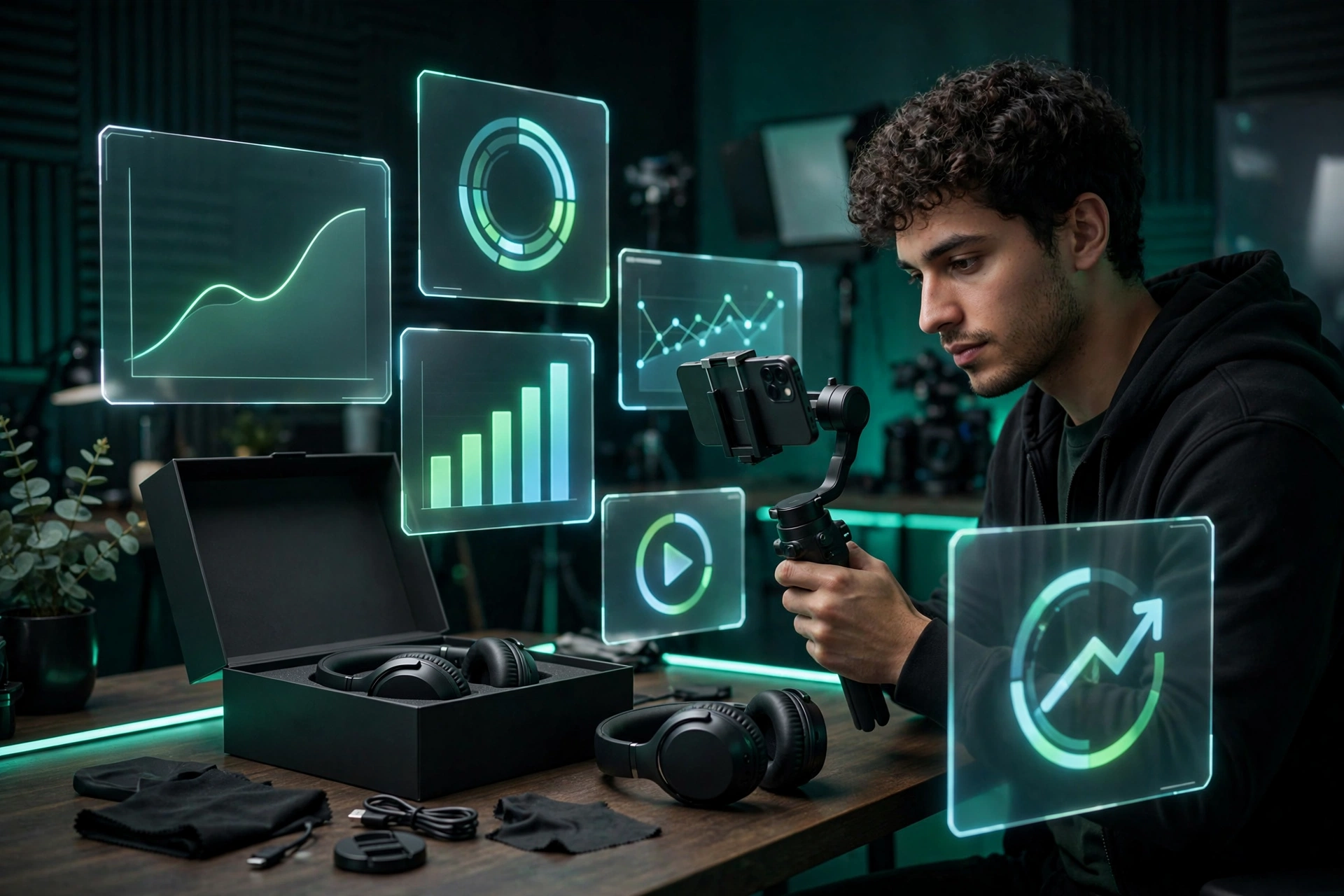
Notice what the Beats 360 is practically designed for: unboxing videos. Swappable cushions in six colors and two materials are a content creator’s dream — every color combination is a new video, every material comparison is a new review, every “which cushion should you buy” is a new piece of searchable content. Beats did not just launch a product; it launched a content format.
This is where modern product launch marketing diverges most from the old playbook. Paid ads buy attention; creators borrow trust. A launch-day video marketing push that puts your product in the hands of ten credible creators on day one will outperform a month of cold ads, because each creator brings an audience that already believes them. The unboxing, the first-impressions review, the comparison video — these formats do your positioning work for you, in the creator’s voice, to an audience you could never afford to reach one impression at a time.
The practical version for your launch: identify 10 to 20 creators, reviewers, or even enthusiastic customers in your niche before launch day. Give them early access, a clear embargo time, and — critically — something worth showing. Beats gave creators colorways and materials to play with. Give your creators a story to tell, not just a product to hold. Make creator seeding a line item in your product launch marketing budget from day one. Then amplify their content with your paid advertising campaigns — creator content consistently outperforms brand creative in paid social because it does not look like an ad.
Lesson 6: Build products that generate their own content
Lesson six is the deeper version of lesson five, and it is the smartest thing about the Beats 360 launch. Interchangeable cushions are not just a product feature — they are a user-generated content engine. Every customer who mixes Navy knit with a Cloud headband is a potential Instagram post. Every “my Beats 360 setup” photo is free advertising. The product markets itself every time someone personalizes it.
Ask yourself: does your launch give customers something worth showing? The most powerful product launch marketing examples 2026 all share this trait — the product creates artifacts that customers want to share. It might be a beautifully designed dashboard, a before-and-after transformation, a personalized result, or packaging worth photographing. If your product is invisible when used, your launch marketing has to work twice as hard. That is product launch marketing that compounds without additional spend.
For service businesses, the equivalent is the “showable outcome.” A web design agency launches a portfolio piece the client brags about. A marketing agency — like the team at KKeyQik — launches a campaign whose results the client screenshots and shares. Design your launch deliverable so that using it well is itself a shareable moment, and build the hashtag, the template, or the prompt that makes sharing effortless.

Lesson 7: Close the loop — measure, amplify, repeat
The final lesson is the one that separates a launch event from a launch engine. Beats will be watching the Beats 360 numbers obsessively in the coming weeks: search interest, sell-through, cushion kit attach rates, review sentiment, share of voice against Sony and Bose. And whatever works will get more budget; whatever doesn’t will get fixed or cut. The launch is not the end of the marketing. It is the beginning of the learning.
Your product launch marketing plan needs the same closed loop, defined before launch day. Decide in advance what success looks like: how many signups, what conversion rate, which traffic sources, what revenue target in the first 30 days. Instrument everything — UTM parameters on every link, a dedicated landing page, post-purchase surveys asking “how did you hear about us.” Then review weekly for the first month and reallocate aggressively toward what is working.
The compounding benefit is real: every launch makes the next one cheaper. The email list you built, the creators you seeded, the press relationships you formed, the search rankings you earned — all of it carries forward. Brands like Beats do not start from zero each launch, and neither should you. The best product launch marketing teams treat launch day as the starting line, not the finish line. Treat launch one as the foundation for launch two.
Your 90-day product launch marketing playbook
Theory is nice; execution is everything. Here is the condensed product launch marketing playbook distilled from the lessons above, sized for a small or mid-sized business launching in the next quarter. If you want to know how to launch a new product successfully, this is the sequence that works:
Days 1–30: Foundation
Write the one-sentence customer story (Lesson 1). Define your segments and check your messaging against each one for accidental fences (Lesson 4). Set your price with an anchor, and plan a launch-only offer for early buyers (Lesson 3). Define your success metrics and instrument your tracking now, not later (Lesson 7). Every one of these is product launch marketing infrastructure — invisible on launch day, decisive afterward.
Days 31–60: Seeding
Identify and brief your 10–20 creators or early-access customers under embargo (Lesson 5). Build the “showable” element of your product or service into the experience (Lesson 6). Prepare your launch-day content: landing page, press release, email sequence, social assets, and the search-optimized page that will capture launch-day queries (Lesson 2). This quiet, unglamorous groundwork is the core of professional product launch marketing.
Days 61–75: The spike
Launch everything in a single coordinated window — media, creators, email, social, paid. Monitor search interest and social conversation in real time. Respond to questions publicly; every answer is content. Amplify the best-performing creator content with paid spend within 48 hours. This is product launch marketing at full volume: everything firing at once.
Days 76–90: The loop
Review your metrics against the targets you set on day one. Double down on the two or three channels that drove real revenue. Turn launch customers into content: testimonials, case studies, unboxings, before-and-afters. Then start planning the next launch — because the audience, list, and relationships you just built are the cheapest marketing you will ever buy. This is how product launch marketing compounds across launches.
Notice what this playbook does not include: a bigger ad budget as the answer to everything. Paid media is an amplifier, not a strategy. The strategy is the story, the audience, the creators, and the loop. Get those right and your budget works ten times harder — which is exactly what the data on launch failures keeps telling us. That is the product launch marketing mindset: strategy first, spend second. Remember the Meta surge story: when the underlying business momentum is real, the market notices. Your launch marketing works the same way — real preparation creates the momentum that paid spend then amplifies.
The bottom line
The Beats 360 is a good headphone. But “good headphone” does not trend at 600% above baseline. What trends is a launch engineered to be talked about: a story about self-expression instead of specs, a price that anchors itself, an audience with no fences, creators armed with content-ready features, and a product that turns every customer into a potential billboard.
Most product launches fail — the research is unambiguous about that. But they rarely fail because the product was bad. They fail because nobody prepared the market to care. The seven product launch marketing lessons above are that preparation, and they are available to any business willing to do the work before launch day instead of after it. Good product launch marketing is not about shouting louder; it is about giving the market a reason to listen.
If you are planning a launch and want a team that thinks this way — story first, audience always, measurement throughout — talk to KKeyQik. We build product launch marketing campaigns that turn attention into revenue, from SEO and paid ads to video and creator strategy. Your product deserves a launch the internet notices. Let us make it happen.
Want to see how AI is changing the launch playbook itself? Read our breakdown of Claude Opus 5.5 for marketers — seven ways cheaper, smarter AI is rewriting what a small team can pull off on launch day.
Frequently Asked Questions
The Beats 360 is Beats' first customizable over-ear headphone, launched September 22, 2026 with swappable cushion kits in multiple colors and materials. The launch trended immediately, making it a live case study in product launch marketing.
Beats led with self-expression and customization — the story of headphones that change with your style — not driver specs. Launch the story customers will tell their friends; if that sentence contains a spec, rewrite it.
Coordinated embargoes, simultaneous press coverage, and a live product page turned launch day into a search spike. Smaller brands can replicate the mechanics: tease to your list, coordinate friendly outlets for one launch hour, and own the narrative when attention peaks.
Beats cut the previous flagship's price on launch day, creating a textbook anchor that made the new model feel like a natural step up. When launching a new tier, present the price against a reference point — your prior offering or the cost of the problem — not in isolation.
Despite being Apple-owned, the headphones work fully across iOS and Android with platform-specific features on each side. Audit your launch messaging for accidental fences — anything that tells a plausible buyer segment this is not for them.
Swappable cushions are practically designed for unboxing videos, comparisons, and setup posts — every color combination is new content. Seed 10 to 20 creators with early access before launch day and give them something genuinely worth showing.
Interchangeable cushions turn every customer into a potential content creator — setup photos and color combinations are organic advertising. Design your launch so that using the product well creates something customers want to share.
Decide success metrics before launch day — signups, conversion, traffic sources, revenue targets — instrument everything, and review weekly for the first month. Every launch should make the next one cheaper through the list, relationships, and rankings it builds.
Story first, engineered attention, anchored pricing, wide-open audience, creator seeding, shareable product design, and a closed measurement loop. Preparation is the entire game — most launches fail on go-to-market, not on product.
The headphones went on sale the day of the announcement, with wider retail availability just two days later — a compressed window that converts attention into purchases before excitement fades. Short, clearly communicated availability windows create genuine urgency without artificial scarcity. Plan your own launch timeline so the gap between announcement and purchase is as short as logistics allow.