

Introduction
On October 21, 2026, one of the most beloved names in entertainment quietly became a eulogy. Electronic Arts confirmed it is closing BioWare — the Edmonton studio behind Mass Effect, Dragon Age, Baldur’s Gate, and Star Wars: Knights of the Old Republic — and ending early development on the next Mass Effect game. The news, first reported by Bloomberg and then confirmed by BioWare itself on social media, sent the search term “bioware” spiking more than 1,000% on Google Trends US within hours. Fans who had waited nearly six years for a new Mass Effect woke up to learn there would not be one.
The business mechanics behind the BioWare shutdown are stark. Roughly 400 EA employees are being let go — about three percent of the company’s workforce, with around 50 roles at BioWare itself. The BioWare shutdown lands just two months after EA went private in a $55 billion buyout backed by Saudi Arabia’s Public Investment Fund, Silver Lake, and Affinity Partners — a deal that saddled the publisher with $18 billion in debt and a promise to investors of $700 million in annual cost savings.
In an internal memo titled “Building EA’s Next Chapter,” executives Cam Weber and David Tinson said the company is concentrating on proven franchises like Battlefield, Apex Legends, and EA Sports. A studio built on slow-burn, story-driven role-playing games no longer fits the portfolio.
But this story is about far more than one studio’s fate. The BioWare shutdown is a live, unfolding case study in brand equity, community loyalty, crisis communication, and what happens when a legendary brand drifts from the promise that made it legendary. For three decades, BioWare was not just a game developer — it was a promise to players: your choices matter, your story matters, and the worlds we build together are worth your time. Millions of people organized their entertainment lives, friendships, and even careers around that promise. When the BioWare shutdown was announced, the grief was real — and so is the marketing education hiding inside it.
Here are nine powerful brand lessons from the BioWare shutdown that any business can steal — whether you sell software, sandwiches, or legal services.
Lesson 1: Brand Equity Is a 30-Year Asset — Build It Like One
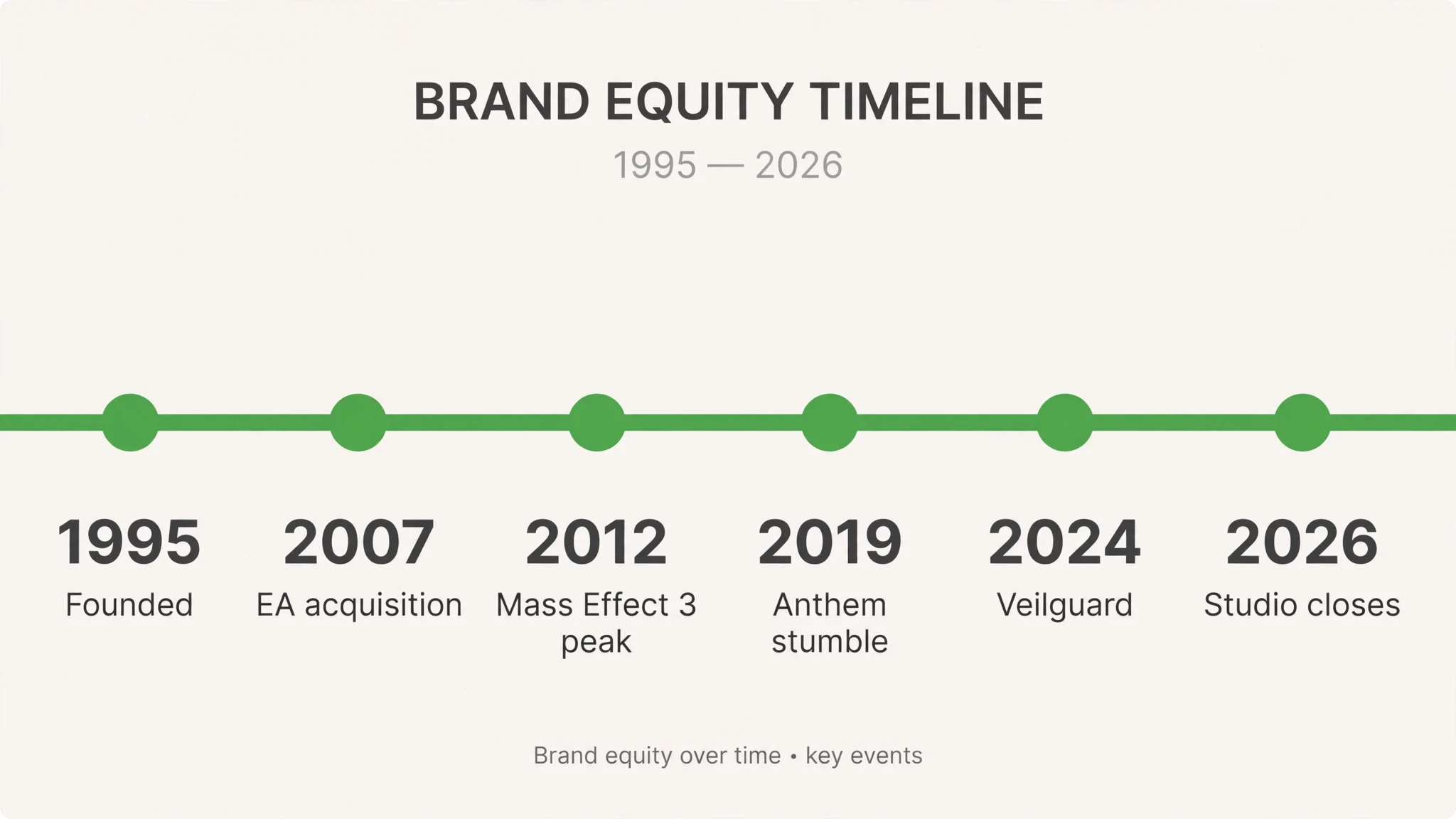
BioWare was founded in 1995 by three medical doctors in Edmonton — Ray Muzyka, Greg Zeschuk, and Augustine Yip — who traded medicine for game development. EA acquired the studio in 2007 for a reported $775 million. What EA was really buying was not office space or code. It was three decades of accumulated trust: the certainty, in a player’s mind, that a BioWare logo on the box meant a story worth living in.
That is the first BioWare shutdown lesson: brand equity compounds over decades and pays out in loyalty that no ad budget can buy. When the BioWare shutdown was announced, the reaction was not “oh well” — it was mourning. Players shared stories of how Mass Effect got them through hard years, how Dragon Age introduced them to lifelong friends, how Knights of the Old Republic shaped their taste in storytelling. That is equity. A brand that can make customers grieve its loss has built something most businesses never achieve: genuine emotional ownership in the audience’s life.
The uncomfortable corollary is that equity can also be spent. BioWare’s last decade drained the account — the Anthem debacle of 2019, the turbulent development and underwhelming reception of Dragon Age: The Veilguard in 2024, which reached 1.5 million players, roughly half of what EA expected. Each disappointment was a withdrawal. The BioWare shutdown did not happen because of one bad quarter; it happened because the withdrawals finally exceeded the deposits. Audit your own brand account the same way. Every kept promise is a deposit. Every overpromised launch, every quality shortcut, every “we’ll fix it later” is a withdrawal. Anchor your positioning in promises you can keep, and the deposits keep coming. The brands that survive hard times are the ones that banked trust when times were easy.
Lesson 2: Communities Outlive Products — Treat Yours as Stakeholders
Long before the BioWare shutdown, the studio’s fans had built something EA could never fully own: a community. Every November 7 — “N7 Day,” named for the elite rank in the Mass Effect universe — fans worldwide celebrated the franchise with art, cosplay, charity streams, and lore debates. Modders kept decade-old games alive with unofficial expansions. Fan wikis documented thousands of pages of fictional history with academic rigor. The community was not an audience. It was a stakeholder — emotionally invested, self-organizing, and fiercely protective.
The second BioWare shutdown lesson: when you build a real community, you are building an asset that survives individual products — but only if you treat members as partners, not metrics. BioWare’s farewell statement understood this instinctively. Rather than corporate boilerplate, the studio wrote directly to players: “What generations of BioWare built together is something to celebrate and remember,” thanking them for being, in the studio’s words, the most meaningful part of its story. That message did not save the studio, but it preserved something arguably more durable: the community’s goodwill toward the people and the legacy, which now attaches itself to wherever those developers go next.
For your business, the takeaway is concrete. A community — a user group, a customer forum, a Discord, a loyal social following — is not a marketing channel; it is a relationship with expectations. Feed it with genuine participation, not just promotions. Celebrate its rituals. Credit its contributions publicly. When hard news comes, speak to it first and speak to it honestly, because a community that hears bad news from you will defend you, while a community that hears it from a leak will bury you. Build two-way channels, such as replies, comments and community spaces, that turn customers into advocates. Products get discontinued. Communities decide what the brand means after that.
Lesson 3: Own the Narrative or the Rumor Mill Will Own You
The BioWare shutdown did not arrive out of nowhere — it arrived as a rumor first. Bloomberg’s reporting broke the story, and within minutes the search term “bioware shut down” was trending alongside “bioware games” and “mass effect.” Only then did BioWare post its own confirmation. The studio’s statement was dignified and human, but the sequencing matters: the narrative was set by a leak, not by the brand.
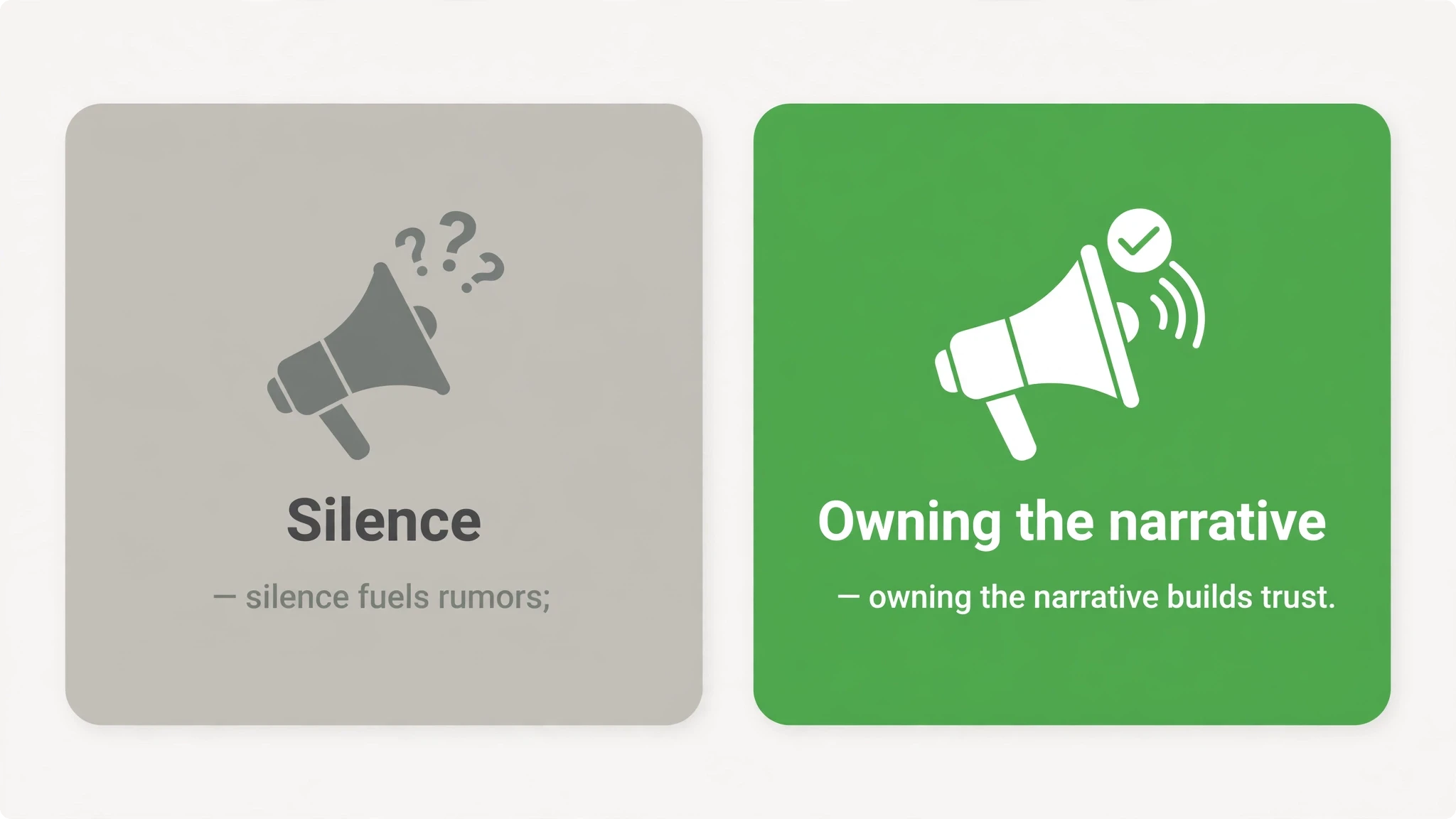
That is the third BioWare shutdown lesson, and it is pure crisis communication: in the gap between a rumor and your response, the internet writes your story for you. Search interest in the BioWare shutdown spiked within hours, and whatever filled that vacuum — speculation, anger, misinformation — became the frame through which everything the brand said afterward was interpreted. BioWare’s own post was graceful, but it was reactive. The brands that navigate crises best are the ones that communicate early, even when the news is incomplete: acknowledge what you know, say what you do not know yet, and promise the next update. Silence is not neutrality; silence is an invitation for everyone else to narrate your crisis.
There is a search-engine dimension here too, and it is directly in a marketer’s wheelhouse. When “bioware shutdown” spiked 1,000%, the results were owned by whoever published fastest with the most authoritative account — news outlets, not the brand. The same dynamic applies at every scale: when something goes wrong with your business, your own channels — your site, your blog, your social accounts — should be the definitive source, published before the rumor mill. That means having a crisis page template, a holding statement, and a decision-maker empowered to hit publish without a three-day approval chain. Our SEO services for small business breakdown explains how owning the authoritative content around your brand name compounds in search. The BioWare shutdown proves the point in reverse: whoever speaks first and clearest owns the story.
Lesson 4: Never Drift From the Core Promise That Made You
If there is a single strategic autopsy to perform on the BioWare shutdown, it is this: the studio spent its final decade chasing trends its audience never asked it to chase. BioWare’s identity — its core promise — was slow, choice-driven, single-player storytelling. Then came the pivot. Star Wars: The Old Republic in 2011 pushed the studio into the MMO gold rush. Anthem in 2019 was a full-blooded lunge at the live-service looter-shooter trend then dominating the industry. Both projects pulled the studio away from what its fans loved it for, and Anthem in particular became a cautionary tale: a troubled, years-long development that launched to a brutal reception and never recovered.
Even Dragon Age: The Veilguard, which began life with live-service and multiplayer elements before BioWare reversed course and shipped it as a single-player game, carried the scars of that drift. Returning to single-player roots was the right instinct, but it was not enough to rebuild what years of strategic whiplash had eroded. The BioWare shutdown is what it looks like when a brand’s strategy and its identity spend a decade arguing with each other.
The fourth BioWare shutdown lesson is the one most businesses need tattooed on their strategy docs: know your core promise, and do not dilute it chasing someone else’s trend. Every industry has its “live-service moment” — the shiny model everyone says you must adopt. For some businesses the pivot is right. But when the pivot contradicts the reason your best customers chose you, it is not innovation; it is identity erosion. A bakery famous for slow-fermented sourdough does not win by launching a frozen pizza line. A consultancy prized for senior-partner attention does not win by productizing itself into a chatbot. Before you chase the trend, ask the BioWare question: does this make our core promise stronger, or does it just make us look busy? Define that promise so clearly that trend-chasing becomes a conscious choice instead of a slow drift. Focus is a marketing strategy. Drift is a slow-motion brand obituary.
Lesson 5: Portfolio Ruthlessness Is a Strategy — Learn to Prune
There is a colder lesson inside the BioWare shutdown, and it belongs to EA’s side of the ledger. Read the “Building EA’s Next Chapter” memo — the document behind the BioWare shutdown — without sentiment: a company carrying $18 billion in buyout debt and a $700 million annual savings commitment looked at its portfolio and made a deliberate choice to concentrate on proven winners — Battlefield, Apex Legends, EA Sports, Marvel’s Iron Man, the next Star Wars Jedi title. Everything else, including a legendary studio with a beloved IP, got cut. It is brutal. It is also, from a pure portfolio-management perspective, coherent.
The fifth BioWare shutdown lesson: every business eventually faces the prune-or-perish decision, and the ones that survive make it deliberately. Most small businesses do the opposite — they accumulate. A service that barely breaks even stays on the menu because “someone might want it.” A product line that confuses the brand stays because killing it feels like admitting failure. An ad channel that has not converted in a year keeps getting budget because it is familiar. The result is a portfolio where the winners subsidize the losers and nobody can tell which is which.
EA’s version of this was extreme, but the discipline scales down. Once a year, run your own “next chapter” review: rank every offering by margin, growth, and alignment with your core promise, and be honest about the bottom quartile. Pruning is not pessimism — it is how you free the resources, attention, and creative energy that your winners need to actually win. The BioWare shutdown is a warning about what happens when pruning comes a decade late and all at once, imposed by debt covenants instead of chosen by leadership. Better to cut one underperforming line this quarter, on your own terms, than to have the market cut your whole studio later. Focus is the kindest cut you can make.
Lesson 6: Manage Expectations in Public — Silence Breeds Cynicism
The next Mass Effect was first teased at The Game Awards in December 2020 — a cinematic glimpse that sent fans into orbit. In 2022, BioWare hired an acclaimed narrative director from the Deus Ex series to lead the writing. As recently as N7 Day in November 2025, the studio assured fans the project was still in development and that EA remained committed to the franchise. Then came months of near-silence, a January 2025 restructuring that quietly moved developers to other teams, and finally the BioWare shutdown announcement revealing the project had been in “early development” with a small team all along.
The sixth BioWare shutdown lesson is about the most underrated marketing discipline there is: expectation management. Teasing a product creates a psychological contract with your audience. Every update — or conspicuous absence of one — either strengthens or weakens it. BioWare’s long, quiet stretch between the 2020 tease and the 2026 cancellation let fans’ imaginations fill the void with a game that could never exist, which made the eventual news feel like a betrayal rather than a business decision. Contrast that with studios that communicate development honestly — regular, modest updates that keep ambition tethered to reality.
For any business, the mechanics are identical. Announcing a feature, a launch date, or a “big thing coming” starts a clock in your customers’ heads. If the timeline slips, say so early and say why — customers forgive delays far more readily than they forgive silence followed by disappointment. And beware the grand tease with nothing behind it: a vague “something exciting is coming” post buys you a week of buzz at the cost of months of credibility if nothing materializes. Our product launch marketing guide details how to structure announcements so momentum builds instead of evaporating. The BioWare shutdown saga shows the alternative: six years of anticipation, converted in a single morning into six years of resentment. Manage the expectation, or the expectation will manage you.
Lesson 7: IP Outlives the Company — Build Assets, Not Just Campaigns
Here is the strange coda to the BioWare shutdown: the studio is gone, but Mass Effect is not. The franchise — its universe, characters, and iconography — remains EA property, and Amazon’s planned Mass Effect television adaptation for Prime Video is still reportedly in development. The games themselves remain playable, sellable, and culturally alive. BioWare the company closed; BioWare the intellectual property endures, potentially generating value for decades.
The seventh BioWare shutdown lesson is one of the most financially literate ideas in modern marketing: build assets that outlive campaigns. A campaign ends when the budget does. An asset — a recognizable brand world, a proprietary methodology, a content library, a trademarked framework, a community ritual like N7 Day — keeps working while you sleep and survives restructuring, pivots, and even ownership changes. BioWare’s true enterprise value was never its headcount; it was the worlds it created and the emotional real estate those worlds occupy in millions of minds.
Translate that to a small business. Your campaigns are rented attention; your assets are owned equity. A genuinely useful industry guide that ranks for years is an asset. A named, repeatable process clients ask for by name is an asset. A video series, a data study, a certification, a community event with its own identity — these are the Mass Effects of a small business: things that keep generating trust and revenue long after the launch buzz fades. Our video marketing services guide shows how serialized video content becomes a compounding brand asset rather than a one-off expense. The BioWare shutdown is proof of the principle at the largest possible scale: companies can be closed, but well-built IP refuses to die. Build things that refuse to die.
Lesson 8: Talent IS the Brand — Market Your People
Strip away the logos and the franchises, and what made BioWare legendary was people: writers, designers, and world-builders whose names fans knew and followed. When veteran developers left over the years — many to found or join other studios — fans tracked those departures like sports trades, because they understood something EA’s spreadsheets arguably did not: the talent was a load-bearing pillar of the brand promise. By the time of the BioWare shutdown, reporting indicated the studio had fewer than 100 people left, a shell of the team that built its classics. The brand on the door was the same. The brand inside the building was not.
The eighth BioWare shutdown lesson: in a services or expertise business, your people are the product, so market them like it. Clients do not hire “the agency” — they hire the strategist whose thinking they trust, the designer whose taste they admire, the account lead who actually answers the phone. Yet most businesses market as if talent were interchangeable, hiding their best people behind stock photos and corporate “we.” That is backwards. Founder stories, team spotlights, bylined thought leadership, behind-the-scenes process content — these are not vanity exercises. They are trust infrastructure. They tell prospects exactly who will be thinking about their problems at 11 PM, and why those minds are worth paying for.
There is a defensive dimension too. When key people leave — and they will — a business that has marketed only its logo discovers its brand equity walked out the door with them. A business that has built its brand around visible, credited expertise retains the reputation system even as individuals move on, because the audience trusts the bench, not just the star. BioWare’s slow talent drain was the quiet first chapter of the BioWare shutdown story; the shutdown announcement was merely the last page. Invest in your people’s visibility now, while the story is still being written. Our social media marketing services guide covers how to turn team expertise into content that builds both personal and company brands. People trust people. Market accordingly.
Lesson 9: How You Exit Matters as Much as How You Enter
Every business studies launches. Almost none studies exits — and the BioWare shutdown shows why that is a mistake. Endings are brand moments too: discontinuing a product, sunsetting a service, closing a location, even winding down the business itself. Handled with grace, an exit becomes a final deposit in the brand-equity account. Handled with silence or spin, it becomes the story people tell about you forever.
BioWare, to its credit, largely got the exit right. Its farewell message was human, specific, and grateful — a roll call of the worlds it built and a direct thank-you to the players who inhabited them. EA’s memo, while corporate by necessity, at least named the studio “legendary” and acknowledged the weight of the decision rather than burying it in euphemism. Contrast that with the all-too-common corporate exit: a dead link, a terse “we’ve decided to sunset,” a support article where a goodbye should be. Customers remember how you made them feel on the way out, and in the age of screenshots, your farewell is permanent marketing — for whatever you do next.
The ninth BioWare shutdown lesson: write your exits with the same care you write your launches. Sunsetting a product? Give users a real timeline, a migration path, and a genuine thank-you — not a pop-up that vanishes in seven days. Closing a location? Celebrate what it meant to the neighborhood. Even a failed campaign deserves a post-mortem shared with the audience that followed it; honesty about what did not work is some of the most trust-building content a brand can publish. Endings are inevitable. Bitterness is optional. The BioWare shutdown will be remembered as sad, but not as shabby — and in brand terms, that distinction is worth millions.
Conclusion
The BioWare shutdown is more than the end of a beloved game studio. It is a compressed masterclass in what makes brands endure — and what makes them end. Thirty years of storytelling equity, spent down by a decade of strategic drift. A community that loved the brand more faithfully than its owner did. A crisis narrative set by a leak instead of the brand. Expectations teased for six years and extinguished in a morning. And through it all, the stubborn afterlife of great IP and the people who built it.
Nine BioWare shutdown lessons, one throughline: brands are not logos, headcounts, or quarterly portfolios. Brands are promises kept in public, over time, in front of a community that is always watching. Keep the promise and the community will carry you through the hard chapters. Break it — or let someone else break it for you — and no amount of restructuring language will bring the story back.
If your business is at an inflection point — a rebrand, a pivot, a hard pruning decision, or simply the moment you realize the strategy and the identity have started arguing — that is exactly when brand discipline matters most. Contact KKeyQik to build a brand strategy that protects your promise, grows your community, and turns your best work into assets that outlive any single campaign.
Sources
- Kotaku: EA To Shut Down BioWare And Cancel The Next Mass Effect Game
- Polygon: BioWare Officially Shutting Down and New Mass Effect Canceled
- Dot Esports: BioWare shutting down, next Mass Effect canceled by EA
Want to put this to work for your business? KKeyQik plans and delivers social media campaigns for small businesses, with an in-house team available 24/7. See our social media marketing service or get a quote within 24 hours.
Frequently Asked Questions
Electronic Arts announced on October 21, 2026 that it is closing BioWare as part of a wider restructuring cutting about 400 jobs across the company. EA said it is concentrating investment on proven franchises like Battlefield, Apex Legends, and EA Sports, and a studio built on slow-burn story-driven RPGs no longer fit that portfolio. The closure follows EA going private in a $55 billion buyout that loaded the company with $18 billion in debt and a commitment to $700 million in annual cost savings.
Yes. EA confirmed that early development on the next Mass Effect game — the project fans had called Mass Effect 5 since its teaser at The Game Awards in December 2020 — is ending along with the studio. According to EA's internal memo, only a small team had been working on the project in early development. The company has not announced any plan to move the project to another studio.
BioWare was founded in Edmonton in 1995 and became one of gaming's most celebrated studios. Its catalog includes Baldur's Gate, Neverwinter Nights, Star Wars: Knights of the Old Republic, the Mass Effect trilogy, the Dragon Age series, the MMO Star Wars: The Old Republic, and Anthem. EA acquired the studio in 2007, the same year the original Mass Effect released.
The studio spent much of the last decade chasing trends outside its core identity. Anthem, its 2019 live-service shooter, was a commercial and critical failure after a troubled development. Dragon Age: The Veilguard, released in October 2024, drew generally positive reviews but reached only about 1.5 million players — roughly half of EA's expectations. Repeated layoffs, including a January 2025 restructuring that moved staff to other EA teams, left the studio with fewer than 100 people.
Quite a lot, according to reporting on the deal. EA went private in August 2026 in a $55 billion acquisition backed by Saudi Arabia's Public Investment Fund, Silver Lake, and Affinity Partners. The leveraged deal saddled EA with $18 billion in debt, and executives promised investors $700 million in annual cost savings — which has driven successive rounds of cuts across the company, with BioWare the most prominent casualty so far.
EA has not announced any change to the availability of BioWare's existing games, which remain playable and purchasable. The Mass Effect and Dragon Age franchises are EA-owned intellectual property, so they could theoretically continue under other studios — though EA has announced no such plans. The franchises' worlds, characters, and fan communities continue independently of the studio.
The planned Mass Effect television adaptation for Prime Video was in development before the shutdown, and its status is now uncertain. EA's announcement did not address the series, and no official update has tied the show's fate to the studio closure. Because the IP belongs to EA rather than BioWare itself, the adaptation could still proceed — but fans are watching for confirmation.
The shutdown is a masterclass in brand management: brand equity compounds over decades but can be spent down by drifting from your core promise; communities are stakeholders, not audiences, and deserve honest communication; whoever speaks first in a crisis owns the narrative; and pruning underperforming offerings early beats having the market prune you later. The full post breaks these into nine actionable lessons for any business.
The BioWare shutdown shows the playbook: communicate early rather than letting leaks set the narrative, speak directly to your community with genuine gratitude instead of corporate boilerplate, give people a clear timeline and a migration path where one exists, and treat the farewell as a final brand moment — customers remember how you made them feel on the way out. Silence invites speculation; honest, human communication preserves goodwill.
Around 50 BioWare roles are affected as part of the roughly 400 EA-wide layoffs, according to Bloomberg's reporting. EA said it will support affected employees in exploring other opportunities inside the company. Many veteran BioWare developers had already departed in recent years for other studios, and the industry's tight-knit RPG community has been actively sharing job leads and tributes since the announcement.