

Updated: September 2026 · By the KKeyQik Team
Most small businesses don’t have a video problem. They have a starting problem — a phone full of half-filmed clips, one abandoned YouTube channel, and the nagging feeling that every competitor figured something out. The gap isn’t talent or budget. It’s that nobody ever gave you a system: what to make, in what order, and how each video earns its keep.
Video marketing services are professional services that plan, produce, edit, and distribute video content to grow a small business’s audience, leads, and sales. A full engagement covers strategy and scripting, filming direction or production, editing and post-production, distribution across platforms like YouTube, Instagram, and TikTok, and performance reporting. What separates video that sells from video that just looks nice is almost always the strategy behind the camera, not the camera itself.
This guide breaks down what those services actually include, the six video types every small business needs, how engagements are structured and measured, and how to choose the right help without getting burned. If you’re starting from zero, it’s the whole map.
Key takeaways
- A real video marketing engagement covers five areas: strategy, production, editing, distribution, and reporting. A proposal that jumps straight to filming days is selling production, not marketing.
- You need six video types, not sixty: a brand story, a product or service demo, short-form social clips, customer stories, educational videos, and founder-led content. That set covers every stage of the buying journey.
- Short-form vertical video is the cheapest reach available in 2026. One filming day a month can produce a month of Reels, TikToks, and Shorts — if the hooks are scripted before the camera rolls.
- Video SEO puts you in Google results and YouTube search where competitors’ blog posts can’t follow. Optimized video pages and a real YouTube presence compound like SEO.
- Measure watch-through rate, click-throughs, and attributed inquiries — not view counts. A video with 800 targeted views and 12 inquiries beats one with 80,000 random views every time.
- When vetting providers, ask who owns the raw footage, how revisions work, and what the distribution plan is. No distribution plan means they make videos, they don’t do marketing.
What Video Marketing Services Actually Include
Strip it to the studs: video marketing is the business of turning attention from video into customers. The “marketing” part matters — filming something pretty is production, not marketing. Marketing means every video has a job: attract strangers, build trust, answer objections, or close the sale. If a provider can’t tell you which job each video does, they’re selling activity, not outcomes.
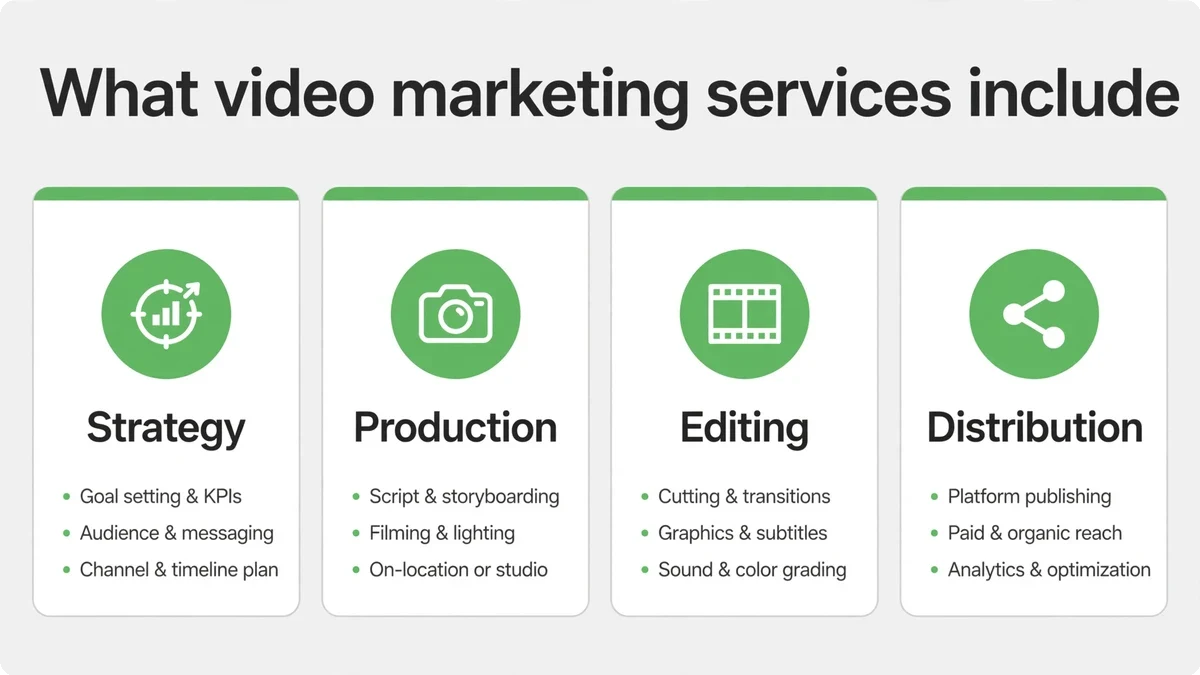
A serious engagement covers these components:
| Component | What it covers | Why it matters |
|---|---|---|
| Strategy & scripting | Audience research, video concepts, hooks, and scripts or talking points for each video | The hook is written before the shoot, not discovered in editing — this is where videos are won or lost |
| Production & filming direction | Shoot planning, on-set direction, lighting and audio standards, or full crew production | Good direction gets usable footage from a phone; bad direction wastes a cinema camera |
| Editing & post-production | Cutting, captions, graphics, color, sound mixing, thumbnails, and platform-specific versions | The edit is the strategy for short video — pacing and captions decide retention |
| Distribution & publishing | Scheduling across YouTube, Instagram, TikTok, and your website, plus repurposing one shoot into many assets | A video nobody sees is a cost, not an asset — distribution is half the job |
| Video SEO | Keyword-targeted titles, descriptions, chapters, transcripts, and schema markup on your site | Optimized video ranks in Google and YouTube search and keeps working for years |
| Paid video promotion | YouTube ads, Meta video campaigns, and retargeting built on your organic winners | Paid spend behind proven videos buys predictable reach instead of gambling on untested creative |
| Reporting | Monthly numbers on views, retention, clicks, and attributed inquiries — plus what changes next | Reporting is how video stops being a creative expense and becomes a measurable channel |
The test of any proposal: does it cover all seven, or does it quietly skip strategy, distribution, and reporting — the three parts that actually determine whether video makes money? Most “video packages” sold to small businesses are production with a marketing label. Ask each provider which of the seven does the heavy lifting in their plan. The honest ones will tell you, and their answers will differ in revealing ways.
Related: Video Marketing for Small Business: Where to Start in 2026 — the first 30 days, step by step.
The 6 Video Types Every Small Business Needs
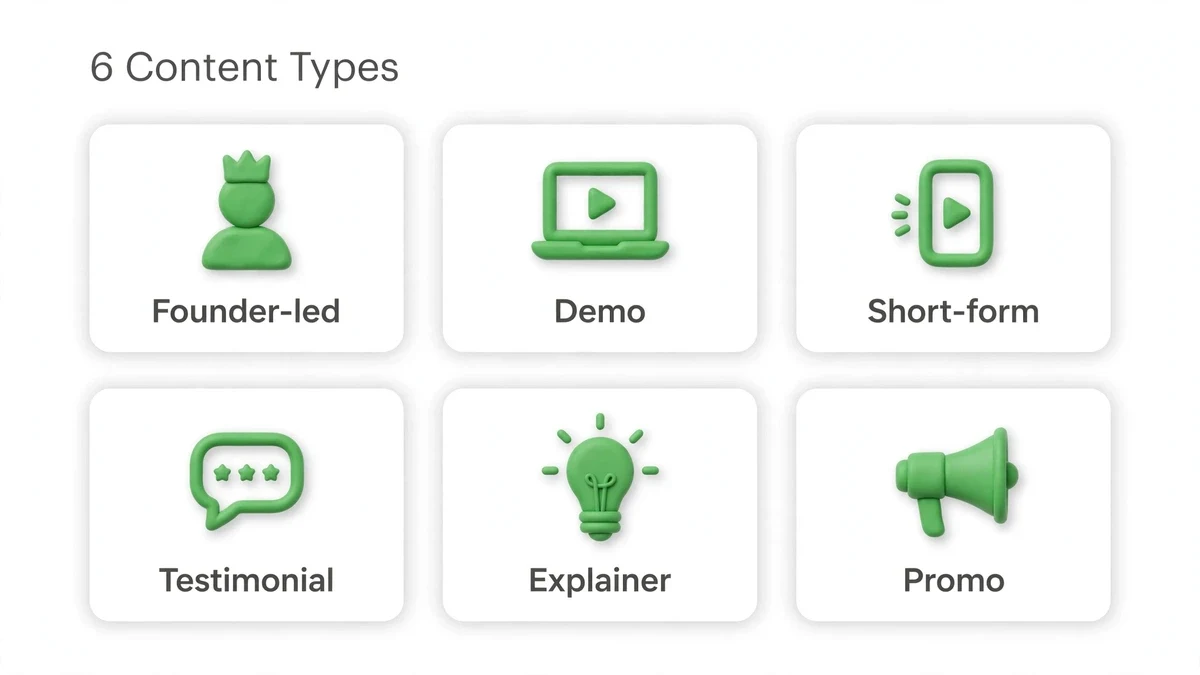
You don’t need a content empire. You need six videos — or six video series — that cover the full buying journey, from stranger to customer to repeat buyer. Everything else is optional until these exist and work.
| Video type | Ideal length | Job it does | Where it lives |
|---|---|---|---|
| Brand story | 60–90 seconds | Makes strangers feel something and remember you | Homepage, About page, YouTube |
| Product or service demo | 60–120 seconds | Shows exactly what buying gets them — kills the “but how does it work?” objection | Product/service pages, sales emails, YouTube |
| Short-form social clips | 15–45 seconds | Earns reach and keeps you visible week after week | Reels, TikTok, Shorts |
| Customer stories | 30–90 seconds | Borrows trust — proof from someone who isn’t you | Homepage, landing pages, ads |
| Educational / how-to | 2–8 minutes | Ranks in search and builds authority before the sales call | YouTube, blog embeds |
| Founder-led videos | 30–90 seconds | Puts a human face on the business — the trust shortcut nothing else replicates | Everywhere: social, email, About page |
Notice what’s missing: no viral stunt videos, no expensive brand films, no “content for content’s sake.” Each of these six has a named job in your funnel. The brand story and short-form clips attract. Educational videos and founder content build trust. Demos and customer stories close. When every video knows its job, you can measure whether it’s doing it — and fix or replace the ones that aren’t.
The order matters too. If you’re starting from zero, film in this sequence: founder intro first (fastest to make, builds the human connection everything else needs), then the demo (answers the question every prospect asks), then customer stories (proof), then the brand story (now you know what to say), then educational content (the long game), with short-form clips running continuously from day one as the distribution engine for all of it. For the platform mechanics — uploads, Shorts, thumbnails — YouTube’s Help Center stays more current than any third-party guide.
Related: Demo Videos That Convert: Anatomy of a Great Product Demo · Founder-Led Video: How Founders Build Trust on Camera · Short-Form Video for Business: Reels, TikTok & Shorts Strategy (2026)
Short-Form Video: The Reach Engine in 2026
Every major platform now rewards short vertical video above all other formats. For a small business, this is the single biggest opportunity in marketing right now — because production value matters less than it ever has. A founder answering one customer question to camera, captioned and tightly cut, routinely outperforms polished brand films costing a hundred times more. Authenticity is the format’s native language, and small businesses are fluent in it by default.
The practical system: one filming day a month, ten to fifteen short clips, each answering one real customer question or demonstrating one thing you do. That’s a month of content from a single afternoon. The discipline that makes it work is scripting hooks before the shoot — the first two seconds decide everything, and “hey guys, welcome back to our channel” is where videos go to die. Write the opening line on paper before anyone picks up a camera.
Then repurpose ruthlessly. One 60-second clip becomes a Reel, a TikTok, a YouTube Short, a LinkedIn video post, and an email embed. Platform-native tweaks (captions styled per platform, hooks adjusted) take minutes; reshooting takes hours. The businesses winning short-form in 2026 aren’t filming more — they’re distributing each thing they film further.
Related: Short-Form Video for Business: Reels, TikTok & Shorts Strategy (2026) — platform differences, cadence, and the hook formulas that stop the scroll.
Founder-Led Video: The Trust Shortcut
Here’s the uncomfortable truth most agencies won’t tell you: the highest-performing video asset a small business can own is the founder talking to camera. Not because founders are charismatic — most aren’t, at first — but because buyers choose people, not logos. A founder explaining why they started the business, answering a hard question honestly, or walking through their process does in 60 seconds what a website takes six pages to attempt.
Founder-led content also solves the consistency problem. You don’t need actors, locations, or elaborate concepts — you need a phone, decent light, and opinions. The founders who win at this aren’t performers; they’re just willing to be specific. “Here’s the mistake I see every homeowner make with their gutters” beats “we’re passionate about excellence” by a mile, because specificity is believable and passion is not.
If being on camera feels unnatural, that’s normal and temporary. Nobody’s first twenty videos are good. The founders who break through film in batches, keep takes loose, and stop rewatching themselves with a critic’s eye. Your customers aren’t comparing you to actors — they’re comparing you to competitors who never show their face at all.
Related: Founder-Led Video: How Founders Build Trust on Camera — getting comfortable, founder formats, and the filming setup that fits in a desk drawer.
Video SEO: Owning Search Results Your Competitors Can’t Buy
Video SEO is the most underpriced attention in search right now. Google increasingly shows video results for how-to, review, and local queries — and YouTube is the second-largest search engine in the world, where buyers research purchases for weeks before they ever visit a website. A well-optimized video can rank in both places and keep sending you prospects for years after it was filmed. Google’s own video SEO documentation is the best reference for how search engines discover and rank video content.
The mechanics aren’t mysterious: keyword research for what your buyers actually search, titles and descriptions written for humans and algorithms, chapters that let Google understand and feature your content, custom thumbnails that earn the click, transcripts and captions for accessibility and indexing, and the video embedded on a matching page of your website with proper schema markup. None of this requires a big budget. It requires doing it at all — most small business videos are uploaded with the filename as the title and no description, which is like printing brochures and leaving them in the garage.
The compounding part is what matters. A blog post competes with every other blog post. A good video on a specific buyer question — “how to choose a [your trade] contractor,” “what does [your service] cost to fix” — often faces almost no video competition at all. We’ve seen single educational videos become a business’s top lead source within a year, working while the owner sleeps. That’s the ROI case for video SEO: film once, rank for years.
Related: Video SEO: Ranking Your Videos on Google and YouTube (2026) — keyword research, thumbnails, chapters, schema, and the metrics that predict rankings.
How a Video Marketing Engagement Actually Works
This is our process — the same one we’d run for you. No mystery, no black box:
- Discovery and audit. We learn your business, your customers, and your funnel — then audit what video exists, what’s worked, and where the gaps are. We also study your reviews; your customers describe your value better than your website does, and their language becomes our scripts.
- Strategy and content plan. The six video types mapped to your buying journey, prioritized by what will move revenue first. You get a 90-day production calendar: what gets filmed, in what order, and what job each video does.
- Scripting and pre-production. Hooks written, talking points drafted, shot lists built. For founder-led content this is light — bullet points, not teleprompters. For demos and brand stories, it’s full scripts. Everything is approved by you before a camera rolls.
- Production. Filming days scheduled and directed — on location, in your space, with real customers and staff where it fits. We direct for the edit: multiple takes of hooks, b-roll captured deliberately, audio treated as non-negotiable.
- Editing and post-production. Cuts, captions, graphics, color, sound, thumbnails, and platform-specific versions from every shoot. You review and approve every video before it publishes. Nothing goes live you haven’t seen.
- Distribution, SEO, and reporting. Videos published on schedule, optimized for search, embedded where they convert, and reported monthly: retention, clicks, inquiries, and what changes next month based on the data.
The part most providers skip is steps one and six — the thinking before and the measuring after. That’s exactly backwards. Production is a commodity; judgment about what to make and whether it worked is the service.
Scoping an Engagement Without the Guesswork
Video engagements vary enormously in scope, so think in deliverables, not vague packages. Here’s how to place yourself honestly:
| Engagement size | Typical deliverables | Best for |
|---|---|---|
| Foundation | Strategy session, founder intro video, one demo video, short-form starter batch (8–12 clips), basic YouTube setup | Businesses starting from zero who need the core assets fast |
| Growth | Everything in Foundation, plus monthly filming day, 12–16 short clips per month, customer story videos, video SEO on all uploads | Businesses ready to make video a consistent channel |
| Full-funnel | Everything in Growth, plus brand story production, educational YouTube series, paid video campaigns, landing page video optimization | Businesses where video is a primary growth driver |
Two scoping rules that protect you. First, never buy production without distribution — a filming day with no publishing plan is an expensive home movie. Second, start smaller than your ambition and expand on data. A foundation engagement that proves which messages convert is worth more than a full-funnel one built on guesses. The right provider will tell you to start smaller, not upsell you on day one.
In-House vs Freelancer vs Agency vs Production Studio
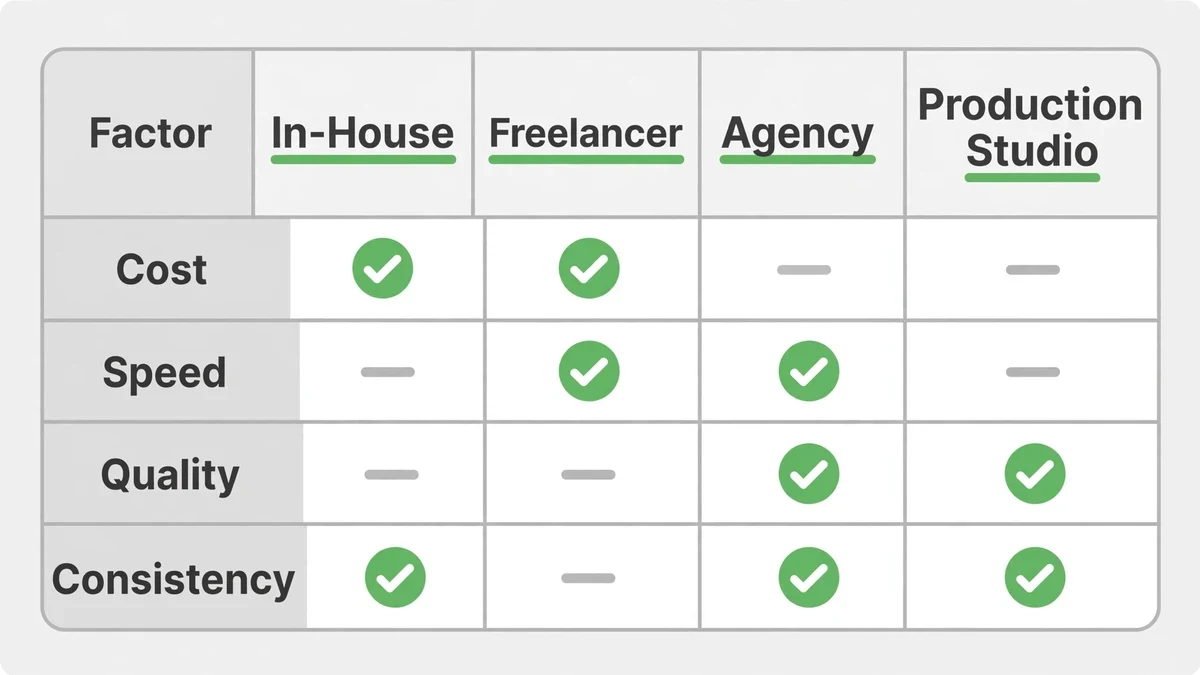
| In-house creator | Freelancer | Marketing agency | Production studio | |
|---|---|---|---|---|
| Core strength | Always available, knows the business | Affordable execution in their lane | Strategy + production + distribution under one roof | Cinematic quality, full crews |
| Weakness | One person’s taste and bandwidth; strategy often missing | Rarely does strategy, SEO, or distribution | Top-tier production may be outsourced | Expensive; marketing strategy usually not included |
| Consistency risk | High — one hire, one point of failure | Medium — juggling multiple clients | Low — team coverage | Low, but engagements are project-based |
| Best when | Video is daily and you can hire senior | You have the strategy and need hands | You want the whole system run for you | You need one flagship brand film |
Our honest take for most US small businesses: a production studio is overkill for 90% of what you need, and an in-house hire is premature until video is proven. The choice that works for most is between a freelancer (you bring the strategy) and an agency (they bring the strategy). If you don’t yet know what videos to make or how they’ll make money, you don’t need a videographer — you need the thinking first. That’s the agency’s job.
Related: How to Choose a Video Production Partner: 15 Questions to Ask — the vetting questions that reveal everything.
Measuring ROI: Metrics That Matter vs Vanity Metrics
| Vanity metric (ignore the dopamine) | Money metric (track this instead) |
|---|---|
| Total view count | Watch-through rate and average view duration |
| Follower growth from one viral clip | Inquiries and bookings attributed to video |
| Likes | Click-through rate to your site or booking page |
| “It got a lot of comments” | Cost per lead on paid video campaigns |
| Production polish compliments | Conversion lift on pages with video vs without |
The attribution question comes up constantly: “how do I know video caused the sale?” You rarely get a clean answer, and you don’t need one. Track directionally: ask new customers how they found you (and record the answers), watch which videos precede inquiries in your analytics, and compare conversion rates on pages with and without video. Businesses that do this consistently find video’s contribution is larger than last-click attribution suggests — because video does its best work early in the journey, building the trust that makes the final click happen.
5 Red Flags in Video Marketing Providers
- No distribution plan. If the proposal ends at “we deliver the final files,” they make videos — they don’t do marketing. Ask where each video goes and why.
- They won’t show full client channels. A sizzle reel of best moments hides inconsistency. Ask to see a client’s actual YouTube channel or Reels feed, start to finish.
- You don’t own the raw footage. Some providers hold footage hostage for future work. Your contract should state that all raw files and project files are yours.
- Unlimited revisions with no process. Sounds generous; in practice it means no creative direction and endless loops. Two structured revision rounds beats unlimited chaos.
- They can’t explain the strategy in one minute. If “what’s the plan?” gets a jargon fog instead of a clear answer, there’s no plan — there’s a filming schedule wearing a strategy costume.
Ready to make video your hardest-working channel?
Every month without a video system is a month your competitors’ faces get more familiar to your shared customers than yours. The fix isn’t a bigger camera — it’s the system this guide describes: the right six videos, hooks written before shooting, distribution that treats every shoot as raw material, and reporting that ties it all to inquiries.
Contact the KKeyQik team and tell us about your business, your customers, and what a new customer is worth to you. We’ll show you exactly what the first 90 days of video look like for your market — strategy first, filming second, results always. If we’re not the right fit, you’ll still leave knowing more about video marketing than most agencies will ever tell you.
About the KKeyQik Team
KKeyQik is a digital marketing agency helping small businesses grow with SEO, social media marketing, PPC (Google Ads and Meta Ads), web development, video editing, and graphic design. The KKeyQik Team publishes practical, no-fluff guides for business owners who want marketing that drives measurable growth.
Frequently Asked Questions
A production company films and edits; a video marketing service turns attention from video into customers. The marketing part means every video has a named job — attract strangers, build trust, answer objections, or close the sale — and the engagement covers strategy, distribution, and reporting, not just shoot days. If a provider can't tell you which job each video does, they're selling production with a marketing label.
No distribution plan — if the proposal ends at 'we deliver the final files,' they make videos, they don't do marketing. Other warnings: they won't show full client channels, you don't own the raw footage, or 'what's the plan?' gets a jargon fog instead of a clear answer. The parts most proposals quietly skip are strategy, distribution, and reporting.
Consistency beats volume: a sustainable cadence is a monthly filming block producing a batch of short clips, plus one or two longer pieces per quarter. One filming day a month can generate weeks of short-form content if hooks are scripted beforehand. It is better to publish steadily for a year than to film fifty videos in month one and go silent.
Start with the two that convert fastest: a founder introduction and a product or service demo. Those go straight at revenue — questions and demonstrations are what prospects need most when deciding. Expensive brand films and viral stunt ideas can wait until the fundamentals are earning their keep.
Fifteen-to-forty-five-second vertical videos filmed on a phone can reach thousands of potential customers who have never heard of you, and the format is built for distribution across Reels, TikTok, and Shorts. One filming day a month can produce a full month of short-form content if the hooks are scripted before the camera rolls. No other format offers that ratio of reach to effort.
Measure watch-through rate, click-throughs, and attributed inquiries — not view counts. A video with 800 targeted views and 12 inquiries can be far more valuable than one with 80,000 random views. Views are a vanity metric; what matters is whether video moves prospects through your funnel.
A video nobody sees is a cost, not an asset. Distribution is half the job: scheduling across YouTube, Instagram, TikTok, and your website, plus repurposing one shoot into many assets so the same filming day feeds every channel. A proposal with no distribution plan is production, not marketing.
Video SEO makes your videos discoverable in YouTube search and Google's video results through keyword-targeted titles, descriptions, chapters, transcripts, and schema markup on your site's video pages. Optimized video ranks where competitors' blog posts can't follow, and it compounds — a well-optimized video keeps sending prospects for years after filming day.
Check whether it covers all seven components or quietly skips strategy, distribution, and reporting. Ask each provider which part does the heavy lifting in their plan, who writes the scripts and hooks, who owns the raw footage, how revisions work, and what the distribution plan is. The honest providers will give you clear, specific answers — and their answers will differ in revealing ways.
Judge nothing before about 90 days of consistent publishing, and expect early data to be noise. Short-form video can bring faster initial reach, while search-driven video is the slowest payoff but compounds the longest. The businesses that quit in week four almost always fail at consistency, not at video.