

Updated: September 2026 · By the KKeyQik Team
To choose video production partner wisely, start here: you’re handing someone your brand’s face and voice, and the difference between a partner who thinks about your revenue and one who thinks about their reel is the difference between an asset and an expense. These fifteen questions — asked in this order — reveal which one you’re talking to. (For context on what a full engagement should include, see our guide to video marketing services for small business.)
A video production partner is a company you hire not just to film and edit, but to plan video around your business goals, distribute it where it earns, and report on whether it worked. The distinction matters because most “video companies” sell production — filming days and edits — while what small businesses actually need is marketing that happens to use video. These questions separate the two in about thirty minutes of conversation.
Key takeaways
- Ask about strategy and distribution before you ask about cameras. The thinking and the publishing determine ROI; the gear doesn’t.
- Demand three things in writing: you own all raw footage, you approve every video before publishing, and the distribution plan is part of the scope.
- Judge providers by full client channels, not sizzle reels. A highlight reel hides inconsistency; a real channel reveals it.
- Start smaller than your ambition. A partner who tries to upsell you on day one is selling, not advising — the right one will tell you to start lean.
- The best answer to “what’s the plan?” takes sixty seconds and mentions your customers. Jargon fog means there’s no plan.
Know What You’re Shopping For First
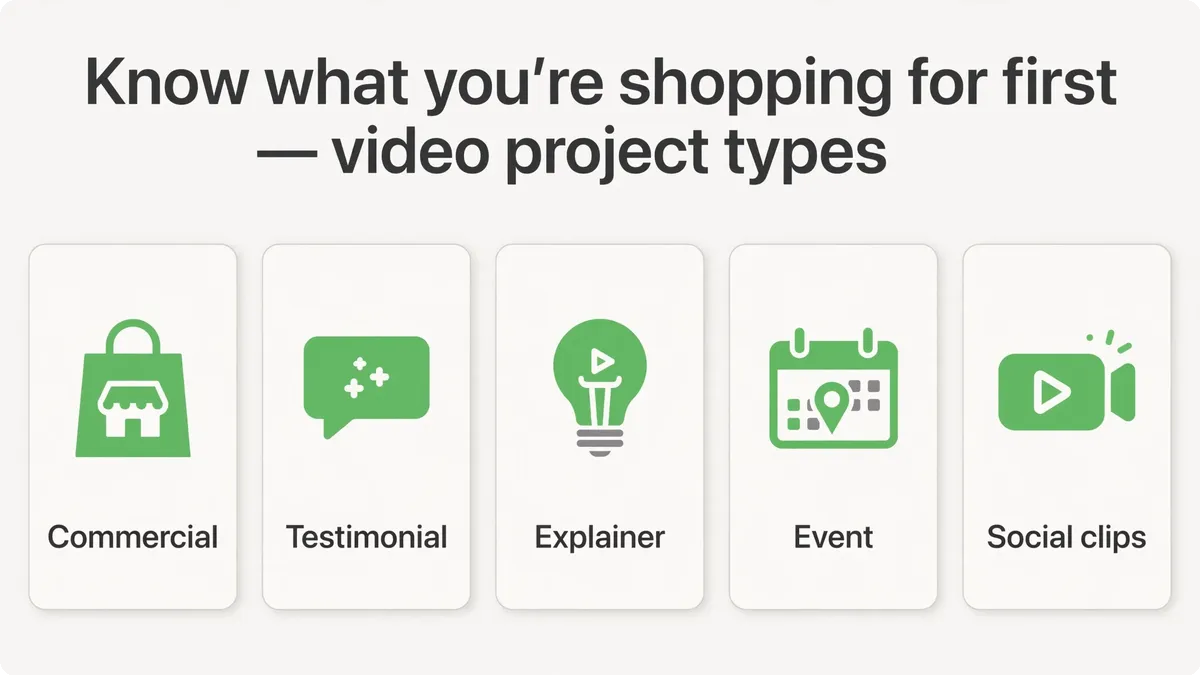
Not all video providers do the same job. Knowing which type you’re talking to focuses every question below:
Most small businesses asking these questions actually need the third row — someone who owns the thinking, not just the filming. Keep that in mind as you read the answers: a brilliant production company can still be the wrong partner if nobody’s planning distribution. A credible video production partner should also know each platform’s technical requirements — from YouTube’s recommended upload encoding settings to the specs in Meta’s Business Help Center.
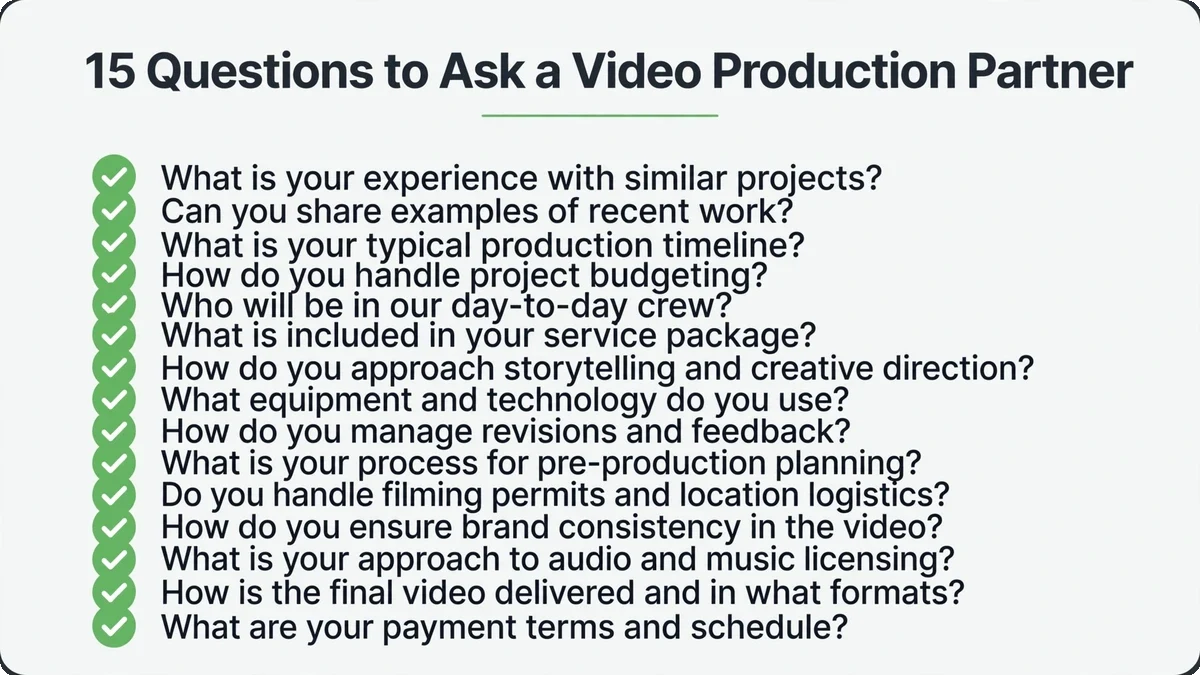
Choose Video Production Partner: 15 Questions to Ask
Strategy (questions 1–4)
- What’s the strategy for my business, in sixty seconds? You’re testing clarity. A good answer names your customers, the videos they’d watch, and what each video should earn. Jargon fog means there’s no strategy — there’s a filming schedule wearing a strategy costume.
- Which videos should we make first, and why that order? Reveals whether they prioritize revenue or their own convenience. “Founder intro and demo first, because those convert fastest” is a thinking answer. “Let’s start with a brand film” is a selling answer.
- How will each video be distributed? If the plan ends at “we deliver final files,” they make videos — they don’t do marketing. You want platforms, cadence, and repurposing named explicitly.
- What does success look like in 90 days, in numbers we both agree on? Forces shared, measurable expectations. Vague promises (“more visibility”) become arguments later; agreed metrics become a working relationship.
Process and creative (questions 5–8)
- Walk me through your process from kickoff to published video. Listen for the unsexy parts: scripting, approvals, revisions, publishing. A process that’s all “creative vision” and no workflow will miss deadlines.
- Who writes the scripts and hooks? The hook is where videos are won. If scripting is “we’ll figure it out on shoot day,” your videos will underperform — hooks are written, not improvised.
- What’s the approval workflow? The only acceptable answer: you see and approve every video before it publishes. Anything looser is how brand disasters happen.
- How do revisions work? Two structured rounds is healthy. “Unlimited revisions” sounds generous and means no creative direction — endless loops that exhaust everyone. Ask what happens when you disagree on creative direction, too.
Proof and track record (questions 9–11)
- Show me a full client channel, not a sizzle reel. A highlight reel of best moments hides inconsistency. A client’s actual YouTube channel or Reels feed — start to finish — shows what you’ll actually get, month after month.
- What results did that client’s video drive? Views are the weakest answer. Listen for inquiries, conversion lifts, watch-through rates — business metrics, not vanity metrics. If they can’t connect any video to any outcome, neither will yours be.
- Can I talk to a current client? The strongest signal in vetting. Happy clients say yes; struggling providers deflect. One ten-minute call tells you more than any proposal deck.
Business terms (questions 12–15)
- Who owns the raw footage and project files? The answer must be you, in writing. Some providers hold footage hostage to lock in future work. Your contract should state all raw files, project files, and final exports are yours, delivered at project end.
- What’s included in the scope, exactly — and what costs extra? Get the deliverables list in writing: number of videos, lengths, formats, revision rounds, publishing, reporting. Verbal “oh, we handle all that” evaporates at invoice time.
- How do we start small and expand? The right partner has a lean starting engagement and a clear path to scale on data. A partner who only sells big packages is optimizing for their cash flow, not your risk.
- What happens if it’s not working after 90 days? Mature providers have an answer: a performance review, a pivot plan, a clean exit. Anyone offended by the question is telling you the exit will be messy.
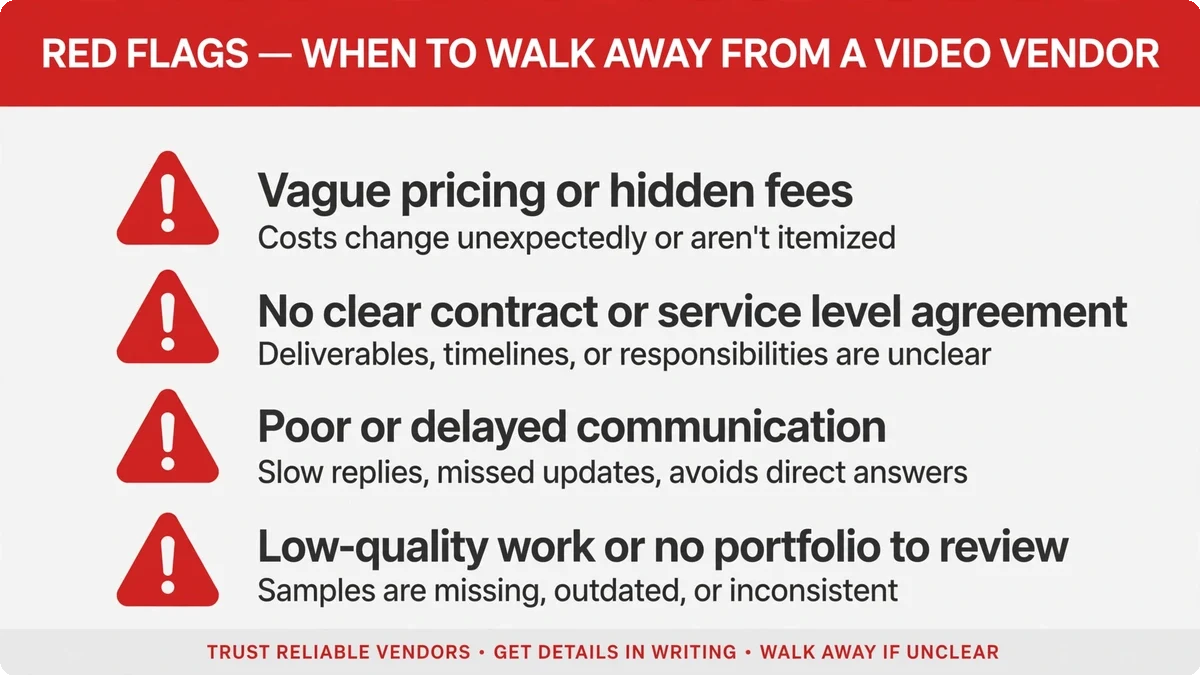
Red Flags When Choosing a Video Production Partner
How We’d Want to Be Vetted
Full disclosure: we’d welcome every question above, because we built our process to survive them. Strategy in sixty seconds? We can do it — your customers, their questions, the videos that answer them, what each one earns. Full client channels? We’ll show you. Raw footage ownership? Yours, in writing, always. Start small? We’d rather prove it on a lean engagement than sell you a big one on promises.
That’s the standard to hold everyone to — including us. The right partner isn’t threatened by hard questions; they’re relieved someone finally asked. If a provider gets defensive at question three, you’ve learned everything you need to know, and it cost you nothing. Ask how they’d get your videos discovered in search, too — Google’s Search Central video best practices explain what search engines need from your video pages.
Before the First Call: How to Brief a Video Production Partner
You’ll get better answers if you brief better. Before you book a single vetting call, write a one-page brief and send it to every video production partner on your shortlist as you learn how to choose video production partner. Same brief, same questions, comparable answers. The brief doesn’t need to be fancy — it needs to be honest.
Start with the outcome, not the video. “We need three videos” is a weak brief. “We need more qualified demo requests from our website, and we think video can help” is a strong one. A good video production partner will push back on your assumptions and reshape the plan; a weak one will just quote the three videos. The brief is a test in itself.
Include what you’re working with: your website, any existing footage or photos, customer testimonials you already have, and access to the people who’d appear on camera. Mention your timeline honestly, and say how decisions get made on your side. If three partners need to approve every script, say so now — it’s better than discovering the bottleneck in week six.
On budget, you don’t need a number — you need a shape. Tell each candidate whether you’re thinking project-based (one defined engagement), retainer (ongoing monthly scope), or a starting project with room to grow. Each model suits different goals, and a trustworthy video production partner will explain the trade-offs instead of just quoting the biggest option. If someone can’t walk you through those trade-offs clearly, that tells you plenty.
Finally, send the brief in advance and watch what comes back. The providers worth talking to will arrive with questions about your customers and your numbers. The ones worth skipping will arrive with a generic deck. You haven’t asked a single one of the fifteen questions yet, and you’ve already learned something.
After the Calls: Scoring the Answers
Three calls in, every provider blurs together. Score them before the blur sets in — ideally within 24 hours of each conversation, while the specifics are fresh.
Build a simple scorecard from the fifteen questions above. For each candidate, as you work through how to choose video production partner, note not just what they said but how they said it: Did they name your customers unprompted? Did distribution come up before you asked? Did they try to shrink the scope to fit your goals, or inflate it to fit their quota? The pattern across answers matters more than any single answer.
Weight strategy and proof heaviest. A provider can learn your industry; they can’t retroactively become strategic. Give extra credit to the one who disagreed with you about something — comfortable agreement is cheap, and the partner who’ll tell you “that video won’t work” before you pay for it is worth more than the one who nods along.
Then check references properly. Don’t ask “were you happy?” — ask “what went wrong, and how did they handle it?” Every engagement hits a snag; you want the video production partner whose snags got fixed fast. Ask references whether the provider hit the dates they promised and whether the reporting was honest when numbers were soft. You’ll learn more from one candid reference than from ten portfolio pieces.
And watch how they follow up after the call. A clear, specific proposal within a few days signals an organized operation that respects your time. A vague “let’s hop on another call” with no written recap signals the opposite. The sales process is the service process in miniature — believe what you see.
Ready to ask us the 15 questions?
Bring the list. Contact the KKeyQik team, tell us about your business and what a new customer is worth to you, and put us through all fifteen. You’ll get straight answers — including “start smaller than you’re thinking” if that’s the honest advice. And if we’re not the right fit, you’ll still know exactly what to demand from whoever is.
Further reading: our complete guide to video marketing services for small business — what’s included, how engagements are structured, and how to measure ROI.
About the KKeyQik Team
KKeyQik is a digital marketing agency helping small businesses grow with SEO, social media marketing, PPC (Google Ads and Meta Ads), web development, video editing, and graphic design. The KKeyQik Team publishes practical, no-fluff guides for business owners who want marketing that drives measurable growth.
Want to put this to work for your business? KKeyQik plans and delivers video production and editing for small businesses, with an in-house team available 24/7. See our video production service or get a quote within 24 hours.
Frequently Asked Questions
Most 'video companies' sell production — filming days and edits — while what small businesses actually need is marketing that happens to use video. You're shopping for a partner who plans video around your business goals, distributes it where it earns, and reports on whether it worked. A brilliant production company can still be the wrong partner if nobody's planning distribution.
A few short calls plus one reference check are usually enough — the fifteen questions reveal a provider's thinking in about thirty minutes of conversation, and a candid reference call confirms it. The real work is the one-page brief you send before any call: goals, customers, timeline. Don't stretch vetting across weeks; a provider who can't answer clearly on call two won't get clearer on call four.
Ask which videos they'd make first and why that order. 'Founder intro and demo first, because those convert fastest' is a thinking answer; 'Let's start with a brand film' is a selling answer. The sequencing reveals whether they're optimizing for your outcomes or for the biggest invoice.
The distribution plan should be in the scope, but ownership of the publishing calendar can sit with either side — the partner can run it or hand over a documented playbook. What matters is that someone is named as responsible for every publish date, not that the partner does everything. If nobody owns distribution, the videos won't ship.
Shared, measurable expectations you both agree on before work starts. Vague promises like 'more visibility' become arguments later; agreed metrics — inquiries, conversion lifts, watch-through rates — become a working relationship. Ask the question early and watch how comfortable they are with being measured.
Three things, non-negotiable: you own all raw footage and project files, you approve every video before it publishes, and the distribution plan is part of the scope. Some providers hold footage hostage to lock in future work, so the contract should state all raw files, project files, and final exports are yours, delivered at project end.
Ask to see a full client channel, not a sizzle reel. A highlight reel of best moments hides inconsistency; a client's actual YouTube channel or Reels feed, start to finish, shows what you'll actually get month after month. Then ask what results those videos drove — listen for inquiries, conversion lifts, and watch-through rates, not view counts.
Ask what went wrong and how the provider handled it — every engagement hits a snag, and you want the one whose snags got fixed fast. Also ask whether the provider hit promised dates and whether reporting was honest when the numbers were soft. One candid reference beats ten portfolio pieces.
Two structured rounds is healthy. 'Unlimited revisions' sounds generous but means there's no creative direction — endless loops that exhaust everyone. Also ask what happens when you disagree on creative direction; a mature provider has a process for that, not just a smile.
Watch for a partner who tries to upsell you on day one instead of suggesting you start lean, scripting that's 'figured out on shoot day,' no answer to what happens if it's not working after 90 days, and any hesitation about you owning your footage. Each one signals a provider optimizing for their cash flow or convenience, not your risk.