

Updated: September 2026 · By the KKeyQik Team
Short-form video is the cheapest reach a small business has ever had access to — full stop. Fifteen to forty-five seconds, filmed on a phone, can put you in front of thousands of local prospects who have never heard of you. But “post more Reels” is useless advice. What works is a strategy: which platforms, what content pillars, what cadence, and the hook formulas that stop the scroll.
(Short-form is the distribution engine inside our guide to video marketing services for small business — this post is the operating manual.) Each platform publishes its own playbook — start with YouTube’s guidance for Shorts and Meta’s Business Help Center for Reels before you build your workflow. The algorithm rewards consistency, so build a short-form video cadence you can sustain for a year, not a month.
Short-form video strategy is a repeatable system for creating and publishing 15–60 second vertical videos that earn reach, build familiarity, and drive inquiries. The strategy has four parts: platform selection (where your buyers actually watch), content pillars (the 3–4 themes every video ladders up to), a sustainable cadence (what you can publish weekly for a year), and hook-first scripting (the opening two seconds written before anything else). Miss any one of the four and you’re posting randomly with extra steps.
Key takeaways
- You don’t need all three platforms — master one, then expand. One platform done well beats three done badly.
- Run 3–4 content pillars so you never wonder “what do I post?” — every video fits a pillar, or it doesn’t get made.
- The hook is the strategy: write the first line before you shoot, film it three times, and never open with branding.
- Repurpose every video across platforms with native tweaks — one shoot, four placements, not four shoots.
- Track saves, shares, and profile visits per pillar — then make more of what the data likes, not what you like.
Reels vs TikTok vs Shorts: Where Should You Be?
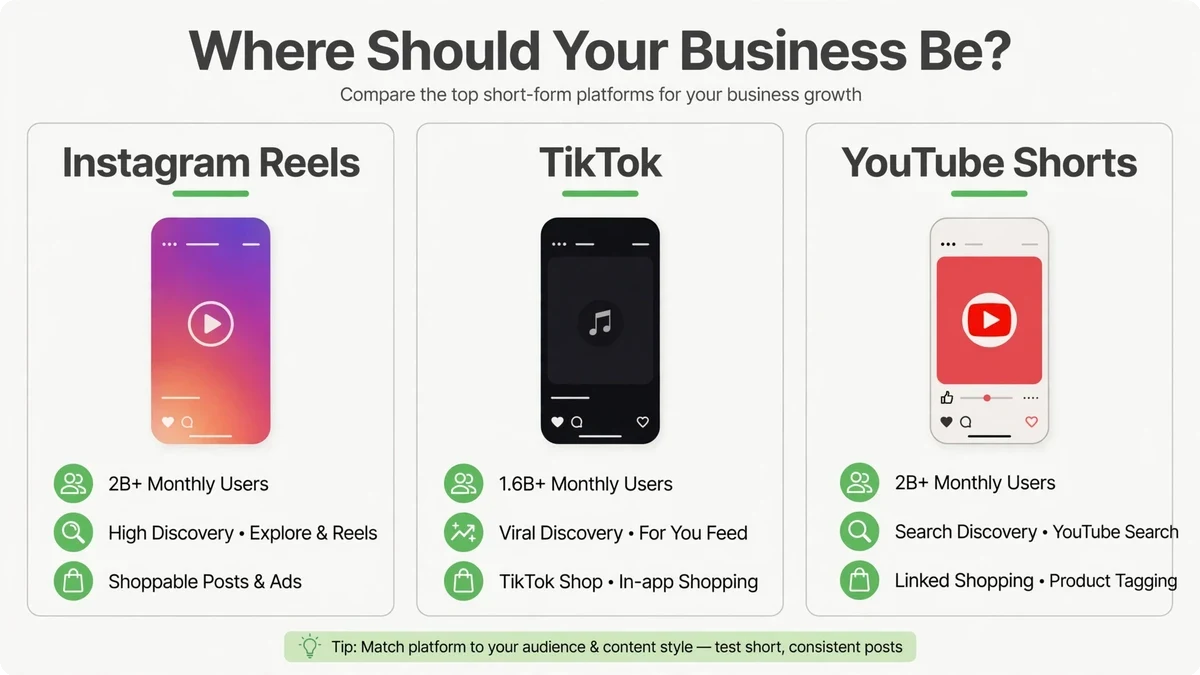
The platforms look similar and behave differently. Pick based on where your buyers are and what each algorithm rewards:
| Instagram Reels | TikTok | YouTube Shorts | |
|---|---|---|---|
| Audience | Broadest age range; strong for local discovery via location tags | Younger skew, but growing fast with 30–50 buyers | Massive reach; viewers already in a video mindset |
| What the algorithm rewards | Watch time + shares to DMs; consistency | Completion rate + rewatches; volume and trends | View velocity; Shorts feed viewers into long-form |
| Business strengths | Local services, D2C, hospitality — discovery + profile as storefront | Personality-driven brands, education, entertainment | How-to and search-adjacent content; builds a subscriber base |
| Weakness | Reach per post has tightened; needs consistency | Trend-chasing burns out non-creators; audience can be far-flung | Shorts viewers convert to subscribers slowly |
| Start here if… | You’re a local business — this is the default pick | Your buyers are under 40 and you enjoy the format | You’re also building long-form YouTube content |
Our default recommendation for US small businesses: start with Instagram Reels. It has the best combination of local discovery, buyer-age coverage, and a profile that functions as a second homepage. Add TikTok when Reels is running smoothly, and Shorts when you have any YouTube presence at all — uploading Shorts costs nothing extra once the video exists.
The 4 Content Pillars
Pillars solve the “what do I post?” problem permanently. Define four themes that cover the full job of your content, then rotate through them. Every video must fit a pillar — no pillar, no post.
| Pillar | Job | Example for a home services business |
|---|---|---|
| Educate | Teach something useful — earns saves and authority | “Three signs your water heater is about to fail” |
| Prove | Show results — earns trust and shares | Before/after of a full repipe, customer reaction on camera |
| Humanize | Show the people — earns follows and familiarity | Day-in-the-life with a tech, shop tour, team intro |
| Convert | Make the offer — earns inquiries | “Fall tune-up slots are open — here’s what it includes” |
The ratio matters: roughly 40% educate, 25% prove, 25% humanize, 10% convert. Businesses that post 90% offers wonder why nobody watches — you’ve built a channel of commercials. Businesses that post 0% offers wonder why nobody calls — you’ve built entertainment with no cash register. The mix above keeps the audience growing and the phone ringing.
Hook Formulas That Stop the Scroll
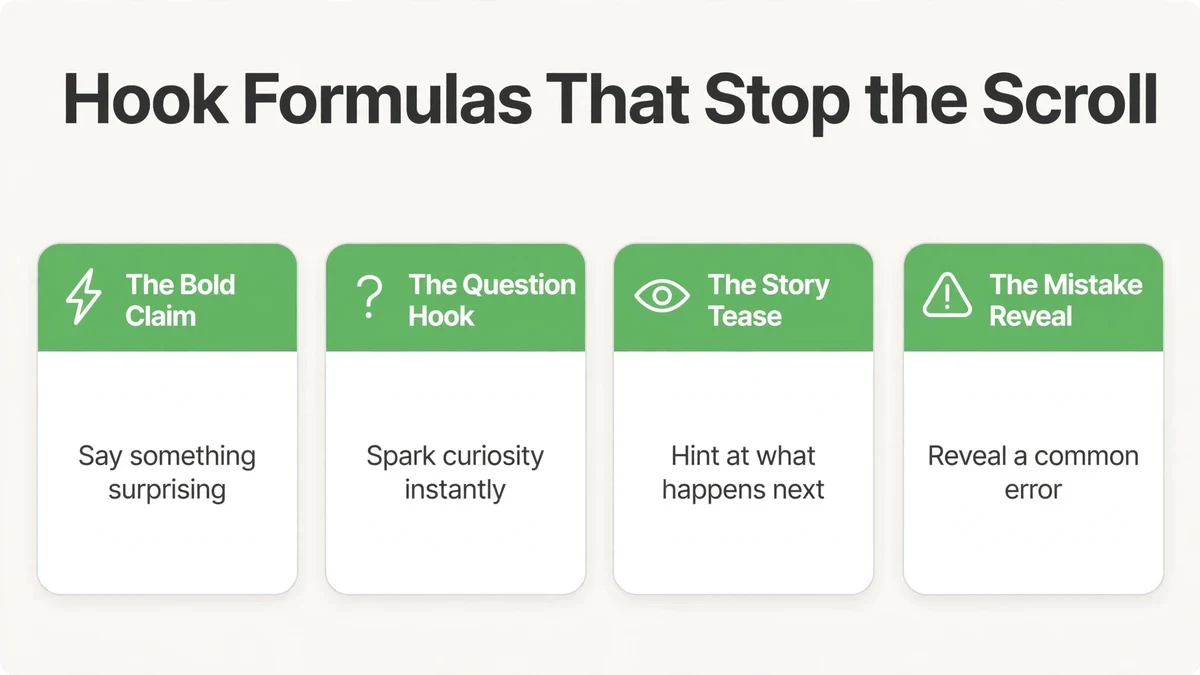
The first two seconds decide everything. No logos, no “hey guys,” no slow fades — the video starts mid-thought, on the most interesting frame. Write the hook as a literal first line before filming, and film it three times so the edit has options. Every short-form video should earn the first three seconds before it asks for the next thirty.
Seven hooks that work for small businesses:
- The mistake: “Stop doing [X] — here’s what to do instead.”
- The number: “Three things I check on every [job type].”
- The contrarian take: “Unpopular opinion: [common advice] is wrong.”
- The question: “Why does [problem] keep happening to [audience]?”
- The result first: show the after for one second, then “here’s how.”
- The story open: “A customer called me in a panic last Tuesday…”
- The direct callout: “If you own a [home type] in [area], watch this.”
After the hook, the structure is simple: deliver the promised value fast, keep one idea per video, and end with the next step as on-screen text. A 30-second video with a great hook and one clear point outperforms a 60-second ramble every time — length is not value.
Cadence: What You Can Sustain for a Year
The honest answer to “how often should I post”: as often as you can sustain without quality collapsing, for twelve months. Consistency beats volume — the algorithm rewards accounts that publish reliably, and audiences reward accounts that never vanish for three weeks.
Starting frameworks:
- Instagram Reels: 3–4 per week. Enough to stay visible, few enough to keep quality high.
- TikTok: 4–7 per week if you’re playing here — this platform rewards volume more than the others.
- YouTube Shorts: 3–5 per week, ideally feeding viewers toward your long-form videos.
More important than any number: batch it. One filming session a month, ten to fifteen clips, hooks scripted in advance. Daily filming is how businesses quit by February. And never sacrifice quality for the calendar — two great videos a week beat five filler clips that train your audience to scroll past you.
The Repurposing Workflow
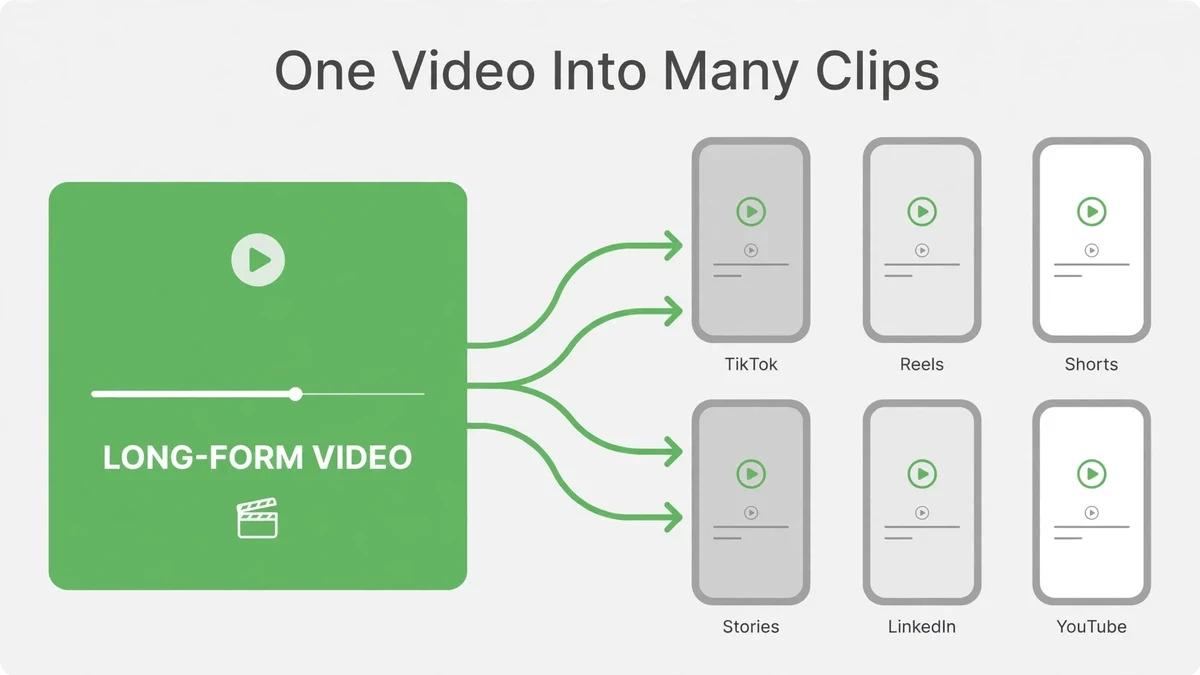
Film once, publish four times. The workflow: shoot vertical 9:16 with the hook up front, edit one master cut with burned-in captions, then adapt per platform — trim the hook tighter for TikTok, add location tags and hashtags for Reels, write a search-friendly title for Shorts, and reframe the caption with a LinkedIn-appropriate angle if your buyers are there. Total extra time per platform: minutes. Total extra reach: multiples. Repurpose deliberately: one long recording session can fuel a month of short-form video posts.
What not to do: cross-post with another platform’s watermark. TikTok watermarks on Reels get suppressed — download clean copies or, better, edit in a neutral app and export separately. And don’t auto-post identical captions everywhere; each platform’s audience reads differently, and a caption written for TikTok looks lost on LinkedIn.
Reading the Data: What to Actually Track
After 30 days and 12+ videos, the data starts talking. Track per video: views, watch-through rate, saves, shares, profile visits, and follows. Then aggregate by pillar: which pillar earns the most saves? The most shares? The most profile visits? Saves mean “this was useful” — make more of that pillar. Shares mean “this is identity” — that’s your reach engine. Profile visits mean “I’m considering you” — check what those visitors see when they land.
The monthly review is simple: double down on the top pillar, fix or drop the bottom one, and test one new hook formula. Strategy isn’t a document you write once — it’s this loop, run monthly. The businesses winning short-form in 2026 aren’t more creative than you. They’re more systematic.
When to Put Budget Behind a Short-Form Video
Organic reach should always come first — but once a short-form video proves itself organically, a small paid push can multiply the result. The rule is simple: only boost winners. Look at your last 60–90 days of short-form video posts and find the top 10% by watch time and saves, not just views. Those are the videos the algorithm already validated with real viewers, which makes them the safest bets for paid distribution.
Before you spend anything, check three things. First, the video needs a clear next step — boosting a short-form video with no CTA just buys expensive views. Second, it should still be relevant: boosting a timely or seasonal clip two months late wastes the budget. Third, keep the budget small and the window short — a modest daily spend over three to five days tells you quickly whether the video converts cold audiences, without committing real money.
And keep perspective: paid distribution amplifies a good short-form video, it doesn’t rescue a weak one. If a clip flopped organically because the hook was soft or the payoff was unclear, no budget will fix that — re-shoot it with a stronger opening instead. Use paid as a spotlight for your proven short-form video winners, track what each meaningful action costs, and kill underperformers fast. That’s how small budgets beat big ones.
Ready to make short-form systematic?
Short-form video rewards the prepared and punishes the random. If you’re posting sporadically — or not at all — the fix is the system above: pillars, hooks, batching, and monthly review. Contact the KKeyQik team and tell us your business and your market. We’ll build your pillar map and your first month of hooks — and if you’d rather hand over filming support and editing too, we do that as well.
Further reading: our complete guide to video marketing services for small business — strategy, the six video types, and ROI measurement.
About the KKeyQik Team
KKeyQik is a digital marketing agency helping small businesses grow with SEO, social media marketing, PPC (Google Ads and Meta Ads), web development, video editing, and graphic design. The KKeyQik Team publishes practical, no-fluff guides for business owners who want marketing that drives measurable growth.
Want to put this to work for your business? KKeyQik plans and delivers video production and editing for small businesses, with an in-house team available 24/7. See our video production service or get a quote within 24 hours.
Frequently Asked Questions
Start with Instagram Reels — it's the default pick for US small businesses because it combines local discovery, broad buyer-age coverage, and a profile that functions as a second homepage. Add TikTok when Reels is running smoothly if your buyers skew younger, and YouTube Shorts once you have any YouTube presence at all. One platform done well beats three done badly, so master one before expanding.
Content pillars are the three or four themes every video ladders up to — educate, prove, humanize, and convert. They permanently solve the 'what do I post?' problem: every video must fit a pillar, or it doesn't get made. Without pillars you're posting randomly with extra steps; with them, every video has a job.
Aim for roughly 40% educate, 25% prove, 25% humanize, and 10% convert. The ratio matters: businesses that post 90% offers have built a channel of commercials nobody watches, while businesses that post 0% offers have built entertainment with no cash register. The mix keeps the audience growing and the phone ringing.
It's the strategy. The first two seconds decide whether anyone watches — no logos, no 'hey guys,' no slow fades; the video starts mid-thought on the most interesting frame. Write the hook as a literal first line before filming, film it three times so the edit has options, and never open with branding.
As often as you can sustain without quality collapsing, for twelve months — consistency beats volume. A realistic starting framework is 3–4 Reels per week: enough to stay visible, few enough to keep quality high. The algorithm rewards accounts that publish reliably, and audiences reward accounts that never vanish for three weeks.
Repurpose with native tweaks — one shoot, four placements, not four shoots. Each platform has its own conventions and aspect-ratio expectations, so adapt captions, cover frames, and any platform-specific features rather than cross-posting blindly. The filming is the expensive part; adapting is cheap.
Track saves, shares, and profile visits per pillar — then make more of what the data likes, not what you like. Saves and shares signal value worth keeping, and profile visits signal buying intent. Vanity metrics like raw view counts tell you far less about what's actually building your business.
Trend-chasing burns out non-creators and attracts audiences that may be far-flung from your buyer base. Repeatable hook formulas — the mistake callout, the number, the contrarian take, the direct question, the result-first open, the story open, the direct callout — are a system you can sustain for a year. Trends are snacks; a strategy is a diet.
Fifteen to sixty seconds, with one idea per video. A 30-second video with a great hook and one clear point outperforms a 60-second ramble every time — length is not value. After the hook, deliver the promised value fast and end with the next step as on-screen text.
Through discovery and familiarity: Reels earn local reach via location tags and shares to DMs, your profile acts as a storefront for curious visitors, and the convert pillar makes the offer explicitly. One video rarely closes a sale — it's the steady accumulation of useful, human videos that turns a stranger into someone who calls.