

Introduction
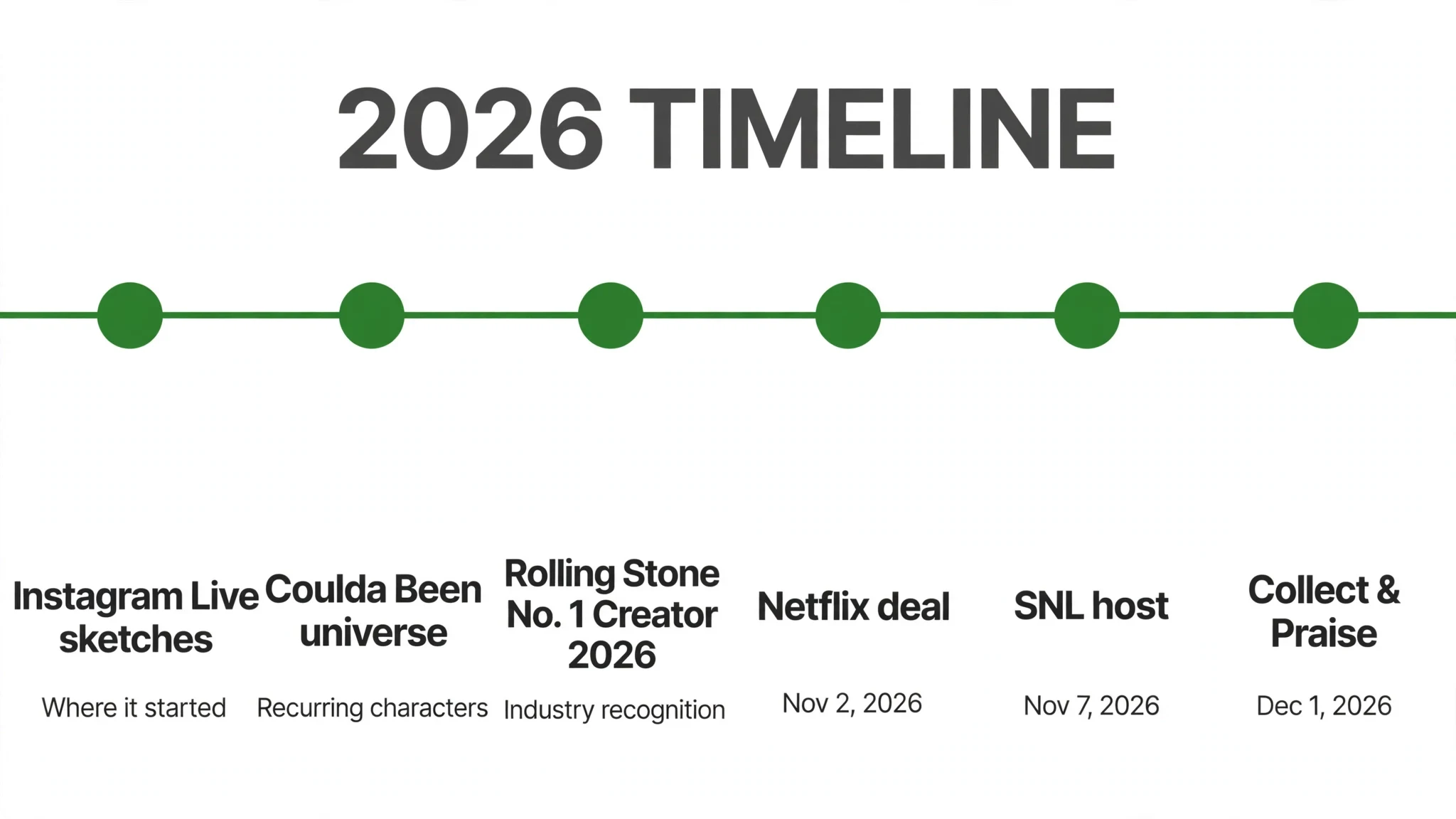
In the space of a single week in November 2026, a comedian who built his career on Instagram Live sketches signed a multi-year deal with Netflix and became the first digital creator ever to host Saturday Night Live. Druski, whose real name is Drew Desbordes, did not get there through a television audition or a talent-agency pipeline. He got there by building an audience one character at a time, funding his own shows when networks passed, and turning a catalog of short videos into a business that the biggest streaming platform in the world decided it needed to own a piece of.
That arc is worth studying even if you have never watched one of his sketches. The creator economy is no longer a side channel for brands that cannot afford television. It is a market worth hundreds of billions of dollars, and the influencer marketing sitting inside it is projected at roughly $40.5 billion for 2026. Small businesses do not need a Netflix deal to benefit from the same forces that produced one. The mechanics Druski used — memorable characters, proof of demand before the pitch, one idea reused across formats, and partnerships chosen for fit rather than fame — work at the scale of a neighbourhood bakery, a local gym, or a regional law firm.
This post breaks down what actually happened around the Druski Netflix deal, puts the numbers behind the creator economy in plain terms, and draws out seven influencer marketing lessons a small business can apply without a Hollywood budget. Each lesson ends with a concrete next step, and the final section turns the whole framework into a five-step plan you can start this week.
What Actually Happened: The Netflix Deal and the SNL Stage
On November 2, 2026, Netflix announced a multi-year agreement with Druski and his production company, 4LIFERS Entertainment, to develop and produce original programming exclusively for the streaming service. The deal also covers licensing of selected titles from his existing catalog, including the Coulda Been series that made him famous online. The first project under the agreement, a semi-scripted comedy called Collect & Praise, is scheduled to premiere on December 1, 2026. In it, Druski plays a money-hungry megachurch pastor, with veteran comedian Mike Epps as his unpredictable deacon, expanding a sketch character that had already drawn more than nine million likes on TikTok into a full series.
The timing mattered as much as the deal itself. Five days later, on November 7, Druski hosted Saturday Night Live, becoming the first digital content creator to host the show in its 52-season history. The same week, coverage of his rise noted that Rolling Stone had named him the number one most influential creator of 2026, that he had appeared on the cover of GQ in August 2026, and that he had been the youngest-ever host of the BET Awards. A creator who once pitched television networks and heard no is now the person those networks’ competitors are building schedules around.
The numbers behind the catalog explain why Netflix moved. The Coulda Been catalog — a set of reality-parody formats built around auditions, dating shows, and a fictional record label — has passed one billion views on YouTube. The first season of Coulda Been House alone drew around 58 million views. Those are not vanity metrics. They are evidence of an audience that returns, watches long-form content, and follows characters across platforms. When Netflix licenses that catalog, it is buying a proven audience along with the shows.
There is a longer backstory that matters for the marketing lessons below. Druski has spoken openly about approaching major entertainment companies with his ideas for years and being turned away. Rather than waiting for permission, he funded his own productions, built the characters on social platforms where the audience already lived, and let the viewing numbers make the argument for him. By the time Netflix came calling, he was not asking for a break. He was negotiating from a position of proven demand. That sequence — audience first, deal second — is the single most transferable idea in this whole story.
The Creator Economy in Numbers
Before the lessons, it helps to know the scale of the market you would be entering, because the figures are large enough to change how a small business should think about creator partnerships.
Goldman Sachs estimates the total addressable market of the creator economy at roughly $250 billion, with projections pointing toward about $480 billion by 2027. Grand View Research puts the 2026 global figure at around $310 billion. The spread between estimates exists because analysts count different things — some include platform revenue and tools, others count only money flowing directly to creators — but every serious estimate points in the same direction, and quickly.
Inside that larger economy, influencer marketing is the part most brands actually buy. Mordor Intelligence valued the global influencer marketing market at $31.07 billion in 2025 and projects it will reach about $40.51 billion in 2026, a jump of roughly 30 percent in a single year. In the United States alone, influencer marketing spending passed $10.52 billion in 2025, according to EMARKETER, crossing the ten-billion mark a year earlier than that firm had previously expected, with growth forecast to accelerate to about 15.7 percent in 2026.
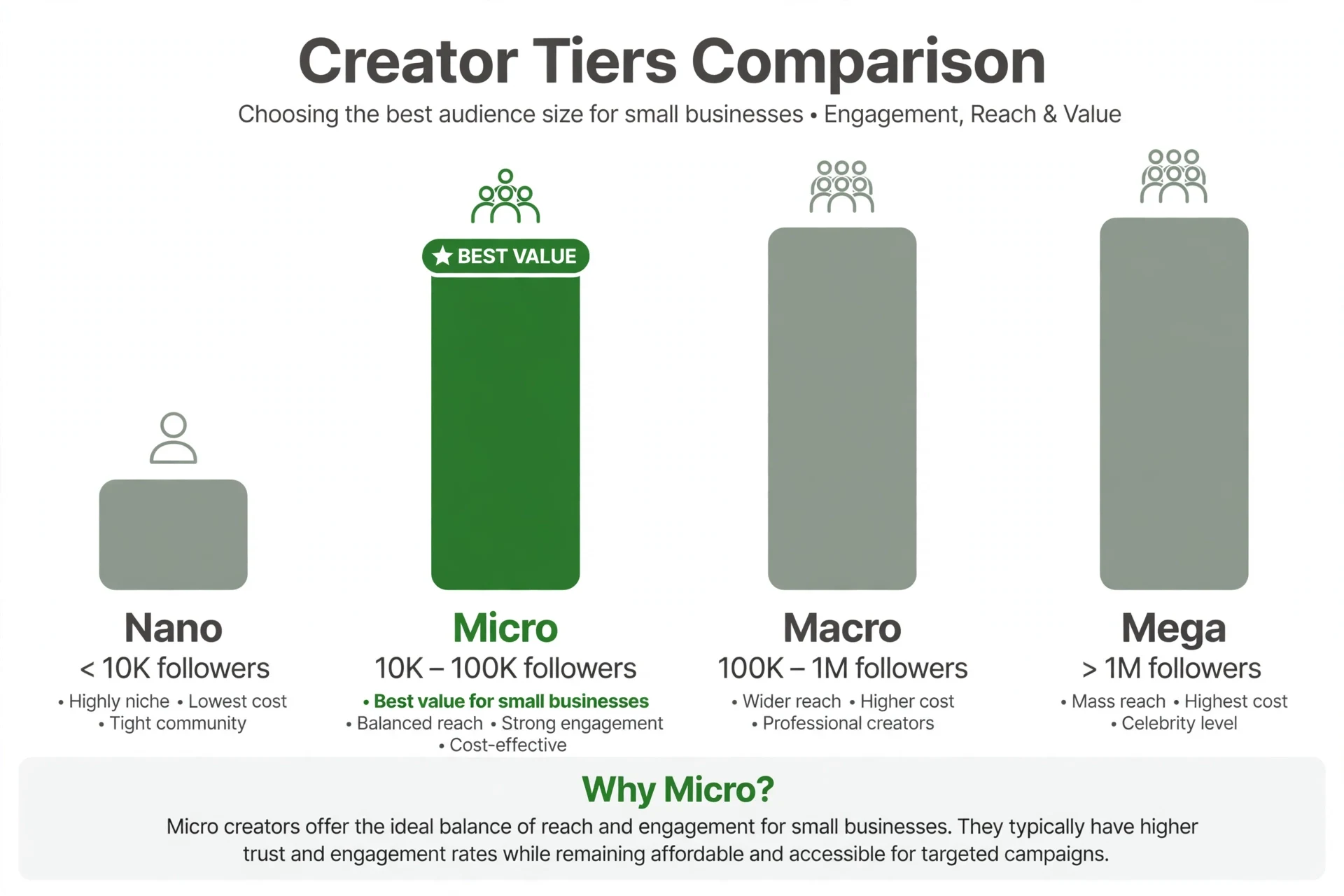
The supply side is just as striking. Roughly 207 million people worldwide create content in some form, and around 50 million do it professionally or semi-professionally. Most of them are small: nano and micro creators — accounts with under 100,000 followers — account for about half of all creator spending in the United States, according to EMARKETER. That last figure is the one that should interest a small business most, because it means the creator economy is not a market reserved for celebrities. It is a market in which small, trusted voices already take half the money.
The demand side is moving just as fast. CreatorIQ’s 2025–26 State of Creator Marketing report found that 71 percent of surveyed organisations had increased their creator investment year over year, with average reported annual influencer budgets rising sharply. Sprout Social’s research found that 83 percent of marketers now rate their influencer programmes as effective or very effective. And nearly two-thirds of new creator marketing spend is being reallocated from traditional paid and digital channels, which means the budgets are not experimental extras. They are money being moved away from older tactics that no longer perform as well.
None of this guarantees results for any single campaign. But it does mean that a small business working with creators in 2026 is joining a mainstream channel with established pricing, measurement tools, and a deep bench of partners — not gambling on a fad. The influencer marketing lessons below are drawn from how the biggest creator success story of the month actually worked, translated into steps a business of any size can take.
1. Build Characters and Worlds, Not Just Content
The first of these influencer marketing lessons is also the most overlooked: Druski did not go viral once. He built a world that audiences could return to. His best-known formats — Coulda Been Love, Coulda Been Records, Coulda Been House — are not one-off jokes. They are recurring universes with their own rules, their own cast of characters, and their own internal logic. Viewers who liked one episode had a reason to watch the next, because the characters were still there and the story was still going.
That is a different model from the one most small businesses use on social media, which is to post whatever is available that week — a product photo, a holiday graphic, a reposted article — and hope something lands. The content is disconnected, so the audience has nothing to follow. There is no reason to come back tomorrow, because tomorrow’s post will have nothing to do with today’s.
A world does not need a cast of actors or a production company. For a small business, a world can be a recurring series with a consistent format: a weekly “shop floor” video where the owner answers one customer question, a monthly before-and-after series showing real client results, a running character in your ads who returns in every campaign. The key is repetition with variation. The format stays recognisable, the content inside it changes, and the audience learns what to expect and when to expect it.
The same principle applies when you work with creators. A one-off sponsored post from an influencer is a rented audience for a day. A recurring partnership — the same creator featuring your product in a series over several weeks — builds familiarity, and familiarity is the bridge between being noticed and being believed. When you brief a creator, think in terms of a short series rather than a single post. Ask what a three-part version of the idea would look like, and price the series rather than the post. The creator gets steadier income, you get repeated exposure to the same audience, and the audience gets a storyline instead of an interruption.
Your next step: pick one format you can repeat weekly for the next three months — a question-and-answer video, a customer story, a behind-the-scenes walkthrough — and commit to the schedule before you worry about making any single episode perfect. Consistency builds the world; polish comes later.
2. Prove the Demand Before You Pitch the Deal
The second of these influencer marketing lessons is the sequence of Druski’s career, and it runs in the opposite direction from how most businesses approach partnerships. He did not pitch Netflix first and then try to build an audience. He built the audience, funded his own shows, collected the viewing numbers, and let the numbers do the pitching. The networks that passed on him for years were not rejecting his talent. They were rejecting an unproven bet. Once the proof existed — a billion views on a catalog, tens of millions on a single season — the same idea became an easy decision for the buyer.
Small businesses usually reverse this order. They approach a creator with a pitch and a budget before they have any evidence that their own product can hold an audience’s attention. Then, when the campaign underperforms, they blame the creator. But the creator’s job is to carry a message to an audience that already trusts them. If the message itself is weak — a product nobody has reviewed, a landing page that confuses visitors, an offer with no clear reason to act — no creator can fix that.
The practical version of proving demand is cheap. Before you spend anything on influencer marketing, publish ten pieces of content about your product or service on your own channels and see which ones people actually engage with. Run a small paid test to a landing page and check whether visitors convert. Collect three genuine customer testimonials with specific outcomes. That evidence does two things: it tells you what message is worth amplifying, and it gives the creator something real to work with instead of a script they have to invent enthusiasm for.
It also changes the negotiation. A creator who can see that your product already converts, that customers already say good things about it, and that your content already earns attention is far more likely to accept a performance-based arrangement or a longer partnership. You are not asking them to gamble their credibility on an unknown product. You are inviting them into something that already works.
Your next step: before your next creator outreach, assemble a one-page proof sheet — your best-performing post, your conversion rate, two customer quotes, and the exact outcome you want the campaign to produce. Send that with your pitch instead of sending a generic introduction.
3. Make One Idea Do Five Jobs
Look closely at the Druski Netflix deal and you will see a single sketch character doing an extraordinary amount of work. The megachurch pastor began as a short social video. That sketch became a recurring character, then a series concept, then a licensing asset, then the anchor of a multi-year Netflix agreement — and along the way it generated press coverage, social clips, and a premiere date that will produce another round of attention in December. One idea, five jobs, each one compounding the last.
Most small businesses do the opposite. They create a piece of content, use it once, and move on. A video is posted to Instagram and forgotten. A blog post goes live and is never linked again. A customer story is told once in a meeting and never written down. The result is a treadmill: constant production, no accumulation, and a marketing cost that never falls because every asset starts from zero.
The influencer marketing lessons here are about reuse, and they apply to creator partnerships directly. When a creator makes something good for you, do not let it live in a single post. Negotiate usage rights that let you put the video on your website, cut it into short clips for your own social channels, quote it in an email, and run it as a paid ad. A creator video that performs well organically is often your best-performing ad creative, because it already carries the social proof of real engagement. The same applies in reverse: give the creator your best-performing content — your most-read blog post, your most-shared video — and ask them to react to it, extend it, or answer it in their own voice. Your idea and their audience meet in the middle, and both sides get more from the same material.
Repurposing also protects your budget. A single well-planned creator session can produce a long video, three short clips, a set of photos, a quote for your website, and a live question-and-answer session. Plan that in the brief, not after the fact, and agree on the deliverables before the shoot. The cost of one creator day is roughly the same whether it produces one asset or five. The return is not.
Your next step: take your single best piece of content from the last six months and list five places it could live — your homepage, an email, a paid ad, a creator brief, a sales deck. Then do the same for the next creator video you commission, before the creator starts filming.
4. Small Creators Often Beat Big Names on Trust
The fourth of these influencer marketing lessons is the one that saves small businesses the most money, and it is hidden in plain sight in the market data. Nano and micro creators — accounts with fewer than 100,000 followers — now account for roughly half of all creator spending in the United States. Brands did not move that money by accident. Smaller creators typically earn higher engagement rates, their audiences know them personally rather than as distant celebrities, and their recommendations read as advice from a peer rather than a paid endorsement from a star.
That matters because the purpose of influencer marketing is not reach. It is trust transfer. A celebrity with ten million followers can put your product in front of a huge audience, but that audience knows the celebrity is being paid, and most of them will scroll past. A local creator with 8,000 followers who genuinely uses your product — a fitness coach recommending a neighbourhood gym, a home cook featuring a local grocer’s ingredients, a DIY creator showing a real renovation with a local supplier’s materials — is speaking to people who believe them, and belief is what converts.
The cost difference is just as important. A single post from a mega creator can cost more than a small business spends on marketing in a quarter. The same budget spread across five micro creators in five different local niches buys five audiences, five sets of content, and five chances to learn what works. It also diversifies risk: if one creator underperforms, the campaign still has four others running.
Finding the right small creators is easier than most businesses assume. Search the platform your customers use, in your city, for the terms your customers search. Look at who is already posting about your category without being paid to do so. Check the comments on their posts — real questions from real followers are a better signal than follower counts. And look at who your own customers already follow. The best creator for a small business is often someone its customers already trust, and that person is usually affordable, responsive, and excited to work with a local brand.
Your next step: identify three creators in your area with between 2,000 and 50,000 followers who already post about your category. Follow them for a week, note what their audiences ask about, and then approach the one whose audience asks the questions your product answers.
5. Fit Beats Follower Count Every Time
The fifth of these influencer marketing lessons is the one that prevents the most expensive mistake in creator marketing: choosing a partner because of the size of their audience rather than the match between their audience and your customer.
Druski’s Netflix deal worked because the fit was exact. Netflix wanted the audience that watches character-driven comedy in long form, and Druski had spent years proving he could hold exactly that audience. The deal did not happen because he had the most followers of any creator, or because his content was the most broadly popular. It happened because his audience and Netflix’s target audience for this kind of programming were the same people. Fit made the economics work.
For a small business, fit has three parts, and all three matter more than follower count. The first is audience overlap: the creator’s followers should look like your customers, in age, location, interests, and buying intent. A creator with 200,000 followers in another country is worth less to a local service business than a creator with 5,000 followers in the same city. The second is content alignment: the creator’s normal content should make your product feel natural rather than forced. If they never talk about food, a restaurant partnership will read as an ad. If they cook every day, the same partnership reads as a recommendation. The third is values alignment: the creator’s tone, language, and public behaviour should be something you would be comfortable standing next to. A creator’s controversy becomes your controversy the moment your logo appears in their post.
The way to check fit is to watch before you pay. Spend two weeks following a creator you are considering. Read their last twenty posts, not just the popular ones. Read the comments. Check whether their followers ask questions your product can answer, whether they live where you operate, and whether they engage with the creator or merely watch passively. Then look at the creator’s past brand partnerships and ask a simple question: did those products belong in that feed, or did they look pasted in? The answer tells you more than any media kit.
Fit also protects the creator. Creators who promote products they do not believe in lose audience trust, and a creator who has lost trust is no use to anyone. The best partnerships are ones the creator would have made for free, because the product genuinely fits their life. When you find that match, the content is better, the audience response is warmer, and the relationship lasts longer than a single campaign. That is why the most successful small-business creator programmes are built on a handful of well-chosen partners rather than a long list of whoever was available.
Your next step: before you contact any creator, write down three fit criteria — audience location, content category, and one value your brand will not compromise on — and reject any creator who misses even one of them, no matter how large their following.
6. Turn the Announcement Into the Marketing
The sixth of these influencer marketing lessons is about timing and theatre. Netflix did not quietly sign the deal and file the paperwork. The announcement arrived as a video teaser from Druski himself on November 2, followed by press coverage, a premiere date, and a cast reveal that gave entertainment outlets something concrete to report. The SNL hosting announcement then landed five days later, and each piece of news fed the next. By the time the show premieres on December 1, the audience will have been warmed up for a month. The announcement was not separate from the marketing. The announcement was the marketing.
Small businesses can borrow this rhythm at any scale, and the same logic applies to the event marketing lessons from WWE Crown Jewel 2026, where the announcement schedule itself built the audience for the event. A product launch, a new service, a partnership, or a milestone is not a single moment. It is a sequence: a hint, a reveal, a detail, a date, and a reminder. Each step gives your audience a reason to pay attention again, and each step gives the press, your email list, and your social followers something new to share.
The same thinking applies to a creator partnership. Do not let the sponsored post be the first time anyone hears about the collaboration. Announce the partnership a week before the content goes live. Let the creator tease it in their own style. Share a behind-the-scenes photo from the shoot. Then publish the content, then share the results. A single creator post becomes a two-week story, and a two-week story reaches people who would have missed a single post entirely.
The discipline here is planning the sequence before you announce anything. Write the five beats — tease, reveal, detail, launch, follow-up — on a calendar before the first one goes out. Give each beat a different piece of information so that nobody sees the same message twice. And give each beat a clear call to action: a date to remember, a link to follow, a question to answer. Announcements without a next step are just noise.
Your next step: for your next launch or partnership, map five announcement beats across two weeks before you publish the first one, and make sure each beat reveals something new.
7. Measure Like a Business, Not a Fan
The seventh of these influencer marketing lessons is the least glamorous and the most important: the creator economy rewards businesses that measure properly, and it punishes those that judge campaigns by how the content felt. Druski’s career is measurable at every step — views per format, growth per character, conversion from short clips to long-form viewing. Netflix could justify the deal because the numbers existed. Your creator campaigns need the same discipline, at your scale.
Measurement starts before the campaign, not after it. Decide the one outcome that matters — sales, bookings, sign-ups, or qualified enquiries — and give the creator a unique way to drive it: a trackable link, a discount code, or a landing page built for that partnership. Without that, you will be guessing whether the campaign worked, and guessing is how budgets get wasted. Roughly half of marketing leaders now cite accurate measurement of return on investment as their greatest challenge in influencer marketing, according to Later’s 2026 research, and the fix is not better guesswork. It is better tracking.
Set a baseline first. Record your normal weekly sales or enquiries for the month before the campaign, so you can see what changed. Then track the campaign’s own numbers: clicks on the trackable link, redemptions of the code, and the cost per result. Compare the creator’s results against your other channels on the same basis — cost per lead, cost per sale — and keep the comparison honest. A creator who drives fewer clicks but better customers is worth more than a creator who drives traffic that never buys.
Then use the data to decide what happens next. The creators who perform well get longer partnerships and larger budgets. The ones who do not get a polite thank-you and no renewal. That is not harsh. It is the same logic Netflix applied: invest where the audience has already proven itself. A small business that measures properly can afford to keep testing, because every test makes the next decision cheaper and smarter.
Your next step: for your next creator campaign, set up one trackable link and one discount code before the content goes live, record your baseline numbers, and review the results two weeks after launch — then double down on the creator who performed best.
Influencer Marketing Lessons: How a Small Business Can Start This Week
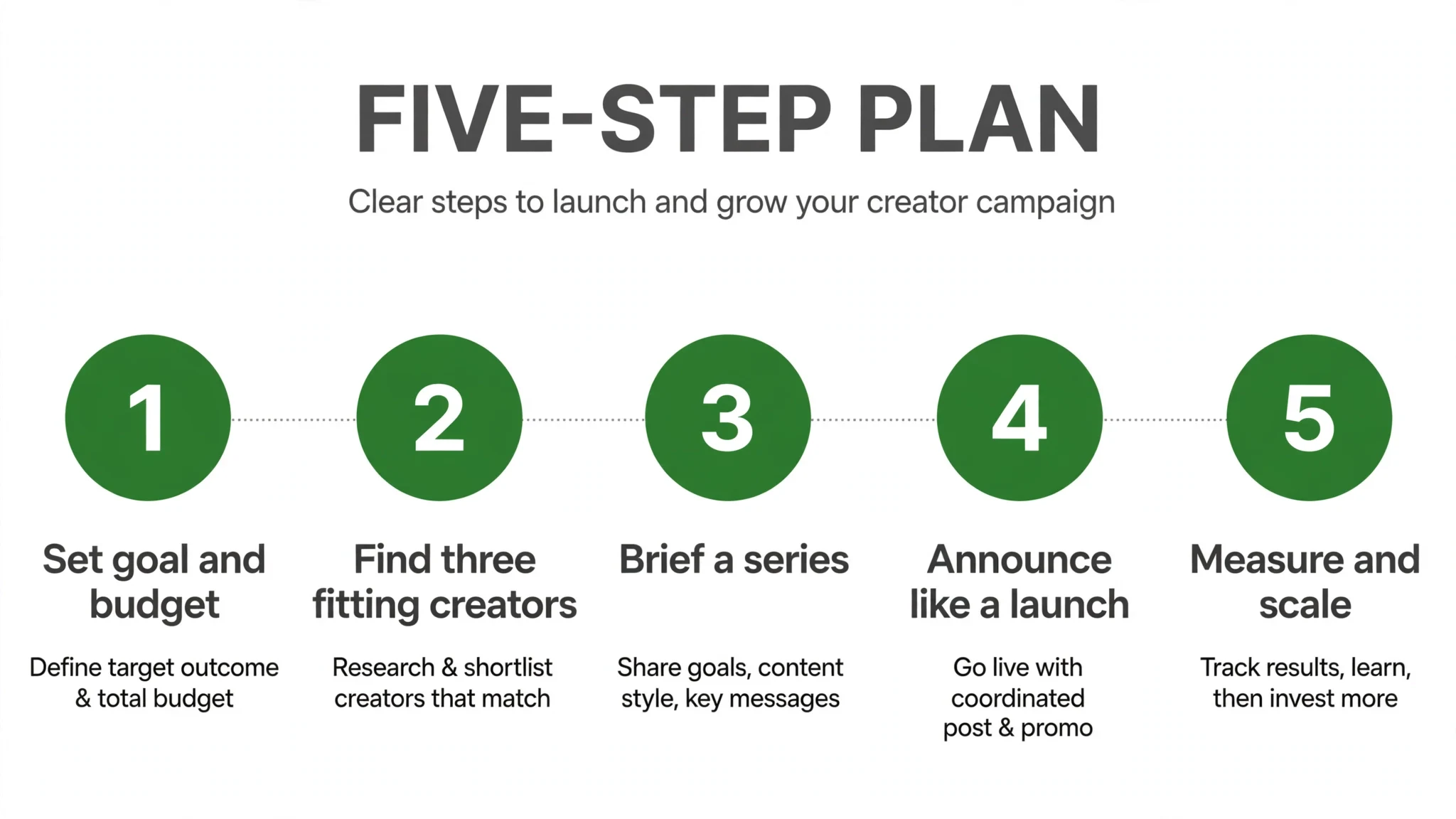
The seven influencer marketing lessons above add up to a simple operating system, and you do not need a large budget or a dedicated team to run it. Here is the five-step version you can start this week.
Step one: set the goal and the budget. Pick one outcome — ten new bookings, fifty email sign-ups, twenty product sales — and one budget you can afford to lose while you learn. A test budget of a few hundred dollars spread across two or three micro creators will teach you more than a single large spend on one big name.
Step two: find three creators who already fit. Use the fit criteria from lesson five. Look for creators in your area, in your category, with audiences between 2,000 and 50,000 followers. Watch them for a week. Shortlist the ones whose followers ask questions your product answers.
Step three: brief for a series, not a post. Give each creator a clear brief: the outcome you want, the proof points from lesson two, the format from lesson one, and the deliverables from lesson three — one long video, three short clips, and usage rights for your own channels. Agree on the trackable link and the code from lesson seven before filming starts.
Step four: announce it like a launch. Use the five-beat sequence from lesson six. Tease the partnership, reveal the creator, share a behind-the-scenes moment, publish the content, and follow up with the result. Each beat goes to your email list and your social channels, not just the creator’s audience.
Step five: measure, then scale what works. Two weeks after launch, compare the creators on cost per result. Renew the best performer for a longer series, thank the others, and put the next budget behind the winner. That is how a small test becomes a programme.
If you want help running this properly, KKeyQik’s social media marketing services cover creator outreach, campaign planning, and content distribution, and the team’s video marketing services can turn a single creator session into the multi-format assets described above. Strong creator content also needs to be found, which is where SEO services come in — the blog posts, landing pages, and video descriptions that keep working long after the campaign ends.
Influencer Marketing Mistakes to Avoid
Before you start, it is worth naming the mistakes that waste the most influencer marketing budgets, because they are all avoidable.
The first is paying for reach instead of fit. A large audience in the wrong city, in the wrong age group, or in the wrong interest category is not an asset. It is a cost with no return. The second is giving the creator a script. Creators know their audience’s language better than any brand does, and a scripted post reads as an advertisement. Give them the facts, the outcome, and the boundaries, then let them say it their way. The third is running a campaign without tracking. If you cannot attribute a single sale or enquiry to the partnership, you cannot justify the next one — and you will end up cancelling a channel that might have been working. The fourth is treating creators as vendors rather than partners. The businesses that get the best creator content are the ones that pay on time, share results, and renew the creators who perform. Creators talk to each other, and a reputation for fair dealing is worth more than any single negotiation. The fifth is expecting one post to change the business. Creator marketing compounds over a series. Judge it after three collaborations with the same creator, not after one.
One more caution, drawn from a very different kind of viral moment: the attention a trend brings is only useful if the product behind it is ready. The free-games surge that drove searches for Steam earlier this month worked because the offer was real and the store could handle the traffic — the same principle behind the lessons in our Steam free games marketing breakdown. A creator campaign that sends thousands of visitors to a broken page or an unclear offer burns trust faster than it builds it. Check the landing page before you pay for the traffic.
Conclusion
Druski’s week in November 2026 — a Netflix deal on Monday, a historic SNL hosting slot on Saturday, a premiere date in December — looks like an overnight success. It is not. It is the visible end of years of building characters, funding his own work, collecting proof, and letting the audience make the argument that the networks would not — a masterclass in influencer marketing lessons, executed over years rather than weeks. The creator economy rewards that sequence, and the market data says the reward is getting larger: a roughly $40.5 billion influencer marketing market in 2026, growing around 30 percent a year, with half the spending already flowing to small creators.
For a small business, the takeaway is not to copy Druski’s content. It is to copy his method: build something repeatable, prove it works before you pitch it, reuse every good idea, choose partners for fit rather than fame, announce like it matters, and measure like a business. Those seven influencer marketing lessons cost very little to start and compound quickly once they are running.
If you would like a team to plan and run creator campaigns for your business — from finding the right creators to tracking the results — talk to KKeyQik or explore what the agency does at kkeyqik.com. The audience is already out there, watching creators they trust. The only question is whether your product is the one those creators are talking about.
Frequently Asked Questions
Netflix announced a multi-year agreement on November 2, 2026, with comedian and creator Druski and his production company, 4LIFERS Entertainment, to develop and produce original programming exclusively for the streaming service. Netflix is also licensing selected titles from his existing Coulda Been catalog. The first project, the semi-scripted comedy Collect & Praise, premieres on December 1, 2026.
Druski hosted Saturday Night Live on November 7, 2026, becoming the first digital content creator to host the show in its 52-season history. It signals that audiences built on social platforms now carry the same cultural weight as traditional television fame, and it shows brands that creator audiences can transfer to mainstream formats.
Estimates vary by methodology, but Goldman Sachs puts the total addressable market at roughly $250 billion, heading toward about $480 billion by 2027, while Grand View Research estimates the 2026 global figure at around $310 billion. Influencer marketing inside that economy is projected at roughly $40.5 billion in 2026.
US influencer marketing spending passed $10.52 billion in 2025, according to EMARKETER, crossing the ten-billion mark a year earlier than previously expected. Growth is forecast to accelerate to about 15.7 percent in 2026, and most marketers now rate their influencer programmes as effective.
A micro influencer typically has between 10,000 and 100,000 followers, while nano creators have under 10,000. Together, nano and micro creators account for roughly half of all creator spending in the United States. Their audiences tend to trust them more, engage at higher rates, and cost far less than celebrity creators, which makes them a practical choice for small business budgets.
Start with a test budget you can afford to treat as learning — often a few hundred dollars spread across two or three micro creators. The goal of the first campaign is to learn which creator, format, and offer produce results, so you can put the next budget behind the winner rather than guessing at scale.
Search the platform your customers use, in your city, for the terms your customers search. Look for creators who already post about your category without being paid, read their comments for real questions from real followers, and check who your own customers already follow. Fit — audience overlap, content alignment, and shared values — matters more than follower count.
Decide one outcome before launch — sales, bookings, sign-ups, or enquiries — and give the creator a unique trackable link or discount code. Record your normal weekly baseline first, then compare the campaign's cost per result against your other channels two weeks after launch. Without tracking, you cannot justify the next campaign.
No. Give the creator the facts, the outcome you want, and any boundaries, then let them present it in their own voice. Creators know their audience's language better than any brand does, and a scripted post reads as an advertisement. The content performs better when it sounds like the creator, not like your marketing department.
Collect & Praise is a semi-scripted comedy premiering on Netflix on December 1, 2026. Druski stars as a money-hungry megachurch pastor, with Mike Epps as his unpredictable deacon. It expands a viral sketch character — whose original video drew more than nine million likes on TikTok — into a full series, showing how one short-form idea can grow into long-form programming.