

Introduction
“National coffee day” is climbing fast in the United States right now — tens of thousands of searches, up 800%, and still rising as the day unfolds. The reason is simple: today, September 29, 2026, is National Coffee Day, and Americans are hunting for free cups, discounts, and limited-edition treats from their favorite chains.
Dunkin’ is giving away free medium coffees to Rewards members. Starbucks chose the day to launch a brand-new espresso drink and three mini pies. Krispy Kreme invented an entirely new doughnut flavor just for the occasion. Cinnabon is dropping Instagram deals, and 7 Brew is handing out collectible state license plate stickers with every drink.
For marketers, this is the interesting part. National Coffee Day marketing is one of the purest examples of awareness-day marketing in existence — a made-up holiday that generates enormous real revenue, app downloads, loyalty signups, and social impressions every single year. And the playbook the big chains are running today is the same playbook any small business can run, on any awareness day, on a fraction of the budget.
This post breaks down 12 national coffee day marketing strategies the biggest brands are using in 2026 — and how your business can adapt each one. And if you would rather have specialists build this kind of calendar-driven growth system for your brand, our team at KKeyQik designs exactly these campaigns.
Why Awareness-Day Marketing Works So Well
Before the tactics, the psychology — because national coffee day marketing succeeds for reasons that apply to every awareness day on the calendar. Awareness-day marketing works because it solves three of marketing’s hardest problems at once.
First, it borrows demand instead of manufacturing it. National Coffee Day already has attention — it is trending on Google, covered by USA Today and PEOPLE, and wired into the cultural calendar. A brand that shows up on the day does not have to create curiosity from scratch; it only has to intercept curiosity that already exists. That is why even a small café’s single Instagram post today will outperform most of its regular content.
Second, it manufactures urgency without discounting your soul. A 24-hour promotion has a built-in deadline, which means you can offer a genuinely aggressive deal without training customers to wait for discounts. The time box is the discount strategy. When RaceTrac runs $1 small coffees all September or Tim Hortons gives a free coffee with no purchase required on the 29th, the scarcity of the window is doing the selling.
Third, it creates a social permission slip. People need a reason to post about your brand. #NationalCoffeeDay is that reason — it gives customers a culturally approved excuse to photograph their cup, tag your shop, and tell their followers where they got it. That is free distribution with social proof baked in, and it is the engine underneath almost every national coffee day marketing strategy below.
The numbers back it up: according to the National Coffee Association’s fall 2026 coffee trends survey, roughly two-thirds of American adults drink coffee daily — more than drink tap or bottled water. The audience is essentially everyone. And the brands that win the day are not the ones with the biggest discounts. They are the ones with the smartest mechanics. Here are twelve of them.
Strategy 1: Gate the Freebie Behind Your App
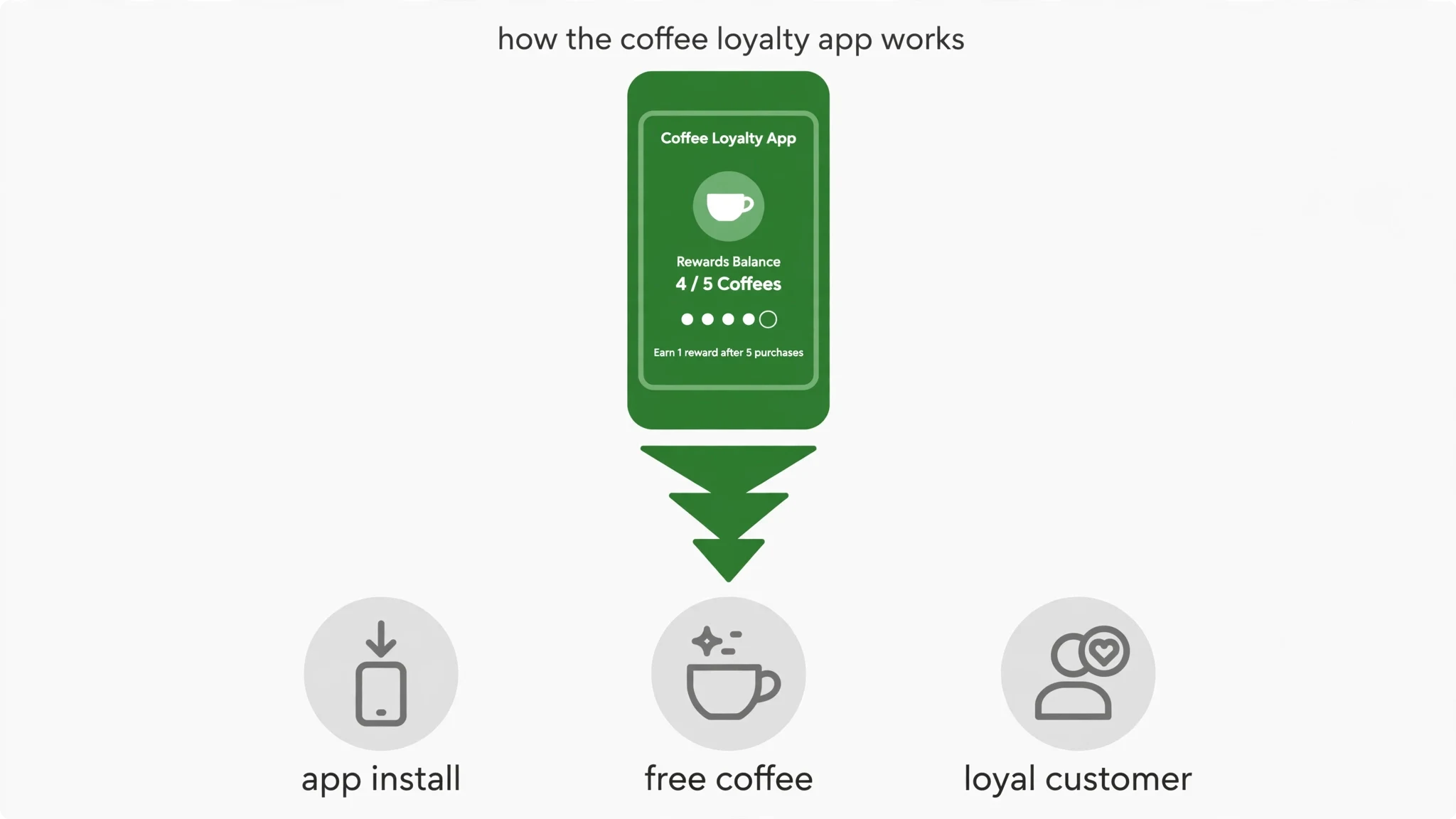
The smartest free-coffee offers this year are not really about coffee. They are about app installs — and this is where national coffee day marketing gets strategic.
Dunkin’ is giving Rewards members a free medium hot or iced coffee with any purchase — but only through the Dunkin’ app. Tim Hortons will hand you a free coffee in any size with no purchase required, but you must activate the offer in the Tim Hortons app first. Circle K requires Inner Circle members to redeem inside the app and enter their phone number at checkout. Scooter’s Coffee is free Sept 27–29, but only when you order through its app.
Every one of these brands is doing the same math: a free cup costs a dollar or two; an installed app with push-notification permission is worth months of owned reach. They are trading a low-cost beverage for a permanent marketing channel. That is national coffee day marketing at its most strategic — the giveaway is the acquisition cost, and the app is the asset.
Your move: Never run a holiday giveaway without a capture mechanism — this is national coffee day marketing rule number one. Freebie in exchange for an email, a loyalty signup, or a follow — the asset you collect must outlast the 24-hour window. If you do not have an app, an SMS list or a simple email capture works the same way.
Strategy 2: Launch Something New on the Day
Starbucks did not discount anything for National Coffee Day. Instead, it launched the Aerocano — a new iced espresso drink built on air-whipped blonde espresso, described as a modern take on the iced americano — plus three new mini pies (Apple Crumble, Pumpkin, and Pecan), all arriving on menus September 29.
This is a different philosophy from the giveaway playbook, and a signature national coffee day marketing move. Starbucks used the holiday’s guaranteed media attention as a free launchpad: every “National Coffee Day deals” roundup in the press had to mention the new products, because launches are news and discounts are not. The holiday becomes a product-launch vehicle, and the press coverage that the day generates does the distribution.
Cinnabon ran the same logic from a smaller angle: on September 29 it is pushing its newer Seattle’s Best Coffee partnership — reminding customers that its bakeries now brew café-quality coffee — and dropping deep discounts and Instagram deals tied to the pairing. The day is the excuse; the product news is the payload.
Your move: Next time a relevant awareness day approaches, ask what you could launch rather than what you could discount. A new flavor, a new bundle, a new limited service — anything with a “new” label rides the holiday’s news wave for free. That is how national coffee day marketing turns a calendar date into a product launch.
Strategy 3: Make the Offer Collectible, Not Just Cheap
7 Brew’s National Coffee Day play is the most interesting national coffee day marketing example of 2026: with any drink purchase on September 29, customers get a free collectible state license plate sticker — distributed by state, while supplies last. One sticker per drink purchased.
Notice what is happening here. A free sticker costs pennies. But “collectible” and “while supplies last” turn a throwaway item into a reason to visit, a reason to buy more than one drink, and a reason to post on social media. Scarcity plus novelty plus identity (your state) is a formula that manufactures desire out of thin air. It is the same mechanics that drive sneaker drops and trading cards, applied to a $6 latte.
Your move: Attach a small, scarce, branded object to your next promotion — a sticker, a pin, a limited card — and you have a national coffee day marketing keepsake that customers photograph, stick on laptops, and keep visible for months.
Strategy 4: Co-Brand With a Non-Competitor
Dunkin’ and L.L.Bean — two New England institutions, one selling coffee, the other selling outdoor gear — are dropping a full co-branded merchandise collection on National Coffee Day: a Dunkin’-inspired Birdseye Sweater, a Boat and Tote, a limited-edition L.L.Bean Coffee Tote, and even miniature coffee-cup accessories. Fans in Boston can hit the L.L.Bean Seaport store for custom doughnuts and complimentary coffee.
Why does this work as national coffee day marketing? Each brand borrows the other’s audience. L.L.Bean gets access to Dunkin’s daily foot traffic and cultural ubiquity; Dunkin’ gets L.L.Bean’s heritage credibility and a reason to exist on merch shelves far beyond September 29. As L.L.Bean’s CMO put it, the collaboration is about two iconic regional brands creating something familiar and fun for fall traditions — and it generated standalone press coverage (USA Today, Commercial Appeal, PEOPLE) that neither brand would have earned alone.
Your move: Find a non-competing business that shares your audience and pitch a joint awareness-day activation. A gym and a smoothie bar, a bookstore and a candle maker — the formula is the same: two audiences, one event, shared costs, doubled reach. Co-branding is national coffee day marketing’s cheapest audience hack.
Strategy 5: Require the Secret Word
Einstein Bros. Bagels is giving away a free any-size, any-flavor hot or iced coffee with any purchase on September 29 — including its limited-time Crème Brûlée flavor. The catch: you have to say “National Coffee Day” in store to redeem it. The offer does not exist online or in the app.
This is theater, and it is brilliant national coffee day marketing. The secret word does three things: it makes the redemption feel like a game (which increases participation), it creates a moment of human interaction at the counter (which builds loyalty more than an app tap), and it generates word-of-mouth — “just say the words” is infinitely more shareable than a promo code. It also quietly filters for in-store traffic, which drives attach purchases.
Your move: For in-person promotions, national coffee day marketing shows a spoken code phrase beats a coupon. It costs nothing, it is memorable, and “just say the magic words” is a built-in viral hook. Track redemptions at the register to measure lift.
Strategy 6: Invent a Limited-Edition Product
Krispy Kreme did not just discount doughnuts for National Coffee Day — it invented one. The Original Glazed Coffee Flavored doughnut, available only September 26–29, with a bonus mechanic: buy any dozen at regular price and get a dozen of the new flavor (or classic glazed) for $5.
Limited-edition products are the premium version of the holiday discount, and a staple of national coffee day marketing. They cannot be price-compared (there is nothing to compare against), they create genuine urgency (gone after the 29th), and they give the press something to photograph. Notice the four-day window, too — Krispy Kreme stretched the “day” into a long weekend, multiplying the sales opportunity without diluting the deadline.
Your move: Repackage something you already sell with a holiday-exclusive twist — a seasonal variant, a special bundle, a renamed classic. The development cost is near zero; the “limited” label does the heavy lifting on perceived value. It is the national coffee day marketing version of a product launch, at any budget.
Strategy 7: Run It Through Delivery Partners
DoorDash is running a buy-one-get-one-free Dunkin’ hot or iced coffee with any $15+ Dunkin’ order on September 29 — and separately, a free Scooter’s medium Caramelicious drink with any DoorDash order from September 27 through 29.
This is national coffee day marketing extended into the delivery channel, and it matters for two reasons. First, it meets customers where they already order — not everyone is near a store. Second, it lets the delivery platform co-fund the promotion: DoorDash gets order volume, the coffee brand gets incremental sales, and the marketing cost is split. Multi-brand, multi-channel promotions reach people the storefront never will. And when you pair organic holiday buzz with paid distribution, the holiday creates the creative and paid media amplifies the winners.
Your move: If you sell through marketplaces, delivery apps, or retail partners, negotiate a co-funded holiday promotion with them. Their platform reach plus your product is a combination neither of you could buy alone — and the platform often shares the discount cost. National coffee day marketing works best when the channel co-funds the offer.
Strategy 8: Stretch the Window Beyond the Day
The brands playing the long game do not limit themselves to 24 hours. Krispy Kreme’s new flavor runs September 26–29. Keurig’s brewer deals (a K-Supreme Plus at $119, down from $219.99) run through September 29. RaceTrac is running $1 small hot coffees every day through September 30 — no membership required. Dairy Queen’s $3 Coffee Cooler runs through November 1.
Stretching the window is an underrated national coffee day marketing tactic. It serves the customers who discover the holiday late (like the ones finding it trending on Google this afternoon) and gives the promotion more days to be covered, shared, and remembered. It also smooths operations — a four-day redemption window spreads the crowd instead of crushing a single morning rush.
Your move: Announce early, redeem long. Open the promotion a few days before the holiday and close it a day or two after — the national coffee day marketing window that catches planners, the day-of crowd, and the latecomers. You capture three audiences for the price of one campaign.
Strategy 9: Make Email and Push Do the Sequencing
Look at how many of this year’s offers live inside apps: Dunkin’, Tim Hortons, Circle K, Scooter’s, Caribou, Pilot. None of those redemptions happen by accident — each one is preceded by an email and push-notification sequence: the teaser a week out, the reminder the night before, the “today only” blast on the morning of the 29th.
The holiday is the excuse to send three messages in a week without annoying anyone, which is why sequencing is the backbone of effective national coffee day marketing. Each message has a different job: the first builds the list (announce the coming offer), the second drives the app open (remind them to activate), the third drives the visit (it is today). Brands that skip the sequencing leave most of the promotion’s value on the table, because awareness without a reminder rarely converts.
Your move: For your next awareness-day campaign, plan a three-message sequence: announce (7 days out), remind (1 day out), activate (morning of). Schedule all three before the campaign starts — day-of scrambling is where holiday promotions go to die.
Strategy 10: Turn Customers Into the Creative Team
One of the highest-ROI national coffee day marketing tactics costs nothing: the user-generated content challenge. Ask customers to post their coffee ritual, tag your shop, and use #NationalCoffeeDay — with a small incentive like a free bag of beans or a month of free coffee for the best photo.
The mechanics are unbeatable. You get authentic creative (better than anything stock), social proof (real people, real cups), algorithmic reach (every tag is a new audience), and a content library you can repost for weeks. Cinnabon’s Instagram-first deals show the same instinct from the brand side — the day’s content lives where the customers already are, and the hashtag does the distribution.
Your move: Before your next awareness-day campaign, draft one simple UGC prompt and one prize — the lowest-cost national coffee day marketing asset there is. Post it the morning of, pin it, and commit to reposting every good entry within the hour. Speed of repost is the whole game in national coffee day marketing — it rewards participation while the day is still live.
Strategy 11: Announce Where the Press Is Already Looking
Notice how every major deal this year was “shared with PEOPLE” or “told to USA Today” ahead of time. Dunkin’ pre-briefed its Rewards offer and the L.L.Bean merch drop. Cinnabon issued a formal September 21 press release from Atlanta. Starbucks seeded the Aerocano story so it led every roundup.
Awareness-day marketing is one of the few moments when national press actively wants your story — and national coffee day marketing coverage proves it, with roundup articles needing entries every year. But they need them early: the USA Today and PEOPLE pieces were filed yesterday and this morning, before the day began. Brands that brief the press a week out get featured; brands that announce on the day get ignored, because the roundup is already written.
Your move: For any holiday promotion — national coffee day marketing or otherwise — send a one-paragraph pitch to local press, bloggers, and deal roundups 7–10 days in advance. Include the who/what/when and one quotable line. You are not begging for coverage — you are supplying inventory for an article someone is already writing.
Strategy 12: Measure the Right Thing
The brands winning National Coffee Day are not measuring cups given away. They are measuring app activations, Rewards enrollments, email captures, repeat-visit rates in the following 30 days, and social mentions with the holiday hashtag. The free coffee is a cost center; the data and the habit are the profit centers.
This is the discipline that separates a promotion from a strategy — and the difference between amateur and professional national coffee day marketing. If Dunkin’ gives away a million free coffees and gains two million app users, the campaign was cheap. If it gives away a million coffees and gains nothing durable, it was expensive. The same math applies at any scale: define the durable asset before the holiday, instrument it, and judge the campaign on that number — not on foot traffic.
Your move: Before your next awareness-day campaign, write down the single metric that matters. In national coffee day marketing that means signups, not sales; subscribers, not visitors. Build the capture into the offer mechanics, and report on that number the week after. Everything else is vanity.
The Bigger Lesson: Build Your Own Promotional Calendar
National Coffee Day is one square on a calendar that has hundreds. The brands above do not win because they love coffee — they win because they treat the calendar as a growth channel, with a repeatable system. That system is what national coffee day marketing really is: pick the dates that fit the brand, attach a capture mechanic, sequence the messages, brief the press, and measure the durable asset.
For a small business, the playbook is even simpler. You do not need twelve strategies — you need one awareness day per quarter, one capture mechanic, and one three-message sequence. Pick the dates honestly connected to what you do (a marketing agency could own World Social Media Day; a bakery could own National Donut Day), skip the rest, and run the same system every time. We have broken down this same trend-jacking mechanic before — our analysis of Taylor Swift’s encore marketing strategies shows how cultural moments become brand revenue. Relevance beats volume — the brands that chase every holiday look desperate; the brands that own one look inevitable.
The holiday is trending today. The system works every day. If you want help building a promotional calendar and the campaigns to fill it — email sequences, social content, landing pages, and the measurement to prove it worked — talk to our team. We build growth systems on exactly these principles.
Related reading: National Taco Day 2026: 8 Marketing Plays Behind Taco Bell’s Global Taco Day Takeover
Want to put this to work for your business? KKeyQik plans and delivers social media campaigns for small businesses, with an in-house team available 24/7. See our social media marketing service or get a quote within 24 hours.
Frequently Asked Questions
National Coffee Day falls on September 29, and it is one of the most active social media moments of the fall season. Customers actively seek out coffee deals, themed content, and brand participation, so it gives even non-coffee businesses a timely hook for engagement and store traffic.
Coffee shops and cafes are the obvious fit, but bakeries, bookstores, co-working spaces, offices, and retailers can all join in. Any business that can connect coffee to its brand — through a giveaway, themed offer, or fun social post — can ride the day's momentum.
Begin planning at least two to three weeks ahead so you have time to design creative, stock any needed supplies, and build teaser content. Launching teaser posts a few days before September 29 builds anticipation and helps your campaign stand out when the day's feed gets crowded.
Simple, easy-to-understand offers perform best — a buy-one-get-one, a percentage off, or a complimentary treat with a coffee purchase. Keep redemption friction low so the line keeps moving and first-time visitors leave with a positive impression.
Use trending hashtags around National Coffee Day, post short-form video of drinks being made, and encourage customers to share their own cups. A simple photo contest or branded hashtag turns one day of foot traffic into weeks of user-generated content.
Paid social can be worth it for local businesses targeting customers within a few miles of the shop. Geo-targeted ads a few days before September 29 can raise awareness, while retargeting site visitors reminds warm audiences to come in on the day itself.
Capture contact information at the point of sale with a loyalty sign-up or a coupon valid for a return visit. A follow-up email or text a few days later thanks them for coming and gives them a reason to return, which is where the real value of the day comes from.
Non-coffee brands can join with humor, behind-the-scenes content of the team's coffee habits, or partnerships with a local cafe. The goal is participation and personality, not a product tie-in — customers respond to brands that feel human on cultural moments.
Both have a place: organic posts and customer challenges cost almost nothing and ride the day’s momentum, while a modest paid boost behind your best-performing post can extend reach locally. The smart move is to run organic first, then put spend only behind what is already working. Either way, define the one durable metric — signups, not foot traffic — before you spend a cent.
The most common mistake is posting a generic graphic with no offer, no call to action, and no follow-up plan. Pair your social content with something actionable — a deal, an event, or a way to capture contacts — so the day's attention converts into lasting customer relationships.