

Introduction
At about 2.30 in the morning on Friday, November 6, 2026, police in Charleston, South Carolina, were called to a Target store in the city’s West Ashley neighbourhood. Shoppers had been gathering outside the closed store for hours, and one of them — a six-year-old girl — had been left asleep in the queue. Her father was arrested, charged with unlawful conduct toward a child, and the child was taken into emergency protective custody, unharmed. The reason for the queue was a Pokémon card release.
That is a grim way to open a marketing post, and it deserves to be stated plainly rather than dressed up as a fun anecdote. Nobody should be queuing overnight for trading cards at the cost of a child’s safety, and no lesson in this post is worth that price.
But the incident is also a measure of something real: the demand surrounding this Pokémon card release was so intense that ordinary people rearranged their nights around it, travelled to stores before dawn, and treated a packet of cardboard rectangles like a once-a-year event. Searches for “Pokémon” passed 50,000 in the United States and rose more than 1,000 percent in a single day, according to Google Trends. The set at the centre of it, Mega Evolution — Delta Reign, went on sale that Friday morning, and within hours its rarest cards were changing hands online for hundreds of dollars.
This post is not a celebration of that frenzy. It is a dissection of it. The Pokémon card release that filled car parks at 2 a.m. is one of the clearest working examples of scarcity marketing in the world today — a system built from limited supply, timed drops, chase items, visible queues and a resale market that turns every launch into a news story. The same mechanics power Supreme’s Thursday drops, Nike’s SNKRS lotteries and the limited-edition meals that fast-food chains use to dominate a news cycle. The difference is scale, not principle, and the principles transfer to businesses of every size.
Below are seven lessons in how to create demand for a product launch, drawn from what actually happened around this Pokémon card release, each one grounded in the reporting and in the psychology research behind it, and each one ending with something a small business can apply without a licensing deal, a printing press, or a queue outside its door at 2 a.m.
What Actually Happened at This Pokémon Card Release
The set that triggered the surge is Mega Evolution — Delta Reign, the Pokémon Delta Reign expansion for the Pokémon Trading Card Game, which went on sale on Friday, November 6, 2026. It is a 141-card set built around the return of Mega Rayquaza, a fan-favourite creature that had not headlined a set for five years.
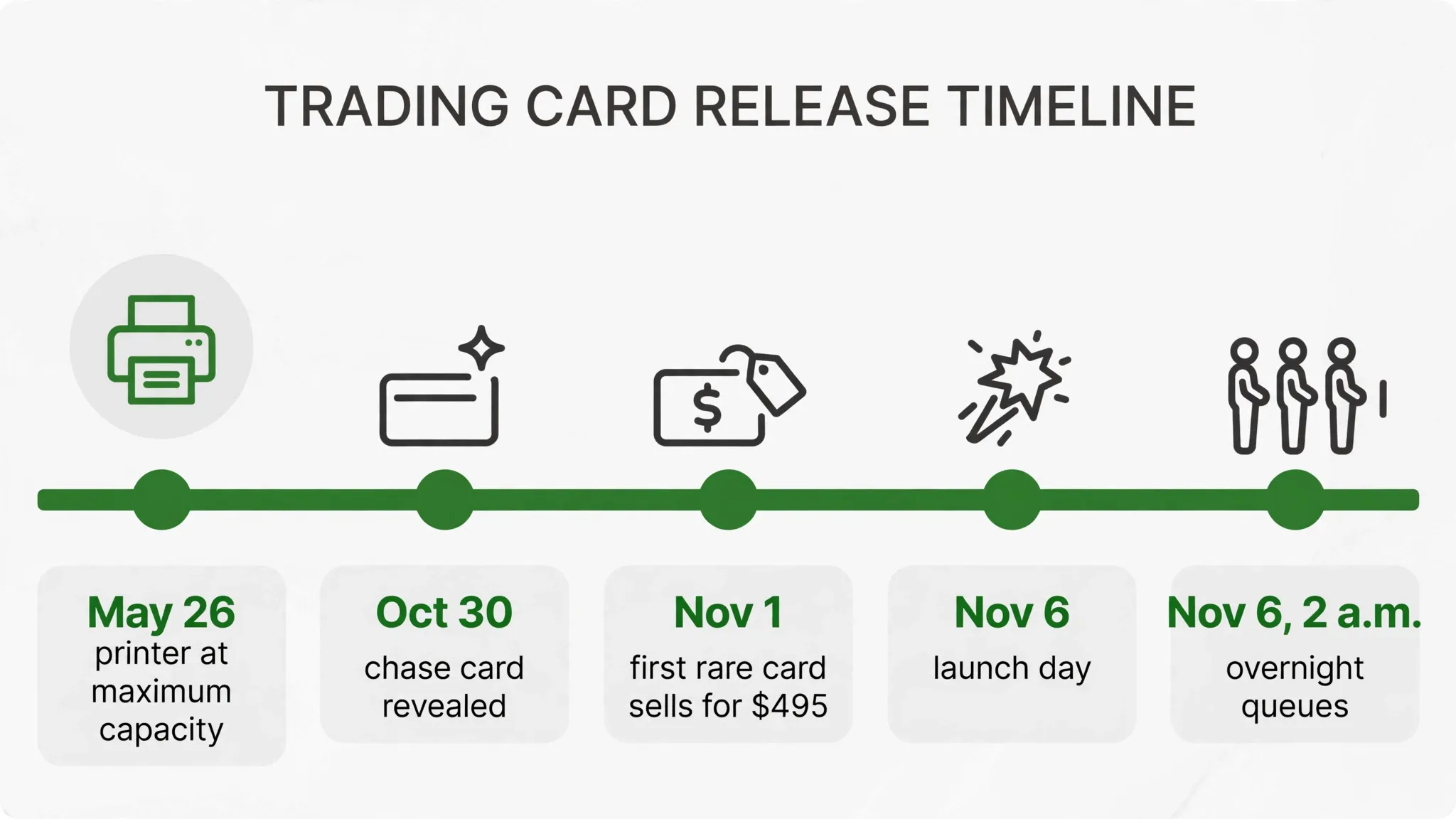
The headline cards are its rarest pulls: the Mega Rayquaza ex Special Illustration Rare and the gold Mega Rayquaza ex Mega Ultra Rare. Before the set had even been on shelves for a day, a raw English copy of the Special Illustration Rare had already sold on eBay for $495, according to market tracking by PriceCharting, and the gold version had sold for about $571. By launch day, market listings put the two chase cards at roughly $379 and $349, with single booster packs selling for around $5 to $9 and sealed booster boxes listed at about $229.
The demand around this Pokémon card release was not confined to one store. In London, a collector who arrived at a central shop at 3 a.m. for a 10 a.m. opening estimated that more than 120 people were already in line, and that roughly half of them were resellers rather than players or collectors. The shop limited its most sought-after box to one per customer. In Gloucester, the BBC reported overnight queues for a release tied to the franchise’s 30th anniversary. In Australia, pre-orders for the flagship Ultra Premium Collection of the 30th anniversary set sold out online within minutes — in one case, bots cleared a retailer’s listing before most shoppers had even seen it — and the collection’s release was pushed back a week by a distribution delay.
None of this is new for a Pokémon card release. The Pokémon Company has said publicly that it is printing affected products as quickly as possible and at maximum capacity, and its May 26, 2026 availability update promised to maximise production for future expansions and keep reprinting products hit by shortages. The numbers behind that statement are staggering: about 10 billion Pokémon cards were printed in the year to March 2026, taking the lifetime total past 85 billion. And still, on launch mornings, the shelves empty. The scarcity is not a shortage of cardboard. It is a shortage of the specific products people want most, at the specific moment they want them — and that gap between total supply and peak demand is exactly where scarcity marketing lives.
Why a Pokémon Card Release Creates Queues at 2 A.M.
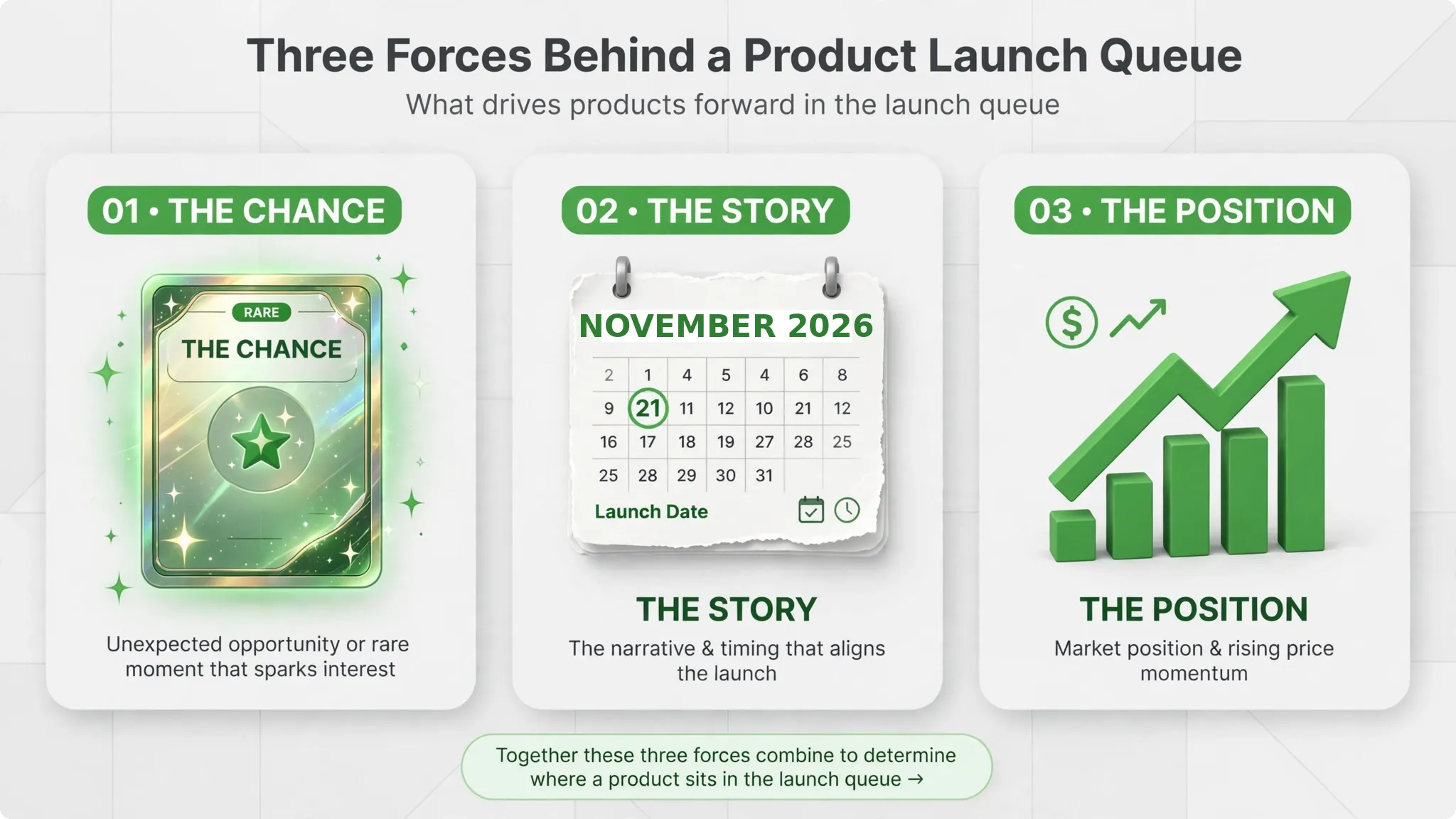
A queue at 2 a.m. outside a Pokémon card release looks irrational until you break down what the people in it are actually buying. They are not buying cardboard. They are buying a chance, a story, and a position in a market that rewards being early.
First, the chance. A booster pack at a Pokémon card release is a lottery ticket with a known price and an unknown outcome. Most packs contain ordinary cards worth pennies. A tiny fraction contain a chase card worth hundreds of dollars. That structure — small stakes, rare jackpot, immediate reveal — is the same one that keeps people pulling slot machine levers, and it is deliberately built into every Pokémon card release. The set’s rarest cards are printed in such small numbers that pulling one feels like winning, and the pull rates are part of the product’s appeal rather than a secret.
Second, the story. A Pokémon card release is not a restock; it is an event with a date, a countdown, and a shared experience. Prerelease tournaments run for a week before launch. Creators open packs on camera. Market trackers publish the first sale prices within hours. By the time the set reaches shelves at a Pokémon card release, the audience has already spent a week talking about it, and buying on day one is how you join the conversation while it is still live. A product bought a month later is the same product, but it carries none of that social currency.
Third, the position. Because the most desirable products at a Pokémon card release sell out fast, the resale market starts moving before the launch day is over. The first English chase card sold for $495 while most of the country was still asleep, and sealed Pokémon Center Elite Trainer Boxes were already trading at nearly three times their listed print value. For resellers, being early is the entire business model. For collectors, being early is insurance against paying the reseller’s price later. Both groups arrive at the same conclusion — get there first — and the queue is the visible result.
For a small business, the useful insight is that none of these three forces requires a global franchise. A chance, a story and a reason to be early can be built around a product launch, a seasonal menu, a workshop, or a limited service package. The rest of this post shows how.
The Psychology Behind Scarcity: Why Less Feels Like More
Before the lessons, it helps to know why scarcity marketing works at all, because the mechanism is older than the Pokémon card release by several decades and it is not a trick of the moment.
The psychologist Robert Cialdini identified scarcity as one of the six core principles of persuasion in his book Influence: The Psychology of Persuasion. The principle is simple: people assign more value to things they believe are less available. A product that might run out feels more desirable than the same product sitting in endless supply, even when nothing about the product itself has changed. The effect is not a quirk of collectors; it shows up in ordinary shoppers, in business buyers, and in anyone who has ever felt a deadline sharpen their attention.
The research behind the principle is unusually solid. In a 1975 study by Worchel, Lee and Adewole, participants rated cookies in a jar as more desirable when only two were left than when the jar held ten — the same cookies, the same jar, different scarcity. A meta-analysis of 416 effect sizes drawn from 131 studies found that scarcity tactics significantly increase both perceived product value and purchase intention. And a 2020 study published in the Journal of Consumer Research found that participants were willing to pay up to 30 percent more for products labelled “only 3 left in stock” than for identical items carrying no scarcity cue.
Three psychological mechanisms explain why the effect is so strong in scarcity marketing. The first is loss aversion: the pain of missing out outweighs the pleasure of gaining the same thing, so a closing window concentrates the mind. The second is social proof: a queue outside a store, a “sold out” badge, or a friend posting their pull all signal that other people want this, which makes us want it too. The third is reactance — when a freedom (the freedom to buy whenever we like) is restricted, we value it more and push back against the restriction by buying now.
A Pokémon card release triggers all three at once: the stock might run out, everyone else is queuing, and the chance to buy at retail price disappears the moment the doors open.
The warning inside the research is just as important as the promise. Scarcity works when the limitation is real, or at least when the audience believes it is real and fair. When customers discover that a “limited” offer was never limited, or that the scarcity was manufactured purely to manipulate them, the trust damage outlasts the sales spike. That distinction — real scarcity versus fake scarcity — runs through every lesson below.
1. Make the Drop an Event, Not a Listing
The first lesson from this Pokémon card release is the most transferable one: a launch is not a date on a calendar, it is an event with a build-up, a moment, and an aftermath. Pokémon treats every Pokémon card release as a three-act production. Weeks before launch, the chase cards are revealed one at a time, each reveal covered by fan sites and creators. In the week before launch, prerelease tournaments let players open the new cards early and post their pulls. On launch day, the set arrives everywhere at once, and the first sale prices are news within hours. The product is a packet of cards. The event is the whole apparatus around it.
Supreme built an empire on the same structure, in miniature. The streetwear brand releases new items every Thursday at 11 a.m., in small batches, with no restocks. Customers queue outside its London store for items that sell out in minutes, and a $48 T-shirt can resell for $200 the same afternoon. The Thursday drop is not a sale; it is an appointment. People organise their week around it, and the regularity of the appointment is part of the pull — the audience always knows when the next one is coming, and the fear of missing it keeps them watching.
Small businesses can borrow the structure without borrowing the scale. Pick a launch date and build a short runway towards it: a teaser a week out, a reveal three days out, a countdown on the final day. A bakery launching a seasonal item, a consultant opening five onboarding slots, a boutique releasing a capsule collection — all of them can give the launch a time, a story, and a reason to pay attention on the day. The key is that the event must be real: a genuine date, a genuine window, and a genuine change in availability when the window closes. An “event” that is really just a product page going live will not hold anyone’s attention twice.
Apply it this week: choose one upcoming launch and give it a date, a teaser, and a closing time. Announce all three together, in one place, so customers can plan around them.
2. Limit Quantity Honestly — and Say So
The second scarcity marketing lesson from this Pokémon card release is about the limit itself. Scarcity only works when the customer can see the limit and believe it. At the London shop, the most sought-after box was capped at one per customer, and the cap was stated plainly. At Pokémon Center, the official store runs a virtual queue for high-demand products during a Pokémon card release and warns collectors in advance that items may sell out before they can complete a purchase. The limit is visible, the rule is clear, and the customer can decide how much effort the purchase is worth.
That honesty matters, because the Pokémon card release also shows what happens when limits are absent. Where no purchase cap exists, bots and resellers sweep up stock in minutes — as they did with the Australian Ultra Premium Collection pre-orders — and genuine customers are left with nothing but the resale market. The result is not just disappointment; it is resentment towards the retailer and the brand. A limit that protects real customers is a service. A free-for-all that rewards the fastest bot is a failure of the launch, however quickly the stock sells out.
For a small business, an honest limit is easy to set and easy to communicate. A workshop with twelve seats is a real limit. A seasonal product made in a batch of fifty is a real limit. A service package available to three new clients a month is a real limit. The mistake is inventing a limit that does not exist — “only 3 left” on a product you can restock tomorrow — because customers notice, and the second time they notice, the scarcity stops working and the trust goes with it.
State the number, state the reason, and honour it when the number is reached. If you sell out, say so, and say when the next batch arrives. A sold-out sign handled well is itself a piece of marketing; it tells the next customer that the last batch was worth buying.
Apply it this week: attach a real number to your next offer — seats, units, or slots — and put that number in the announcement. When it sells out, publish the sell-out and the date of the next release.
3. Build a Chase Item
Every Pokémon card release has a chase: one or two cards so rare that they define the whole set. For the Pokémon Delta Reign set, it is the Mega Rayquaza ex Special Illustration Rare, illustrated by the winner of the 2024 Pokémon TCG Illustration Contest, and its gold counterpart. Everything else in the set orbits those two cards. They are the reason creators film pack openings at every Pokémon card release, the reason market trackers publish prices, and the reason a queue forms for a product whose ordinary contents cost a few dollars. Without the chase, the set would be a commodity. With it, the set is a hunt.
The chase item is the engine of scarcity marketing because it concentrates desire. A customer who would never queue for a booster pack will queue for the chance of pulling the card everyone is talking about. The same logic built Supreme’s most famous stunt: in 2016, the brand sold a red clay brick carrying its logo for $30, and it sold out instantly — not because anyone needed a brick, but because scarcity had turned an ordinary object into a status symbol. Nike’s SNKRS app works the same way: most releases are ordinary shoes, but the occasional collaboration or limited colourway turns the whole app into a lottery that millions enter.
A small business does not need a gold card to use this. It needs one item in the offer that is visibly special and genuinely hard to get. A restaurant can offer a single table with a chef’s tasting menu on one night a month. A designer can release one numbered print in an edition of twenty. A coach can offer one intensive day per quarter, priced and positioned as the flagship. The chase item does not have to be the best seller; its job is to make the rest of the offer feel worth looking at, and to give the audience something to talk about. The critical rule is that the chase item must be real and attainable, not a mirage.
If nobody ever wins, the audience stops playing. Pokémon’s chase cards are rare, but they are genuinely in the packs — people do pull them, and the pulls are filmed and shared, which keeps the hunt credible.
Apply it this week: identify one item, package, or experience in your business that could be the chase — the thing people ask about, photograph, or mention to friends — and give it a name, a number, and a visible place in your next launch.
4. Let the Queue Do the Marketing
The fourth scarcity marketing lesson is the one most small businesses overlook: the queue is not a problem to hide, it is an advertisement you do not have to pay for. The overnight lines outside Target stores during this Pokémon card release, the 120-person queue in London, the pre-dawn crowds in Gloucester — every one of them was photographed, filmed, and shared, and every share told the same story: this product is so wanted that people are standing in the cold for it. That is social proof at industrial scale, and it cost the brand nothing.
The mechanism is older than trading cards. A restaurant with a line outside it looks better than an empty one. A workshop with a waitlist looks more valuable than one with open seats. A product page showing “sold out” looks more desirable than one showing “in stock”. The queue, the waitlist, and the sell-out badge all do the same job: they let strangers’ behaviour do the persuading, so the business does not have to. Cialdini’s research on social proof found that people look to others when deciding what to do, and they look hardest when the situation is uncertain — which is exactly the situation a new customer faces when deciding whether a product is worth their money.
The practical version of this for a small business is to make demand visible rather than hiding it. Publish the waitlist number. Share the photo of the queue, the full booking calendar, or the “sold out in 48 hours” result. Show the customer testimonials that arrived after the last launch, not just the ones from three years ago. And when a launch sells out, say so loudly — a sold-out announcement is the cheapest, most credible advertisement a business can run, because it is a fact, not a claim.
The WWE Crown Jewel event earlier this month used the same principle at a far larger scale: the visible demand around its venue change and streaming move became part of the story, and the search numbers followed, as we covered in our WWE Crown Jewel 2026 event marketing breakdown.
One caution: visibility must be honest. A fabricated queue, a fake waitlist, or a “sold out” badge on a product that never sold is not social proof; it is deception, and customers who discover it will say so publicly. The Pokémon queues were real, which is why they worked as marketing. Yours must be real too.
Apply it this week: after your next launch, publish one honest number — seats filled, units sold, hours to sell out — and let that number do the talking in your next announcement.
5. Seed the Story Before Launch Day
The fifth lesson from this Pokémon card release is about timing. By the time a Pokémon card release reaches the shelves, the audience has already been primed for weeks. The chase cards are revealed one by one. Creators open early packs at prerelease events. Market trackers publish the first prices. Fan sites run set guides. None of that happens on launch day; it happens in the weeks before, and it is the reason launch day feels like a climax rather than a cold start. The audience arrives already informed, already excited, and already decided that they want in.
Nike’s SNKRS releases follow the same pattern. A drop is teased with cryptic social posts, early access goes to loyalty members through raffles and timed draws, and the story of the shoe — the athlete, the city, the collaboration — is told before the shoe is ever available to buy. By the time the purchase window opens, the customer is not deciding whether to buy; they are deciding whether they will be fast enough. The sale is the last step of a campaign, not the first.
Small businesses usually invert this order. The product is finished, the page goes live, and then the marketing starts — which means the marketing is trying to create demand from zero on the day it matters most. The fix is a short seeding runway. Three weeks out, hint at what is coming. Two weeks out, show a detail: a material, a name, a behind-the-scenes photo. One week out, reveal the offer and the date, and let your email list and your most engaged followers see it first. On launch day, the audience should feel like they have been waiting, not like they have been ambushed by it.
That early access matters twice over: it rewards your loyal customers, and it gives you a first wave of buyers whose posts and shares become the social proof for everyone else. Our earlier look at the Pokémon McDonald’s Happy Meal collaboration showed the same pattern in a different setting — the launch worked because the audience knew it was coming and knew it would not last.
Apply it this week: for your next launch, write three short posts now — a hint, a detail, and a reveal — and schedule them across the two weeks before the date. The launch should feel expected, not sudden.
6. Price for the Long Game, Not the Spike
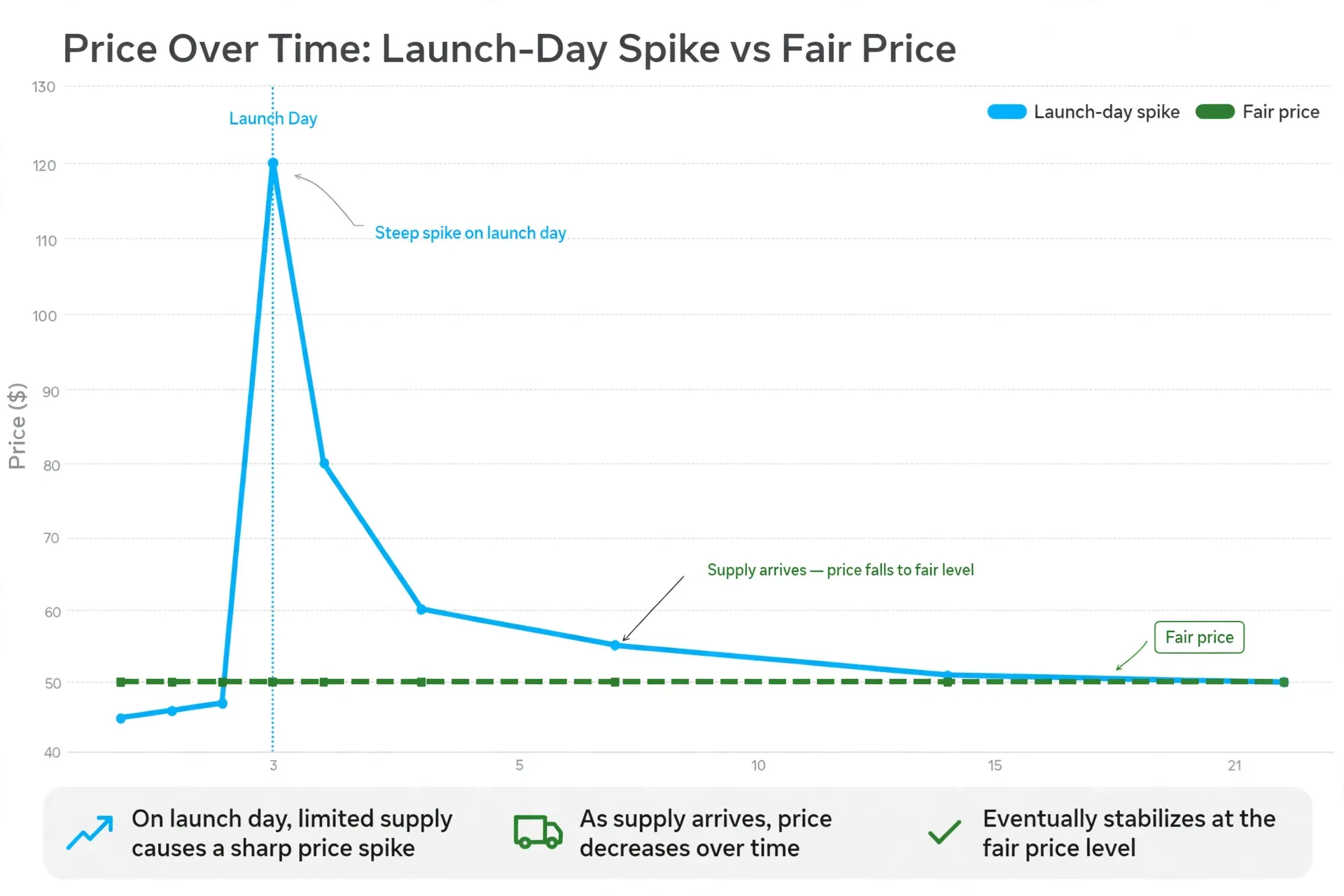
The sixth scarcity marketing lesson is the hardest one to follow, because it asks a business to leave money on the table in the short term. On launch day, the Pokémon Delta Reign chase cards sold for far more than their ordinary value — $495 for a single card that, a week later, was already listed at far lower prices as supply reached the market. Market coverage of the set was explicit about this: prices across the Pokémon Delta Reign set were already falling from their launch highs, and the advice for anyone chasing a specific card was to wait for the market to settle. The spike at this Pokémon card release was real, but it was temporary, and anyone who paid the spike price paid for impatience, not for value.
The Pokémon Company itself has taken the long view. Instead of raising prices to match the resale market, it has publicly committed to printing at maximum capacity and reprinting affected products — a supply-side answer to a demand-side problem. That choice protects the hobby’s future: if cards become unaffordable, children and new players leave, and the audience that sustains the next thirty years of releases disappears. The company’s May 2026 statement is worth reading as a business decision, not just a press release. It chose volume and accessibility over the short-term margin that scarcity pricing would have delivered.
Small businesses face the same choice at a smaller scale, and the temptation runs the other way. A sold-out launch invites a price rise, and a price rise feels like free money. But a customer who pays a spike price and watches the same product return at the ordinary price a month later feels cheated, and that feeling attaches to the brand, not to the market.
The smarter play is to price the launch fairly, let the sell-out be the story, and capture the long-term value in repeat purchases and referrals rather than in a single inflated transaction. If demand genuinely exceeds supply for months, a modest, explained price adjustment is honest; a launch-day surge price is not. And if your customers resell your product at a premium, treat that as information about your pricing, not as a windfall to chase. The resale market is a signal that you underpriced the chase item — the lesson is to make the next chase item better, not to punish the customers who bought this one.
Apply it this week: before your next launch, write down the price you would be comfortable defending to a customer in six months’ time, and launch at that price — even if the first day’s demand suggests you could charge more.
7. Plan the Second Wave Before the First One Sells Out
The seventh lesson from this Pokémon card release is the one that separates a one-day story from a lasting business. A Pokémon card release does not end on launch day. The Pokémon Delta Reign launch is no exception: the company’s availability statement promises reprints of affected products, and the 30th anniversary set’s product schedule stretches across months, with booster bundles, mini tins, figure collections and the Ultra Premium Collection still to come. The first wave creates the demand; the second wave harvests it. Customers who missed out on day one are not lost — they are the audience for the next release, provided the business tells them when it is coming and keeps them warm in the meantime.
Most small businesses do the opposite. They launch, they sell out, and then they go quiet until the next product is ready. The customers who missed out drift away, the momentum dissipates, and the next launch starts from zero again. The fix is to plan the second wave at the same time as the first. When a launch sells out, capture the demand: open a waitlist, take pre-orders for the next batch, and give the people on that list something — early access, a small bonus, or simply the first message when stock returns. The waitlist is not a consolation prize; it is the beginning of the next launch’s audience, and it is built from the most motivated customers you have.
The same logic applies to services. A consultant who fills a workshop can open the next date before the first one runs. A coach who sells out a programme can take deposits for the next cohort. A retailer who sells out a seasonal line can show the next season’s preview to the customers who missed out. The point is continuity: every launch should leave the audience with a next step, not a dead end. The Steam free games launch we covered earlier this month used a related version of the same idea — a giveaway that brought new users in and gave them a reason to return — and the principle holds for paid launches too. Demand that is captured and nurtured compounds; demand that is left to cool evaporates.
Apply it this week: when your next offer sells out, do not just post “sold out”. Post the date of the next release, open the waitlist in the same message, and give the people who join it a reason to stay.
What Small Businesses Should NOT Copy From This Pokémon Card Release
A case study is only useful if it includes the parts you should not imitate, and this Pokémon card release has three of them.
First, do not manufacture danger. The Charleston incident is the extreme end of overnight queuing at a Pokémon card release, and it happened because a launch created a situation in which people felt they had to be physically present, in the dark, hours before opening. A small business should never design a launch that rewards showing up at 2 a.m., standing in bad weather, or putting anyone at risk. If your launch creates a queue, manage it: numbered tickets, a virtual queue, a timed entry system, or a simple online pre-order. The Pokémon Center’s virtual queue is the model here, not the car park at 2 a.m. Demand is a compliment; a dangerous queue is a liability.
Second, do not feed the reseller market at your customers’ expense. Where purchase limits are absent, bots and professional resellers take the stock and genuine customers pay the markup. That is bad for the customer, bad for the brand, and bad for the long-term audience, because the people who actually love the product are the ones priced out. Purchase limits, verified accounts, and one-per-customer rules are not friction; they are protection for the customers who matter most. If your product is being resold at three times its price within hours, the launch has a design problem, and the fix belongs to you, not to your customers.
Third, do not confuse a spike with a strategy. A Pokémon card release generates enormous attention for a weekend, and then the attention moves on to the next set. A small business that chases spikes — one viral moment, one sold-out day — without building the systems behind it will find itself starting from zero every time. The businesses that benefit most from scarcity marketing are the ones that pair it with the unglamorous work: reliable fulfilment, honest communication, a waitlist that actually gets answered, and a second wave that actually arrives. Scarcity is a spark. The business is the engine it has to light.
Your Scarcity Launch Checklist
If you want to run a scarcity launch of your own, here is the sequence, distilled from these scarcity marketing examples for small businesses:
- Pick the offer — one product, package, or experience with a genuine limit.
- Set the number — units, seats, or slots — and the reason for it, and state both publicly.
- Name the chase — the one item in the offer that people will talk about and photograph.
- Seed the story — a hint, a detail, and a reveal across the two weeks before launch.
- Open the window — a fixed date and time, a countdown, and a clear closing point.
- Make demand visible — publish the numbers, share the queue, announce the sell-out.
- Protect your customers — purchase limits, a virtual queue, or timed entry; never a dangerous free-for-all.
- Capture the overflow — a waitlist and a dated second wave, announced the moment the first wave sells out.
- Price fairly — a price you can defend in six months, not a spike price for launch day.
- Follow through — deliver the second wave on the date you promised, and tell the waitlist first.
Run that sequence once, honestly, and you will learn more about your demand than a year of always-available selling will teach you. Run it repeatedly, and it becomes a rhythm your customers recognise and plan around — which is, in the end, what a Pokémon card release really is: a rhythm, kept faithfully, for thirty years.
Conclusion
A Pokémon card release put 50,000 searches on the board, filled car parks before dawn, and sent a single card to $495 before most of the country had woken up. It did that without a single advertisement aimed at the people in those queues, because the system did the advertising: a real limit, a chase worth hunting, a story seeded weeks early, a queue that everyone could see, and a resale market that turned every sale into a headline. The seven scarcity marketing lessons above are the working parts of that system, and none of them requires a global franchise to use. They require a genuine limit, an honest number, a story worth telling, and the discipline to follow through on the second wave.
The caution matters as much as the lessons. Scarcity is a powerful tool, and like any powerful tool it can hurt people when it is used carelessly. The Charleston incident is a reminder that demand, unmanaged, becomes a hazard — and that the businesses worth imitating are the ones that manage it. Set the limit, protect the queue, price fairly, and plan the next wave. Do that, and the frenzy becomes something far more useful: a launch your customers remember, a story they tell, and a reason to come back for the next one.
If you want help turning a launch like this into a system — timed drops, waitlists, and campaigns that build demand instead of chasing it — our team builds exactly that kind of work. Talk to KKeyQik about your next launch, or explore our SEO services for small business and social media marketing services to see how we help businesses get found, get chosen, and get remembered. And if video is part of your launch plan, our video marketing services for small business can turn a single drop into a story your audience watches, shares, and acts on.
Frequently Asked Questions
Scarcity marketing is the practice of using limited supply, limited time, or limited access to make an offer more desirable. It works because people value things more when they believe those things might run out. When the limit is real and clearly stated, it helps customers decide faster and makes a launch feel like an event rather than a routine listing.
The Mega Evolution — Delta Reign set combined several demand drivers at once: a long-awaited returning character, a small number of rare chase cards, a fixed launch date, and a large audience of collectors and players. Prerelease events and creator videos built anticipation for weeks before launch day, so demand was already high when stores opened. The Pokémon Company has said it is printing at maximum capacity and reprinting affected products.
A chase card is one of the rarest cards in a set — the card collectors most want to pull from a pack. In Delta Reign, the Mega Rayquaza ex Special Illustration Rare plays that role. Chase cards concentrate desire: they give creators something to film, give market trackers something to price, and give buyers a reason to shop on launch day rather than waiting.
It is ethical when the limit is real, clearly stated, and honoured. A workshop with twelve seats, a seasonal product made in a batch of fifty, or a service with three new client slots a month are all genuine limits. It becomes unethical when a business invents a limit that does not exist, such as claiming low stock on a product it can restock tomorrow. Customers notice fake scarcity, and the trust it costs is worth more than the sales it gains.
Start with what you already have: a real number and a real date. Attach a unit, seat, or slot count to your next offer, announce the launch date in advance, and give the offer a closing time. Add a waitlist so the customers who miss out have a next step. None of that requires paid advertising — it requires a clear offer, a calendar, and follow-through.
Drop marketing is a launch model built around timed, limited releases. Supreme releases new items every Thursday at 11 a.m. in small batches, and Nike runs timed sneaker releases through its SNKRS app. The regular schedule trains the audience to watch for the next drop, and the limited quantity makes each drop feel urgent. Small businesses can borrow the rhythm — a monthly release date, a seasonal drop, a limited batch — at any scale.
Pick a number you can defend and explain. Base it on something real: the seats in the room, the units you can make well, or the clients you can serve properly in a month. State the number and the reason together when you announce the offer, and honour the limit when it is reached. If you sell out, say so publicly and give the date of the next release.
Treat the sell-out as the start of the next launch, not the end of this one. Announce it, open a waitlist, and give the people on that list a date for the next batch plus a reason to stay — early access or the first message when stock returns. The waitlist is built from your most motivated customers, and it becomes the audience for your next release.
Yes, in three common ways. Fake scarcity destroys trust when customers discover the limit was invented. Missing purchase limits let resellers and bots take the stock, leaving genuine customers frustrated. And a launch that creates a dangerous queue — people waiting overnight in bad conditions — becomes a safety problem rather than a marketing win. The fix for all three is the same: real limits, clear rules, and a managed queue.
Give the launch a short runway. Three weeks out, hint at what is coming. Two weeks out, share one concrete detail, such as a material, a name, or a behind-the-scenes photo. One week out, reveal the full offer and the date, and let your email list and most engaged followers see it first. By launch day, your audience should feel like they have been waiting for something, not like they have been ambushed by it.