

When one of America’s most beloved grocery brands starts closing stores, every retailer should pay attention. Publix — the Lakeland, Florida-based chain famous for its cult-following subs, gleaming stores, and famously loyal shoppers — confirmed in early October 2026 that it will close seven locations across Florida, Georgia, and South Carolina by the end of the year. It is a small number against a footprint of more than 1,440 stores, but the signal behind it is loud: even a retailer with decades of goodwill is not immune to softer consumer spending, shifting shopping habits, and the slow migration of everyday purchases toward clubs, apps, and delivery.
For small businesses, the story is not really about Publix. It is about what the closures reveal about modern retail marketing: how customer loyalty is built and lost, how closure announcements should be communicated, how multi-location brands handle local SEO when stores disappear, and how smaller retailers can win the customers a giant leaves behind. This guide breaks down 9 retail marketing lessons from the Publix closures that any small retailer — grocery or otherwise — can put to work in 2026.
What Happened: Publix Trims Seven Stores by Year-End
Here is the situation, straight from the reporting. Publix will close seven locations by the end of 2026: four in Florida (St. Petersburg, Miami, West Palm Beach, and Palm Bay), two in Georgia (Atlanta and Chamblee), and one in South Carolina (Goose Creek). Not every closure is a full exit. The company said it plans to rebuild the West Palm Beach and Palm Bay stores, and the Goose Creek closure is tied to a redevelopment project — meaning several of these are “tear down and replace” moves rather than permanent retreats. The St. Petersburg and Miami locations, by contrast, are described in coverage as permanent closures.
The financial backdrop explains the caution. Publix reported $15.7 billion in sales for the 13 weeks ended June 27, 2026 — up just 1% year over year — while comparable-store sales actually declined 0.5% for the quarter. It was coming off a rare first-quarter earnings decline, with net income down 21.5%. Management pointed to changes in Medicare drug pricing and softer consumer spending as the drag. Against that backdrop, the chain has also made a string of customer-facing changes that generated friction: it ended support for Publix Pay, its in-app contactless payment option, in March; it tightened its open-carry policy in May; and in August it began eliminating the 10-items-or-less limit at express checkout lanes. Each change drew its own wave of shopper reaction. None of these alone closed a store, but together they tell a story about a premium brand navigating a value-hungry moment — and that is where the retail marketing lessons begin.
Lesson 1: Watch Your Comparable-Sales Signals Before Headlines Force You To
Publix’s closures did not arrive out of nowhere. Comparable-store sales declined 0.5% in the second quarter and 0.3% across the first half of 2026 — the kind of soft, persistent signal that precedes bigger moves. In retail marketing, your own “comparable sales” data is the earliest warning system you own: foot traffic trends, average basket size, repeat-purchase rates, and search impressions for your store name. Small retailers often market hardest when business is already booming and go quiet exactly when the data starts sagging. The Publix pattern is the reverse playbook: when the numbers soften, that is when your retail marketing should get louder and sharper — reactivation campaigns to lapsed customers, local offers timed to slow days, and honest reviews of what is actually bringing people through the door. Track three numbers weekly: transactions, average ticket, and repeat-visit rate. If two of them drift down for a month, treat it as a marketing emergency, not a waiting game.
Lesson 2: Every Policy Change Is a Marketing Event — Treat It Like One
Look at the friction Publix generated this year without intending to. Ending Publix Pay irritated loyal app users. The open-carry policy update triggered boycott calls. Removing the express-lane item limit confused regulars. None of these were marketing campaigns, but every one of them behaved like one: customers talked about them, posted about them, and formed opinions about the brand because of them. The retail marketing lesson is that operational changes need a communications plan, not just an operations plan. Before you change hours, pricing, payment options, or store policies, write the customer-facing version first: why the change helps them, what stays the same, and where to give feedback. Announce it on your own channels before customers discover it at the register. A policy change discovered is a complaint; a policy change announced with a reason is a brand moment. Small retailers that communicate operational shifts proactively protect the trust their retail marketing spent years building.
Lesson 3: Communicate Closures and Changes Like a Brand, Not a Memo
When Publix closed its West Palm Beach store, the company directed customers to a Belmart Plaza Publix about 1.3 miles away and offered affected employees transfers. That is the right instinct, and it is a retail marketing lesson in itself: every closure announcement is read by three audiences — the customers losing their store, the customers of nearby stores, and the competitors deciding whether to pounce. If you ever close a location, consolidate hours, or move, announce it yourself first, in plain language, with a clear redirect: where customers should go next, what happens to their loyalty points or prescriptions, and who to contact with questions. Silence lets competitors and rumor mills write the story. Small retailers can do this even better than giants: a personal note from the owner, a thank-you event in the final week, and a visible handoff to the nearest location turn a loss into a loyalty moment. In retail marketing, how you close matters as much as how you open — because the customers you treat well on the way out often follow you to the next location.
Lesson 4: Keep Your Local SEO Airtight When Locations Change
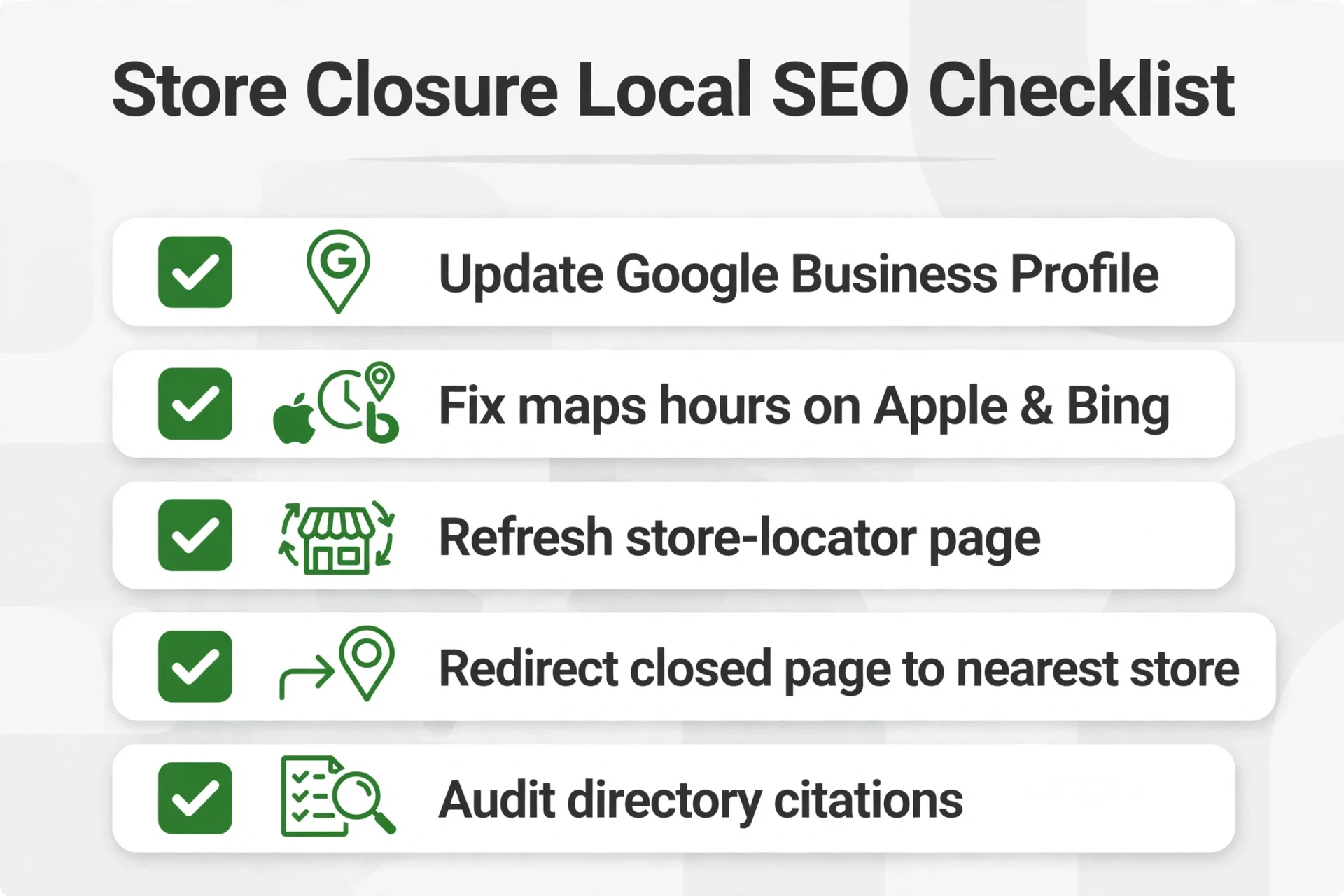
Seven closures across three states means seven Google Business Profiles, seven sets of map listings, seven local landing pages, and hundreds of directory citations that now need updating. When a multi-location retailer shutters a store but leaves its local listings live — or worse, lets them show the wrong hours — it bleeds trust and sends customers on wasted trips. The retail marketing lesson for businesses of any size: your local SEO is a living system, not a set-and-forget asset. Every location change should trigger a checklist: update the Google Business Profile (mark permanently closed or remove, never leave it stale), update your store-locator page the same day, fix hours and holiday schedules on Apple Maps and Bing, and redirect the closed location’s landing page to the nearest open store rather than letting it 404. For single-location retailers, the mirror lesson applies: audit your own listings quarterly. Wrong hours on Google are the digital equivalent of a locked door with the lights on. Local search drives the majority of “near me” purchase decisions, so local SEO hygiene is retail marketing at its most practical. If local search is a weak spot, a focused local SEO for small business effort pays for itself in foot traffic.
Lesson 5: Rebuilds Are Reinvestment Stories — Market Them That Way
Three of the seven Publix closures are not exits at all: West Palm Beach, Palm Bay, and Goose Creek are slated for rebuilds and redevelopment. That distinction is everything in retail marketing. A closure reads as retreat; a rebuild reads as reinvestment. The lesson: when you renovate, relocate, or temporarily close, never let the story be “we closed.” Make it “we are building something better, and here is what is coming.” Share renderings, timelines, and progress updates. Invite loyal customers to a reopening event and give them a reason to come back on day one. Small retailers renovating a single store can run the same play on a smaller budget: a “pardon our dust” campaign with weekly progress photos, a countdown to reopening, and a grand-reopening offer for email subscribers turns downtime into anticipation. In retail marketing, construction is content — but only if you publish it, and the rebuild story is one of the most underused retail marketing assets a local store owns.
Lesson 6: Premium Positioning Needs Constant Proof
Publix built its empire on being the premium grocer: cleaner stores, better service, the famous subs. That positioning works beautifully when shoppers reward the experience — and strains when budgets tighten and staples migrate to clubs and apps. Analysts quoted in the coverage noted that mainstream grocers are all facing this unfavorable dynamic. The retail marketing lesson cuts both ways. If you charge a premium, your marketing must constantly prove the premium is worth it: show the service, the quality, the experience — not just the price tag. Publix’s deli counters and “Pub Sub” following are proof-of-premium assets most grocers would kill for, and they deserve center stage in every campaign. But premium brands also need a value story for lean times: bundle deals, loyalty rewards, and private-label heroes that let budget-conscious shoppers stay without trading down to a competitor. Small retailers should audit their own premium claims quarterly. If your marketing says “best quality in town,” your content should be showing it weekly — behind-the-scenes videos, sourcing stories, customer testimonials. Positioning is not a tagline; it is a promise your retail marketing has to keep proving.
Lesson 7: Your Employees Are Your Loudest Marketing Channel
One detail buried in the closure coverage deserves more attention: Publix is employee-owned, and the company offered transfers to workers at closing stores. That matters for retail marketing more than most owners realize. Employees are the first people customers ask about a closure, a price change, or a rumor — and their answer becomes the brand’s answer. A well-treated team that trusts leadership will reassure customers; an anxious, uninformed team will confirm their worst fears. The lesson: brief your staff before you brief the public. Give them the talking points, the timeline, and honest answers to the questions customers will ask. Beyond closures, this is everyday retail marketing: the cashier who mentions the new loyalty perk, the associate who posts a genuine behind-the-scenes photo, the team that actually believes in the product. No ad budget beats a staff that markets for you because they want to. If you run a retail team, your internal communications are marketing communications — write them accordingly, and measure employee sentiment the way you measure customer sentiment.

Lesson 8: When a Giant Closes Near You, Move Fast — That Is Your Opening
Here is the flip side every small retailer should see. Every permanent closure — St. Petersburg, Miami, and any market where a big box goes dark — creates a vacuum, and vacuums get filled fast. Competitors will run conquest campaigns: geo-targeted ads around the closing store, “welcome” offers for displaced shoppers, and local SEO plays for “[grocery] near me” searches that suddenly have one less result. The retail marketing lesson: monitor competitor closures in your trade area like a hawk, and have a conquest playbook ready. That means geo-fenced social ads, a landing page that speaks directly to displaced customers (“Former Publix shoppers: here’s your new neighborhood market”), review-generation pushes while attention is high, and community outreach in the affected neighborhood. Speed matters more than budget here — the first retailer to welcome displaced shoppers with a genuine offer usually keeps them. Set up Google Alerts for competitor names plus “closing” in your metro area. When the news breaks, your retail marketing should be live within 48 hours, not 48 days. Small retailers cannot outspend giants, but they can absolutely outmaneuver them in the weeks after a closure.
Lesson 9: Loyalty Programs Are Retention Insurance — Price Them Accordingly
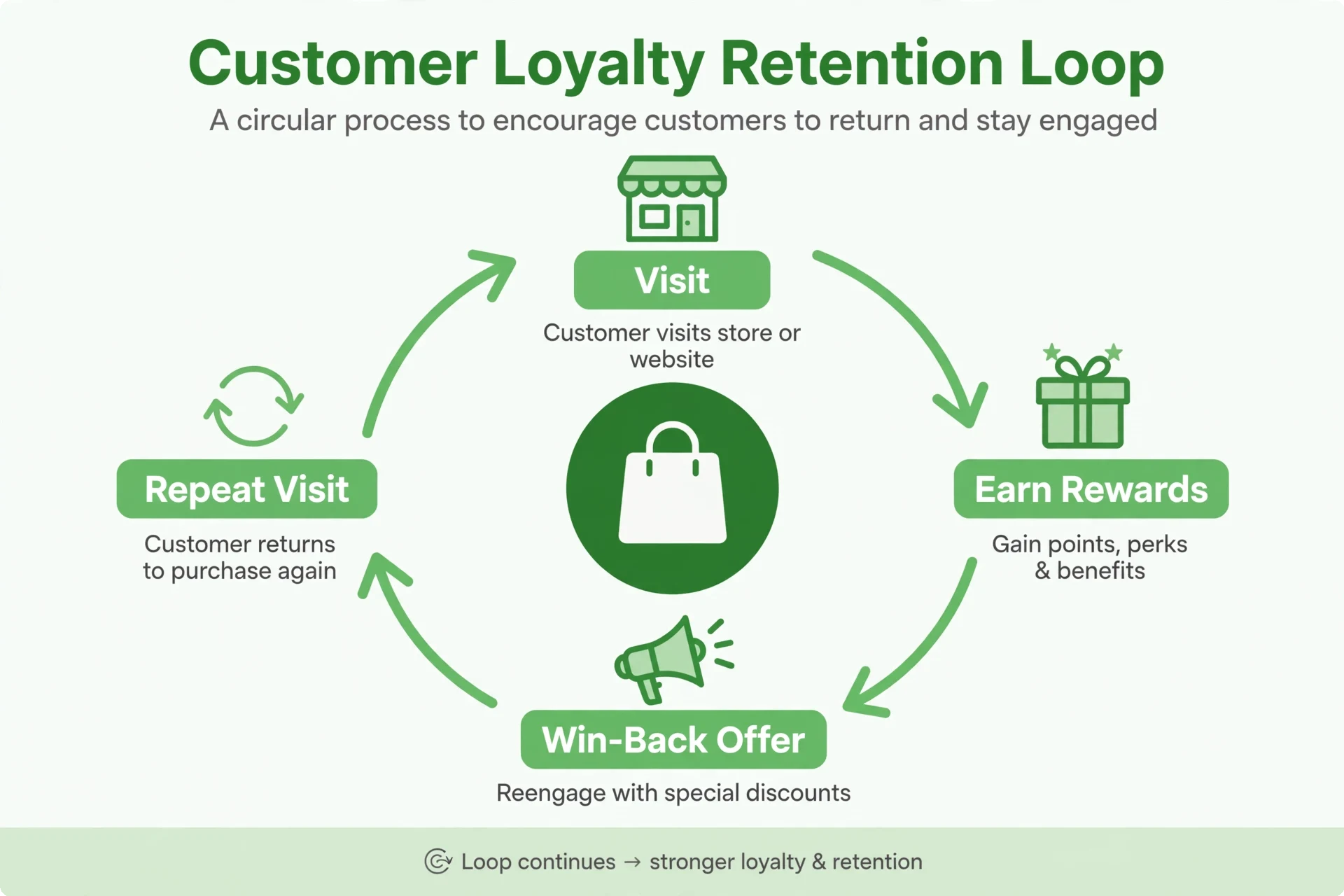
The Publix story is, at its core, a retention story. When comparable-store sales slip, the retailers that hold up best are the ones with deep loyalty data: they know which customers are drifting, what brings them back, and which offers actually move the needle. Publix’s scale gives it enormous first-party data; small retailers have something arguably better — personal relationships at a scale where every regular has a name. The retail marketing lesson: build your loyalty and reactivation engine before you need it, because building it during a slump is twice as hard. That means an email or SMS list you actually use, a simple points or perks program customers understand in ten seconds, and a win-back sequence for anyone who has not purchased in 60–90 days. Track one retention metric above all: what percentage of this month’s revenue came from repeat customers? If that number is climbing, your retail marketing is compounding. If it is falling while acquisition spend rises, you are filling a leaky bucket. Loyalty is not a nice-to-have program — it is the insurance policy that pays out exactly when headlines like these arrive.
The 2026 Backdrop: Why Retail Marketing Matters More This Holiday Season
The Publix closures land at a sensitive moment for retail marketing. Comparable-store sales are softening across mainstream grocery, shoppers are consolidating trips toward clubs and delivery apps, and every discretionary dollar is being fought over heading into the holidays. In this environment, retail marketing cannot be a seasonal afterthought — it has to be the operating system. The retailers winning right now share three traits: they know their repeat-customer numbers cold, their local search presence is flawless, and every operational change ships with a customer-facing story. Whether you run one store or one hundred, those are the retail marketing fundamentals that decide who gains share when the market tightens.
Your Retail Marketing Action Plan for This Week
Reading about Publix is interesting; acting on it is profitable. Here is a one-week sprint distilled from the nine lessons above:
1. Pull your three numbers (transactions, average ticket, repeat-visit rate) and compare them to 90 days ago. Two drifting down means a marketing push starts today. 2. Audit your local listings. Check your Google Business Profile, Apple Maps, and Bing for correct hours, categories, and photos. Fix anything stale before the holiday season. 3. Write the “change script.” Draft the customer-facing version of your next policy, pricing, or hours change now — reason, reassurance, feedback channel — so you are never caught announcing at the register. 4. Brief your team on one talking point this week: the offer, event, or story you want every customer to hear about. 5. Launch or revive one retention touch. A win-back email to 90-day lapsed customers costs almost nothing and routinely outperforms cold acquisition. 6. Set a competitor alert. Google Alerts for “[competitor] closing” in your metro area, so you can move within 48 hours if a vacuum opens near you.
Retail is not dying; it is differentiating. The stores that thrive in 2026 are the ones that market like every customer is a choice, every policy is a message, and every location change is a story. Publix will be fine — 1,440 stores do not disappear over seven closures. But the small retailers that study moments like this, and act while the lesson is fresh, are the ones that take share while giants retrench. That is what great retail marketing has always done: turn someone else’s headline into your own momentum.
Ready to turn local shoppers into loyal customers? KKeyQik helps small businesses win their trade area with local SEO, social media that actually drives foot traffic, and ad campaigns built for ROI. From SEO services for small business to social media marketing services and video marketing that shows off what makes your store different — let’s build the retail marketing engine your competitors wish they had. Get in touch today.
Want to put this to work for your business? KKeyQik plans and delivers SEO for small businesses, with an in-house team available 24/7. See our SEO service or get a quote within 24 hours.
Frequently Asked Questions
Publix is closing seven locations across Florida, Georgia, and South Carolina by the end of 2026, citing softer consumer spending and declining comparable-store sales — down 0.5% in the second quarter. Three of the seven are rebuild or redevelopment projects, so not every closure is a permanent exit. The move reflects a broader squeeze on mainstream grocers as shoppers consolidate trips toward clubs, apps, and delivery.
The reported closures include four Florida stores (St. Petersburg, Miami, West Palm Beach, and Palm Bay), two in Georgia (Atlanta and Chamblee), and one in South Carolina (Goose Creek). The West Palm Beach, Palm Bay, and Goose Creek sites are tied to rebuilds or redevelopment, meaning Publix plans to return with newer stores. The St. Petersburg and Miami locations are described in coverage as permanent closures.
No. Publix operates more than 1,440 stores across eight southeastern states, so seven closures represent a fraction of one percent of its footprint. The company posted $15.7 billion in quarterly sales with modest growth, even as comparable-store sales softened. This is a selective trim and reinvestment cycle — closing underperforming or outdated locations while rebuilding others — not a sign of corporate distress.
Move within 48 hours. Run geo-targeted ads around the closing store, create a landing page welcoming displaced shoppers, and push for fresh reviews while neighborhood attention is high. The first retailer to greet those customers with a genuine offer usually keeps them. Set up Google Alerts for competitor names plus "closing" in your metro area so you never learn about it last.
Update the profile the same day the change takes effect: mark the location permanently closed (never leave it stale), update hours on Apple Maps and Bing too, refresh your website's store-locator page, and redirect the closed location's landing page to the nearest open store instead of letting it return a 404. Wrong hours on Google are the digital equivalent of a locked door with the lights on.
You cannot outspend them, but you can outmaneuver them: win on local SEO for "near me" searches, build genuine community relationships, and react faster to neighborhood events like competitor closures. Lean into what chains do poorly — personal service, local sourcing stories, and real staff-customer relationships. Pair that with a simple loyalty program and consistent social content, and a small store can take meaningful share in its trade area.
Announce it yourself first, in plain language, before customers discover it on their own. Explain what is happening, where they should go next, and what happens to loyalty points, prescriptions, or pending orders. A personal note from the owner, a thank-you event in the final week, and a visible handoff to the nearest location turn a loss into a loyalty moment. Silence lets competitors and rumors write the story for you.
Loyalty programs give you first-party data on exactly who is drifting — and a direct channel to win them back. Retailers with deep loyalty data can run targeted win-back offers to lapsed customers instead of discounting blindly for everyone. Even a simple email or SMS list with a 60–90 day win-back sequence routinely outperforms cold acquisition on ROI. Build the retention engine before you need it; building one during a slump is twice as hard.
Publix ended support for Publix Pay, its in-app contactless payment option, in March 2026, and the change drew complaints from loyal app users. The lesson is that every operational change behaves like a marketing event: customers talk about it, post about it, and form opinions about your brand because of it. Before changing hours, pricing, or payment options, write the customer-facing version first — why it helps them, what stays the same — and announce it on your own channels before they discover it at the register.
Keep every location's Google Business Profile accurate with current hours, categories, and photos; sync Apple Maps and Bing; maintain a fast, accurate store-locator page; and redirect closed-location pages to the nearest open store to preserve link equity. Audit directory citations quarterly so third-party sites stop sending customers to wrong addresses. For retailers, local search drives the majority of "near me" purchase decisions — it is retail marketing at its most practical.