

Updated: September 2026 · By the KKeyQik Team
Every few months we meet a business owner halfway through building a website on the wrong platform. The design looks fine. The copy reads well. But the platform fights everything the business needs it to do — the store cannot handle the product catalog, or the blog cannot support the content strategy, or simple changes require a developer for what should be a five-minute edit. The problem was never the design. It was the choice made before design started.
For most small businesses in 2026, that choice comes down to two names: wordpress vs shopify. Both are excellent platforms, and our team designs, builds, and maintains sites on both for small businesses across the US. They were simply built for different jobs — and understanding those jobs is the fastest way to a decision you will not regret.
WordPress is a content-first website platform you own and extend; Shopify is a commerce-first platform that manages the technical side of selling online for you. Pick the one that matches how your business actually sells and markets, and your website becomes an asset. Pick the wrong one, and you will spend years working around it. That is why the WordPress vs Shopify decision deserves real thought before design starts.
Key Takeaways
- WordPress is the natural default when content, search visibility, and lead generation drive your marketing.
- Shopify is the natural default when selling products online is the core of the business.
- Each platform can do the other’s job, but one direction is always easier than the other.
- Match the platform to your team’s skills and appetite for maintenance — not just to the feature list.
- Switching platforms later is possible, but it is a rebuild, not a flip of a switch. Decide carefully now.
The Core Difference Between the Two Platforms
Strip away the feature lists and the difference is philosophical. WordPress gives you ownership and flexibility; Shopify gives you simplicity and a managed store. Neither is better in the abstract. They answer different questions.
WordPress: A Content-First Platform You Own
WordPress is open-source software you install on your own hosting. You own the files, the database, and the design. An enormous ecosystem of themes and plugins means almost any layout, integration, or function you can imagine already exists — and when it does not, a developer can build it, because nothing about the platform is locked away from you.
That ownership is also a responsibility. Hosting, software updates, security, and backups are yours to manage — directly, or through the team or agency that supports you. For content-heavy businesses this tradeoff is usually worth it: WordPress remains the strongest foundation for publishing. Blogs, resource libraries, landing pages, and search-driven content programs all run beautifully on it. And when you need to sell, WooCommerce turns the same site into a full online store, sharing one design, one content system, and one login.
Shopify: A Commerce-First Platform That Runs Your Store
Shopify is a hosted platform: your store lives on Shopify’s infrastructure, and hosting, security, updates, and the checkout are handled for you as part of the subscription. You trade some control for the confidence that the technical foundation of selling online simply works.
Out of the box you get product pages, inventory management, payments, discounts, shipping integrations, and a checkout refined by years of testing. The theme system covers most store designs a small business needs, and the app marketplace extends functionality without code. Content publishing exists — Shopify has a built-in blog — but it is clearly the supporting act. If your site is a store first and a publication a distant second, that ordering is exactly right.
Five Dimensions That Decide the Answer
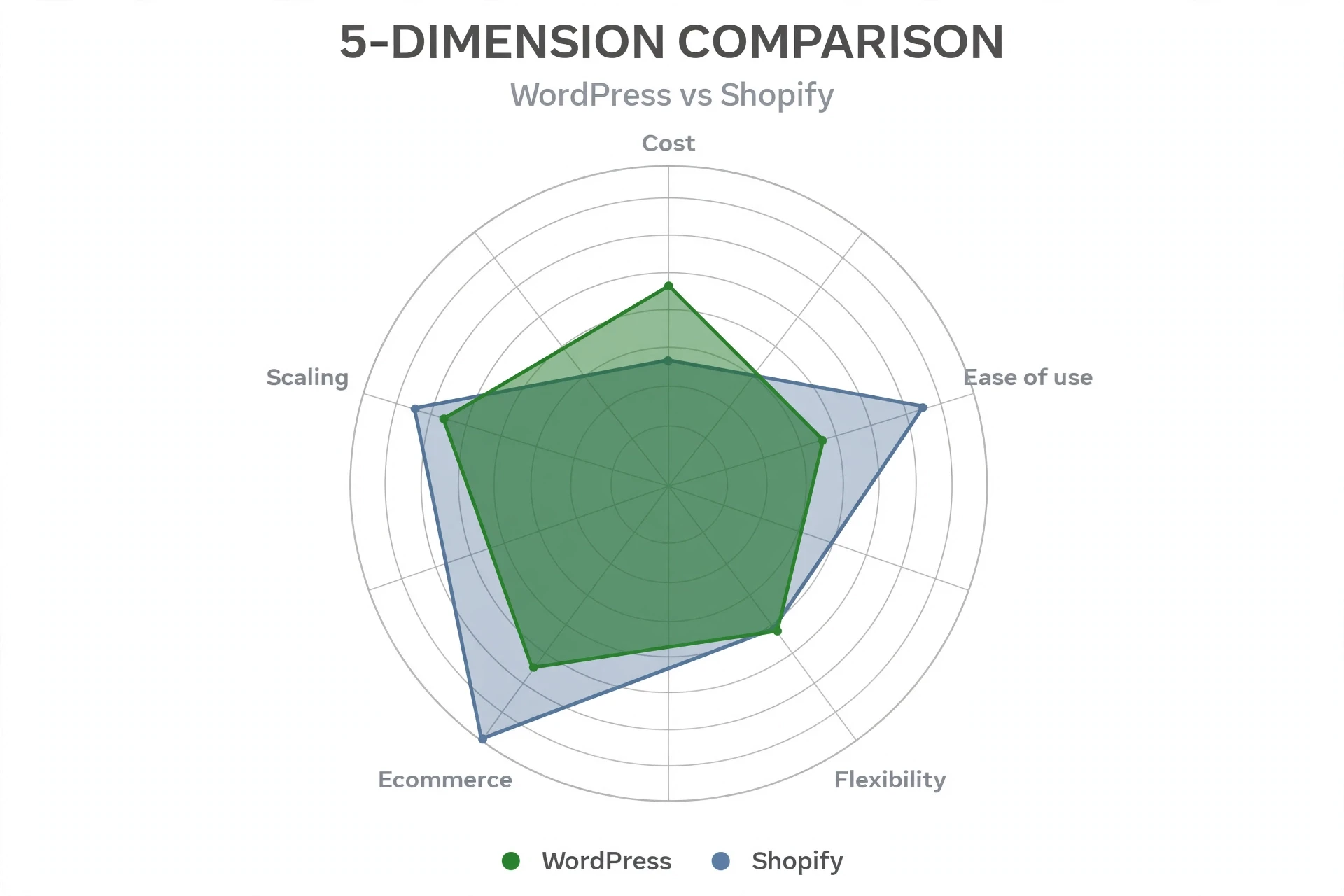
Forget feature-by-feature comparisons for a moment. The right choice usually becomes obvious once you work through five questions about your business.
1. How You Sell
Start here, because it matters most. If the site’s primary job is to generate leads — quote requests, bookings, inquiries — for services you deliver yourself, WordPress leans ahead. Its content and landing-page flexibility is built for persuasion. If the site’s primary job is to take orders for physical or digital products, Shopify leans ahead. Its entire architecture exists to move a visitor from product page to paid order with minimum friction.
2. Your Content Marketing Ambitions
Businesses that plan to publish regularly — weekly articles, guides, a resource library, embedded video — should weigh this heavily. WordPress was born as a publishing tool, and two decades of refinement show: editorial workflows, content organization, and search optimization control run deeper than anything else at this level. If content will be occasional — a few announcement posts a year — Shopify’s simpler blog is plenty.
3. Your Customization Needs
Standard needs — a clean store, standard product options, common payment methods — fit comfortably inside Shopify. The moment you need something unusual — custom product configurators, membership areas, complex booking flows, deep integrations with internal systems — WordPress’s open architecture becomes the safer bet. Our rule of thumb: if you can describe what you need using Shopify’s existing vocabulary, choose Shopify; if you are inventing new vocabulary, choose WordPress. choose Shopify; if you are inventing new vocabulary, choose WordPress. This vocabulary test settles the WordPress vs Shopify question for content-heavy businesses faster than any feature list.
4. Your Appetite for Maintenance
Be honest about this one. Shopify bundles hosting, security, and updates into the subscription — the platform stays current whether you think about it or not. WordPress splits those responsibilities across hosting, themes, and plugins, which means someone has to keep everything updated and backed up. Many small businesses hand that to their web team and never think about it again. Either way, the maintenance has to live somewhere — the question is whether you want it bundled or delegated.
5. Your Team’s Skills
Finally, consider who will run the site day to day. A non-technical team adding products, writing posts, and tweaking pages will find Shopify’s admin calmer and harder to break. A team comfortable with a slightly steeper learning curve — or one supported by developers — will find WordPress more powerful. The best platform is the one your people will actually use. In the WordPress vs Shopify debate, team capability is often the tiebreaker.
WordPress vs Shopify: Side-by-Side Comparison
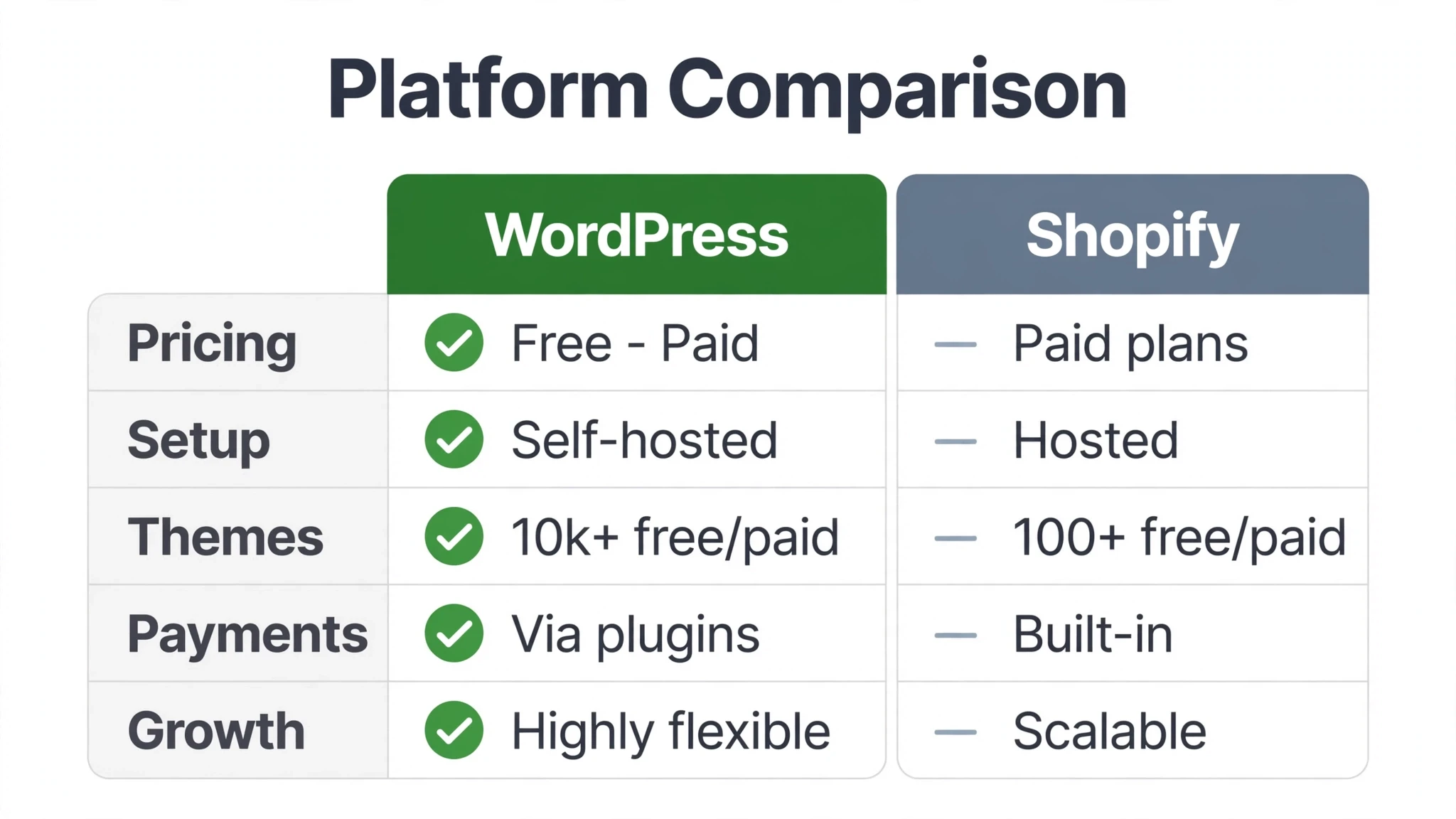
| Dimension | WordPress | Shopify |
|---|---|---|
| Best fit | Content-led businesses, lead generation, publishers | Product-led businesses, dedicated online stores |
| Content control | The deepest publishing and SEO flexibility available | Solid basics; blog and content are secondary |
| Ecommerce strength | Strong via WooCommerce; highly customizable | Best-in-class out of the box; checkout included |
| Maintenance burden | Yours to manage: hosting, updates, security, backups | Bundled into the platform subscription |
| Scalability | Scales with the right hosting and development support | Scales on Shopify’s infrastructure automatically |
7 Questions to Answer Before You Choose
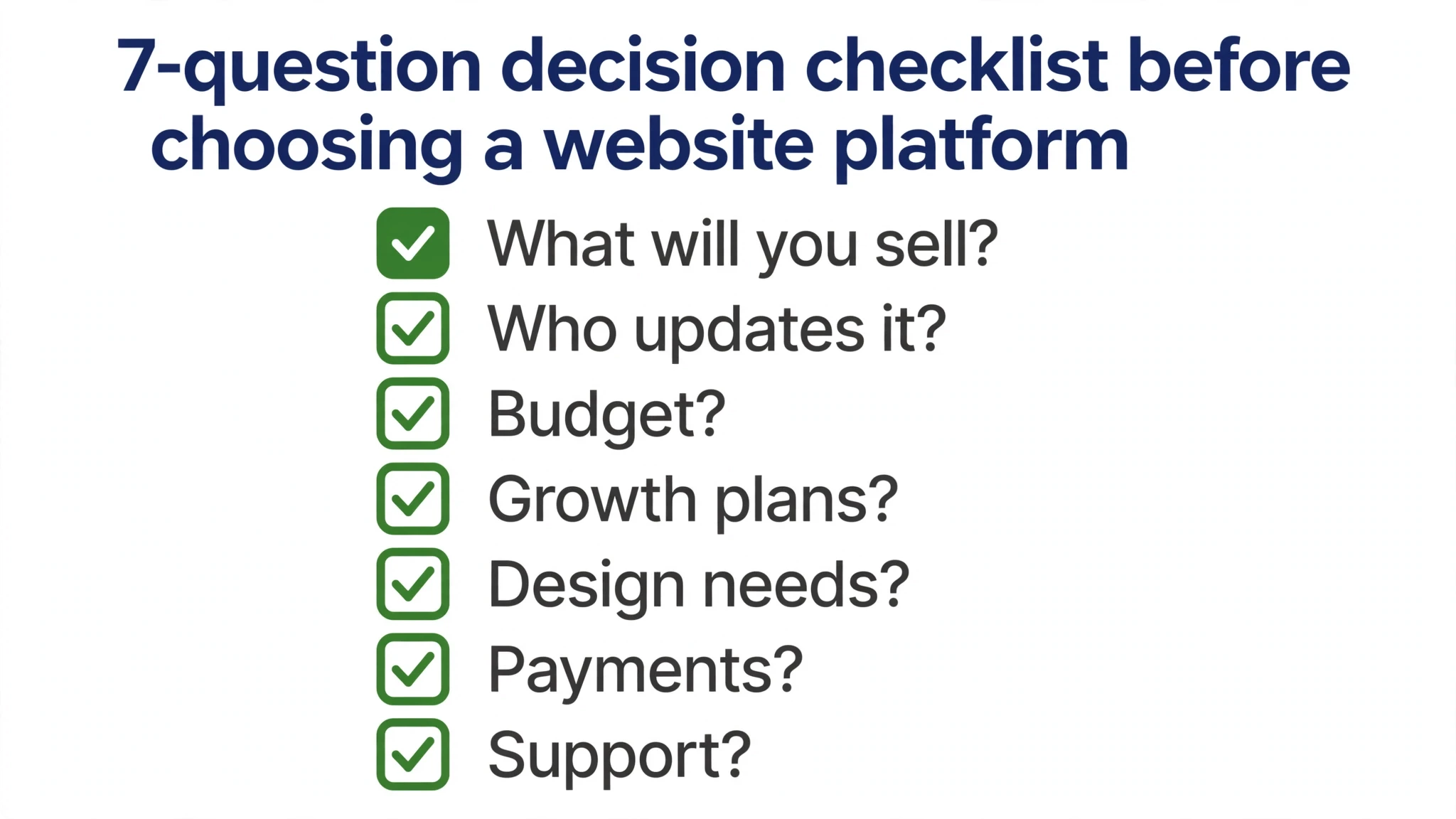
Work through these in order. By question seven, most businesses have their answer.
- Will the site’s primary job be generating leads or selling products? Lead generation points to WordPress; direct product sales point to Shopify.
- How much of your marketing will run through published content? A serious publishing program points to WordPress; occasional posts point to Shopify.
- Who will update the site week to week, and how technical are they? A non-technical team favors Shopify’s simpler admin; a supported or technical team can use either.
- Do you need functionality beyond a standard online store? Custom workflows, memberships, and unusual integrations favor WordPress’s open architecture.
- How do you feel about ongoing maintenance? If you want it invisible, Shopify bundles it. If you are comfortable delegating it to a web team, WordPress works fine.
- How many products will you sell, and how complex are they? Large catalogs with variants, bundles, and shipping rules play to Shopify’s strengths.
- Where is the business headed in three years — more content, more commerce, or both? Choose the platform that fits where you are going, not just where you are.
When the Answer Is “WordPress With Ecommerce Added” or “Shopify With Content Added”
Here is the nuance most comparisons skip: you are rarely choosing between selling and publishing. You are choosing which one is the foundation and which one gets added on top. Framing the WordPress vs Shopify choice this way keeps the decision grounded in business reality.
Adding a store to WordPress is a mature, well-traveled path. WooCommerce powers a huge share of the web’s online stores, and because it lives inside WordPress, your products, blog posts, and landing pages share one design system and one content workflow. This is the right shape when marketing drives the business: the content brings people in, and the store converts a share of them.
Adding serious content to Shopify is possible — the blog works, pages work, and Shopify sites can rank well — but the publishing experience stays shallow compared to WordPress. There is less control over content architecture, fewer editorial tools, and more friction when the content program grows ambitious. This shape works when the store is the business and content plays a supporting role: buying guides, announcements, and a handful of SEO pages.
The decision shortcut we use with clients: if content leads and commerce follows, start with WordPress. If commerce leads and content follows, start with Shopify. The platform that matches your primary motion should be the foundation; the secondary motion gets added to it. Apply that rule and the WordPress vs Shopify answer usually becomes obvious.
The Migration Reality Check
Every platform decision should be made with one eye on the exit. Switching later is entirely possible — businesses do it all the time — but go in with clear eyes about what it involves.
A migration is a rebuild, not a transfer. The design gets recreated on the new platform. Products, customers, orders, and content get exported, cleaned, and re-imported — and the data never maps one-to-one, so expect manual cleanup. Every URL needs a redirect mapped to its new home, or years of search visibility evaporate. Custom functionality gets rebuilt from scratch. And through all of it, the business keeps running, which means the migration happens in parallel with daily operations.
None of this is a reason to fear the decision. It is a reason to make it deliberately, using the framework above, instead of defaulting to whichever platform you heard of first. The cheapest migration is the one you never need.
This article is part of our guide to web design and development services for small business.
WordPress vs Shopify: The Two-Minute Decision Shortcut
If you are still torn after the full WordPress vs Shopify comparison, here is the shortcut experienced teams use. Answer two questions honestly. First: will you sell products as the core of the business within the next two years? If yes, the WordPress vs Shopify debate tilts toward Shopify, because its checkout, payments, and inventory tooling are built for that job from day one. If no — if you sell services, generate leads, or publish content — the WordPress vs Shopify debate tilts toward WordPress, because its content and SEO flexibility are unmatched at a small business budget.
Second: who will run the site day to day? A non-technical owner who wants everything to “just work” will be happier with Shopify’s managed environment. Someone comfortable with (or willing to hire for) occasional technical maintenance will get more long-term leverage from WordPress. The WordPress vs Shopify question has no universal winner, but it almost always has a clear winner for your specific situation once those two answers are on the table.
One last WordPress vs Shopify note: whichever platform you choose, the quality of the build matters more than the logo on the box. A well-built WordPress site beats a sloppy Shopify store, and vice versa. Pick the foundation that fits your business, then invest in building it properly.
Ready to Build on the Right Foundation?
Choosing the platform is the first decision; building it well is the second. If you would like help thinking through the choice — or designing and developing the site once you have made it — reach out through our contact page. We will help you pick the foundation your business can grow on.
Frequently Asked Questions
Yes — the platform shapes what your designer can build and what it will cost to maintain, so deciding first avoids rework later. A good designer will still validate the choice with you by asking how you sell, how much content you'll publish, and who will run the site day to day. Bring those three answers to the first conversation and the platform decision usually takes minutes. Choosing after the design is done often means paying for the same work twice.
WordPress is the natural default when content, search visibility, and lead generation drive your marketing. Its publishing and SEO flexibility make long-form content strategies easier to run. If blogging and organic search are core to how you win customers, WordPress fits better.
Shopify is the natural default when selling products online is the core of the business. Checkout, inventory, payments, and order management work out of the box with far less maintenance. If your site exists primarily to sell, Shopify lets you focus on products instead of platform upkeep.
Yes. WordPress with ecommerce added is a real option, and each platform can do the other's job. The post notes that one direction is usually easier than the other, so this works best when content is the primary job and the store is secondary. For a catalog-heavy business, Shopify's native commerce tools will fight you less.
WordPress asks for more hands-on maintenance — updates, hosting, backups, and occasional troubleshooting — which suits teams with some technical comfort or a maintenance partner. Shopify handles most of that behind the scenes, which suits lean teams. The post’s advice: match the platform to your team’s skills and appetite for maintenance, not just the feature list.
Choosing based on what a competitor or friend uses instead of how their own business sells and markets. A store-first business on a content platform, or vice versa, spends years paying for workarounds. Run your own answers through the five dimensions — selling model, content plans, customization needs, maintenance tolerance, team skills — before copying anyone else's stack.
Possible, but it is a rebuild, not a flip of a switch — the post is blunt about this. Content, products, redirects, and integrations all have to be recreated on the new platform. That is why the decision deserves real thought before design starts.
If you need unusual layouts, custom functionality, or deep integrations, WordPress’s open ecosystem gives you far more room. Shopify covers most standard commerce needs cleanly but constrains you outside its app ecosystem. The more custom your requirements, the stronger the case for the platform you own.
Not automatically. A developer's preference often reflects what they build fastest, not what your team can run cheapest for years. Ask them to map their recommendation to your selling model, content plans, and who maintains the site after launch. If the recommendation fits those three, their preference is a plus — if not, keep looking.
The post provides seven questions covering your sales model, content plans, customization needs, maintenance tolerance, and team skills. It also covers the in-between cases: ‘WordPress with ecommerce added’ or ‘Shopify with content added.’ Answering these honestly is the fastest way to a decision you will not regret.