

Searches for “1980s” are climbing again in the United States — up sharply this week and still active. The reason is easy to spot once you look around. Across social media, people are feeding their selfies into AI image tools and asking to be reimagined as 1980s portraits, complete with voluminous hair, neon lighting, and the grainy look of an old photograph. Celebrities and public figures have joined in, turning the retro-selfie wave into a full-blown cultural moment. Meanwhile, the fashion world is running its own parallel revival: power shoulders, bold stripes, statement jewelry, and maximalist color are headlining the 2026 collections, and Pinterest’s trend data shows interest in “80s luxury” up dramatically as shoppers move away from quiet minimalism.
For a small business owner, this is not a cue to buy a neon windbreaker. It is a cue to pay attention to nostalgia marketing — one of the most reliable tools in modern advertising, and one that works precisely when the present feels uncertain. Nostalgia marketing is the deliberate use of memories, retro aesthetics, and throwback references to build emotional connection with an audience. When executed well, it turns a stranger’s childhood into your brand’s story. And the numbers behind it are unusually strong for a “soft” tactic.
This guide breaks down 8 nostalgia marketing lessons from the current 1980s comeback — each one grounded in how the retro wave is actually playing out right now — so your small business can ride the trend instead of watching it pass by.
What Is Driving the 1980s Comeback in 2026
The current 1980s surge has two engines, and both matter for marketers.
The first is the AI retro-selfie phenomenon. The internet is having what fashion press has called “a very 1980s moment”: users upload a modern selfie and get back a convincingly 1980s portrait. The format is irresistible because it is personal — it places the viewer inside the decade rather than showing them a poster of it. That personal placement is exactly what good nostalgia marketing does with a brand’s creative: it invites the audience to step into the memory, not just look at it.
The second engine is fashion and design. The 2026 runways leaned hard into 1980s codes — strong shoulders, cinched waists, glossy fabrics, oversized accessories — framed not as costume but as “power glamour” for an uncertain moment. Trend researchers describe the shift as a reaction to economic and cultural unpredictability: when the present feels shaky, people reach for aesthetics that signal confidence and stability. Depop’s 2026 report found that 65% of consumers are drawn to styles or items from past eras, and 8 in 10 mix vintage references into their outfits. Pinterest’s 2026 predictions echo it, with a 225% jump in searches related to 80s luxury. This is not fringe behavior. It is mainstream consumer psychology, and it is measurable in search volume, social shares, and sales.
For marketers, the takeaway is bigger than any single decade. The 1980s will eventually give way to another revival, but the mechanism — familiar aesthetics turning into attention, affinity, and purchases — stays the same. That is what the eight lessons below are really about.
Lesson 1: Nostalgia Is an Attention Amplifier — Use It Like One
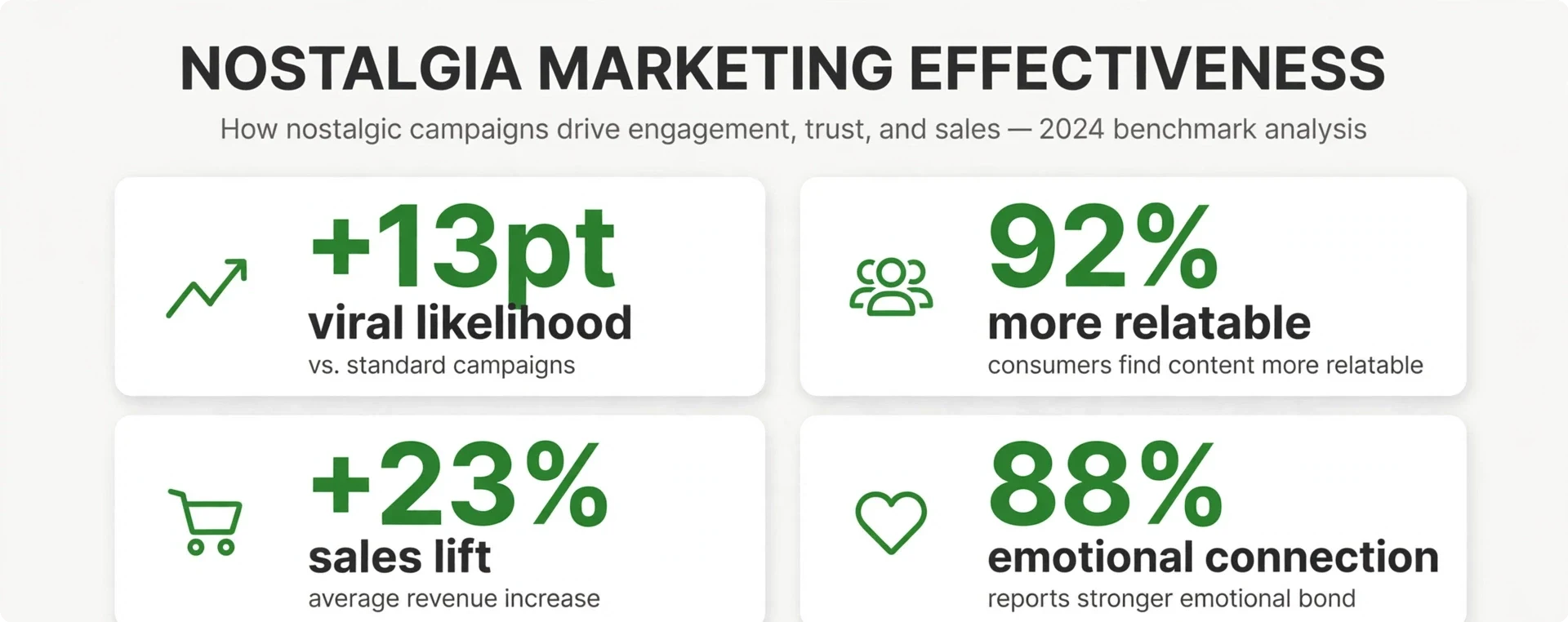
The strongest argument for nostalgia marketing is not that it is cute. It is that it measurably outperforms neutral creative on the metrics advertisers pay for. A Kantar analysis cited in a recent research compilation found that nostalgic ads carry a 13-point higher likelihood of going viral than ads without nostalgic elements, with 92% of consumers saying nostalgia makes advertisements feel more relatable. The same body of research shows nostalgic creative scoring 14 points higher on ad distinctiveness, 15 points higher on enjoyability, and 9 points higher on emotional connection.
Separate Nielsen research adds the commercial punchline: emotional ads drove a 23% sales lift, compared with a small decline for average ads from the same brand. Another Nielsen finding, reported by branding researchers, puts it in plain language: 88% of consumers say nostalgic advertising makes them feel emotionally connected to a brand.
Small businesses often assume these are big-brand numbers, the province of Super Bowl budgets. The mechanism does not care about your media budget, though. A throwback visual in a social post, a retro color palette in a landing page hero, or a jingle-style audio cue in a short video all run through the same emotional circuitry as a national spot. The lesson is to treat nostalgia as an amplifier for messages you already want to send — your launch, your sale, your story — not as a separate genre of content. If you are running social media marketing services for your own business or someone else’s, build one nostalgic creative variant into every campaign and let the engagement numbers pick the winner. Nostalgia marketing earns its place in the A/B test, not just the mood board.
Lesson 2: Match the Decade to Your Audience — Especially Gen Z
The classic mistake in nostalgia marketing is assuming everyone is nostalgic for the same thing. A 55-year-old remembers the 1980s firsthand; a 25-year-old does not — but that does not mean the younger customer is immune to the decade. Researchers distinguish between personal nostalgia (memories you lived) and vicarious nostalgia (a fondness for an era you never experienced). The current 1980s wave is fueled heavily by the second kind: young users remixing a decade they know only through parents, pop culture, and now AI-generated portraits of themselves in it.
That is good news for small businesses targeting younger buyers. You do not need your audience to have lived through the era; you need the era’s visual language to be legible to them. Millennials and Gen Z are, in fact, among the most receptive audiences: one branding study reported that 79% of millennial and Gen Z consumers find brands that evoke nostalgia more authentic and trustworthy. The appeal crosses generations — what changes is which reference points unlock it.
The practical move is audience research before creative. Survey your customers, scan your comment sections, and look at the age distribution of your engaged followers. Then choose references that land for that cohort: 1980s synth and arcade visuals for millennials, 2000s and 2010s callbacks for younger Gen Z. The nostalgia marketing that converts is the nostalgia your specific audience can feel, not the decade you happen to like. Run a quick poll in your Stories (“which throwback should we do next?”) and you will have both your creative direction and your first round of engagement.
Lesson 3: Sound and Texture Drive Recall — Don’t Rely on Images Alone
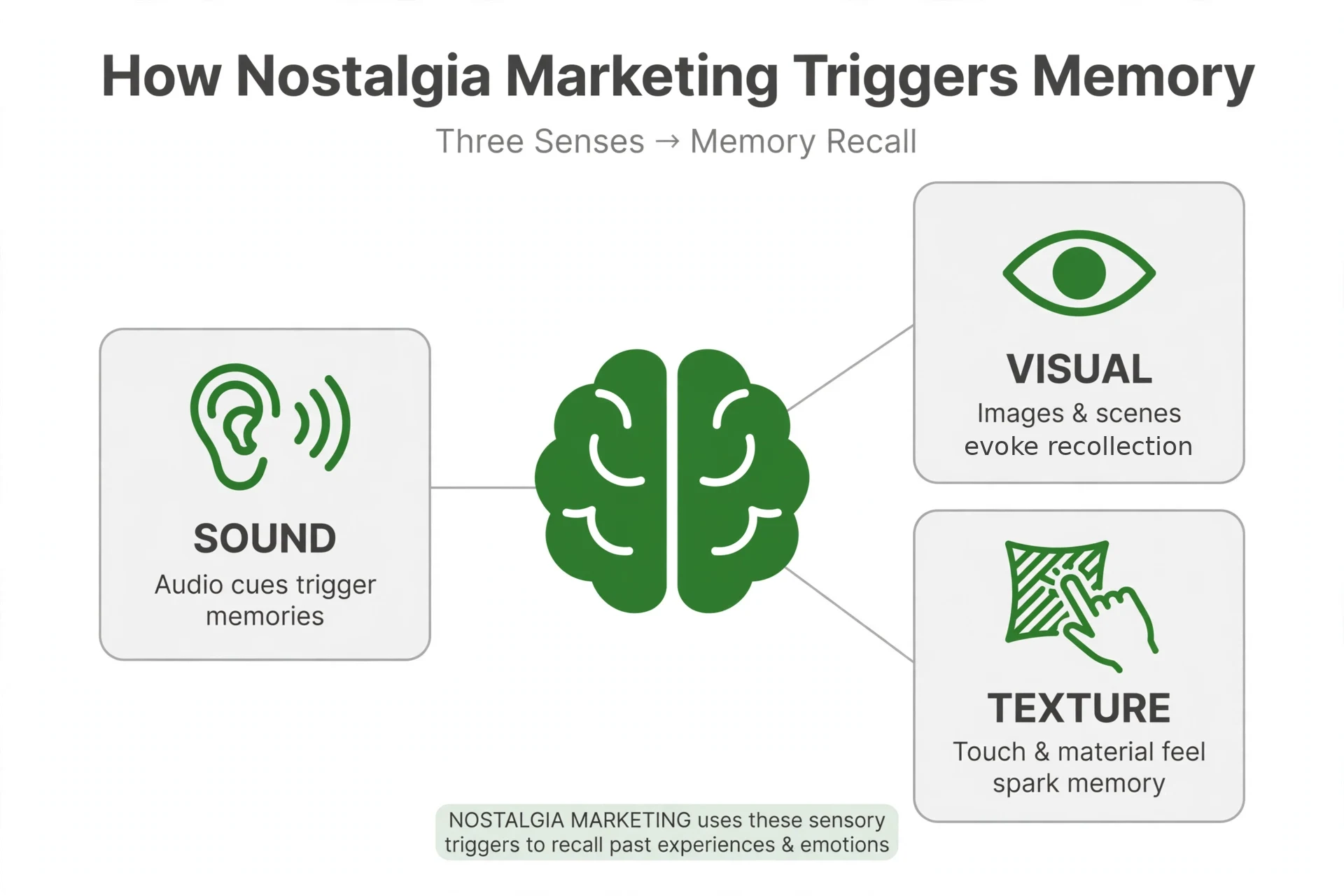
Most nostalgia marketing stops at visuals: a retro filter, a vintage logo, a throwback product shot. The research suggests the strongest memory triggers are multisensory. Familiar jingles, era-specific color palettes, and period product imagery combine into what researchers call nostalgia-coded elements — and advertising studies using EEG and eye-tracking have found they lift aided and unaided brand recall dramatically compared with contemporary creative. Nielsen’s consumer neuroscience work found nostalgic ads outperform modern ads by 30 to 40 percent on memorability and emotional engagement.
For a small business, this is a production checklist, not a budget line. Short-form video is the ideal vehicle: a 15-second clip with a synth-style audio bed, VHS-style transitions, or an analog film-grain overlay does more emotional work than a static retro graphic. Short-form video strategy already rewards hook-first creative; a nostalgia-coded hook — the first two seconds of a familiar musical style or a texture people associate with childhood — is one of the cheapest scroll-stoppers available. Even outside video, small nostalgia marketing touches count: email subject lines that reference a bygone phrase, packaging that echoes a classic design language, or hold music that evokes an era. Nostalgia marketing works through senses, so audit your brand for the senses you are currently ignoring.
Lesson 4: Borrow the Decade — Don’t Cosplay It
Watch how fashion is handling the 1980s revival and copy its restraint. The guidance from style editors is consistent: do not recreate an entire 1980s look — borrow a detail or two and mix it with the contemporary. A structured blazer with modern jeans; a statement necklace over a simple dress; high-tops with a current silhouette. The decade reads as confident rather than costume because the reference is curated, not copied.
The same discipline separates effective nostalgia marketing from cringe. The brands that win with retro creative modernize the reference: current typography with a retro palette, today’s UX with yesterday’s mascot, a modern product photographed like a 1985 catalog page. The ones that fail go full theme park — every asset screaming the decade until the brand itself disappears. Your audience wants the feeling of the memory, not a museum exhibit.
Apply this to brand identity design decisions as well. A heritage-style secondary logo, a limited-edition retro package, or a throwback social avatar can live alongside a modern primary identity. The contrast is the point: the retro element feels special precisely because the rest of the brand is current. Nostalgia marketing is seasoning, and the dish is your brand as it exists today.
Lesson 5: Let Social Platforms Do the Nostalgia Work for You
Some of the most successful nostalgia marketing in history was never paid media at all — it was platform mechanics. Facebook’s “On This Day” resurrects users’ own old posts and photos, generating organic sharing no ad budget could buy. Spotify Wrapped turns a year of listening into a shareable personal artifact, and the annual ritual has become one of the company’s most effective retention tools. Instagram’s #ThrowbackThursday grew into a cultural phenomenon with tens of millions of tagged posts, powered entirely by users’ own nostalgic impulse.
The lesson for small businesses is to build nostalgia marketing participation formats, not just broadcast creative. Your customers already have nostalgia; give them a stage for it. A “show us your first product” challenge, a then-and-now transformation series featuring real customers, an anniversary campaign that invites followers to share their own memories of your business — these formats borrow the mechanics of Wrapped and Throwback Thursday at small-business scale. User-generated content built on nostalgia also solves the authenticity problem: nothing reads as more genuine than a customer’s own photo. When your social media marketing calendar needs a reliable engagement format, a nostalgia-driven UGC prompt is one of the highest-ROI moves available, because the creative cost is near zero and the emotional payload is enormous.
Lesson 6: Packaging and Design Are the Fastest Nostalgia Levers
If you sell a physical product, your fastest path into nostalgia marketing is the package. Retro-inspired packaging consistently outperforms category averages in consumer perception testing, and the vintage-styled market has been growing steadily for years. The mechanism is simple: the package is the first physical touchpoint, and a retro design turns an ordinary unboxing into a memory event. Limited-edition throwback packaging also creates urgency — a collector’s dynamic that standard packaging cannot match.
The same principle applies to digital “packaging”: your website hero, your email templates, your social profile assets. A seasonal retro refresh of these surfaces — think a 1980s-inspired color treatment for a holiday campaign — signals novelty without requiring a rebrand. One caution from the research: the majority of nostalgic advertising historically skews toward hedonic products — things bought for pleasure rather than pure utility — so if your product is strictly utilitarian, anchor the nostalgia in the experience around the product (the unboxing, the onboarding, the community) rather than forcing a retro aesthetic onto the product itself. Nostalgia marketing should feel like a gift to the customer, not a costume the product is wearing.
Lesson 7: Ride the Wave Early — Trend Timing Is the Whole Game
The 1980s trend is active right now, which means it is also on a clock. Every nostalgia wave follows the same arc: early adopters make it feel fresh, the mainstream makes it feel familiar, and latecomers make it feel tired. The marketing value concentrates in the first two phases. Pinterest’s 225% surge in 80s-luxury interest and Depop’s data on vintage mixing are signals that this wave is in its mainstream phase — still rising, but not early.
For small businesses, the operational lesson is speed. You do not need a six-month campaign to participate in a nostalgia wave; you need a two-week creative sprint. A retro-themed social series, a throwback product drop, a nostalgic email campaign — these can be planned and shipped in days, which is exactly the tempo that lets a small brand outmaneuver larger competitors stuck in quarterly planning cycles. Set up trend alerts for cultural revivals the way retailers set up alerts for competitor moves — an early-warning system for your next nostalgia marketing wave: Google Trends, Pinterest Predicts, and social listening for phrases like “throwback,” “retro,” and specific decade names in your niche.
And know when the wave has peaked. The brands that get mocked for nostalgia marketing are the ones still posting retro memes six months after the moment passed. Plan your exit with your entry: a defined campaign window, a clear end date, and fresh creative ready to rotate in. Nostalgia marketing is a wave to ride, not a personality to adopt.
Lesson 8: Measure Emotion, Not Just Clicks
The final lesson is about measurement, because nostalgia marketing fails in analytics dashboards that only track last-click conversions. Nostalgic creative is an upper- and mid-funnel weapon: it builds distinctiveness, enjoyability, and emotional connection — the Kantar metrics — which then convert downstream. Nielsen’s 23% sales lift for emotional ads did not come from better calls to action; it came from better feelings about the brand. If you judge a nostalgia campaign purely on same-session conversion rate, you will undercount its value and kill your best-performing creative.
Build a measurement stack that fits the tactic. Track brand-lift signals: direct and branded search volume during the campaign, social sentiment in comments, save and share rates (the true currency of emotional creative), and repeat-visit rate on your site. Then connect those to revenue with a longer attribution window — 30 to 90 days, not 7. One more number worth internalizing from the research: nostalgia-based campaigns generate roughly 16% higher purchase intent than non-nostalgic equivalents. That is the metric that bridges the emotion-to-revenue gap, and it is the number to put in front of anyone who asks why the throwback creative deserves budget. For local businesses, pair this with tight local SEO so the attention your nostalgia campaign earns converts into “near me” searches that actually find you.
Putting It Together: Your 30-Day Nostalgia Marketing Sprint
Trends reward the fast. If the 1980s wave has your attention, here is a compact sprint plan distilled from the eight nostalgia marketing lessons above:
Week 1 — Research and creative direction. Poll your audience on their favorite throwback references (Lesson 2). Audit your brand’s sensory assets — sound, texture, color — for nostalgia opportunities (Lesson 3). Pick one decade-coded aesthetic and commit to borrowing, not cosplaying (Lesson 4).
Week 2 — Build the participation format. Launch one UGC prompt or challenge built on customer memories (Lesson 5). Produce three short-form videos with nostalgia-coded hooks — familiar audio styles, retro textures, era-specific transitions (Lessons 1 and 3). Keep the vintage market’s steady growth in mind as you brief any packaging or design refresh (Lesson 6).
Week 3 — Launch and amplify. Ship the campaign while the wave is still rising (Lesson 7). Put paid support behind the single best-performing organic post, not the whole set. Make sure your local listings and site are ready to capture the branded-search lift.
Week 4 — Measure and decide. Review the emotion metrics — shares, saves, sentiment, branded search — alongside revenue on a 30-day window (Lesson 8). Keep what the data validates, retire the wave on schedule, and bank the creative templates for the next revival. There is always a next revival.
The 1980s will fade from the trend charts eventually. The brands that learned how nostalgia marketing works during this wave will be ready when the next decade takes its turn — and they will already have the audience research, the creative templates, and the measurement discipline to move first.
Ready to turn cultural moments into customers? KKeyQik builds social, content, and video campaigns that convert attention into revenue — including nostalgia marketing creative like the strategies in this guide. Talk to our team and let’s put your brand on the wave, not behind it.
Sources
- Harper’s Bazaar India — “How to dress like you belong in the ’80s without using AI”
- Mint Lounge — “1980s fashion revival: How to wear the trend in 2026”
- Grazia Daily — “Glamoratti: The 80s Trend Set To Soar In 2026”
- Spiralytics — “120+ Nostalgia Marketing Statistics”
- Digital Polo — “How to Use Nostalgia in Your Branding and Design”
- Social Targeter — “Examining the Influence of Nostalgia Marketing on Brand Engagement Strategies”
Want to put this to work for your business? KKeyQik plans and delivers brand and graphic design for small businesses, with an in-house team available 24/7. See our graphic design service or get a quote within 24 hours.
Frequently Asked Questions
Nostalgia marketing is the deliberate use of memories, retro aesthetics, and throwback references to build an emotional connection with an audience. Instead of selling only features or benefits, it sells a feeling — it turns a stranger's childhood, or their fondness for a past era, into your brand's story.
Two forces are driving it. Across social media, people are using AI tools to reimagine their selfies as 1980s portraits, a format celebrities have joined too. In parallel, fashion's 2026 collections leaned hard into 1980s codes — power shoulders, bold stripes, maximalist color — and trend data shows interest in 80s luxury surging as shoppers move away from minimalism.
It works for small businesses. The mechanism — familiar cues triggering emotion and attention — does not require a big media budget. A throwback visual in a social post, a retro color palette on a landing page, or an era-evocative audio cue in a short video all run through the same emotional circuitry as a national ad campaign.
Both personal nostalgia (memories you lived) and vicarious nostalgia (fondness for an era you never experienced) drive response. Millennials and Gen Z are among the most receptive audiences — research cited in the branding literature finds most of them consider brands that evoke nostalgia more authentic and trustworthy. Match the decade to your specific audience.
Retro or limited-edition packaging, throwback user-generated-content challenges, short-form videos with era-coded hooks (familiar musical styles, vintage textures), a heritage-style secondary logo, era-evocative email subject lines, and "then and now" customer stories. Start with one or two rather than rebranding everything.
Run a two-week sprint: poll your audience on their favorite throwback references, launch one participation prompt built on customer memories, and produce three short-form videos with nostalgia-coded hooks. Put paid support behind the single best-performing organic post instead of boosting the whole set.
No. Design is only the visual layer. The strongest memory triggers are multisensory — familiar sounds, textures, and storytelling matter as much as imagery. And the reference should be modernized: borrow a detail or two from the era and mix it with the contemporary, rather than recreating the decade as a costume.
Match the decade to your audience's actual memories, keep the retro element as seasoning rather than the whole brand, and give the campaign a defined window. The brands that get mocked for nostalgia are the ones posting retro memes months after the moment passed — plan your exit when you plan your entry.
Track emotion and attention signals first: shares, saves, comment sentiment, and branded search volume during the campaign. Then connect those to revenue with a longer attribution window of 30 to 90 days, since nostalgic creative builds the feelings that convert downstream rather than only driving same-session clicks.
Keep it to a defined, short window — a few weeks, not a few quarters. Every nostalgia wave follows an arc from fresh to familiar to tired, and the marketing value concentrates in the early phases. Ride the wave while it is rising, measure honestly, then rotate in fresh creative and bank your templates for the next revival.