

On October 7, 2026, American Airlines did something every brand dreads: it announced bad news. The Fort Worth-based carrier told the world it would end six routes next year — Chicago to Lincoln, Dallas to Albany, Miami to Tulum, Miami to Montréal, LaGuardia to Bozeman, and Phoenix to Provo — with the final flights disappearing between January and May 2027. Within days, “american airlines dropped destinations list” was climbing Google’s active US trends with a 600% surge, and the airline’s branded search results filled with coverage of what it was cutting.
That sounds like a reputation disaster. It wasn’t — and that is exactly why marketers should pay attention. The American Airlines route cuts reveal a disciplined playbook for handling bad news in the search era: announce it yourself, frame it inside a bigger story, give the market a clear business reason, and build the owned content that keeps your version of events ranking. The airline didn’t just cut flights; it showed how a brand can deliver unwelcome news without surrendering its search results to it.
This post breaks the American Airlines route cuts down into nine transferable lessons — a bad-news SERP playbook any brand can adapt the next time it has to announce a price change, a service reduction, a product sunset, or any other headline its customers won’t love. None of these require an airline-sized PR department. They require thinking like a marketer before you think like a manufacturer.
What Actually Happened: The American Airlines Route Cuts in Plain Terms
Before the lessons, the facts — because the American Airlines route cuts are worth understanding on their own terms.
According to reporting by The Points Guy on October 7, 2026, American will end six routes as part of its latest route map update. Chicago O’Hare to Lincoln, Nebraska ends in April 2027. Dallas-Fort Worth to Albany, New York — a seasonal summer service — will not resume in May 2027 as planned. Miami to Tulum, Mexico and Miami to Montréal both end in January 2027. LaGuardia to Bozeman, also seasonal, will not resume in May 2027. Phoenix to Provo, Utah ends in January 2027. No destination loses American service entirely, though three markets — Lincoln, Provo, and Tulum — will only keep nonstop flights to Dallas-Fort Worth, the airline’s largest hub, after the cuts.
The American Airlines route cuts landed inside a larger story. American also announced two additions from New York’s JFK airport: a four-times-weekly seasonal nonstop to Bozeman (moved from LaGuardia, where it could only operate on Saturdays) launching June 18, 2027, and a twice-daily service to Seattle — a route American last flew in 2019 — starting April 6, 2027. The airline framed the whole package as schedule tuning in pursuit of consistent profitability.
The business reason was stated plainly. An American spokesperson said the changes were “part of targeted actions to strengthen the airline” as it moderates planned growth for next summer, against a backdrop of punishing fuel costs: jet fuel averaged $4.43 a gallon in early October, per Airlines for America data, nearly double the $2.42 average the airline paid in 2025, with supply-chain disruptions tied to the U.S. and Israel’s war with Iran rippling through the market. Jason Reisinger, American’s managing director of global network planning, added that the carrier is “continuing to build a network from New York that offers customers more choice and more ways to connect to the destinations they care about.”
The American Airlines route cuts were not the airline’s only 2026 network move. Earlier in the year, American fully exited three destinations — Doha in March, Santa Maria in May, and Tijuana in August, per aviation analytics data reported October 14 — citing geopolitical instability for Doha and weak financial performance for the other two. And over the summer, it temporarily suspended six routes from Los Angeles and Charlotte amid the same fuel-price pressure, calling it a seasonal adjustment and noting that already-booked passengers would be offered other arrangements or refunds.
With the facts straight, here are the nine lessons.
Lesson 1: Announce the Bad News Yourself — Before the Internet Does It for You
The single most important marketing decision in the American Airlines route cuts was the most basic one: American announced them. The airline issued its schedule update through official channels, gave reporters specifics, and put its own statement on the record — before schedule-tracking data and aviation watchers could break the story on their own terms.
This matters more than it sounds. In the search era, whoever publishes first shapes the narrative vocabulary. When a brand announces its own bad news, the coverage inherits its framing — “route map update,” “moderated growth,” “strengthen the airline.” When the news leaks or is discovered by outsiders, the framing belongs to whoever found it — “slashes routes,” “abandons cities,” “retreats.” The facts are identical; the search queries they generate are not. “American Airlines route cuts” is a neutral query a brand can compete on. “American Airlines abandons Lincoln” is a hostile one it cannot.
The mechanism behind the American Airlines route cuts announcement is straightforward and available to any business. When you know unwelcome news is coming — a price increase, a discontinued product, a closed location — publish your version first, on your own domain, with your own headline. That page becomes the canonical source every reporter links to, and it starts ranking for the branded queries from day one. Silence is not neutral; silence is a vacuum, and the internet fills vacuums with its own adjectives. American’s announcement didn’t stop the coverage, but it ensured the coverage quoted American’s words. That is the difference between being the subject of a story and being a source in it.
Lesson 2: Pair Every Cut with a Win — The Swap Frame
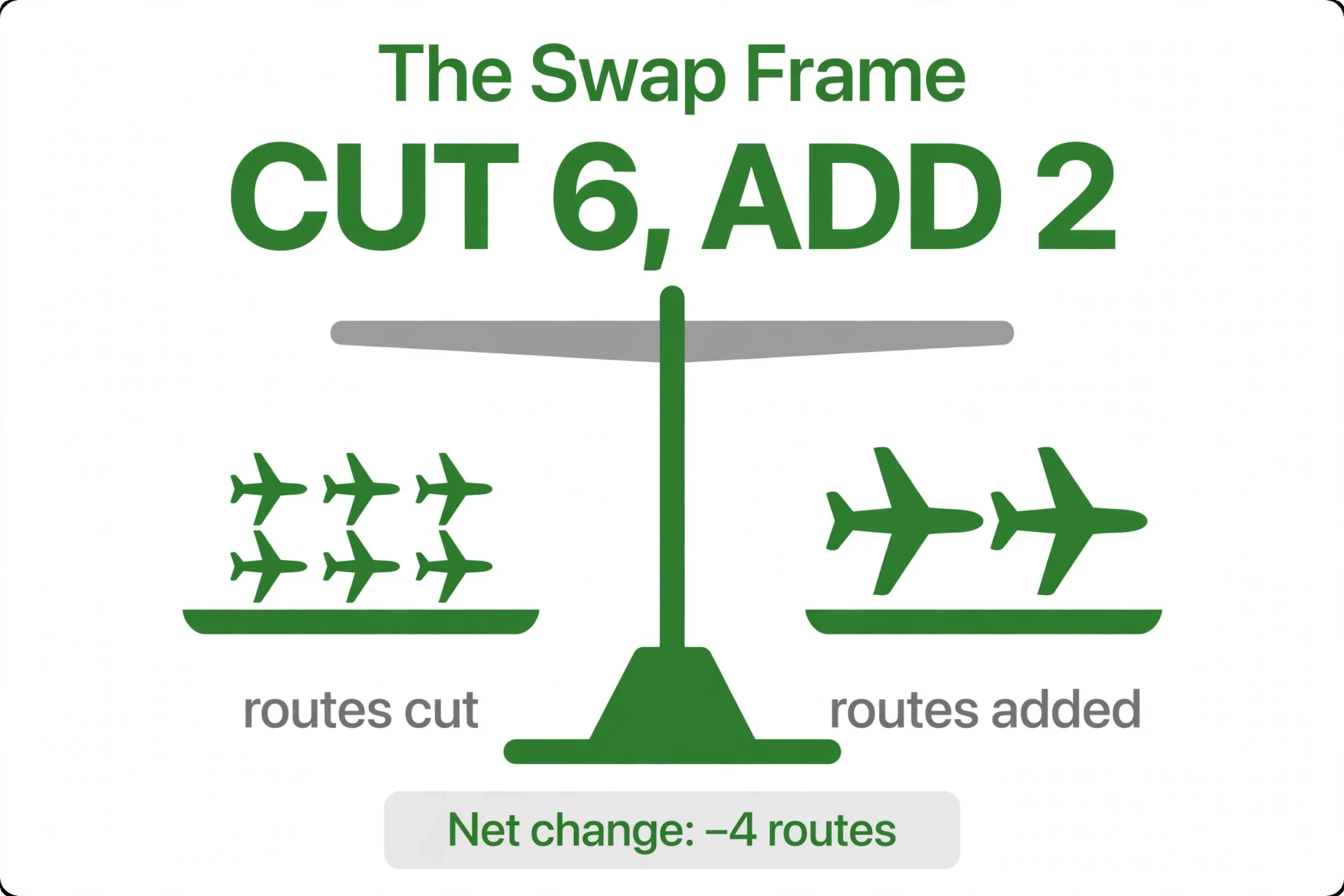
Notice the structure of the American Airlines route cuts announcement: six routes cut, two routes added. The headline the airline wanted — and largely got — was a network update with additions, not a retreat. Moving the Bozeman flight from LaGuardia to JFK was even presented as an upgrade: the flight could operate four days a week from JFK instead of being restricted to Saturdays at LaGuardia.
This is the swap frame, and it is one of the oldest tools in corporate communications — but American executed it with unusual discipline. The additions were real and newsworthy on their own (a twice-daily return to Seattle, a market American hadn’t served from JFK since 2019, is genuinely interesting). The pairing meant that every article about the American Airlines route cuts also carried the Seattle and Bozeman news, diluting the negative signal with forward momentum.
Small brands can run the same play at any scale. Sunsetting a product? Announce it alongside the replacement. Raising prices? Launch it with the new features the increase funds. Closing a location? Open the announcement with where you’re expanding. The swap frame does not hide bad news — American’s cuts were fully visible in every story — but it gives the audience, and the algorithm, something positive to index alongside it. A story that is 100% negative generates 100% negative search associations. A story that is 70% negative and 30% positive gives your owned content and your defenders something to work with. Never ship bad news alone if you have any good news within a quarter of it.
Lesson 3: Name the Business Reason Plainly — Transparency Beats Spin
American’s explanation for the American Airlines route cuts was refreshingly free of euphemism. The spokesperson pointed to “targeted actions to strengthen the airline” and moderated growth for next summer, set against fuel costs that had nearly doubled year over year. No one had to decode it: fuel is expensive, so the network is being tuned for profitability.
Contrast the American Airlines route cuts with how bad news usually gets announced — vague references to “strategic realignment,” “evolving our footprint,” or “difficult decisions” with no mechanism attached. Vague explanations invite speculation, and speculation is always worse than the truth. When a brand says “we’re optimizing our network,” the audience hears “they’re in trouble.” When a brand says “jet fuel costs $4.43 a gallon, so we’re concentrating on routes that work,” the audience hears a business making a business decision.
The marketing lesson: give the market a reason with numbers in it. Specificity is the antidote to rumor. American’s fuel-cost framing worked because it was verifiable (the Airlines for America data was public), sympathetic (every traveler understands expensive fuel), and impersonal (it’s a cost problem, not a failure problem). When your brand delivers bad news, attach it to a cause your customers can check and understand. The goal is not to make people happy about the news — it is to make the news feel rational instead of mysterious. Rational bad news gets processed; mysterious bad news gets investigated.
Lesson 4: Be Exhaustively Specific — Dates, Routes, and What’s NOT Changing
One underrated strength of the American Airlines route cuts announcement was its granularity. American didn’t announce “several route adjustments.” It named all six routes, gave each one’s end date (January 2027, April 2027, or a May 2027 non-resumption), and — critically — clarified what was not changing: no destination loses American service entirely, and three affected markets keep their Dallas-Fort Worth nonstops.
This specificity serves two marketing functions. First, it collapses the rumor space. When the facts are complete and precise, there is nothing for speculators to fill in — no one needs to guess which cities are next, because the airline said exactly which ones and when. Second, it creates owned search inventory. Each specific detail — “Miami to Tulum ends January 2027” — is a long-tail query that American’s own materials can rank for, crowding out third-party speculation on the exact searches worried customers will run.
For your own bad-news announcements, completeness is a feature. Name the affected products, the effective dates, and the exceptions. Publish an FAQ alongside the announcement that answers the obvious follow-ups before they’re asked. Every question you leave unanswered becomes someone else’s headline — and someone else’s ranking page. The brands that suffer most from bad-news cycles are rarely the ones with the worst news; they’re the ones with the thinnest facts, because thin facts leave room for thick speculation.
Lesson 5: Put a Human Name on the Announcement
The American Airlines route cuts didn’t come from a faceless “company statement” alone. Jason Reisinger, the managing director of global network planning, was quoted by name explaining the New York build-up. A named executive saying “we’re building a network with more choice and more ways to connect” lands differently than an anonymous spokesperson saying the same words.
This is a small detail with an outsized effect on trust. Named humans are accountable; anonymous statements are not. When a real person with a real title attaches their name to a decision, it signals that the company stands behind it — which paradoxically makes the news easier to accept. Readers may disagree with the decision, but they can see that someone owned it.
The practical takeaway from the American Airlines route cuts for smaller brands: never let bad news arrive unsigned. The founder, the CEO, or the relevant executive should be the voice of difficult announcements — in the press release, in the blog post, in the customer email. It feels riskier, but it reads as braver, and bravery is a trust signal. Customers forgive decisions made by people they can picture; they resent decisions made by “the company.” If you’re the one making the call, be the one who says so.
Lesson 6: Own the Negative Keywords Before Someone Else Does
Here’s where the American Airlines route cuts become a pure SEO lesson. Within days of the announcement, “american airlines dropped destinations list” was an actively rising US search trend. That query — and its cousins like “american airlines cancelled routes” and “is american airlines cutting flights” — is negative-intent branded search: people typing the brand name plus bad news. Every brand eventually faces these queries. The question is who ranks for them.
The playbook, drawn from established reputation-management practice, is to build owned content around the negative keywords themselves. Search Engine Journal’s reputation-management guidance makes the point directly: brand searches generate “People Also Asked” prompts that plant doubts searchers never had — and if your own pages don’t answer those questions, someone else’s will. The fix is to publish the pages that target the uncomfortable queries: a route-change FAQ, a “network updates” hub, a help-center article titled with the exact words customers are searching. American’s own schedule and newsroom pages are the natural candidates for this — and the faster they exist, the less room there is for speculation to rank.
Apply this to your business now, before you need it. Audit the negative-modifier queries around your brand: “[brand] cancelled,” “[brand] closing,” “[brand] problems,” “[brand] refund.” If you don’t have owned pages that honestly address them, you’re renting your reputation to whoever publishes first. Building those pages during calm weather — help articles, policy pages, transparent FAQs — means that when bad news breaks, your infrastructure is already ranking. The American Airlines route cuts prove the demand exists: thousands of people searched for the dropped-destinations list. The only question is whether they found the airline’s version or a stranger’s.
Lesson 7: Flood the SERP with Positive Owned Assets — The Suppression Playbook
Owning the negative keywords is defense. The American Airlines route cuts also illustrate the offense: keeping the overall branded SERP healthy by maintaining a deep bench of positive, authoritative owned assets that search engines can rank.
This is the suppression playbook that Search Engine Land outlined for 2026: build a real entity footprint with structured data, claim high-authority properties (LinkedIn, YouTube, industry directories, review profiles), publishing consistently so freshness signals stay strong on branded queries, and earn legitimate digital PR — contributed articles, interviews, press coverage — because coverage on authoritative domains ranks on its own and lifts everything you control. The honest caveat from that same guidance: suppression takes two to six months to reshape a first-page SERP, and rankings rebound when the work stops. It is maintenance, not a one-time fix.
In the American Airlines route cuts story, the airline benefits from this structurally. The same week as the cuts, coverage of its JFK expansion, its new business-class suites, its fleet-wide seatback screens, and its lounge investments gave search engines fresh, positive, authoritative pages to rank for “American Airlines” queries. The negative story didn’t disappear — but it shared the front page with growth stories, which is the realistic goal. No brand can delete accurate news. What it can do is make sure the front page tells the whole story, not just the bad chapter. Start building that bench now: the time to publish your best owned content is before you need it to outrank something.
Lesson 8: Time the Announcement with the Calendar, Not Against It
The American Airlines route cuts were announced as part of a forward-looking schedule update — routes ending in January, April, and May 2027, revealed in October 2026. That timing was deliberate and instructive. By announcing the American Airlines route cuts three to seven months before they take effect, American gave affected customers maximum rebooking runway, gave travel media a planning-cycle story rather than a shock story, and attached the news to the natural rhythm of airline schedule announcements.
Timing is an underused lever in bad-news marketing. News broken without a calendar context feels abrupt; news placed inside a cycle — a schedule update, a quarterly review, a product roadmap — feels managed. The October timing also meant the story competed with holiday-travel planning coverage rather than dominating a slow news week, and the long lead times let the airline’s customer-service operation absorb the impact gradually instead of all at once.
The general principle the American Airlines route cuts illustrate: never let bad news arrive as a surprise if you can attach it to a process. Product sunsets belong in roadmap updates. Price changes belong in plan announcements. Service reductions belong in schedule releases. The container doesn’t change the content, but it changes the reception — from “what are they hiding?” to “this is how they run their planning.” And the lead time matters as much as the container: the earlier the affected customers hear it from you, the less it feels like something done to them.

Lesson 9: Take Care of the Affected People — Publicly
The final lesson of the American Airlines route cuts is the most human one. When American suspended routes over the summer, its statement included a specific commitment: passengers who had already booked on affected routes would be offered alternative travel arrangements or refunds. That single sentence does more reputation work than any press release framing.
Here’s why the American Airlines route cuts approach works: the audience for bad-news announcements splits in two. The general public reads the headline; the affected customers read the remedy. Journalists quote the framing, but affected customers remember whether they were taken care of — and they talk about it in reviews, forums, and social posts that rank for your brand queries for years. A generous, clearly stated remedy converts the most dangerous audience (angry affected customers) into a neutral or even positive one, cutting off the supply of negative user-generated content at the source.
Make the remedy the headline of your customer-facing version. “Here’s what changes, here’s when, and here’s exactly what we’re doing for you” — in that order. Spell out the options, the deadlines, and the contact path. Then deliver on it visibly, because the follow-through becomes the second story. Brands are rarely remembered for the bad news itself; they’re remembered for how the bad news treated people. American’s rebooking-and-refund commitment is the part of the story most likely to be quoted back favorably — which is exactly why it belongs in the announcement, not in the fine print.
What the American Airlines Route Cuts Mean for Your Marketing
The American Airlines route cuts are ultimately a story about control: control of the announcement (Lesson 1), of the framing (Lesson 2), of the explanation (Lesson 3), of the facts (Lesson 4), of the voice (Lesson 5), of the negative keywords (Lesson 6), of the SERP (Lesson 7), of the timing (Lesson 8), and of the customer experience (Lesson 9).
No brand gets to choose whether bad news comes. Every brand gets to choose how it arrives. The companies that treat difficult announcements as a marketing discipline — planned, specific, human, and search-aware — don’t avoid the coverage; they shape it. And in an era when a single trending query can define your brand for a news cycle, shaping it is everything.
If your brand doesn’t have a bad-news playbook yet, build one before you need it: the owned pages, the FAQ templates, the spokesperson bench, the SERP monitoring. KKeyQik helps growing brands build the search foundation that holds up under pressure — search engine optimization that owns your branded queries before a crisis, social media marketing that keeps your narrative alive in real time, and video content that puts a human face on your hardest announcements. Bad news is inevitable. Being unprepared for it isn’t.
Related reading: September 2026 CPI Report: 7 Inflation-Proof Marketing Moves for Smarter Brands · Publix Is Closing Stores in 2026: 9 Retail Marketing Lessons for Small Businesses
Want to put this to work for your business? KKeyQik plans and delivers website copy, blog posts and other content for small businesses, with an in-house team available 24/7. See our content writing service or get a quote within 24 hours.
Frequently Asked Questions
American is ending six routes: Chicago O'Hare to Lincoln, Nebraska (April 2027); Dallas-Fort Worth to Albany, New York (seasonal, not resuming May 2027); Miami to Tulum, Mexico (January 2027); Miami to Montréal (January 2027); LaGuardia to Bozeman (seasonal, not resuming May 2027); and Phoenix to Provo, Utah (January 2027). No destination loses American service entirely, though Lincoln, Provo, and Tulum will only keep nonstop flights to Dallas-Fort Worth afterward.
The airline said the cuts are "part of targeted actions to strengthen the airline" as it moderates planned growth for next summer, against jet fuel costs that nearly doubled year over year — averaging $4.43 a gallon in early October 2026 versus $2.42 in 2025, per Airlines for America data, amid supply-chain disruptions tied to the U.S. and Israel's war with Iran. Naming a verifiable business reason is itself one of the post's marketing lessons: specific causes beat vague corporate language.
Yes — and that pairing is the post's "swap frame" lesson. American is adding two routes from New York JFK: a four-times-weekly seasonal nonstop to Bozeman starting June 18, 2027 (moved from LaGuardia, where it could only fly Saturdays), and a twice-daily service to Seattle starting April 6, 2027, a route it last flew in 2019. Announcing additions alongside cuts gives every story — and every search result — something positive to carry.
The core lesson is to announce bad news yourself, on your own channels, before outsiders break it. Whoever publishes first sets the narrative vocabulary: American's version framed the story as a "route map update" and "moderated growth," while a leak would have been framed in harsher terms. Publishing first also makes your page the canonical source that reporters link to and that starts ranking for branded queries from day one.
A bad-news SERP is what happens when a brand's search results fill with negative coverage — for American, queries like "american airlines dropped destinations list" surged 600% on Google's active US trends within days of the announcement. It matters because branded search is where your most motivated audience goes: existing customers, prospects comparing options, and journalists. If you don't have owned content competing on those queries, strangers define your brand for the news cycle.
By publishing owned pages that target the uncomfortable queries directly — route-change FAQs, policy pages, and help-center articles titled with the exact words customers are searching. Search Engine Journal's reputation guidance notes that brand searches surface "People Also Asked" prompts that plant doubts searchers never had; if your pages don't answer them, someone else's will. The time to build those pages is during calm weather, so they're already ranking when bad news breaks.
Suppression is the SEO discipline of outranking negative results with stronger positive assets: building an entity footprint with structured data, claiming high-authority properties, publishing consistently so freshness signals stay strong, and earning legitimate digital PR. Search Engine Land's 2026 guidance puts the realistic timeline at two to six months to reshape a first-page SERP — and warns that rankings rebound when the work stops, so it's maintenance, not a one-time fix.
Specificity collapses the rumor space. By naming all six routes with exact end dates — January 2027, April 2027, or a May 2027 non-resumption — and clarifying what wasn't changing, American left nothing for speculators to fill in. It also created owned search inventory: each precise detail is a long-tail query the airline's own materials can rank for, crowding out third-party speculation on the exact searches worried customers run.
When American temporarily suspended six routes over the summer of 2026, its statement said passengers already booked would be offered alternative travel arrangements or refunds. The marketing lesson is that the remedy is the message for affected customers: spell out the options, the deadlines, and the contact path in the announcement itself. Brands are rarely remembered for the bad news — they're remembered for how the bad news treated people.
Start with the infrastructure: owned pages that honestly address your brand's negative-modifier queries, FAQ templates for difficult announcements, a named spokesperson bench, and SERP monitoring so you see a bad-news query rising in real time. Then rehearse the discipline this post covers — announce it yourself, pair cuts with wins, name the business reason plainly, be specific, time it with the calendar, and lead with the remedy. A digital marketing partner can help build the search foundation — branded-query SEO, always-on social presence, and executive video content — that holds up when the news turns difficult.