

On October 21, 2026, Anthropic introduced Claude Duet — a new app where its AI works as a proactive agent instead of a chatbot that waits for your next prompt. It is the kind of launch that matters to marketers for two reasons at once: it is a masterclass in how to bring a complex product to market, and it signals a shift in how small businesses will actually do their marketing work in the years ahead.
Here is what Claude Duet is, in plain terms. Claude Duet is a standalone app for iOS, Android, and the web, currently in research preview behind a waitlist, open to Claude Pro and Max subscribers in the United States. Instead of you opening a chat thread and typing a question, Claude Duet comes to you: each morning it assembles a brief of what needs your attention across your connected email, calendar, and work apps, then keeps monitoring those apps every few hours and messages you when something requires a decision. Hand Claude Duet a task — scheduling, a sales forecast, a slide deck, a web app prototype, chasing unpaid invoices — and it keeps working on its own cloud computer even after you close your laptop or switch off your phone. It carries over the memory, skills, and connected apps from your existing Claude account, plugs into more than 6,000 connectors and plugins in the Claude Marketplace — Gmail, Slack, QuickBooks, Stripe, HubSpot, Shopify, LinkedIn, DocuSign among them — and asks for your approval before it takes any sensitive action, like sending a message, making a payment, or signing a document.
The launch also arrived with unusual honesty. Anthropic said plainly that this early version may misread a thread, misjudge what is urgent, or miss something that lands between its periodic checks — and that it cannot yet show you its own browser activity as it happens. That candor is itself part of the story.
Search interest spiked immediately: “claude duet” jumped 500% on Google Trends US within a day of the announcement, with “claude duet app” emerging as a breakout related query. When the market leans in this fast, the smart move for a business owner is not just to watch the product — it is to study the launch. Here are seven marketing lessons worth stealing from how Claude Duet entered the world, plus a practical look at what proactive agents mean for your own marketing operations.
1. Lead With the Customer’s Boring Problems, Not the Demo
Most technology launches open with what the product can do. Claude Duet’s launch opened with what the customer dreads doing. Anthropic’s announcement examples were not glamorous demos of artificial general intelligence — they were a stack of unpaid invoices with payment reminders already drafted, a payroll run prepared for review, contracts readied for signature, a county health permit fee waiting on approval, a vendor renewal redlined to Net 60 with the changes summarized, and twenty-seven wrong delivery orders with refunds already drafted. Mundane, specific, instantly recognizable.
That framing is a deliberate marketing choice, and it is the single most transferable lesson in the Claude Duet launch. Small businesses do not buy capabilities; they buy relief from specific pains. A dashboard is a capability. “Twenty-seven refunds you forgot about, drafted and waiting for your okay” is relief. The more concrete the pain you name, the more the prospect feels seen — and the more your marketing converts.
Audit your own homepage and ad copy against this standard. If your headline describes what your service is (“full-service digital marketing agency”), rewrite it to describe the specific pain it removes (“your ads are running, but nobody can tell you what each sale actually cost”). Anthropic is selling one of the most advanced AI systems on earth, and it chose to talk about invoices. Your marketing should be at least that grounded in your customer’s real to-do list.
This is the core of product launch marketing that converts: name the job the customer is trying to get done, show the before-and-after, and let the technology be the proof rather than the pitch.
2. Run Scarcity Like a Strategy, Not a Gimmick
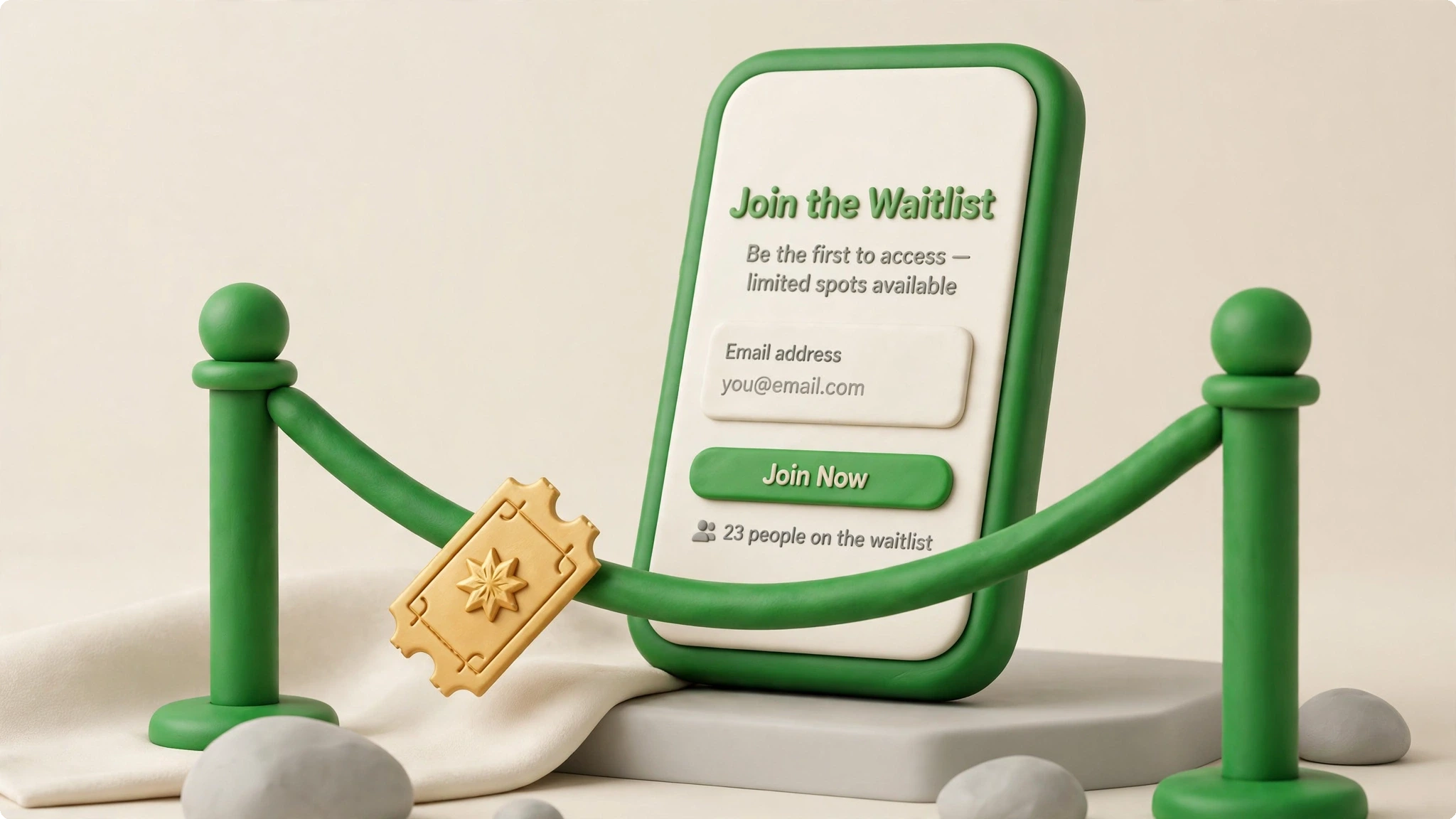
Claude Duet is not available to everyone. It is a research preview, gated by a waitlist, limited to Pro and Max subscribers, and restricted to the United States — Team and Enterprise plans are explicitly excluded for now. Every one of those gates does double duty: it controls the operational load of a careful rollout, and it manufactures the oldest demand lever in marketing — scarcity.
Scarcity works when it is honest and structural, not when it is a countdown timer slapped on a landing page. Anthropic’s gates are credible because they are tied to real constraints: a research preview genuinely needs a bounded test group, and a product that touches inboxes and payments genuinely needs a careful ramp. The waitlist converts curiosity into a concrete action — joining a line — which is a far stronger commitment than reading a blog post. And exclusion creates aspiration: the people who cannot get in yet talk about it, which is free distribution.
Small businesses can run the same playbook at their own scale. Opening a new service line? Launch it to a founding cohort of ten clients with a stated reason for the cap — onboarding depth, quality control, a feedback loop. Rolling out a seasonal offer? Tie the window to a genuine constraint, like production capacity or calendar availability. The mechanism is the same one Claude Duet used: a real reason for the limit, a clear way to claim a spot, and the patience to let demand compound. Artificial urgency erodes trust; structural scarcity builds it.
There is a second-order benefit worth noting. A waitlist is also a research instrument. Every signup teaches you something about who wants the product and why. That is the deeper function of the Claude Duet waitlist: it is a demand signal and a research panel in one. If you ever launch with a waitlist, treat the list as a dataset: segment it, survey a sample, and let the early demand shape the final offer.
3. Differentiate in a Crowded Field With One Sharp Line
Claude Duet did not launch into an empty market. OpenAI had already shipped Dots, its always-on agent for professionals and small businesses. Meta had Muse, an assistant that shops, books, and sends emails on a user’s behalf. Anthropic’s answer was not a longer feature list — it was a single sharp line of differentiation, repeated across the announcement: Claude Duet comes to you, works while you step away, and checks with you before it acts on your behalf.
Notice what that line does. It does not claim to do more things than the rivals. It claims a different relationship with the user — proactive but permissioned. Against Dots, which pitches always-on professional tooling, Claude Duet positions on judgment and restraint. Against Muse, which leans into doing errands and showing live browser activity, Claude Duet draws the opposite boundary: no personal errands, no ticket booking, no live browser view, and explicit approval gates on anything sensitive. The product is defined as much by what it refuses to do as by what it does.
For a small business, this is the positioning lesson the Claude Duet launch teaches, and it matters most. You do not need to out-feature every competitor in your market; you need one legible line that explains why you are different, and the discipline to repeat it everywhere. “We are the agency that answers in under an hour” is a line. “We are the roofer who photographs every repair and sends the report the same day” is a line. The line has to be true, it has to matter to the buyer, and it has to survive contact with your actual operations.
If you want the full picture of how the rival camp is playing this, our breakdown of OpenAI’s Dots launch and what it means for small business marketing covers the other side of the agent race — and our earlier piece on what the Claude Opus 5.5 model means for marketers explains the engine both of these products are now built on. Read the Claude Duet announcement next to those two and you can see the competitive geometry clearly: three labs, three different answers to the same question of who the proactive agent should be.
4. Make Trust the Feature, Not the Footnote
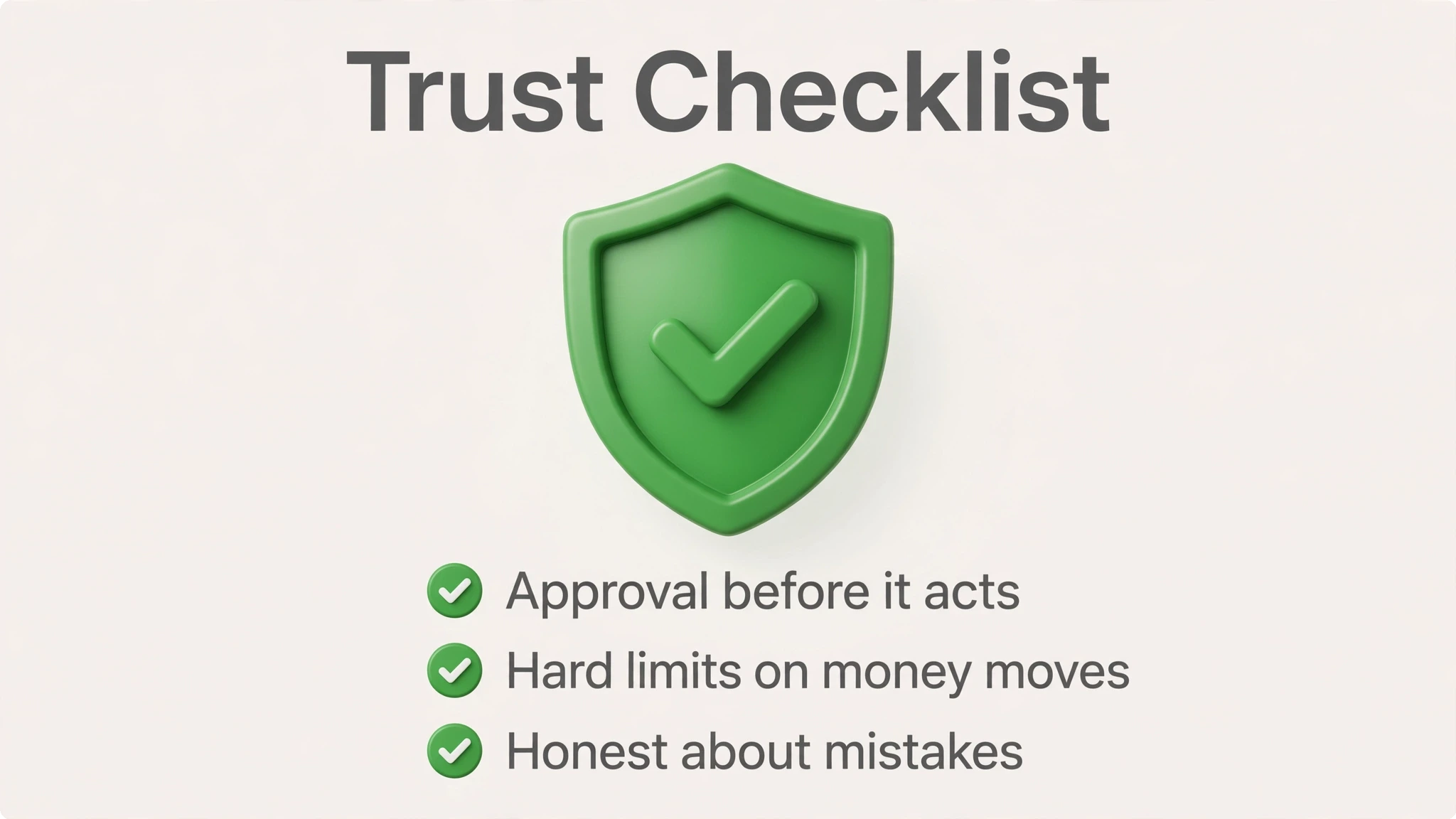
The boldest marketing decision in the Claude Duet launch was not about features at all — it was about trust. An agent that can read your email, draft messages in your name, and move through your business apps is asking for an extraordinary level of access. Anthropic’s response was to make the safety architecture part of the headline: Claude Duet asks before it acts on your behalf, requires explicit approval for sending messages, payments, or signatures, runs its logins and approvals inside your own cloud computer so sensitive details stay out of the conversation, ships a classifier that screens messages to prevent sensitive information from leaking, and turns down requests for credit card numbers and government identification by default. It also publishes hard limits: no trading securities, no moving money between accounts.
This is transparency as a growth strategy, and Claude Duet made it the centerpiece. In a market where one rival’s assistant made headlines for handing a stranger a user’s home address during a sale, trust is not a compliance checkbox — it is the product’s central selling point. Anthropic understood that the objection killing agent adoption is not “does it work?” but “can I let it near my business?” Every approval gate in the announcement is an answer to that objection, placed before the objection can form.
The lesson applies far beyond AI. Whatever you sell, your customer’s sharpest unspoken worry is your biggest marketing opportunity — if you address it head-on instead of burying it in fine print. A home services company that publishes its background-check and insurance process on the homepage. A financial advisor who explains exactly how client data is stored before the first call. A software vendor with a public page on what its tool will never do with your data. Naming the fear, and answering it with specifics rather than slogans, is how you convert skeptics. In 2026, “trust us” is not a message. “Here is exactly how we protect you, step by step” is.
5. Ship Your Limitations Publicly
Buried in most launch announcements is a quiet paragraph of caveats. Anthropic put its caveats in the open: this research preview may misread a thread, misjudge what is urgent, or miss something that arrives between its periodic checks. Background checks run every few hours rather than continuously — partly to protect the user’s usage limits. The agent cannot yet show you its browser as it works. These are not footnotes; they are part of the official story.
That honesty is strategically sound. Overpromising is the fastest way to destroy a new product’s reputation, because the gap between the promise and the reality becomes the story. By stating the limits upfront, Anthropic sets the frame: this is a research preview, judge it as one. When the product works well, it exceeds a modest expectation. When it stumbles, the stumble was disclosed. Either way, the company keeps its credibility — the asset that compounds across every future launch.
Small businesses routinely do the opposite of what the Claude Duet launch did, especially in marketing copy. “We guarantee results.” “The best in town.” “Zero risk.” These phrases feel like confidence; they function as liabilities. The moment reality falls short of the absolute, the customer does not just feel disappointed — they feel misled, and misled customers write reviews. A stronger posture is specific and bounded: what you do, for whom, by when, and what falls outside the promise. “We respond to every inquiry within one business day” beats “world-class customer service” precisely because it can be verified. Say what you cannot do, and everything you claim you can do becomes more believable.
6. Sell the Morning, Not the Machine
The most vivid image in the entire Claude Duet announcement is not a technical diagram. It is a morning: you wake up to a brief that tells you what slipped, what needs a decision, and what has already been handled. Everything else in the launch — the virtual machine, the Opus 5.5 model, the 6,000 connectors — is scaffolding for that one scene. Anthropic is selling a feeling: the workday starting under control.
This is outcome-first marketing at its best, and the Claude Duet announcement is a textbook example. It is also where most small-business marketing breaks down. Businesses love to sell the machine — the process, the tools, the certifications, the years in business. Customers buy the morning — the result, the relief, the transformed day. Nobody hires a landscaper because they admire mowing technique; they hire the Saturday morning when the yard is already perfect. Nobody buys accounting software for its reconciliation engine; they buy the month-end that closes itself.
Rewrite one page of your marketing this week with this lens. For every feature you list, add the sentence that starts with “which means your morning looks like…” If you sell social media management, the feature is a content calendar; the morning is opening your phone to a week of posts already scheduled, reviewed, and on-brand. If you sell search engine optimization, the feature is a technical audit; the morning is a report showing the pages that moved and the calls that followed. Sell the morning. The machine is just how you get there — and for the right customers, the machine barely needs mentioning at all.
7. Build for the Ongoing Relationship, Not the One-Off Prompt
The deepest shift Claude Duet represents is structural: it moves the product from transactions to a relationship. A chatbot handles the prompt you give it and forgets you. Claude Duet maintains one continuous thread, carries over your memory and skills, learns which updates you want and how often, and checks in on a rhythm. The unit of value is no longer the answer — it is the ongoing attention.
Marketing has been making this same shift for years, and the winners are the businesses that treat customers as relationships rather than conversions. Email lists that only ever send promotions are transactional. A list that sends useful briefings, remembers preferences, and follows up after a purchase is relational — and it retains. Loyalty programs, post-purchase check-ins, re-engagement campaigns, review requests timed to the moment of delight: these are the marketing equivalents of the morning brief. They say “we are still paying attention” when the customer is not actively buying.
The practical takeaway from Claude Duet is to audit your customer lifecycle for silence. Where do customers hear from you only when you want something? A quote request that goes cold after one follow-up. A project that ends with an invoice and nothing else. A subscriber who joined six months ago and has received nothing but sales emails. Each silence is a place where a proactive touch — a check-in, a useful summary, a heads-up about something relevant — would compound into retention. Claude Duet’s entire product thesis is that attention, sustained over time, is the scarcest resource in business. Your marketing should be built on the same thesis: the sale is the beginning of the conversation, not the end of it.
What Proactive AI Agents Actually Mean for Your Marketing Operations
Beyond the launch lessons, Claude Duet points at a near future worth preparing for. Proactive agents will not just be products you read about — they will be tools inside your marketing stack, watching the metrics and the inbox while you do the work that needs a human. Here is a realistic map of where tools like Claude Duet fit, and where the guardrails must stay up.
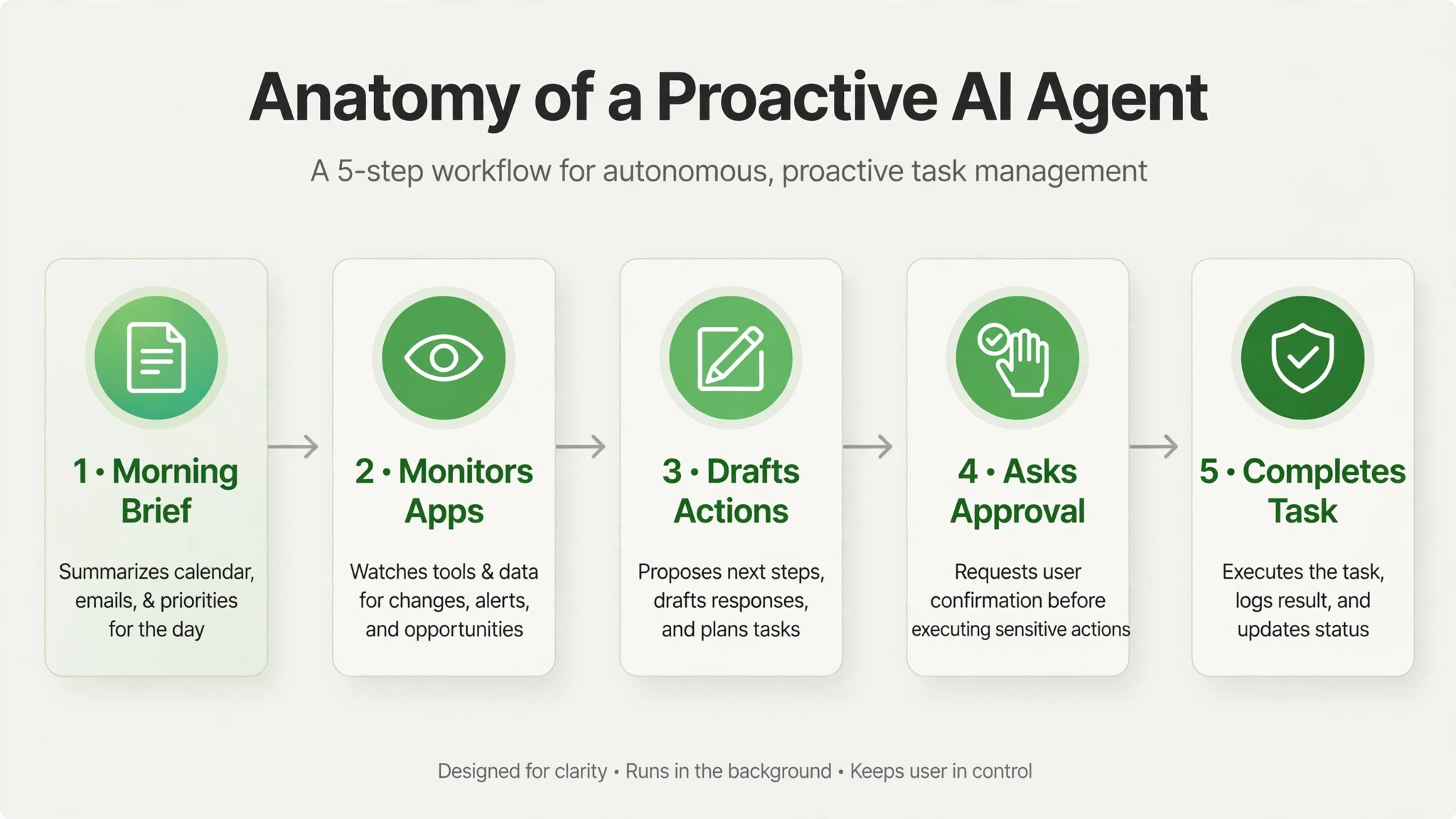
Lead triage and follow-up. The number-one leak in most small-business funnels is speed: leads that wait hours for a response go cold. A proactive agent connected to your inbox and CRM can flag a hot inquiry the moment it lands, draft a personalized first reply for your approval, and keep the follow-up sequence moving while you are on a job site or in meetings. The Duet model — draft first, send only with approval — is exactly the right shape for this. A proactive agent in the Claude Duet mold drafts the reply; a human approves it before it reaches a customer.
Review and reputation monitoring. Agents that watch connected apps every few hours are a natural fit for review surveillance: a new one-star review on Google, a complaint thread gaining traction, a press mention you would otherwise miss. The agent surfaces it; you decide the response. Pair this with a standing playbook for rebuilding customer trust after a rough patch, and a bad review becomes a handled review within the hour instead of a discovery at the end of the week.
Campaign anomaly alerts. Ad spend creeping up with no conversions, a landing page’s conversion rate dropping after a deploy, an email sequence’s open rate falling off a cliff — these are the “slipping items” of marketing, and they are exactly what an agent like Claude Duet is built to catch. The lesson from Claude Duet’s design is to define what counts as “needs a decision” in advance: set the thresholds, or the agent’s vigilance becomes noise.
Content pipeline assistance. Research briefs, first-draft outlines, repurposing one piece of content across formats, pulling performance data into a weekly report — agents can carry the mechanical middle of content marketing. What they cannot do is supply the judgment: the angle, the voice, the strategic call about what deserves to exist. Keep humans on strategy and let agents handle assembly.
The guardrails, non-negotiable. Everything Claude Duet got right about safety applies to any agent you deploy: approval before anything customer-facing goes out, hard limits on money movement, and honest logging of what the agent did. Start every Claude Duet-style agent workflow in read-and-draft mode. Promote an action to automatic only after it has been right — and reviewed — dozens of times. And keep one human accountable for the agent’s output the way you would for a junior employee’s: the agent works for you, which means its mistakes are yours.
The Honest Limitations Worth Watching
A clear-eyed read of the Claude Duet launch includes what is not there yet — and these gaps are the difference between a useful pilot and a premature bet.
First, availability is narrow: a US-only research preview, behind a waitlist, for Pro and Max subscribers only. Team and Enterprise plans are excluded, which means most companies cannot deploy it as an organization yet. Second, the economics are shared: background checks and larger tasks draw from the same usage limits as the rest of a Claude subscription, so an agent that checks your apps all day is spending the budget you would otherwise use for direct work. Third, the acknowledged failure modes — misread threads, misjudged urgency, missed items between checks — are precisely the failure modes that matter most in customer-facing workflows. And fourth, the inability to watch the agent’s browser as it works means you are trusting a black box with your business apps, mitigated only by the approval gates.
None of this diminishes the launch; it frames it. The right posture for a small business right now is to join the waitlist, run a contained pilot on internal chores — the invoices, the briefs, the meeting prep — and keep customer-facing automation on a short leash until the reliability story is proven. Watch how quickly Anthropic widens access beyond Pro and Max, whether Team and Enterprise tiers arrive, and how the approval UX evolves. Those three signals will tell you when proactive agents graduate from promising preview to operational infrastructure.
The Bottom Line
Claude Duet’s launch is two stories in one. As a product, it is Anthropic’s bet that the next era of AI belongs to agents that come to you — with a morning brief, background vigilance, and permissioned action. As a marketing case study, it is a clinic in how to launch something genuinely new: lead with the customer’s most boring problems, gate access with honest scarcity, differentiate with one sharp line, make trust the headline feature, disclose your limitations before anyone else can, sell the transformed morning instead of the machinery, and design for the ongoing relationship rather than the one-off transaction.
The businesses that internalize those seven lessons will market better whether or not they ever install Claude Duet. And the ones that also pilot the agents — carefully, with approval gates and human accountability — will find themselves with something their competitors do not: attention that compounds while they sleep.
If you want help turning these ideas into an actual plan — a launch strategy with real scarcity mechanics, positioning with a sharp differentiating line, or a marketing operation that keeps working when you step away — talk to our team. We build marketing that compounds.
Sources:
- VentureBeat — “Anthropic’s answer to Muse is here: Claude Duet, a mobile and desktop AI agent that takes actions proactively” — https://venturebeat.com/technology/anthropics-answer-to-muse-is-here-claude-duet-a-mobile-and-desktop-ai-agent-that-takes-actions-proactively
- Digital Trends — “Anthropic unveils Claude Duet, its answer to AI agents like Dots” — https://www.digitaltrends.com/computing/anthropic-unveils-claude-duet-ai-agent/
- TechBooky — “Anthropic Launches Claude Duet, a Proactive AI Agent for Work” — https://www.techbooky.com/anthropic-launches-claude-duet-a-proactive-ai-agent-for-work/
- Inc42 — “Anthropic Launches New Proactive AI Agent Claude Duet” — https://inc42.com/buzz/anthropic-takes-on-openai-meta-with-new-proactive-ai-agent-claude-duet/
- Pulse2 — “Anthropic Launches Claude Duet As Proactive AI Agent For Work And Small Businesses” — https://pulse2.com/anthropic-launches-claude-duet-as-proactive-ai-agent-for-work-and-small-businesses/
- SiliconNoon — “Claude Duet: Anthropic’s always-on agent runs on Opus 5.5” — https://siliconnoon.com/claude-duet-anthropics-always-on-agent-runs-on-opus-55/
Frequently Asked Questions
Claude Duet is a proactive AI agent app from Anthropic, announced on October 21, 2026. Instead of waiting for you to type a prompt like a traditional chatbot, it comes to you: it monitors your connected work apps, sends a morning brief of what needs attention, and keeps working on tasks in the background — even when your devices are off. It is currently in research preview behind a waitlist.
The regular Claude app waits for you to start a conversation; Claude Duet starts the conversation itself. It maintains one ongoing thread you can message by text or voice, carries over your memory, skills, and connected apps, and checks your accounts every few hours to surface anything that needs a decision. The shift is from prompt-driven answers to continuous, proactive assistance.
Access is limited: Claude Duet is a research preview rolling out by waitlist to Claude Pro and Max subscribers in the United States only. Team and Enterprise plans are not included at launch, and Anthropic has not announced a timeline for other countries. Background checks and larger tasks count against the same usage limits as the rest of a Claude subscription.
Anthropic's examples focus on everyday business chores: finding unpaid invoices and drafting payment reminders, preparing payroll for review, getting contracts ready for signature, building sales forecasts and dashboards, creating slide decks, and even prototyping web applications. It connects to more than 6,000 tools and plugins — including Gmail, Slack, QuickBooks, Stripe, HubSpot, and Shopify — so it can work across the apps a small business already uses.
No. Anthropic built explicit approval gates into the product: Claude Duet checks with you before sending messages, making payments, signing documents, or taking other sensitive actions. It also has hard limits — it will not trade securities or move money between accounts — and ships a classifier that blocks requests for sensitive data like credit card numbers or government IDs by default.
Anthropic has been upfront that this early version may misread a thread, misjudge what is urgent, or miss something that arrives between its periodic checks. It checks connected accounts every few hours rather than continuously, and it cannot yet show you its own browser activity as it works. Treat it as a promising research preview, not finished infrastructure.
All three are proactive agents, but they draw different boundaries. Claude Duet positions on being proactive yet permissioned — it comes to you but always asks before acting, and it refuses personal errands like booking tickets. The competitive race is now about judgment and trust: which agent interrupts at the right moments and earns access to your inbox, calendar, and business apps.
If you are a US-based Pro or Max subscriber, joining the waitlist is a low-risk way to start learning. The sensible pilot is internal chores first — briefs, invoice follow-ups, meeting prep — where mistakes are cheap. Keep anything customer-facing on a short leash with human approval until the reliability story is proven across real-world use.
Seven stand out: lead with the customer's specific pains instead of demos, use honest structural scarcity like a waitlist, differentiate with one sharp positioning line, make trust the headline feature, disclose limitations publicly, sell the transformed outcome rather than the machinery, and design for the ongoing customer relationship instead of one-off transactions.
Agents like Claude Duet point toward marketing operations that watch themselves: lead triage that flags hot inquiries instantly, review monitoring that surfaces reputation risks within the hour, campaign anomaly alerts when spend or conversion drifts, and content pipelines that handle the mechanical middle. The human role shifts to strategy, judgment, and approval — with guardrails that keep a person accountable for everything the agent does.