

Introduction
On Friday afternoon, November 13, 2026, the United States stopped flying. At around 3:54 p.m. Eastern time, the Federal Aviation Administration ordered a nationwide ground stop: every departing flight, at every airport in the country, was told to stay on the ground. Planes already in the air were allowed to land. Nothing else was allowed to leave. The order stayed in place for more than four hours, and by the time it was lifted, close to 10,000 flights had been cancelled and more than 9,000 delayed. It was only the second nationwide ground stop since the attacks of September 11, 2001.
Within hours, “faa ground stop” became the most searched term in America, drawing more than 10 million searches and climbing over 1,000 percent. Millions of people were not just reading the news. They were checking departure boards, refreshing airline apps, posting from airport gates, and demanding answers from brands in real time. For the airlines, the airports, and every business that touches travel, it was the hardest kind of marketing test there is: no warning, no script, and an audience that was already angry before the first message went out.
That is why FAA ground stop marketing matters, and why this post is not really about airplanes. It is about what happens to a brand when something goes wrong in public and ten million people are watching. The ground stop is a case study in crisis communication, and the lessons apply far beyond aviation. A hotel, a restaurant, a software company, or a local shop will never face a nationwide ground stop, but every one of them will face a day when their service fails, their customers are stranded, and their phone starts ringing. The seven lessons of FAA ground stop marketing below come from what actually happened on November 13, 2026 — what the airlines and airports did well, where they stumbled, and what any business can copy before its own bad day arrives.
What Happened on Friday, November 13, 2026
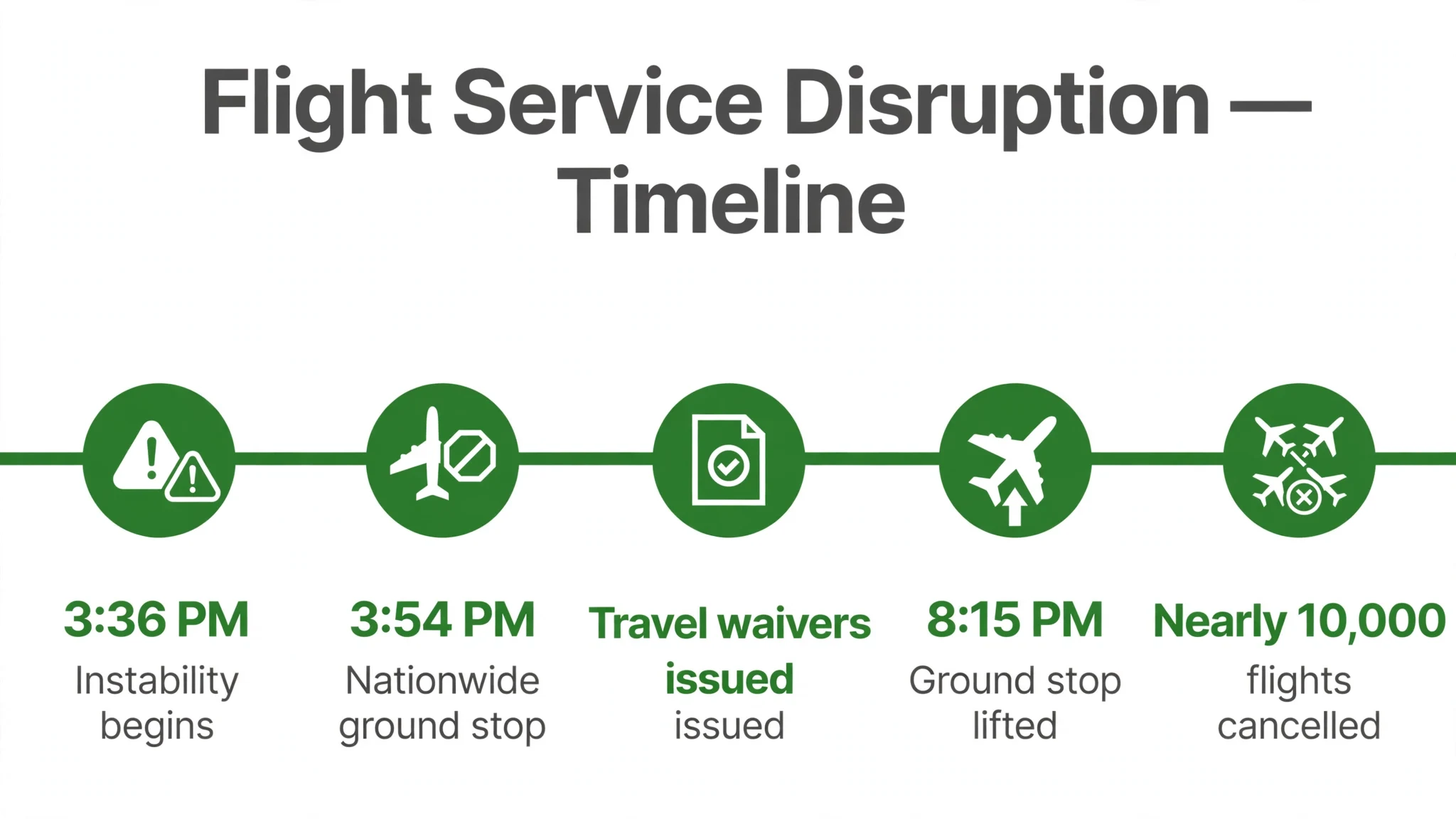
The trouble began at 3:36 p.m. Eastern, when air traffic control facilities started reporting instability in their radar and communications systems. Transportation Secretary Sean Duffy later explained that the network switches and routers carrying air traffic data had been overloaded, producing inconsistent information across the system. The old analogue equipment at the heart of the network was blamed; the newer internet-based switches, officials said, had not failed. The problem was traced to telecommunications equipment that is being upgraded across FAA facilities by the contractor L3Harris, which is replacing decades-old copper wiring with modern high-speed networks.
Eighteen minutes later, at about 3:54 p.m., the FAA issued the order that stopped the country. Its advisory told airlines and operators that all departing traffic should remain grounded until further notice, “due to extraordinary circumstances and for reasons of safety.” International departures were handled case by case. Flights already airborne continued to their destinations. Chicago’s O’Hare and Midway airports had already been placed under their own local ground stops shortly before the national order, after an equipment failure there.
The human scale of the disruption grew fast. By 6:04 p.m., flight tracking service FlightAware counted 1,913 cancellations and 10,494 delays across the United States. By 9 p.m., the figures stood at more than 9,000 delayed flights and 6,275 cancelled. By 11:30 p.m., cancellations approached 10,000, and tracking service Flightradar24 put the total at nearly 10,000 cancelled flights through Saturday. Delta and American each cancelled more than 2,200 flights, United cancelled about 1,800, and Southwest cancelled nearly 1,400. Passengers were taken off aircraft after boarding in some places, and in Cancun, 52 departures were still waiting to leave by 7 p.m. local time.
The response from Washington came quickly. Secretary Duffy posted on X that the stop was caused by a communications issue affecting all Air Route Traffic Control Centers, the facilities that guide aircraft above 18,000 feet. Homeland Security Secretary Markwayne Mullin told reporters there was no indication of a deliberate attack, describing the event as a telecommunications outage, while adding that investigators were not ruling anything out. Officials also confirmed there was no link to the Microsoft Outlook outage that had disrupted email the day before, a connection many people online had been speculating about.
At 8:15 p.m. Eastern, after technicians tested the systems and confirmed they were stable, the FAA lifted the ground stop. Flights began resuming, but the damage was done. Airline schedules take days to recover from a disruption of this size, and the airlines warned passengers to expect delays through the weekend.
Delta and United moved first on the customer side, issuing travel waivers that let passengers change their flights at no extra cost — Delta for trips rebooked by November 21, United for trips departing between November 12 and November 20. American Airlines acknowledged the disruption but had not confirmed a waiver when the first reports were filed. Passengers, meanwhile, were told they were not entitled to cash compensation, because a failure of the air traffic system counts as an extraordinary circumstance outside the airlines’ control. The scale of the disruption is what makes FAA ground stop marketing such a useful case study: no brand could hide from it, and every response was public.
Why the FAA Ground Stop Is a Marketing Story
It is tempting to treat a ground stop as an operations story and leave the marketing team out of it. That is a mistake, and the search data proves it. When ten million people search for the same phrase in a single day, they are not only looking for facts. They are looking for a brand to talk to. Passengers search for their airline’s name next to the word “cancelled.” They open X and Instagram before they open the airline’s app. They tag the company, post photos of departure boards, and compare notes with strangers in the same terminal. Every one of those searches and posts is a moment when a brand either shows up or does not.
The stakes of showing up are measurable. Research on travel disruption communication has found that brands which respond quickly and with empathy hold on to customer trust, while brands that stay quiet or respond badly can see their reputation scores fall by as much as 40 percent in a single day. The same research found that 78 percent of travellers who experience poor crisis communication will actively avoid that brand when they book their next trip. That is the real cost of a bad afternoon: not the refunds or the rebooking, but the customers who quietly choose a competitor next time and never tell you why.
FAA ground stop marketing is also a useful mirror for businesses that never touch aviation. A ground stop is an extreme version of a situation every company faces: a service failure that is not your fault, that you cannot fix yourself, and that your customers blame you for anyway. The airlines did not cause the telecommunications failure. They still had to answer for it. A local restaurant does not cause a power cut, a software company does not cause a cloud outage, and a shop does not cause a supplier to miss a delivery — but in each case, the customer experience belongs to the brand, and the brand’s communication decides whether the customer comes back. That is the thread running through all seven lessons of FAA ground stop marketing that follow.
Lesson 1: Acknowledge It in the First 15 Minutes
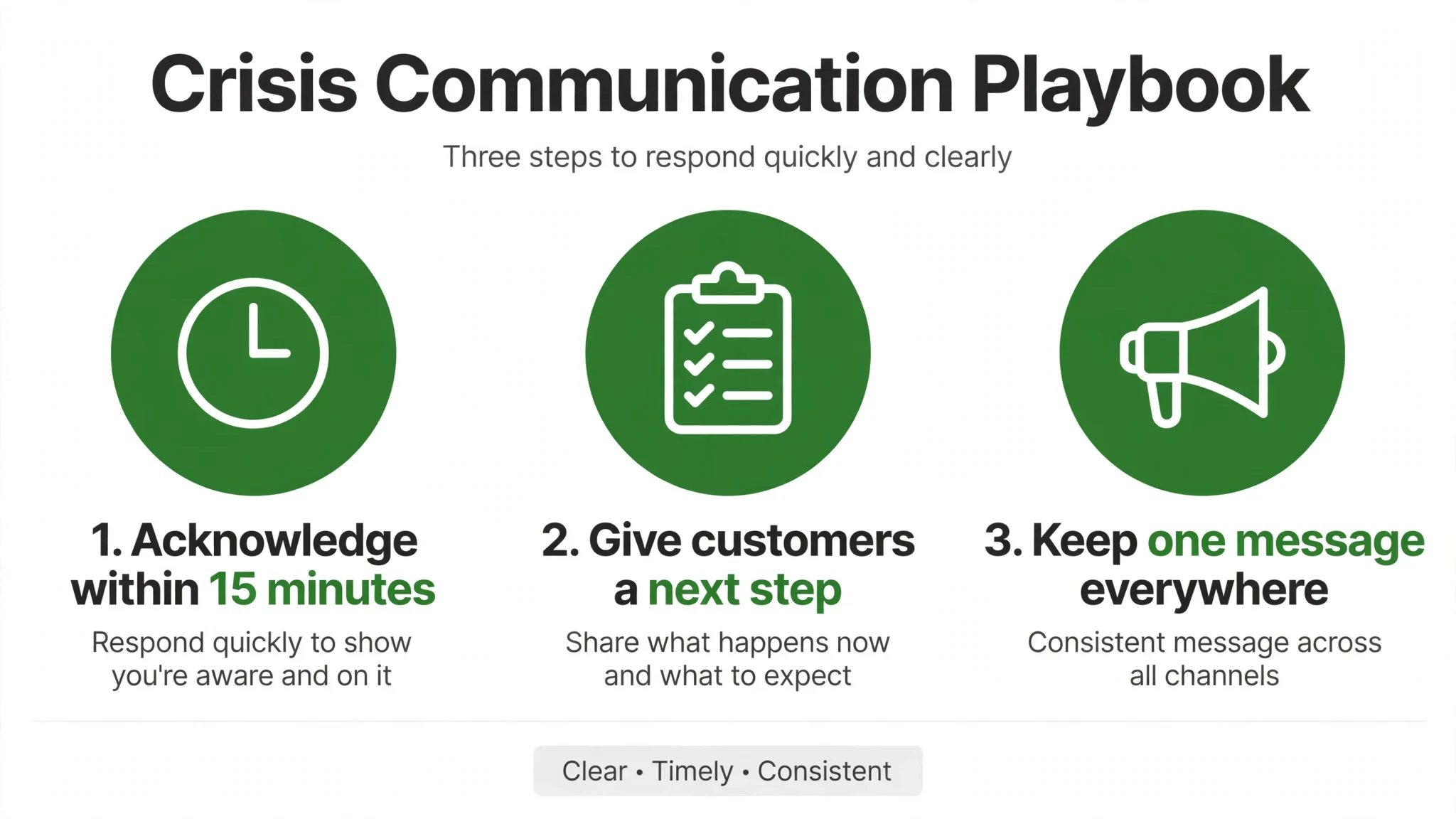
The single most important rule of FAA ground stop marketing is speed, and the standard is brutal: acknowledge the problem publicly within fifteen minutes, before customers start complaining in large numbers. Crisis communication specialists call this the golden rule, and the reason is simple. In the first minutes of a disruption, the audience is not yet angry. It is confused. People want to know whether the problem is real, whether the brand knows about it, and where to get updates. A short, honest message in that window buys patience. Silence in that window buys rumours.
The airlines understood this. Delta posted on X while the ground stop was still fresh, telling customers that no flights were departing, that flights already en route would continue, and that a travel waiver was in place. United posted its own update on its website, explaining plainly that new domestic departures would not leave while the stop was in effect and that cancellations were being made because of congestion in the air traffic system. Airports did the same: Newark Liberty told travellers to confirm their flight status before heading to the airport, and San Francisco International posted regular updates, including confirmation when Pacific-bound flights were cleared to depart. Secretary Duffy’s own post on X landed within the first hour, naming the cause in plain language.
Contrast that with what happens in FAA ground stop marketing when a brand waits. In July 2025, Alaska Airlines suffered an IT outage caused by a third-party hardware failure, cancelling roughly 150 flights and affecting about 15,600 passengers after a system-wide ground stop. The case is remembered in airline marketing circles precisely because Alaska acknowledged the problem immediately on social media, explained what was happening, apologised, and pointed customers to updates. The outage was bad. The communication meant it did not become a reputation disaster.
Speed is not a tactic in FAA ground stop marketing. It is the foundation everything else stands on. For a small business, the practical version of this lesson is a fifteen-minute rule of your own. The moment you know something is wrong — your booking system is down, your delivery van broke down, your kitchen lost power — post a short message on the channel your customers actually check. Say what happened in one sentence, say what you are doing about it, and say when the next update will come. You do not need the full answer. You need to be the first voice your customers hear, not the fifth rumour they read.
Lesson 2: Say What You Know — and What You Don’t
The second lesson of FAA ground stop marketing is honesty about uncertainty. When the ground stop was announced, nobody knew how long it would last. The first advisory said only that departures should remain stopped “until further notice.” That vagueness was honest, but it left a vacuum, and vacuums fill fast. Within the first hour, voices on air traffic control channels were speculating that the stop was connected to the Microsoft Outlook outage from the day before. Others wondered aloud whether it was a cyberattack.
The officials who handled this well did two things. First, they said what they knew, clearly and early: a telecommunications outage had hit the air traffic control centres, and the stop was a safety measure. Second, they said what they did not know, without pretending otherwise. Secretary Mullin told reporters there was no indication of a deliberate attack and that the evidence pointed to a telecommunications failure, while also saying plainly that investigators were not ruling anything out. When asked directly whether it could be a cyberattack, he said the possibility was not known yet. That is not a satisfying answer, but it is a trustworthy one, and trust is the currency that matters in a crisis.
The officials also corrected the record where it mattered. The FAA and the Department of Homeland Security both confirmed there was no link to the Microsoft outage. And when the company behind the FAA’s new SMART airspace system, Air Space Intelligence, saw its product being blamed online, it posted the same afternoon to say the ground stop was not based on or a result of its system. Each of those corrections was small. Together, they stopped a false story from becoming the story.
Small businesses face the same choice on a smaller stage, and FAA ground stop marketing shows why the honest answer wins: never fill a gap in your knowledge with a guess. If a customer asks when your service will be back and you do not know, say so, and say when you will update them. A business that says “we don’t know yet, next update at 6 p.m.” keeps its credibility. A business that invents a time and misses it loses credibility twice — once for the failure, and once for the broken promise. In FAA ground stop marketing, as in every crisis, the audience forgives uncertainty far more easily than it forgives being misled.
Lesson 3: Give People Something to Do, Not Just Something to Read
The third lesson of FAA ground stop marketing is the difference between communication and customer service. An update that only describes the problem leaves the customer exactly where they were: stuck, with nothing to do but wait and complain. An update that gives the customer a next step turns a frustrated person into a person with a plan. FAA ground stop marketing works best when every message ends with an action.
Delta and United understood this. Their travel waivers were not just policy announcements. They were instructions: change your flight at no extra cost, here is the window, here is how. Delta told passengers they could change their trip on or before November 21, with the new departure on or before the same date. United told passengers they could reschedule with change fees and fare differences waived, as long as the new flight was in the same cabin between the same cities and departed between November 12 and November 20. Those are specific, usable directions, and they arrived while people were still standing at gates deciding what to do next.
Delta’s social posts did the same work in miniature. After the stop was lifted, the airline posted that flights were resuming safely and directed customers to check the Delta app or its flight status page for the latest updates, thanking them for their patience while operations were restored. The message was short, but it contained everything a stranded passenger needed: the situation had changed, here is where to look, and here is what to do.
That is the practical core of FAA ground stop marketing: a message that ends with an action is customer service, and a message that ends with an apology is only a statement. The broader principle is one that crisis specialists have written about for years. When Southwest Airlines’ operations collapsed in December 2022, one of the things the airline eventually got right was building a single landing page with key information for travellers, giving the flood of phone calls, emails, and social media messages somewhere useful to go. A landing page, a waiver link, a rebooking button, a phone number — any of these beats a fourth apology post.
For a small business, the translation is straightforward. When something goes wrong, your message should always answer the question “what do I do now?” If your online store is down, point customers to a phone number or a backup ordering link. If your restaurant has to close for the evening, tell booked guests how to rebook and when the next table is available. If your service is delayed, give customers a way to check their own status instead of asking them to call you. In FAA ground stop marketing, the brands that won the day were the ones that treated communication as a tool for solving the customer’s problem, not as a press release about their own.
Lesson 4: Talk to the People Affected, Not About Them
The fourth lesson of FAA ground stop marketing is about point of view, and it is the one most brands get wrong. When a crisis hits, companies instinctively write about the people affected in the third person: “our customers are experiencing delays,” “travellers may face disruption,” “passengers are advised.” It sounds professional. To the person reading it from a departure gate, it sounds distant, as if the company is describing someone else’s problem.
The Southwest Airlines case is the textbook example. After the December 2022 meltdown, marketing analysts noted that most of the airline’s early posts spoke about impacted travellers rather than to them. The recommendation that came out of it was simple: centre the people directly affected and speak to them first, using words like “you.” A message that says “your flight is delayed, here is what you can do” lands completely differently from one that says “customers are experiencing delays.”
The best messages during the ground stop followed this rule. Delta’s posts spoke directly to its customers about their flights and their options. United’s website update addressed travellers in plain terms about what was happening to their journeys. When the stop lifted, Delta thanked customers for their patience — a small, direct, human gesture aimed at the people who had actually waited. Even the airports kept it personal and practical: check your flight, check with your airline, here is the latest for your airport.
Point of view is a small detail in FAA ground stop marketing, and it is one of the easiest to get right. There is a useful test any business can run before posting in a crisis. Read the message aloud and ask whether it sounds like something you would say to a person standing in front of you. “We understand your flight has been cancelled and we are sorry” passes. “Customers may experience service interruptions” does not. The first version treats the reader as a person. The second treats them as a category. FAA ground stop marketing rewards the first version, because in a crisis people do not remember the brand’s statement. They remember whether the brand seemed to care about them specifically.
Lesson 5: One Message, Every Channel, at the Same Time
The fifth lesson of FAA ground stop marketing is about consistency. During the ground stop, a passenger could get information from the FAA, from their airline, from their airport, from the news, and from a hundred strangers on social media — and if those sources disagreed, the passenger trusted none of them. The brands that communicated well made sure the same facts appeared everywhere at the same time.
Look at how the message travelled. The FAA posted the ground stop on X. Secretary Duffy posted the cause on X. The airlines posted matching updates on their own X accounts and websites. Airports from Newark to San Francisco posted the same core message — the stop is in effect, check with your airline — on their own accounts. Airlines for America, the industry trade group, posted the identical guidance. A traveller who checked three different sources heard the same story three times, and that repetition built confidence.
Consistency also means keeping the message updated in every place at once. That discipline is one FAA ground stop marketing rewards, because a traveller who checks three sources and hears three different stories trusts none of them. When the stop was lifted at 8:15 p.m., the FAA posted it, the airlines posted it, and the airports posted it. Delta’s follow-up message pointed customers to the app and the flight status page, so there was one authoritative place to check. The alternative — an updated website, a stale social feed, and a phone line giving out yesterday’s information — is how a manageable disruption turns into a trust problem.
For a small business, this lesson is about discipline, not budget. You do not need a social media command centre. You need a list, written before anything goes wrong, of every place your customers look for you: your website, your Google Business Profile, your Instagram, your Facebook page, your voicemail message, and the sign on your door. When a crisis hits, update all of them with the same message, in the same words, at the same time. A customer who finds one answer on Instagram and a different answer on your website will assume one of them is wrong. FAA ground stop marketing shows that the brands people trusted were the ones that sounded like one organisation, not five departments that had never met.
Lesson 6: When the World Stops Moving, Serve the People Who Are Stuck
The sixth lesson of FAA ground stop marketing is the one most marketers miss, because it is not about the company in crisis at all. It is about everyone else. When ten million people search for the same disruption, the audience is not only the airline’s customers. It is every business near an airport, every hotel with empty rooms, every restaurant with a stranded crowd outside, and every travel brand that could help.
A nationwide ground stop strands hundreds of thousands of people in airports and in the cities around them. Those people need hotel rooms, meals, rides, phone chargers, and something to do while they wait. The businesses that notice this fastest win twice: they make money on a night when their competitors are still reading the news, and they earn a customer who will remember who helped them. An airport hotel that posts “rooms available, shuttle running every 20 minutes, walk-ins welcome” at 5 p.m. on a ground-stop Friday is doing real-time marketing at its best. A restaurant near the terminal that offers a discount to stranded travellers and posts a photo of a full dining room is turning a crisis into a story.
This is also where travel brands that were not involved in the disruption can show up with genuine value. A travel insurance company can post a plain-language explanation of what a ground stop means for claims. A packing and luggage brand can share a checklist for an unexpected overnight stay. A local tourism board can point stranded visitors toward the city’s evening attractions. None of this is selling. All of it is useful, and useful is what gets shared when ten million people are searching.
The same principle of FAA ground stop marketing scales down to any small business. When a disruption hits your town — a storm, a road closure, a power cut, a transit shutdown — the businesses that respond first are the ones that post something helpful within the hour, not the ones that wait for the news cycle to end. FAA ground stop marketing teaches that a crisis concentrates attention, and attention is the most valuable thing in marketing. The brands that earn it are the ones that serve the people the crisis stranded, not the ones that advertise at them.
Lesson 7: The Recovery Is the Real Campaign
The seventh lesson of FAA ground stop marketing is the one that decides whether a crisis is forgotten or remembered. The ground stop lasted a little over four hours. The recovery lasted days. Airlines warned that returning to normal schedules would take the whole weekend, and passengers were still facing cancellations on Saturday morning, including US-bound flights cancelled from London Heathrow. The brands that understood FAA ground stop marketing knew the work was not over when the FAA lifted the order. It was just entering its second phase.
Recovery communication has three jobs. The first is practical: keep telling people what is happening until it is actually over, not until the headline fades. The second is emotional: thank the people who waited, acknowledge what the disruption cost them, and show that the brand knows it was not a minor inconvenience. Delta’s message after the lift — thanking customers for their patience while the airline worked to restore normal operations — is the shape of this, even if it was only a few lines long.
The third job is structural: explain what will change so it does not happen again, and then actually change it. Secretary Duffy used the aftermath to press for 50 billion dollars in funding to rebuild the air traffic control system, arguing that the old equipment had failed because it had not been updated. Whether or not that funding arrives, the public argument itself is part of the recovery: it tells the audience the problem is being taken seriously.
For a small business, the recovery phase is where loyalty is actually built. A customer whose order was delayed will forgive the delay if the follow-up is good. That means a personal message when the problem is fixed, not a generic post. It means an honest account of what went wrong and what you changed. And it means resisting the temptation to move on the moment the crisis leaves the news. In FAA ground stop marketing, as in every kind of crisis communication, the audience judges you twice: once for how you behaved while the problem was happening, and once for how you behaved after it. The second judgement lasts longer.

What Small Businesses Can Copy This Week
You do not need a nationwide crisis to use these lessons. You need a plan, written now, while nothing is wrong. Here is the version a small business can build in a single afternoon.
First, write your fifteen-minute message in advance. Draft three short templates: one for a service outage, one for a delay or closure, and one for a problem caused by someone else, like a supplier or a platform. Each template should say what happened in one sentence, what customers should do next, and when the next update will arrive. Keep them in a shared document every team member can reach.
Second, make your channel list. Write down every place a customer might look for you — website, Google Business Profile, Instagram, Facebook, email, voicemail, and the sign on your door — and decide who updates each one. When a problem hits, one person owns the message and every channel carries the same words.
Third, decide who speaks. In a crisis, one voice is better than five. Pick the person on your team who writes most naturally and give them the authority to post without waiting for three rounds of approval. The fifteen-minute rule is impossible if every message needs a meeting.
Fourth, prepare something useful for the people affected. If you sell a product, know what you can offer when things go wrong: a rebooking link, a backup ordering method, a discount on a future visit, a clear refund path. The offer does not need to be generous. It needs to be ready.
These five steps are the practical core of FAA ground stop marketing for a small business: templates, channels, one voice, a ready offer, and a real follow-up. Fifth, practise the recovery. Decide now that after any disruption, you will message affected customers personally, explain what changed, and follow up until the problem is genuinely resolved. The follow-up is where a small business beats a large one, because a personal message from a real person is something an airline cannot send to ten million people.
What Not to Do During a Crisis
The lessons of FAA ground stop marketing above describe what works. The ground stop also shows what to avoid. Do not sell during the crisis. A promotional post scheduled to go out while your customers are stranded reads as indifference, and it will be screenshotted. Pause scheduled posts the moment a serious disruption begins. Do not speculate about the cause. The officials who said “we don’t know yet” kept their credibility; anyone who had guessed wrong would have lost it. Do not go silent while you wait for perfect information. A short, honest holding message beats a perfect message that arrives four hours late. And do not argue with angry customers in public. Answer them directly, move the conversation to a private channel, and solve the problem there.
Conclusion
The FAA ground stop of November 13, 2026, lasted a little over four hours. In that time, more than ten million people searched for what was happening, close to 10,000 flights were cancelled, and every travel brand in America was tested in public. The test was not about whose planes were newest or whose prices were lowest. It was about communication: who spoke first, who told the truth about what they did not know, who gave people something useful to do, and who kept talking until the problem was actually over.
Those are the seven lessons of FAA ground stop marketing, and they belong to every business, not just airlines. FAA ground stop marketing is not a separate discipline. It is crisis communication, practised in public, at full speed. Acknowledge fast. Be honest about uncertainty. Give people a next step. Speak to the people affected, not about them. Keep one message across every channel. Serve the people the crisis stranded. And treat the recovery as the real campaign, because that is when customers decide whether to come back.
Your business will have its own bad day. It will not arrive with a nationwide alert, and it will not trend on Google. But your customers will still be watching, and they will still judge you on the same seven things. The brands that prepare for that day now — with templates, a channel list, one clear voice, and a plan for the follow-up, the same playbook FAA ground stop marketing teaches — are the ones that turn a crisis into the reason customers trust them more, not less.
If your business needs help building that kind of plan — from social media marketing that responds in real time, to SEO and video marketing that keep your brand visible when it matters most — KKeyQik helps small businesses across the United States turn attention into customers. Get in touch and let us build a communication plan that is ready before your next bad day arrives.
Frequently Asked Questions
The FAA ground stop was a nationwide order issued on Friday, November 13, 2026, at about 3:54 p.m. Eastern time, telling every departing flight at every airport in the United States to stay on the ground. Flights already in the air were allowed to continue to their destinations, while international departures were handled case by case. It was only the second nationwide ground stop since the attacks of September 11, 2001, the previous one having come in January 2023.
The ground stop lasted a little over four hours. It was lifted at 8:15 p.m. Eastern time on November 13, 2026, after FAA technicians tested the systems and confirmed they were stable. Flights began resuming that evening, but airline schedules took days to recover, and passengers were still facing cancellations on Saturday morning as airlines worked through the backlog.
The ground stop was caused by a telecommunications outage affecting air traffic control centres across the country. Transportation Secretary Sean Duffy said radar and communications became unstable at 3:36 p.m. Eastern, with network switches and routers overloaded by data. Officials blamed ageing analogue equipment at the heart of the network and said the newer internet-based switches had not failed. The outage was linked to telecommunications systems being upgraded across FAA facilities.
Flight tracking service FlightAware counted more than 9,000 delayed flights and 6,275 cancelled flights by 9 p.m. Eastern on November 13, 2026, and cancellations approached 10,000 by 11:30 p.m. Flightradar24 put the total at nearly 10,000 cancelled flights through Saturday. Delta and American each cancelled more than 2,200 flights, United cancelled about 1,800, and Southwest cancelled nearly 1,400.
Officials said there was no indication of a cyberattack. Homeland Security Secretary Markwayne Mullin described the event as a telecommunications outage and said there was no evidence of a deliberate attack, while adding that investigators were not ruling anything out. Officials also confirmed there was no link to the Microsoft Outlook outage that had disrupted email the day before, a connection many people online had speculated about.
Delta and United issued travel waivers that let passengers change their flights at no extra cost. Delta allowed passengers to change trips scheduled for November 13 and 14, with the new departure on or before November 21. United waived change fees and fare differences for rebooked flights in the same cabin between the same cities, departing between November 12 and November 20. American Airlines acknowledged the disruption but had not confirmed a waiver when the first reports were filed.
The 15-minute rule is the principle that a brand should acknowledge a problem publicly within fifteen minutes, before customers start complaining in large numbers. In the first minutes of a disruption, the audience is confused rather than angry, and a short honest message buys patience while silence buys rumours. Delta posted on X while the ground stop was still fresh, explaining what was happening and pointing customers to its travel waiver, which is the shape this rule takes in practice.
Post a short message on the channel your customers actually check within fifteen minutes, saying what happened in one sentence, what customers should do next, and when the next update will come. Give people a next step, such as a rebooking link, a phone number, or a backup ordering method, rather than only describing the problem. Update every channel with the same message at the same time, speak directly to the people affected using words like "you," and follow up personally once the problem is fixed.
Yes, but the marketing should be useful rather than promotional. When flights stop, stranded travellers need hotel rooms, meals, rides, and something to do while they wait, so an airport hotel posting available rooms and shuttle times, or a nearby restaurant welcoming stranded travellers, is genuinely helpful and gets shared. Travel brands that were not involved can also publish plain-language guidance, such as what a ground stop means for travel plans. The rule is to serve the people the crisis stranded, not to advertise at them.
Do not let scheduled promotional posts go out while your customers are stranded, because a sales message in the middle of a disruption reads as indifference and will be screenshotted. Do not speculate about the cause of the problem, since a wrong guess costs more credibility than an honest "we don't know yet." Do not go silent while waiting for perfect information, and do not argue with angry customers in public — answer them directly, move the conversation to a private channel, and solve the problem there.