

Introduction
Every November, Google quietly publishes one of the most useful documents in retail marketing — and most small businesses never read it as a marketing document at all. The Google Holiday 100 is a curated gift guide built from the year’s biggest Search trends, and the 2026 edition arrived on November 9 with a clear message about what shoppers actually want this year.
Google processes more than a billion shopping-related searches every single day, so when it publishes a list of the products whose searches surged most in 2026, that list is not a guess about taste. It is a readout of demand, measured at a scale no small business could ever buy.
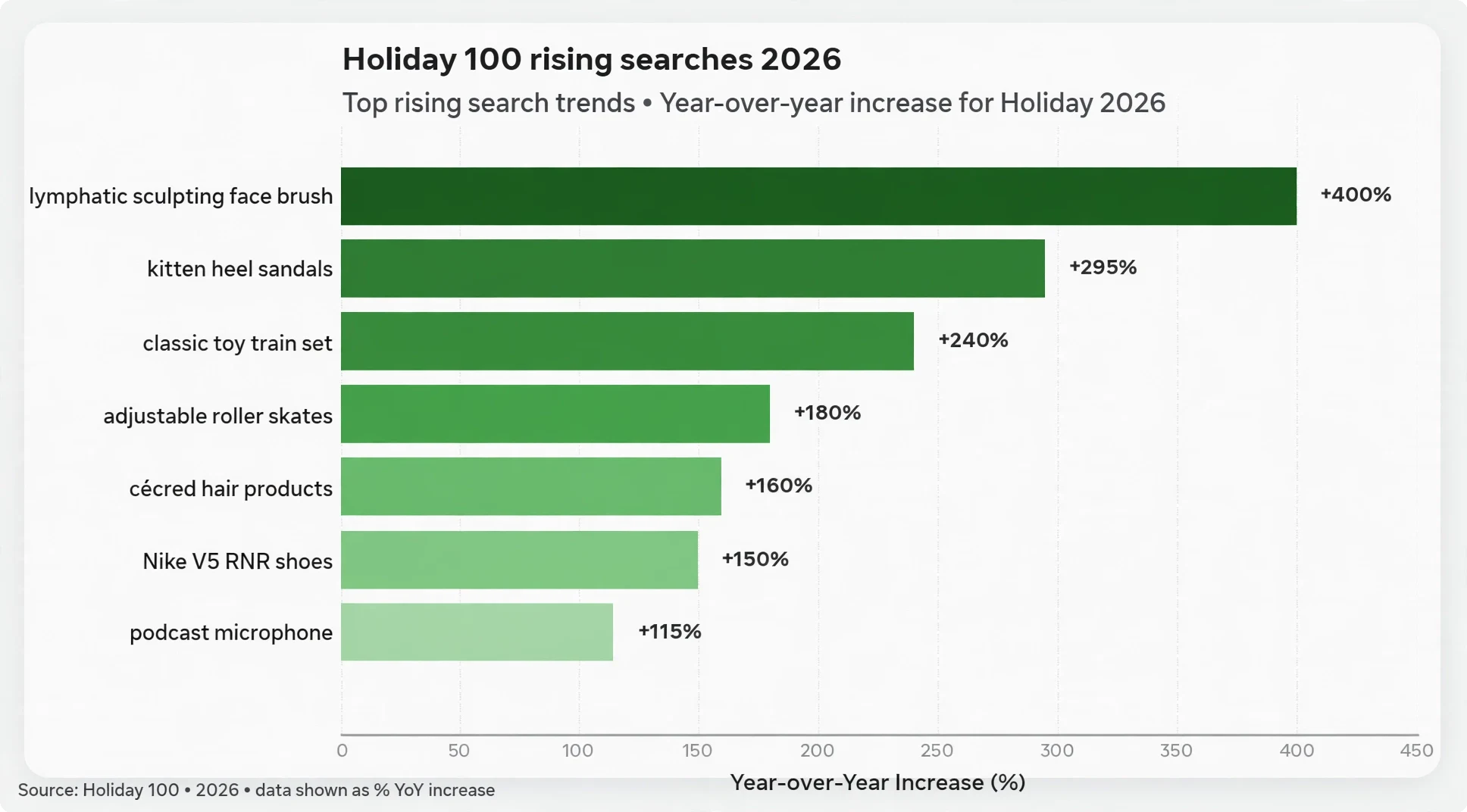
That is what makes the Google Holiday 100 2026 edition worth a small business owner’s attention. It is not really a gift guide. It is a demand forecast, published free, two weeks before Black Friday, by the company that sees the searches first. A lymphatic sculpting face brush saw searches jump 400 percent. Kitten heel sandals climbed 295 percent. Classic toy train sets rose 240 percent. Each of those numbers is a signal about where shoppers’ attention — and money — is heading in the weeks that matter most for the year.
Small businesses cannot outspend the big retailers on holiday advertising. But they can out-listen them, and the Google Holiday 100 hands them the listening for free. This post breaks down what is on the Google Holiday 100 list, what the 2026 holiday season looks like in numbers, and seven Google Holiday 100 lessons any small business can put to work right now — including a five-step playbook, the mistakes that waste holiday search traffic, and how to tell whether your holiday pages are actually working.
What Is Google Holiday 100 2026?
The Google Holiday 100 is Google’s annual gift guide, compiled from the year’s biggest Search trends across tech, home, style, beauty, toys, and more. The 2026 edition was published on November 9, 2026, on the Google blog, and it lives as a mini-site at g.co/holiday100, where shoppers can browse the full list of 100 trending gifts by category. Each category overview includes specific data about the search trends behind the picks, and product highlights on the mini-site link through to an AI Mode overview — a detail that matters more than it first appears, as we will see in lesson six.
The idea behind the Google Holiday 100 is simple. Google watches what people search for all year, spots the products and categories whose search interest surged, and turns that demand data into a guide. The Google Holiday 100 deliberately mixes two kinds of winners: viral sensations that broke through this year and nostalgic styles making a comeback. That combination is itself a lesson. Holiday demand is never only about what is new, and it is never only about what is familiar. The products that win December are the ones that manage to be both — fresh enough to feel exciting, familiar enough to feel safe as a gift.
For marketers, the Google Holiday 100 is useful precisely because it measures search demand rather than sales. Sales figures tell you what already sold. Search figures tell you what people are thinking about buying, often weeks before they buy it. A product whose searches jumped 400 percent has an audience forming around it in real time. A small business that notices that audience early can build a page, a guide, or a social post for it while the big retailers are still planning their December campaigns around last year’s winners.
The 10 Rising Searches of Google Holiday 100 2026
Google highlighted ten rising trends for 2026 alongside the full Google Holiday 100 list. Each one is a window into a shift in what shoppers want, and together they sketch the shape of this holiday season more vividly than any single forecast.
Facial wellness tools had the breakout year. Searches for “lymphatic sculpting face brush” spiked by 400 percent, the largest jump on the Google Holiday 100 list. At-home beauty and self-care is not a niche any more; it is one of the fastest-growing gift categories in the country.
The kitten heel renaissance is in full swing. Searches for “kitten heel sandals” strutted up 295 percent, and utilitarian style peaked too, with “utility jacket” searched more than ever. Fashion’s 2026 story is practical polish — shoes you can actually walk in, layers that work hard.
Nostalgia is doing serious numbers. Queries for “classic toy train set” skyrocketed 240 percent, and searches for “adjustable roller skates” cruised up 180 percent. Two products from another era, both surging at once, is not a coincidence. It is a pattern, and patterns are what marketers should chase.
Creator tools are now a gift category. Searches for “podcast microphone” rose 115 percent as would-be podcasters geared up, and searches for “cécred hair products” — the haircare brand from Beyoncé — grew 160 percent. The creator economy is no longer just a marketing channel. It is a shelf of products people buy for each other.
Two quieter signals round out the ten. Perfume officially claimed the top type of gift set searched this year, which tells you how shoppers solve the hardest gifting problem — buying for someone whose taste you are unsure of. And searches for “ski mug” were a breakout search of the year, a small, cosy, affordable object that captures the season’s mood: comfort, warmth, and a little winter ritual. Throwback kicks complete the picture, with queries for “nike v5 rnr running shoes” climbing 150 percent in 2026.
Read together, these ten Google Holiday 100 trends say something a small business can act on: this year’s shoppers are buying self-care, nostalgia, practical style, and the tools to create. None of those are categories reserved for big brands.
The 2026 Holiday Season in Numbers
The Google Holiday 100 lands in a season that is bigger than ever, and the forecasts behind it are worth knowing before you plan a single campaign. Adobe forecasts 275.1 billion dollars in US online spending between November 1 and December 31, up 6.7 percent on last year. Deloitte puts total US holiday retail sales at 1.70 to 1.71 trillion dollars, up 4.0 to 4.8 percent. The National Retail Federation forecasts November and December retail sales will grow 4.2 percent over 2025 to pass 1 trillion dollars. Online is growing roughly twice as fast as stores, with e-commerce up 7.5 to 8.4 percent.
Black Friday itself falls on November 27 this year, and Adobe expects 12.9 billion dollars in online spending on that single day, up 9.2 percent. More than half of the season’s online spending — 57.4 percent — will happen on phones. Buy now, pay later spending is forecast at 21.3 billion dollars for the season. The average shopper plans to spend about 708 dollars on gifts, according to PwC, and two-thirds of US consumers rank better prices and promotions as their top consideration.
Two numbers matter most for a small business planning search and content. First, nearly half of shoppers — 48 percent — plan to begin making purchases before Halloween, and a quarter start in October. The season no longer begins on Black Friday; it begins the moment the Halloween decorations come down.
Second, traffic from AI chat tools and AI browsers to US retail sites is forecast to grow 130 percent this season, after a 693 percent jump during the 2025 season. The way shoppers find products is changing under everyone’s feet, and the Google Holiday 100 mini-site linking its picks to AI Mode overviews is Google telling you exactly where that change is heading.
Lesson 1: Search Demand Is the Real Gift List
The first Google Holiday 100 lesson is the most important one, and it is a change of habit. Most small businesses build their holiday range by looking at what sold last year, what suppliers are pushing, or what competitors are stocking. The Google Holiday 100 suggests a better starting point: look at what people are searching for right now.
Search demand is the earliest signal a business gets. A product on the Google Holiday 100 whose searches are up 400 percent has an audience that is already forming, already curious, and already typing the product’s name into Google. That audience is cheap to reach, because the competition for those exact searches has not caught up yet. By the time a trend shows up in a supplier catalogue or a competitor’s window display, the easy traffic is gone.
Put this into practice with tools you already have. Open Google Trends and compare the search interest for your product categories against the Google Holiday 100 risers. Check Google Search Console for the queries already bringing people to your site, and look for the ones climbing week on week. If you sell beauty products, the 400 percent jump in facial wellness searches is a direct instruction: build a page, a guide, or a bundle around it.
If you sell toys, the train set and roller skate numbers are telling you where the demand sits. The Google Holiday 100 is free, the data is current, and the businesses that act on it first capture the traffic while it is still inexpensive.
Lesson 2: Gift Guides Are the Highest-ROI Holiday SEO Play
The Google Holiday 100 is, at its core, a gift guide — and that format is the single highest-return SEO move a small business can make this season. Christmas search is different from the rest of the year’s search: a large share of it is about gifts. Shoppers do not search for a product; they search for a person. “Gifts for dad”, “gifts for teachers under 50 dollars”, “gifts for podcasters” — these are the queries that fill November and December, and they are exactly the queries a small gift guide can rank for.
Build one guide, and build it properly. A strong holiday gift guide recommends specific products for a specific person or budget, with honest descriptions and clear links to buy. Keep it on a permanent URL you can reuse next year, because gift guide pages build authority over time — a guide that ranks this December will rank faster next December if the URL stays live.
Get it published now, not in the week of Black Friday, because Google says crawling can take anywhere from a few days to a few weeks, and pages you want ranking in December should be live by early November at the latest.
Use the Google Holiday 100 as your research. If your shop sells anything adjacent to the Google Holiday 100’s risers — beauty tools, nostalgic toys, creator gear, cosy homeware — your guide should name the trend, explain why it is surging, and show your version of it. You do not need a hundred products. Ten well-chosen ones, each matched to a real recipient, will outperform a hundred-item catalogue page that reads like a warehouse shelf. For a deeper look at how search visibility compounds over time, see our guide to SEO services for small business.
Lesson 3: Nostalgia Is a Growth Category, Not a Gimmick
Two of the ten Google Holiday 100 risers are unapologetically retro: the classic toy train set, up 240 percent, and adjustable roller skates, up 180 percent. That is not a quirk of the data. It is a reminder that nostalgia is one of the most reliable demand engines in holiday shopping, and small businesses are better placed to use it than anyone.
Nostalgia works as a gift because it solves the hardest part of giving: choosing something the recipient will actually feel something about. A train set is not just a toy; it is a memory of a grandparent’s living room. Roller skates are not just footwear; they are a summer from twenty years ago. When a product carries that kind of emotional charge, the marketing almost writes itself — the story is the product, and the product is the story.
If your range has anything with a retro thread, pull it forward this season. Photograph it the way people remember it, not the way a catalogue would. Write product descriptions that name the memory, not just the specification.
And if your range has nothing retro in it, borrow the mechanism instead of the product: package a modern item with a nostalgic frame — a “like the ones you grew up with” line, a throwback colourway, a gift note that invites the recipient to remember. The Google Holiday 100 is telling you that shoppers are already in a nostalgic mood. Meet them there.
Lesson 4: Wellness and Self-Care Own the Breakout Aisle
The single biggest number in the Google Holiday 100 2026 list is a wellness number: searches for “lymphatic sculpting face brush” jumped 400 percent. Add the 160 percent growth in searches for cécred hair products, the breakout of the ski mug, and perfume becoming the most-searched gift set type, and a clear picture forms. This year’s shoppers are buying care — for skin, for hair, for quiet evenings at home.
For a small business reading the Google Holiday 100, the opportunity is not limited to beauty brands. Wellness is a positioning as much as a category. A candle shop is selling calm. A tea seller is selling a ritual. A bookshop is selling an evening off. Any product that helps someone slow down, look after themselves, or feel a little more put together fits the demand the Google Holiday 100 is measuring.
The practical move is to name the benefit plainly. “A gift for someone who needs a night off” will outsell “premium self-care bundle” because it describes a person, not a shelf. Build a small self-care collection, give it a gift guide of its own, and write the copy around the feeling — rest, warmth, a little luxury at home — rather than the ingredients. Shoppers searching for face brushes and haircare are not buying tools. They are buying the ten minutes those tools represent.
Lesson 5: The Creator Economy Is Now a Gift Category
Searches for “podcast microphone” rose 115 percent in 2026, and that number deserves more attention than it gets. A microphone is not a traditional gift. It is equipment for a side hustle, a creative project, a voice someone wants to find. Its presence on the Google Holiday 100 tells you that millions of shoppers are now buying gifts for creators — and that creators themselves are a mainstream gift recipient.
This matters for small businesses in two ways. First, if you sell anything a creator uses — microphones, lights, notebooks, software, courses, studio gear — you have a gift audience you may not have named yet. Build a “gifts for creators” or “gifts for podcasters” page and you are matching a search that is growing at triple digits.
Second, even if you sell nothing of the sort, the creator economy is a marketing channel you can borrow: the same people buying microphones are the people making the videos and podcasts your customers watch. A product that shows up in a creator’s gift guide, unboxing, or holiday list gets in front of buyers at the exact moment they are ready to spend.
The deeper lesson is that gift categories are no longer fixed. Ten years ago, nobody’s holiday list included a podcast microphone. This year it is one of the fastest-growing gift searches in America. The businesses that win holiday search are the ones that notice when a new recipient appears — the podcaster, the streamer, the side-hustler — and build a page for them before the big retailers do. If you want that kind of visibility working across your channels, our social media marketing services and video marketing services for small business are built for exactly that.
Lesson 6: AI Search Is the New Shop Window — Optimise for It
Look closely at how Google built the Google Holiday 100 mini-site and you will see the future of product discovery. Each category overview includes trend data, and product highlights link through to an AI Mode overview. Google is not just publishing a list; it is routing shoppers from a trend, to a product, to an AI-generated summary. The place shoppers browse for products is no longer a page of ten blue links. It is the short answer an AI assistant gives them, and the products named in that answer are the ones that get bought.
The numbers back it up. Adobe expects traffic from AI chat tools and AI browsers to US retail sites to grow 130 percent this season, and Google says AI Mode now has more than a billion monthly users. Shoppers are already asking AI tools to curate gift lists, compare products, and recommend what to buy. If your products cannot be found, understood, and recommended by those tools, you are invisible to a fast-growing share of holiday buyers.
Optimising for AI search is mostly the unglamorous work you should be doing anyway, done consistently. Keep your product data clean and complete in Google Merchant Center. Use structured data so search engines can read your prices, availability, and reviews without guessing.
Write product descriptions that answer real questions — who is this for, what problem does it solve, why this one — in plain language, because AI tools quote pages that answer questions clearly. Publish gift guides and comparison content, because AI overviews draw heavily on editorial pages that organise choices for a reader. And keep your pages fast on phones, where 57.4 percent of holiday spending happens.
None of this is exotic. It is the same SEO discipline, pointed at a new surface.
Lesson 7: Timing Beats Discounts
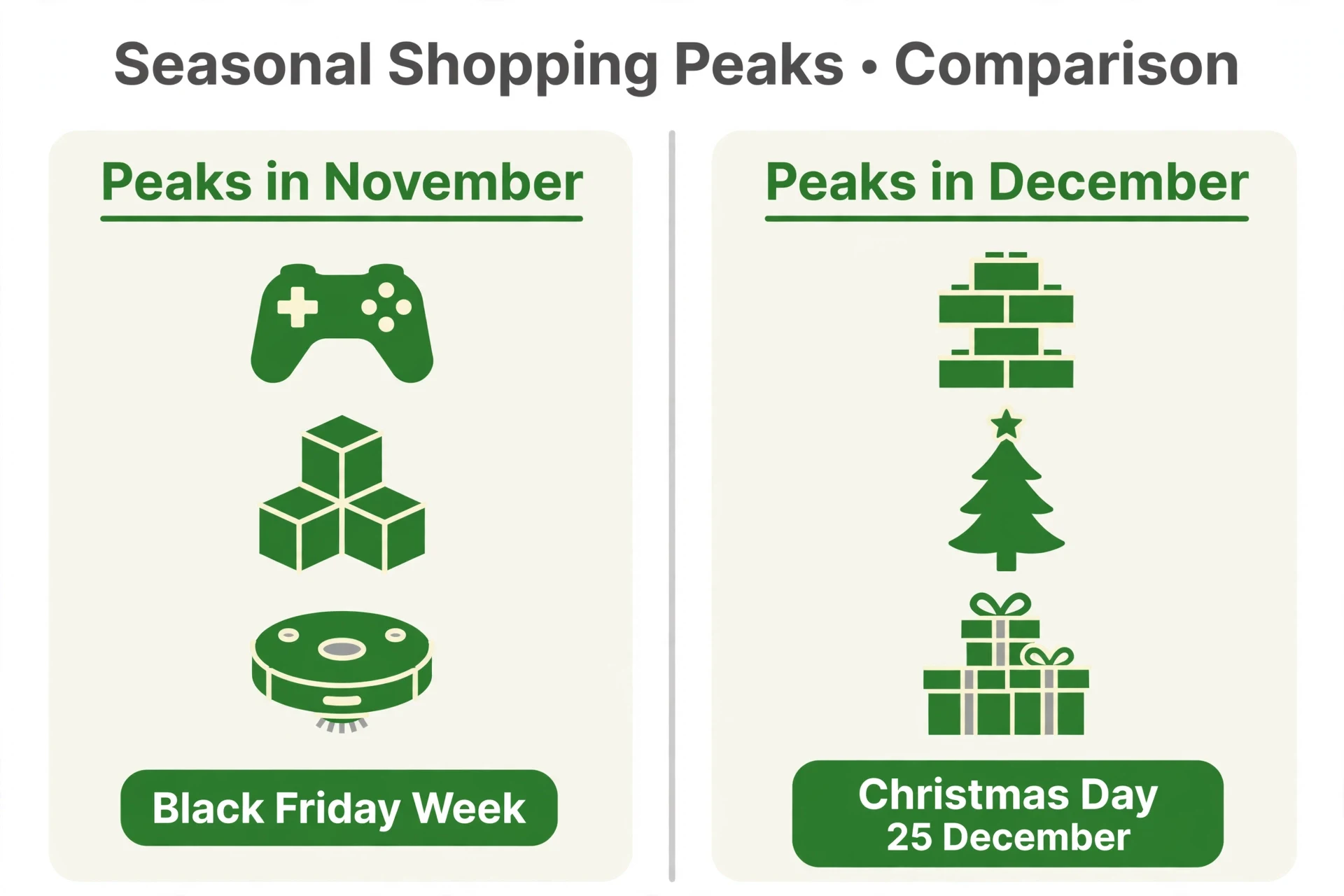
The last Google Holiday 100 lesson is about the calendar, and it is the one small businesses get wrong most often. Holiday demand does not arrive all at once. Five years of weekly search data shows two distinct tribes of gift categories: one group that peaks in November, roughly four weeks before Christmas, and another that peaks in December, within about a week of the holiday itself. Gaming, toys, and robot vacuums typically peak in November, around Black Friday week. LEGO sets, Christmas trees, and ornaments peak in December, close to the day itself.
That split is a planning tool. If your products sit in the November group, your pages, guides, and campaigns need to be live by November 1 — gift searches start the morning after Halloween, and nearly half of shoppers begin buying before Halloween. If your products sit in the December group, you have a little longer, but the same rule applies: Google needs days to weeks to crawl and index a new page, so anything you launch in the week of Black Friday is already late for the searches that matter.
Discounts, by contrast, are a weak lever this year. Adobe expects peak discounts of up to 30 percent during Cyber Week but only 10 to 15 percent through December, and two-thirds of shoppers say they are looking for better prices and promotions — which means everyone is discounting, and discounting alone no longer differentiates you. Timing does. The business whose gift guide was live on November 1, indexed, and ranking when the November peak arrived will outsell the business that launched a deeper discount on November 26 with a page Google had not yet found. Be early, be indexed, and be the answer when the search happens.
The 5-Step Holiday Search Playbook for Small Businesses
The seven lessons above condense into a short playbook you can run this week, while there is still time for it to matter.
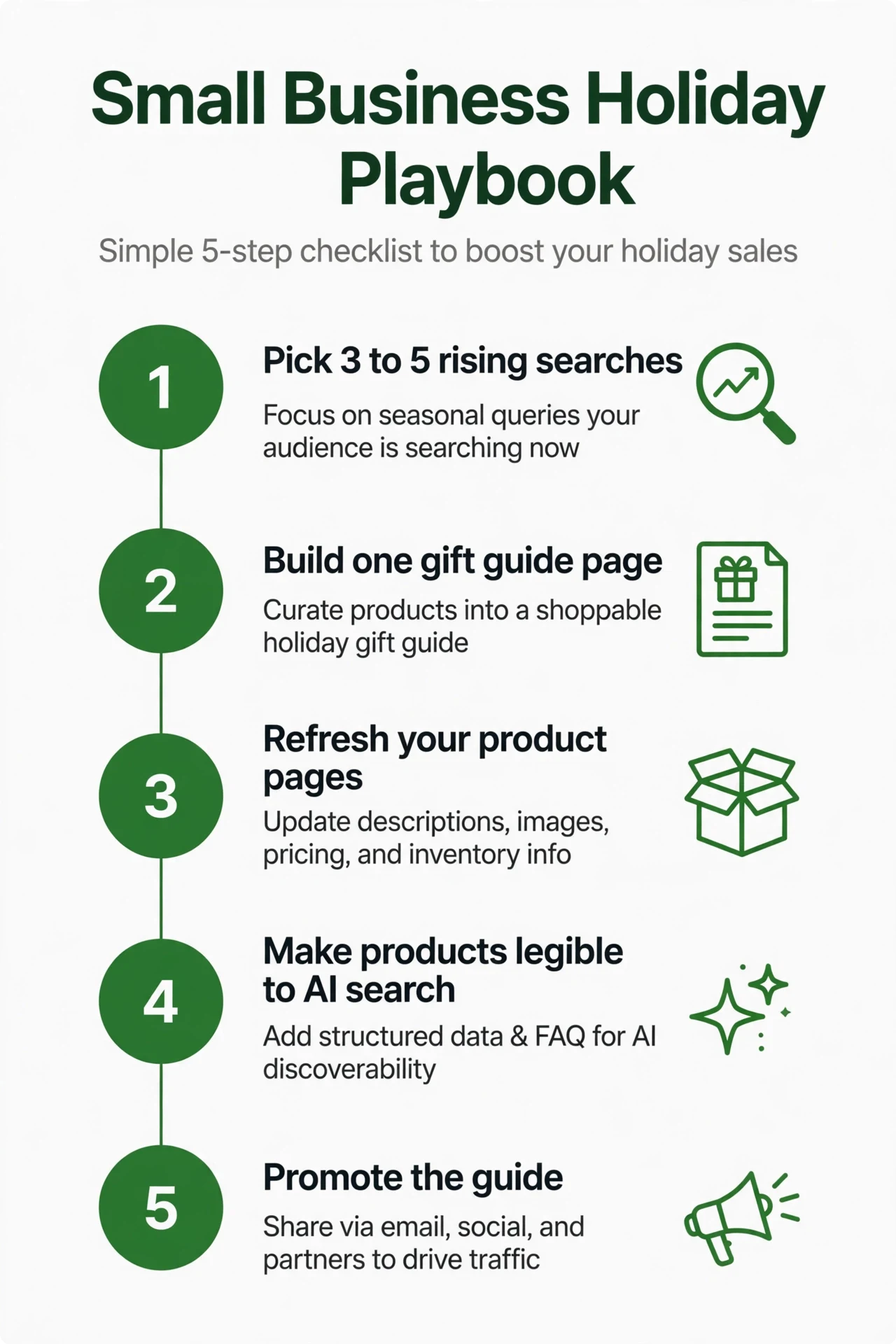
Step 1: Pick three to five rising searches. Open the Google Holiday 100 and Google Trends, and choose the risers closest to what you sell — a product, a category, or a recipient. Three is enough. Five is plenty. Do not chase all ten.
Step 2: Build one gift guide page. One strong page beats five thin ones. Give it a permanent URL, a specific recipient or budget in the title, ten or so well-chosen products, and honest descriptions. Link it from your homepage and your main category pages so Google finds it fast.
Step 3: Refresh your product pages. Add the trending terms where they fit naturally, answer the questions shoppers actually ask, and make sure prices, availability, and delivery cut-offs are visible without scrolling. If you sell online, check your Merchant Center feed the same day.
Step 4: Make your products legible to AI search. Add structured data, write plain-language descriptions that answer “who is this for”, and publish at least one comparison or guide page per category. This is the work that gets your products quoted in AI Mode overviews and AI chat answers.
Step 5: Promote the guide where your customers already are. Share it on social with the trend as the hook — “the gift searches up 400% this year” — send it to your email list with the recipient in the subject line, and, if you run ads, point them at the guide rather than the homepage. A guide converts better than a catalogue because it has already done the choosing for the shopper.
Run those five steps before Black Friday on November 27 and you will have done more useful holiday marketing than most businesses manage in the whole season. The playbook works because it follows the demand instead of fighting it — and the demand is printed, free, in the Google Holiday 100.
4 Mistakes That Waste Holiday Search Traffic
Chasing every trend on the Google Holiday 100 list. The Google Holiday 100 has a hundred products in it. A small business that tries to cover all of them ends up with a hundred thin pages and no authority on any of them. Pick the three to five closest to your range and go deep.
Publishing late. A gift guide published on Black Friday week is a gift guide for next year. Google needs days to weeks to crawl and index new pages, and the November demand peak arrives four weeks before Christmas. Publish now, promote now, and let the page earn its ranking while the season builds.
Building thin gift pages. A page that lists ten products with no descriptions, no recipient, and no reason to choose one over another will not rank and will not convert. AI overviews and search engines both favour pages that genuinely help a shopper decide. Write the descriptions as if you were advising a friend.
Ignoring the phone. With 57.4 percent of the season’s online spending happening on mobile, a gift guide that is slow or fiddly on a phone is a gift guide that loses more than half its audience. Test every page on a real phone, check the load time, and make the path from guide to checkout as short as you can.
How to Measure Whether It Worked
Holiday search work is measurable within days, and you should watch four numbers. First, Google Search Console: look at the queries bringing people to your gift guide and product pages, and watch for the trending terms you targeted climbing in impressions and clicks.
Second, the gift guide page itself: sessions, time on page, and click-through to products tell you whether the guide is helping shoppers decide. Third, AI referral traffic: watch for visits arriving from AI chat tools and AI browsers, a channel Adobe expects to grow 130 percent this season. Fourth, the business outcome: orders, average order value, and reactivations among customers who had gone quiet, measured over the four to six weeks after the guide went live.
Judge the campaign on those outcomes, not on how attractive the guide looked. A plain guide that ranks and converts beats a beautiful one nobody finds. And keep the page live after Christmas. A gift guide URL that survives the season keeps its authority, and next November it will rank faster than any new page you could build — which is exactly how small businesses turn one good holiday into a compounding advantage. For a look at how a different kind of year-end moment compounds the same way, see our breakdown of Spotify Wrapped 2025 marketing lessons.
Conclusion
The Google Holiday 100 2026 edition is a gift to marketers disguised as a gift guide. It tells you, in numbers, what millions of shoppers are already searching for: self-care tools up 400 percent, nostalgic toys up 240 percent, creator gear up 115 percent, and a holiday season worth 275 billion dollars online. It tells you when the demand peaks, which categories peak first, and where the discovery is moving — toward AI answers and gift guides that do the choosing for the shopper.
The businesses that win this holiday will not be the ones with the deepest discounts. They will be the ones that read the demand early, built one strong gift guide on a permanent URL, made their products legible to AI search, and were indexed and ranking before the November peak arrived. That work is still possible this week. The Google Holiday 100 list is published, the searches are rising, and Black Friday is on November 27.
If you want help turning search demand into holiday revenue — a gift guide that ranks, product pages that AI tools can quote, and campaigns timed to the demand calendar — talk to our team or explore what we do at KKeyQik. The season rewards the businesses that start now.
Frequently Asked Questions
Google Holiday 100 2026 is Google's annual gift guide, built from the year's biggest Search trends across tech, home, style, beauty, toys, and more. It was published on November 9, 2026, and lives as a mini-site at g.co/holiday100, where shoppers can browse 100 trending gifts by category. For marketers, it works as a demand forecast: it shows which products shoppers are already searching for, weeks before the peak buying season.
Google published the 2026 edition of the Holiday 100 on Monday, November 9, 2026, on the Google blog. It arrives about two weeks before Black Friday, which falls on November 27 this year. That timing matters for small businesses: the list gives them a current read on search demand while there is still time to build gift guides and product pages and get them indexed before the November demand peak.
Google highlighted ten rising trends for 2026. Searches for "lymphatic sculpting face brush" jumped 400 percent, "kitten heel sandals" rose 295 percent, "classic toy train set" climbed 240 percent, "adjustable roller skates" rose 180 percent, "cécred hair products" grew 160 percent, "nike v5 rnr running shoes" climbed 150 percent, and "podcast microphone" rose 115 percent. Perfume became the most-searched gift set type, "utility jacket" was searched more than ever, and "ski mug" was a breakout search of the year.
Google builds the Holiday 100 from Search trend data, not from sales figures or sponsorships. It looks at which products and categories saw the biggest surges in search interest over the year, then curates those into a guide across categories such as tech, home, style, beauty, and toys. The list deliberately mixes viral sensations that broke through this year with nostalgic styles making a comeback. Because it measures search demand rather than sales, it shows what people are thinking about buying, often before they buy it.
Start by finding the risers closest to what you sell, whether that is a product, a category, or a recipient. Then build one gift guide page around those trends on a permanent URL, refresh the matching product pages with plain-language descriptions, and promote the guide on social media and email. The list is free, the data is current, and acting on it early means reaching shoppers while competition for those exact searches is still low.
A holiday gift guide is an editorial page that recommends specific products for a specific person or budget, with honest descriptions and clear links to buy. It helps SEO because Christmas search is largely about gifts: shoppers search for a person, not a product, with queries such as "gifts for dad" or "gifts for podcasters". A guide that answers those queries can rank for them, and a guide kept on a permanent URL builds authority year after year, so it ranks faster each December.
As early as possible, and no later than early November. Gift searches start the morning after Halloween, and nearly half of shoppers begin buying before Halloween. Google says crawling a new page can take anywhere from a few days to a few weeks, so a guide published in the week of Black Friday is already late for the searches that matter. Categories such as gaming and toys typically peak in November, around Black Friday week, while LEGO sets, Christmas trees, and ornaments peak in December.
Google's AI Mode is becoming a major way shoppers discover products. Product highlights on the Holiday 100 mini-site link through to AI Mode overviews, and Google says AI Mode now has more than a billion monthly users. Adobe expects traffic from AI chat tools and AI browsers to US retail sites to grow 130 percent this holiday season. To be found there, businesses need clean product data, structured data, and plain-language pages that answer real questions, because AI tools quote pages that answer questions clearly.
Five years of weekly search data show two groups. Gaming, toys, and robot vacuums typically peak in November, roughly four weeks before Christmas and around Black Friday week. LEGO sets, Christmas trees, and ornaments typically peak in December, within about a week of the holiday itself. Knowing which group your products sit in tells you when your pages need to be live and ranking, and when to concentrate your promotion.
Watch four numbers. In Google Search Console, check which queries bring people to your guide and whether the trending terms you targeted are climbing in impressions and clicks. On the guide page itself, look at sessions, time on page, and click-through to products. Watch for visits arriving from AI chat tools and AI browsers. Finally, judge the business outcome: orders, average order value, and reactivations among customers who had gone quiet, measured over the four to six weeks after the guide went live. Keep the page live after Christmas so it keeps its authority for next year.