

Introduction
Every December, the same thing happens. Millions of people open the same app, screenshot the same style of colourful cards, and flood every social feed with the soundtrack of their year. Friends compare top artists, argue about listening ages, and tag each other in Wrapped Party results. For a few days, one brand owns the internet without buying a single ad — because its customers do the advertising for it.
That brand is Spotify, and the campaign is Wrapped. Right now, Spotify Wrapped 2025 is surging in search across the United States, with more than 100,000 searches and interest doubling in a matter of hours as the year-end recap season approaches. The 2025 edition arrived with close to a dozen new features, and the numbers behind it are the kind most marketers only dream about: 200 million engaged users and 500 million shares within the first 24 hours, with sharing up 41 percent on the previous year. That is why Spotify Wrapped marketing has become the benchmark every year-end campaign is measured against.
Small businesses cannot copy Spotify’s budget, its data science team, or its hundreds of millions of users. But they can copy the thinking. Spotify Wrapped marketing works because of a handful of principles that have nothing to do with scale: it turns behaviour into a story, it makes the customer the hero, it designs one moment to be shared, and it shows up at the same time every year until people start waiting for it. Those principles work for a gym with 400 members, a salon with a loyal client list, or a software company with a few thousand users.
This post breaks down what is new in Spotify Wrapped 2025, why the formula keeps working, and seven Spotify Wrapped marketing lessons any small business can put into practice — including a step-by-step playbook for building a Wrapped-style campaign of your own, the mistakes that sink most attempts, and how to measure whether yours worked.
What Spotify Wrapped 2025 Actually Includes
Spotify Wrapped began in 2015 as a modest feature called Year in Music: a simple rundown of each listener’s most-streamed songs and artists. It stayed a quiet utility until 2019, when an intern named Jewel Ham, then a student at Howard University, helped transform the dry data summary into a vibrant, personalised, visual story built for social feeds. That redesign turned a reporting feature into a cultural event, and Spotify has been refining the formula every year since.
The 2025 edition is the most layered version yet. Spotify describes it as more captivating and revealing than any previous Wrapped, and the feature list backs that up. Every feature in the 2025 edition is a deliberate Spotify Wrapped marketing choice, designed to make the experience more personal, more social, and more shareable than the year before. The familiar pieces return: total minutes listened across music, podcasts and audiobooks, top artists, top songs, and top genres. But nearly a dozen new and updated elements sit on top of them.
Listening Age compares your taste with other listeners in your age group by looking at the release years of the tracks you played most. Stream mostly nineties rock and your listening age may land somewhere in your forties, whatever your real age. It is playful, slightly exposing, and exactly the kind of detail people screenshot.
Clubs sort listeners into one of six themed groups based on how they listen — Soft Hearts, Club Serotonin, Cosmic Stereo, Full Charge, Grit Collective and Cloud State Society — and assign each person a role inside their club, such as Curator or Archivist. Instead of telling you a genre, Spotify hands you an identity and a community to belong to.
Wrapped Party is the year’s headline addition and Spotify’s first live multiplayer feature. You can invite up to nine friends into a party, compare listening data in real time, and collect themed awards — most obsessed fan, early bird, picky listener, and more. What was a solo scroll through personal stats is now a group game.
Top Albums appears for the first time. After years of listeners asking, Wrapped now spotlights the full albums they returned to again and again, not just individual tracks. The Top Songs 2025 playlist has also grown from the usual selection to a full top 100, with the number of times you streamed each track shown beside it.
Top Artist Sprint shows how your top five artists changed across the year — who dominated your summer, who owned September, who quietly disappeared by October. The Top Song Quiz tests how well you actually know your own listening habits. A Fan Leaderboard shows where you rank among your top artist’s listeners worldwide, based on total minutes listened.
The Listening Archive uses AI to pull out up to five of your most memorable streaming days and describe them back to you. Artist clips return — a thank-you message from one of your top artists inside the experience — joined this year by Author Clips from audiobook writers and Podcaster Clips from favourite show hosts. You can also slow the story down or revisit a moment without restarting from the beginning.
To qualify for a personalised Wrapped, a listener needs at least 30 songs streamed for more than 30 seconds each, across at least five different artists, with listening tracked from January through mid-November. Spotify also took the campaign into the physical world, with 50 fan destinations around the globe where listeners could gather and celebrate together. And in a telling shift, the 2025 edition scaled artificial intelligence back sharply after the previous year’s AI-heavy rollout drew criticism: the Listening Archive is now the only AI-powered feature in the experience.
The Numbers Behind the Noise
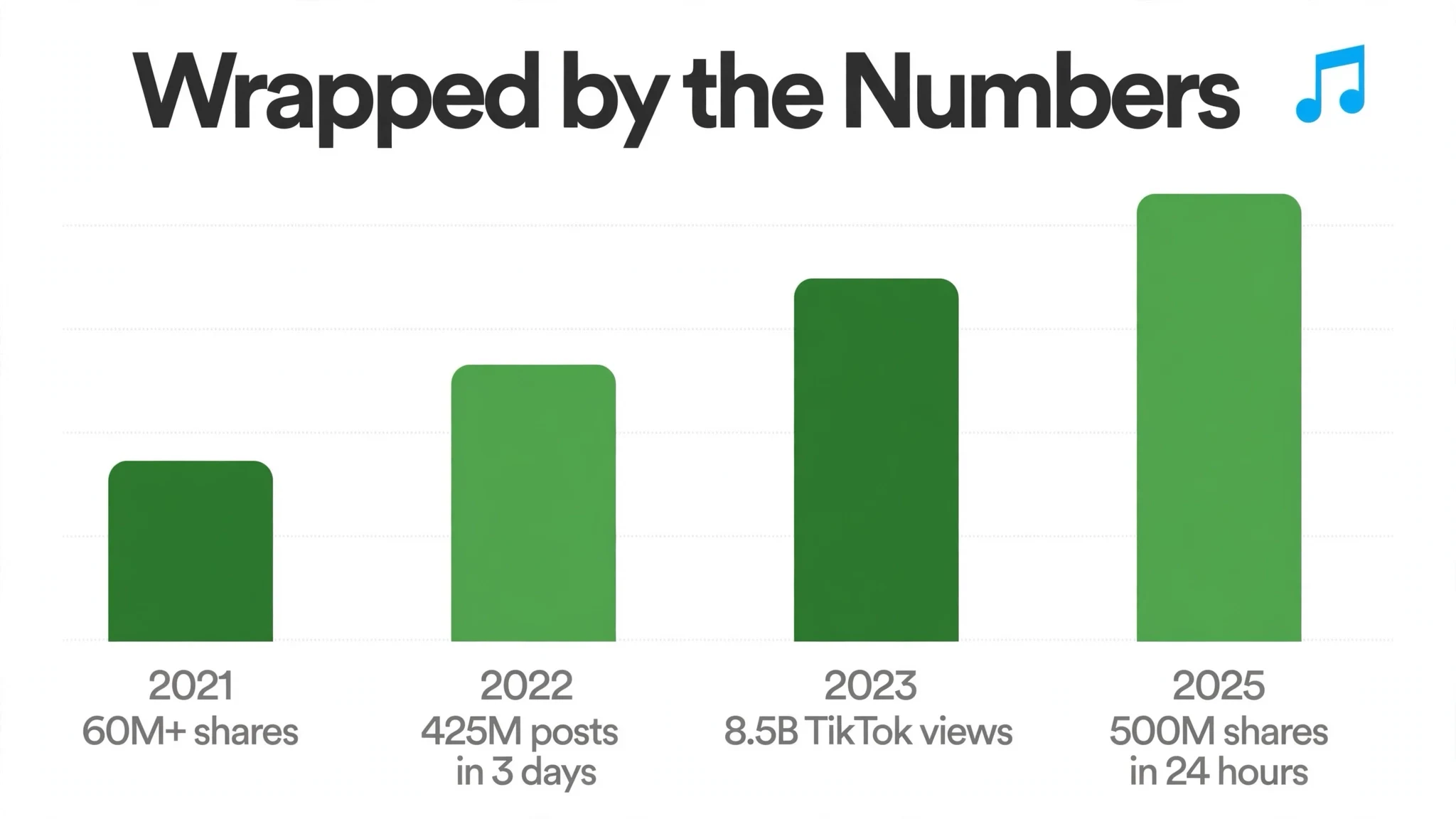
The scale of Spotify Wrapped marketing is difficult to overstate, and the trajectory is what makes it a case study rather than a curiosity. In 2021, listeners shared more than 60 million Wrapped stories and cards across social media. In 2022, the first three days alone produced more than 425 million posts about Wrapped. By 2023, the #SpotifyWrapped hashtag had generated over 8.5 billion views on TikTok. The 2025 edition raised the bar again: 200 million engaged users and 500 million shares within its first 24 hours, with shares up 41 percent year over year, reaching that audience 19 percent faster than the previous edition.
The commercial effect is just as striking. Wrapped has been reported to lift Spotify’s monthly active users by around 60 percent every December, with retention benefits stretching well into the new year. That is the compounding return of a campaign that behaves like a product launch: each December it brings lapsed listeners back, pulls in curious non-users who see their friends’ cards, and gives existing users a fresh reason to stay.
The format has also become an industry template. YouTube Music built its own Recap, Reddit launched its version, and Apple Music developed its Replay feature — every major audio platform now runs a year-end recap because Spotify proved the model. The idea has travelled well beyond music, too: email tools, fitness apps and software companies all run their own year-in-review moments, and one software company, Gorgias, reported earning more than $20,000 in annual recurring revenue from a Wrapped-style recap campaign aimed at its own customers.
For a small business, the lesson in these numbers is not the size of them. It is the direction. Every figure above grew because the campaign repeated, improved slightly, and arrived at the same moment each year. Wrapped did not go viral once. It built a habit, and the habit is what compounds.
Why Spotify Wrapped Marketing Works: The Psychology
Spotify Wrapped marketing succeeds for reasons that have very little to do with music. Strip away the playlists and what remains is a precise piece of applied psychology — four triggers that any business can borrow.
Identity first, brand second. A Wrapped card is not an advertisement for Spotify. It is a portrait of the person sharing it. When someone posts their top artists, they are telling the world who they are: their taste, their moods, their year. People share things that express identity far more readily than they share things that promote a company, and Wrapped is engineered so the shareable object is the user, not the logo. That is the core insight of the whole Spotify Wrapped marketing playbook — the brand becomes the vehicle for self-expression, and the user becomes the distribution channel.
Belonging beats broadcasting. The 2025 edition leans harder into this than any before it. Clubs give listeners a tribe. Wrapped Party turns a private recap into a group contest. The Fan Leaderboard tells you where you stand among people who love the same artist. Each feature answers the same human need: to find your people and to know where you fit. A campaign that creates belonging earns something a discount code never will — a reason for people to return to each other, with your brand as the meeting place.
Anticipation is a marketing asset. Wrapped arrives at the same cultural moment every year, at the point when people are already reflecting on the year behind them. Because it is annual, regular and slightly mysterious — nobody knows exactly which day it will drop — it generates weeks of speculation, prediction posts and countdown energy before a single card is shared. Scarcity works the same way in other campaigns: our earlier breakdown of the Pokémon card release showed how limited availability and a fixed drop date can turn a product launch into an event people plan around. Wrapped does the same with attention. It is available only briefly, it cannot be revisited at will, and that window is part of the appeal.
Zero effort, maximum reward. The listener does nothing to earn their Wrapped. The data already exists; Spotify simply returns it in a beautiful format. There is no form to fill, no purchase to make, no task to complete. The asymmetry is the point: all of the work sits with the brand, all of the reward sits with the user. When sharing costs nothing and flatters the sharer, sharing becomes the default. Add one-tap posting to Instagram and TikTok, and the path from seeing your stats to publishing them is a single gesture.
There is one more psychological layer worth naming: reciprocity. Wrapped feels like a gift. Spotify spent a year quietly paying attention to what you loved, then handed it back as a story. People respond to that kind of attention with loyalty — and with posts. A business that shows its customers it was paying attention earns the same response at any scale.
7 Spotify Wrapped Marketing Lessons for Small Businesses
Lesson 1: Turn Your Data Into Your Customer’s Story
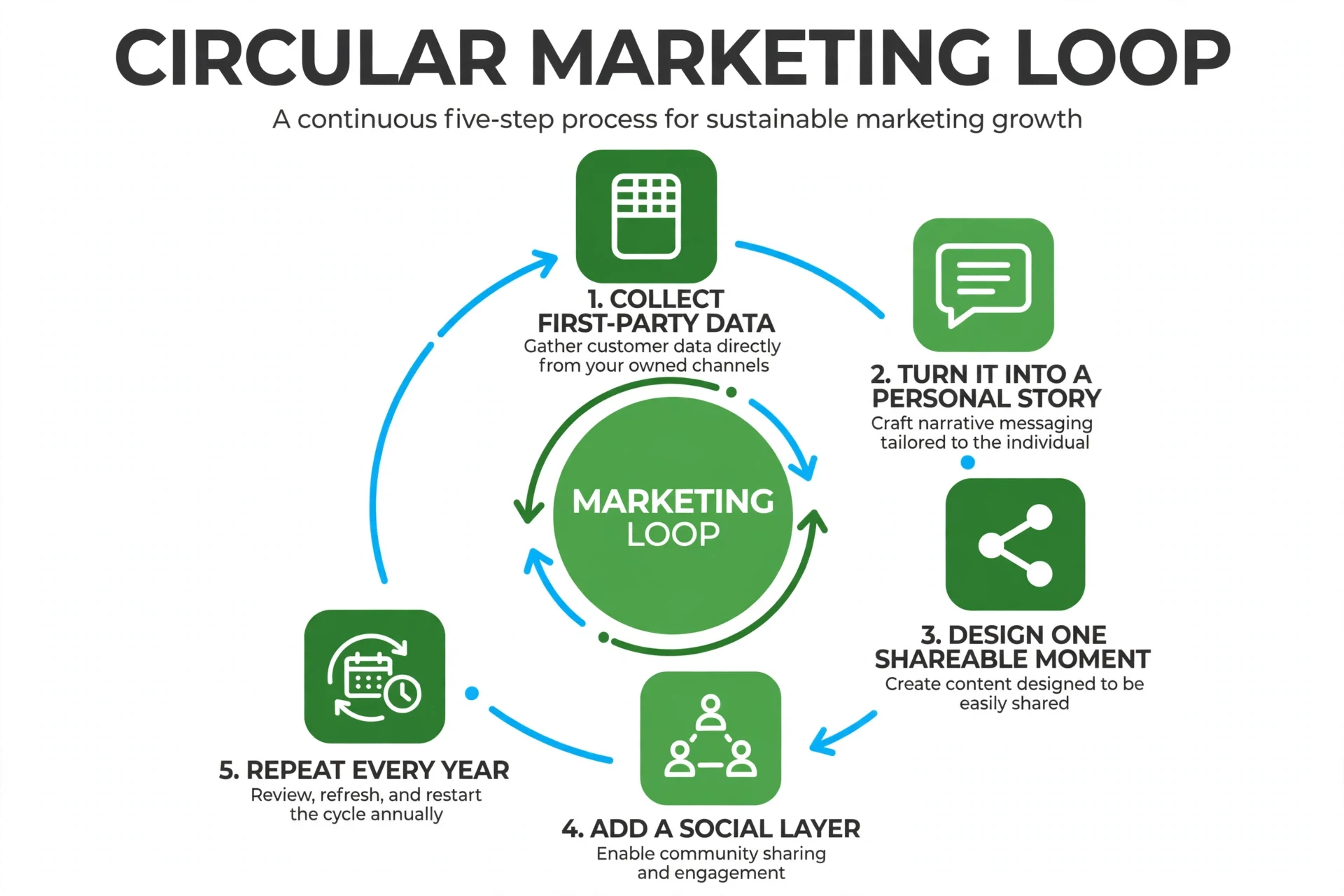
The first Spotify Wrapped marketing lesson is also the most important: the data was already there. Spotify did not run a survey or commission research. It took behaviour its users had already generated — every listen, skip, late-night session and genre shift — and returned it as a narrative. The campaign’s raw material was first-party data collected quietly, all year, before anyone thought about a campaign.
Most small businesses sit on the same kind of raw material without realising it. A gym knows which classes each member attends and how often. A salon knows which services a client books and how their style has changed. An online store knows what a customer buys, when, and what they browse but never purchase. A software company knows which features a user touches daily and which they ignore. That is the beginning of a Wrapped-style campaign, and it costs nothing to collect — it is already being collected.
The practical move is to unify that data before you need it. If purchase history lives in one tool, email engagement in another, and support conversations in a third, you cannot build a personal story from any of them. A single customer view — even a simple one, in a CRM or a well-kept spreadsheet — is the foundation. Decide now which three to five data points would genuinely interest your customers: total visits, favourite service, longest streak, money saved, hours trained, projects completed. Then make sure you are recording them cleanly, with the customer’s consent, all year. A Wrapped-style campaign is built in the eleven months before it launches, not the week it goes live.
Your next step: list the five most interesting facts you already know about a typical customer, and check whether you could produce them for any individual customer today. If you cannot, that is your first job — not the design, not the hashtag, but the data.
Lesson 2: Make the Customer the Hero, Not Your Brand
Open any Wrapped card and notice what is missing: a sales message. There is no discount, no upgrade prompt, no “try Premium” banner dominating the frame. Spotify understood that the moment a personal story starts selling, people stop sharing it. The card works precisely because it is about the listener.
Small businesses get this backwards more often than they admit. The year-end email becomes a list of company achievements. The anniversary post becomes a timeline of the founder’s journey. The recap celebrates the business, and the customer is an audience member. Flip that. Your customer’s year is more interesting to them than yours is, and it is certainly more shareable. It is a discipline the Spotify Wrapped marketing team applies ruthlessly: the product never interrupts the portrait.
A fitness studio’s version should celebrate the member: 148 sessions, 62 early mornings, a personal best in October. A coffee shop’s version should celebrate the regular: 214 flat whites, a loyalty streak since March, a favourite corner table. An agency’s version should celebrate the client: campaigns launched, leads generated, milestones reached together. In every case, the business is the stage, not the star. Customers share stories in which they look good. Give them one.
Your next step: rewrite your next customer-facing recap so every sentence starts with the customer’s achievement, not yours. If the business name appears more than the customer’s name, rewrite it again.
Lesson 3: Design One Moment to Be Shared
Wrapped is not a report. It is a sequence of vertical, full-screen story cards that end in a single frame built to leave the app. That final card is the whole point: bold type, one striking stat, a clean layout, and a share button a thumb’s width away. Every design decision serves the moment of sharing.
This is the Spotify Wrapped marketing lesson most small businesses skip. They produce a nice email, or a decent social post, and then hope people share it. Hope is not a distribution strategy. Sharing has to be designed in: a specific visual, a specific stat, a specific button, at a specific moment.
Build your version around one card, not ten. Pick the single most flattering or surprising fact about each customer and put it on a clean, vertical graphic in your brand colours, with the customer’s name on it. Add a one-tap share path — a pre-written caption, a hashtag, a direct link to post it. If the customer has to screenshot, crop, write a caption and find the right hashtag, most of them will not bother. Every step you remove doubles the chance they follow through. Our earlier look at the Druski Netflix deal showed the same dynamic from the other side: influencer campaigns spread because the content is built to be reposted, not because audiences are generous. Design for the repost and the repost will happen.
Your next step: mock up a single shareable card for one real customer, using real data, and time how long it takes a colleague to post it from their phone. If it takes more than thirty seconds, simplify it.
Lesson 4: Build a Date People Wait For
Wrapped works partly because of when it arrives. Year-end reflection is already happening; Spotify simply claims a date inside it. And because the campaign repeats at the same time every year, anticipation has become part of the product. People speculate about the drop date, creators publish prediction videos, and the launch itself becomes news. That is the Spotify Wrapped marketing calendar at work: scarcity plus repetition equals anticipation. Consistency turned a campaign into a calendar event.
Small businesses can claim a date of their own. It does not have to be December. A gym can run a “Year in Training” every January. A retailer can run a “Your Year With Us” on each customer’s signup anniversary. A software company can run a quarterly usage recap. What matters is not the date itself but the repetition: the same moment, the same format, every cycle, until customers start asking when it is coming back. The first year, you will promote it. By the third year, if the experience is good, customers will promote it for you.
The discipline here is restraint. Wrapped arrives once a year, and that scarcity protects it. A recap sent every month becomes noise; a recap sent once a year becomes an event. Pick your moment, protect it, and improve the experience a little each cycle rather than reinventing it. The compounding effect comes from the repetition, not the novelty.
Your next step: choose one recurring date for your recap — an anniversary, a season, a milestone — put it in the calendar for next year now, and tell your customers it is coming. A promised date creates anticipation before the first card exists.
Lesson 5: Add a Social Layer — Nobody Wants to Celebrate Alone
The boldest change in Spotify Wrapped 2025 is that it stopped being a solo experience. Wrapped Party lets friends compete over their listening data. Clubs sort listeners into tribes. The Fan Leaderboard ranks you against strangers who love the same artist. Spotify recognised that a personal story becomes a bigger story when other people are in it.
This is the Spotify Wrapped marketing lesson with the most headroom for small businesses, because community is the one advantage a small business holds over a giant. A local gym’s members know each other. A salon’s clients talk to each other. A niche software product’s users share a profession. Build your recap so customers can compare, compete, and connect — with permission, and with the emphasis on fun rather than ranking.
A gym could publish a members’ leaderboard of total sessions, with the top member’s consent, and let the friendly rivalry drive attendance for a month. A coffee shop could create a “regulars club” for its most frequent visitors, with a badge they can share. A business software company could show users how their usage compares with similar teams, anonymised and opt-in. The mechanic is the same in each case: take a private stat, add a social frame, and let people enjoy it together. Community turns a campaign into a tradition, and traditions retain customers far better than discounts do.
Your next step: identify one stat your customers would enjoy comparing with each other, and build a simple opt-in way to share it — a leaderboard, a club, a group challenge. Launch it alongside your recap, not as an afterthought.
Lesson 6: Let Personality Do the Selling
Wrapped’s copy is playful, specific, and human. It gives you a listening age, assigns you a club, quizzes you on your own taste, and hands out trophies with names like “most obsessed fan.” It never sounds like a corporation reporting metrics. It sounds like a friend who was paying attention and found the whole thing funny.
That tone is the Spotify Wrapped marketing voice at its best: specific, warm, and impossible to mistake for a press release. Playful framing makes data feel like entertainment rather than surveillance. A listening age is a more generous way to present “here is the era of music you never left” than a chart of release years. A club is a warmer way to say “here is your dominant genre” than a bar graph. The personality is what makes people screenshot the card instead of scrolling past it.
Small businesses often sand the personality out of their marketing in the name of professionalism. The result is copy nobody remembers. We saw the same pattern when a single viral phrase took over feeds: our breakdown of the Habibi viral phrase showed how a playful, specific voice travels further than a polished corporate one.
Your recap is the one place where you can afford to be specific, witty, and warm: name the customer’s quirkiest habit, celebrate the odd stat, write like a person who knows them. A pet store could crown a “most pampered pup.” A bookshop could name a “midnight reader.” A marketing agency could hand a client the “campaign that refused to quit” award. The risk of being too playful is small. The risk of being forgettable is the real one — and it is the one most businesses take every day.
Your next step: write the five most playful, specific lines your recap could contain for real customers, then use at least three of them. If the copy could belong to any business, it belongs to none.
Lesson 7: Listen to the Backlash and Fix It in Public
The final Spotify Wrapped marketing lesson comes from the edition before this one. The 2024 Wrapped leaned heavily on AI-generated content, and listeners noticed — and complained, loudly, that the experience felt colder and less personal than the year before. Spotify could have dismissed the criticism. Instead, the 2025 edition visibly corrected course: artificial intelligence was scaled back to a single feature, the Listening Archive, while the human touches — artist messages, author clips, fan destinations, the mixtape feel — were brought back to the front.
That correction is itself a Spotify Wrapped marketing masterclass. Customers trust brands that visibly listen more than brands that never make mistakes. A public fix signals that feedback changes decisions, and that signal is worth more than a flawless launch. Small businesses should treat their own campaigns the same way: launch the first version, ask customers what landed and what did not, and show them the changes next time. “You told us the recap felt generic, so this year every card is built from your actual visits” is a more persuasive message than any slogan, because it is proof rather than a promise.
The feedback loop also protects you from the most common failure in personalised marketing: the creepy line. Data that feels thoughtful delights people; data that feels surveilled alarms them. The difference is usually consent and transparency — customers who opted in, who know what you track, and who can see the value in what you return. Ask, listen, adjust, and say so. That loop is the difference between a campaign people welcome and one they block.
Your next step: after your first recap goes out, survey the recipients with three questions — what delighted you, what felt off, what should we add — and publish one visible change based on the answers before the next cycle.
How to Build Your Own “Wrapped”: A Small-Business Playbook
The seven Spotify Wrapped marketing lessons above are the strategy. This section is the execution — a practical sequence any small business can follow without a data science team or an enterprise budget.
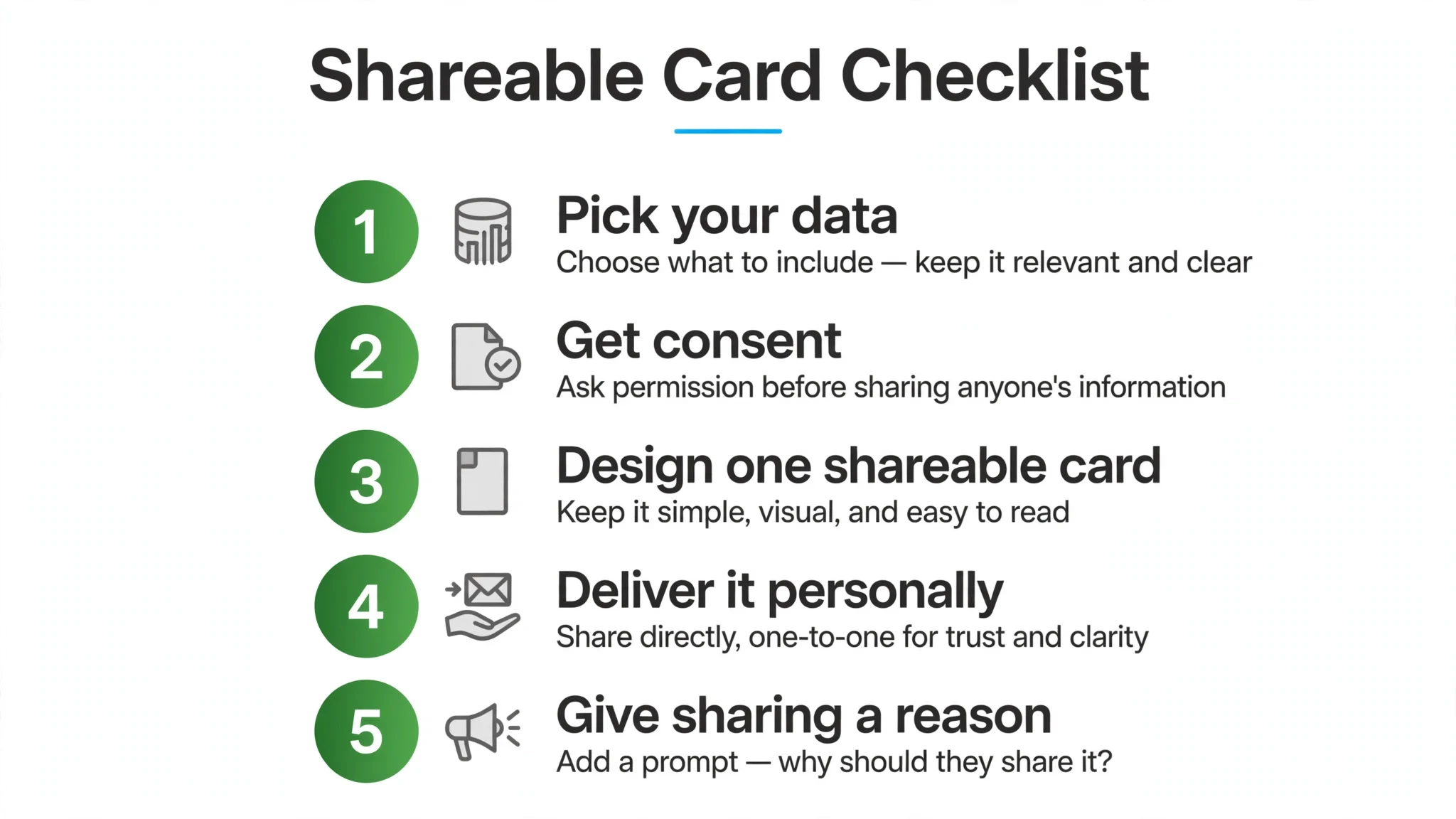
Step 1: Pick your data. Choose three to five data points that are true, personal, and flattering. Total visits, favourite product or service, longest streak, biggest milestone, money or time saved. Avoid anything that could embarrass a customer, and avoid anything you cannot verify. If you only have two reliable data points, build the campaign around two — a short, accurate recap beats a long, invented one.
Step 2: Get consent and be transparent. Personalised marketing runs on trust. Tell customers what you track and why, let them opt in to the recap, and let them opt out of any part of it. Regulations such as GDPR and CCPA require this in many markets, but the rule is good practice everywhere: people share what they chose to share. A short line — “We built this from your visits with us this year, and you can opt out any time” — costs nothing and earns a great deal.
Step 3: Design one shareable card. Use a simple design tool to build a vertical card in your brand colours: the customer’s name, one hero stat, two supporting stats, and a short playful line. Keep the layout clean — one focal number, plenty of space, nothing competing for attention. Export it as a single image the customer can post without editing. If you serve customers by email, send the card as the email’s hero image with a one-tap share link beneath it.
Step 4: Deliver it where your customers already are. Email works for most service businesses. Social direct messages work for younger audiences. In-app delivery works if you have an app. Whatever the channel, deliver the recap personally — addressed to the individual, not blasted to a list. The personal delivery is what makes the customer feel seen, and that feeling is the whole point.
Step 5: Give sharing a reason and a place. Add a hashtag, a tag to your account, and a prompt: “Share your year with us.” Feature the best shared cards on your own channels, with permission, and thank the people who post them. When customers see their peers sharing, the social proof does the persuading for you. And when someone shares, respond — a comment, a repost, a genuine reaction. The conversation after the share is where loyalty is built.
Step 6: Time it deliberately. Year-end works for most businesses, but an anniversary is often better: the customer’s signup anniversary, the anniversary of their first purchase, or a seasonal moment that fits your trade. A landscaping company could run a “Your Year in the Garden” each spring. A tax practice could run a “Your Year in Numbers” each January. Pick the moment your customers are already reflecting, and claim it.
Real businesses have already proven the model at small scale. A boutique gym can send members a “Workout Wrapped” with total hours trained, top classes attended, and personal milestones, then invite them to share it with a hashtag. A salon can send clients a “Year in Style” with visits, favourite treatments, and a stylist’s note. An e-commerce store can send a “Your Year With Us” with orders, favourite categories, and a thank-you from the team. The software example is instructive too: Gorgias, a helpdesk app, built a Wrapped-style recap for its customers and reported earning more than $20,000 in annual recurring revenue from it. None of these need Spotify’s infrastructure. They need clean data, one good card, and the courage to make the customer the hero.
5 Mistakes That Kill a Wrapped-Style Campaign
Copying the format without the data. A generic “thanks for a great year” graphic with stock imagery is not a Wrapped. The magic is the personal data. If you cannot personalise it, do not launch it — wait until your data is ready.
Making it about your business. The recap that lists your awards, your growth, and your new offices is a press release, not a gift. Customers share stories about themselves. Keep the focus on them.
Adding friction to sharing. A PDF attachment, a link that requires a login, a card that needs cropping — each step loses a share. The path from receiving to posting should be one tap, or as close to it as you can get.
Over-automating the human out of it. The Spotify Wrapped marketing team learned this publicly in 2024: when the experience felt machine-generated, listeners pushed back. Use automation to assemble the data, but let a human write the lines, choose the tone, and respond to the shares. People can tell the difference, and they reward the human version.
Ignoring privacy. Personalised marketing without consent is a trust problem waiting to happen. Collect only what you need, explain what you collect, honour opt-outs immediately, and never publish a customer’s data without their permission — including on a leaderboard. One careless share can cost more trust than a whole campaign earns.
How to Measure Whether Your Version Worked
Wrapped-style campaigns are measurable, and the metrics that matter are not vanity numbers. Track shares and reposts of the recap cards, but also track what the shares produce: referral traffic to your site, new followers, reactivated customers who had gone quiet, and repeat visits in the weeks after the campaign. Compare retention among customers who received a recap against those who did not. Watch for user-generated content volume — the photos, screenshots and stories your customers post are the campaign’s real output, and earned media of that kind is consistently trusted more than advertising. Customer.io’s research on Wrapped-style campaigns notes that 92 percent of consumers trust earned media far more than ads, which is exactly why a customer’s own post outperforms your own.
Set a baseline before you launch, measure for four to six weeks after, and judge the campaign on business outcomes — reactivations, bookings, repeat purchases — not on how pretty the cards looked. Then feed what you learned into next year’s version. That is the loop Spotify Wrapped marketing has run for a decade: launch, listen, improve, repeat.
Conclusion
Spotify Wrapped 2025 is trending again for a simple reason: it is the rare marketing campaign people genuinely look forward to. It works because it respects a basic truth about attention — people share what says something about them, they return to experiences that make them feel seen, and they wait for moments that arrive on schedule and keep getting better.
The seven Spotify Wrapped marketing lessons in this post are not reserved for companies with hundreds of millions of users. Turn your customer data into your customer’s story. Make the customer the hero. Design one moment to be shared. Build a date people wait for. Add a social layer. Let personality do the selling. And when customers tell you something missed, fix it in public. Run that loop every year, and your smallest campaign can start behaving like your biggest one.
If you want help building a Wrapped-style campaign for your own customers — from the data and the design to the delivery and the measurement — our team plans and runs personalised campaigns for small businesses every day. Talk to KKeyQik about your next campaign and we will map out a version that fits your customers, your data, and your budget. Or explore how we approach social media marketing and video marketing to turn one good idea into content your customers actually share. Visit KKeyQik to start the conversation.
Frequently Asked Questions
Spotify Wrapped marketing is the strategy behind Spotify's annual year-end recap, which turns each listener's own listening data into a personalised, shareable story. Instead of advertising the product, Spotify returns the user's year in music — top artists, songs, minutes listened — in a visual format designed for social sharing. The 2025 edition reached 200 million engaged users and 500 million shares within its first 24 hours, making it one of the most effective organic campaigns in digital marketing.
The 2025 edition adds nearly a dozen new features, including Listening Age, which estimates your musical age from the release years of your most-played tracks; Clubs, which sort listeners into six themed groups; and Wrapped Party, a live multiplayer feature for up to nine friends. It also introduces Top Albums for the first time, a Top Artist Sprint, a Top Song Quiz, a Fan Leaderboard, and a Listening Archive that resurfaces your most memorable streaming days. The Top Songs 2025 playlist now includes your full top 100 tracks with play counts.
Spotify Wrapped 2025 is surging in search across the United States as the year-end recap season approaches, with interest doubling in a matter of hours. Wrapped has become a cultural moment people anticipate each year, so search interest spikes as listeners check for the new edition, revisit last year's features, and share their results. The 2025 edition's new social features, including Wrapped Party and Clubs, have added to the conversation.
Wrapped is designed around sharing from the start. The output is a vertical story format that fits Instagram and TikTok, the final card is built to be posted, and sharing takes a single tap. Just as importantly, the card expresses the sharer's identity — their taste, their year — so posting it feels like self-expression rather than advertising. People share what says something about them, and Wrapped gives them something worth saying.
The central lesson is to turn your customer data into your customer's story. Spotify does not survey its users or buy attention; it returns behaviour they already generated as a narrative about them. A small business can do the same with data it already holds — visits, purchases, milestones — by presenting it as a personal recap in which the customer is the hero and the business is the stage.
Start with three to five data points you already record reliably, such as total visits, favourite service, or longest streak. Get the customer's consent, then design one clean vertical card with their name, one hero stat, and a short playful line. Deliver it personally by email or message, add a hashtag and a one-tap share path, and time it to a moment your customers already care about — year-end, an anniversary, or a seasonal milestone.
Use data that is true, personal, and flattering: how often a customer visited, what they bought or booked most, a milestone they reached, or time they saved. Avoid anything that could embarrass a customer and anything you cannot verify. If you only have two reliable data points, build the campaign around two — a short, accurate recap earns more trust than a long, invented one.
Wrapped Party is Spotify's first live multiplayer feature, letting up to nine friends compare listening data in real time and collect themed awards. It matters because it shows the next step in personalised marketing: adding a social layer. A private stat becomes a group experience, and group experiences create community, conversation, and repeat engagement — outcomes a solo recap cannot deliver on its own.
The most common mistakes are copying the format without real personal data, making the recap about the business instead of the customer, adding friction to sharing, and over-automating the human tone out of the copy. Privacy matters too: collect only what you need, explain what you collect, honour opt-outs, and never publish a customer's data without permission. Spotify learned the automation lesson publicly in 2024, when listeners pushed back against an AI-heavy edition, and the 2025 version visibly corrected course.
Track shares and reposts of the recap cards, referral traffic to your website, new followers, and reactivated customers who had gone quiet. Compare retention among customers who received a recap against those who did not, and watch the volume of user-generated content your customers post. Judge the campaign on business outcomes — reactivations, bookings, and repeat purchases over the following four to six weeks — not on how attractive the cards looked.